wheel OLDSMOBILE SILHOUETTE 1998 User Guide
[x] Cancel search | Manufacturer: OLDSMOBILE, Model Year: 1998, Model line: SILHOUETTE, Model: OLDSMOBILE SILHOUETTE 1998Pages: 444, PDF Size: 23.2 MB
Page 133 of 444

REVERSE (R): Use this gear to back up.
NOTICE:
Shifting to REVERSE (R) while your vehicle is
moving forward could damage your transaxle.
Shift to REVERSE (R) only after your vehicle
is stopped.
To rock your vehicle back and forth to get out of snow,
ice or sand without damaging your transaxle, see
“Stuck: In Sand, Mud, Ice
or Snow” in the Index.
NEUTRAL (N): In this position, your engine
doesn’t connect with the wheels.
To restart when you’re
already moving, use NEUTRAL (N) only.
Also, use
NEUTRAL, (N) when your vehicle is being towed.
Shifting out of PARK (P) or NEUTRAL (N) while
your engine
is cLracing” (running at high speed) is
dangerous. Unless your foot is firmly on the
brake pedal, your vehicle could move very
rapidly. You could lose control and
hit people or
objects. Don’t shift out of PARK
(P) or
NEUTRAL
(N) while your engine is racing.
I NOTICE: I
Damage to your transaxle caused by shifting out
of PARK
(P) or NEUTRAL (N) with the engine
racing isn’t covered by your warranty.
2-31
ProCarManuals.com
Page 135 of 444

NOTICE:
If’ your vehicle seems to start up rather slowly, or
if it seems not to shift gears as you go faster,
something may be wrong with a transaxle system
sensor.
If you drive very far that way, your
vehicle can be damaged.
So, if this happens, have
your vehicle serviced right away. Until then, you
can use
SECOND (2) when you are driving less
than
35 mph (55 km/h) and THIRD (3) for
higher speeds. FIRST
(1): This position
gives you even more power
(but lower fuel economy) than SECOND (2). You can
use it on very steep hills, or in deep snow or mud. If the
selector lever is put in
FIRST (1), the transaxle won’t
downshift into first gear until the vehicle is going
slow enough.
NOTICE:
If your front wheels can’t rotate, don’t try to
drive. This might happen
if you were stuck in
very deep sand or mud or were up against a solid
object. You could damage your transaxle.
Also, if you stop when going uphill, don’t hold
your vehicle there with
only the accelerator
pedal. This could overheat and damage the
transaxle. Use your brakes or shift into PARK
(P)
to hold your vehicle in position on a hill.
2-33
ProCarManuals.com
Page 153 of 444
Side Window Latches
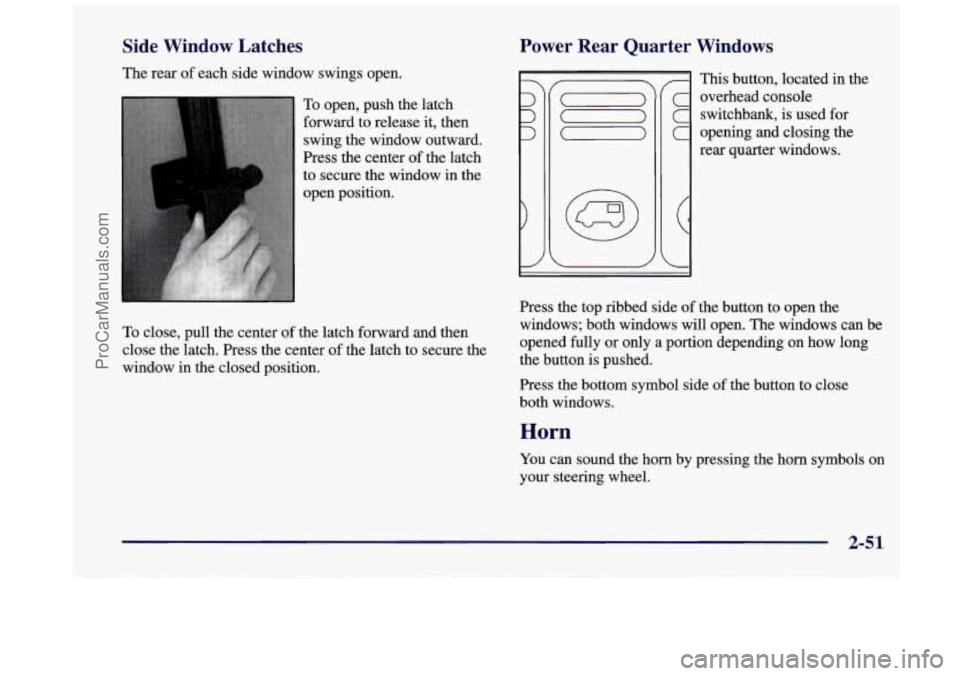
The rear of each side window swings open.
To open, push the latch
forward to release it, then
swing the window outward.
Press the center of the latch
to secure the window in the
open position.
To close, pull the center of the latch forward and then
close the latch. Press the center of the latch to secure the
window in the closed position.
Power Rear Quarter Windows
This button, located in the
overhead console
switchbank, is used for
opening and closing the
rear quarter windows.
Press the top ribbed side of the button to open the
windows; both windows will open. The windows can be
opened fully
or only a portion depending on how long
the button is pushed.
Press the bottom symbol side of the button to close
both windows.
Horn
You can sound the horn by pressing the horn symbols on
your steering wheel.
2-51
ProCarManuals.com
Page 154 of 444
Tilt Wheel
A tilt steering wheel allows you to adjust the steering
wheel before
you drive. You can also raise it to the
highest level to give your legs more room when you exit
and enter the vehicle.
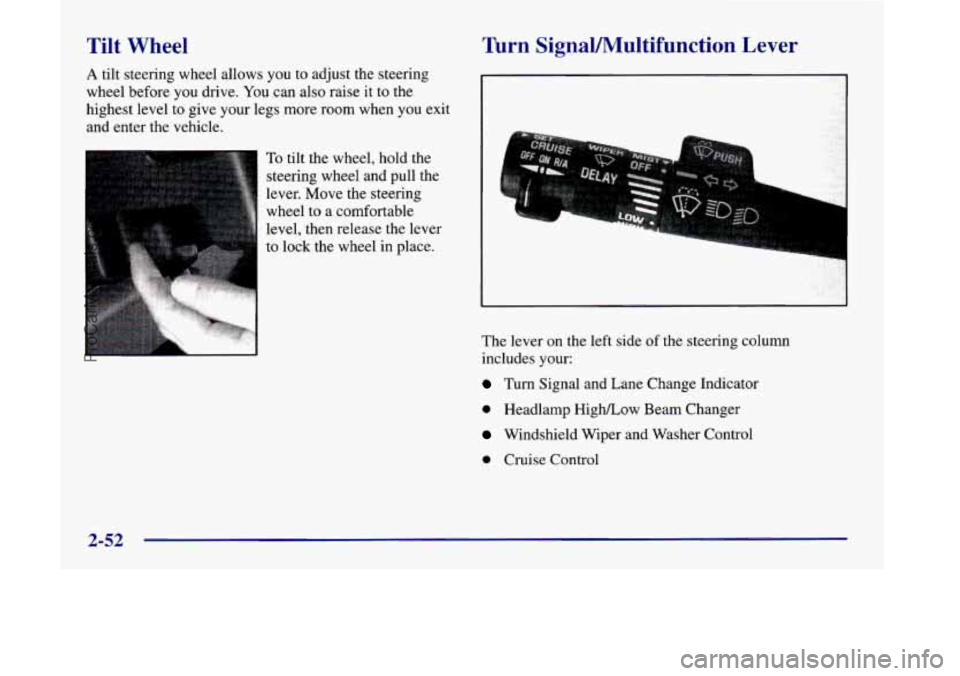
To tilt the wheel, hold the
steering wheel and pull the
lever. Move the steering
wheel to a comfortable
Turn SignaVMultifunction Lever
1
Icr
I
The lever on the left side of the steering column
includes your:
Turn Signal and Lane Change Indicator
0 Headlamp HighLow Beam Changer
Windshield Wiper and Washer Control
0 Cruise Control
2-52
ProCarManuals.com
Page 158 of 444
A CAUTION:
0
0
Cruise control can be dangerous where you
can’t drive safely at
a steady speed. So,
don’t use your cruise control on winding
roads or in heavy traffic.
Cruise control can be dangerous on
slippery roads. On such roads, fast changes
in tire traction can cause needless wheel
spinning, and you could lose control. Don’t
use cruise control on slippery roads.
If your vehicle
is in cruise control when the optional
traction control system begins
to limit wheel spin, the
cruise control will automatically disengage. (See
“Traction Control System” in the Index.) When road
conditions allow you to safely use
it again, you may turn
the cruise control back on. Setting Cruise Control
- CAUTION:
If you
leave your crulse control switch on when
you’re not using cruise, you might hit a button
and go into cruise when you don’t want to. You
could be startled and even lose control. Keep the
cruise control switch off until you want to use
it.
1. Move the cruise control switch to ON.
2. Get up to the speed you want.
2-56
ProCarManuals.com
Page 167 of 444
Both outside mirrors can be folded forward or rearward.
In the rearward position, they will fold almost flush with
the vehicle. This feature is particularly useful in
automatic car washes.
Your mirrors have a blue tint to reduce glare while
driving at night.
Convex Outside Mirror
Your passenger’s side mirror is convex. A convex
mirror’s surface is curved
so you can see more from the
driver’s seat.
A convex mirror can make things (like other
vehicles) look farther away than they really are.
If you cut too sharply into the right lane, you
could hit a vehicle on your right. Check your
inside mirror or glance over
your shoulder before
changing lanes.
Storage Compartments
Your vehicle’s large carrying capacity can store many
items.
If you have the extended wheelbase version, you
can carry things as large as a
4‘ x 8’ piece of plywood.
You can
also use the floor pins that are used to attach the
seats, to secure larger loads. This section
also describes
storage areas for specific items like sunglasses and cups.
Glove Box
Your vehicle has a glove box below the
instrument panel.
To open the glove box, lift the latch release. Use the key
to lock or unlock the glove box.
The glove box door has a detent to prevent the door
from lowering too far. Open the glove box until the door
is partway open, then pull the door down if you need it
fully open. To close the glove box, the door must be
pushed up past the detent.
In the door of the glove box, you will find a tissue pack
holder and clip for a pen
or pencil.
2-65
ProCarManuals.com
Page 185 of 444
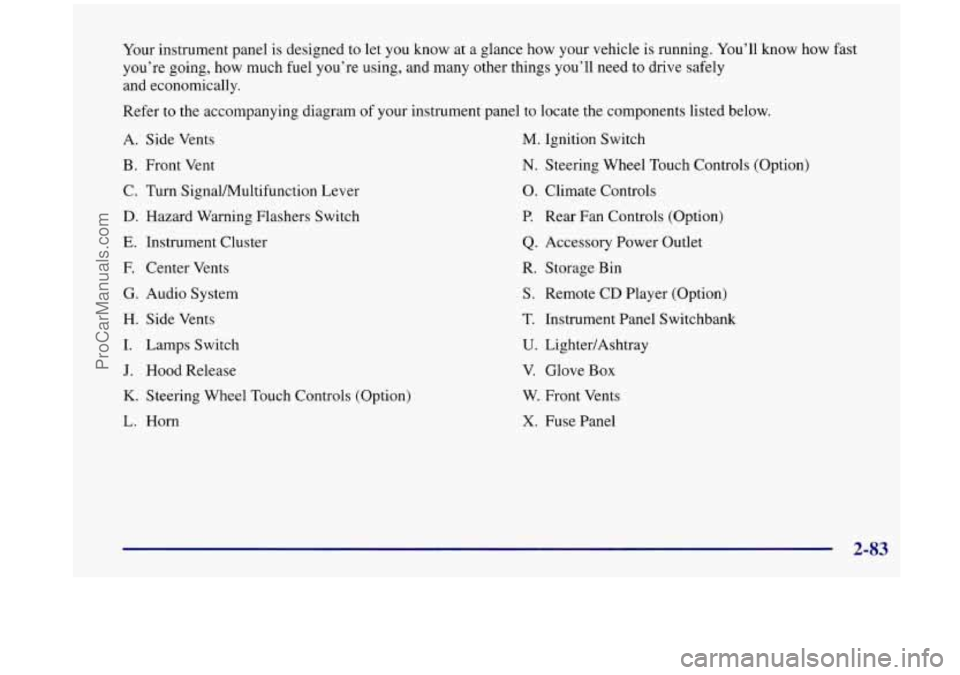
Your instrument panel is designed to let you know at a glance how your vehicle is running. You’ll know how fast
you’re going, how much fuel you’re using, and many other things you’ll need to drive safely
and economically.
Refer to the accompanying diagram of your instrument panel to locate the components listed below.
A. Side Vents
B. Front Vent
C. Turn SignalMultifunction Lever
D. Hazard Warning Flashers Switch
E. Instrument Cluster
F. Center Vents
G. Audio System
H. Side Vents
I. Lamps Switch
J. Hood Release
K. Steering Wheel Touch Controls (Option)
L. Horn
M. Ignition Switch
N. Steering Wheel Touch Controls (Option)
0. Climate Controls
P. Rear Fan Controls (Option)
Q. Accessory Power Outlet
R. Storage Bin
S. Remote CD Player (Option)
T. Instrument Panel Switchbank
U. LightedAshtray
V. Glove Box
W. Front Vents
X, Fuse Panel
2-83
ProCarManuals.com
Page 192 of 444

A CAUTION:
Your regular brake system may not be working
properly if the anti-lock brake system warning
light is flashing. Driving with the anti-lock brake
system warning light flashing can lead to an
accident. After you’ve pulled off the road and
stopped carefully, have the vehicle towed
for service.
If the anti-lock brake system warning light stays on
longer than normal after you’ve started your engine, turn
the ignition off. Or, if the light comes on and stays on
when you’re driving, stop
as soon as possible and turn
the ignition off. Then start the engine again to reset the
system.
If the light still stays on, or comes on again
while you’re driving, your vehicle needs service.
If the
light is on but not flashing and the regular brake system
warning light isn’t on, you still have brakes, but
you
don’t have anti-lock brakes.
The anti-lock brake system warning light should come
on briefly when you turn the ignition key to
RUN. If the
light doesn’t come on then, have
it fixed so it will be
ready to warn you if there
is a problem.
Traction Control System Warning Light
(Option)
This warning light should
come on briefly as you start
the engine.
If the warning
light doesn’t come on then,
have
it fixed so it will be
ready
to warn you if there’s
a problem.
If it stays
on, or comes on when you’re driving, there
may be
a problem with your traction control system and
your vehicle may need service. When this warning light
is on,
the system will not limit wheel spin. Adjust your
driving accordingly.
2-90
ProCarManuals.com
Page 193 of 444

The traction control system warning light may come on
for the following reasons:
If there’s a brake system problem that is specifically
related to traction control, the traction control system
will turn
off and the warning light will come on. If
your brakes begin to overheat, the traction control
system will turn off and the warning light will come
on until your brakes cool down.
If the traction control system is affected by an
engine-related problem, the system will turn off and
the warning light will come on.
If the traction control system warning light comes on
and stays
on for an extended period of time when the
system
is turned on, your vehicle needs service.
Low Traction Light (Option)
LOW
TRACTION
If your vehicle has the
traction control system,
there will be a
LOW
TRACTION light on the
instrument panel.
When your anti-lock system is adjusting brake pressure
to help avoid a braking skid, or when your traction
control system is limiting wheel spin, the
LOW
TRACTION light will come on. Slippery road
conditions may exist if this light comes on,
so adjust
your driving accordingly. The light will come on and
stay
on for four seconds when your anti-lock system
adjusts brake pressure for less than four seconds or
when your traction control system limits wheel spin for
less than four seconds. Otherwise, the light will
go out
as soon as the anti-lock system
stops adjusting brake
pressure or the traction control system stops limiting
wheel spin.
The
LOW TRACTION light also comes on briefly, as a
bulb check, when the engine is started. If the light
doesn’t come on then, have it fixed
so it will be there to
tell you when
the system is active.
2-91
ProCarManuals.com
Page 205 of 444
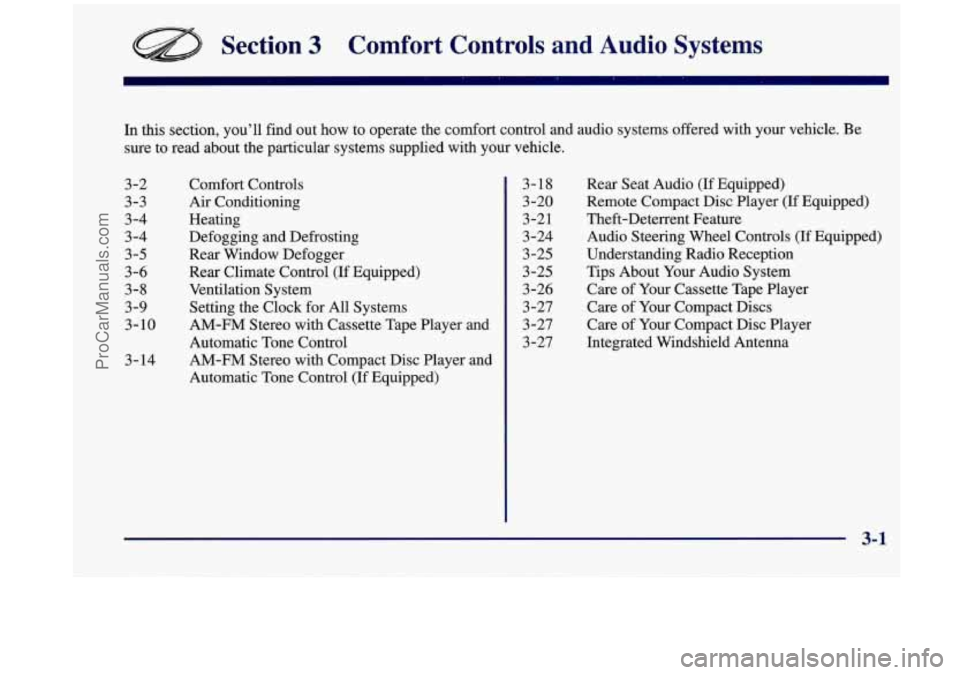
Section 3 Comfort Controls and Audio Systc-;
In this section, you’ll find out how to operate the comfort control and audio systems offered with your vehicle. Be
sure to read about the particular systems supplied with your vehicle.
3-2
3-3
3-4
3-4
3-5
3-6
3-8
3-9 3-10
3- 14 Comfort Controls
Air Conditioning
Heating
Defogging and Defrosting
Rear Window Defogger
Rear Climate Control (If Equipped)
Ventilation System
Setting the Clock for All Systems
AM-FM Stereo with Cassette Tape Player and
Automatic Tone Control
AM-FM Stereo with Compact Disc Player and
Automatic Tone Control
(If Equipped) 3-18
3 -20
3-21
3 -24
3 -25
3 -25
3-26
3-27
3 -27
3-27 Rear Seat
Audio
(If Equipped)
Remote Compact Disc Player (If Equipped)
Theft-Deterrent Feature Audio Steering Wheel Controls
(If Equipped)
Understanding Radio Reception
Tips About Your Audio System
Care of Your Cassette Tape Player
Care of Your Compact Discs
Care of Your Compact Disc Player
Integrated Windshield Antenna
3-1
ProCarManuals.com