wheel OLDSMOBILE SILHOUETTE 1998 Workshop Manual
[x] Cancel search | Manufacturer: OLDSMOBILE, Model Year: 1998, Model line: SILHOUETTE, Model: OLDSMOBILE SILHOUETTE 1998Pages: 444, PDF Size: 23.2 MB
Page 351 of 444
Tire Inspection and Rotation
Tires should be rotated every 6,000 to 8,000 miles
(10 000 to 13 000 km). Any time you notice unusual
wear, rotate your tires as soon
as possible and check
wheel alignment. Also crheck for damaged tires or
wheels.
See “When It’s ‘Time for New Tires”
and “Wheel Replacement” later in this section for
more information.
The purpose of regular rotation is to achieve more
uniform wear for all tires on the vehicle. The first
rotation
is the most important. See “Scheduled
Maintenance Services” in the Index for scheduled
rotation intervals.
1
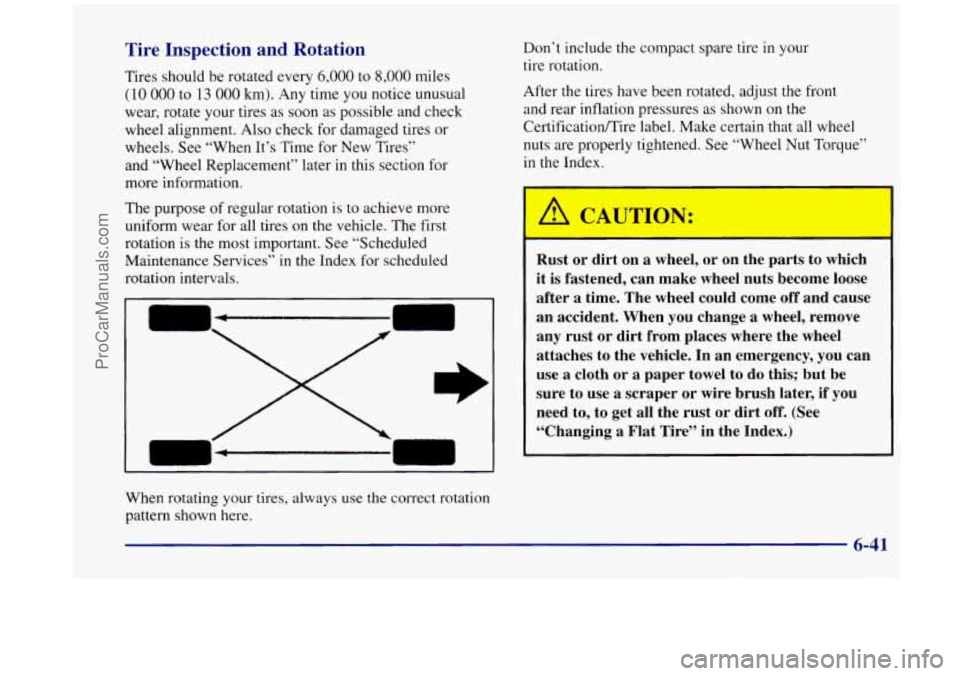
When rotating your tires, always use the correct rotation
pattern shown here. Don’t
include the compact spare tire
in your
tire rotation.
After the tires have been rotated, adjust the front
and rear inflation pressures as shown on the
CertificatiodTire label. Make certain that all wheel
nuts are properly tightened. See “Wheel Nut Torque”
in the Index.
Rust or dirt on
a wheel, or on the parts to which
it is fastened, can make wheel nuts become loose
after
a time. The wheel could come off and cause
an accident. When you change
a wheel, remove
any rust or dirt from places where the wheel
attaches to the vehicle. In an emergency, you can
use
a cloth or a paper towel to do this; but be
sure
to use a scraper or wire brush later, if you
need to,
to get all the rust or dirt off. (See
“Changing
a Flat Tire” in the Index.)
6-41
ProCarManuals.com
Page 353 of 444

CAUTION:
Mixing tires could cause you to lose control while
driving.
If you mix tires of different sizes or types
(radial and bias-belted tires), the vehicle may not
handle properly, and you could have a crash.
Using tires of different sizes may also cause
damage to your vehicle. Be sure to use the same
size and type tires on all wheels.
It’s all right to drive with your compact spare,
though. It was developed for use on your vehicle.
i A CAUTION: I
I If you use bias-ply tires on your vehicle, the
wheel rim flanges could develop cracks after
many miles of driving.
A tire and/or wheel could
fail suddenly, causing a crash. Use only radial-ply
tires with the wheels
on your vehicle.
Uniform Tire Quality Grading
The following information relates to the system
developed by the United States National Highway
Traffic Safety Administration, which grades tires by
treadwear, traction and temperature performance. (This
applies only to vehicles sold in the United States.) The
grades are molded on the sidewalls
of most passenger
car tires. The Uniform Tire Quality Grading system
does not apply to deep tread, winter-type snow tires,
space-saver or temporary use spare tires, tires with
nominal rim diameters of
10 to 12 inches (25 to 30 cm),
or to some limited-production tires.
While the tires available on General Motors passenger
cars and light trucks may vary with respect to these
grades, they must also conform to Federal safety
requirements and additional General Motors Tire
Performance Criteria
(TPC) standards.
6-43
ProCarManuals.com
Page 354 of 444

Treadwear Temperature -- A, B, C
The treadwear grade is a comparative rating based on
the wear rate
of the tire when tested under controlled
conditions on a specified government test course. For
example, a tire graded
150 would wear one and a half
(1 1/2) times as well on the government course as a tire
graded
100. The relative performance of tires depends
upon the actual conditions of their use, however, and
may depart significantly from the norm due to variations
in driving habits, service practices and differences in
road characteristics and climate.
Traction -- A, B, C
The traction grades, from highest to lowest, are A,
B, and C, and they represent the tire’s ability to stop
on wet pavement as measured under controlled
conditions on specified government test surfaces of
asphalt and concrete.
A tire marked C may have poor
traction performance.
Warning: The traction grade assigned to this tire is
based on braking (straight ahead) traction tests and
does not include cornering (turning) traction. The temperature grades
are
A (the highest), B, and C,
representing the tire’s resistance to the generation of
heat and its ability to dissipate heat when tested under
controlled conditions on a specified indoor laboratory
test wheel. Sustained high temperature can cause the
material of the tire to degenerate and reduce tire life, and
excessive temperature can lead to sudden tire failure.
The grade
C corresponds to a level of performance
which all passenger car tires must meet under the
Federal Motor Vehicle Safety Standard
No. 109. Grades
B and A represent higher levels of performance on the
laboratory test wheel than the minimum required by law.
Warning: The temperature grade for this tire is
established for a tire that
is properly inflated and not
overloaded. Excessive speed, underinflation, or
excessive loading, either separately or in combination,
can cause heat buildup and possible tire failure.
6-44
ProCarManuals.com
Page 355 of 444
Wheel Alignment and Tire Balance
The wheels on your vehicle were aligned and balanced
carefully at
the factory to give you the longest tire life
and best overall performance.
Scheduled wheel alignment and wheel balancing are
not needed. However, if you notice unusual tire wear or
your vehicle pulling one way or the other, the alignment
may need
to be reset. If you notice your vehicle
vibrating when driving on a smooth road, your wheels
may need to be rebalanced.
Wheel Replacement
Replace any wheel that is bent, cracked, or badly rusted
or corroded. If wheel nuts keep coming loose, the wheel,
wheel bolts and wheel nuts should be replaced.
If the
wheel leaks air, replace it (except some aluminum
wheels, which can sometimes be repaired). See your
retailer if any
of these conditions exist.
Your retailer will know the kind of wheel you need.
Each new wheel should have
the same load-carrying
capacity, diameter, width, offset and be mounted the
same way
as the one it replaces.
If you need to replace any of your wheels, wheel bolts
or wheel nuts, replace them only with new
GM original
equipment parts. This way,
you will be sure to have the right wheel, wheel bolts
and wheel nuts
for your
Oldsmobile model.
Using the wrong replacement wheels, wheel bolts
or wheel nuts on your vehicle can be dangerous.
It could affect the braking and handling of your
vehicle, make your tires lose air and make you
lose control. You could have
a collision in which
you or others could be injured. Always use the
correct wheel, wheel bolts and wheel nuts for
replacement.
NOTICE:
The wrong wheel can also cause problems with
bearing life, brake cooling, speedometer or
odometer calibration, headlamp aim, bumper
height, vehicle ground clearance and tire
or tire
chain clearance to the body and chassis.
See “Changing
a Flat Tire” in the Index for more
information.
6-45
ProCarManuals.com
Page 356 of 444
Used Replacement Wheels
I * I
1
Putting a used wheel on your vehicle is
dangerous. You can’t know how it’s been used or
how far it’s been driven. It could fail suddenly
and cause an accident. If you have to replace a
wheel, use
a new GM original equipment wheel.
Tire Chains
NOTICE:
Use tire chains only where legal and only when
you must. Use only
SAE Class “S” type chains
that are the proper size for your tires. Install
them on the front tires and tighten them as
tightly as possible with the ends securely
fastened. Drive slowly and follow the chain
manufacturer’s instructions. If you can hear the
chains contacting your vehicle, stop and retighten
them.
If the contact continues, slow down until it
stops. Driving too fast or spinning the wheels
with chains on will damage your vehicle.
6-46
ProCarManuals.com
Page 362 of 444
Foreign materials such as calcium chloride and other
salts, ice melting agents, road oil and tar, tree sap, bird
droppings, chemicals from industrial chimneys, etc., can
damage your vehicle’s finish if they remain
on painted
surfaces. Wash the vehicle
as soon as possible. If
necessary, use non-abrasive cleaners that are marked
safe for painted surfaces to remove foreign matter. Don’t take your vehicle through an automatic
car wash
that has silicon carbide tire cleaning brushes. These
brushes can also damage the surface of these wheels. Cleaning Tires
To clean your tires, use a stiff brush with a tire cleaner.
Exterior painted surfaces are subject to aging, weather
and chemical fallout that can take their toll over a period
of years.
You can help to keep the paint finish looking
new by keeping your vehicle garaged or covered
whenever possible.
Cleaning Aluminum Wheels
(If Equipped)
Keep your wheels clean using a soft clean cloth with
mild soap and water. Rinse with clean water. After
rinsing thoroughly, dry with a soft clean towel.
A wax
may then be applied.
The surface of these wheels is similar to the painted
surface of your vehicle. Don’t use strong soaps,
chemicals, abrasive polishes, abrasive cleaners or
abrasive cleaning brushes on them because
you could
damage the surface.
I NOTICE:
When applying a tire dressing always take care to
wipe off any overspray or splash from all painted
surfaces
on the body or wheels of the vehicle.
Petroleum-based products may damage the paint
finish.
Sheet Metal Damage
If your vehicle is damaged and requires sheet metal
repair or replacement, make sure the body repair shop
applies anti-corrosion material to the parts repaired or
replaced to restore corrosion protection.
6-52
ProCarManuals.com
Page 368 of 444

r
FUSE USAGE CHART
CIRCUIT LH T/LP RH T/LP
SWC
BACKLIGHT
3REAKERS
I HEADLAMP ELEC PRNDL
ABS SOL ELC RR DEFOG RR FOG LP
PWR MIRROR CTSY
LAMP FRT PWR
SCKT
CIGARDLC
Fl FRT HVAC/HI
1 CRUISE I TiSlG I SIR
I PWROTRVENT I RRHVAC I FR&~~$~~~w' I SUNROOF I HVAC/DRL I
FRT WPRMSHR BCM
PRGRM
RR WPA WSHR
MALURADIO/DIC
SWC ACCY
LH HEADLP RH
HEADLP
HAZARD LOW LOW
I PWR LOCK I RR PWR SCKT 1 ABS MOD BATr I LH:ktDLP I RH%DLp
I I DRL I CANVENTSOL I ABSFCS IGN I PCM /
For More information, See Owner's Manual Printed in /
Circuit Breakers
HEADLAMP
PWR WDOIRR
VENT
PWR SEATIPSD
FRT HVAC/HI
BLWR DRL
Control Module,
Headlamp and
I/P
Dimmer Switch
Front Power Windows
6-Way Power Seat(s) and Rear
Side Door Actuator Motor
Blower Motor Hi Speed Relay
in Module
Fuses
swc
BACKLIGHT
ELEC PRNDL
PWR MIRROR Steering Wheel
Radio Control
Switches (Illumination)
Instrument Cluster to
PRNDL Indicators
Power Remote Control
Mirror Switch
CRUISE Cruise Control Module, Switch
and Release Switch
PWR QTR VENT Interior Lamps and
Multifunction Switch
(Power Vent Switch)
FRT WPWSHR Windshield Wipermasher
Motor and Switch
BCM
PWR LOCK
RH TLP
RR FOG LP
CIGARIDLC
TISIG Not
Used
Not Used Cigarette Lighter and Data Link
Connector (DLC)
Turn Signal Switch
6-58
ProCarManuals.com
Page 369 of 444

Fuses Fuses
RR HVAC SWC ACCY
HAZARD
RR PWR SCKT
DRL
LH T/LP
RR DEFOG
FRT PWR SCKT
SIR
FRT HVAC LOW/MED BLWR Rear
Blower Motor, Rear
Heater-A/C Control, and
Temperature Door
Actuator (Rear)
Steering Wheel Radio Control
Switches
Turn Signal Switch
Rear Electric Accessory
Plug Housing
DRL Control Module
Not Used
Rear Window Defogger Relay
Front Electric Accessory
Plug Housing
Inflatable Restraint
Control Module
Heater-A/C Control MALL/RADIO/DIC
BCM, Driver Information
Display, Radio and Radio Rear Speaker Amplifier
STOP LAMP
ABS MOD BATT
CAN VENT
SOL
ELC CTSY LAMP
IGN 1
Stoplamp Switch to Stoplamps
Electronic Brake Control
Module/Electronic Brake
Traction Control Module (EBCM/EBTCM)
Evaporative Emissions (EVAP)
Canister Vent Solonoid Valve
Electronic Level Control (ELC)
Air Compressor and ELC
Relay, Trailer Harness
BCM
ALC Sensor, BCM, Electronic
Brake Control Indicator Lamp
Driver Module, Instrument
Panel Cluster, Rear Window
Wipermasher and
Multifunction Switch (Fog
Lamp SwitcWTraction Control
Switch) and Stoplamp/Torque
Converter Clutch (TCC) Switch
6-59
ProCarManuals.com
Page 374 of 444
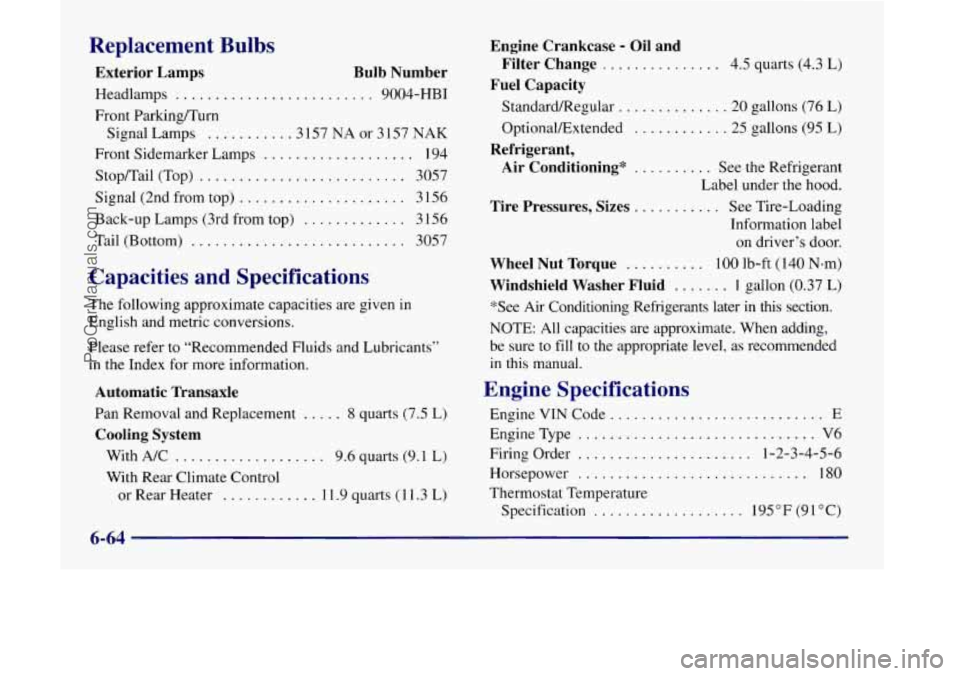
Replacement Bulbs
Exterior Lamps Bulb Number
Headlamps ......................... 9004-HBI
Signal Lamps
.......... .3 157 NA or 3 157 NAK
Front Sidemarker Lamps ................... 194
Stop/Tail (Top)
.......................... 3057
Signal (2nd from top)
..................... 3 156
Tail (Bottom) ........................... 3057
Front Parking/Turn
Back-up Lamps (3rd from top)
............. 3156
Capacities and Specifications
The following approximate
capacities are given in
English and metric conversions.
Please refer to “Recommended Fluids and Lubricants’’
in the Index for more information.
Automatic Transaxle
Pan Removal and Replacement ..... 8 quarts (7.5 L)
With A/C
................... 9.6 quarts (9.1 L)
Cooling System
With Rear Climate Control
or Rear Heater
............ 1 1.9 quarts (1 1.3 L)
Engine Crankcase - Oil and
Fuel Capacity Filter Change
............... 4.5 quarts (4.3 L)
Standard/Regular .............. 20 gallons (76 L)
OptionalExtended
............ 25 gallons (95 L)
Refrigerant,
Air Conditioning*
.......... See the Refrigerant
Label under the hood.
Tire Pressures, Sizes ........... See Tire-Loading
Information label
on driver’s door.
Wheel Nut Torque .......... 100 lb-ft (140 N-m)
Windshield Washer Fluid ....... 1 gallon (0.37 L)
*See Air Conditioning Refrigerants later in this section.
NOTE: All capacities are approximate. When adding,
be sure to fill to the appropriate level, as recommended
in this manual.
Engine Specifications
Engine VIN Code ........................... E
Firing Order
...................... 1-2-3-4-5-6
EngineType
.............................. V6
Horsepower
............................. 180
Thermostat Temperature Specification
................... 195°F (91°C)
6-64
ProCarManuals.com
Page 375 of 444
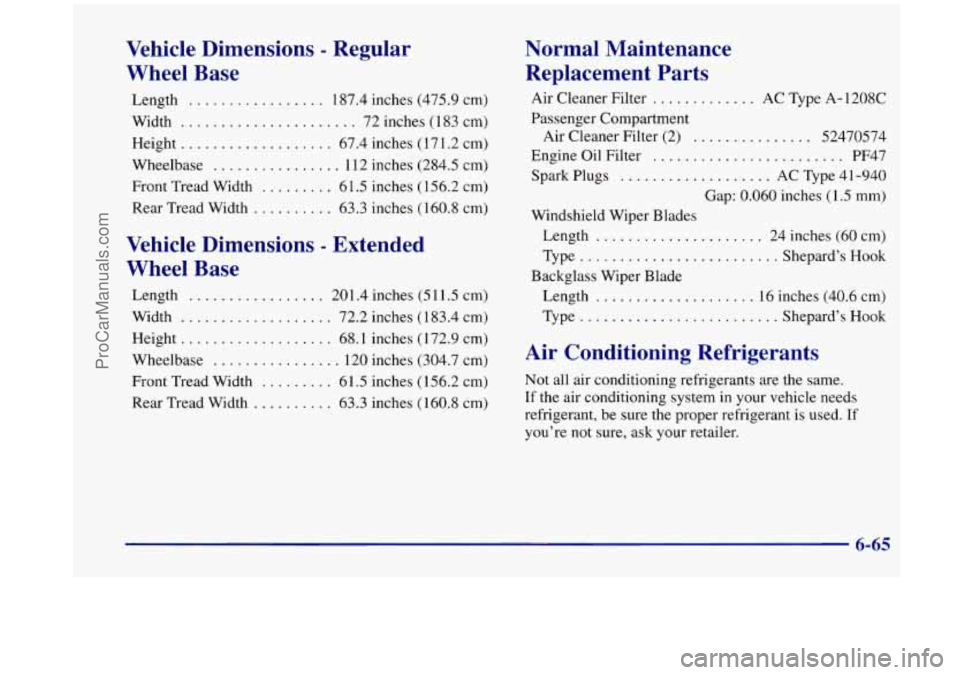
Vehicle Dimensions - Regular
Wheel Base
Length ................. 187.4 inches (475.9 cm)
Width
...................... 72 inches (183 cm)
Height
................... 67.4 inches (1 7 1.2 cm)
Wheelbase
................ 11 2 inches (284.5 cm)
Front Tread Width
......... 6 1.5 inches (1 56.2 cm)
Rear Tread Width
.......... 63.3 inches (1 60.8 cm)
Vehicle Dimensions - Extended
Wheel Base
Length ................. 20 1.4 inches (5 1 1.5 cm)
Width
................... 72.2 inches (183.4 cm)
Height
................... 68.1 inches (172.9 cm)
Wheelbase
................ 120 inches (304.7 cm)
Front Tread Width
......... 6 1.5 inches (156.2 cm)
Rear Tread Width
.......... 63.3 inches ( 160.8 cm)
Normal Maintenance
Replacement Parts
Air Cleaner Filter ............. AC Type A- 1208C
Passenger Compartment Air Cleaner Filter
(2) ............... 52470574
Engine Oil Filter
........................ PF47
Spark Plugs
................... AC Type 4 1-940
Gap: 0.060 inches (1.5 mm)
Windshield Wiper Blades
Length
..................... 24 inches (60 cm)
Type
......................... Shepard’s Hook
Length
.................... 16 inches (40.6 cm)
Type
......................... Shepard’s Hook
Backglass Wiper Blade
Air Conditioning Refrigerants
Not all air conditioning refrigerants are the same.
If the air conditioning system in your vehicle needs
refrigerant, be sure the proper refrigerant is used.
If
you’re not sure, ask your retailer.
6-65
ProCarManuals.com