seat OLDSMOBILE SILHOUETTE 1998 Owner's Manual
[x] Cancel search | Manufacturer: OLDSMOBILE, Model Year: 1998, Model line: SILHOUETTE, Model: OLDSMOBILE SILHOUETTE 1998Pages: 444, PDF Size: 23.2 MB
Page 31 of 444

Replacing the Bucket Seats
Don’t put the seats in so they face rearward because they
won’t latch that way. If you want more storage room
behind the seat, adjust the seat by sliding it forward.
The bucket seats have seat position labels, located on the
back
of the seat, showing where the seat must go. Follow
that diagram. See “Seat Controls” in the beginning of
this
section for more details. The seat must be placed in the
proper location for the legs
to attach correctly.
RIGHT
ONLY seats that don’t have the built-in child
restraint option fit only in the right location of either
row, the
E and F or I and J sets of floor cups.
The CENTER
OR LEFT seat fits in the center location
or in either left location, the
A and B, C and D or G
and H sets of floor cups.
The
LEFT ONLY seats that don’t have the built-in child
restraint option fit only in the left location of either row,
the
A and B or G and H sets of floor cups.
RIGHT ONLY seats that have the built-in child restraint
option fit only
in the right location of the second row,
the
E and F sets of floor cups.
LEFT ONLY seats that have the built-in child restraint
option fit only
in the left location of the second row, the
A and B sets of floor cups.
Make sure the seat is in the full rear position before
beginning this procedure.
1. With the seat folded, squeeze the angled gray bar
toward the solid gray crossbar while placing the
front hooks of the bench seat
onto the front two
floor pins.
To do this,
the seat will
need to be angled
so that
the front hooks clear the
floor pins.
1-19
ProCarManuals.com
Page 32 of 444
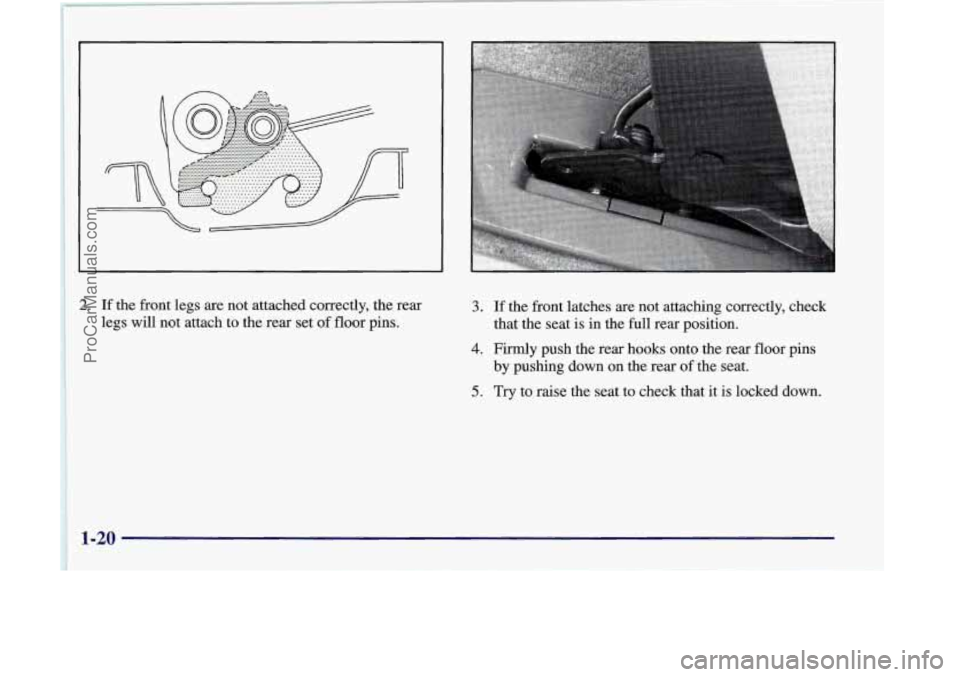
2. If the front legs are not attached correctly, the rear
legs will not attach to the rear set of floor pins. 3. If the front latches are not attaching correctly, check
that the seat is in the full rear position.
4. Firmly push the rear hooks onto the rear floor pins
by pushing down on the rear of
the seat.
5. Try to raise the seat to check that it is locked down.
1-20
ProCarManuals.com
Page 33 of 444
A CAUT~ON:
A seat that isn’t locked into place properly can
move around
in a collision or sudden stop. People
in the vehicle could be injured.
Be sure to lock
the seat into place properly when installing it.
6. Lift the seatback recliner lever or pull the nylon strap
on the back
of the seat and raise the seatback until it
locks upright.
7. Push and pull on the seatback to check that it is
locked in place.
A CAUTION:
If the seatback isn’t locked, it could move
forward in a sudden stop or crash. That could
cause injury to the person sitting there. Always
press rearward on the seatback to be sure it
is locked.
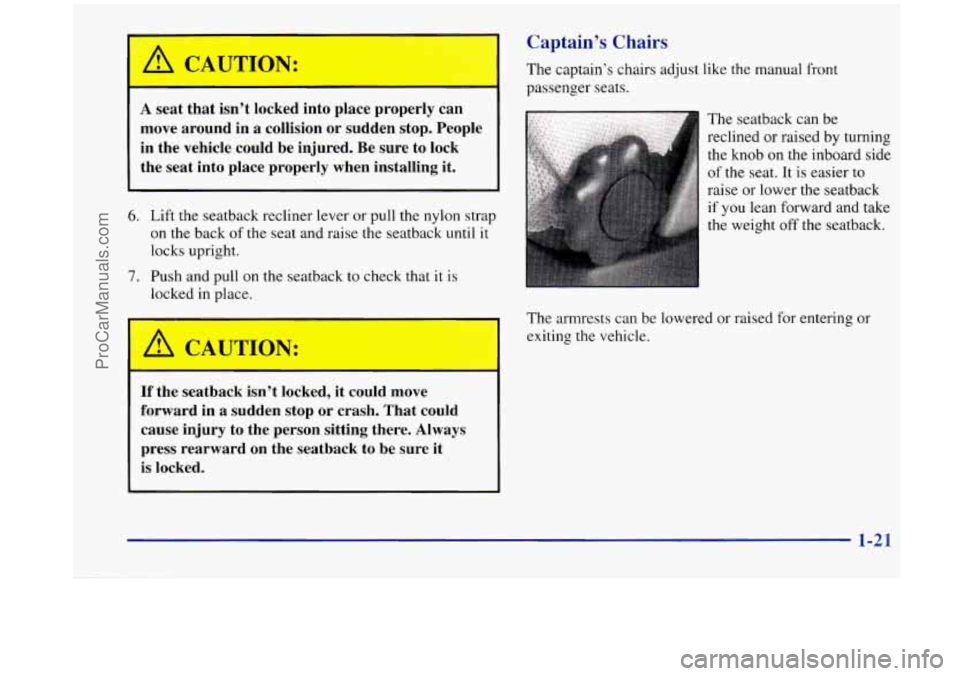
Captain’s Chairs
The captain’s chairs adjust like the manual front
passenger seats.
The seatback can be
reclined or raised by turning
the knob on the inboard side
of the seat.
It is easier to
raise
or lower the seatback
if you lean forward and take
the weight
off the seatback.
The armrests can
be lowered or raised for entering or
exiting the vehicle.
1-21
ProCarManuals.com
Page 34 of 444
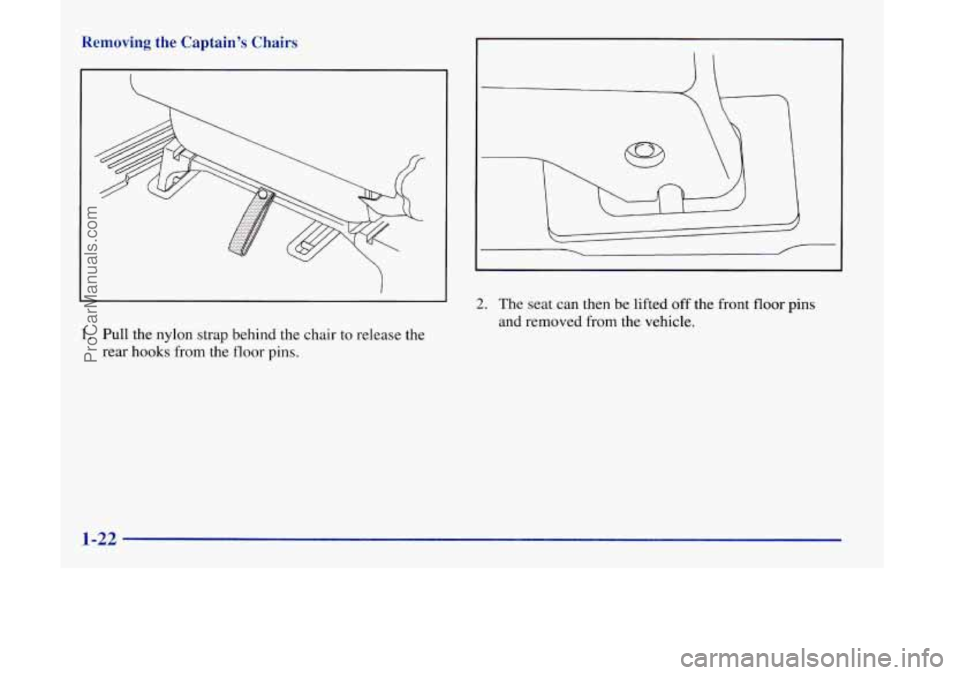
Removing the Captain’s Chairs
1. Pull the nylon strap behind the chair to release the
rear hooks
from the floor pins.
2. The seat can then be lifted off the front floor pins
and removed from the vehicle,
1-22
ProCarManuals.com
Page 35 of 444
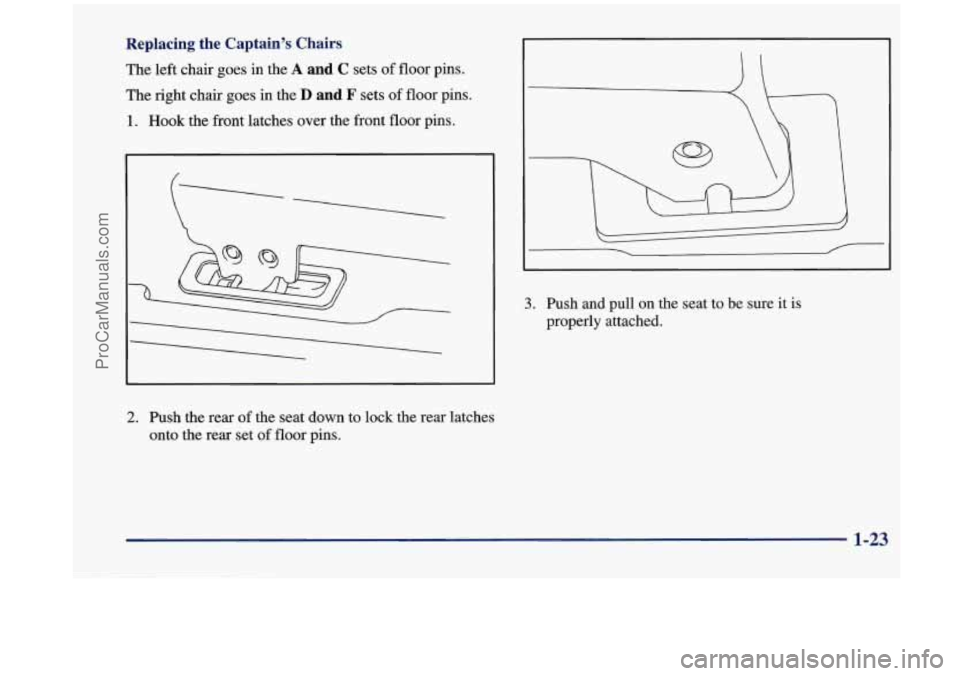
Replacing the Captain’s Chairs
The left chair goes in the A and C sets of floor pins.
The right chair goes in the
D and F sets of floor pins.
1. Hook the front latches over the front floor pins.
2. Push the rear of the seat down to lock the rear latches
onto the rear set
of floor pins.
3. Push and pull on the seat to be sure it is
properly attached.
1-23
ProCarManuals.com
Page 36 of 444
Safety BeT ;: They’re for Everyone
This part of the manual tells you how to use safety belts
properly. It also tells
you some things you should not do
with safety belts.
And it explains the Supplemental Restraint System
(SRS),
or air bag system.
a CAUTION:
Don’t let anyone ride where he or she can’t wear
a safety belt properly. If you are in a crash and
you’re not wearing a safety belt, your injuries
can be much worse.
You can hit things inside the
vehicle or be ejected from it.
You can be seriously
injured or killed. In the same crash, you might
not be if you are buckled up. Always fasten your
safety belt, and check that your passengers’ belts
are fastened properly too.
A CAUTION: ’.
It is extremely dangerous to ride in a cargo area,
inside or outside of
a vehicle. In a collision,
people riding in these areas are more likely to be
seriously injured or killed.
Do not allow people to
ride in any area of your vehicle that is not
equipped with seats and safety belts. Be sure
everyone in your vehicle is in
a seat and using a
safety belt properly.
1-24
ProCarManuals.com
Page 37 of 444
Your vehicle has a light
that comes on as a reminder
to buckle up. (See “Safety
Belt Reminder Light” in
the Index.)
In most states and Canadian provinces, the law says to
wear safety belts. Here’s why:
They work.
You never know if you’ll be in a crash. If you do have a
crash, you don’t know if it will be a bad one.
A few crashes are mild, and some crashes can be
so
serious that even buckled up a person wouldn’t survive.
But most crashes are in between. In many
of them,
people who buckle up can survive and sometimes walk
away. Without belts they could have been badly
hurt
or killed.
After more than
30 years of safety belts in vehicles,
the facts
are clear. In most crashes buckling up does
matter
. . . a lot!
Why Safety Belts Work
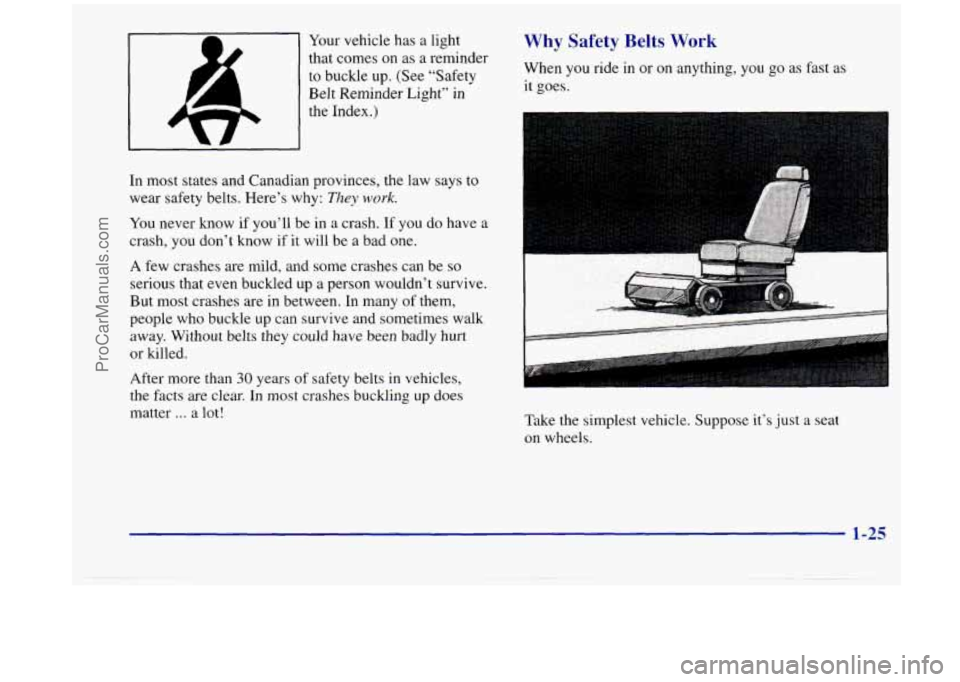
When you ride in or on anything, you go as fast as
it goes.
I
Take the simplest vehicle. Suppose it’s just a seat
on wheels.
1-25
ProCarManuals.com
Page 41 of 444
Q: If I’m a good driver, and I never drive far from
A: You may be an excellent driver, but if you’re in an
home, why should I wear safety belts?
accident -- even one that isn’t your fault -- you and
your passengers can be hurt. Being a good driver
doesn’t protect you from things beyond your
control, such as bad drivers.
Most accidents occur within
25 miles (40 km) of
home. And the greatest number of serious injuries
and deaths occur at speeds of less than
40 mph
(65 kdh).
Safety belts
are for everyone.
How to Wear Safety Belts Properly
Adults
This part is only for people of adult size.
Be aware that there
are special things to know about safety
belts and children. And there are different rules for smaller
children and babies. If a child will be riding
in your
vehicle, see the part of this manual called “Children.”
Follow those rules for everyone’s protection. First, you’ll want to know which restraint systems your
vehicle has.
We’ll start with the driver position.
Driver Position
This part describes the driver’s restraint system.
Lap-Shoulder Belt
The driver has a lap-shoulder belt. Here’s how to wear
it properly.
1. Close and lock the door.
2. Adjust the seat (to see how, see “Seats” in the Index)
so you can sit up straight.
1-29
ProCarManuals.com
Page 53 of 444
How the Air Bag Systems Work
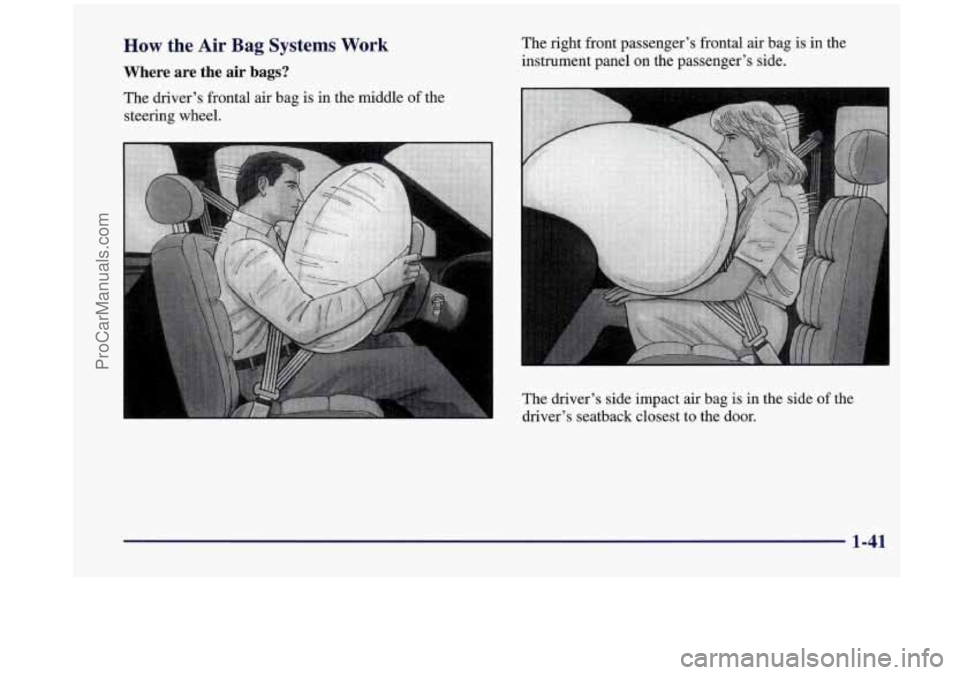
Where are the air bags?
The driver’s frontal air bag is in the middle of the
steering wheel. The right front
passenger’s frontal air bag is in the
instrument panel on the passenger’s side.
The driver’s side impact air bag is in the side of the
driver’s seatback closest to the door.
1-41
ProCarManuals.com
Page 54 of 444
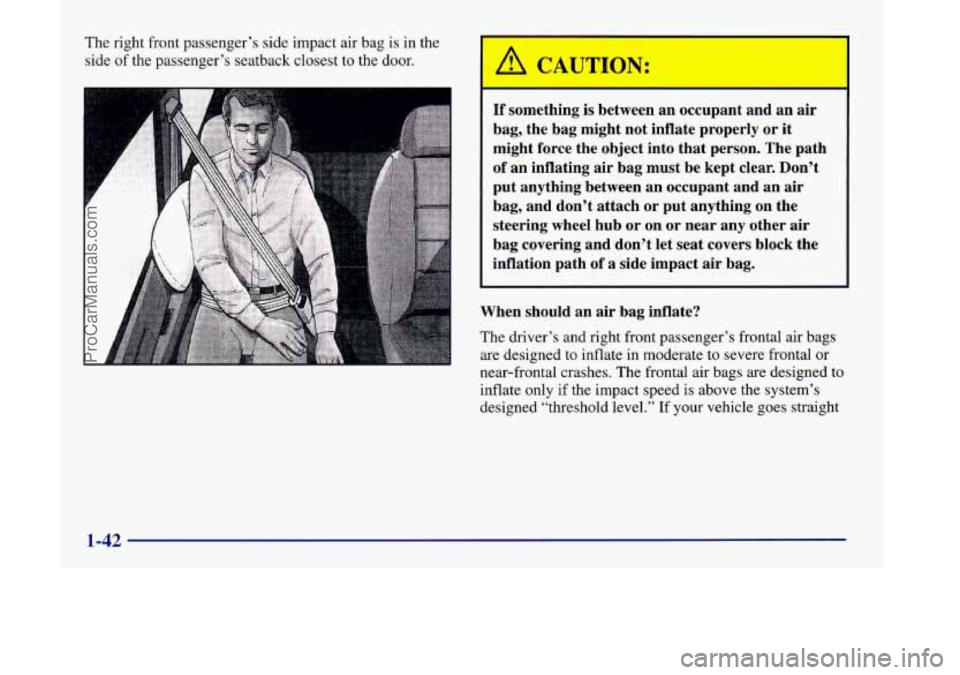
The right front passenger’s side impact air bag is in the
side
of the passenger’s seatback closest to the door. A CAUTION:
If something is between an occupant and an air
bag, the bag might not inflate properly or
it
might force the object into that person. The path
of an inflating air bag must be kept clear. Don’t
put anything between an occupant and an air
bag, and don’t attach or put anything on the
steering wheel hub or on
or near any other air
bag covering and don’t let seat covers block the
inflation path
of a side impact air bag.
When should an air bag inflate?
The driver’s and right front passenger’s frontal air bags
are designed to inflate in moderate to severe frontal or
near-frontal crashes. The frontal air bags are designed to
inflate
only if the impact speed is above the system’s
designed “threshold level.” If your vehicle goes straight
1-42
ProCarManuals.com