clock OLDSMOBILE SILHOUETTE 2003 User Guide
[x] Cancel search | Manufacturer: OLDSMOBILE, Model Year: 2003, Model line: SILHOUETTE, Model: OLDSMOBILE SILHOUETTE 2003Pages: 466, PDF Size: 21.55 MB
Page 276 of 466
Steering in Emergencies
There are times when steering can be more effective
than braking. For example, you come over a hill and find
a truck stopped in your lane, or a car suddenly pulls
out from nowhere, or a child darts out from between
parked cars and stops right in front of you. You can
avoid these problems by braking
- if you can stop
in time. But sometimes you can’t; there isn’t room.
That’s the time for evasive action
- steering around
the problem.
Your vehicle can perform very well in emergencies
like these. First apply your brakes.
See
Braking on page 4-6. It is better to remove as
much speed as you can from a possible collision.
Then steer around the problem, to the left or right
depending on the space available. An emergency
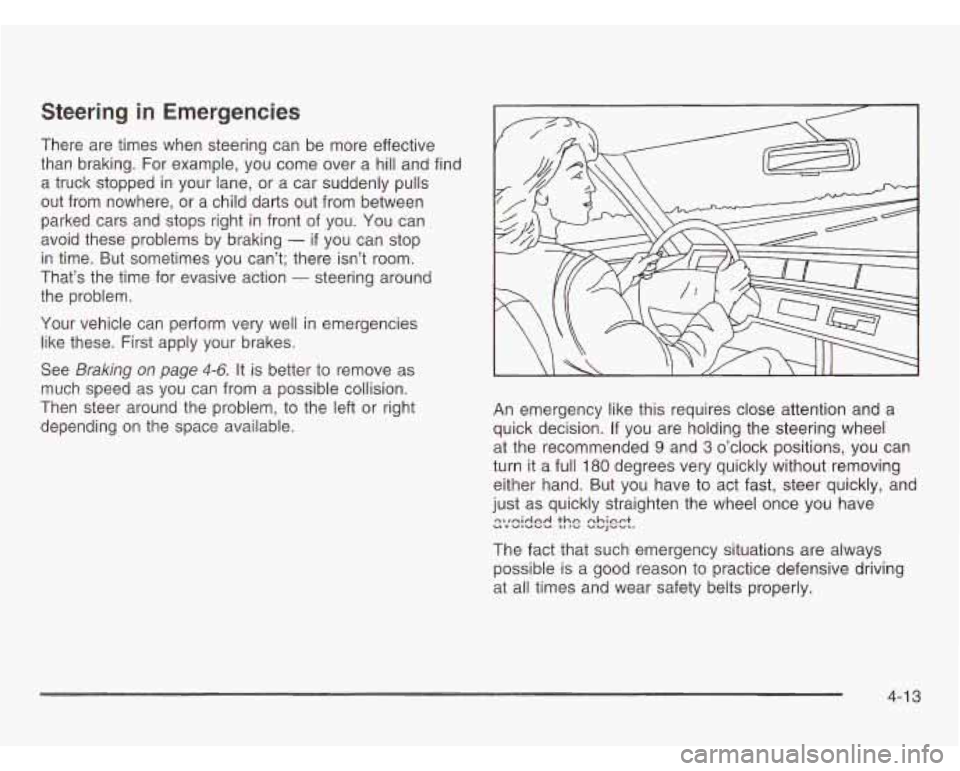
like this requires close attention and
a
quick decision. If you are holding the steering wheel
at the recommended
9 and 3 o’clock positions, you can
turn
it a full 180 degrees very quickly without removing
either hand. But you have to act fast, steer quickly, and
just as quickly straighten the wheel once you have
.~
nirlnd +ho nhinnt U” VlUVU L, I” “U,VVL.
The fact that such emergency situations are always
possible is a good reason to practice defensive driving
at all times and wear safety belts properly.
4-1 3
Page 316 of 466
When you put the fuel cap back on, turn it to the right
(clockwise) until you hear a clicking sound. Make
sure you fully install the cap. The diagnostic system can
determine
if the fuel cap has been left off or improperly
installed. This would allow fuel to evaporate into the
atmosphere. See
Malfunction Indicator Lamp on
page 3-47.
The malfunction indicator lamp (SERVICE ENGINE
SOON or CHECK ENGINE light) will come on
if the
fuel cap is not properly installed.
Notice: If you need a new fuel cap, be sure to get
the right type. Your dealer can get one for you.
If you get the wrong type, it may not fit properly.
This may cause your malfunction indicator lamp to
light and may damage your fuel tank and emissions
system. See “Malfunction Indicator Lamp”
in the
Index.
Filling a Po -able Fuel C ‘ainer
I-
I fil portablc uel container while it is in
your vehicle. Static electricity discharge from
the container can ignite the gasoline vapor.
You can be badly burned and your vehicle
damaged if this occurs.
To help avoid injury
to you and others:
Dispense gasoline only into approved
containers.
Do not fill a container while it is inside a
vehicle, in a vehicle’s trunk, pickup bed or on any surface other than the ground.
Bring the fill nozzle in contact with the
inside of the fill opening before operating
the nozzle. Contact should be maintained
until the filling is complete.
0 Don’t smoke while pumping gasoline.
5-9
Page 341 of 466
How to Add Coolant to the Radiator
Notice: Your engine has a specific radiator fill
procedure. Failure to follow this procedure could
cause your engine to overheat and be severely
damaged.
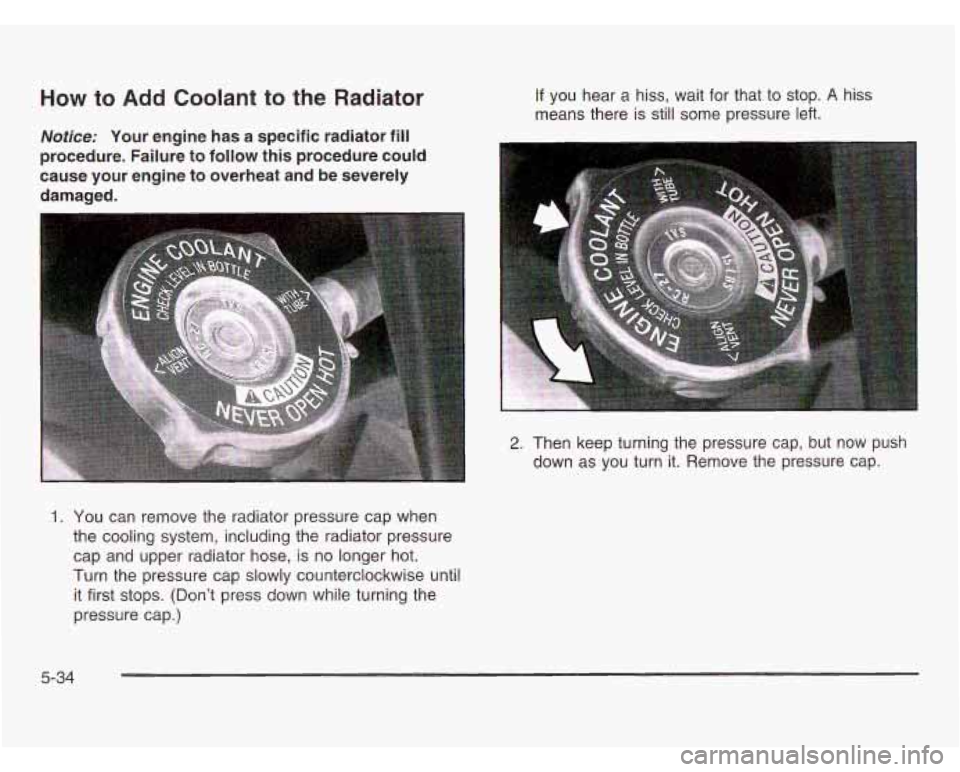
If you hear a hiss, wait for that to stop. A hiss
means there is still some pressure left.
1. You can remove the radiator pressure cap when
the cooling system, including the radiator pressure
cap and upper radiator hose, is no longer hot.
Turn the pressure cap
slowly counterclockwise until
it first stops. (Don’t press down while turning the
pressure cap.)
2. Then keep turning the pressure cap, but now push
down as you turn it. Remove the pressure cap.
5-34
Page 362 of 466
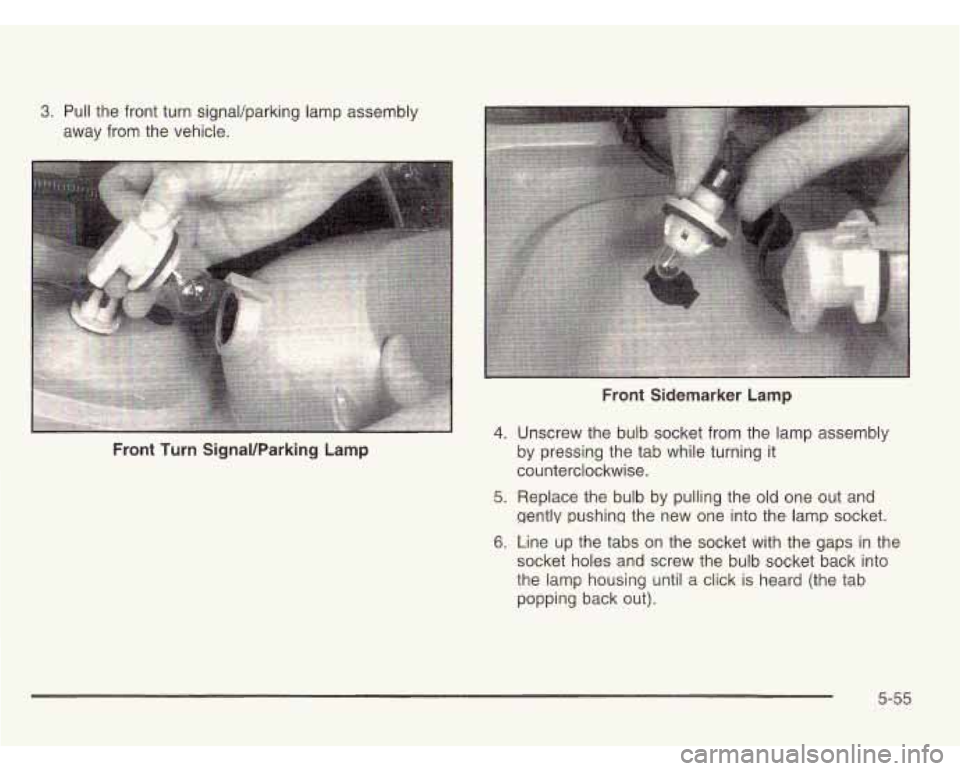
3. Pull the front turn signaVparking lamp assembly
away from the vehicle.
Front Turn SignaVParking Lamp
4.
5.
6.
Front Sidemarker Lamp
Unscrew the bulb socket from the lamp assembly
by pressing the tab while turning it
counterclockwise.
Replace the bulb by pulling the old one out and
gently pushing the new one into the lamp socket.
Line up the tabs on the socket with the gaps in the
socket holes and screw the bulb socket back into
the lamp housing until a click is heard (the tab
popping back out).
5-55
Page 379 of 466
C
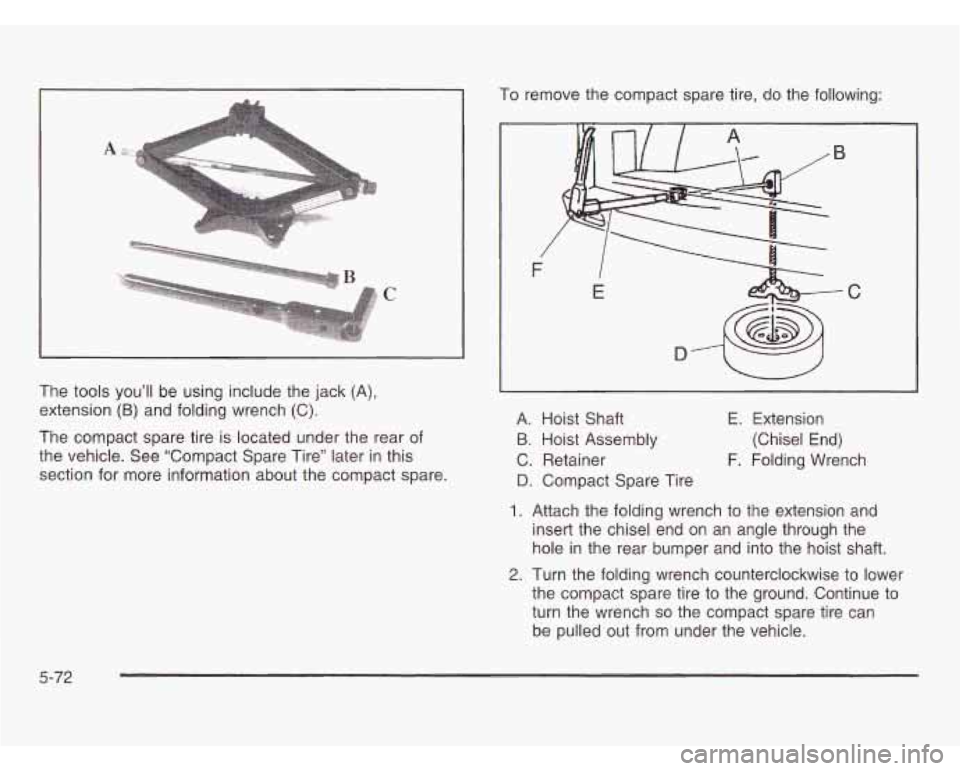
The tools you’ll be using include the jack (A),
extension
(B) and folding wrench (C).
The compact spare tire is located under the rear of
the vehicle. See “Compact Spare Tire” later in this
section for more information about the compact spare. To
remove the compact spare tire, do the following:
B
-C
A. Hoist Shaft
B. Hoist Assembly
C. Retainer
D. Compact Spare Tire E. Extension
(Chisel End)
F. Folding Wrench
I. Attach the folding wrench to the extension and
insert the chisel end on an angle through the
hole in the rear bumper and into the hoist shaft.
2. Turn the folding wrench counterclockwise to lower
the compact spare tire to the ground. Continue to
turn the wrench
so the compact spare tire can
be pulled out from under the vehicle.
5-72
Page 380 of 466
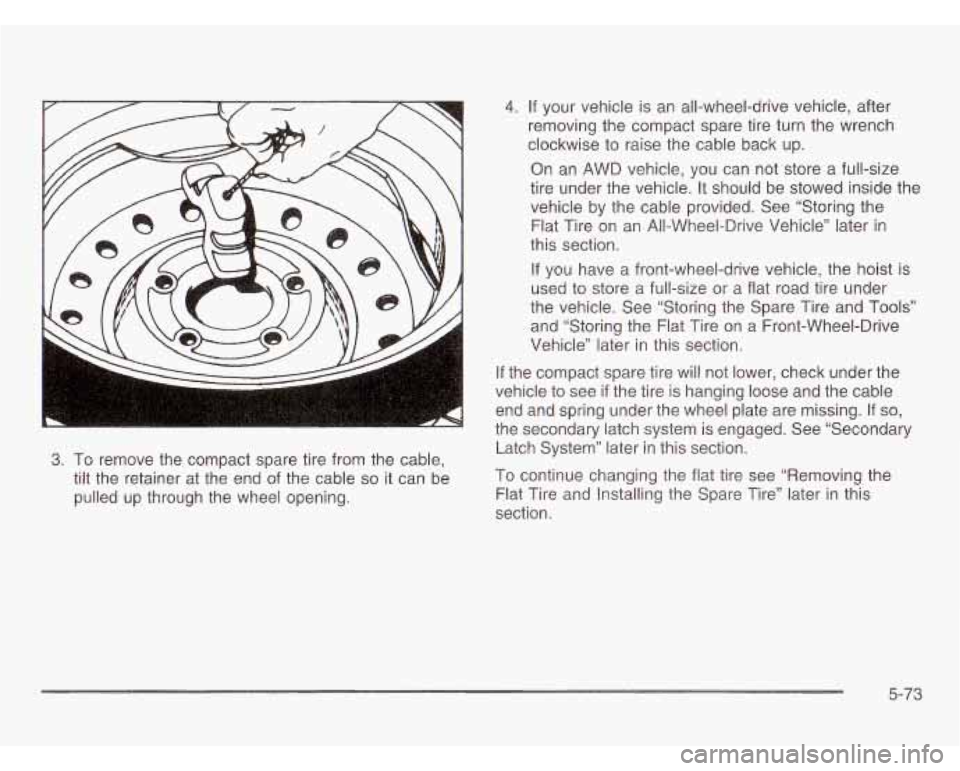
3. To remove the compact spare tire from the cable,
tilt the retainer at the end
of the cable so it can be
pulled up through the wheel opening.
-. If your vehicle is an all-wheel-drive vehicle, after
removing the compact spare tire turn the wrench
clockwise to raise the cable back up.
On an AWD vehicle, you can not store
a full-size
tire under the vehicle. It should be stowed inside the
vehicle by the cable provided. See “Storing the
Flat Tire on an All-Wheel-Drive Vehicle” later
in
this section.
If you have a front-wheel-drive vehicle, the hoist is
used to store a full-size or a flat road tire under
the vehicle. See “Storing the Spare Tire and
Tools”
and “Storing the Flat Tire on a Front-Wheel-Drive
Vehicle” later
in this section.
If the compact spare tire will not lower, check under the
vehicle to see
if the tire is hanging loose and the cable
end and spring under the wheel plate are missing. If
so,
the secondary latch system is engaged. See “Secondary
Latch System” later
in this section.
To continue changing the flat tire see “Removing the
Flat Tire and Installing the Spare Tire” later in this
section.
5-73
Page 382 of 466
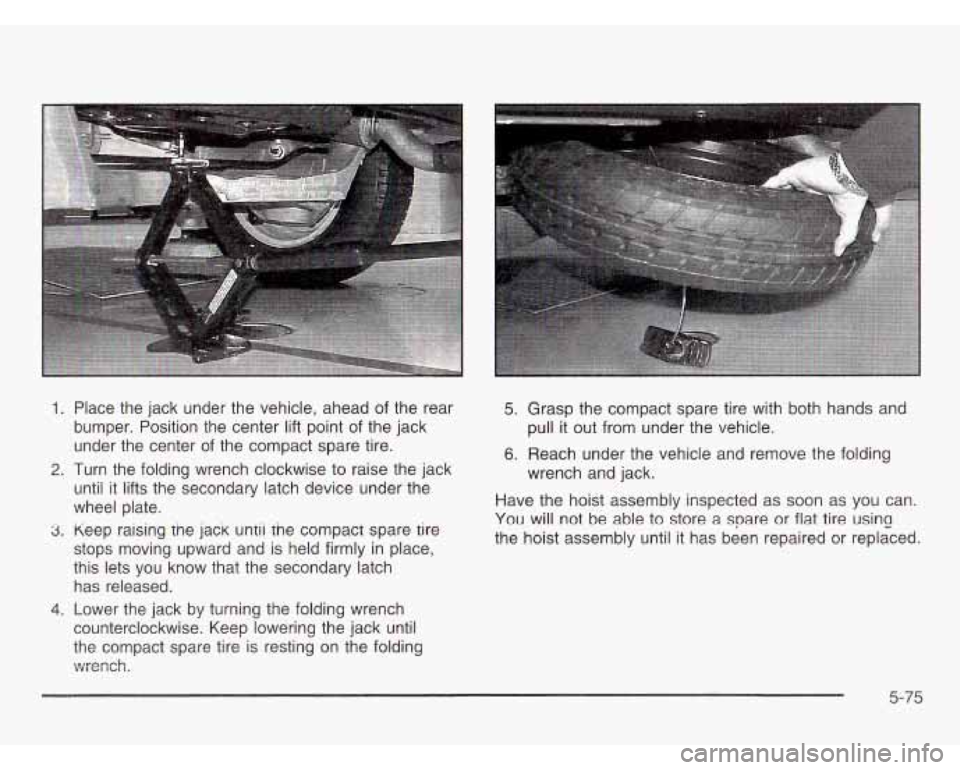
1. Place the jack under the vehicle, ahead of the rear
bumper. Position the center
lift point of the jack
under the center of the compact spare tire.
2. Turn the folding wrench clockwise to raise the jack
until it lifts the secondary latch device under the
wheel plate.
5. Grasp the compact spare tire with both hands and
6. Reach under the vehicle and remove the folding
pull
it out
from under the vehicle.
wrench and jack.
Have the hoist assembly inspected as soon as you can.
You will not be able to store a spare or flat tire usinG
the hoist assembly until it has been repaired or replaced. 3. Keep raising tne jack untii rne compact spare tire
stops moving upward and is held firmly in place,
this lets you know that the secondary latch
has released.
4. Lower the jack by turning the folding wrench
counterclockwise. Keep lowering the jack until
the compact spare tire is resting on the folding
wrench. ~- -~
5-75
Page 385 of 466
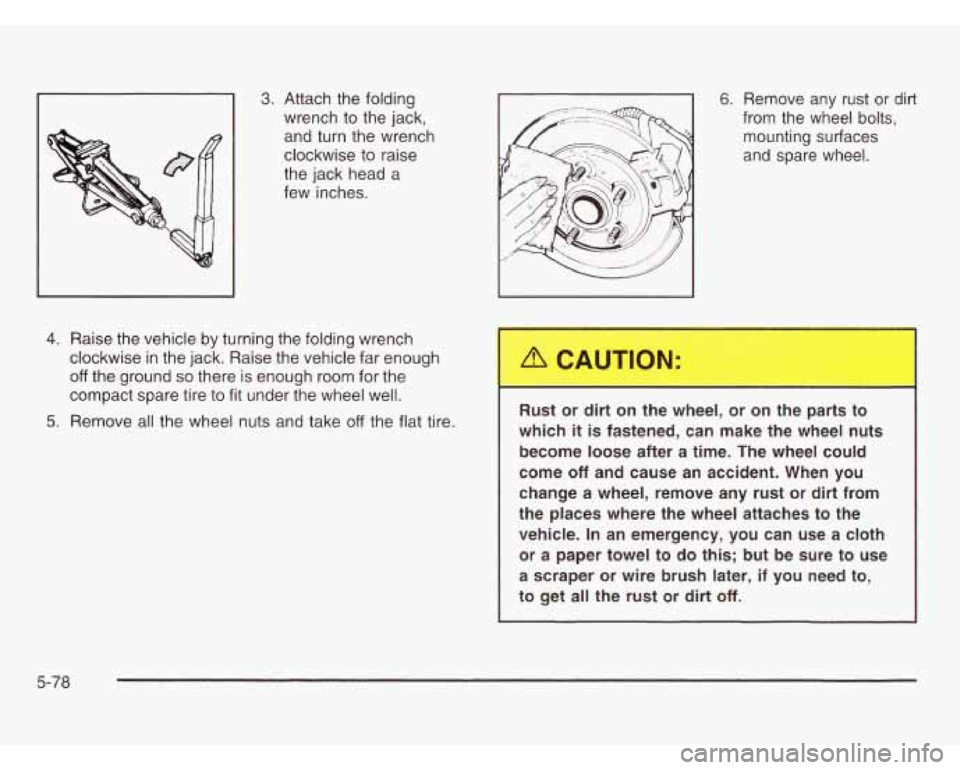
3. Attach the folding
wrench to the jack,
and turn the wrench
clockwise to raise
the jack head a
few inches.
4. Raise the vehicle by turning the folding wrench
clockwise in the jack. Raise the vehicle far enough
off the ground so there is enough room for the
compact spare tire to
fit under the wheel well.
5. Remove all the wheel nuts and take off the flat tire.
6. Remove any rust or dirt
from the wheel bolts, mounting surfaces
and spare wheel.
Rust or dirt on the wheel, or on the parts to
which
it is fastened, can make the wheel nuts
become loose after a time. The wheel could
come
off and cause an accident. When you
change a wheel, remove any rust or dirt from
the places where the wheel attaches
to the
vehicle.
In an emergency, you can use a cloth
or a paper towel to do this;
but be sure to use
a scraper or wire brush later, if you need to,
to get all the
rust or dirt off.
5-78
Page 386 of 466
I
Nev,. use oil or grease on st,,s or nuts. If you
do, the nuts might come loose. Your wheel
could fall
off, causing a serious accident.
7. Install the compact spare tire and put the wheel
nuts back on with the rounded end
of the nuts
toward the wheel. Tighten each nut by hand until
the wheel is held against the hub.
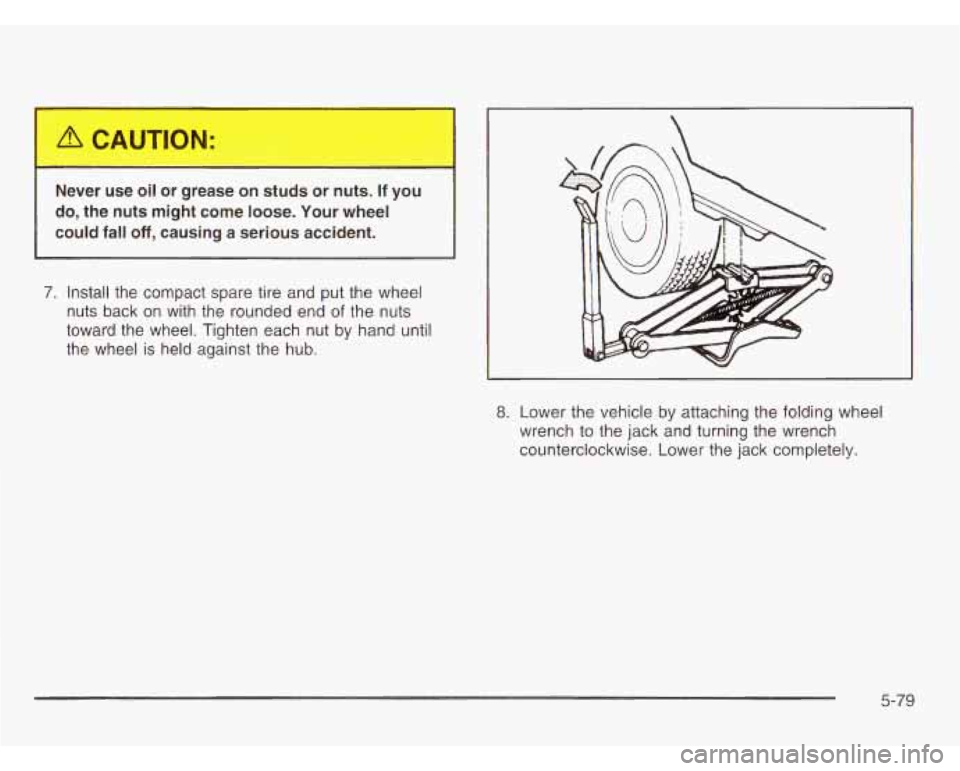
8. Lower the vehicle by attaching the folding wheel
wrench to the jack and turning the wrench
counterclockwise. Lower the jack completely.
5-79
Page 407 of 466
Underhood Fuse Block
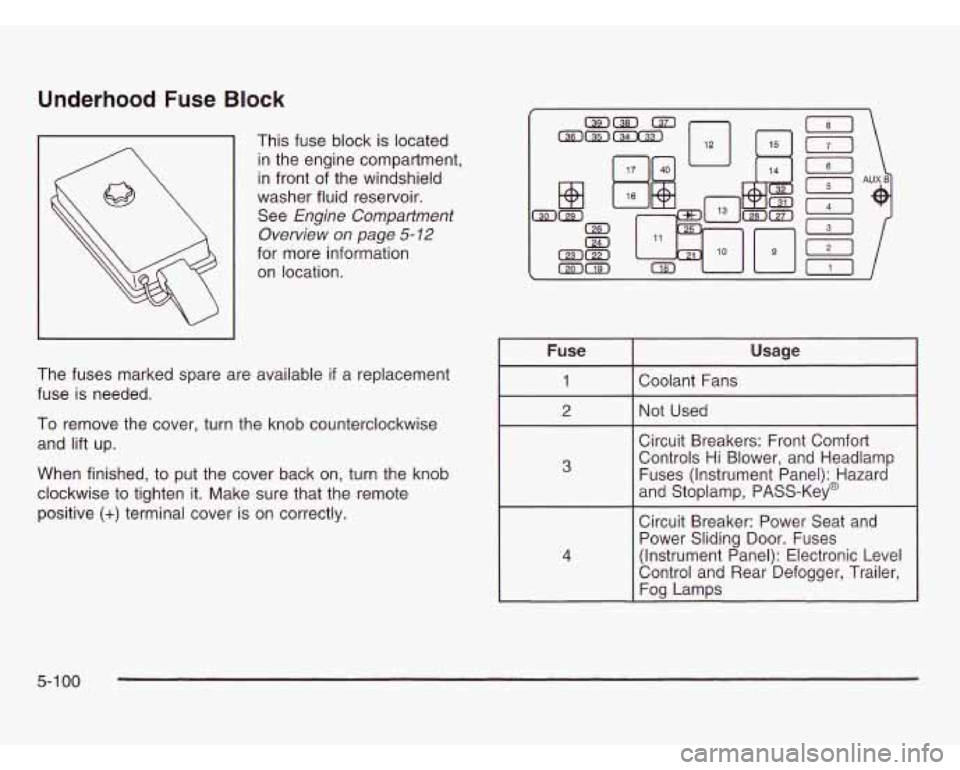
This fuse block is located
in the engine compartment,
in front of the windshield
washer fluid reservoir.
See
Engine Compartment
Overview
on page 5-12
for more information
on location.
The fuses marked spare are available
if a replacement
fuse
is needed.
To remove the cover, turn the knob counterclockwise
and lift up.
When finished, to put the cover back on, turn the knob
clockwise to tighten it. Make sure that the remote
positive
(+) terminal cover is on correctly.
(71
[61
[2)
111 Aul
I Fuse
I 2
4
Usage
Coolant Fans
Not Used
Circuit Breakers: Front Comfort
Controls Hi Blower, and Headlamp
Fuses (Instrument Panel): Hazard
and Stoplamp, PASS-Key@
Circuit Breaker: Power Seat and
Power Sliding Door. Fuses
(Instrument Panel): Electronic Level
Control and Rear Defogger, Trailer,
Fog Lamps
5-1 00