service OLDSMOBILE SILHOUETTE 2003 User Guide
[x] Cancel search | Manufacturer: OLDSMOBILE, Model Year: 2003, Model line: SILHOUETTE, Model: OLDSMOBILE SILHOUETTE 2003Pages: 466, PDF Size: 21.55 MB
Page 122 of 466
REVERSE (R): Use this gear to back up.
Notice: Shifting to REVERSE (R) while your vehicle
is moving forward could damage your transaxle.
Shift to REVERSE
(R) only after your vehicle
is stopped.
To rock your vehicle back and forth to get out of snow,
ice or sand without damaging your transaxle, see
If You Are Stuck: In Sand, Mud, Ice or Snow on
page 4-30.
NEUTRAL (N): In this position, your engine doesn’t
connect with the wheels. To restart when you’re already
moving, use NEUTRAL
(N) only. Also, use NEUTRAL (N)
when your vehicle is being towed.
Shifting into a drive gear while your engine
Unless your foot
is firmly on the brake pedal,
your vehicle could move very rapidly. You
could lose control and
hit people or objects.
Don’t shift into a drive gear while your engine
is racing.
“rqcjng” (running 3t high speed) i$ dangP?rQl!s
Notice: Damage to your transaxle caused by
shifting into a drive gear with the engine racing
isn’t covered by your warranty.
AUTOMATIC OVERDRIVE (D): This position is for
normal driving. If you need more power for passing,
and you’re:
Going less than 35 mph (55 km/h), push your
Going about 35 mph (55 km/h) or more, push the
You’ll shift down to the next gear and have more power.
Notice; If your vehicle seems to start up rather
slowly, or if
it seems not to shift gears as you go
faster, something may be wrong with a transaxle
system sensor. If you drive very far that way,
your vehicle can be damaged.
So, if this happens,
.lave your vehicle serviced right away. Until then,
you can use SECOND
(2) when you are driving
less than
35 mph (55 km/h) and AUTOMATIC
accelerator pedal
about halfway down.
accelerator all the way down. n\~nnn~
= In s-” L:-L-” -.......A. w v LnurlI Y L \YI tui 1 utyt IC# apr;r?wa.
2-37
Page 123 of 466
Warm-up Shift
Your vehicle has a computer controlled transaxle
designed to warm up the engine faster when the outside
temperature is
35°F (2°C) or colder. You may notice
that the transaxle will shift at a higher vehicle speed until
the engine is warmed up. This is a normal condition
designed to provide heat to the passenger compartment
and defrost the windows more quickly. See
Climate
Control System on
page 3-25 for more information.
THIRD
(3): This position is also used for normal driving,
but it offers more power and lower fuel economy than
AUTOMATIC OVERDRIVE (D).
Here are some times you might choose THIRD
(3)
instead of AUTOMATIC OVERDRIVE (D):
When driving on hilly, winding roads.
When towing a trailer (so there is less shifting
When going down a steep hill. between gears).
SECOND
(2): This position gives you more power,
but lower fuel economy. You can use SECOND
(2) on
hills. It can help control your speed as you go down
steep mountain roads, but then you would also want to
use your brakes
off and on.
Notice: Don’t drive in SECOND (2) for more than
25 miles (40 km), or at speeds over 55 mph (90 km/h),
or you can damage your transaxle. Use THIRD
(3) or
AUTOMATIC OVERDRIVE (D) as much as possible.
Don’t
shift into SECOND (2) unless you are going
slower than
65 mph (105 km/h) or you can damage
your engine.
Notice: If your vehicle seems to start up rather
slowly, or if
it seems not to shift gears as you go
faster, something may be wrong with a transaxle
system sensor. If you drive very far that way, your
vehicle can be damaged.
So, if this happens, have
your vehicle serviced
right away. Until then, you can
use SECOND
(2) when you are driving less than
35 mph (55 km/h) and THIRD (3) for higher speeds.
FIRST
(1): This position gives you even more power
(but lower fuel economy) than
SECOND (2). You can use
it on very steep hills, or in deep snow or mud.
If the shift
lever is put in FIRST
(I), the transaxle won’t downshift
into first gear until the vehicle is going slow enough.
Notice: If your front wheels won’t turn, don’t try to
drive. This might happen if you were stuck in very
deep sand or mud or were up against a solid object.
You could damage your transaxle. Also, if you stop
when going
uphill, don’t hold your vehicle there with
only the accelerator pedal. This could overheat and
damage the transaxle. Use your brakes to hold your
vehicle in position on a
hill.
2-38
Page 132 of 466
Onstar@ System Onstar@ Services
Onstar@ Drovides a number of service plans. Some of
the services currently provided by OnStap are:
e
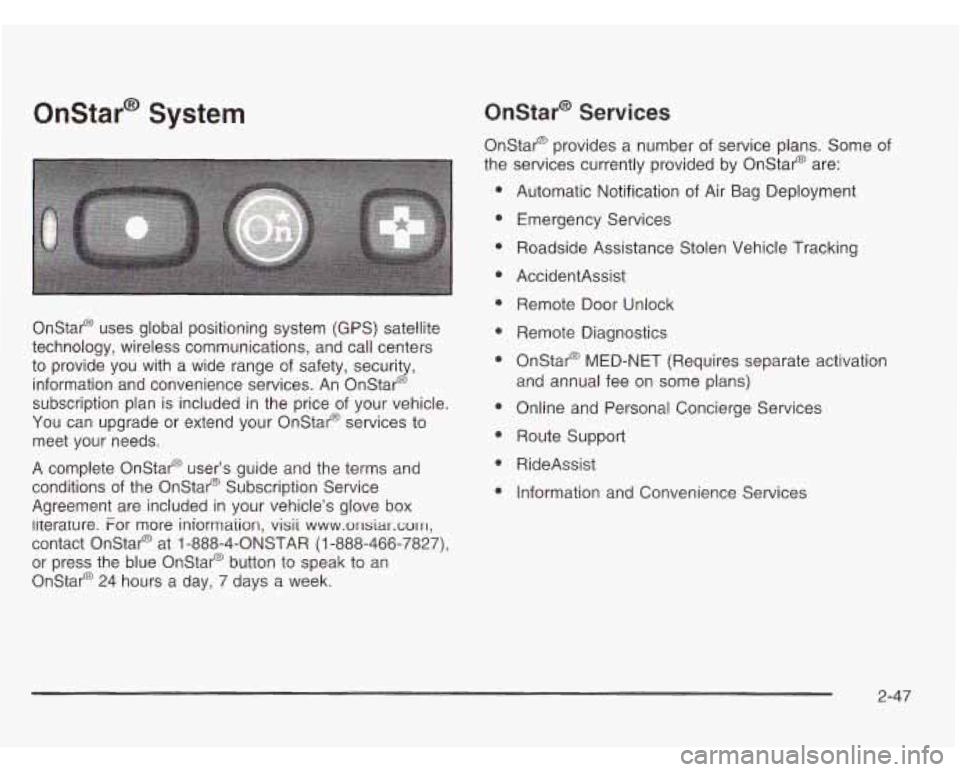
Onstar@ uses global positioning system (GPS) satellite
technology, wireless communications, and call centers
to provide you with a wide range
of safety, security,
information and convenience services. An Onstar@
subscription plan is included in the price of your vehicle.
You can upgrade or extend your Onstar@ services to
meet your needs.
A complete OnStap user’s guide and the terms and
conditions
of the Onstar@ Subscription Service
Agreement are included
in your vehicle’s glove box
iiterature. For more iniormaiion, visii
www.msiar.cwrl,
contact Onstar@ at 1 -888-4-ONSTAR (1 -888-466-7827),
or press the blue Onstar@ button to speak to an
Onstar@ 24 hours a day, 7 days a week. Automatic Notification
of Air Bag Deployment
Emergency Services
Roadside Assistance Stolen Vehicle Tracking
AccidentAssist Remote Door Unlock
Remote Diagnostics
Onstar@ MED-NET (Requires separate activation
and annual fee on some plans)
Online and Personal Concierge Services
Route Support
RideAssist
Information and Convenience Services
2-47
Page 133 of 466
Onstar@ Personal Calling
With Onstar@ Personal Calling, you have a safer way to
stay connected while driving.
It’s a hands-free wireless
phone that’s integrated into your vehicle. You can place
calls nationwide using voice-activated dialing with no
contracts, no roaming charges and no access fees.
To find out more about Onstar@ Personal Calling, refer to
the Onstar@ user’s guide in your vehicle’s glove box, or
call Onstar@ at
1 -888-4-ONSTAR (1 -888-466-7827).
Onstar@ Virtual Advisor
With Onstar@ Virtual Advisor you can listen to the news,
entertainment and informative topics, such as traffic
and weather reports. You are able to listen and reply to
your e-mail through your vehicle’s speakers.
A completed Subscription Service Agreement is required
prior to delivery of Onstar@ services and prepaid
calling minutes are also required for Onstar@ Personal
Calling and Onstar@ Virtual Advisor use. Terms and
conditions of the Subscription Service Agreement can be
found at www.onstar.com.
2-48
Page 134 of 466
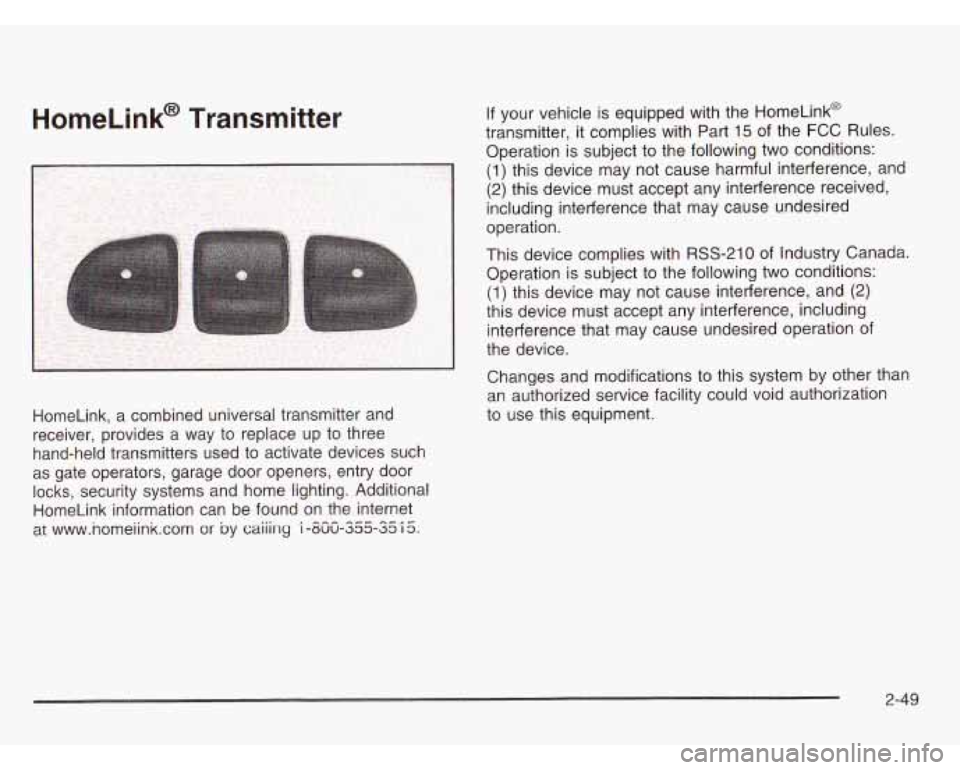
HomeLink, a combined universal transmitter and
receiver, provides a way to replace up to three
hand-held transmitters used to activate devices such
as gate operators, garage door openers, entry door
locks, security systems and home lighting. Additional
HomeLink information can be found on the internet
at www.nomeiink.com
or by caiiing i -uuu-333-~3 I 3. --- --A-
an authorized service facility could void authorization
to use this equipment.
2-49
Page 158 of 466
Section 3 Instrument Panel
Instrument Panel Overview ........................... 3.4
Hazard Warning Flashers
............................ 3.6
Other Warning Devices
............................... 3.6
Horn
............................................................. 3.7
Tilt Wheel
..................................................... 3-7
Turn SignaVMultifunction Lever
......................... 3.7
Exterior Lamps
............................................. 3.14
Interior Lamps
.............................................. 3.17
Switchbanks
................................................. 3.21
Instrument Panel Switchbank
.......................... 3-21
Overhead Console Switchbank
....................... 3.21
Ultrasonic Rear Parking Assist (URPA)
............ 3.22
Accessory Power Outlets
............................... 3.24
Climate Controls
............................................ 3.25
Climate Control System
................................. 3.25
Dual Climate Control System
.......................... 3.28
Rear Climate Control System
Rear Climate Control System (With Entertainment System)
...................... -3-34
Passenger Compartment Air Filter
................... 3.37
Warning Lights, Gages and Indicators
............. 3.39
Instrument Panel Cluster
................................ 3.40
Outlet Adjustment
......................................... 3.31
ilAlM-.nr I+ lZmtnwtq;n-mnt Ctrctnm \VUiLllWUL LIIL~ILUIIiIII~.. . Vy~L~..., .... ....... " "L 4-49
Speedometer and Odometer ........................... 3.41 Safety
Belt Reminder Light
............................. 3.42
Air Bag Readiness Light
................................ 3-43
Brake System Warning Light
.......................... 3-44
Anti-Lock Brake System Warning Light
............. 3-45
Traction Control System (TCS) Warning Light
...... 3-46
Engine Coolant Temperature Gage
.................. 3-47
Malfunction Indicator Lamp
............................. 3-47
Fuel Gage
................................................... 3-51
Message Center
............................................. 3-52
Service Traction System Warning Message
...... 3-52
Traction Active Message
................................ 3-53
Engine Coolant Temperature Warning
Message
.................................................. 3-53
Charging System Indicator Message
................ 3-54
Low Oil Pressure Message
............................ 3-54
Low Engine Oil Level Message
....................... 3-55
Change Engine Oil Message
.......................... 3-56
Power Sliding Door Warning Message
............. 3-56
Rear Hatch Ajar Warning Message
.................. 3-58
PASS-Key@
I II Security Message ................... -3-58
All-Wheel Drive Disable Warning Message
....... 3-59
Low Fuel Warning Message
........................... 3-59
Driver Information Center (DIC)
....................... 3-60
Eee: P, jar '!!s:n?!g !!esss;e .......................... ... Iz-c;7 v .
3- 1
Page 194 of 466
Passenger Compartment Air Filter
Passenger compartment air, both outside and
recirculated air, is routed through a passenger
compartment filter. The filter removes certain
contaminants from the air, including pollen and dust
particles Reductions in airflow, which may occur more
quickly in dusty areas, indicate that the filter needs to be
replaced early. For how often to change the air filter, see
Part A: Scheduled Maintenance Services on page 6-4.
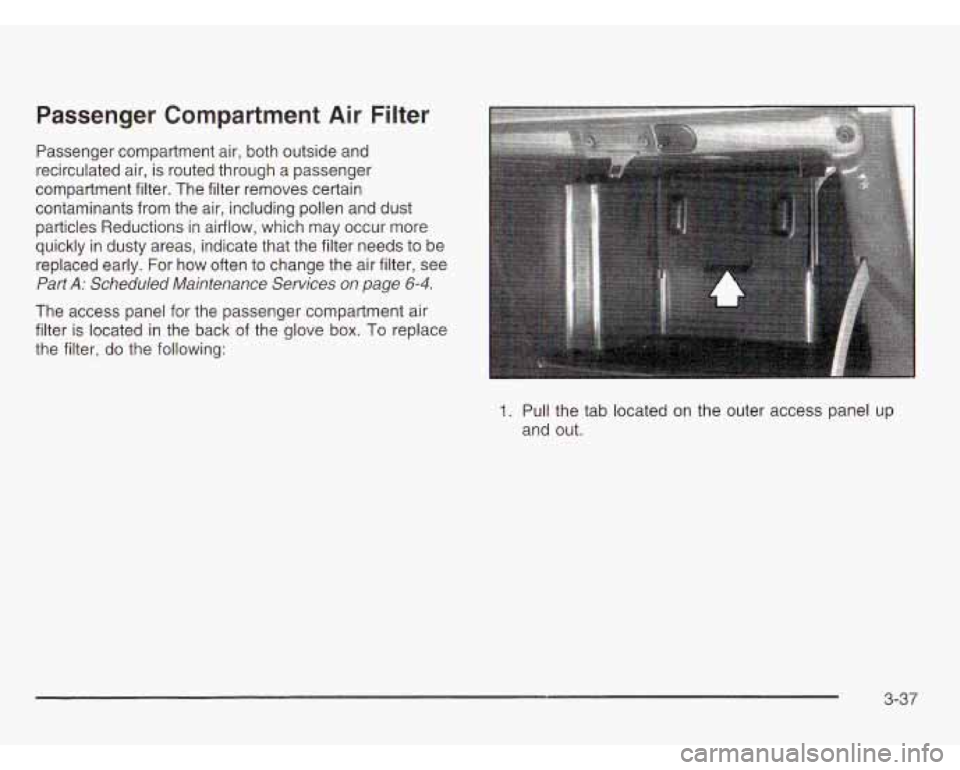
The access panel for the passenger compartment air
filter is located in the back of the glove box. To replace
the filter, do the following:
1. Pull the tab located on the outer access panel up
and out.
3-37
Page 200 of 466
Air Bag Readiness Light
There is an air bag readiness light on the instrument
panel, which shows the air bag symbol. The system
checks the air bag’s electrical system for malfunctions.
The light tells you
if there is an electrical problem.
The system check includes the air bag sensor, the air
bag modules, the wiring and the diagnostic module.
For more information on the air bag system, see
Air Bag
Systems on page
1-69.
This light will come on
when you start your
vehicle, and it will flash for
a few seconds. Then
the light should go out.
This means the system
is ready.
If the air bag readiness light stays on after you start the
bag system may not work properly. Have your vehicle
serviced right away. .,nL;-lm nr n-mrrn nm ..rhn- ,,-ma qvn Av;~r;mrn \,A~*V qir VGIIIbIG VI bW111Ga VI1 YYIIGII YWU UI’V UiIViIIy’ YWUt UBI
If the air bag .eaG...ess light ,.ays on after y--
start your vehicle, it means the air bag system
may not be working properly. The air bags
in
your vehicle may not inflate in a crash, or they
could even inflate without a crash. To help avoid
injury to yourself or others, have your vehicle
serviced right away if the air bag readiness
light
stays on after you start your vehicle.
The air bag readiness light should flash for a few
seconds when you turn the ignition key to
RUN. If the
light doesn’t come on then, have it fixed
so it will
be ready to warn you
if there is a problem.
3-43
Page 202 of 466
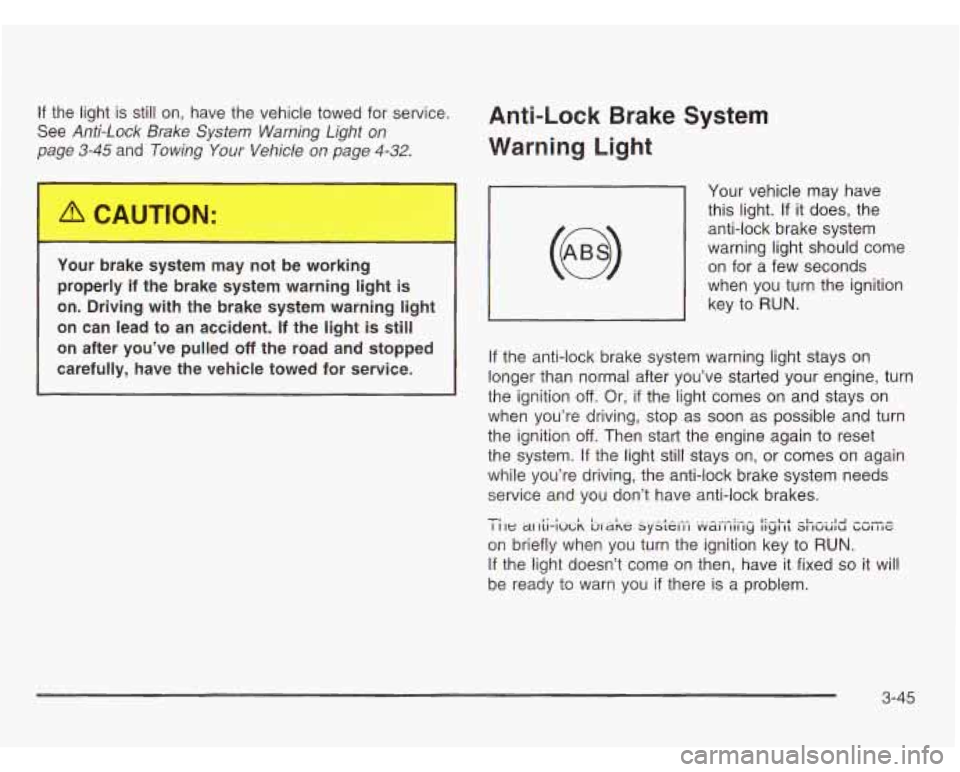
If the light is still on, have the vehicle towed for service.
See
Anti-Lock Brake System Warning Light on
F e 3-45 and Towing \’ rr Vehicle on page 4-32.
Your brake system may not be working
properly
if the brake system warning light is
on. Driving with the brake system warning light
on can lead to an accident.
If the light is still
on after you’ve pulled
off the road and stopped
carefully, have the vehicle towed for service.
r
Anti-Lock Brake System
Warning Light
Your vehicle may have
this light. If it does, the
anti-lock brake system
warning light should come
on for
a few seconds
when you turn the ignition
key to RUN.
If the anti-lock brake system warning light stays on
longer than normal after you’ve started your engine, turn
the ignition
off. Or, if the light comes on and stays on
when you’re driving, stop as soon as possible and turn
the ignition
off. Then start the engine again to reset
the system. If the light still stays on, or comes on again
while you’re driving, the anti-lock brake system needs
service and you don’t have anti-lock brakes.
-I -I. I- .I I^ .-,.- -..-I __.^___ :--. l:-.LL -L-..l-l -^-_ I I le dl Ill-IWGK UldKt: byblW i I vval I 111 ly llYl11 31 lwuiu bWl I IC
on briefly when you turn the ignition key to RUN.
If the light doesn’t come on then, have it fixed so it will
be ready to warn you if there
is a problem.
3-45
Page 203 of 466
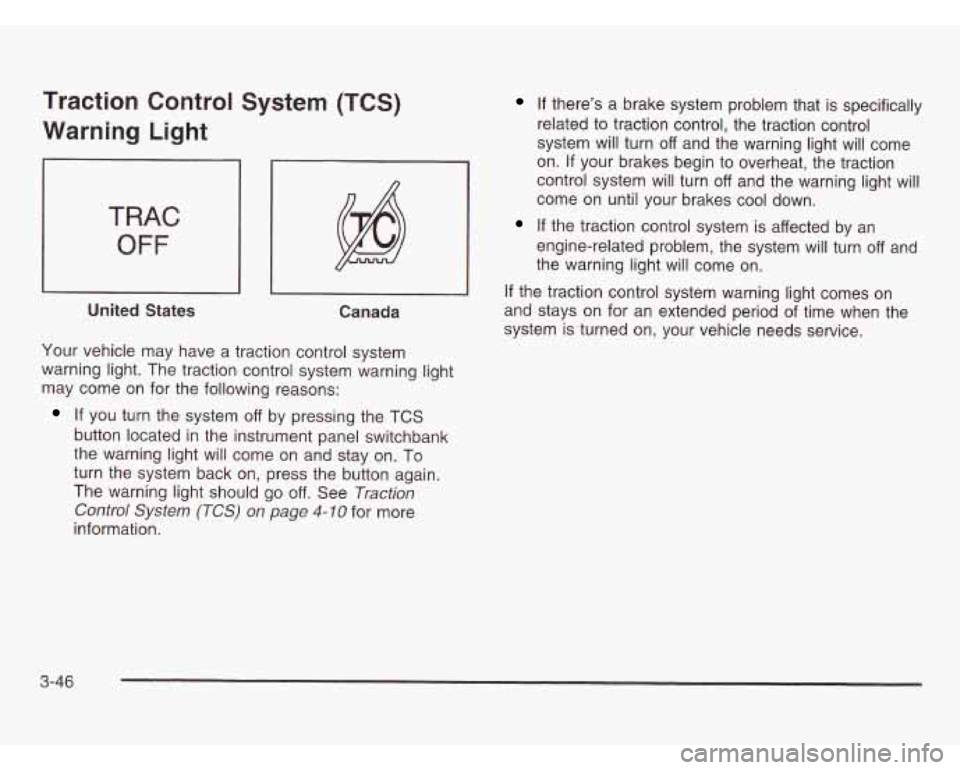
Traction Control System (TCS)
Warning Light
TRAC
OFF
United States Canada
Your vehicle may have a traction control system
warning light. The traction control system warning light
may come on for the following reasons:
If you turn the system off by pressing the TCS
button located in the instrument panel switchbank
the warning light will come on and stay on.
To
turn the system back on, press the button again.
The warning light should go
off. See Traction
Control System
(TCS) on page 4-10 for more
information.
If there’s a brake system problem that is specifically
related to traction control, the traction control
system will turn off and the warning light will come
on.
If your brakes begin to overheat, the traction
control system will turn
off and the warning light will
come on until your brakes cool down.
If the traction control system is affected by an
engine-related problem, the system will turn
off and
the warning light will come on.
If the traction control system warning light comes on
and stays on for an extended period of time when the
system is turned on, your vehicle needs service.
3-46