tires OLDSMOBILE SILHOUETTE 2003 User Guide
[x] Cancel search | Manufacturer: OLDSMOBILE, Model Year: 2003, Model line: SILHOUETTE, Model: OLDSMOBILE SILHOUETTE 2003Pages: 466, PDF Size: 21.55 MB
Page 289 of 466
Winter Driving Include an ice scraper, a small brush or broom, a
supply of windshield washer fluid, a rag, some winter
outer clothing, a small shovel, a flashlight, a red cloth
and a couple
of reflective warning triangles. And, if you
will be driving under severe conditions, include a
small bag
of sand, a piece of old carpet or a couple of
burlap bags to help provide traction. Be sure you
properly secure these items in your vehicle.
Driving on Snow or Ice
Most of the time, those places where your tires meet
the road probably have good traction.
However,
if there is snow or ice between your tires
and the road, you can have a very slippery situation.
You’ll have a lot less traction or “grip” and will need to be
very careful.
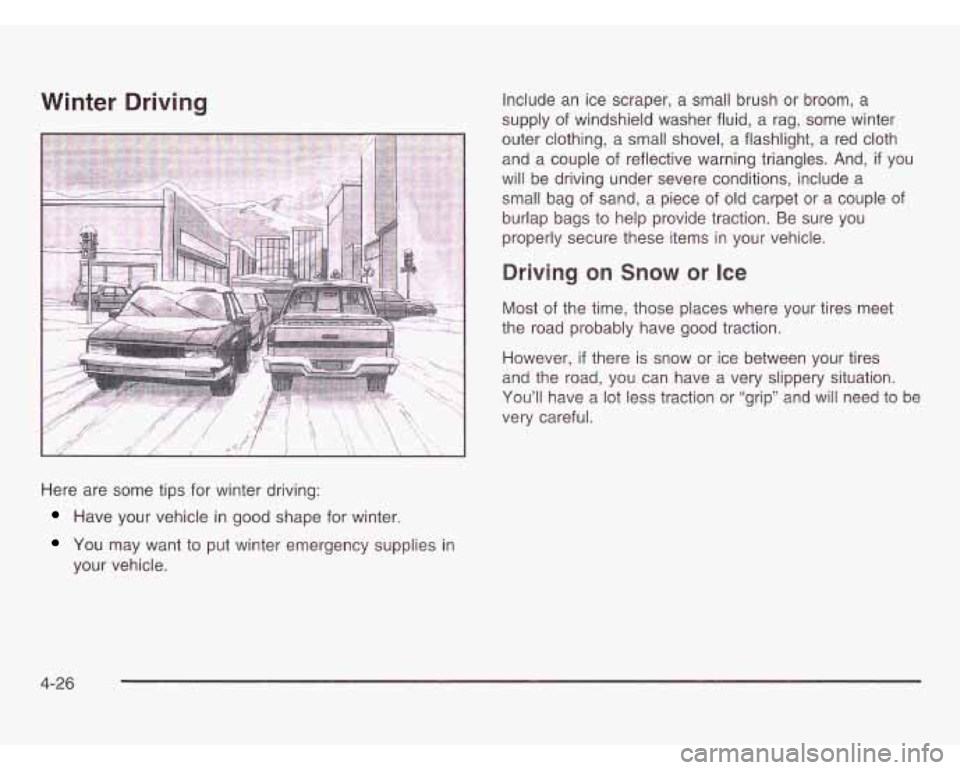
Here are some tips for winter driving:
Have your vehicle in good shape for winter.
You may want to put winter emergency supplies in
your vehicle.
4-26
Page 290 of 466
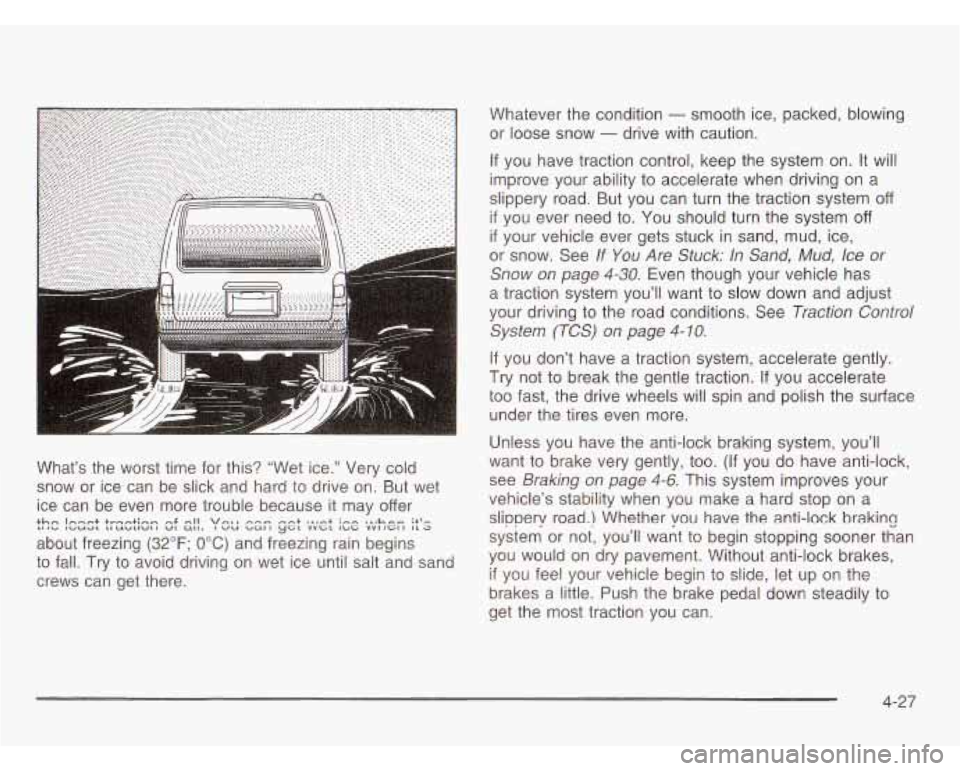
What’s the worst time for this? “Wet ice.” Very cold
snow or ice can be slick and hard to drive on. But wet
ice can be even more trouble because it may offer
about freezing
(32°F; OOC) and freezing rain begins
to fall. Try to avoid driving on wet ice until salt and sand
crews can get there.
thn in-& tvnntinn n$ -11 Vnvm n-m nnt *a,-+ :nn aaeh-n :+*a Lllb ILiU3L IIUbLiUII VI (511. I VU bCd1 I YGL WYGL IGG VWI ltl I I1 3
Whatever the condition - smooth ice, packed, blowing
or loose snow
- drive with caution.
If you have traction control, keep the system on.
It will
improve your ability to accelerate when driving on a
slippery road. But you can turn the traction system
off
if you ever need to. You should turn the system off
if your vehicle ever gets stuck in sand, mud, ice,
or snow. See If You Are Stuck: In Sand, Mud, Ice or
Snow on page
4-30. Even though your vehicle has
a traction system you’ll want to slow down and adjust
your driving to the road conditions. See
Traction Control
System (TCS) on page
4- 10.
If you don’t have a traction system, accelerate gently.
Try not to break the gentle traction. If you accelerate
too fast, the drive wheels will spin and polish the surface
under the tires even more.
Unless you have the anti-lock braking system, you’ll
want to brake very gently, too. (If you do have anti-lock,
see
Braking on page 4-6. This system improves your
vehicle’s stability when you make a hard stop on a
slipperv road.) Whether you have
the anti-lock braking
system or not, you’ll want to begin stopping sooner than
you would on dry pavement. Without anti-lock brakes,
if you feel your vehicle begin to slide, let up on the
brakes a little. Push the brake pedal down steadily
to
get the most traction you can.
4-27
Page 293 of 466
Run your engine only as long as you must. This saves
fuel. When you run the engine, make it
go a little
faster than just idle. That is, push the accelerator
slightly. This uses less fuel for the heat that you get
and
it keeps the battery charged. You will need a
well-charged battery to restart the vehicle, and possibly
for signaling later on with your headlamps. Let the
heater run for a while.
Then, shut the engine
off and close the window almost
all the way to preserve the heat. Start the engine
again and repeat this only when you feel really
uncomfortable from the cold. But do it as little as
possible. Preserve the fuel as long as you can.
To help keep warm, you can get out of the vehicle
and do some fairly vigorous exercises every half hour
or
so until help comes.
If You Are Stuck: In Sand, Mud,
Ice or Snow
In order to free your vehicle when it is stuck, you will
need to spin the wheels, but you don’t want to spin your
wheels too fast. The method known as “rocking” can
help you get out when you’re stuck, but you must
use caution.
If you let your tires spin at high spe ~ ~, ~ rey
can explode, and you or others could be
injured. And, the transaxle or other parts
of
the vehicle can overheat. That could cause an
engine compartment fire or other damage.
When you’re stuck, spin the wheels as little as
possible. Don’t spin the wheels above
35 mph
(55 km/h) as shown on the speedometer.
4-30
Page 294 of 466
Notice: Spinning your wheels can destroy parts
of your vehicle as well
as the tires. If you spin the
wheels too fast while shifting your transaxle
back and forth, you can destroy your transaxle.
See “Rocking Your Vehicle
To Get It Out.”
For information about using tire chains on your vehicle,
see
Tire Chains on page 5-67.
Rocking Your Vehicle To Get It Out
First, turn your steering wheel left and right. That will
clear the area around your front wheels.
If your vehicle
has traction control, you should turn your traction
control system
off. See Traction Control System (TCS)
on page 4-10.
Then shift back and forth between
REVERSE (R) and a forward gear, spinning the wheels
as little as possible. Release the accelerator pedal
while you shift, and press lightly on the accelerator pedal
when the transaxle
is in gear. By slowly spinning your
wheels in the forward and reverse directions, you
will cause a rocking motion that may free your vehicle.
If that doesn’t get you out after a few tries, you may
need to be towed out. If you do need to be towed out,
see “Towing Your Vehicle” following.
4-31
Page 297 of 466

Loading Your Vehicle
The CertificationDire label is found on the rear edge of
the driver's door.
The label shows the size of your original tires and the
inflation pressures needed to obtain the gross weight
capacity of your vehicle. This is called the Gross Vehicle
Weight Rating (GVWR). The GVWR includes the
weight of the vehicle, all occupants, fuel and cargo. The
Certificationflire label also tells you the maximum
weights for the front and rear axles, called the Gross
Axle Weight Rating (GAWR).
To find out the actual loads
on your front and rear axles, you need to go to a
weigh station and weigh your vehicle. Your dealer can
help you with this. Be sure to spread out your load
equally on both sides of the centerline.
Never exceed the GVWR for your vehicle or the GAWR
for e:'"er the front or rear axle.
Do not load your vehicle any heavier than the
GVWR, or either the maximum front or rear
GAWR. If you do, parts on your vehicle can
break, and
it can change the way your vehicle
handles. These could cause you to lose
control and crash.
Also, overloading can
shorten the life of your vehicle.
Notice: Your warranty does not cover parts or
components that fail because
of overloading.
4-34
Page 299 of 466

Towiv a Trailer
=mm
If you don’t use the correct equipment and
drive properly, you can lose control when you
pull a trailer. For example, if the trailer is too
heavy, the brakes may not work well
-- or even
at all. You and your passengers could be
seriously injured. Pull a trailer only if you have
followed all the steps
in this section. Ask your
dealer for advice and information about towing
a trailer with your vehicle.
Notice: Pulling a trailer improperly can damage
your vehicle and result
in costly repairs not covered
by your warranty. To pull a trailer correctly, follow
the advice
in this part, and see your dealer for
important information about towing a trailer with
your vehicle. Additional rear axle maintenance
is required for a vehicle used to tow a trailer.
See “Scheduled Maintenance Services” in the Index. Your
vehicle can tow a trailer. To identify what the
vehicle trailering capacity
is for your vehicle, you should
read the information in “Weight of the Trailer” that
appears later in this section. But trailering is different
than just driving your vehicle by itself. Trailering means
changes in handling, durability and fuel economy.
Successful, safe trailering takes correct equipment
and
it has to be used properly.
That’s the reason for this section. In
it are many
time-tested, important trailering tips and safety rules.
Many
of these are important for your safety and that of
your passengers.
So please read this section carefully
before you pull a trailer.
Load-pulling components such as the engine, transaxle,
wheel assemblies and tires are forced to work harder
against the drag of the added weight. The engine
is required to operate at relatively higher speeds and
under greater loads, generating extra heat. What’s more,
the trailer adds considerably to wind resistance,
increasing the pulling requirements.
4-36
Page 300 of 466
If You Do Decide To Pull A Trailer
If you do, here are some important points:
e
e
e
There are many different laws, including speed limit
restrictions, having
to do with trailering. Make sure
your rig will be legal, not only where you live
but also where you’ll be driving.
A good source for
this information can be state or provincial police.
Consider using a sway control
if your trailer will
weigh
2,000 Ibs. (900 kg) or less. You should
always use a sway control
if your trailer will weigh
more than
2,000 Ibs. (900 kg). You can ask a
hitch dealer about sway controls.
Don’t tow a trailer at
all during the first 500 miles
(800 km) your new vehicle is driven. Your engine,
axle or other parts could be damaged.
e
e Then, during the first 500 miles (800 km) that you
tow a trailer, don’t drive over
50 mph (80 km/h)
and don’t make starts at full throttle. This helps your
engine and other parts of your vehicle wear
in at
the heavier loads.
You can use THIRD
(3) (or, as you need to, a lower
gear) when towing
a trailer. Operating your vehicle
in THIRD
(3) when towing a trailer will minimize
heat buildup and extend the life
of your transaxle.
Three important considerations have to do with weight:
the weight of the trailer,
* the weight of the trailer tongue
and the weight on your vehicle’s tires.
4-37
Page 302 of 466
If you’re using a weight-carrying or a weight-distributing
hitch, the trailer tongue weight
(A) should be 10 percent
to
15 percent of the total loaded trailer weight (B).
Do not exceed the maximum allowable tongue weight
for your vehicle.
After you’ve loaded your trailer, weigh the trailer and then
the tongue, separately, to see
if the weights are proper.
If they aren’t, you may be able to get them right simply by
moving some items around in the trailer.
Total Weight on Your Vehicle’s Tires
Be sure your vehicle’s tires are inflated to the upper
limit for cold tires. You’ll find these numbers on
the Certification/Tire Label at the rear edge of the
driver’s door, or see
Loading Your Vehicle on page 4-34
Then be sure you don’t go over the GVW limit for
your vehicle, including the weight of the trailer tongue.
Hitches
It’s important to have the correct hitch equipment.
Crosswinds, large trucks going by and rough roads
are a few reasons why you’ll need the right hitch.
Here are some rules to follow:
The bumpers
on your vehicle are not intended
for hitches.
Do not attach rental hitches or other
bumper-type hitches to them. Use only a
frame-mounted hitch that does not attach to
the bumper.
If you’ll be pulling a trailer that, when loaded, will
weigh more than
2,000 Ibs. (900 kg). be sure to
use a properly mounted, weight-carrying hitch and
sway control of the proper size. This equipment
is very important for proper vehicle loading
and good handling when you’re driving.
Will you have to make any holes in the body of
your vehicle when you install a trailer hitch?
If you do, then be sure to seal the holes later when
deadly carbon monoxide (CO) from your exhaust
can get into your vehicle. See
Engine Exhaust
on page
2-43. Dirt and water can, too.
yx! re!-!-!nve !!-!e hitch. !f \’E! den'? sn2! !!?%??,
4-39
Page 304 of 466
rowing a trailer requires a certain amount of experience.
Before setting out for the open road, you’ll want to get
to know your rig. Acquaint yourself with the feel of
handling and braking with the added weight of the trailer.
And always keep in mind that the vehicle you are
driving is now a good deal longer and not nearly as
responsive as your vehicle is by itself.
Before you start, check the trailer hitch and platform
(and attachments), safety chains, electrical connector,
lamps, tires and mirror adjustment. If the trailer has
electric brakes, start your vehicle and trailer moving and
then apply the trailer brake controller by hand to be
sure the brakes are working. This lets you check your
electrical connection at the same time.
During your trip, check occasionally to be sure that the
load is secure, and that the lamps and any trailer
brakes are still working.
Following Distance
Stay at least twice as far behind the vehicle ahead as
you would when driving your vehicle without a trailer.
This can help you avoid situations that require
heavy braking and sudden turns.
Passing
You’ll need more passing distance up ahead when
you’re towing a trailer. And, because you’re a good deal
longer, you’ll need to go much farther beyond the
passed vehicle before you can return to your lane.
Backing Up
Hold the bottom of the steering wheel with one hand.
Then, to move the trailer to the left, just move that hand
to the left. To move the trailer to the right, move your
hand to the right. Always back up slowly and,
if possible,
have someone guide you.
Making Turns
Notice: Making very sharp turns while trailering
could cause the trailer
to come in contact with
the vehicle. Your vehicle could be damaged.
Avoid making very sharp turns while trailering.
When you’re turning with a trailer, make wider turns than
normal.
Do this so your trailer won’t strike soft shoulders;
curbs, road signs, trees or other objects. Avoid jerky or
sudden maneuvers. Signal well
in advance.
4-41
Page 308 of 466
Section 5 Service and Appearance Care
Service ............................................................ 5.3
Doing Your Own Service Work
......................... 5.3
Adding Equipment to the Outside
of
Your Vehicle .............................................. 5-4
Fuel
.............................................................. -5-5
Gasoline Octane
............................................ 5-5
Gasoline Specifications
................................... 5-5
California Fuel
............................................... 5-6
Additives
....................... .... ......... 5-6
Fuels in Foreign Countries
........... ..... 5-7
Filling Your Tank
............................ ..... 5-7
Filling a Portable Fuel Container
.................... 5-9
Checking Things Under the
Hood .................. -5-1 0
Hood Release .............................................. 5-10
Engine Compartment Overview ....................... 5-12
Engine Oil
................................................... 5-14
Engine Air CleanedFilter
................................ 5-19
Automatic Transaxle Fluid
.............................. 5-20
Radiator Pressure Cap
............................... 5-26
Engine Overheating
.................................... 5-26
Cooling System
............................. , ....... 5-29
Power Steering Fluid .................. , ....... 5-37
Windshield Washer Fluid
................. , ....... 5-38
Brakes
.......................... .... ........ 5-39
r.--.:.-- ---I-.- b CI lyll IC uuvlal I1 4-LU c r)r) .............................................
Battery ........................................................ 5.43
Jump Starting
............................................... 5-44
All-Wheel Drive
.............................................. 5-50
Bulb Replacement .......................................... 5-52
Halogen Bulbs
.............................. ......... 5-52
Front Turn Signal, Sidemarker and
Taillamps, Turn Signal, Stoplamps and
Headlamps
...................................... ..... 5-52
Parking Lamps
.............................. ..... 5-54
Replacement Bulbs
....................................... 5-57
Back-up Lamps
......................................... 5-56
Windshield Wiper Blade Replacement
.............. 5-58
Tires
.............................................................. 5-60
Inflation
- Tire Pressure ................................ 5-61
Tire Inspection and Rotation
........................... 5-62
When It
Is Time for New Tires ....................... 5-63
Buying New Tires
......................................... 5-64
Uniform Tire Quality Grading
.......................... 5-65
Wheel Alignment and Tire Balance
.................. 5-66
Wheel Replacement
...................................... 5-66
Tire Chains
.................................................. 5-67
Accessory Inflator
......................................... 5-68
If a Tire Goes Flat ........................................ 5-69
Changing a Flat Tire ..................................... 5-70
Compact Spare Tire ...................................... 5-86
5- 1