tires OLDSMOBILE SILHOUETTE 2003 Owner's Guide
[x] Cancel search | Manufacturer: OLDSMOBILE, Model Year: 2003, Model line: SILHOUETTE, Model: OLDSMOBILE SILHOUETTE 2003Pages: 466, PDF Size: 21.55 MB
Page 376 of 466
Your air inflator will automatically shut off after about
10 minutes. The light in the switch will blink. After about
one minute you can use the system again. Press the
inflator switch and the indicator light will come on.
Notice: Don’t run your air inflator for longer than
30 minutes at one time. If you do, you may damage
the system.
After running the air inflator for
30 minutes, wait at least
10 minutes before restarting the air inflator.
To turn off the inflator, do the following:
1. Press the switch and detach the hose, first from the
2. Put the protective cap back on.
3. Place the inflator kit tools in the pouch, and store in
inflated
object, then from the outlet.
the glove box.
To put the cover back on, line up the tabs at the back
of the cover and put it in place. Push down the tab
to secure the cover.
If a Tire Goes Flat
It’s unusual for a tire to “blow out” while you’re driving,
especially
if you maintain your tires properly. If air
goes out of a tire, it’s much more likely to leak out
slowly. But if you should ever have a “blowout”, here are
a few tips about what to expect and what to do:
If a front tire fails, the flat tire will create a drag that
pulls the vehicle toward that side. Take your foot
off the
accelerator pedal and grip the steering wheel firmly.
Steer to maintain lane position, and then gently brake
to a stop well out of the traffic lane.
A rear blowout, particularly on a curve, acts much like
a skid and may require the same correction you’d use
in a skid. In any rear blowout, remove your foot from
the accelerator pedal. Get the vehicle under control by
steering the way you want the vehicle to go. It may
be very bumpy and noisy, but you can still steer.
Gently brake to a stop
- well off the road if possible.
If a tire goes flat, the next part shows how to use
your jacking equipment to change a flat tire safely.
5-69
Page 393 of 466
Compact Spare Tire
Although the compact spare tire was fully inflated
when your vehicle was new,
it can lose air after a time.
Check the inflation pressure regularly. It should be
60 psi (420 kPa).
After installing the compact spare on your vehicle,
you should stop as soon as possible and make sure
your spare tire is correctly inflated. The compact spare
is made to perform well at speeds up to 65 mph
(105 km/h) for distances up to 3,000 miles (5 000 km),
so you can finish your trip and have your full-size
tire repaired or replaced where you want. Of course,
it’s best to replace your spare with a full-size tire as soon
as you can. Your spare will last longer and be in good
shape in case you need it again.
Notice: When the compact spare is installed, don’t
take your vehicle through an automatic car wash
with guide rails. The compact spare can get caught
on the rails. That can damage the tire and wheel,
and maybe other parts of your vehicle.
Don’t use your compact spare on other vehicles. And
don’t mix your compact spare tire or wheel with
other wheels or tires. They won’t
fit. Keep your spare tire
and its wheel together.
Notice: Tire chains won’t fit your compact spare.
Using them can damage your vehicle and can
damage the chains too. Don’t use tire chains on
your compact spare.
All-Wheel Drive
After installing a compact spare tire on a vehicle with
all-wheel drive you will need to drive with light to
moderate acceleration, for
10 seconds, in a straight line.
This action will allow the vehicle to detect the compact
spare tire and disable the all-wheel drive system.
The AWD DISABLE message will come on indicating
that the all-wheel drive system is
off. You may detect
a slight pull during this time, but this is normal.
Notice: You may damage your vehicle’s all-wheel
drive system if your vehicle
is driven for an extended
period with a compact spare tire installed and
the all-wheel drive system in operation. See “All-Wheel Drive System’’ and “AWD Disable
Warning Message’’
in the Index for more information.
5-86
Page 399 of 466
Aluminum Wheels
Keep your wheels clean using a soft clean cloth
with mild soap and water. Rinse with clean water.
After rinsing thoroughly, dry with a soft clean towel.
A wax may then be applied.
The surface of these wheels is similar to the painted
surface of your vehicle. Don’t use strong soaps,
chemicals, abrasive polishes, abrasive cleaners,
cleaners with acid, or abrasive cleaning brushes on
them because you could damage the surface.
Do not
use chrome polish on aluminum wheels.
Don’t take your vehicle through an automatic car wash
that has silicone carbide tire cleaning brushes. These
brushes can also damage the surface of these wheels
Tires
To clean your tires, use a stiff brush with tire cleaner.
Notice: When applying a tire dressing, always take
care to wipe
off any overspray or splash from all
painted surfaces on the body or wheels of the
vehicle. Petroleum-based products may damage the
paint finish and tires.
Sheet Metal Damage
If your vehicle is damaged and requires sheet metal
repair or replacement, make sure the body repair shop
applies anti-corrosion material to parts repaired or
replaced to restore corrosion protection.
Original manufacturer replacement parts will provide the
corrosion protection while maintaining the warranty.
Finish Damage
Any stone chips, fractures or deep scratches in the
finish should be repaired right away. Bare metal
will corrode quickly and may develop into major repair
expense.
Minor chips and scratches can be repaired with touch-up
materials avaliable from your dealer or other service
outlets. Larger areas
of finish damage can be corrected
in your dealer’s body and paint shop.
5-92
Page 419 of 466
If the system is ever reset accidentally, you must
change your oil at
3,000 miles (5 000 km) since your
last oil change. Remember to reset the oil life system
whenever the oil is changed. See
Engine Oil on
page
5-74 for information on resetting the system.
An Emission Control Service.
Lubricate chassis components with each engine oil
and filter change.
Lubricate the suspension, steering linkage, transaxle
shift linkage and the underbody contact points and
linkage.
After the services are performed, record the date,
odometer reading and who performed the service on the
maintenance record pages in Part
E of this schedule.
7,500 Miles (12 500 km)
0 Rotate tires. See Tire lnspection and Rotation on
page 5-62
for proper rotation pattern and additional
information.
(See footnote +.)
15,000 Miles (25 000 km)
0 Inspect engine air cleaner filter if you are driving in
dusty conditions. Replace filter if necessary.
An Emission Control Service. (See footnote t.)
0 Replace passenger compartment air filter. If you
drive regularly under dusty conditions, the filter may require replacement more often.
Cl Rotate tires. See Tire Inspection and Rotation on
page 5-62
for proper rotation pattern and additional
information.
(See footnote +.)
22,500 Miles (37 500 km)
0 Rotate tires. See Tire Inspection and Rotation on
page
5-62 for proper rotation pattern and additional
information.
(See footnote +.)
6-6
Page 420 of 466
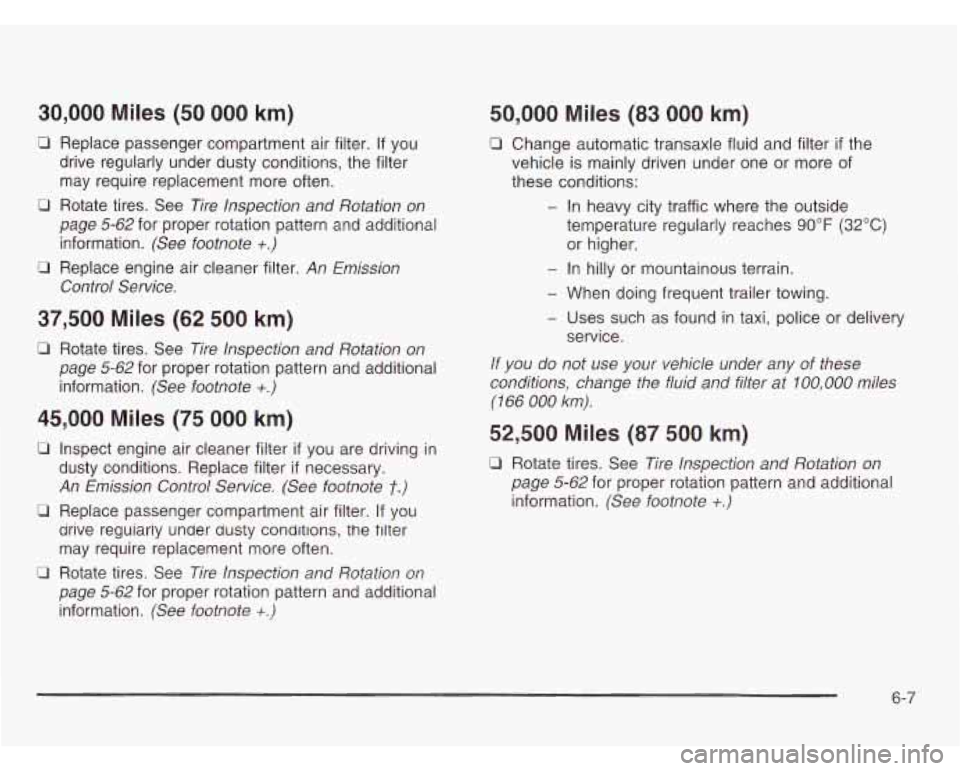
30,000 Miles (50 000 km)
0 Replace passenger compartment air filter. If you
drive regularly under dusty conditions, the filter
may require replacement more often.
0 Rotate tires. See Tire Inspection and Rotation on
page
5-62for proper rotation pattern and additional
information.
(See footnote +.)
Control Service.
0 Replace engine air cleaner filter. An Emission
37,500 Miles (62 500 km)
c3 Rotate tires. See Tire Inspection and Rotation on
page
5-62 for proper rotation pattern and additional
information.
(See footnote +.)
45,000 Miles (75 000 km)
0 Inspect engine air cleaner filter if you are driving in
dusty conditions. Replace filter if necessary.
An Emission Control Service. (See footnote t.)
50,000 Miles (83 000 km)
c1 Change automatic transaxle fluid and filter if the
vehicle is mainly driven under one or more of
these conditions:
- In heavy city traffic where the outside
temperature regularly reaches
90°F (32°C)
or higher.
- In hilly or mountainous terrain.
- When doing frequent trailer towing.
- Uses such as found in taxi, police or delivery
service.
If you do not use your vehicle under any of these
conditions, change the fluid and filter at
100,000 miles
(1 66 000 km).
52,500 Miles (87 500 km)
0 Replace passenger compartment air filter. If you
arive reguiariy unuer Uusty
conditions, the filter
may require replacement more often.
0 Rotate tires. See Tire Inspection and Rotation on
page
5-62 for proper rotation pattern and additional
information.
(See footnote +.)
0 Rotate tires. See Tire Inspection and Rotation on
page
5-62 for proper rotation pattern and additional
information.
(See footnote +.)
6-7
Page 421 of 466
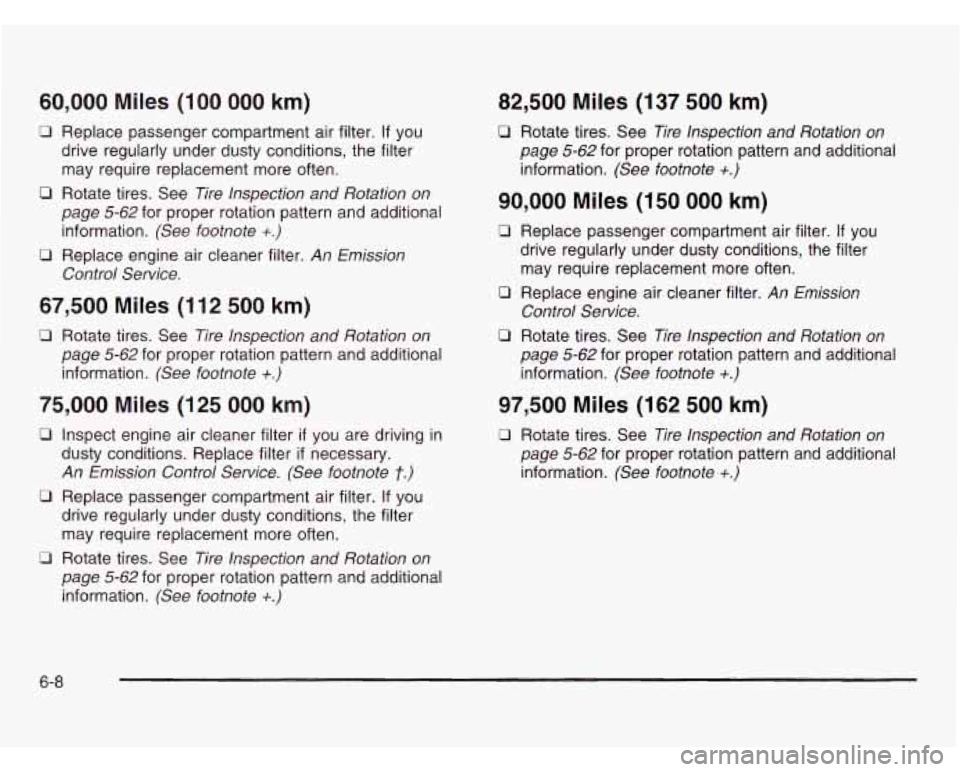
60,000 Miles (100 000 km)
0 Replace passenger compartment air filter. If you
drive regularly under dusty conditions, the filter
may require replacement more often.
0 Rotate tires. See Tire Inspection and Rotation on
page 5-62
for proper rotation pattern and additional
information.
(See footnote +.)
Control Service.
0 Replace engine air cleaner filter. An Emission
67,500 Miles (112 500 km)
0 Rotate tires. See Tire Inspection and Rotation on
page 5-62
for proper rotation pattern and additional
information.
(See footnote +.)
75,000 Miles (125 000 km)
0 Inspect engine air cleaner filter if you are driving in
dusty conditions. Replace filter if necessary.
An Emission Control Service. (See footnote t.)
0 Replace passenger compartment air filter. If you
drive regularly under dusty conditions, the filter
may require replacement more often.
0 Rotate tires. See Tire Inspection and Rotation on
page
5-62 for proper rotation pattern and additional
information.
(See footnote +.)
82,500 Miles (137 500 km)
0 Rotate tires. See Tire Inspection and Rotation on
page 5-62
for proper rotation pattern and additional
information.
(See footnote +.)
90,000 Miles (150 000 km)
0 Replace passenger compartment air filter. If you
drive regularly under dusty conditions, the filter
may require replacement more often.
Control Service.
page 5-62
for proper rotation pattern and additional
information.
(See footnote +.)
0 Replace engine air cleaner filter. An Emission
0 Rotate tires. See Tire Inspection and Rotation on
97,500 Miles (162 500 km)
0 Rotate tires. See Tire Inspection and Rotation on
page 5-62
for proper rotation pattern and additional
information.
(See footnote +.)
6-8
Page 423 of 466
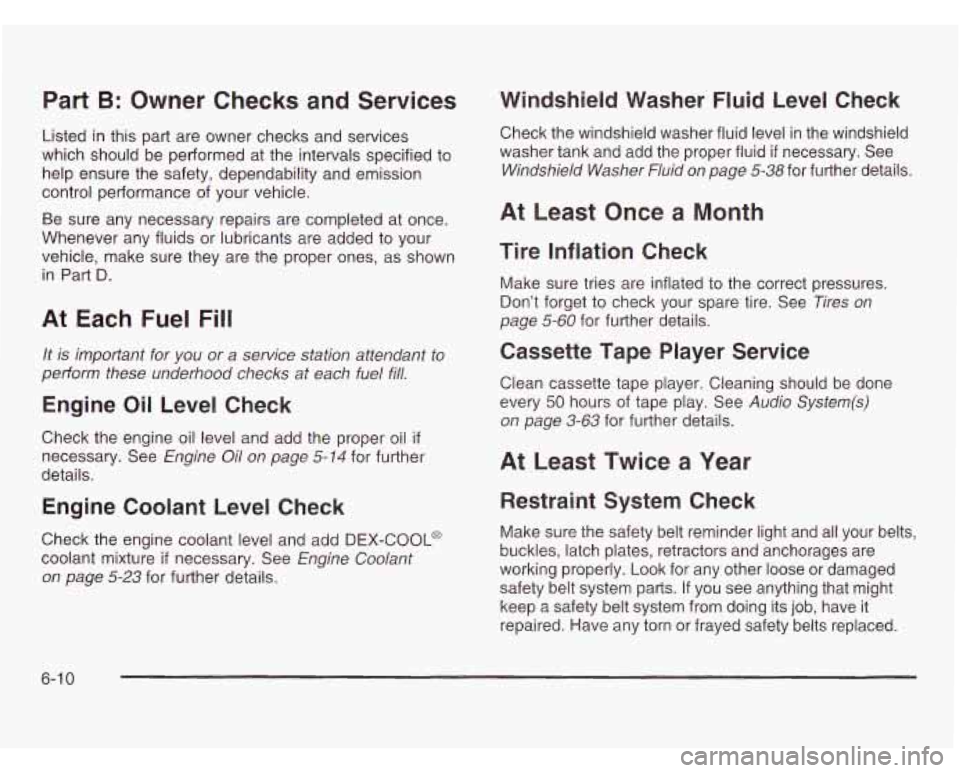
Part B: Owner Checks and Services
Listed in this part are owner checks and services
which should be performed at the intervals specified to
help ensure the safety, dependability and emission
control performance of your vehicle.
Be sure any necessary repairs are completed at once.
Whenever any fluids or lubricants are added to your
vehicle, make sure they are the proper ones, as shown
in Part D.
At Each Fuel Fill
It is important for you or a service station attendant to
perform these underhood checks at each fuel fill.
Engine Oil Level Check
Check the engine oil level and add the proper oil if
necessary. See Engine Oil on page 5-14 for further
details.
Engine Coolant Level Check
Check the engine coolant level and add DEX-COOL@
coolant mixture
if necessary. See Engine Coolant
on page 5-23
for further details.
Windshield Washer Fluid Level Check
Check the windshield washer fluid level in the windshield
washer tank and add the proper fluid
if necessary. See
Windshield Washer Fluid on page 5-38 for further details.
At Least Once a Month
Tire Inflation Check
Make sure tries are inflated to the correct pressures.
Don’t forget to check your spare tire. See
Tires on
page 5-60
for further details.
Cassette Tape Player Service
Clean cassette tape player. Cleaning should be done
every
50 hours of tape play. See Audio Systern(s)
on page 3-63 for further details.
At Least Twice a Year
Restraint System Check
:s , Make sure the safety belt reminder light and all your bell
buckles, latch plates, retractors and anchorages are
working properly. Look for any other loose or damaged
safety belt system parts.
If you see anything that might
keep a safety belt system from doing its
job, have it
repaired. Have any torn or frayed safety belts replaced.
6-1 0
Page 439 of 466
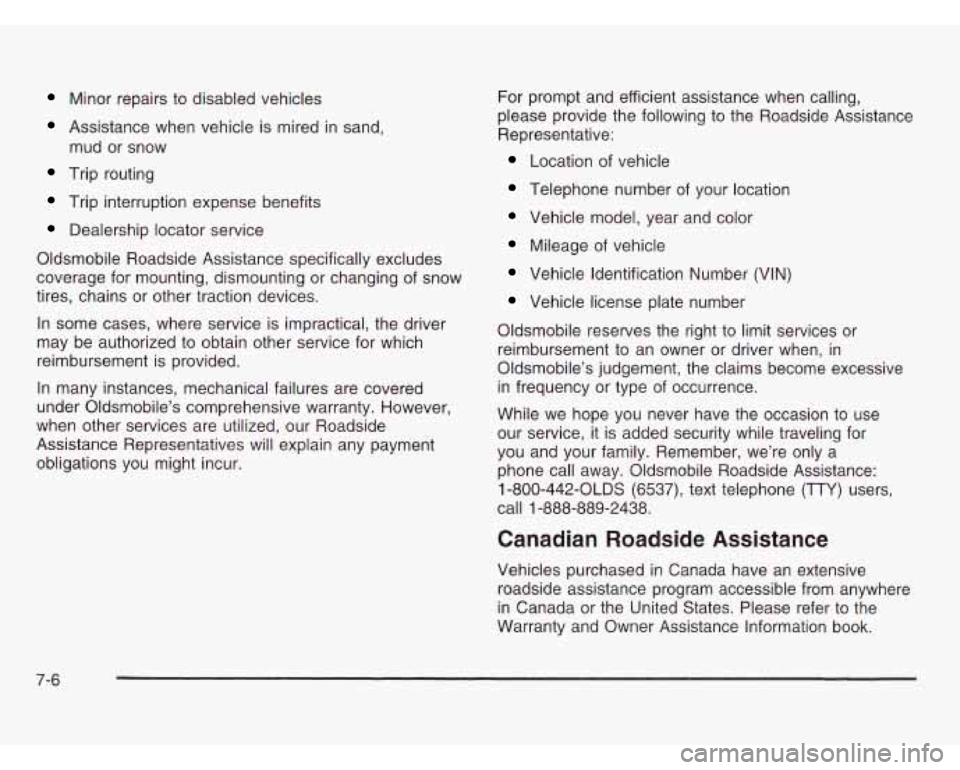
Minor repairs to disabled vehicles
Assistance when vehicle is mired in sand,
Trip routing
Trip interruption expense benefits mud
or snow
Dealership locator service
Oldsmobile Roadside Assistance specifically excludes
coverage for mounting, dismounting or changing of snow
tires, chains or other traction devices.
In some cases, where service is impractical, the driver
may be authorized to obtain other service for which
reimbursement is provided.
In many instances, mechanical failures are covered
under Oldsmobile’s comprehensive warranty. However,
when other services are utilized, our Roadside
Assistance Representatives will explain any payment
obligations you might incur. For prompt and
efficient assistance when calling,
please provide the following to the Roadside Assistance
Representative:
Location of vehicle
Telephone number of your location
Vehicle model, year and color
Mileage of vehicle
Vehicle Identification Number (VIN)
Vehicle license plate number
Oldsmobile reserves the right
to limit services or
reimbursement to an owner or driver when, in
Oldsmobile’s judgement, the claims become excessive
in frequency or type of occurrence.
While we hope you never have the occasion to use
our service, it is added security while traveling for
you and your family. Remember, we’re only a
phone call away. Oldsmobile Roadside Assistance:
1 -800-442-OLDS (6537), text telephone (TTY) users,
call 1-888-889-2438.
Canadian Roadside Assistance
Vehicles purchased in Canada have an extensive
roadside assistance program accessible from anywhere
in Canada or the United States. Please refer to the
Warranty and Owner Assistance Information book.
7-6
Page 447 of 466
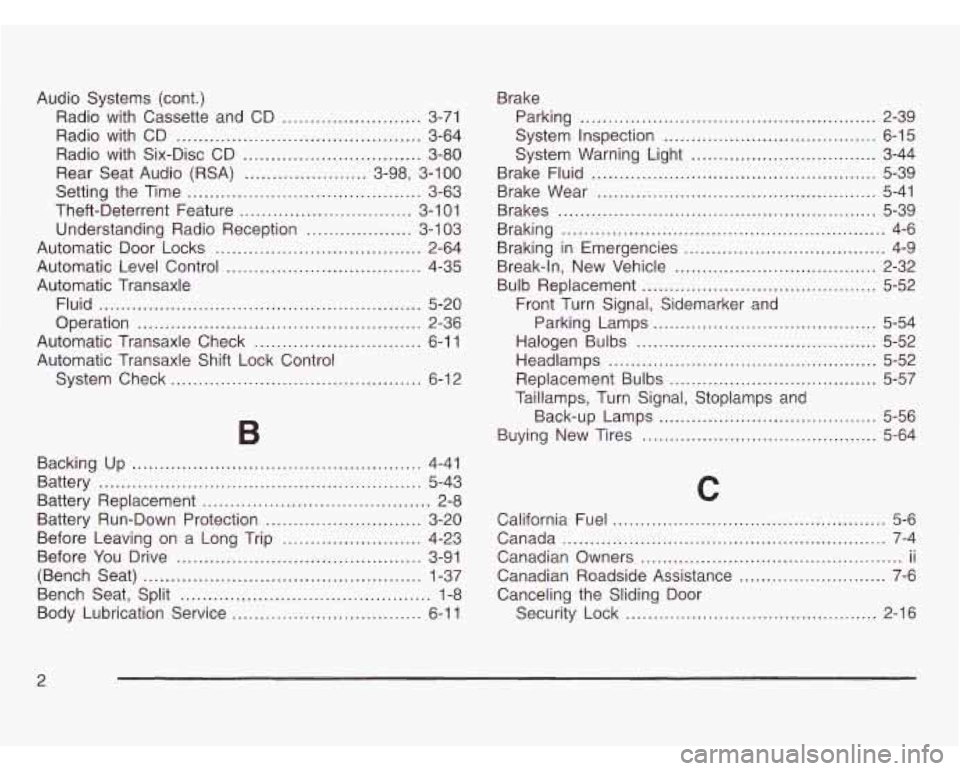
Audio Systems (cont.) Radio with Cassette and CD
......................... 3-71
Radio with CD
............................................ 3-64
Radio with Six-Disc CD
................................ 3-80
Rear Seat Audio (RSA)
...................... 3-98, 3-1 00
Setting the Time .......................................... 3-63
Theft-Deterrent Feature
............................... 3-1 01
Understanding Radio Reception
................... 3-1 03
Automatic Door Locks
..................................... 2-64
Automatic Level Control
................................... 4-35
Automatic Transaxle
Fluid
....................................................... 5-20
Automatic Transaxle Check
.............................. 6-1 1
Automatic Transaxle Shift Lock Control
System Check
................................... ... 6-12
Operation
................................................... 2-36
B
Backing
Up .................................................... 4-41
Battery
.......................................................... 5-43
Battery Replacement
......................................... 2-8
Battery Run-Down Protection
............................ 3-20
Before Leaving on a Long Trip
......................... 4-23
Before You Drive
............................................ 3-91
(Bench Seat)
.................................................. 1-37
Bench Seat, Split
............................................. 1-8
Body Lubrication Service
.................................. 6-1 1 Brake
Parking
.................................. .... 2-39
System Inspection
....................... ........ 6-15
System Warning Light
...................... .... 3-44
Brake Fluid
.................................................... 5-39
Brake Wear
................................................... 5-41
Brakes
.......................................................... 5-39
Braking
........................................................... 4-6
Braking in Emergencies
..................................... 4-9
Break-In, New Vehicle
..................................... 2-32
Bulb Replacement
........................................... 5-52
Halogen Bulbs
............................................ 5-52
Headlamps
................................................. 5-52
Front Turn Signal,
Sidemarker and
Parking Lamps
......................................... 5-54
Replacement Bulbs
...................................... 5-57
Taillamps, Turn Signal, Stoplamps and
Back-up Lamps
........................................ 5-56
Buying New Tires
........................................... 5-64
C
California Fuel .......................................... 5-6
Canada
..................................... .......... 7-4
Canadian Owners
....................... ................. II
Canadian Roadside Assistance ........................... 7-6
Canceling the Sliding Door
Security Lock
.............................................. 2-16
Page 448 of 466
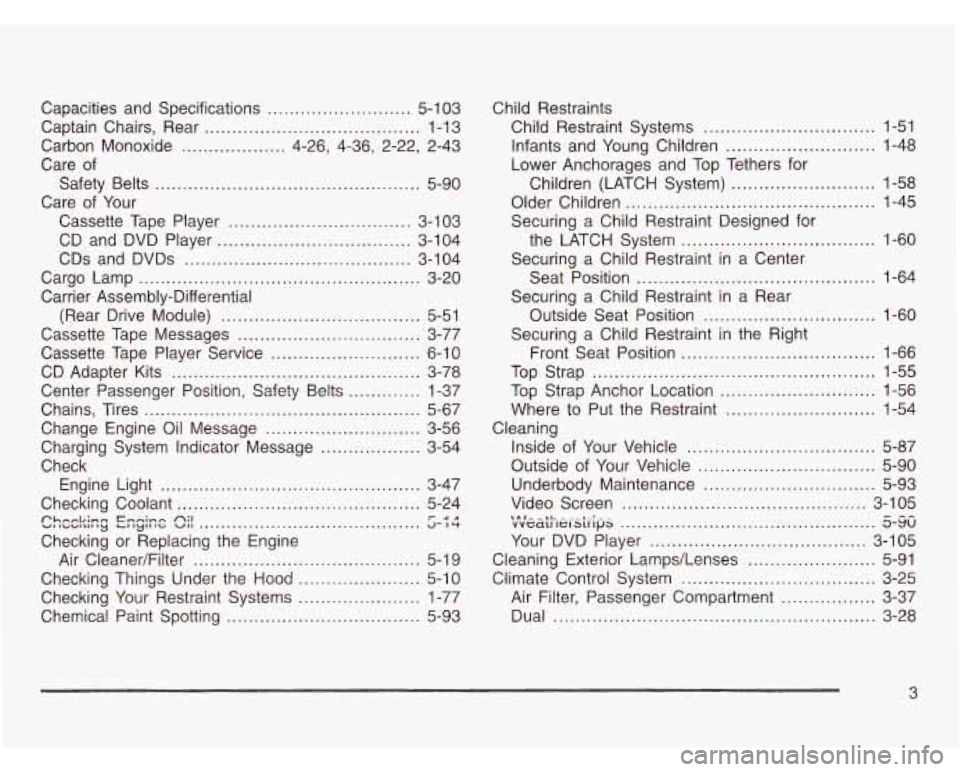
Capacities and Specifications .......................... 5-1 03
Captain Chairs. Rear
....................................... 1-13
Carbon Monoxide
................... 4-26, 4-36, 2-22, 2-43
Care of
Safety Belts
................................................ 5-90
Care of Your
Cassette Tape Player
................................. 3-103
CD and DVD Player
................................... 3-104
CDs and DVDs ......................................... 3-104
Cargo Lamp
................................................... 3-20
Carrier Assembly-Differential
(Rear Drive Module)
.................................... 5-51
Cassette Tape Messages
................................. 3-77
Cassette Tape Player Service
........................... 6-10
CD Adapter Kits
............................................. 3-78
Chains, Tires
.................................................. 5-67
Change Engine Oil Message
............................ 3-56
Charging System Indicator Message
.................. 3-54
Check
Checking Coolant
............................................ 5-24
Checking or Replacing the Engine Air CleanedFilter
......................................... 5-1 9
Checking Things Under the Hood
...................... 5-10
Center Passenger Position, Safety Belts ............. 1-37
Engine Light
............................................... 3-47
PhneLinm Enm;nn A:I VI l~ur\iIly Li lyll IG VI1 4- I y. 4A ........................................
Checking Your Restraint Systems ...................... 1-77
Chemical Paint Spotting
................................... 5-93 Child Restraints
Child Restraint Systems
............................... 1-51
Infants and Young Children
........................... 1-48
Lower Anchorages and Top Tethers for
Children (LATCH System)
.......................... 1-58
Older Children
.......................................... 1-45
Securing a Child Restraint Designed for
the LATCH System
................................ 1-60
Securing a Child Restraint in a Center
Seat Position
........................................... 1-64
Securing a Child Restraint in a Rear
Outside Seat Position
............................... 1-60
Securing a Child Restraint in the Right
Front Seat Position
................................... 1-66
Top Strap
................................................... 1-55
Where to Put the Restraint
........................... 1-54
Inside of Your Vehicle
.................................. 5-87
Outside of Your Vehicle
................................ 5-90
Underbody Maintenance
............................... 5-93
Video Screen
............................................ 3-105
VVedll IelsLI Ips 5-YU
Your DVD Player ....................................... 3-105
Cleaning Exterior LampsILenses
....................... 5-91
Air Filter, Passenger Compartment
................. 3-37
Dual
.......................................................... 3-28
-I--- iup S+m clap Anchor L~atio~~ 1-56 ............................
Cleaning
I A r- -11- - .._I .. I .. 1- ..............................................
Climate Control System ................................... 3-25
3