wiper fluid OLDSMOBILE SILHOUETTE 2003 Owners Manual
[x] Cancel search | Manufacturer: OLDSMOBILE, Model Year: 2003, Model line: SILHOUETTE, Model: OLDSMOBILE SILHOUETTE 2003Pages: 466, PDF Size: 21.55 MB
Page 166 of 466
Flash-to-Pass
When the headlamps are off, pull the lever toward you
to momentarily switch on the high beams (to signal
that you are going to pass). When you release the lever,
they will turn
off.
Windshield Wipers
To operate the windshield wipers turn the band marked
WIPER, located on the multifunction lever.
MIST: Turn the band to MIST for a single wiping cycle.
Hold it there until the wipers start. Then let
go. The
wipers will stop after one wipe.
If you want more wipes,
hold the band on mist longer.
OFF: Turn the band to
OFF to turn off the
windshield wipers.
LOW: Turn the band to LOW, for steady wiping at
low speed.
HIGH: Turn the band to HIGH, for steady wiping at
high speed.
DELAY: Turn the band away from you to one of the
five sensitivity settings between
OFF and LOW, to
choose the delayed wiping cycle. The further the band
is turned toward LOW, the shorter the delay will be.
Use this setting tor light rain or snow. Remember that damaged
wiper blades may prevent you
from seeing well enough to drive safely. To avoid
damage, be sure to clear ice and snow from the wiper
blades before using them.
If they’re frozen to the
windshield, carefully loosen or thaw them. If your blades
do become damaged, get new blades or blade inserts.
Heavy snow or ice can overload your wipers.
A circuit
breaker will stop them until the motor cools. Clear away
snow or ice to prevent an overload.
Windshield Washer
To wash your windshield, press and hold the windshield
washer paddle. The washers and wipers will operate.
When you release the paddle, the washers will stop, and
the wipers will continue
to operate for two cycles, unless
your wipers had already been on. In that case, the wipers
will resume the wi--
- r speed you had selected earlier.
I I
In freezing weather, don’t use your washer
until the windshield is warmed. Otherwise the
washer fluid can form ice on the windshield,
blocking your vision.
3-9
Page 167 of 466
Rear Window WasherNViper
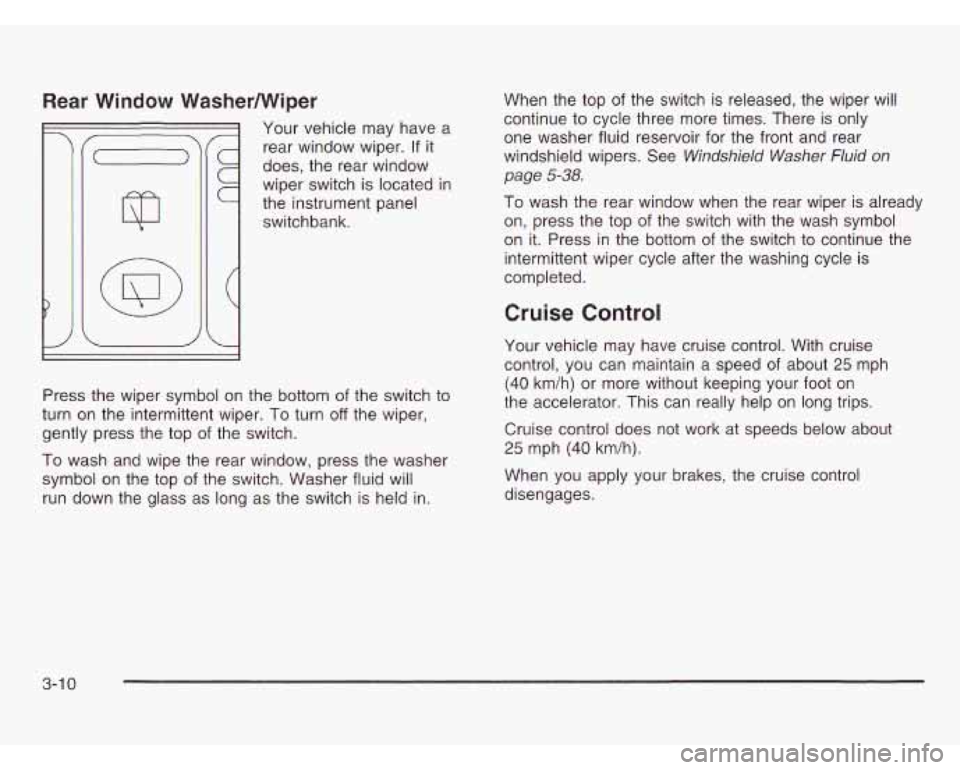
Your vehicle may have a
rear window wiper. If it
does, the rear window
wiper switch is located
in
the instrument panel
switchbank.
i
1
Press the wiper symbol on the bottom of the switch to
turn on the intermittent wiper.
To turn off the wiper,
gently press the top of the switch.
To wash and wipe the rear window, press the washer
symbol on the top of the switch. Washer fluid will
run down the glass as long as the switch is held in. When
the top
of the switch is released, the wiper will
continue to cycle three more times. There is only
one washer fluid reservoir for the front and rear
windshield wipers. See
Windshield Washer Fluid on
page
5-38.
To wash the rear window when the rear wiper is already
on, press the top
of the switch with the wash symbol
on it. Press in the bottom of the switch to continue the
intermittent wiper cycle after the washing cycle is
completed.
Cruise Control
Your vehicle may have cruise control. With cruise
control, you can maintain a speed of about
25 mph
(40 km/h) or more without keeping your foot on
the accelerator. This can really help on long trips.
Cruise control does not work at speeds below about
25 mph (40 km/h).
When you apply your brakes, the cruise control
disengages.
3-1 0
Page 282 of 466
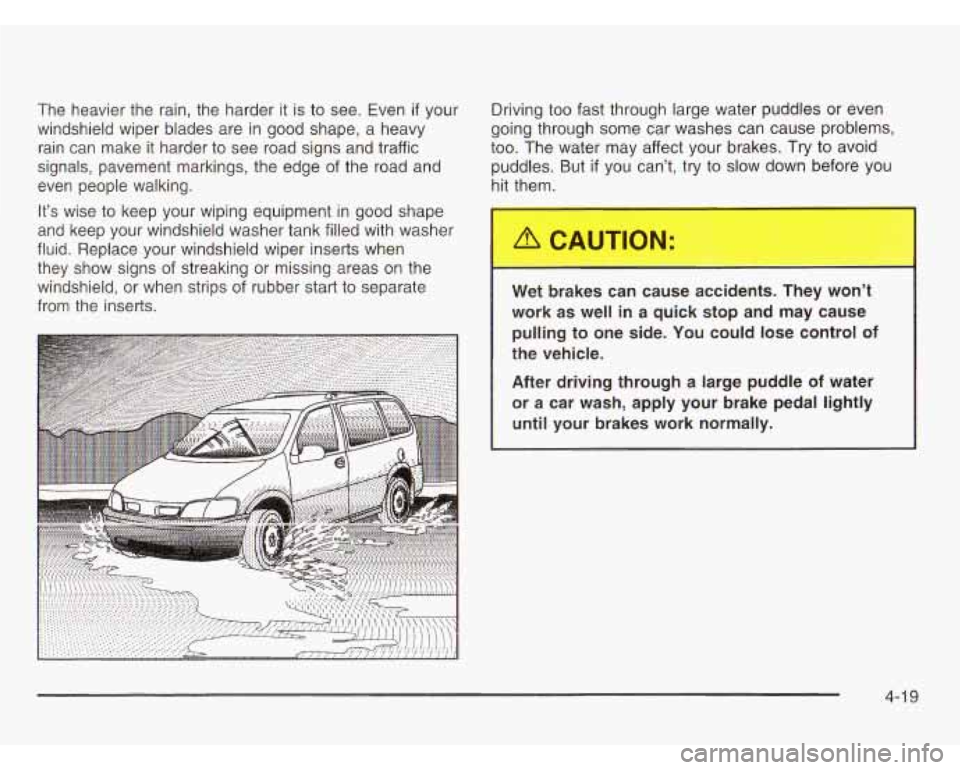
The heavier the rain, the harder it is to see. Even if your
windshield wiper blades are in good shape, a heavy
rain can make it harder to see road signs and traffic
signals, pavement markings, the edge
of the road and
even people walking.
It’s wise to keep your wiping equipment in good shape
and keep your windshield washer tank filled with washer
fluid. Replace your windshield wiper inserts when
they show signs of streaking or missing areas on the
windshield, or when strips of rubber start to separate
from the inserts. Driving too fast through large
water puddles or even
going through some car washes can cause problems,
too. The water may affect your brakes. Try to avoid
puddles. But if you can’t, try to slow down before you
hit them.
Wet brakes can cause accidents. They won’t
work as well
in a quick stop and may cause
pulling to one side. You could lose control of
the vehicle.
After driving through a large puddle of water
or a car wash, apply your brake pedal lightly
until your brakes work normally.
4-1 9
Page 286 of 466
When you want to leave the freeway, move to the
proper lane well in advance.
If you miss your exit,
do not, under any circumstances, stop and back up.
Drive on to the next exit.
The exit ramp can be curved, sometimes quite sharply.
The exit speed is usually posted.
Reduce your speed according to your speedometer, not
to your sense of motion. After driving for any distance
at higher speeds, you may tend to think you are
going slower than you actually are.
Before Leaving on a Long Trip
Make sure you’re ready. Try to be well rested. If you
must start when you’re not fresh
- such as after a day’s
work
- don’t plan to make too many miles that first
part of the journey. Wear comfortable clothing and shoes
you can easily drive in.
Is your vehicle ready for a long trip? If you keep it
serviced and maintained, it’s ready to go. If it needs
you’ll find experienced and able service experts in
dealerships all across North America. They’ll be ready
and willing to help
if you need it.
ser?l!ce, !?%.le It dene befere st2fiinCJ e$. Qf cwrse,
Here are some things you can check before a trip:
e
e
e
e
e
e
e
Windshield Washer Nuid: Is the reservior full?
Are all windows clean inside and outside?
Wiper Blades: Are they in good shape?
Fuel, Engine Oil, Other Fluids: Have you checkea
all levels?
Lamps: Are they all working? Are the lenses clean?
Tires: They are vitally important to a safe,
trouble-free trip.
Is the tread good enough for
long-distance driving? Are the tires all inflated
to the recommended pressure?
Weather Forecasts: What’s the weather outlook
along your route? Should you delay your trip a
short time to avoid a major storm system?
Maps: Do you have up-to-date maps?
4-23
Page 308 of 466
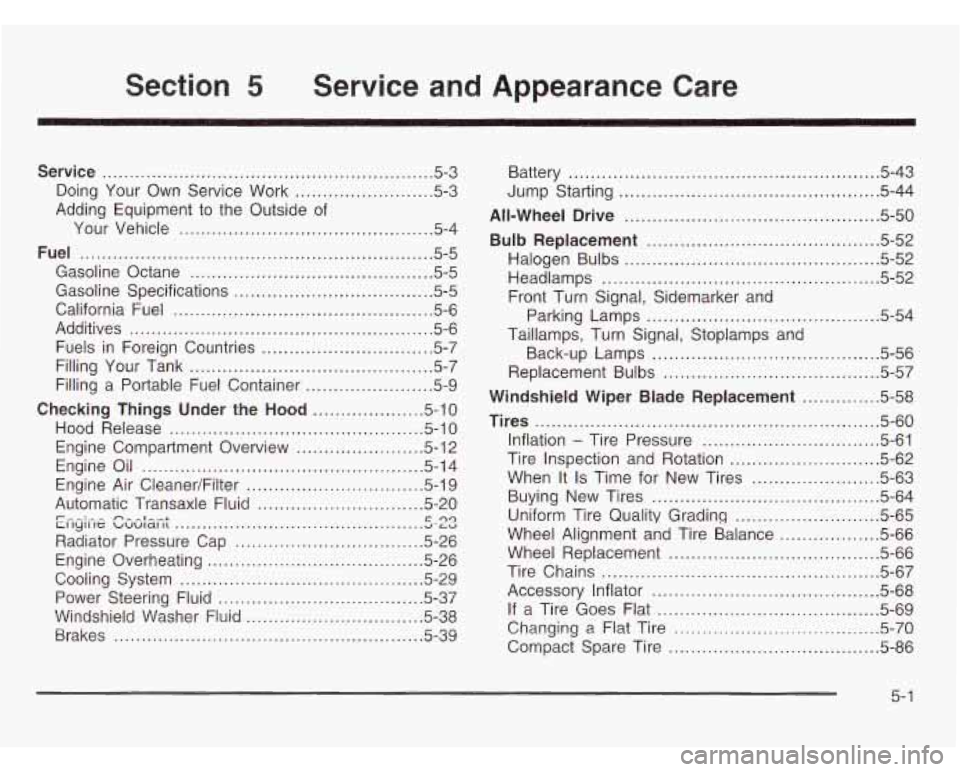
Section 5 Service and Appearance Care
Service ............................................................ 5.3
Doing Your Own Service Work
......................... 5.3
Adding Equipment to the Outside
of
Your Vehicle .............................................. 5-4
Fuel
.............................................................. -5-5
Gasoline Octane
............................................ 5-5
Gasoline Specifications
................................... 5-5
California Fuel
............................................... 5-6
Additives
....................... .... ......... 5-6
Fuels in Foreign Countries
........... ..... 5-7
Filling Your Tank
............................ ..... 5-7
Filling a Portable Fuel Container
.................... 5-9
Checking Things Under the
Hood .................. -5-1 0
Hood Release .............................................. 5-10
Engine Compartment Overview ....................... 5-12
Engine Oil
................................................... 5-14
Engine Air CleanedFilter
................................ 5-19
Automatic Transaxle Fluid
.............................. 5-20
Radiator Pressure Cap
............................... 5-26
Engine Overheating
.................................... 5-26
Cooling System
............................. , ....... 5-29
Power Steering Fluid .................. , ....... 5-37
Windshield Washer Fluid
................. , ....... 5-38
Brakes
.......................... .... ........ 5-39
r.--.:.-- ---I-.- b CI lyll IC uuvlal I1 4-LU c r)r) .............................................
Battery ........................................................ 5.43
Jump Starting
............................................... 5-44
All-Wheel Drive
.............................................. 5-50
Bulb Replacement .......................................... 5-52
Halogen Bulbs
.............................. ......... 5-52
Front Turn Signal, Sidemarker and
Taillamps, Turn Signal, Stoplamps and
Headlamps
...................................... ..... 5-52
Parking Lamps
.............................. ..... 5-54
Replacement Bulbs
....................................... 5-57
Back-up Lamps
......................................... 5-56
Windshield Wiper Blade Replacement
.............. 5-58
Tires
.............................................................. 5-60
Inflation
- Tire Pressure ................................ 5-61
Tire Inspection and Rotation
........................... 5-62
When It
Is Time for New Tires ....................... 5-63
Buying New Tires
......................................... 5-64
Uniform Tire Quality Grading
.......................... 5-65
Wheel Alignment and Tire Balance
.................. 5-66
Wheel Replacement
...................................... 5-66
Tire Chains
.................................................. 5-67
Accessory Inflator
......................................... 5-68
If a Tire Goes Flat ........................................ 5-69
Changing a Flat Tire ..................................... 5-70
Compact Spare Tire ...................................... 5-86
5- 1
Page 424 of 466
Also look for any opened or broken air bag coverings,
and have them repaired or replaced. (The air bag
system does not need regular maintenance.)
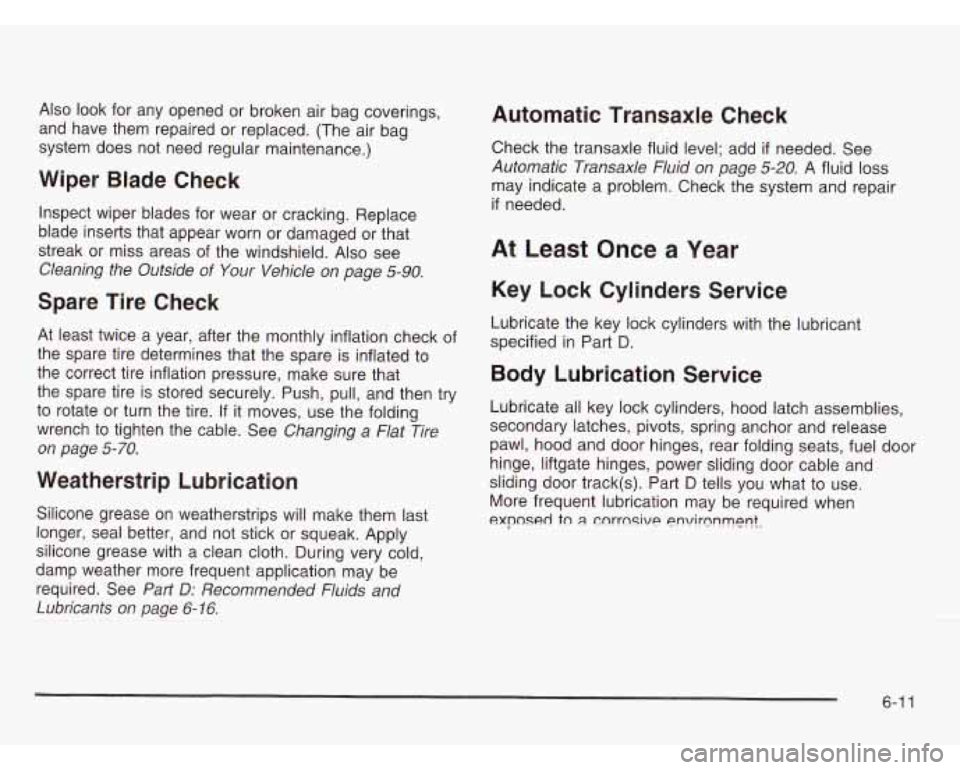
Wiper Blade Check
Inspect wiper blades for wear or cracking. Replace
blade inserts that appear worn or damaged
or that
streak or miss areas of the windshield. Also see
Cleaning the Outside of Your Vehicle on page 5-90.
Spare Tire Check
At least twice a year, after the monthly inflation check of
the spare tire determines that the spare is inflated to
the correct tire inflation pressure, make sure that
the spare tire is stored securely. Push, pull, and then try
to rotate or turn the tire.
If it moves, use the folding
wrench to tighten the cable. See
Changing a Flat Tire
on page
5-70.
Weatherstrip Lubrication
Silicone grease on weatherstrips will make them last
longer, seal better, and not stick or squeak. Apply
silicone grease with a clean cloth. During very cold,
damp weather more frequent application may be
required. See
Part D: Recommended Fluids and
Lubricants on page
6-16.
Automatic Transaxle Check
Check the transaxle fluid level; add if needed. See
Automatic Transaxle Fluid on page 5-20. A fluid loss
may indicate a problem. Check the system and repair
if needed.
At Least Once a Year
Key Lock Cylinders Service
Lubricate the key lock cylinders with the lubricant
specified
in Part D.
Body Lubrication Service
Lubricate all key lock cylinders, hood latch assemblies,
secondary latches, pivots, spring anchor and release
pawl, hood and door hinges, rear folding seats, fuel door
hinge, liftgate hinges, power sliding door cable and
sliding door track(s). Part
D tells you what to use.
More frequent lubrication may be required when
exnosed tn ;I cnrrnsive enyirnnm~nf.
6-1 1
Page 452 of 466
Fuel (cont.) Filling a Portable Fuel Container
..................... 5-9
Filling Your Tank
........................................... 5-7
Fuels in Foreign Countries
.............................. 5-7
Gage ......................................................... 3-51
Gasoline Octane
........................................... 5-5
Gasoline Specifications .................................. 5-5
System Inspection ....................................... 6-1 4
Fuses and Circuit Breakers
........................... 5-96
Windshield Wiper
......................................... 5-96
Low Warning Message
................................. 3-59
Fuses
G
Gage Engine Coolant Temperature
......................... 3-47
Fuel
.......................................................... 3-51
Speedometer
.............................................. 3-41
Garage Door Opener
....................................... 2-49
Gasoline Octane
........................................................ 5-5
Specifications ............................................... 5-5
Gate Operator and Canadian Programming ........ 2-52
Glass Surfaces
............................................... 5-89
Glove
Box ..................................................... 2-54
GM Mobility Program for Persons with
Disab!!!t!es 7-5 .. E ....................................................
Hatch Ajar Warning Message ............................ 3-58
Hazard Warning Flashers
................................... 3-6
Head Restraints
............................................... 1-6
Headlamp Wiring
............................................ 5-96
Headlamps
.................................................... 5-52
Bulb Replacement ....................................... 5-52
Front Turn Signal, Sidemarker and
Parking Lamps
......................................... 5-54
Halogen Bulbs
............................................ 5-52
Heated Seats
................................................... 1-4
Highway Hypnosis
........................................... 4-24
Hill and Mountain Roads
.................................. 4-24
Hitches
.............................................. ..... 4-39
HomeLink Transmitter, Programming
.............. 2-50
HomeLink@ Transmitter ................................ 2-49
Hood
Checking Things Under
................................ 5-10
Release ..................................................... 5-10
Horn
............................................................... 3-7
iiuw tile Sysierrl Yiurks ................................... 3-za ^^
How to Add Coolant to the Coolant
Recovery Tank
............................................ 5-31
How to Add Coolant to the Radiator
.................. 5-34
How to Add Fluid
............................................ 5-22
How
to Check ........................................ 5-20, 5-61
Headphones
................................................... 3-92
How
to Check Power Steering Fluid .................. 5-38
7
Page 463 of 466
When to Check and Change ............................ 5-20
When to Check Power Steering Fluid
................ 5-38
When You Are Ready to Leave After Parking
on a Hill
..................................................... 4-43
Where to Put the Restraint
............................... 1-54
Why Safety Belts Work .................................... 1-23
Windshield, Backglass and Wiper Blades
........... 5-91
Windows ....................................................... 2-24
Power
........................................................ 2-25
Power Rear Quarter
..................................... 2-26
Windshield Washer
........................................... 3-9
Fluid
.......................................................... 5-38 Windshield
Washer Fluid Level Check
............ 6-10
Windshield Wiper
Blade Replacement
.................. ........ 5-58
Fuses
........................................................ 5-96
Windshield Wipers
............................................ 3-9
Winter Driving
................................................ 4-26
Wiper Blade Check
..................... ............ 6-11
Weight of the Trailer
........................................ 4-38
Your Vehicle and the Environment
....................... 6-2
18