oil temperature OPEL 1900 1973 User Guide
[x] Cancel search | Manufacturer: OPEL, Model Year: 1973, Model line: 1900, Model: OPEL 1900 1973Pages: 625, PDF Size: 17.22 MB
Page 297 of 625
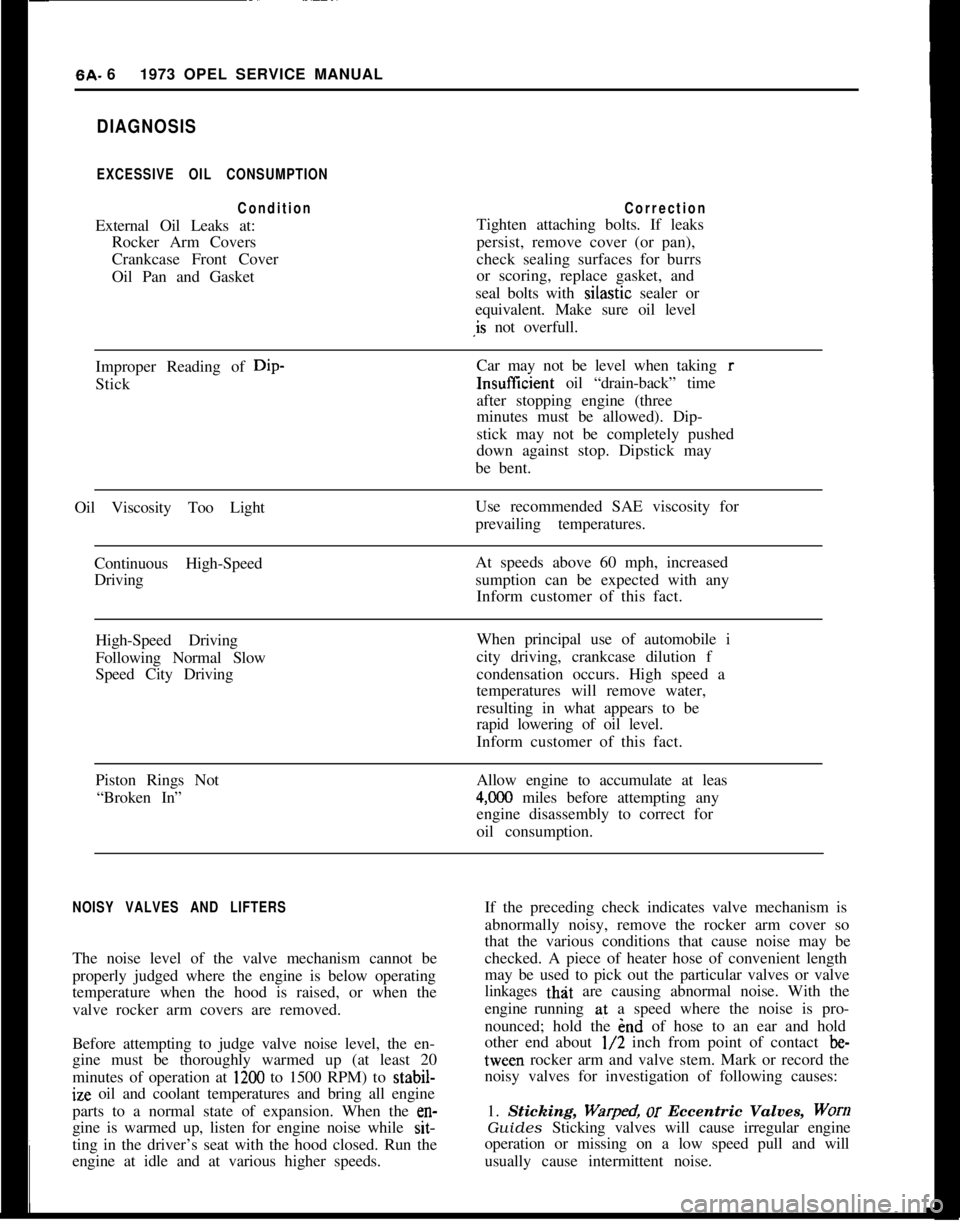
6A. 61973 OPEL SERVICE MANUALDIAGNOSIS
EXCESSIVE OIL CONSUMPTION
ConditionCorrectionExternal Oil Leaks at:Tighten attaching bolts. If leaks
Rocker Arm Coverspersist, remove cover (or pan),
Crankcase Front Covercheck sealing surfaces for burrs
Oil Pan and Gasketor scoring, replace gasket, and
seal bolts with silastic sealer or
equivalent. Make sure oil level
,is not overfull.
Improper Reading of Dip-Car may not be level when taking r
StickInsuffIcient oil “drain-back” time
after stopping engine (three
minutes must be allowed). Dip-
stick may not be completely pushed
down against stop. Dipstick may
be bent.
Oil Viscosity Too LightUse recommended SAE viscosity for
prevailing temperatures.
Continuous High-SpeedAt speeds above 60 mph, increased
Drivingsumption can be expected with any
Inform customer of this fact.
High-Speed DrivingWhen principal use of automobile i
Following Normal Slowcity driving, crankcase dilution f
Speed City Drivingcondensation occurs. High speed a
temperatures will remove water,
resulting in what appears to be
rapid lowering of oil level.
Inform customer of this fact.
Piston Rings NotAllow engine to accumulate at leas
“Broken In”
4,OCO miles before attempting any
engine disassembly to correct for
oil consumption.
NOISY VALVES AND LIFTERSIf the preceding check indicates valve mechanism is
abnormally noisy, remove the rocker arm cover so
that the various conditions that cause noise may be
The noise level of the valve mechanism cannot bechecked. A piece of heater hose of convenient length
properly judged where the engine is below operatingmay be used to pick out the particular valves or valve
temperature when the hood is raised, or when thelinkages
thit are causing abnormal noise. With the
valve rocker arm covers are removed.engine running at a speed where the noise is pro-
nounced; hold the end of hose to an ear and hold
Before attempting to judge valve noise level, the en-other end about
l/2 inch from point of contact be-
gine must be thoroughly warmed up (at least 20tween rocker arm and valve stem. Mark or record the
minutes of operation at
1200 to 1500 RPM) to stabil-noisy valves for investigation of following causes:ize oil and coolant temperatures and bring all engine
parts to a normal state of expansion. When the
en-1. Sticking, Warped, or Eccentric Valves, Worngine is warmed up, listen for engine noise while
sit-Guides Sticking valves will cause irregular engine
ting in the driver’s seat with the hood closed. Run theoperation or missing on a low speed pull and will
engine at idle and at various higher speeds.usually cause intermittent noise.
Page 298 of 625
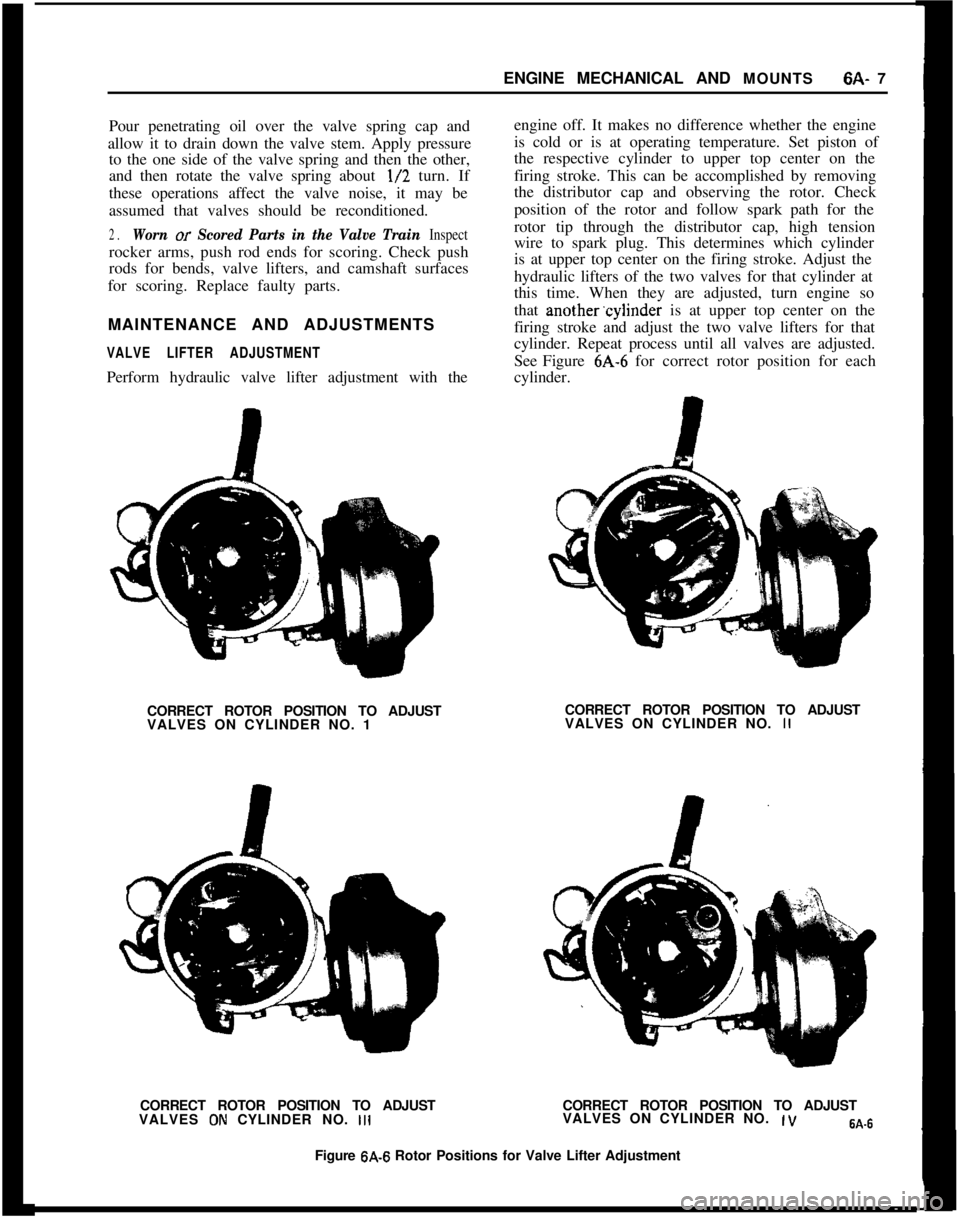
ENGINE MECHANICAL AND MOUNTS6A- 7
Pour penetrating oil over the valve spring cap andengine off. It makes no difference whether the engine
allow it to drain down the valve stem. Apply pressureis cold or is at operating temperature. Set piston of
to the one side of the valve spring and then the other,the respective cylinder to upper top center on the
and then rotate the valve spring about l/2 turn. Iffiring stroke. This can be accomplished by removing
these operations affect the valve noise, it may bethe distributor cap and observing the rotor. Check
assumed that valves should be reconditioned.position of the rotor and follow spark path for the
2.Worn or Scored Parts in the Valve Train Inspectrotor tip through the distributor cap, high tension
rocker arms, push rod ends for scoring. Check pushwire to spark plug. This determines which cylinder
rods for bends, valve lifters, and camshaft surfacesis at upper top center on the firing stroke. Adjust the
for scoring. Replace faulty parts.hydraulic lifters of the two valves for that cylinder at
this time. When they are adjusted, turn engine so
MAINTENANCE AND ADJUSTMENTSthat another.cylinder is at upper top center on the
firing stroke and adjust the two valve lifters for that
VALVE LIFTER ADJUSTMENTcylinder. Repeat process until all valves are adjusted.
See Figure 6A-6 for correct rotor position for each
Perform hydraulic valve lifter adjustment with thecylinder.
CORRECT ROTOR POSITION TO ADJUSTCORRECT ROTOR POSITION TO ADJUST
VALVES ON CYLINDER NO. 1VALVES ON CYLINDER NO. II
CORRECT ROTOR POSITION TO ADJUSTCORRECT ROTOR POSITION TO ADJUST
VALVES
ON CYLINDER NO. IllVALVES ON CYLINDER NO. ,VW-6Figure
6A-6 Rotor Positions for Valve Lifter Adjustment
Page 312 of 625

ENGINE MECHANICAL AND MOUNTS6A- 21
2.. Expand a telescope gage to fit the cylinder bore at
right angles to the piston pin 2-l/2” from top. See
Figure 6A-33.cylinders, the glazed cylinder walls should be slightly
dulled without increasing the bore diameter by
means of the finest grade honing stones.
TELESCOPE GAUGE1
Figure 6A-33 Checking Cylinder Bores
TELESCOPE/GAUGE
MICROMETER
Figure
6A-34 Measuring Telescope Gage3. Measure the piston to be installed. See Figure6A-32. The piston must be measured at right angles
to the piston pin
2-l/2” below the top of piston. The
piston must be between
.C008” and .0012” smaller
than the cylinder bore.
Both block and piston must be at approximately the
same temperature when measurements are made or
expansion errors will occur. A
dif.ference of 10 de-
grees F between parts is sufficient to produce a varia-
tion of .0005”.
Fitting New Piston RingsWhen new piston rings are installed without reboringNew piston rings must be checked for clearance in
piston grooves and for gap in cylinder bores; how-
ever, the flexible oil rings are not checked for gap.
The cylinder bores and piston grooves must be clean,
dry, and free of carbon and burrs.
To check the end gap of compression rings, place the
ring in the cylinder in which it will be used and
square it in the bore by tapping with the lower end
of a piston. Measure the gap with feeler gages.
Piston ring end gap should be
,014” - ,022” (top) and
,014” - ,022” (2nd) and the oil ring end gap should
be
.015” - ,055”.
If gap is less than specified, file the ends of rings
carefully with a smooth tile to obtain proper gap.
Install piston rings as follows:
1. Upper ring is chrome plated and can be installed
either way up. Number two (2) ring has to be in-
stalled with the marking “top” up. Oil ring can be
installed either way
up. See Figure 6A-35.
1. PISTON
2. NO.
I COMPRESSION RING - INSTALLED
WITH EITHER SIDE UP.
3. NO. 2 COMPRESSION RING - INSTALLED
WITH “TOP” MARKING TOWARDS THE TOP.
4. UPPER AND LOWER STEEL BAND RING
-
INSTALLED WITH EITHER SIDE UP.5. INTERMEDIATED RING
- INSTALLED WITH
EITHER SIDE UP.
6A-35
Figure 6A.35 Arrangement of Piston Rings2. Install piston rings so gaps are positioned as shown
in Figure 6A-36.
Page 320 of 625
ENGINE MECHANICAL AND MOUNTS6A- 29
Cooling System - Type ,._...___..___..___........................... Liquid Cooling With Circulating Pump
Filler Cap Type
- Pressure _,._.,,._.,,...,,.........,..,.....,.,.................,,......................... 13.2-15.2 PSI
Water Temperature Control
._,..__,,._.,,__.,,...,.,.,,.,,.,,.,...............,,...,,,... Thermostat and Bypass
Thermostat Open At
._,,.,,.......,__.,.........,,...,...,,..,.,,.,,...................................................... 189 F.
Cooling System Capacity
. . . . . . . . . . . . .._...__..............,,.,,.,,..,...................................,,................6 Qts.
Fan Drive
.,,...,,,....,,.,..,..,,........,..,,..,,,.............,..,,.,..,,.................,,............... Water Pump Shaft
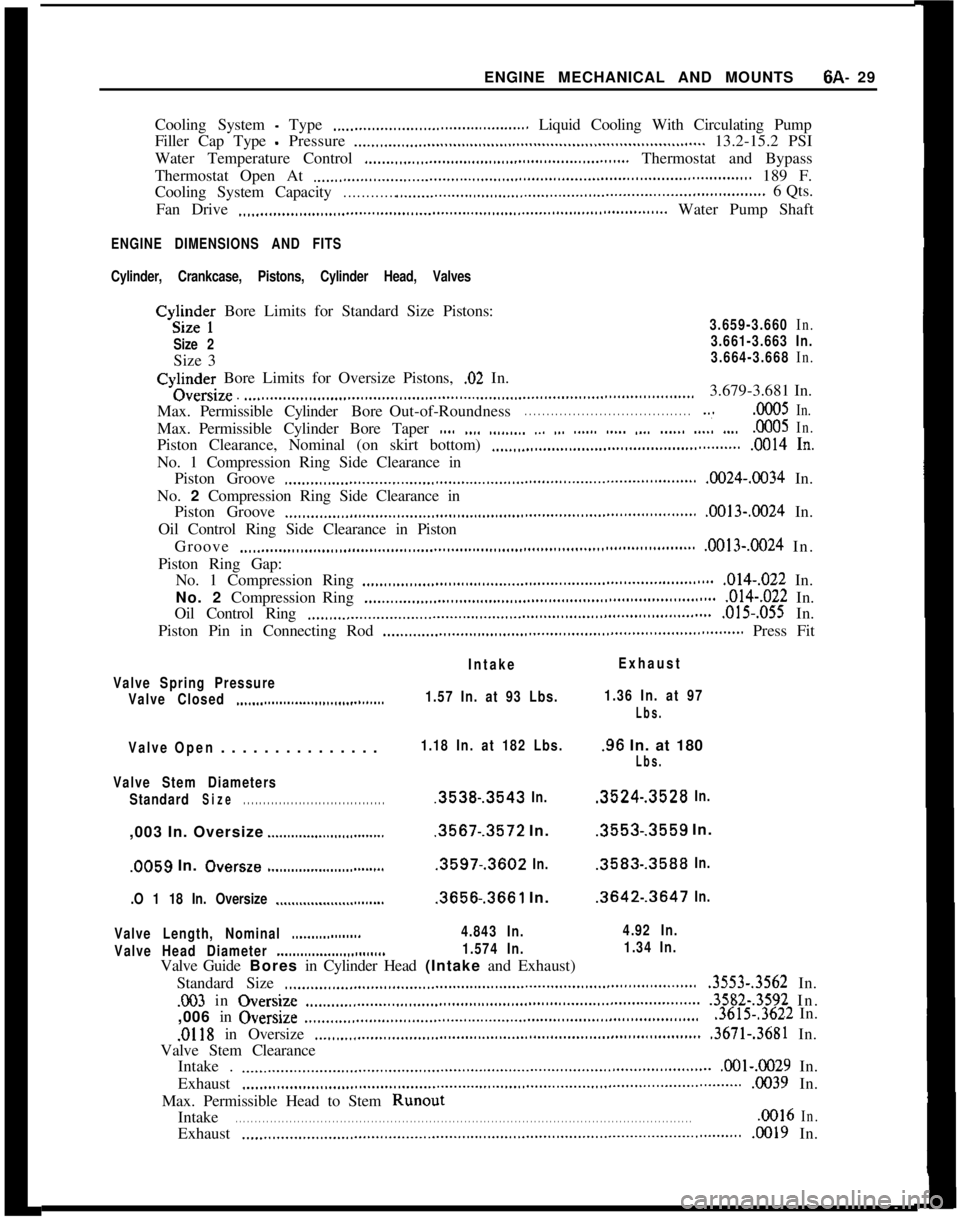
ENGINE DIMENSIONS AND FITS
Cylinder, Crankcase, Pistons, Cylinder Head, Valves
Cyg;te; Bore Limits for Standard Size Pistons:3.659-3.660 In.
Size 23.661-3.663 In.Size 3
3.664-3.668 In.Cylindey Bore Limits for Oversize Pistons,
.02 In.Oversm
. .._............,..,,...,................................,,.,,.,,.........................................3.679-3.681 In.
Max.PermissibleCylinderBoreOut-of-Roundness
. . . . . . . . . . . . . . . . . . . . . . . . . . . . . . . . . . . . . . ..~.OOO5In.Max.Permissible Cylinder Bore Taper
,.., ,.,, ,.,._,__. ,_, ,.. .__... ..__. ,__. .____. ..__. .._..0005In.Piston Clearance, Nominal (on skirt bottom)
_..__,,_.,.___.__.._...........,.......................... .0014 In.No. 1 Compression Ring Side Clearance in
Piston Groove
,...,,,.,,,.,,...,__..........,,..,,...,,...,..,.,,.,,..,,..,,..,,..................,,,..,,,..., .0024-.0034 In.
No. 2 Compression Ring Side Clearance in
Piston Groove
_..,,..,,,..,,..,,..,,....,.......,...,,,.,.,,,..,..,..,,..,,..,,,..,,,.,,,..,,,...,,,..,,,,..., .0013-.OO24 In.
Oil Control Ring Side Clearance in Piston
Groove
__..__..._..,,,..,...,,,..,....,..,,..,.........,..,,...,,.,,.,,..,..,,..,,...,,...,,,..,,,..,,,...,,..... .0013-X024 In.
Piston Ring Gap:
No. 1 Compression Ring
..,,.,,,..,,,..,,..,,,.,,.,,,..,......,,.,..............,......................... .014-,022 In.
No. 2 Compression Ring
_..___..__.,,..,,..,,,..,.,,,..,,.,,....................,......................... .014-,022 In.
Oil Control Ring
,...,,...,___.___.._..................,,,..,..,,..,,.,,,..,,,.,,..,,,..,,,...,,,,..,,,...,.... ,015.,055 In.
Piston Pin in Connecting Rod
..____.___..._,,__.,,,,,..,,.,,..,.................,,............................... Press Fit
IntakeExhaust
Valve Spring Pressure
Valve Closed
_______........___..,,,,,,............1.57 In. at 93 Lbs.1.36 In. at 97
Lbs.
ValveOpen. . . . . . . . . . . . . . .1.18 In. at 182 Lbs..96 In. at 180
Lbs.
Valve Stem Diameters
Standard
Size. . . . . . . . . . . . . . . . . . . . . . . . . . . . . . . . . . . ..3538-.3543 In..3524-.3528 In.,003 In. Oversize
____.....__.._..,,,,,,.........3567-.3572 In..3553-.3559 In..0059 In.
Oversze .__......_______...............3597-.3602 In..3583-.3588 In.
.O 1 18 In. Oversize
_._...._._____...............3656-.3661 In..3642-.3647 In.
Valve Length, Nominal
..___.............4.843 In.4.92 In.
Valve Head Diameter
___.......____...,,,........1.574 In.1.34 In.Valve Guide Bores in Cylinder Head (Intake and Exhaust)
Standard Size
,,...,,...,,..,,..,,,..,,....................................,..,,...,,.,,,,..,,,,..,,...,,,,.., .3553-.3562 In.003 in Oversjze
.,..__,,._.,__..___....,,...,,..,,...,,,,,,.,,.,,..,................,.....,................. .3582-.3592 In.
,006 in Overslze
..,...,,..,,.......................................,.........................................3615-.3622 In.
.0118 in Oversize ,._.,,..,............,,...,,........................................,,.................... .3671-.3681 In.
Valve Stem Clearance
Intake .
.._........___..___.....,............,...,,..........................................,,...................... .OOl-.0029 In.
Exhaust
._.,,........,,...,,..,,...........,,...,................,..,,..,,................,,.....,.,........................ 0039 In.
Max. Permissible Head to Stem Runout
Intake
. . . . . . . . . . . . . . . . . . . . . . . . . . . . . . . . . . . . . . . . . . . . . . . . . . . . . . . . . . . . . . . . . . . . . . . . . . . . . . . . . . . . . . . . . . . . . . . . . . . . . . . . . . . . . . . . . . . . . ..OO16In.Exhaust
.,...........,,...,...,.,,...........,,...,....,....,.,,,..,,.,,,........................................,.......... .0019 In.
Page 321 of 625
GA. xl1973 OPEL SERVICE MANUAL
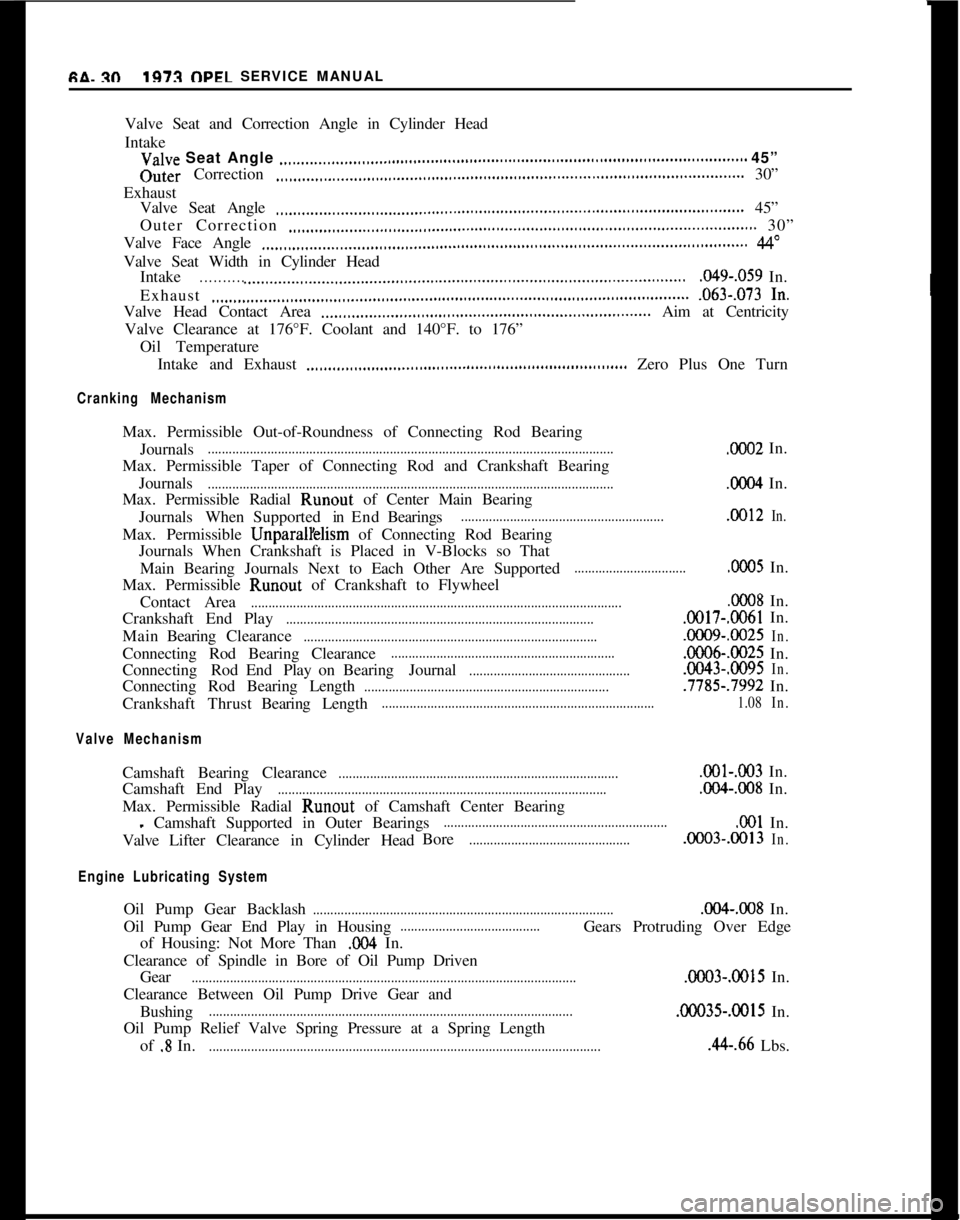
Valve Seat and Correction Angle in Cylinder Head
Intake
Valve Seat Angle ..,._,..__....,,..,,,..,.,.,.,..............,............................................................... 45”Outer Correction
.,,,.,,._.,._..___,,,.,,,,,.......,,.,..,...,,..,..,,..,,..,,,.............................................. 30”
Exhaust
Valve Seat Angle
,,,.,,.__,.__..___.,..,,..,...,,....,..,..,..,,..,..,...,..,,,...,,......................................... 45”
Outer Correction
.,,..,,...,._.,.__....,,,.....,,,........................................................................... 30”
Valve Face Angle
,,..,,,..,.__..__.._..,,,..,,...,,......,.,..,..,..,,.,,,..,..,,,..,,,..,,,...,,................................ 44”Valve Seat Width in Cylinder Head
Intake
. . . . . . . . . . .._..._._.................,,..,.....,,..,............,...,..,,,..,,..,,...,,...,,,..,..................049-,059 In.
Exhaust
.,..,,,..,,.___..,,..,,...,..,,,..,,...,,...,,...............,,..,,..........,,....,,...,..................... .063-,073 In.Valve Head Contact Area
,,..,,,..,,___.__.,,..,,..,.,,..........,...,,..,,............,,,...,....... Aim at Centricity
Valve Clearance at 176°F. Coolant and 140°F. to 176”
Oil Temperature
Intake and Exhaust
_.,,..,,,,,,..,,....,...,,,.,.,,,.,..........................,,,..,,,,.... Zero Plus One Turn
Cranking MechanismMax. Permissible Out-of-Roundness of Connecting Rod Bearing
Journals
.....................................................................................................................OC02 In.
Max. Permissible Taper of Connecting Rod and Crankshaft Bearing
Journals
.....................................................................................................................ooO4 In.
Max. Permissible Radial Runout of Center Main Bearing
JournalsWhenSupportedinEndBearings
...........................................................0012In.Max. Permissible UnparalYelism of Connecting Rod Bearing
Journals When Crankshaft is Placed in V-Blocks so That
Main Bearing Journals Next to Each Other Are Supported
................................0005 In.
Max. Permissible Runout of Crankshaft to Flywheel
Contact Area
...........................................................................................................0008 In.
Crankshaft End Play
.........................................................................................GOl7-.CO61 In.
MainBearingClearance
.....................................................................................ooO9-.@I25In.Connecting Rod Bearing Clearance
.................................................................ooO6-.0025 In.
Connecting RodEnd PlayonBearing Journal
...............................................0043-.0095In.Connecting Rod Bearing Length
.......................................................................7785-.7992 In.
CrankshaftThrustBearingLength
..............................................................................1.08In.
Valve MechanismCamshaft Bearing Clearance
.................................................................................OOl-,003 In.
Camshaft End Play
...............................................................................................004-038 In.
Max. Permissible Radial Runout of Camshaft Center Bearing
- Camshaft Supported in Outer Bearings................................................................,001 In.
ValveLifter Clearance in Cylinder HeadBore
...............................................0003-.OOl3In.
Engine Lubricating SystemOil Pump Gear Backlash
......................................................................................0%.008 In.
Oil Pump Gear End Play in Housing
........................................Gears Protruding Over Edge
of Housing: Not More Than
,004 In.
Clearance of Spindle in Bore of Oil Pump Driven
Gear
...............................................................................................................OCO3-.0015 In.
Clearance Between Oil Pump Drive Gear and
Bushing
.........................................................................................................00035-.OOl5 In.
Oil Pump Relief Valve Spring Pressure at a Spring Length
of
.8 In..................................................................................................................44-.66 Lbs.
Page 323 of 625
66.321973 OPEL SERVICE MANUAL
COOLING SYSTEM
CONTENTS
Subject
DESCRIPTION AND OPERATION:
Cooling System and Water Pump
. . . . . . . . . . . . . . . . . . . . . . . . . . . . . . . .DIAGNOSIS: (Not Applicable)
MAINTENANCE AND ADJUSTMENTS:
Checking and Filling Cooling System
. . . . . . . . . . . . . . . . . . . . . . . .Draining
andFlushingCoolingSystem. . . . . . . . . . . . . . . . . . . . . .Conditioning the Cooling System
. . . . . . . . . . . . . . . . . . . . . . . . . . . . . . . .Using and Testing Anti-Freeze Solutions
. . . . . . . . . . . . . . . . . .Fan Belt Adjustment or Replacement
. . . . . . . . . . . . . . . . . . . . . . . .Radiator Thermostat Inspection and Test
. . . . . . . . . . . . . . . .MAJOR REPAIR:
Water Pump Removal
. . . . . . . . . . . . . . . . . . . . . . . . . . . . . . . . . . . . . . . . . . . . . . . . . . . . .Radiator
Removal. . . . . . . . . . . . . . . . . . . . . . . . . . . . . . . . . . . . . . . . . . . . . . . . . . . . . . . . . . . . . .SPECIFICATIONS:
Cooling System Capacities
. . . . . . . . . . . . . . . . . . . . . . . . . . . . . . . . . . . . . . . . . . . .Page No.
68-32
6B-32
68-32
68-33
68-33
68-33
68-33
68-34
68-34
6B-35
DESCRIPTION AND OPERATION
COOLING SYSTEM AND WATER PUMPThe coiling system is of the conventional pressurized
type. A centrifugal pump arranged in timing case
serves to circulate the coolant.
When the thermostat is closed, the coolant will re-
turn to the pump via a by-pass for swift and uniform
warming up of the engine the coolant circulates
through the radiator, only when the engine has
reached normal operating temperature.
The heater system branches off the cooling system
ahead of thermostat in flow direction so that the
heater is in operation before engine has reached full
operating temperature.
MAINTENANCE AND ADJUSTMENTS
Checking and Filling Cooling SystemThe coolant level should be checked only when the
engine is cold and only enough coolant should be
added to bring the level halfway between core andtank top. It is unnecessary and undesirable to remove
the radiator cap and check the coolant level each
time the car stops at a filling station for gasoline or
oil, since the engine is usually hot at such times.
WARNING: Never remove the radiator cap quickly
when engine is HOT Sudden release of cooling
sys-
tern pressure may cause the coolant to boil and some
of it may be ejected from the radiator
filler neck,
resulting in
inl’ury to persons or damage to the car
finish.If it is necessary at any time to remove the radiator
cap when engine is hot, rotate the cap counterclock-
wise until first stop is reached. Leave cap in this
position until all pressure in cooling system has been
released, then turn cap past the first stop and remove
it.
Draining and Flushing
Cooling SystemThe cooling system should be completely drained
and the recommended coolant installed every two (2)
years.To drain the cooling system, remove radiator cap,
remove lower radiator hose from the lower tank and
Page 324 of 625
COOLING SYSTEM6B- 33
remove drain plug on right.side of cylinder block. Set
heater temperature control valve at full heat posi-
tion. After the cooling system is drained, and plugs
reinstalled, fill the system with clean water. Run the
engine long enough to open the thermostat for com-
plete circulation through the system, then com-
pletely drain the cooling system before sediment has
a chance to settle.
Conditioning the Cooling System
“Rust Inhibitor and Stop Leak”, or equivalent listed
under Group 8.800 is recommended for use in the
cooling system, particularly when preparing for in-
stallation of anti-freeze solution. This material stops
small seepage leaks, has rust preventive properties
and its soluble oil is effective in eliminating a squeal-
ing noise which sometimes develops at the water
pump seal washer. Instructions for its application are
printed on the conditioner bottle.
It is very important to make certain that the cooling
system is properly prepared before an anti-freeze so-
lution is installed, otherwise loss of solution through
leakage may occur or seepage may result in damage
to the engine. The cooling system should be drained
and flushed as described under Draining and Flush-
ing Cooling System. All joints should be checked for
leakage and corrected, and the conditioner described
above should be added with the anti-freeze solution.
Inspect the water pump, radiator core, heater and
defroster cores, water jacket plugs, and edge of cylin-
der head gaskets for evidence of water leaks. Tighten
all hose clamps in the cooling and heating systems
and replace any deteriorated hoses.
Using and Testing Anti-Freeze
Solutions
Inhibited year around (ethylene glycol type) engine
coolant solution which is formulated to withstand
two full calendar years of normal operation without
draining or adding inhibitors should be used at all
times. Freeze protection should be provided to pro-
tect against corrosion. When adding solution due to
loss of coolant for any reason or in areas where tem-
peratures lower than minus 20 degrees F. may be
encountered, a sufficient amount of any of the sev-
eral brands of year around coolant (Ethylene Glycol
base) compatible to GM Specification 1899-M avail-
able on the market should be used. Water or alcohol
base coolants are not recommended for this vehicle
at any time.
If for any reason water only is used as a coolant in
an emergency, it is extremely important that Buick
Heavy Duty Cooling System Protector and Water
Pump Lubricant or equivalent be added to the cool-
ing system as soon as possible. If any other cooling
System protector is used, be certain it is labeled toindicate that it meets General Motors Specification
GM 1894-M. It should be recognized that this is only
a temporary measure. The manufacture intends that
permanent type coolant solution be used year around
in the cooling system.
The cooling system should be completely drained
and the recommended coolant installed every two (2)years.It is advisable to test the anti-freeze solution at inter-
vals during the winter to make certain that the solu-
tion has not been weakened. Use only hydrometers
which are calibrated to read both the specific gravity
and the temperature, and have a table or other means
of converting the freezing point at various tempera-
tures of solution. Disregarding the temperature of
the solution when making the test may cause an error
as large as 30 degrees F. Care must be exercised to
use the correct float or table for the particular type
of anti-freeze being tested.
Fan Belt Adjustment or Replacement
A tight fan belt will cause rapid wear of the alterna-
tor and water pump bearings. A loose belt will slip
and wear excessively and will cause noise, engine
over-heating, and unsteady alternator output. A fan
belt which is cracked or frayed, or which is worn so
that it bottoms in the pulleys should be replaced. The
fan belt may be replaced by loosening the alternator
brace at alternator, slightly loosening the alternator
mounting bolts and moving alternator inward to pro-
vide maximum slack in the belt.
The alternator must be moved outward to adjust the
fan belt. After the generator brace and mounting
bolts are securely tightened, the fan belt tension
should be 45 lb. using Tensioner J-23600.
WARNING: Zfa
fan blade is bent or damaged in any
way, no attempt should be made to repair and reuse
the damaged part. A bent or damaged fan assembly
should always be replaced with a new
fal. assembly.
It is essential that fan assemblies remain in proper
balance and proper balance cannot be assured once
a fan assembly has been bent or damaged. A fan
assembly that is not in proper balance could fail and
fly apart during subsequent
we creating an ex-
tremely dangerous condition.
Radiator Thermostat Inspection and Test
A sticking radiator thermostat will prevent the cool-
ing system from functioning properly. If the thermo-
stat sticks in the open position, the engine will warm
up very slowly. If the thermostat sticks in the closed
position, the engine will overheat.
The thermostat may be removed for inspection and
Page 325 of 625
6B- 341973 OPEL SERVICE MANUAL
test by partially draining the cooling system and dis-
connecting the water outlet housing from the ther-
mostat housing which is mounted on the right front
side of cylinder head.
The standard thermostat valve should start to open
at 189 degrees F and fully open at approximately 212
degrees F. If thermostat does not operate at specified
temperatures, it should be replaced as it cannot be
repaired.MAJOR REPAIR
WATER PUMP REPAIRSThe water pump bearing outer race is shrunk fit into
the water pump cover. For this reason the cover,
shaft bearing, and hub are not repairable.
Water Pump RemovalOpel radiators do not have a drain plug. Drain radia-
tor by first, loosening radiator cap, then remove
lower hose from lower radiator tank.
1. Drain coolant into a clean container. Remove
radiator and shroud.
2. Remove fan belt.
3. Remove fan blade and pulley on water pump shaft.
4. Disconnect inlet hose and heater hose from water
pump. Remove bolts, pump assembly and gasket
from timing chain cover.
5. Check pump shaft bearing for end play or rough-
ness in operation. If bearings are not in serviceable
condition, the assembly must be replaced.
Water Pump Installation1. Make sure the gasket surfaces on pump and timing
chain covers are clean. Install pump assembly with
new gasket. Bolts must be tightened uniformly.
Torque to 11 lb. ft.
2. Install radiator and shroud. Connect radiator hose
to pump inlet and heater hose to nipple.
3. Install fan pulley and fan blade, tighten attaching
bolts securely. Install belts and adjust for proper
tension.4. Fill cooling system and check
,for leaks at pump
and hose joints.
RADIATOR REMOVAL AND INSTALLATION
RemovalI. Loosen radiator cap, then remove lower radiator
hose and drain radiator coolant into suitable con-
tainer.
2. On vehicles with automatic transmission, unscrew
oil lines from connectors on lower radiator tank and
plug lines. On GT models with automatic transmis-
sion the lines have to be disconnected at the coupling
before removing from the tank. It is essential that no
dirt enters the oil lines. When unscrewing oil lines,
hold connectors on lower radiator tank with pliers to
avoid leakages. Ensure that no dirt enters oil cooler.
3. Remove lower attaching nut and slide radiator
upward and out of engine compartment.
Installation1. Install radiat,or into engine compartment and se-
cure lower attaching nut.
2. On vehicles with automatic transmissions, fasten
oil cooler lines to lower radiator tank. It is essential
that no dirt enters the oil lines. When tightening oil
lines, hold connectors on lower radiator tank with
pliers to avoid leakages. Ensure that no dirt enters oil
cooler. Torque to 1 I-15
lbs.ft.3. Install lower radiator hose and add collected coo-
lant.
All Opels are provided with a radiator initial fill of
an antifreeze solution containing corrosion inhibitor.
The antifreeze has either a glycol or glycerin base
and protects the engine against freezing, down to
minus 22 degrees F. (minus 30 degrees C.). Before
the start of the cold season, coolant must be checked
with a hydrometer and if necessary, brought to the
necessary specific gravity by adding anti-freeze with
a glycol or glycerin base. As the specific gravities of
all anti- freeze solutions having a glycol or glycerin
base are practically the same, the hydrometer can be
used for all these types. Because of the tolerances of
the hydrometer, or slight differences in specific
gravity, variations of plus or minus 5 degrees can be
expected. Coolant must be checked at a temperature
of plus 68 degrees F. (plus 20 degrees C.)
Page 335 of 625
SE- 441973 OPEL SERVICE MANUAL
CARBURETOR AND THROTTLE LINKAGE
ALL MODELS
CONTENTS
Subject
DESCRIPTION AND OPERATION:
Carburetor
. . . . . . . . , . . . . . . . . . . . . . . . . . . . . . . . . . . . . . . . . . . . . . . . . . . . . . . . . . . . . . . . . . . . . . . . . . . .DIAGNOSIS:
Carburetor
. . . . . . . . . . . . . . . . . . . . . . . . . . . . . . . . . . . . . . . . . . . . . . . . . . . . . . . . . . . . . . . . . . . . . . . . . . . .MAINTENANCE AND ADJUSTMENTS:
Idle Speed and Mixture Adjustments
. . . . . . . . . . . . . . . . . . . . . . . .Fast Idle Speed Adjustment
. . . . . . . . . . . . . . . . . . . . . . . . . . . . . . . . . . . . . . . . . .Throttle Linkage Adjustment
. . . . . . . . . . . . . . . , . , . . . . . . . . . . . . . . . . . . . . . .MAJOR REPAIR:
RemoveandInstallCarburetor. . . . . . . . . . . . . . . . . . . . . . . . . . . . . . . . I...Throttle Linkage Removal
. . . . . . . . . . . . . . . . . . . . . . . . . . . . . . . . . . . . . . . . . . . . . .OverhaulCarburetor
. . . . . . . . . . . . . . . . . . . . . . . . . . . . . . . . . . . . . . . . . . . . . . . . . . . . . . . .SPECIFICATIONS:
Carburetor
Specifications
. . . . . . . . . . . . . . . . . . . . . . . . . . . . . . . . . . . . . . . . . . . . . . . .Page No.
6E-44
6E-49
6E-50
6E-51
6E-51
6E-52
6E-53
6E-53
6E-58
DESCRIPTION AND OPERATION
CARBURETORThe two-barrel carburetor for all 1973 Opel1
19G0,Manta and GT models is a down-draft carburetor
with two barrels of 1.25 inch diameter each. It has
an automatic choke and a secondary valve operated
by a vacuum diaphragm, except when installed in an
Opel GT. In the GT, the secondary throttle valve is
operated by mechanical linkage from the primary
throttle valve.
The two-barrel carburetor consists of three main
parts
- throttle body, float chamber and air horn.
Each barrel is a separate system, but both barrels
discharge into a common inlet in the intake mani-
fold. The secondary barrel does not have a choke
valve or an accelerator pump. See Figure
6E-2.The throttle valve of the primary barrel is opened
through the throttle linkage. When the primary
throttle valve is almost open, at approximately half
of the maximum engine RPM, the secondary throttlevalve is opened by vacuum applied through a
vacuum diaphragm case. See Figure
6E-3. The sec-
ondary throttle valve on the GT model is opened by
mechanical linkage from the primary throttle shaft.
Choke SystemThe automatic choke is operated by a bi-metal
spring. The tension of the spring
- depending on
temperature of the heater coil
- decreases with rising
temperature and the choke valve opens progressively
until it is completely opened at engine operating tem-
perature. The choke valve is off-set so that choke
valve opening increases as air flow increases.
If the choke valve is closed, the throttle valve is
opened slightly to provide a fast idle speed. This is
done through a cam, abutment lever and throttle
connecting link. With the throttle valve opened
slightly, the vacuum during cranking can take effect
up to the choke valve, thereby drawing ample fuel
out of the main nozzle. See Figure
6E-4.With rising temperature of the heater coil, the choke
Page 358 of 625
2. If inspection of contact points indicates excessive
burning, pitting or wear, check condenser and re-
place if necessary.
3. Inspect all connections and wires in the primary
ignition circuit. Correct any abnormal conditions
found.Carburetor1. Clean fuel strainer in fuel pump. To prevent fuel
leakage in pump, disconnect “IN” line from pump
and raise end above fuel level. The in-line fuel filter
should be replaced every 12,000 miles or every 12
months.
2. Check for freedom of choke valve operation and
clean shaft if necessary, with suitable solvent.
3. Inspect throttle cable or linkage bracket and re-
turn spring for wear. With helper depressing acceler-
ator pedal to floor, check for wide open throttle.
Adjust accelerator pedal height so wide open throttle
is obtained when pedal is within
l/2 inch from floor.
Lubricate linkage pivot points with engine oil.
Air CleanerCheck paper element every 6,000 miles and replace
every
24,ooO miles. If a vehicle is operated in dusty
territory, check condition of air cleaner element
more frequently and replace if necessary.
Fan Belt1. Inspect belt for wear, cracks or frayed points.
Replace and/or adjust as necessary. Specified ten-
sion for belt using Gauge J-23600 is 45 lbs.
Cooling System1. Inspect the radiator, water pump, cylinder head
areas and all radiator and heater hose connections
for evidence of engine coolant leaks.
2. Inspect all hoses for deterioration from gas and oil
contact. Correct as required.
Inspection should be made with engine operating at
normal temperature, cooling system completely
filled, temperature control lever fully open and nor-
mal pressure in the system. Normal pressure should
be 13.2 to 15.2 psi.
Engine Lubrication SystemInspect engine for evidence of oil leakage. Correctany abnormal condition with sealastic or new seals
and gaskets.
Battery
1. Inspect battery, battery mount and cables and
check electrolyte level. Proper level should be just
above the cell plates.
CAUTION:Do not over fill.
2. Determine the serviceability of the battery by ap-
plying the 421 Battery Test.
Positive Crankcase VentilationClean crankcase ventilator metered orifice in the in-
take manifold fitting every 6,000 miles. Also all hoses
and fittings should be inspected, cleaned and re-
placed, if necessary.
To clean, remove rubber hose from metered orifice
and apply air pressure to orifice to remove any for-
eign particles that may be trapped.
Valve Lifter AdjustmentRefer to Engine Mechanical and Mounts section for
valve lifter adjustment procedure.
Engine Tune-Up Instrument ChecksThe following instrument checks and adjustments
serve as a final check on engine condition. These
checks may discover some new problems that may
not have been obvious before. The engine is also
given its final adjustments that will assure maximum
performance, reliability, and proper emission con-
trol.
Refer to Electrical Group for checking procedures of
the following:
Cranking Voltage Check
Ignition Timing
Distributor Advance
Ignition Output
Secondary Resistance
Current Output and Voltage Setting
Idle Speed and Mixture AdjustmentsRefer to carburetor section.