ABS OPEL 1900 1973 Owner's Manual
[x] Cancel search | Manufacturer: OPEL, Model Year: 1973, Model line: 1900, Model: OPEL 1900 1973Pages: 625, PDF Size: 17.22 MB
Page 184 of 625

FRONT SUSPENSION3A- 17Torque values must be used as specified during reas-
sembly to assure proper retention of these parts.1. Attach lower control arm to front spring eye.
Torque bolts to 18
lb.ft.2. Install spring compressor on spring and compress
spring to appropriate length.
3. Raise jack with spring compressor, spring and
control arm assembly into position under the car.
4. Install lower ball joints and torque nuts to 54
Ib.ft.Install new cotter pin.
5. Attach lower control arms to frame cross member
using new lock nuts.
6. Attach both shock absorbers. Torque bolts to 30
lb.ft.7. Remove spring compressor.
8. Install front wheels.
On replacement of the damper bushings on the front
springs, only the one-part damper bushing is in-
stalled for either the two-leaf or three-leaf spring.
For proper location of the marking lugs, see Figure3A-26.
Installation (Opel 1900. Manta)
CAUTION: Fasteners are important attachingparts in
that they
co&d affect the performance of vital com-
ponents and systems, and/or could result in major
repair expense. They must be replaced with one of
the same part number or with an equivalent part, if
replacement becomes necessary. Do not use a re-
placement part of
lesser quality or substitute design.
Torque values must be used as specified
during reas-
sembly to assure proper retention of these parts.1. Properly seat spring between lower control arm
and cross member.
2. Raise jack and place lower control into position.CROSS SECTION
SA-26Fig. 3A-26 Front Spring Damper Bushing.
3. Attach lower control ball joint to steering knuckle
and torque nut to 54
lb.ft.4. Tighten lower control arm to cross member bolt
to 43 lb.ft.
5. Attach stabilizer bar to cross member to body
support.
6. Install shock absorber and torque lower attaching
nut and bolt to 30
lb.ft.7. Install nuts on upper shock absorber attaching
studs. Tighten nuts until a distance from top of nut
to stud is approximately
l/2 inch.
8. Install front wheels and tighten nuts to 65
lb.ft.9. Remove stands and lower car.
SPECIFICATIONSBOLT TORQUE AND FRONT END ALIGNMENT
Page 185 of 625

3A- 161973 OPEL SERVICE MANUAL
SPECIFICATIONS
Torque Specifications
Use a reliable torque wrench to tighten all parts listed to insure proper
tightness without straining or distorting parts. These specifications are for
clean and lightly-lubricated threads only; dry or dirty threads produce in-
creased friction which prevents accurate maasurement of tightness.
LocationFront Suspension Crossmember to Front Frame
Clamp, Steering Mast to Steering Mast Flange
(GT)
........................................................................................
Clamp, Steering Mast to Steering Mast Flange(1900
-Manta)..................................................................
Clamp,UpperUniversalJoint(GT)..................................Clamp, Lower Universal Joint (GT)
..................................
WheelNuts............................................................................Lower Control Arm Shaft to Lower Control Arm
..........Lower Control Arm Ball Joint to Steering Knuckle
......Upper Control Arm Ball Joint to Steering Knuckle
(GT)........................................................................................Upper Control Arm Ball Joint to Steering Knuckle
(1 900 Manta)
..................................................................Upper Control Arm Ball Joint to Upper Control Arm
ShockAbsorbertoLowerControlArm..........................Steering Arm to Steering Knuckle (1900
- Manta)......
Brake Backing Plate or Brake Disc Shield andSteering Arm to Steering Knuckle
(GTJ
Hex Head Bolt M 10......Hex Head Bolt M 8
......
Brake Backing Plate to Steering Knuckle(1900 Manta)
..................................................................
Brake Caliper to Steering Knuckle.................................
Lower Control Arm to Front Spring Eye (GT)................
Brake Disc to Front Wheel Hub........................................Upper Control Arm to Crossmember (1900
- MantajLower Control Arm to Crossmember (1900
- Manta)
Steering Gear Housing to Front Suspension
Crossmember (GT)
............................................................
Steering Gear Housing to Front SuspensionCrossmember (1900
- Manta)........................................Stabilizer Bar to Lower Control Arm
(Opel 1900
- Manta)........................................................Tie Rod Clamp Bolts
(GTJ....................................................
CastleNut,TieRodtoSteeringArm..............................Upper Control Arm Shaft to Shock Absorber Support
and Upper Control Arm (GT)
..........................................
CrossMember to
BodySupport Attachment................
FrontSuspensionAssemblytoFrame............................Front End Alignment Specifications
Torque
Lb.Ft.36
1522
14
22
6540
5429
ii30
5847
18
58
72
1836
40
43
1830
87
:i33
58
47ModelCaster’
Camber”1900‘3
l/2-6 l/2GT
3+1-:%+*Permissible deviation from left to right wheel
- Max. 1’.
Toe-In”Min.-Max.
l/8-3/ 16
l/32-1/8Outer Wheel
When Inner
Wheel at 20
19
l/418
l/2
Page 190 of 625
FRONT END ALIGNMENT 3C-23
ing geometry, the following checks and inspections
must be made to insure correctness of alignment
equipment readings and alignment adjustments.
1. The front tires should have approximately the
same wear and all tires must be inflated to specified
pressures (see Wheel and Tire Specifications
- Sec-
tion 3G).
2. Check front wheel bearings for looseness and ad-
just if necessary (see Front Suspension Adjustments
- Section 3A).
3. Check for run-out of wheels and tires, (see Section
3G).
4. Check wheels and tires for balance and correct if
out-of-balance (See Section 3G).
5. Check for looseness at ball joints and tie
rdd ends;
if found excessive, it must be
corxcted before align-
ment readings will have any value.
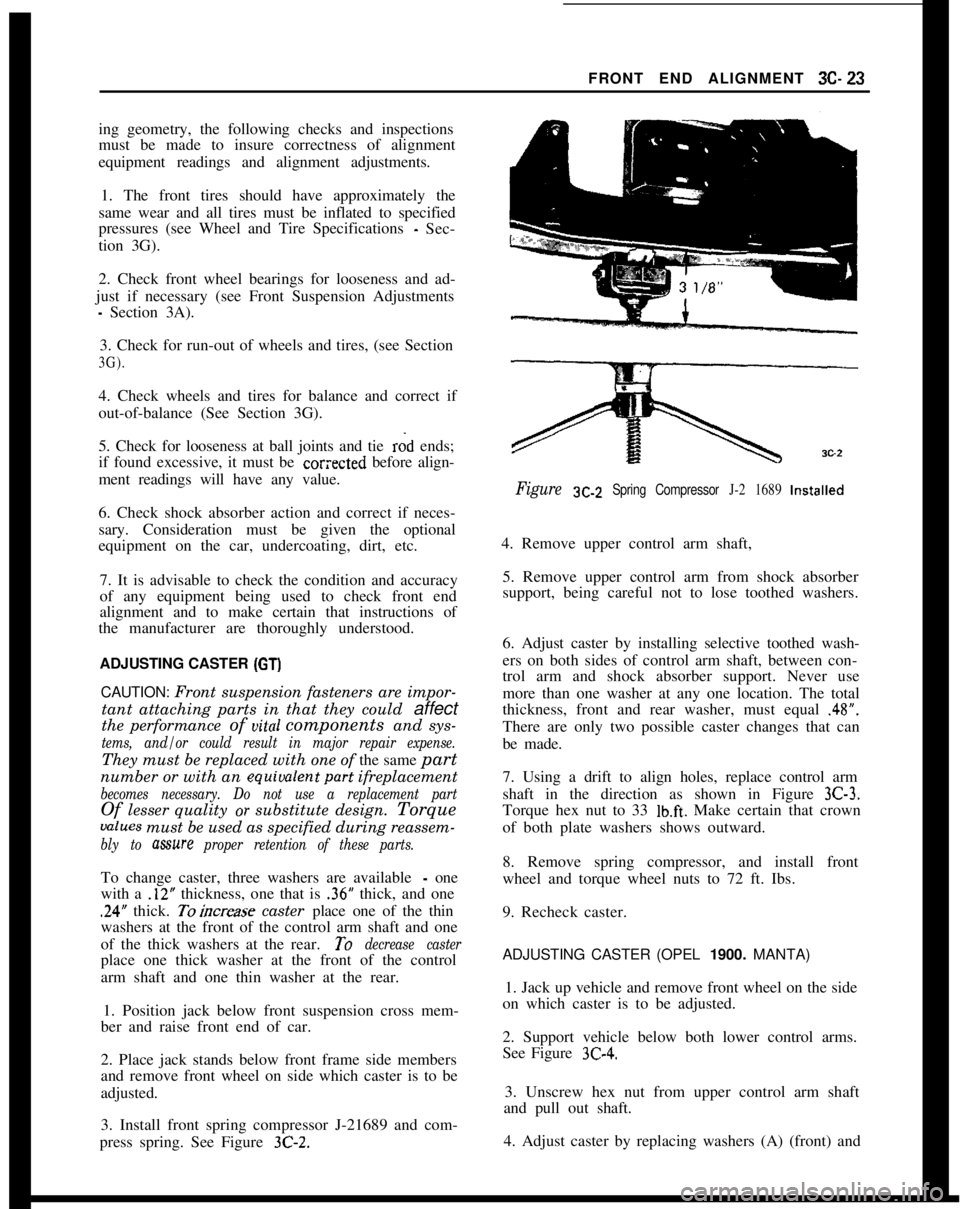
Figure SC-Z Spring Compressor J-2 1689 Installed
6. Check shock absorber action and correct if neces-
sary. Consideration must be given the optional
equipment on the car, undercoating, dirt, etc.
7. It is advisable to check the condition and accuracy
of any equipment being used to check front end
alignment and to make certain that instructions of
the manufacturer are thoroughly understood.
ADJUSTING CASTER (GT)
4. Remove upper control arm shaft,
5. Remove upper control arm from shock absorber
support, being careful not to lose toothed washers.
6. Adjust caster by installing selective toothed wash-
ers on both sides of control arm shaft, between con-
trol arm and shock absorber support. Never use
CAUTION: Front suspension fasteners are impor- more than one washer at any one location. The total
tant attaching parts in that they could
affectthickness, front and rear washer, must equal .48”.
the performance of uital components and sys-
tems, and/or could result in major repair expense.
There are only two possible caster changes that can
be made.
They must be replaced with one of the same
part
number or with an equiualentpart ifreplacement
becomes necessary. Do not use a replacement part
Of lesser quality or substitute design. Torque
values must be used as specified during reassem-
bly to mure proper retention of these parts.
7. Using a drift to align holes, replace control arm
shaft in the direction as shown in Figure
3C-3.
Torque hex nut to 33 lb.ft. Make certain that crown
of both plate washers shows outward.
To change caster, three washers are available
- one
with a
.12” thickness, one that is .36” thick, and one
.24” thick. Toincrease caster place one of the thin
washers at the front of the control arm shaft and one
of the thick washers at the rear.
To decrease caster
place one thick washer at the front of the control
arm shaft and one thin washer at the rear.
1. Position jack below front suspension cross mem-
ber and raise front end of car. 8. Remove spring compressor, and install front
wheel and torque wheel nuts to 72 ft. Ibs.
9. Recheck caster.ADJUSTING CASTER (OPEL
1900. MANTA)
2. Place jack stands below front frame side members
and remove front wheel on side which caster is to be
adjusted. 1. Jack up vehicle and remove front wheel on the side
on which caster is to be adjusted.
3. Install front spring compressor J-21689 and com-
press spring. See Figure
3C-2.
2. Support vehicle below both lower control arms.
See Figure
3C-4.
3. Unscrew hex nut from upper control arm shaft
and pull out shaft.
4. Adjust caster by replacing washers (A) (front) and
Page 191 of 625

3C-24 1973 OPEL SERVICE MANUAL
NOTE:
FRONT OF CAR
4Figure
3C-3 Upper Control Arm Shaft and Bushingsx.3
Figure
3C-4 Supporting Vehicle at Both Lower
Control Arms(B) (rear) between upper control arm and shock ab-
sorber support. See Figure
3C-5.5. One
.24” thick washer each is installed in produc-
tion on each car side. Consequently, only two adjust-
ments are possible by adding washers of different
thickness.
6. One
.12” in front and one .36” in the rear (caster
increase of 1 degree) or one
.36” in front and one. 12”
in the rear (caster decrease of 1 degree). Never addFRONT OF CAR
3G5
Figure
3C-5 Caster Adjustment Washer Location -Opel 1900 - Manta
several washers in one place. The washers B installed
in production have a larger outer diameter than the
washer A. For service, the Parts and Accessories
Department supplies only larger washers with an
outer diameter of 1.57”.
7. Insert control arm shaft from front towards the
rear into upper control arm and shock absorber
SUP-port. Observe that the crown of both plate washers
shows inwards. See Figure
3C-5.8. Torque hex nut of control arm shaft to 40 ft.lbs.
Always use new self-locking nut.
9. Torque wheel nuts to 75
ft.lbs.10. Recheck caster setting.
Page 194 of 625

STEERING GEAR ASSEMBLY3D. 27
STEERING GEAR ASSEMBLY
CONTENTS
Subject
DESCRIPTION AND OPERATION:
Description and Operation of Steering Gear. . . . . . . . . . . .DIAGNOSIS: (Not Applicable)
MAINTENANCE AND ADJUSTMENTS:
AdjustmentofSteeringGear
. . . . . . . . . . . . . . . . . . . . . . . . . . . . . . . . . . . . . . . .MAJOR REPAIR:
Removal and Installation of Steering Gear
Assembly
andTieRods. . . . . . . . . . . . . . . . . . . . . . . . . . . . . . . . . . . . . . . . . . . . . . . .Disassembly and Reassembly of Steering Gear
Assembly With Tie Rods
. . . . . . . . . . . . . . . . . . . . . . . . . . . . . . . . . . . . . . . . . . . .SPECIFICATIONS:
TighteningSpecifications
. . . . . . . . . . . . . . . . . . . . . . . . . . . . . . . . . . . . . . . . . . . . . . . .
Page No.
3D-27
3D-273D-28
3D-303D-33
DESCRIPTION AND OPERATIONDESCRIPTION AND OPERATION OF
STEERING GEAR ASSEMBLYThe Opel 1900
- Manta and GT steering gear is the
rack and pinion type. The steering gear pinion shaft,
connected to the lower end of the steering column,
moves the rack to the left or right thereby transmit-
ting the turning motion of the steering wheel to the
tie rods and steering arms.
The steering gear housing is held to the cross mem-
ber by rubber bushings and clamps. The bushings
serve to prevent driving noises and vibrations from
being transmitted into the passenger compartment.
A pinion shaft is seated in the upper portion of the
steering gear housing and is supported by a needle
bearing in the upper housing, and a bushing in the
lower housing. The pinion is not adjustable.
A rubber “0” ring seal is provided for sealing needle
bearing, and a second “0” ring for sealing pinion
bushing. The rack and pinion shaft are held in mesh
by a thrust spring and shell. See Figure
3D-2.The pressure of the thrust spring may be varied by
means of an adjusting screw. The spring forces the
sintered bronze shell against the rack, which in turn
is held against the pinion shaft. Backlash in the steer-ing gear is avoided, and road shocks are effectively
absorbed.
The rack is seated in the long neck of the steering
gear housing in a self-lubricating sintered metal
bushing. It is laterally guided by the sintered bronze
shell in the adjusting screw opening, and in the short
gear housing neck by the rack guide bushing. See
Figure
3D-3.MAINTENANCE
AND ADJUSTMENTS
ADJUSTMENTS OF STEERING GEAR
Adjustment of Steering GearAdjustment of the steering gear assembly is accom-
plished by turning the adjusting screw in or out. See
Figure
3D-2.Positioning of the adjusting screw exerts a pressure
on the rack, thereby varying the backlash between
the pinion and rack.
1. Set steering gear to high point by positioning front
wheels straight ahead with steering wheel centered.
Flexible coupling bolt hole will be positioned hori-
zontal (or parallel) to the rack.
2. Thread adjusting screw into steering gear housing
Page 197 of 625

3D- 301973 OPEL SERVICE MANUALFigure 3D-8 - Removing Clamp Bolt3. Remove cotter pin located on left and right tie rod
end and unscrew nut.
4. Using Tool J-21687, press tie rod ends out of
steering arms.
5. Disconnect steering gear housing from front sus-
pension cross member and remove steering gear
together with tie rods.
Installation . GTCAUTION: Fasteners are important attaching parts in
that they could affect the performance of vital com-
ponents and systems, and/or could result in major
repair expense. They must be replaced
with one of
the same part number or with an equivalent part if
replacement becomes necessary. Do not
use a re-
placement part of lesser quality or substitute design.
Torque values must be used as specified during reas-
sembly to assure proper retention of these parts.
1. Position steering gear on front suspension cross
member and torque attaching bolts to 18
lb.ft.2. Position tie rod ball studs in steering arms; install
nuts and torque to 29 lb.ft. Lock in position with new
cotter pins.
3. Fully turn steering wheel so that flat or cutout
surface on lower portion of steering shaft is parallel
to flexible coupling bolt hole.
4. Install the lower end of steering shaft to the flexi-
ble coupling and adjust dimension between steering
wheel hub and direction signal switch housing cover
to
l/8 and 3/32 inch. Maintain adjustment by tight-
ening flexible coupling bolt and nut to 15 lb.ft. Lock
the bolt and nut in position with lock-plate tabs.5. Reinstall stop bolt into steering column.
6. Full turn steering wheel both right and left. If any
resistance is noticeable, it will be necessary to remove
the sleering column and correct the cause.
D. Installation (Opel 1900. Manta)CAUTION: Fasteners are important attachingparts in
that they could affect the performance of vital com-
ponents and systems, and/or could result in
maJbrrepair expense. They must be replaced with one of
the same part number or with an equivalent part if
replacement becomes necessary. Do not use a re-
placement part oflesser
quaky or substitute design.
Torque values must be used as specified during reas-
sembly to assure proper retention of these parts.
1. Prior to installation, set steering gear to high
point. The steering wheel spokes point downwards in
an oblique angle. The elongated cutout of the lower
steering mast must coincide with the clamp bolt hole
of the pinion flange.
2. Position steering gear on front suspension cross
member and torque attaching bolts to 29 lb.ft.
3. Position tie rod studs in steering arms. Install nuts
and torque to 29
Ib.ft. Lock in position with new
cotter pin.
4. Install the lower end of the steering shaft to flexi-
ble coupling and torque clamp bolt to 22
lb.ft.5. Attach guard plate to both side members and
lower deflector panel.
DISASSEMBLY AND ASSEMBLY OF
STEERING GEAR ASSEMBLY WITH TIE RODS
Disassembly - GT1. Carefully clamp gear assembly in soft jaw vise and
slip clamps and rubber bellows off gear housing to
expose area where ball joint screws into rack.
2. Bend up round edges of lockplates from tie rod
ball studs and disconnect tie rod ball studs from rack.
See Figure
3D-9). It is important that rack be held
secure with open end wrench to prevent damage to
rack teeth.
3. Loosen adjusting screw lock nut; remove adjusting
screw from steering gear housing, and take out thrust
spring and sintered bronze shell. See Figure
3D-11.4. Rotate gear assembly in vise so that pinion shaft
portion of assembly is held by vise, and remove pin-
ion nut, flat washer, and special washer.
Page 203 of 625

3E- 361973 OPEL SERVICE MANUAL
and ignition switch in RUN position, the fog lights
are automatically switched off. Direction signals
work in the normal manner; pushing the lever up for
right turn signal and pulling the lever down for left
turn signal.
DESCRIPTION AND OPERATION OF HORN
The horn button is located in the center part of the
steering wheel. The horn is actuated by pushing on
the ends of the spokes for the Opel 1900 - Manta and
by pushing on the center horn button on 57R, 57L,
and GT. The button is provided with a plug connec-
tion for each springloaded plunger. See Figure
3E-3.Figure
3E-3 Horn Button Connections (Opel 1900Manta)DESCRIPTION OF STEERING COLUMN
ASSEMBLYThe steering column mast jacket is provided with a
tube-frame section
.(See B of Figure 3E-4) with
bulges which compresses or folds itself, if a suffi-
ciently large energy is exerted to one or other end of
the steering mast jacket assembly. This tube-frame
section absorbs most of the energy. The steering col-
umn consists of two parts, the upper and lower mast
jacket assembly and’the steering shaft. The
upp,ersteering mast is firmly connected to the tube while
the lower steering mast is clearance-free attached to
the tube by means of injected plastic (See Figure
3E-4). Consequently, the steering mast withstands
all torsional stresses.
As soon as the primary energy becomes effective, the
plastic pins (c) shear off and the steering shaft com-
presses. Thereafter the steering mast jacket is partly
compressed.
A slide-off base is welded to the steering mast jacket.
It is provided with two (2) slots for the respective
attaching bolts. A metal piece (See Figure 3E-4) is
located in each slot which is attached to the slide-off
base with injected plastic. The open sides of the slots
face the driver so that the primary energy cannotpush the steering mast jacket assembly into the pas-
senger compartment. The secondary energy caused
by the driver can on the other hand effect a shearing
of the plastic pins and loosening of the slide-off base
so that it moves downwards. Thereby the steering
mast jacket assembly is compressed further and ab-
sorbs the impact energy to a large extent.
The energy absorbing steering is not more suscepti-
ble to damage than a standard steering. However, the
steering mast jacket assembly, especially if removed,
has in contrast with the standard steering to be given
a difierent treatment.
Figure
3E-4 Energy Absorbing Steering Column
The energy absorbing steering column must by no
means be subject to impacts or blows. A sharp blow
onto the exposed steering shaft ends, leaning onto
steering column or dropping may loosen or even
shear off the plastic attachments which bring about
rigidity of assembly. In spite of a steering column
damaged in this way the operating function of the
steering is retained due to the lateral flattenings on
steering shaft tube and lower steering shaft. How-
ever, after a short period of operation rattling noises
will be noticeable so that the steering column has to
be replaced. For pulling steering wheel off steering
column use appropriate special tool. Therefore, it is
of importance that the instructions for removal and
installation as well as disassembly and assembly are
Strictly adhered to.
MAJOR REPAIRREMOVAL AND INSTALLATION OF
STEERING COLUMN ASSEMBLY
The removal of this assembly is only necessary for
Page 205 of 625
3E- 38 ,1973 OPEL SERVICE MANUAL
ponents and systems, and/or could result in major
repair expense. They must be replaced with one or
the same part number or with
an equivalent part if
replacement becomes necessary. Do not use a
re-
placement part of lesser quality or substitute design.
Torque
values must be used as specified during reas-
sembly to assure proper retention of these parts.On installation, make sure steering wheel spokes
point downwards and steering gear is in high point.
1. Carefully insert steering mast into universal joint
flange.
2. Loosely attach slide-off base attaching nuts at un-
derside of instrument panel.
3. Attach steering mast jacket at front of dash, using
a notched hex nut.
4. Torque nuts at slide-off base to II
lb.ft.5. Tighten screw at steering mast clamp to 22
lb.ft.6. Reconnect wires to directional signal switch and
ignition switch.
7. Reconnect battery.
REMOVAL AND INSTALLATION OF
STEERING WHEELThis procedure may be performed with the steering
column assembly either removed or installed in the
car.
Removal
1. Disconnect battery.
2. Pry off horn cap and remove wires from cap. See
Figure
3E-3.3. Bend lockplate tabs down and take off steering
shaft nut and lockplate.
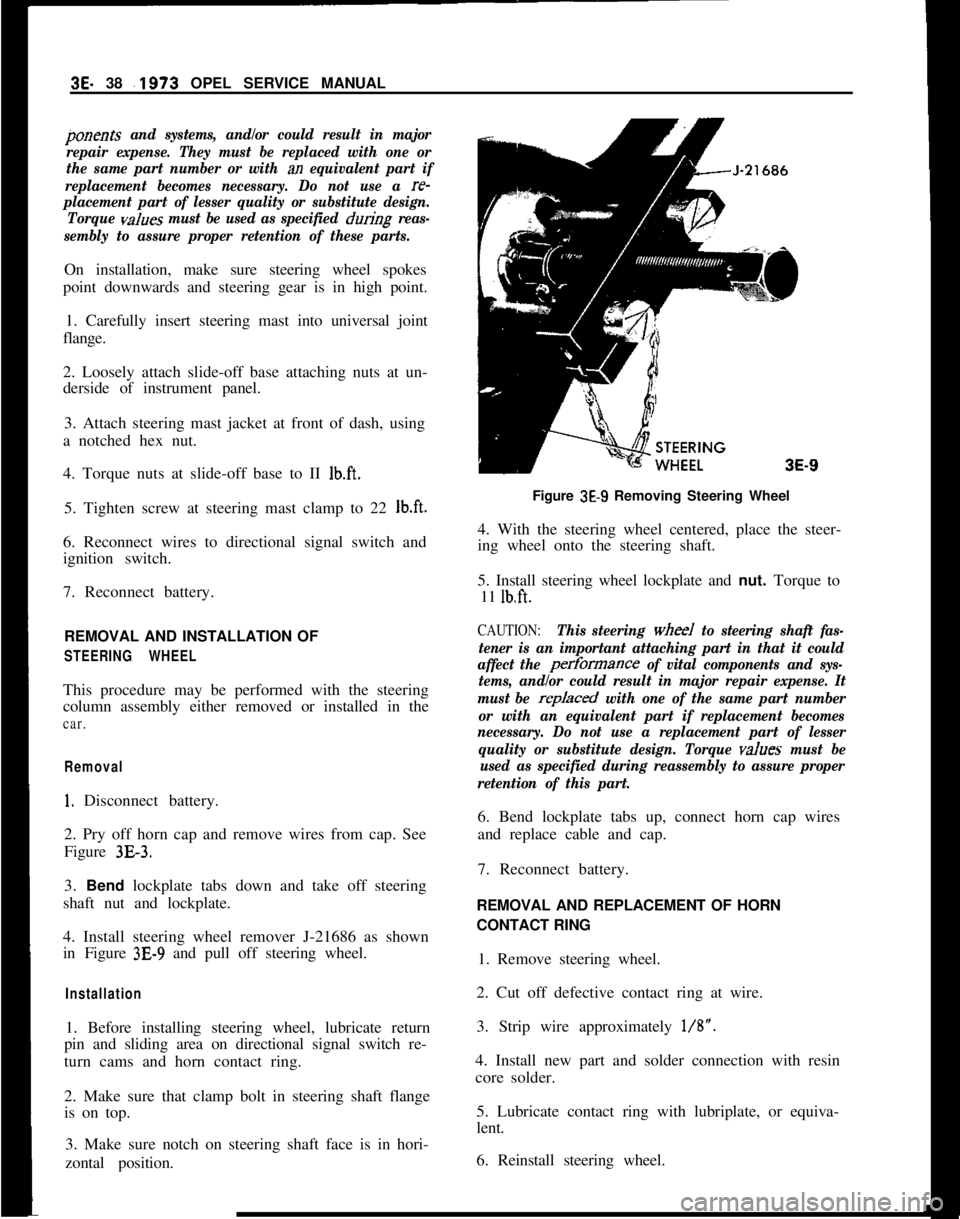
4. Install steering wheel remover J-21686 as shown
in Figure
3E-9 and pull off steering wheel.
Installation1. Before installing steering wheel, lubricate return
pin and sliding area on directional signal switch re-
turn cams and horn contact ring.
2. Make sure that clamp bolt in steering shaft flange
is on top.
3. Make sure notch on steering shaft face is in hori-
zontal position.Figure
3E-9 Removing Steering Wheel
4. With the steering wheel centered, place the steer-
ing wheel onto the steering shaft.
5. Install steering wheel lockplate and nut. Torque to
11
lb.ft.
CAUTION:
This steering wheeI to steering shaft fas-
tener is an important attaching part in that it could
affect the
performance of vital components and sys-
tems, and/or could result in major repair expense. It
must be repked
with one of the same part number
or with an equivalent part if replacement becomes
necessary. Do not use a replacement part of lesser
quality or substitute design. Torque
values must be
used as specified during reassembly to assure proper
retention of this part.6. Bend lockplate tabs up, connect horn cap wires
and replace cable and cap.
7. Reconnect battery.
REMOVAL AND REPLACEMENT OF HORN
CONTACT RING
1. Remove steering wheel.
2. Cut off defective contact ring at wire.
3. Strip wire approximately
l/8”.4. Install new part and solder connection with resin
core solder.
5. Lubricate contact ring with lubriplate, or equiva-
lent.
6. Reinstall steering wheel.
Page 209 of 625

3E- 421973 OPEL SERVICE MANUAL
GT STEERING COLUMN ASSEMBLY
CONTENTS
Subject
DESCRIPTION AND OPERATION:
DescriptionofSteeringColumn. . . . . . . . . . . . . . . . . . . . . . . . . . . . . . . . . . .DIAGNOSIS: (Not Applicable)
MAINTENANCE AND ADJUSTMENTS: (Not
Applicable)
MAJOR REPAIR:
RemovalandInstallationofSteeringWheel. . . . . . . . . . . .Removal and Installation of Ignition Lock
Cylinder
. . . . . . . . . . . . . . . . . . . . . . . . . . . . . . . . . . . . . . . . . . . . . . . . . . . . . . . . . . . . . . . . . . . . . . . . . . . . . .Removal and Installation of Steering Column
Assembly
. . . . . . . . . . . . . . . . . . . . . . . . . . . . . . . . . . . . . . . . . . . . . . . . . . . . . . . . . . . . . . . . . . . . . . . . . .Removal and Installation of Center Steering Shaft
Removal and Installation of Ignition Switch
and/or Steering Lock
.,~ ,........ ~ . . . . . . . . . . . . . . . . . . . . . . . . . . . . . . . . . . . . . . .Removal and Installation of Upper Steering
Bearing and/or Directional Signal Switch
. . . . . . . . . . . .Removal and Installation of Steering Column
Lower Bearing
. . . . . . . . . . . . . . . . . . . . . . . . . . . . . . . . . . . . . . . . . . . . . . . . . . . . . . . . . . . . . . . .SPECIFICATIONS:
Steering Column Torques
. . . . . . . . . . . . . . . . . . . . . . . . . . . . . . . . . . . . . . . . . . . . . . . .Page No.
3E-42
3E-44
3E-45
3E-45
3E-46
3E-46
3E-48
3E-49
3E-50
DESCRIPTION AND OPERATION
DESCRIPTION OF STEERING COLUMNThe Energy Abosrbing, Locking Steering .Column
assembly is used on the GT. This cohnnn is designed
to compress under impact. When an automobile is
being driven, the forward movement of the automo-
bile and the forward movement of the driver both
constitute a form of energy or force. When an au-
tomobile is involved in a frontal collision, the pri-
mary force (forward movement of the car) is
suddenly halted, while the secondary force (the
driver) continues its forward direction. A severe col-
lision generally involves these two forces
- the pri-
mary and the secondary forces. The secondaryjmpact occurs when the driver is thrust forward onto
the steering wheel and column.
The Energy Absorbing Column is designed to absorb
these primary and secondary forces to the extent thatthe severity of the secondary impact is reduced. Dur-
ing a collision, the steering column compresses and
thereby reduces its tendency to move rearward into
the driver’s compartment. A split second later when
the driver is thrown forward (the secondary impact)
his energy is also partially abosrbed by the compres-
sion characteristics of the column.
The Energy Absorbing, Locking Column assembly
may be easily disassembled and reassembled. The
serviceman should be aware that it is important that
only the specified screws, bolts and nuts be used as
designated during reassembly, and that they are
tightened to their specified torque. This precaution
will insure the energy absorbing action of the assem-
bly. Particular care should be exercised to avoid us-
ing overlength bolts as they may prevent a portion of
the assembly from compressing under impact.
Equally as important is correct torquing of all bolts
and nuts.
When the Energy Absorbing, Locking Column is
Page 211 of 625

3E. 441973 OPEL SERVICE’MANUAL
Figure 3E-17 Steering Column Bracket
installed in a car it is no more susceptible to damage
through usage than an ordinary column; however,
when the column is removed, special care must be
taken in handling this assembly.Only the speufied
wheel puller should be used.When the column is removed from the car, such
actions as a sharp blow on the end of the steering
shaft laying things across or on top of the column
assembly, leaning on the column assembly, or drop-
ping of the assembly could shear or loosen the plastic
fasteners that maintain column rigidity or possibly
bend the assembly causing a binding condition.
It is
therefore important that the removal and installation
and the disassembly and reassembly procedures be
strictly followed when servicing this assembly.The steering column assembly is attached with a
bracket (A) at four points to the connecting brace
below the instrument panel. See Figure
3E-17. The
two upper bolts are designed as tear-lock-bolts. A
bolt (B) is welded to the bracket which engages in an
narrowing elongated hole. The same applies to the
upper bolt (C) of the steering column lower bearing
attachment which engages in a hole of the connect-
ing brace.
As soon as a sufficiently large secondary energy
becomes effective, the steering mast jacket slides to-
wards the front whereby the bolt (B) as well as the
bolt head (C) is additionally pushed into the respec-
tive narrowing elongated holes. Both elongated holes
are arranged so that the primary energy cannot push
the steering mast assembly into the passenger com-
partment.
The GT steering column incorporates two universaljoints to allow
~for the offset between the steering
column and the gear assembly.
The upper steering column assembly is connected to
the center steering shaft with one universal joint,
while the lower universal joint connects the center
steering shaft to the steering gear pinion shaft.
REMOVAL AND INSTALLATION
REMOVAL AND INSTALLATION OF STEERING
WHEELThis procedure may be performed with the steering
column assembly either removed or installed in the
car.Removal
1. Disconnect battery.
2. Remove horn cap.
3. Bend lockplate tabs down and remove steering
wheel nut, lockplate and washer.
4. Mark shaft and wheel hub for reassembly align-
ment.
5. Remove steering wheel using steering wheel puller
J-21686. Do not rap on end of puller in order to free
wheel from shaft as this would very likely loosen
plastic injections that maintain steering shaft rigid-
ity. Striking of underside of steering wheel to jar it