ABS OPEL 1900 1973 Workshop Manual
[x] Cancel search | Manufacturer: OPEL, Model Year: 1973, Model line: 1900, Model: OPEL 1900 1973Pages: 625, PDF Size: 17.22 MB
Page 286 of 625
DRUM BRAKES5C- 27MAINTENANCE AND ADJUSTMENTSBRAKE ADJUSTMENT
Preliminary Checks
1. Depress brake pedal firmly. If pedal travels to
within two inches of toeboard and has a hard feel,
brake shoes require adjustment or relining. However,
if pedal has a spongy feel, brake system needs bleed-
ing.2. Remove one rear drum if lining is worn nearly to
rivets. Reline both rear brakes (drum brakes only).
3. Check fluid level in master cylinder reservoir and
add fluid if necessary.
4. Fully release parking brake lever and place trans-
mission in neutral.
5. Pull on both ends of rear brake cable a number of
times to make sure that cables operate rear brake
shoes freely and do not bind in conduits. Check for
free movement of cable in brake cable sheave and
check brake cable spring for tension. Replace a weak
or broken cable spring.
Pedal Height Adjustment
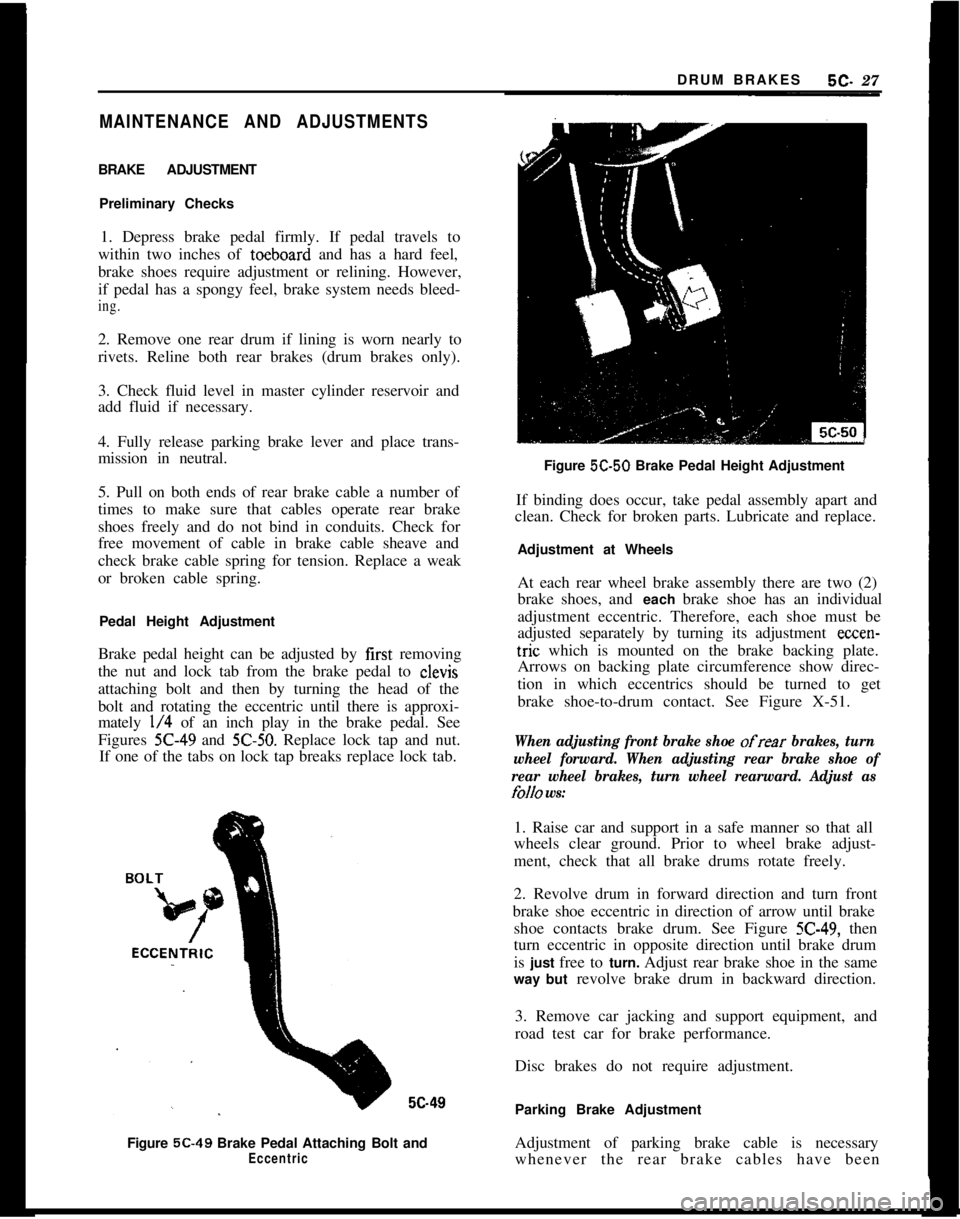
Brake pedal height can be adjusted by first removing
the nut and lock tab from the brake pedal to clevis
attaching bolt and then by turning the head of the
bolt and rotating the eccentric until there is approxi-
mately
l/4 of an inch play in the brake pedal. See
Figures
X-49 and 5C-50. Replace lock tap and nut.
If one of the tabs on lock tap breaks replace lock tab.5c49
Figure 5C-49 Brake Pedal Attaching Bolt and
EccentricFigure 5C-50 Brake Pedal Height Adjustment
If binding does occur, take pedal assembly apart and
clean. Check for broken parts. Lubricate and replace.
Adjustment at Wheels
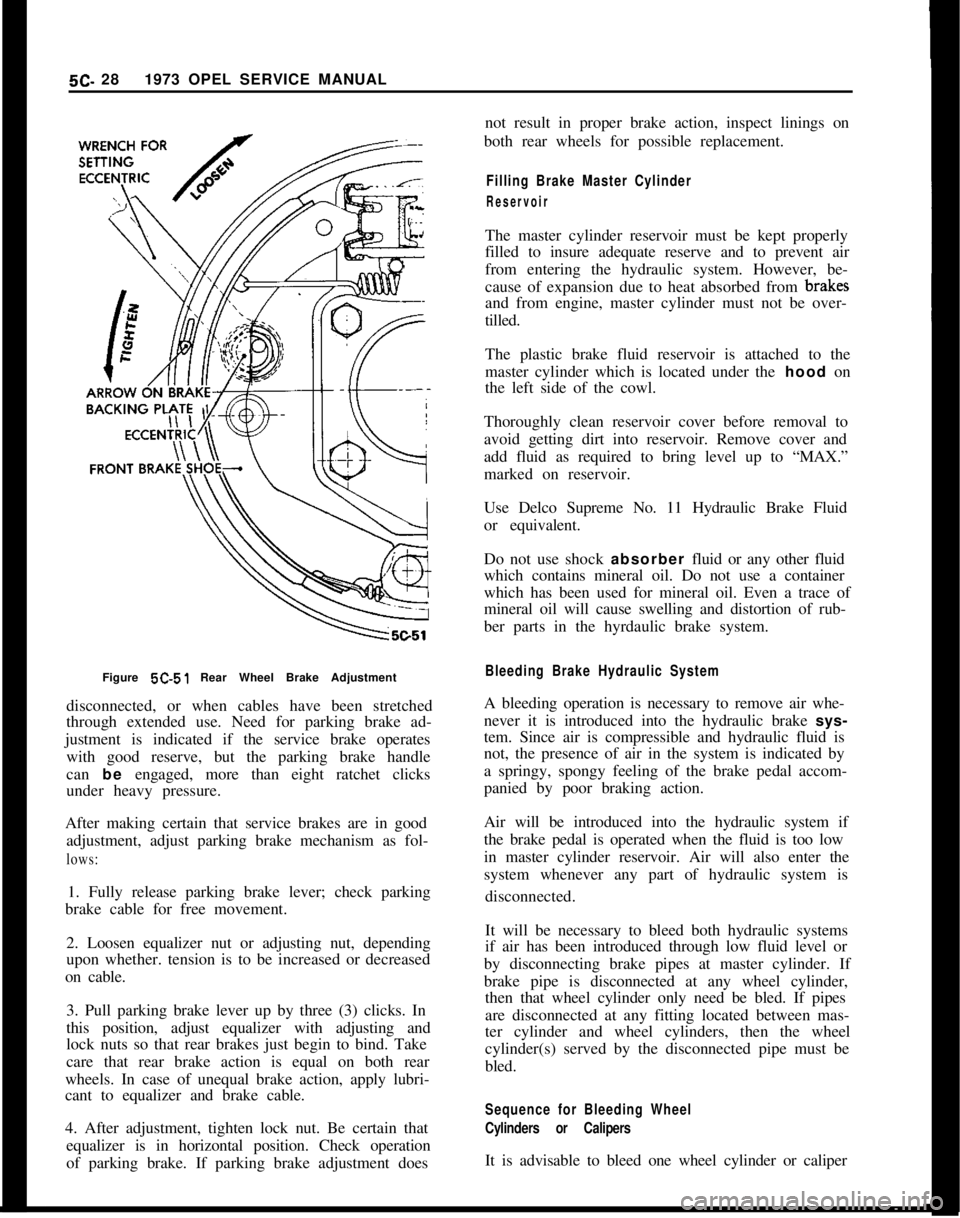
At each rear wheel brake assembly there are two (2)
brake shoes, and each brake shoe has an individual
adjustment eccentric. Therefore, each shoe must be
adjusted separately by turning its adjustment
ccccn-tric which is mounted on the brake backing plate.
Arrows on backing plate circumference show direc-
tion in which eccentrics should be turned to get
brake shoe-to-drum contact. See Figure X-51.
When adjusting front brake shoe ofrear brakes, turn
wheel forward. When adjusting rear brake shoe of
rear wheel brakes, turn wheel rearward. Adjust as
folio ws:1. Raise car and support in a safe manner so that all
wheels clear ground. Prior to wheel brake adjust-
ment, check that all brake drums rotate freely.
2. Revolve drum in forward direction and turn front
brake shoe eccentric in direction of arrow until brake
shoe contacts brake drum. See Figure
5C-49, then
turn eccentric in opposite direction until brake drum
is just free to turn. Adjust rear brake shoe in the same
way but revolve brake drum in backward direction.
3. Remove car jacking and support equipment, and
road test car for brake performance.
Disc brakes do not require adjustment.
Parking Brake Adjustment
Adjustment of parking brake cable is necessary
whenever the rear brake cables have been
Page 287 of 625
5C- 281973 OPEL SERVICE MANUAL
Figure 5C-51 Rear Wheel Brake Adjustment
disconnected, or when cables have been stretched
through extended use. Need for parking brake ad-
justment is indicated if the service brake operates
with good reserve, but the parking brake handle
can be engaged, more than eight ratchet clicks
under heavy pressure.
After making certain that service brakes are in good
adjustment, adjust parking brake mechanism as fol-lows:1. Fully release parking brake lever; check parking
brake cable for free movement.
2. Loosen equalizer nut or adjusting nut, depending
upon whether. tension is to be increased or decreased
on cable.
3. Pull parking brake lever up by three (3) clicks. In
this position, adjust equalizer with adjusting and
lock nuts so that rear brakes just begin to bind. Take
care that rear brake action is equal on both rear
wheels. In case of unequal brake action, apply lubri-
cant to equalizer and brake cable.
4. After adjustment, tighten lock nut. Be certain that
equalizer is in horizontal position. Check operation
of parking brake. If parking brake adjustment doesnot result in proper brake action, inspect linings on
both rear wheels for possible replacement.
Filling Brake Master Cylinder
ReservoirThe master cylinder reservoir must be kept properly
filled to insure adequate reserve and to prevent air
from entering the hydraulic system. However, be-
cause of expansion due to heat absorbed from brakff
and from engine, master cylinder must not be over-
tilled.
The plastic brake fluid reservoir is attached to the
master cylinder which is located under the hood on
the left side of the cowl.
Thoroughly clean reservoir cover before removal to
avoid getting dirt into reservoir. Remove cover and
add fluid as required to bring level up to “MAX.”
marked on reservoir.
Use Delco Supreme No. 11 Hydraulic Brake Fluid
or equivalent.
Do not use shock absorber fluid or any other fluid
which contains mineral oil. Do not use a container
which has been used for mineral oil. Even a trace of
mineral oil will cause swelling and distortion of rub-
ber parts in the hyrdaulic brake system.
Bleeding Brake Hydraulic SystemA bleeding operation is necessary to remove air whe-
never it is introduced into the hydraulic brake sys-
tem. Since air is compressible and hydraulic fluid is
not, the presence of air in the system is indicated by
a springy, spongy feeling of the brake pedal accom-
panied by poor braking action.
Air will be introduced into the hydraulic system if
the brake pedal is operated when the fluid is too low
in master cylinder reservoir. Air will also enter the
system whenever any part of hydraulic system is
disconnected.
It will be necessary to bleed both hydraulic systems
if air has been introduced through low fluid level or
by disconnecting brake pipes at master cylinder. If
brake pipe is disconnected at any wheel cylinder,
then that wheel cylinder only need be bled. If pipes
are disconnected at any fitting located between mas-
ter cylinder and wheel cylinders, then the wheel
cylinder(s) served by the disconnected pipe must be
bled.
Sequence for Bleeding Wheel
Cylinders or CalipersIt is advisable to bleed one wheel cylinder or caliper
Page 302 of 625
ENGINE MECHANICAL AND MOUNTS6A- 11
a. Attach left chain to alternator support rear bolt.
b. Bolt right chain to existing threaded hole at lower
right front of engine.
2. Assemble loose ends of chain to support device J-bolts and adjust to remove engine weight from motor
mounts.
3. Remove the two motor mount bracket to motor
mount retaining nuts.
4. Remove the two front suspension to frame rail bolt
retaining nuts.
5. Remove nut and bolt at lower end of steering shaft
U-joint.
6. With a floor jack under the center of the front
suspension cross member, raise car high enough for
wheels and suspension assembly to be rolled from
under car.
7. Position jack stands under both front jack brackets
on underbody to support car in this position.
8. Remove both front cross member support to frame
attaching bolts.
9. Remove brake pipe to brake hose retaining clips
at frame rails and disconnect brake hose from brake
pipes. Use an absorbent material or suitable con-
tainer for the brake fluid that will drain out.
10. Lower the front suspension assembly and remove
from under car.
11. Drain engine oil and remove oil pan and gasket.
Installation (Opel 1900 and Manta)1. Apply a light bead of sealer to the clean sealing
surfaces of the oil pan and affix a new gasket.
2. Bolt oil pan and gasket assembly to engine block.
3. Roll front suspension and floor jack under car and
raise into position careful to pilot the cross member
to frame rail attaching bolts and steering shaft to
their respective locations.
4. Install cross member’support to frame attaching
bolts and torque to 22 lb.ft.
5. Connect brake hose to brake pipes and install
retaining clips.
6. Bleed front brake system. Maintain brake fluid1Wd.
7. Remove jack stands and lower car.8. Install suspension to frame rail bolt retaining nuts.
9. Release and remove engine supporting device.
10. Install motor mount bracket to motor mount
retaining nuts.
11. Install steering shaft U-joint lower bolt and nut.
12. Replace engine oil.
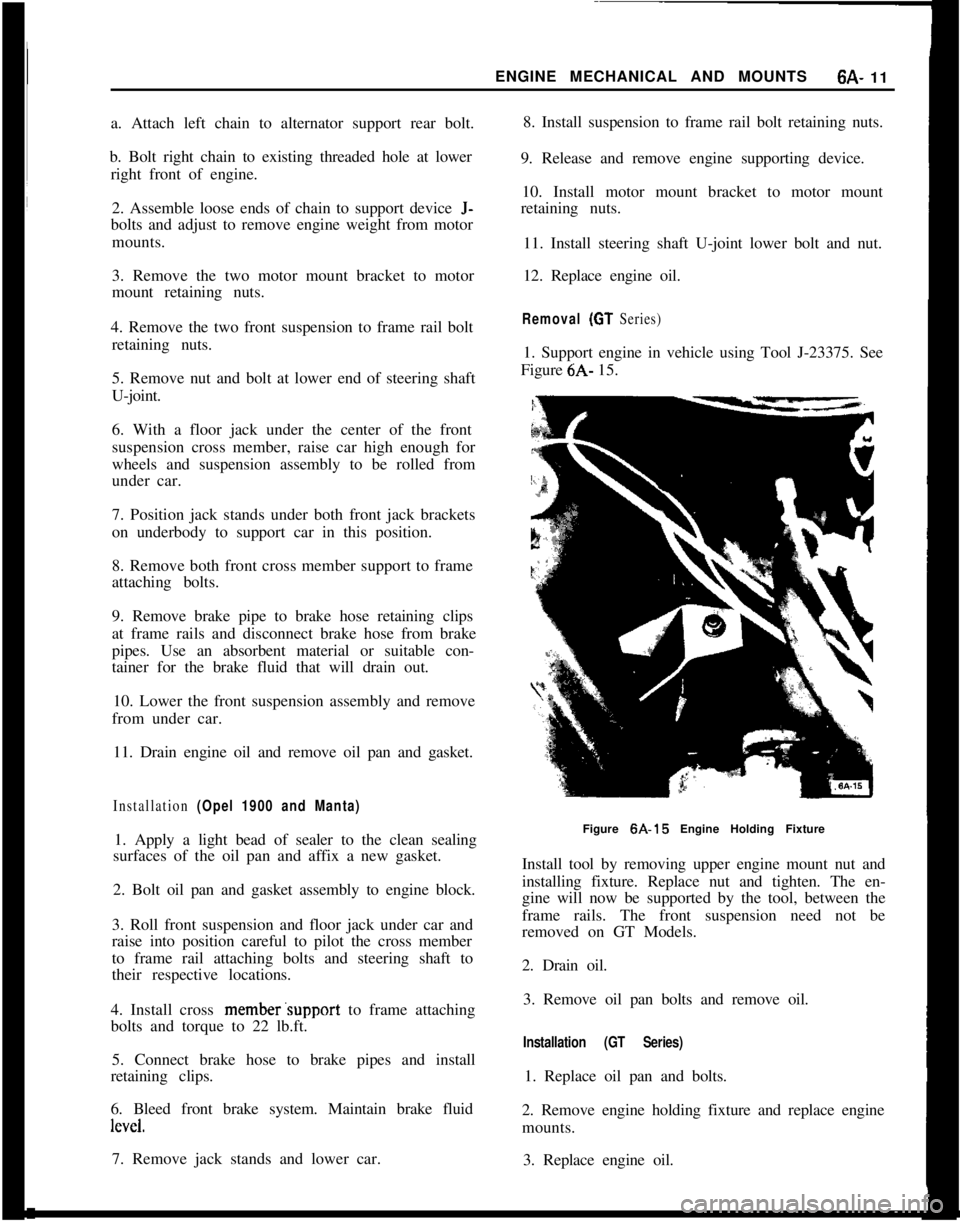
Removal (GT Series)1. Support engine in vehicle using Tool J-23375. See
Figure 6A- 15.
Figure 6A-15 Engine Holding Fixture
Install tool by removing upper engine mount nut and
installing fixture. Replace nut and tighten. The en-
gine will now be supported by the tool, between the
frame rails. The front suspension need not be
removed on GT Models.
2. Drain oil.
3. Remove oil pan bolts and remove oil.
Installation (GT Series)1. Replace oil pan and bolts.
2. Remove engine holding fixture and replace engine
mounts.
3. Replace engine oil.
Page 313 of 625
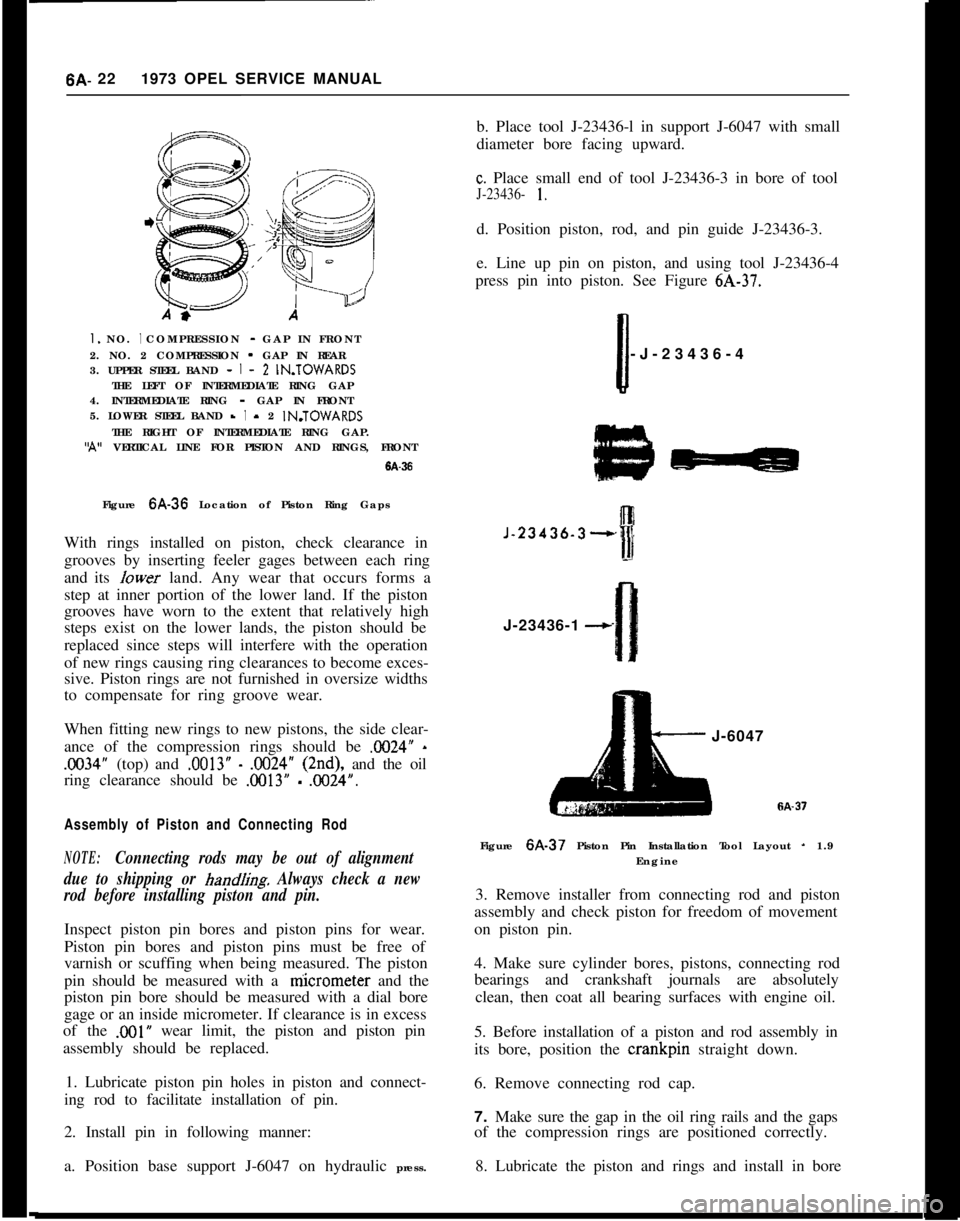
6A- 221973 OPEL SERVICE MANUALI. NO. I COMPRESSION - GAP IN FRONT
2. NO. 2 COMPRESSION - GAP IN REAR
3. UPPER STEEL BAND -
I - 2 IN.TOWARDS
THE LEFT OF INTERMEDIATE RING GAP
4. INTERMEDIATE RING - GAP IN FRONT
5. LOWER STEEL BAND -
I - 2 IN.TOWARDS
THE RIGHT OF INTERMEDIATE RING GAP.‘A” VERTICAL LINE FOR PISTON AND RINGS, FRONT
6A-36Figure 6A-36 Location of Piston Ring Gaps
With rings installed on piston, check clearance in
grooves by inserting feeler gages between each ring
and its Iower land. Any wear that occurs forms a
step at inner portion of the lower land. If the piston
grooves have worn to the extent that relatively high
steps exist on the lower lands, the piston should be
replaced since steps will interfere with the operation
of new rings causing ring clearances to become exces-
sive. Piston rings are not furnished in oversize widths
to compensate for ring groove wear.
When fitting new rings to new pistons, the side clear-
ance of the compression rings should be X024”
-
.1X34” (top) and .0013” - .OO24” (2nd), and the oil
ring clearance should be
.OO13” - .0024”.
Assembly of Piston and Connecting Rod
NOTE:Connecting rods may be out of alignment
due to shipping or
hand/i& Always check a new
rod before installing piston and pin.Inspect piston pin bores and piston pins for wear.
Piston pin bores and piston pins must be free of
varnish or scuffing when being measured. The piston
pin should be measured with a niicrometer and the
piston pin bore should be measured with a dial bore
gage or an inside micrometer. If clearance is in excess
of the
,001” wear limit, the piston and piston pin
assembly should be replaced.
1. Lubricate piston pin holes in piston and connect-
ing rod to facilitate installation of pin.
2. Install pin in following manner:
a. Position base support J-6047 on hydraulic press.b. Place tool J-23436-l in support J-6047 with small
diameter bore facing upward.
c. Place small end of tool J-23436-3 in bore of tool
J-23436- 1.d. Position piston, rod, and pin guide J-23436-3.
e. Line up pin on piston, and using tool J-23436-4
press pin into piston. See Figure 6A-37.
Ii-J-23436-4
J-23436-3--,J-23436-1
--cJ-6047
Figure 6A-37 Piston Pin Installation Tool Layout
- 1.9
Engine
3. Remove installer from connecting rod and piston
assembly and check piston for freedom of movement
on piston pin.
4. Make sure cylinder bores, pistons, connecting rod
bearings and crankshaft journals are absolutely
clean, then coat all bearing surfaces with engine oil.
5. Before installation of a piston and rod assembly in
its bore, position the crankpin straight down.
6. Remove connecting rod cap.
7. Make sure the gap in the oil ring rails and the gaps
of the compression rings are positioned correctly.
8. Lubricate the piston and rings and install in bore
Page 314 of 625
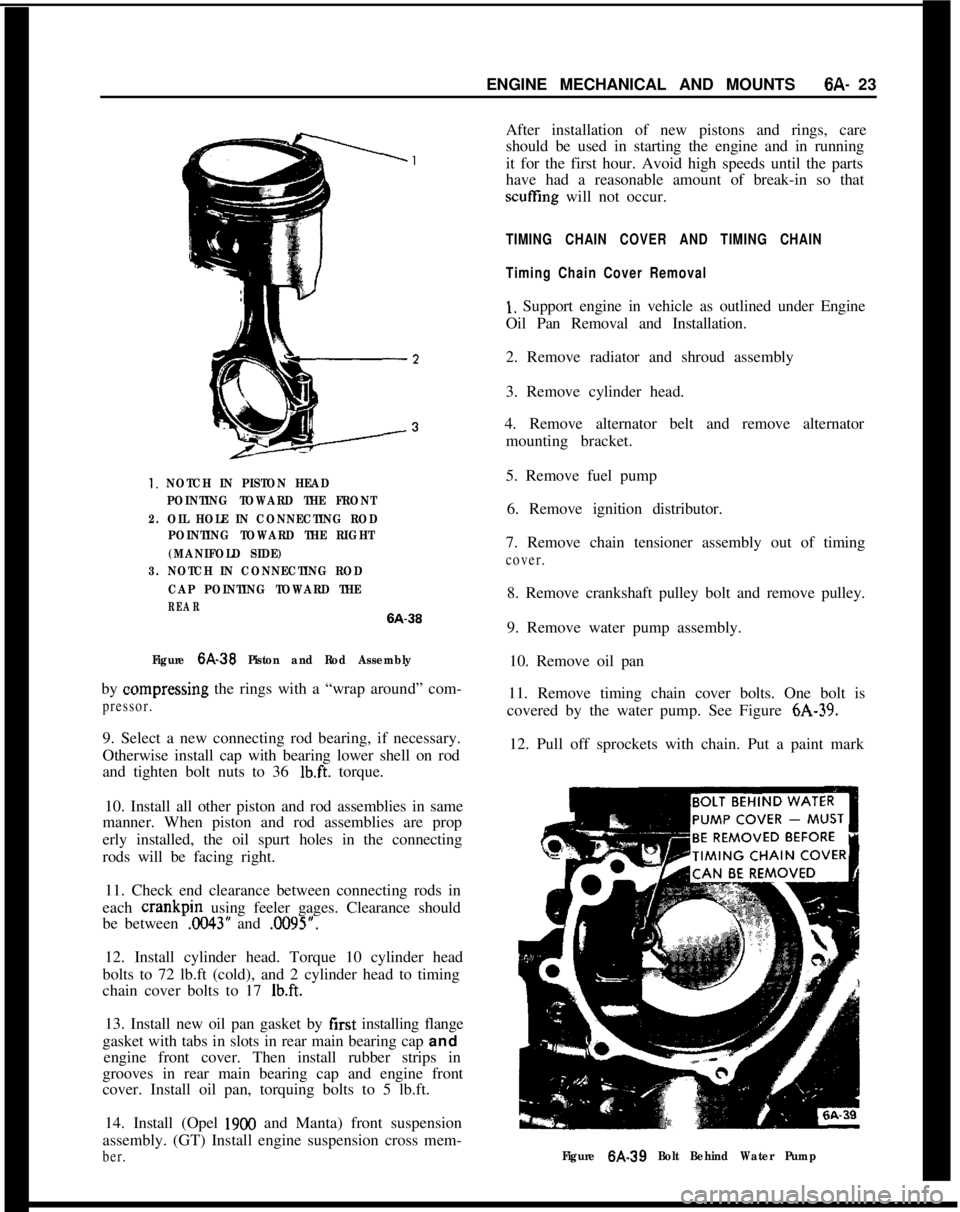
ENGINE MECHANICAL AND MOUNTS6A- 231. NOTCH IN PISTON HEAD
POINTING TOWARD THE FRONT
2. OIL HOLE IN CONNECTING ROD
POINTING TOWARD THE RIGHT
(MANIFOLD SIDE)
3. NOTCH IN CONNECTING ROD
CAP POINTING TOWARD THE
REAR6A-36
Figure
6A-39 Piston and Rod Assemblyby oompressing the rings with a “wrap around” com-
pressor.9. Select a new connecting rod bearing, if necessary.
Otherwise install cap with bearing lower shell on rod
and tighten bolt nuts to 36
lb.ft. torque.
10. Install all other piston and rod assemblies in same
manner. When piston and rod assemblies are prop
erly installed, the oil spurt holes in the connecting
rods will be facing right.
11. Check end clearance between connecting rods in
each crankpin using feeler gages. Clearance should
be between
.0043” and .0095”.
12. Install cylinder head. Torque 10 cylinder head
bolts to 72 lb.ft (cold), and 2 cylinder head to timing
chain cover bolts to 17
lb.ft.13. Install new oil pan gasket by first installing flange
gasket with tabs in slots in rear main bearing cap and
engine front cover. Then install rubber strips in
grooves in rear main bearing cap and engine front
cover. Install oil pan, torquing bolts to 5 lb.ft.
14. Install (Opel
1900 and Manta) front suspension
assembly. (GT) Install engine suspension cross mem-
ber.After installation of new pistons and rings, care
should be used in starting the engine and in running
it for the first hour. Avoid high speeds until the parts
have had a reasonable amount of break-in so that
scuffling will not occur.
TIMING CHAIN COVER AND TIMING CHAIN
Timing Chain Cover Removal
1, Support engine in vehicle as outlined under Engine
Oil Pan Removal and Installation.
2. Remove radiator and shroud assembly
3. Remove cylinder head.
4. Remove alternator belt and remove alternator
mounting bracket.
5. Remove fuel pump
6. Remove ignition distributor.
7. Remove chain tensioner assembly out of timing
cover.8. Remove crankshaft pulley bolt and remove pulley.
9. Remove water pump assembly.
10. Remove oil pan
11. Remove timing chain cover bolts. One bolt is
covered by the water pump. See Figure 6A-39.
12. Pull off sprockets with chain. Put a paint mark
Figure 6A-39 Bolt Behind Water Pump
Page 328 of 625
FUEL SYSTEMSC- 37
must always be removed before the distributor can be
removed.
EVAPORATION CONTROL SYSTEM1. The function of the fuel evaporation control sys-
tem is to absorb the fuel vapors developing in the fuel
tank, especially when vehicle is parked, due to at-
mospheric pressure and temperature influences, and
to release these fuel vapors during vehicle operation.
2. This system utilizes the property of the activated
carbon to absorb and expel fuel vapors. The activated
carbon container is installed on the left front side of
the engine compartment. The fuel tank has a
non-vented tiller cap. Vent hoses are joined in the area of
the tank. A plastic evaporation line leads from there
along vehicle underbody to the activated carbon con-
tainer.
3. A small tube above the throttle valve body con-
nects the carburetor to the activated carbon con-
tainer. In this way, the fuel vapor collected in the
activated carbon container is fed through the carbu-
retor into the combustion chambers during engine
operation.
4. The carburetor is provided with an internal and
outside ventilation, the activated carbon container is
also connected to the outside ventilation (only effec-
tive when engine is idling). In this way, the fuel
vapors escaping to the outside during engine idle are
collected by the activated carbon container and fed
into the combustion chambers.
5. The vent lines are connected to the upper part of
the activated carbon container. Fresh air enters
through a foam rubber filter at the lower part andflows, together with the fuel vapor, to the carburetor.
Metered bores in the hose fittings of the fuel tank
control the air
- and fuel vapor flow through the
activated carbon container to the carburetor, and the
pressure release in the fuel tank and ensure complete
purging of the carbon container.
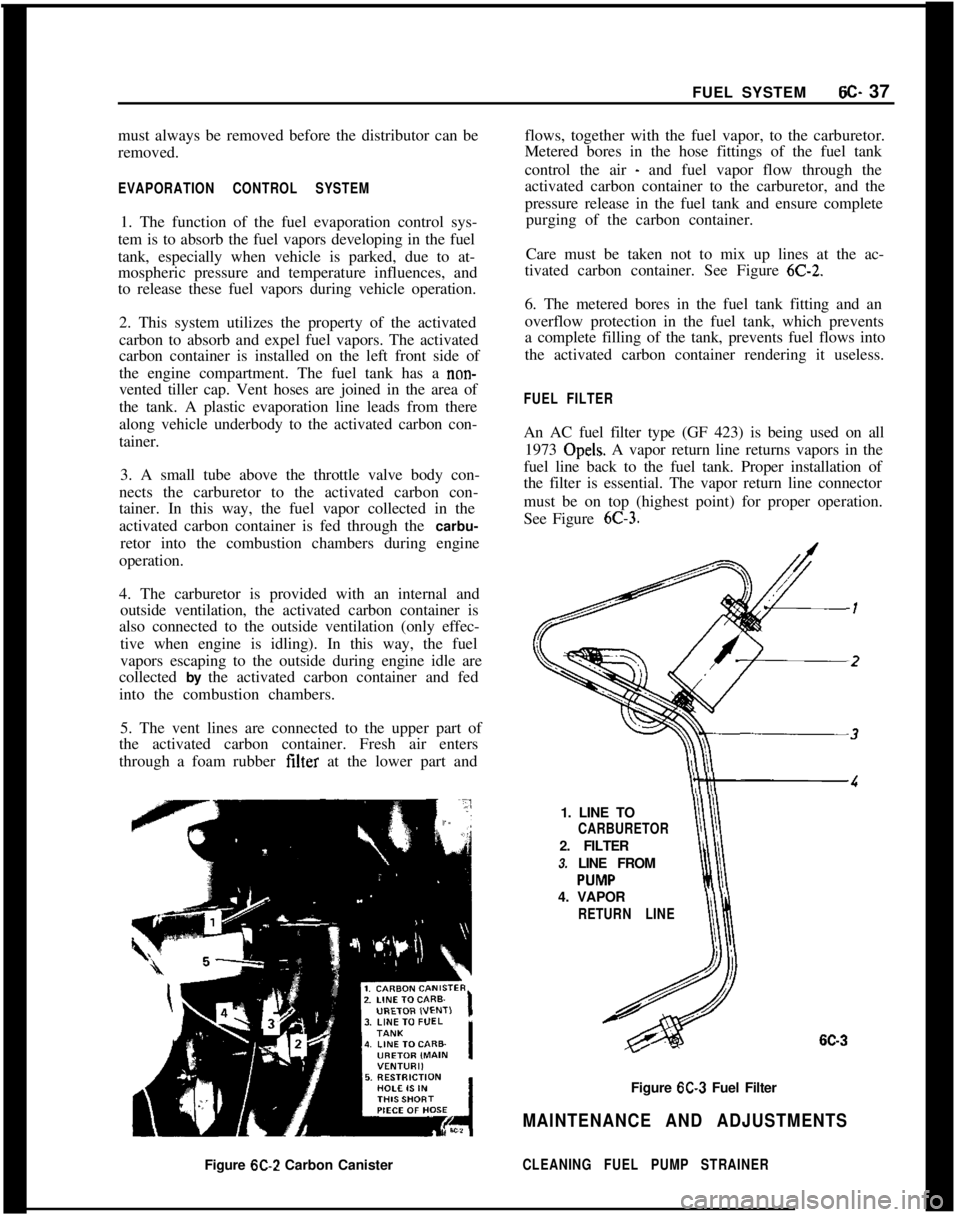
Care must be taken not to mix up lines at the ac-
tivated carbon container. See Figure
6C-2.6. The metered bores in the fuel tank fitting and an
overflow protection in the fuel tank, which prevents
a complete filling of the tank, prevents fuel flows into
the activated carbon container rendering it useless.
FUEL FILTERAn AC fuel filter type (GF 423) is being used on all
1973 Opels. A vapor return line returns vapors in the
fuel line back to the fuel tank. Proper installation of
the filter is essential. The vapor return line connector
must be on top (highest point) for proper operation.
See Figure
6C-3.1. LINE TO
CARBURETOR2. FILTER
3. LINE FROM
4. VAPOR
RETURN LINE
6C-3Figure
6C-3 Fuel Filter
MAINTENANCE AND ADJUSTMENTSFigure
6C-2 Carbon CanisterCLEANING FUEL PUMP STRAINER
Page 400 of 625
AUTOMATIC TRANSMISSION7c- 39
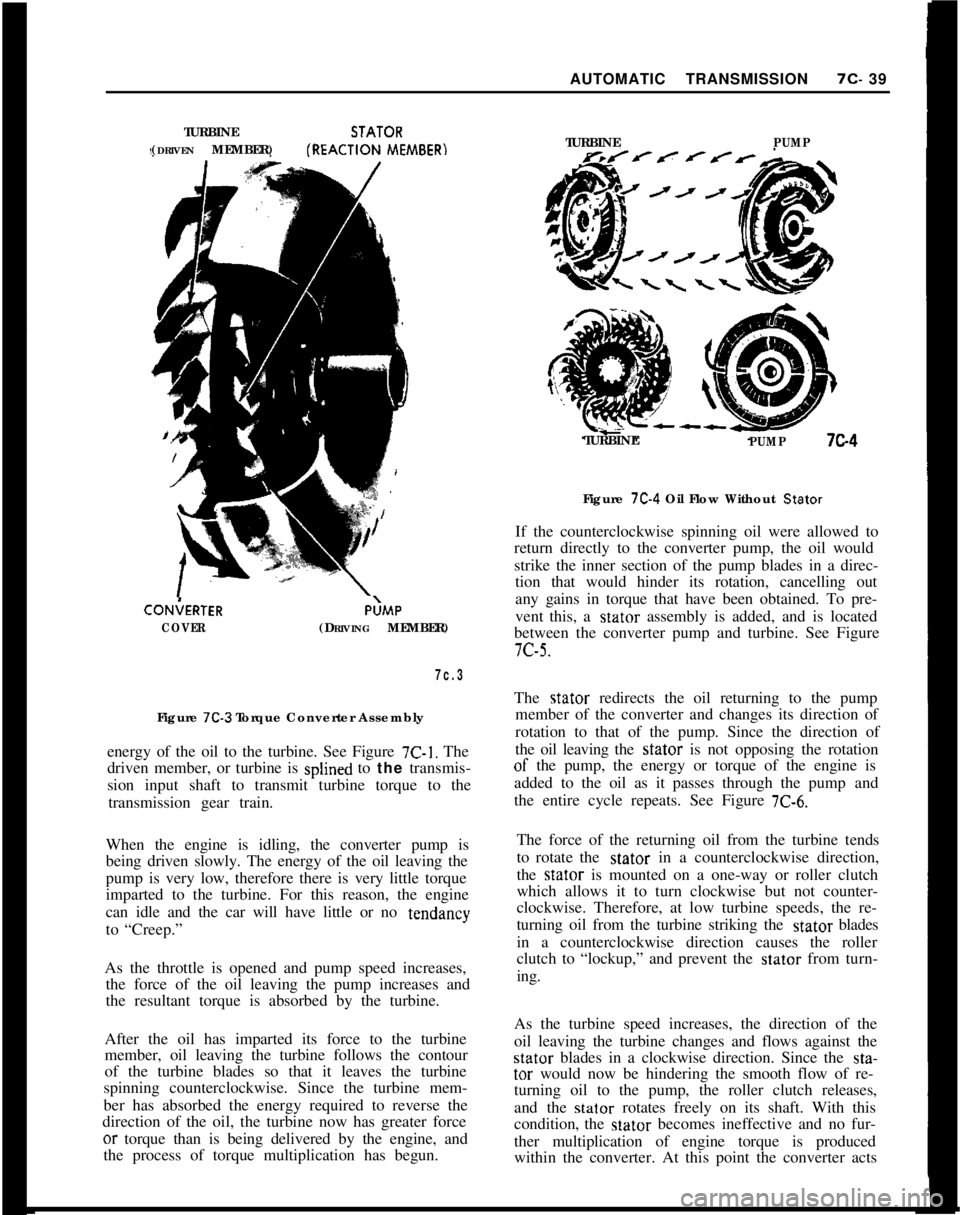
TURBINESTATOR
(DRIVEN MEMBER)fREACTION
MEMBER)CON;ERTER
COVERP;MP
(DRIVING MEMBER)
7c.3Figure
7C-3 Torque Converter Assembly
energy of the oil to the turbine. See Figure
7C-1. The
driven member, or turbine is splined to the transmis-
sion input shaft to transmit turbine torque to the
transmission gear train.
When the engine is idling, the converter pump is
being driven slowly. The energy of the oil leaving the
pump is very low, therefore there is very little torque
imparted to the turbine. For this reason, the engine
can idle and the car will have little or no tendancy
to “Creep.”
As the throttle is opened and pump speed increases,
the force of the oil leaving the pump increases and
the resultant torque is absorbed by the turbine.
After the oil has imparted its force to the turbine
member, oil leaving the turbine follows the contour
of the turbine blades so that it leaves the turbine
spinning counterclockwise. Since the turbine mem-
ber has absorbed the energy required to reverse the
direction of the oil, the turbine now has greater forceor torque than is being delivered by the engine, and
the process of torque multiplication has begun.TURBINE
PUMPTURBINE
PUMP7c4Figure
7C-4 Oil Flow Without Stator
If the counterclockwise spinning oil were allowed to
return directly to the converter pump, the oil would
strike the inner section of the pump blades in a direc-
tion that would hinder its rotation, cancelling out
any gains in torque that have been obtained. To pre-
vent this, a stator assembly is added, and is located
between the converter pump and turbine. See Figure7c-5.
The stator redirects the oil returning to the pump
member of the converter and changes its direction of
rotation to that of the pump. Since the direction of
the oil leaving the stator is not opposing the rotationof the pump, the energy or torque of the engine is
added to the oil as it passes through the
the entire cycle repeats. See Figure
7C-6.pump and
The force of the returning oil from the turbine tends
to rotate the stator in a counterclockwise direction,
the stator is mounted on a one-way or roller clutch
which allows it to turn clockwise but not counter-
clockwise. Therefore, at low turbine speeds, the re-
turning oil from the turbine striking the stator blades
in a counterclockwise direction causes the roller
clutch to “lockup,” and prevent the stator from turn-
ing.
As the turbine speed increases, the direction of the
oil leaving the turbine changes and flows against thestator blades in a clockwise direction. Since the sta-tar would now be hindering the smooth flow of re-
turning oil to the pump, the roller clutch releases,
and the stator rotates freely on its shaft. With this
condition, the stator becomes ineffective and no fur-
ther multiplication of engine torque is produced
within the converter. At this point the converter acts
Page 528 of 625

REFRIGERANT COMPONENTS ALL MODELS9s. 19
Figure 98.3 Effect of One B.T.U. on One
Pc’und of
water
teristics of heat if we think of heat as a sort of color-
ing dye. If we add one drop of red dye to a glass of
water, it will turn slightly pink. Another drop will
make the water more reddish in color (Fig.
9B-4).The more drops of dye we add, the redder the water
will get. Each drop of dye corresponds to 1 Btu and
the succeedingly deeper shades of red are like in-
creases in temperature.
Figure
98-4 Addition of B.T.U. Heats Water
It may seem a little puzzling to talk about beat in a
story on air conditioning but, when you stop to
think about it, we are handling heat exclusively. Al-
though we ordinarily think of an air conditioner as
a device for making air cold, it doesn’t do that di-
rectly. What it does is take heat away from the in-
coming air and transfer that heat outside the vehicle.
We know now that cold is nothing more than the
absence of heat, and that heat always flow from a
warm object to a colder one. We also have
:a clearer
idea of how heat is measured.
From everything we’ve learned about heat
EO far, it
seems to behave in a perfectly normal manner. Yetsometimes heat will disappear without leaving a sin-
gle clue.
Ice vs. Water for CoolingEtery once in a while in the old days, the ice-man
would forget to refill the ice-box. Occasionally, as the
last sliver of ice melted away, somebody would come
up with a bright idea. He would remember that the
water in the drain-pan always felt ice-cold when he
had emptied it other times. So, he would get the
thermometer out and check its temperature. Sure
enough, it usually was about as cold as the ice. Why
not put the drain-pan back in the ice compartment
to keep things cold until the iceman returned the
next day
It was a good idea. but it never worked. For some
strange reason the ice-box never stayed cold. The
drain water soon got quite warm and in a couple of
hours, the butter in the ice-box would begin to melt,
the milk would start to sour, and the vegetables
would wilt.
Why did this happen? The drain water was only a
few degrees warmer than the ice yet it didn’t draw
nearly as much heat out of the stored foods. How-
ever, the difference between the behavior of cold
drain water and ice is the real secret as to how any
refrigerator works and we can easily learn the an-
swer by using an ordinary thermometer.
When we put a drain pan full of cold water into the
ice compartment, we expect the heat to flow from the
warm foods to the colder water. Remember, that
heat always flows from a warm object to a colder
object and when we add heat to water, it gets
warmer. Each Btu of heat added to a pound of water
makes it one degree warmer.
Figure 98.5 Melting Ice Remains at 32 Degrees
Page 529 of 625
98-20 1973 OPEL SERVICE MANUAL
If we were to put a thermometer in the cold drain
water, we would see the temperature gradually creep
upwards. That is to be expected because heat is flow-
ing into the cold water making it warmer. Before
long the water would be as warm as the stored foods.
Then the water could no longer attract heat because
heat will not flow from one warm object to another
equally warm object. Since we no longer can draw
heat out of the foods we no longer are cooling them.
Now, let’s see what happens when we put ice instead
of cold water into the ice-box. This time, we’ll set the
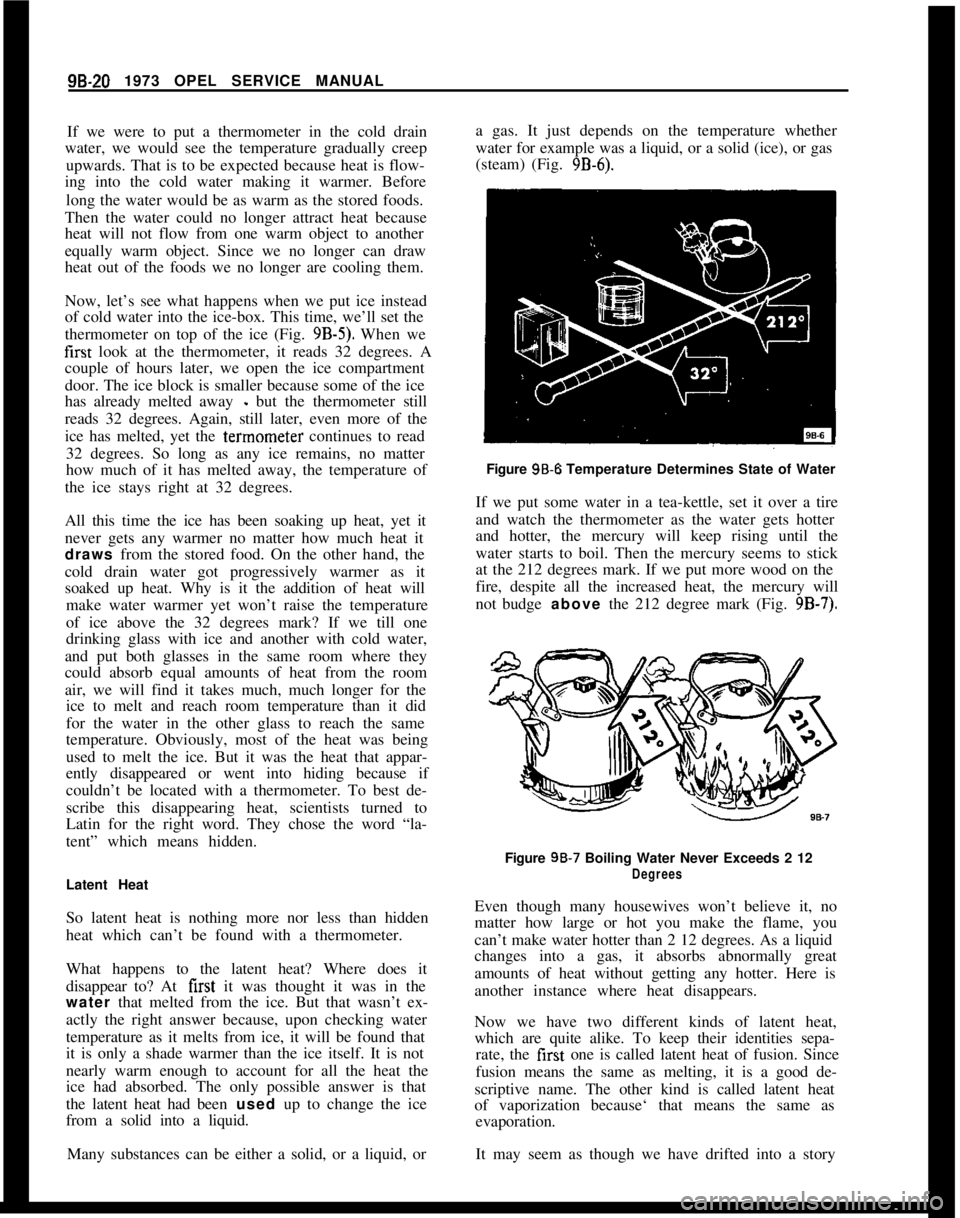
thermometer on top of the ice (Fig. 9B-5). When wefirst look at the thermometer, it reads 32 degrees. A
couple of hours later, we open the ice compartment
door. The ice block is smaller because some of the ice
has already melted away
- but the thermometer still
reads 32 degrees. Again, still later, even more of the
ice has melted, yet the termometer continues to read
32 degrees. So long as any ice remains, no matter
how much of it has melted away, the temperature of
the ice stays right at 32 degrees.
All this time the ice has been soaking up heat, yet it
never gets any warmer no matter how much heat it
draws from the stored food. On the other hand, the
cold drain water got progressively warmer as it
soaked up heat. Why is it the addition of heat will
make water warmer yet won’t raise the temperature
of ice above the 32 degrees mark? If we till one
drinking glass with ice and another with cold water,
and put both glasses in the same room where they
could absorb equal amounts of heat from the room
air, we will find it takes much, much longer for the
ice to melt and reach room temperature than it did
for the water in the other glass to reach the same
temperature. Obviously, most of the heat was being
used to melt the ice. But it was the heat that appar-
ently disappeared or went into hiding because if
couldn’t be located with a thermometer. To best de-
scribe this disappearing heat, scientists turned to
Latin for the right word. They chose the word “la-
tent” which means hidden.
Latent Heat
So latent heat is nothing more nor less than hidden
heat which can’t be found with a thermometer.
What happens to the latent heat? Where does it
disappear to? At first it was thought it was in the
water that melted from the ice. But that wasn’t ex-
actly the right answer because, upon checking water
temperature as it melts from ice, it will be found that
it is only a shade warmer than the ice itself. It is not
nearly warm enough to account for all the heat the
ice had absorbed. The only possible answer is that
the latent heat had been used up to change the ice
from a solid into a liquid.
Many substances can be either a solid, or a liquid, ora gas. It just depends on the temperature whether
water for example was a liquid, or a solid (ice), or gas
(steam) (Fig.
9B-6).Figure 99-6 Temperature Determines State of Water
If we put some water in a tea-kettle, set it over a tire
and watch the thermometer as the water gets hotter
and hotter, the mercury will keep rising until the
water starts to boil. Then the mercury seems to stick
at the 212 degrees mark. If we put more wood on the
fire, despite all the increased heat, the mercury will
not budge above the 212 degree mark (Fig.
9B-7).Figure 98.7 Boiling Water Never Exceeds 2 12
DegreesEven though many housewives won’t believe it, no
matter how large or hot you make the flame, you
can’t make water hotter than 2 12 degrees. As a liquid
changes into a gas, it absorbs abnormally great
amounts of heat without getting any hotter. Here is
another instance where heat disappears.
Now we have two different kinds of latent heat,
which are quite alike. To keep their identities sepa-
rate, the first one is called latent heat of fusion. Since
fusion means the same as melting, it is a good de-
scriptive name. The other kind is called latent heat
of vaporization because‘ that means the same as
evaporation.
It may seem as though we have drifted into a story
Page 530 of 625
REFRIGERANT COMPONENTS ALL MODELSSE- 21
about heat instead of refrigeration. But in doing so,
we have learned how a simple ice-box works. It’s
because the magic of latent heat of fusion gives ice
the ability to soak up quantities of heat without get-
ting any warmer.
Therefore, since it stays cold, it can continue to draw
heat away from stored foods and make them cooler.
The latent heat of vaporization can be an even better
“magnet” because it will soak up even more heat.
Whenever we think of anything boiling, we instinc-
tively think of it being very hot. However, that’s not
true in every case. Just because water
boi1.s at 212
degrees doesn’t mean that all other substances will
boil at the same temperature. Some would have to be
put into a blast furnace to make them bubble and
give off vapor. On the other hand, others will boil
violently while sitting on a block of ice.
And so each substance has its own particular boiling
point temperature. But regardless of whether it is
high or low, they all absorb unusually large quanti-
ties of heat without getting any warmer when they
change from a liquid into a vapor.
Consequently, any liquid that will boil at a tempera-
ture below the freezing point of water, will make ice
cubes and keep vegetables cool in a mechanical re-
frigerator.
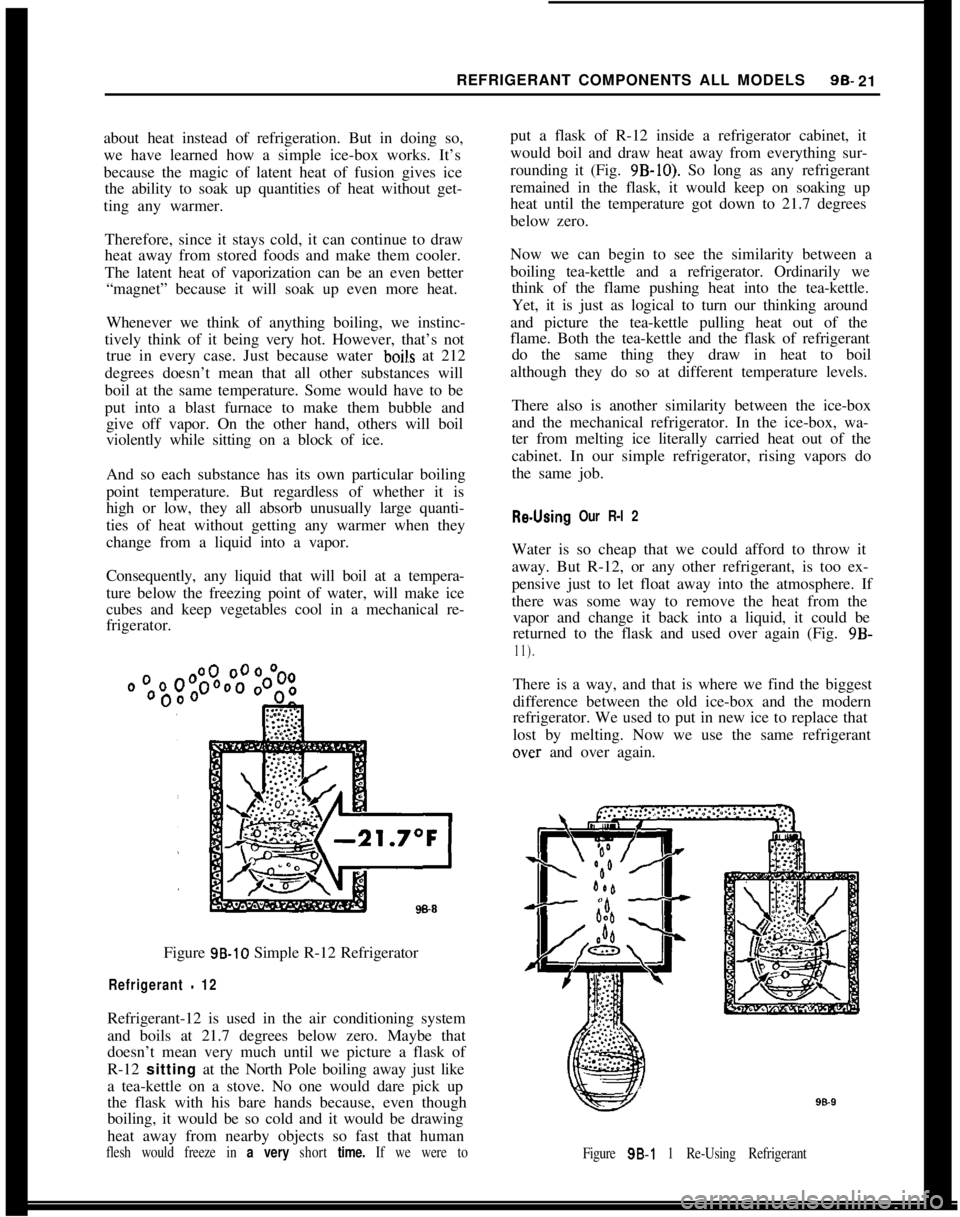
Figure
9B-10 Simple R-12 Refrigerator
Refrigerant - 12Refrigerant-12 is used in the air conditioning system
and boils at 21.7 degrees below zero. Maybe that
doesn’t mean very much until we picture a flask of
R-12 sitting at the North Pole boiling away just like
a tea-kettle on a stove. No one would dare pick up
the flask with his bare hands because, even though
boiling, it would be so cold and it would be drawing
heat away from nearby objects so fast that human
flesh would freeze in a very short time. If we were toput a flask of R-12 inside a refrigerator cabinet, it
would boil and draw heat away from everything sur-
rounding it (Fig.
9B-10). So long as any refrigerant
remained in the flask, it would keep on soaking up
heat until the temperature got down to 21.7 degrees
below zero.
Now we can begin to see the similarity between a
boiling tea-kettle and a refrigerator. Ordinarily we
think of the flame pushing heat into the tea-kettle.
Yet, it is just as logical to turn our thinking around
and picture the tea-kettle pulling heat out of the
flame. Both the tea-kettle and the flask of refrigerant
do the same thing they draw in heat to boil
although they do so at different temperature levels.
There also is another similarity between the ice-box
and the mechanical refrigerator. In the ice-box, wa-
ter from melting ice literally carried heat out of the
cabinet. In our simple refrigerator, rising vapors do
the same job.Rdsing
Our R-l 2Water is so cheap that we could afford to throw it
away. But R-12, or any other refrigerant, is too ex-
pensive just to let float away into the atmosphere. If
there was some way to remove the heat from the
vapor and change it back into a liquid, it could be
returned to the flask and used over again (Fig. 9B-
11).There is a way, and that is where we find the biggest
difference between the old ice-box and the modern
refrigerator. We used to put in new ice to replace that
lost by melting. Now we use the same refrigerantover and over again.
Figure 9B-1 1 Re-Using Refrigerant