air condition OPEL 1900 1973 Owner's Manual
[x] Cancel search | Manufacturer: OPEL, Model Year: 1973, Model line: 1900, Model: OPEL 1900 1973Pages: 625, PDF Size: 17.22 MB
Page 228 of 625
WHEELS AND TIRES3G- 61Cornering Tread WearThe modern independently-sprung automobile al-
lows the driver to negotiate turns at a high rate of
speed with a greater feeling of safety. This fact is
responsible for a comparatively new type of tread
wear that can easily be mistaken for toe or camber
wear.When a car is making a turn, the tires are supposed
to be rolling in a circle. When the turn is made at
high speed, however, centrifugal force acting on the
car causes the tires to be distorted sideways and to
slip or skid on the road surface. This produces a
diagonal cross type of wear, which in severe cases
will result in a fine or sharp edge on each rib of the
tire treads.
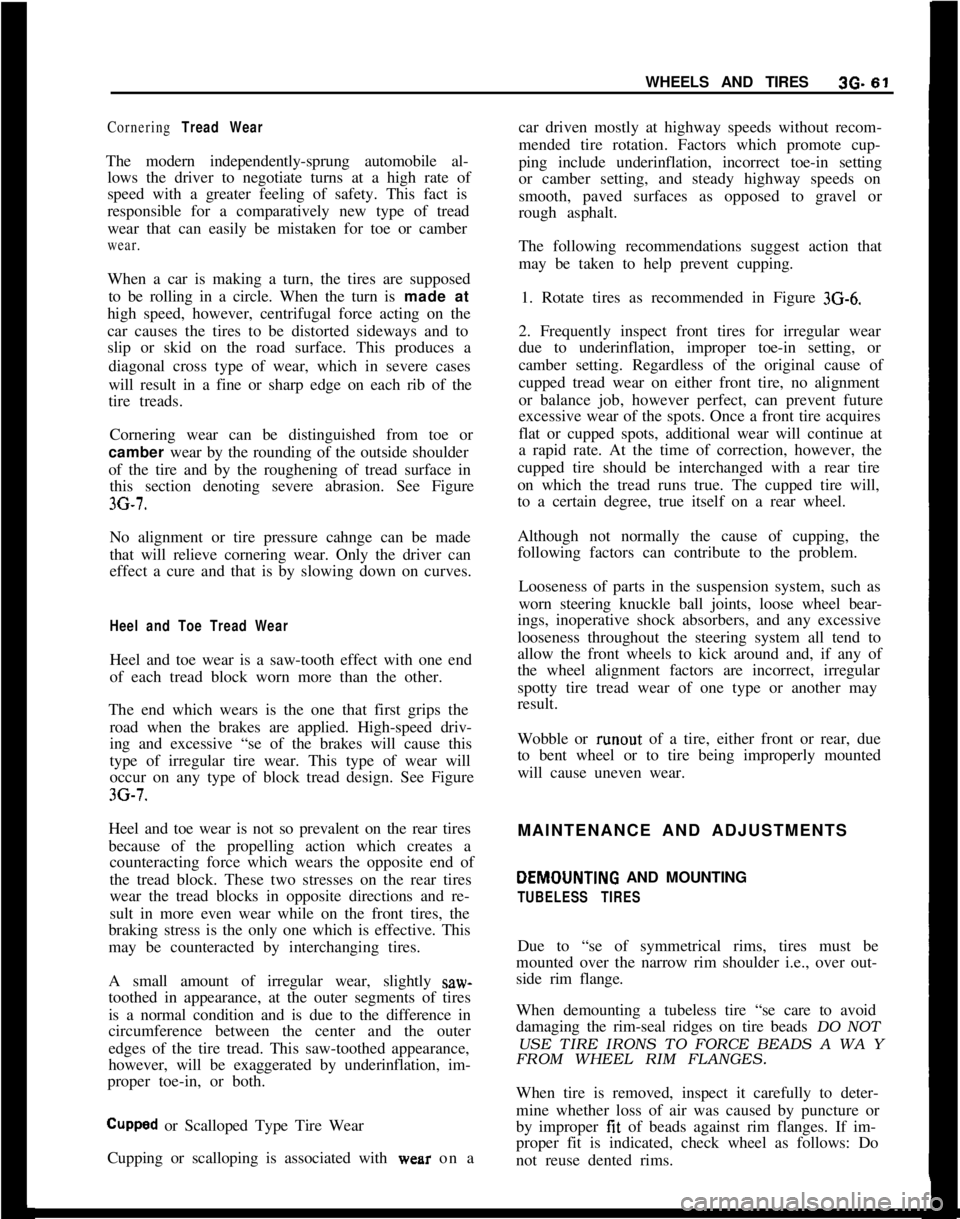
Cornering wear can be distinguished from toe or
camber wear by the rounding of the outside shoulder
of the tire and by the roughening of tread surface in
this section denoting severe abrasion. See Figure
3G-7.No alignment or tire pressure cahnge can be made
that will relieve cornering wear. Only the driver can
effect a cure and that is by slowing down on curves.
Heel and Toe Tread WearHeel and toe wear is a saw-tooth effect with one end
of each tread block worn more than the other.
The end which wears is the one that first grips the
road when the brakes are applied. High-speed driv-
ing and excessive “se of the brakes will cause this
type of irregular tire wear. This type of wear will
occur on any type of block tread design. See Figure3G-7.
Heel and toe wear is not so prevalent on the rear tires
because of the propelling action which creates a
counteracting force which wears the opposite end of
the tread block. These two stresses on the rear tires
wear the tread blocks in opposite directions and re-
sult in more even wear while on the front tires, the
braking stress is the only one which is effective. This
may be counteracted by interchanging tires.
A small amount of irregular wear, slightly
saw-toothed in appearance, at the outer segments of tires
is a normal condition and is due to the difference in
circumference between the center and the outer
edges of the tire tread. This saw-toothed appearance,
however, will be exaggerated by underinflation, im-
proper toe-in, or both.Cupped or Scalloped Type Tire Wear
Cupping or scalloping is associated with wear on acar driven mostly at highway speeds without recom-
mended tire rotation. Factors which promote cup-
ping include underinflation, incorrect toe-in setting
or camber setting, and steady highway speeds on
smooth, paved surfaces as opposed to gravel or
rough asphalt.
The following recommendations suggest action that
may be taken to help prevent cupping.
1. Rotate tires as recommended in Figure
3G-6.2. Frequently inspect front tires for irregular wear
due to underinflation, improper toe-in setting, or
camber setting. Regardless of the original cause of
cupped tread wear on either front tire, no alignment
or balance job, however perfect, can prevent future
excessive wear of the spots. Once a front tire acquires
flat or cupped spots, additional wear will continue at
a rapid rate. At the time of correction, however, the
cupped tire should be interchanged with a rear tire
on which the tread runs true. The cupped tire will,
to a certain degree, true itself on a rear wheel.
Although not normally the cause of cupping, the
following factors can contribute to the problem.
Looseness of parts in the suspension system, such as
worn steering knuckle ball joints, loose wheel bear-
ings, inoperative shock absorbers, and any excessive
looseness throughout the steering system all tend to
allow the front wheels to kick around and, if any of
the wheel alignment factors are incorrect, irregular
spotty tire tread wear of one type or another may
result.
Wobble or runout of a tire, either front or rear, due
to bent wheel or to tire being improperly mounted
will cause uneven wear.
MAINTENANCE AND ADJUSTMENTSDEMOUNTING AND MOUNTING
TUBELESS TIRESDue to “se of symmetrical rims, tires must be
mounted over the narrow rim shoulder i.e., over out-
side rim flange.
When demounting a tubeless tire “se care to avoid
damaging the rim-seal ridges on tire beads DO NOT
USE TIRE IRONS TO FORCE BEADS A WA Y
FROM WHEEL RIM FLANGES.
When tire is removed, inspect it carefully to deter-
mine whether loss of air was caused by puncture or
by improper
tit of beads against rim flanges. If im-
proper fit is indicated, check wheel as follows: Do
not reuse dented rims.
Page 229 of 625
3G- 621973 OPEL SERVICE MANUAL
1. Clean rims thoroughly, using No. 3 coarse steel
wool to remove all oxidized rubber, soap solution,
etc. Remove rust with wire brush.2. Inspect butt weld and other areas of rim contactedby tire beads to make certain there is no groove or
high spot. Remove any groove or high spot by tiling
smooth.
3. Inspect valve stem and replace it if damaged.
Make certain that valve stem is properly installed to
provide an air tight joint.
4. Before mounting a tubeless tire on a wheel, mois-
ten a cloth with mounting compound or soap solu-
tion and wipe rim-seal ridges of both beads to remove
all foreign substances.
5. Moisten base of both beads with mounting com-
pound or soap solution to help beads snap into place
when tire is inflated. Start tire over rim flange at
point opposite valve stem.
6. Inflate tire until both beads are firmly seated
against rim flanges and temporarily over inflate.
Leak test wheel and tire assembly and if satisfactory,
reduce to recommended pressure.
SPECIFICATIONSWHEEL AND TIRE BALANCE
Wheel and tire balance is the equal distribution of the
weight of the wheel and tire assembly around the axis
of rotation. Wheel unbalance is the principal cause of
tramp and general car shake and roughness and con-
tributes somewhat to steering troubles.
The original balance of the tire and wheel assembly
may change as the tire wears. Severe acceleration,
severe brake applications, fast cornering and side slip
wear the tires out in spots and often upset the origi-
nal balance condition and make it desirable to rebal-
ance the tire and wheel as an assembly. Tire and
wheel assemblies should be rebalanced after punc-
tures are repaired.
Because of the speed at which cars are driven, it is
necessary to test the wheel and tire assembly for
dynamic balance. Dynamic balancing of a wheel and
tire assembly must be done on a machine designed to
indicate out-of-balance conditions while the wheel is
rotating on the car. Since procedures differ with dif-
ferent machines, the instructions of the equipment
manufacturer must be carefully followed.
General SpecificationsWheels
Opel 1900
- Manta and GT ,._......,,,._.................,...,,..............................~,,,.................... 5.J x 13
Tires
1900 - Manta __.......,,___.,...,,..,.....,,....,,...........,...,,.,,...,.........,,..................,....................... 165-13
GT . . . . . . . ..__........_..............,...,,........,,,...,,..........,....,..,,...,,........,..................,,,.....................165-13
Tire Size and Pressures (Pounds Per Square Inch
Cold)
ModelTire Size51.53.54.57
165-1357R.57L165-13
77
165-13Recommended(Standard
PressureInflation)
FrontRear24
PSI32PSI23
PSI26PSI
19PSI23
PSI
NOTE:
1.Tire inflation pressures may increase as much as 6 pounds per square inch
when hot.
2.For continuous high-speed operation (over 75 MPH), increase tire inflation
pressures 4 pounds per square inch over the recommended pressures up to a
maximum of 30 pounds per square inch cool for 4 ply rating tires. When the
4 psi pressure adjustment for sustained high speed with maximum vehicle load
Page 263 of 625
5A- 41973 OPEL SERVICE MANUAL
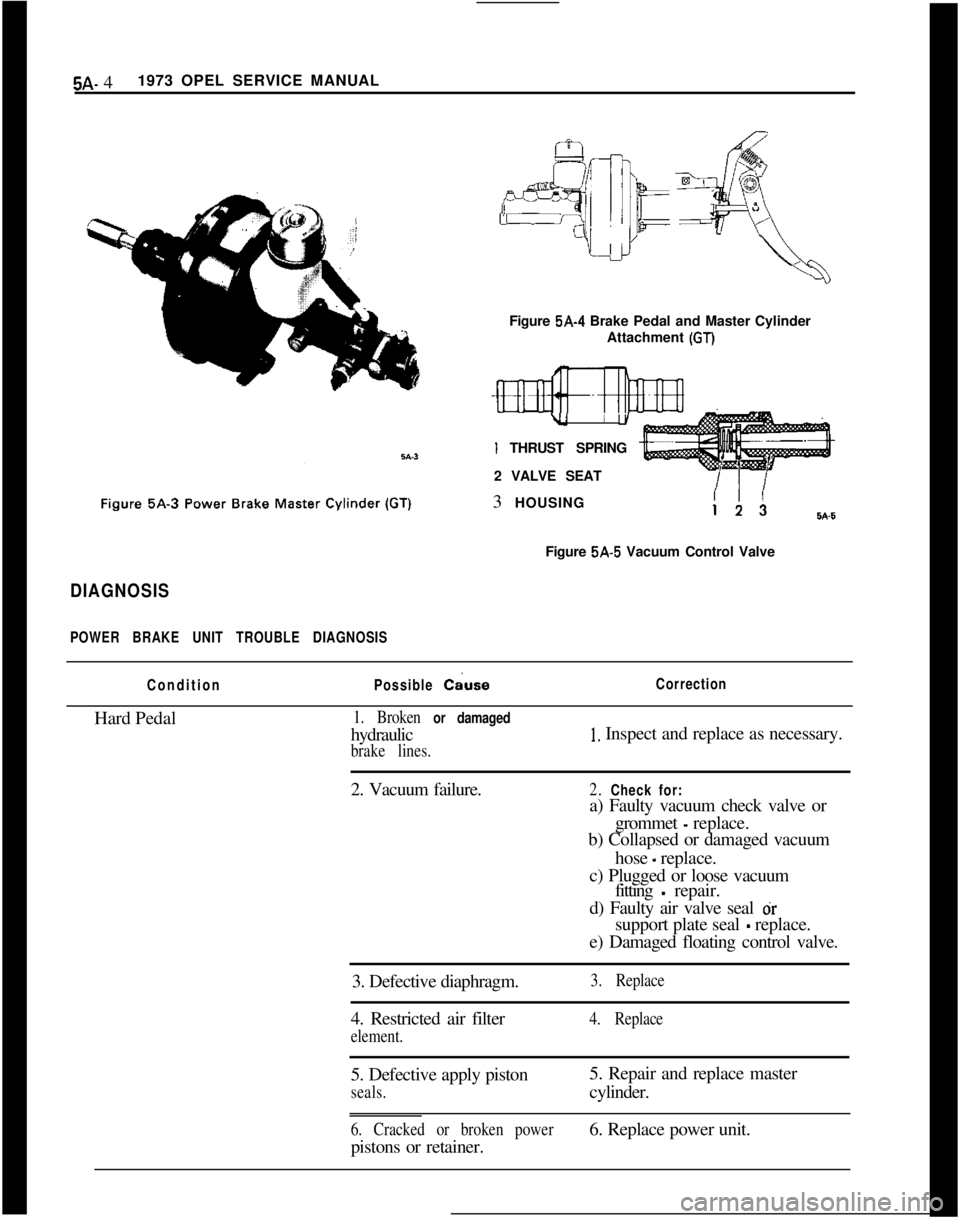
Figure
5A-4 Brake Pedal and Master Cylinder
Attachment
(GT)
v1I cy
1 THRUST SPRING
2 VALVE SEAT
3 HOUSING
Figure
5A-5 Vacuum Control Valve
DIAGNOSIS
POWER BRAKE UNIT TROUBLE DIAGNOSIS
ConditionPossible Cause
CorrectionHard Pedal
1. Broken or damagedhydraulic
brake lines.
1, Inspect and replace as necessary.
2. Vacuum failure.
2. Check for:a) Faulty vacuum check valve or
grommet
- replace.
b) Collapsed or damaged vacuum
hose
- replace.
c) Plugged or loose vacuum
fitting
- repair.
d) Faulty air valve seal
drsupport plate seal
- replace.
e) Damaged floating control valve.
3. Defective diaphragm.
4. Restricted air filter
element.3. Replace
4. Replace5. Defective apply piston5. Repair and replace master
seals.cylinder.
6. Cracked or broken powerpistons or retainer.6. Replace power unit.
Page 264 of 625
POWER BRAKE BOOSTER AND MASTER CYLINDER5A- 5ConditionGrabby Brakes (Apparent
Off-and On Condition)
Possible Cause1. Broken or damaged
hydraulic brake lines.Correction1. Inspect and replace, as
“CXXSSary.2. Insufficient fluid in
master cylinder.
3. Defective master cylinder
seals.4. Cracked master cylinder
casting.2. Fill reservoirs with approved
brake fluid check for leaks.
3. Repair or replace, asnecessary.4. Replace
5. Leaks at front disc brake
calipers or rear wheel
cylinders
in pipes or connections.5. Inspect and repair, as
necessary.Brakes Fail to Release6. Air in hydraulic system.
1. Blocked passage in power
piston.
2. Air valve sticking shut.6. Bleed system.
1. Inspect and repair or replace,
as necessary.
2. Check for proper lubrication of
air valve “0” ring.
3. Broken piston return spring
3. Replace
master cylinder.
4. Tight pedal linkage.5. Repair or replace, as
necessary.
MAINTENANCE AND ADJUSTMENTS
CHECKING BRAKE BOOSTER OPERATIONThe operation of the brake booster can be checked by
simple means and without any special devices.
1. With engine off, first clear the booster of any
vacuum by depressing brake pedal several times.
2. Then depress brake pedal and start engine. If the
vacuum system is working correctly, the brake pedal,
kept under even foot pressure, moves farther down-
wards due to the additional pressure developed by
the booster. Should the brake pedal not move farther
downwards, the vacuum system is deficient. In this
case check the vacuum hose to booster, to vacuum
control valve and to engine intake manifold connec-
tions.3. If the vacuum system operates properly, the defect
is in the brake booster itself. A dirty filter impairs oreven prevents air from entering into the booster and
thereby the formation of a difference in pressure in
the vacuum cylinder.
Repairs cannot be carried out on the brake booster.
If no deficiency can be found in the vacuum system
or filter, the brake booster has to be replaced.
Under normal operating conditions the brake
booster requires no service. However, under adverse
conditions such as frequent driving on sandy or
dusty roads, the filter and sound deadener should be
replaced occasionally. To do so, the brake booster
must be removed but it isn’t necessary to detach the
master cylinder.
BRAKE BOOSTER FILTER SERVICEUnder normal operating conditions the filter need
not be exchanged for a new one.
Under adverse operating conditions
- frequent driv-
Page 272 of 625

DISC BRAKES5B- 13
Condition
Possible CauseCorrection
2. Front end out of line.2. Check and align to manufac-
turer’s specifications.
3. Unmatched tires on sameaxle.3. Tires with approximately the
same amount of tread should be used
on the same axle.
4. Restricted brake tubes
or hoses.4. Check for soft hoses and damaged
lines. Replace with new hoses and
new double-walled steel brake
tubing.
5. Malfunctioning caliper
assembly.5. Frozen caliper
- check for
stuck or sluggish pistons, proper
lubrication.
6. Defective or damaged
shoe and lining (grease or
brake fluid on lining or
bent shoe).6. Install new shoe and lining in
complete axle sets.
7. Malfunctioning rear
brakes.7. Check for brake adjustment,
defective lining (grease or brake
fluid on lining) or defective wheel
cylinders. Repair as necessary.
8. Loose suspension parts.
9. Loose calipers.8. Check all suspension mountings.
9. Check and torque bolts to
specifications.
Brake Roughness or Chatter
(Pedal Pulsates)
1. Excessive lateralrunout.1. Check per instructions and
replace or machine the rotor, if not
within specifications.
2. Parallelism not within
specifications.2. Check per instructions and replace
or machine the rotor, if not within
specifications.
3. Wheel bearings not
adjusted.3. Adjust wheel bearings to correct
specifications.
4. Rear drums out of round.4. Check runout and, if not within
specifications, turn the drums within
specifications.
5. Shoe reversed (steel
against iron).5. Replace shoe and lining and
machine rotor within specifications.
ExcesGve Pedal Effort1. Malfunctioning power
brake.1. Check power brake and repair,
if necessary.
Page 273 of 625

5B- 141973 OPEL SERVICE MANUALConditionPossible CauseCorrection2. Partial system failure.2. Check front and rear brake system
and repair, if necessary. Also, check
brake warning light, if a failed
system is found and light did not
function.
3. Excessively worn shoe
and lining.3. Check and replace in axle sets.
4. Piston in caliper stuck
or sluggish.4. Remove caliper and rebuild.
5. Fading brakes due to
incorrect lining.
6. Vacuum leak.5. Remove and replace with original
equipment lining.
6. Check for ruptured hose or loose
attachment.
Excessive Pedal Travel1. Partial brake system
failure.1. Check both front and rear system
for a failure and repair. Also, check
warning light
- it should have indi-
cated a failure.
2. Insufficient fluid in
master cylinder.
3. Poor rear brake
adjustment.2. Fill reservoirs with approved
brake fluid. Check for leaks.
3. Adjust rear brake per
specifications.
4. Air trapped in system.4. Bleed system.
5. Bent shoe and lining.5. Replace axle set of shoe and
lining.
Dragging Brakes (A very
light drag is present in
all disc brakes
immediately after pedal
is released.)1. Master cylinder pistons
not returning correctly.1. With reservoir cover off, check
for fluid spurt at bypass holes as
pedal is depressed. Adjust push rod,
if necessary, or rebuild master
cylinder.
2. Restricted brake tubes2. Check for soft hoses or damaged
or hoses.tubes and replace with new hoses and
new double-walled steel brake tubing.
3. Incorrect parking brake
adjustment on rear brakes.3. Check and readjust to correct
specifications.
Grabbing or Uneven Braking
Action (All conditions
listed under “Pulls”
.)4. Check valve installed in
outlet to front disc brakes.
1. Malfunction of power
brake unit.4. Check master cylinder outlet and
remove check valve if present.
1. Check operation and repair, if
necessary.
Page 279 of 625
58.201973 OPEL SERVICE MANUAL
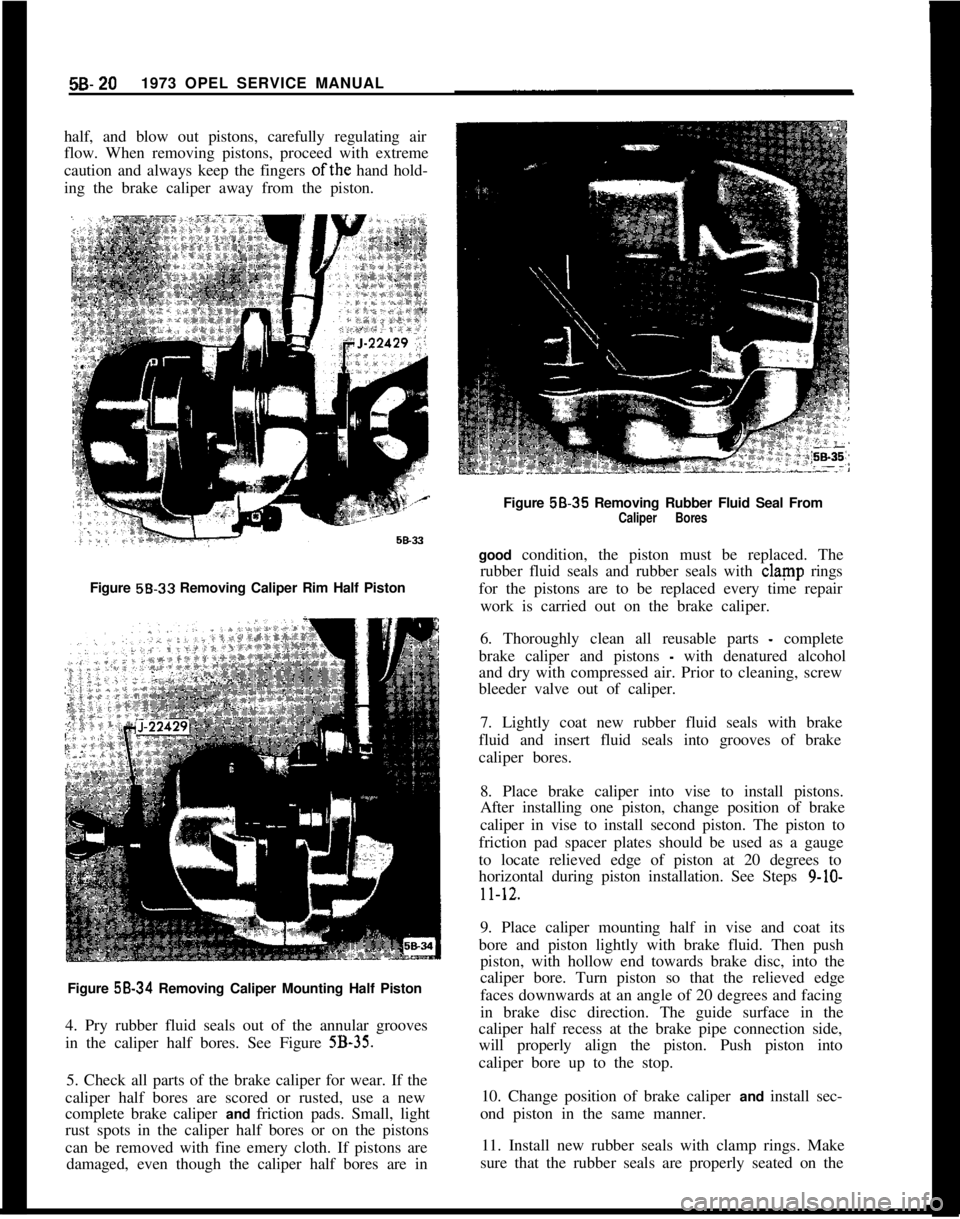
half, and blow out pistons, carefully regulating air
flow. When removing pistons, proceed with extreme
caution and always keep the fingers ofthe hand hold-
ing the brake caliper away from the piston.
Figure 55.33 Removing Caliper Rim Half Piston
Figure 58-34 Removing Caliper Mounting Half Piston
4. Pry rubber fluid seals out of the annular grooves
in the caliper half bores. See Figure
5B-35.5. Check all parts of the brake caliper for wear. If the
caliper half bores are scored or rusted, use a new
complete brake caliper and friction pads. Small, light
rust spots in the caliper half bores or on the pistons
can be removed with fine emery cloth. If pistons are
damaged, even though the caliper half bores are inFigure 58-35 Removing Rubber Fluid Seal From
Caliper Boresgood condition, the piston must be replaced. The
rubber fluid seals and rubber seals with
clapp rings
for the pistons are to be replaced every time repair
work is carried out on the brake caliper.
6. Thoroughly clean all reusable parts
- complete
brake caliper and pistons
- with denatured alcohol
and dry with compressed air. Prior to cleaning, screw
bleeder valve out of caliper.
7. Lightly coat new rubber fluid seals with brake
fluid and insert fluid seals into grooves of brake
caliper bores.
8. Place brake caliper into vise to install pistons.
After installing one piston, change position of brake
caliper in vise to install second piston. The piston to
friction pad spacer plates should be used as a gauge
to locate relieved edge of piston at 20 degrees to
horizontal during piston installation. See Steps
9-IO-
11-12.9. Place caliper mounting half in vise and coat its
bore and piston lightly with brake fluid. Then push
piston, with hollow end towards brake disc, into the
caliper bore. Turn piston so that the relieved edge
faces downwards at an angle of 20 degrees and facing
in brake disc direction. The guide surface in the
caliper half recess at the brake pipe connection side,
will properly align the piston. Push piston into
caliper bore up to the stop.
10. Change position of brake caliper and install sec-
ond piston in the same manner.
11. Install new rubber seals with clamp rings. Make
sure that the rubber seals are properly seated on the
Page 281 of 625
5C- 221973 OPEL SERVICE MANUAL
DRUM BRAKES
CONTENTS
Subject
DESCRIPTION AND OPERATION:
Description of Brake Mechanism. . . . . . . . . . . . . . . . . . . . . . . . . . . . . . .OperationofHydraulicServiceBrake
. . . . . . . . . . . . . . . . . . . . . . . .DIAGNOSIS:
BrakeTrouble
Diagnosis. . . . . . . . . . . . . . . . . . . . . . . . . . . . . . . . . . . . . . . . . . . . . . . . . .MAINTENANCE AND ADJUSTMENTS:
BrakeAdjustment
. . . . . . . . . . . . . . . . . . . . . . . . . . . . . . . . . . . . . . . . . . . . . . . . . . . . . . . . . . . . . .Filling, Bleeding and Flushing Brake
Hydraulic System
. . . . . . . . . . . . . . . . . . . . . . . . . . . . . . . . . . . . . . . . . . . . . . . . . . . . . . . . . .MAJOR REPAIR:
Replace or Reline Brake Shoes
. . . . . . . . . . . . . . . . . . . . . . . . . . . . . . . . . . .Inspecting and Reconditioning Brake Drums
. . . . . . . . . .Brake Wheel Cylinder Overhaul
. . . . . . . . . . . . . . . . . . . . . . . . . . . . . . . . . .
ReplacingBrakePipes. . . . . . . . . . . . . . . . . . . . . . . . . . . . . . . . . . . . . . . . . . . . . . . . . . . . . .SPECIFICATIONS:
Brake Specifications
. . . . . . . . . . , . . . . . . . . . . . . . . . . . . . . . . . . . . . . . . . . . . . . . . . . . . . . .
DESCRIPTION AND OPERATION - DRUM
BRAKES
DESCRIPTION OF BRAKE MECHANISM
Wheel Brake Assemblies
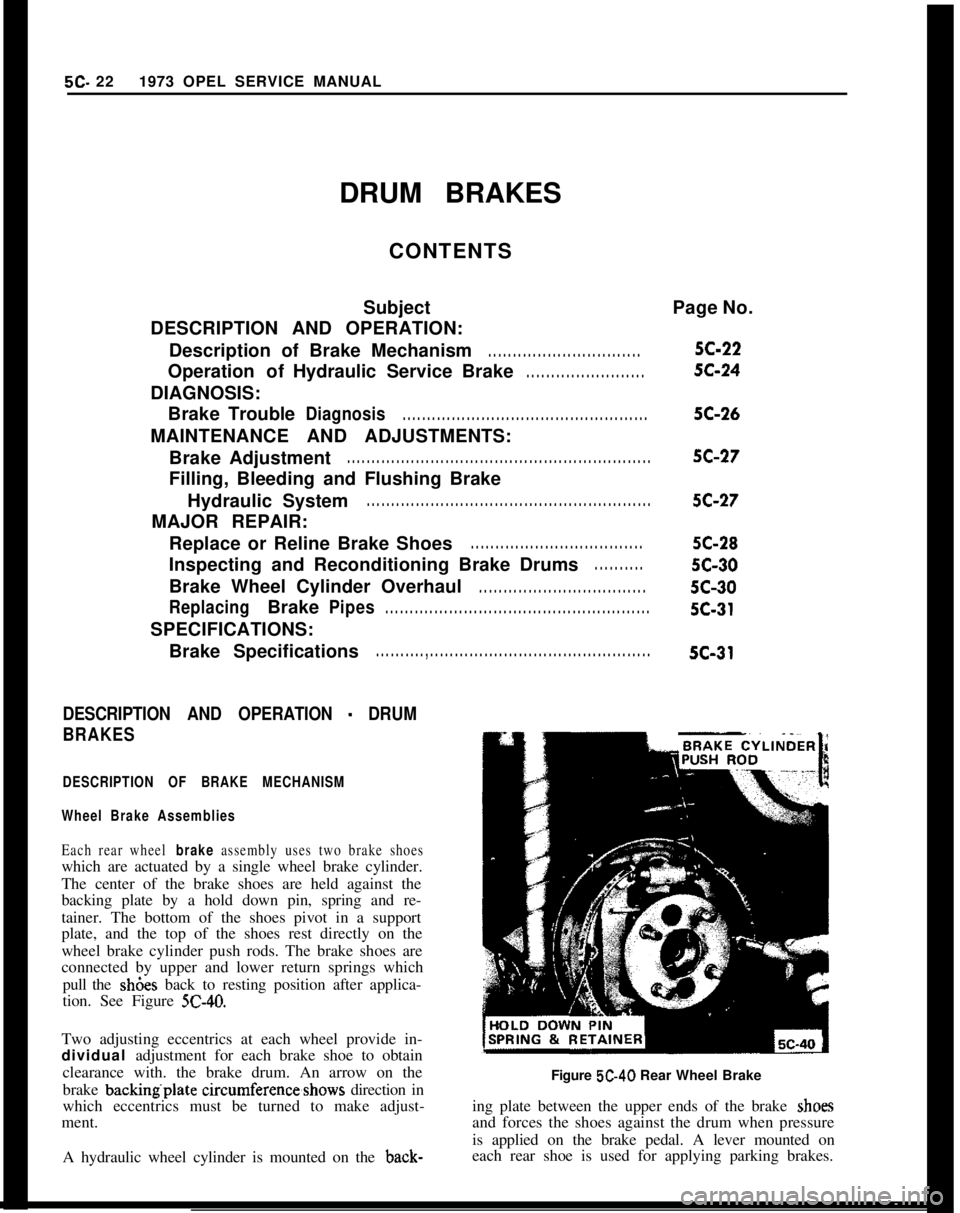
Each rear wheel brake assembly uses two brake shoeswhich are actuated by a single wheel brake cylinder.
The center of the brake shoes are held against the
backing plate by a hold down pin, spring and re-
tainer. The bottom of the shoes pivot in a support
plate, and the top of the shoes rest directly on the
wheel brake cylinder push rods. The brake shoes are
connected by upper and lower return springs which
pull the sh6es back to resting position after applica-
tion. See Figure
5C-40.Two adjusting eccentrics at each wheel provide in-
dividual adjustment for each brake shoe to obtain
clearance with. the brake drum. An arrow on the
brake backing.plate circumference,shows direction in
which eccentrics must be turned to make adjust-
ment.
A hydraulic wheel cylinder is mounted on the back-Page No.5C-225C-245C-26
5C-275C-275C-28
5c-30
5c-305c-315c-31
Figure 5C-40 Rear Wheel Brake
ing plate between the upper ends of the brake
shoeand forces the shoes against the drum when pressure
is applied on the brake pedal. A lever mounted on
each rear shoe is used for applying parking brakes.
Page 288 of 625
DRUM BRAKESBC- 29
at a time to avoid getting fluid level in reservoir
dangerously low. The correct sequence for bleeding
is bleed the wheel cylinder or caliper nearest the
master cylinder first in either circuit.
Do not perform bleeding operation while any brake
drum is removed.
Bleeding Wheel Cylinder or Caliper
1. Check fluid level, in reservoir and refill, if neces-
sary. Level must be brought up to “MAX” mark on
plastic reservoir.
2. Clean all dirt from around respective bleeder
valve, and then remove cap.
3. Push bleeder hose over bleeder valve, placing
other end of hose in a glass jar. Bleeder hose should
always be used to avoid getting fluid on linings.
4. Hold pressure on brake pedal and crack open the
bleeder valve to allow air (and,or) brake fluid to flow
out of the system. Allow pedal to travel to the floor.
Close bleeder valve. Release pedal and repeat this
procedure at each wheel cylinder in the circuit until
all air is removed. Frequently check reservoir fluid
level. Allowing fluid to be emptied will draw air into
the system.
5. Remove bleeder hose and install cap.
6. When bleeding operation is completed, make sure
that fluid level is brought up to “MAX” marking on
reservoir, then install cover.
7. Discard the brake fluid deposited in glass jar dur-
ing bleeding operation.
Flushing Brake Hydraulic System
It is recommended that both brake system circuits be
thoroughly flushed whenever the master cylinder is
replaced or if there is any doubt as to the grade of
fluid in the system.
Flushing of the brake system is performed in the
same manner as the bleeding operation except that
fluid is forced through the lines and wheel cylinder
until it emerges clear in color. Approximately one
half pint of brake fluid is required to flush the hy-
draulic system thoroughly.
When flushing is completed, make certain the master
cylinder reservoir is filled to the proper level.Figure
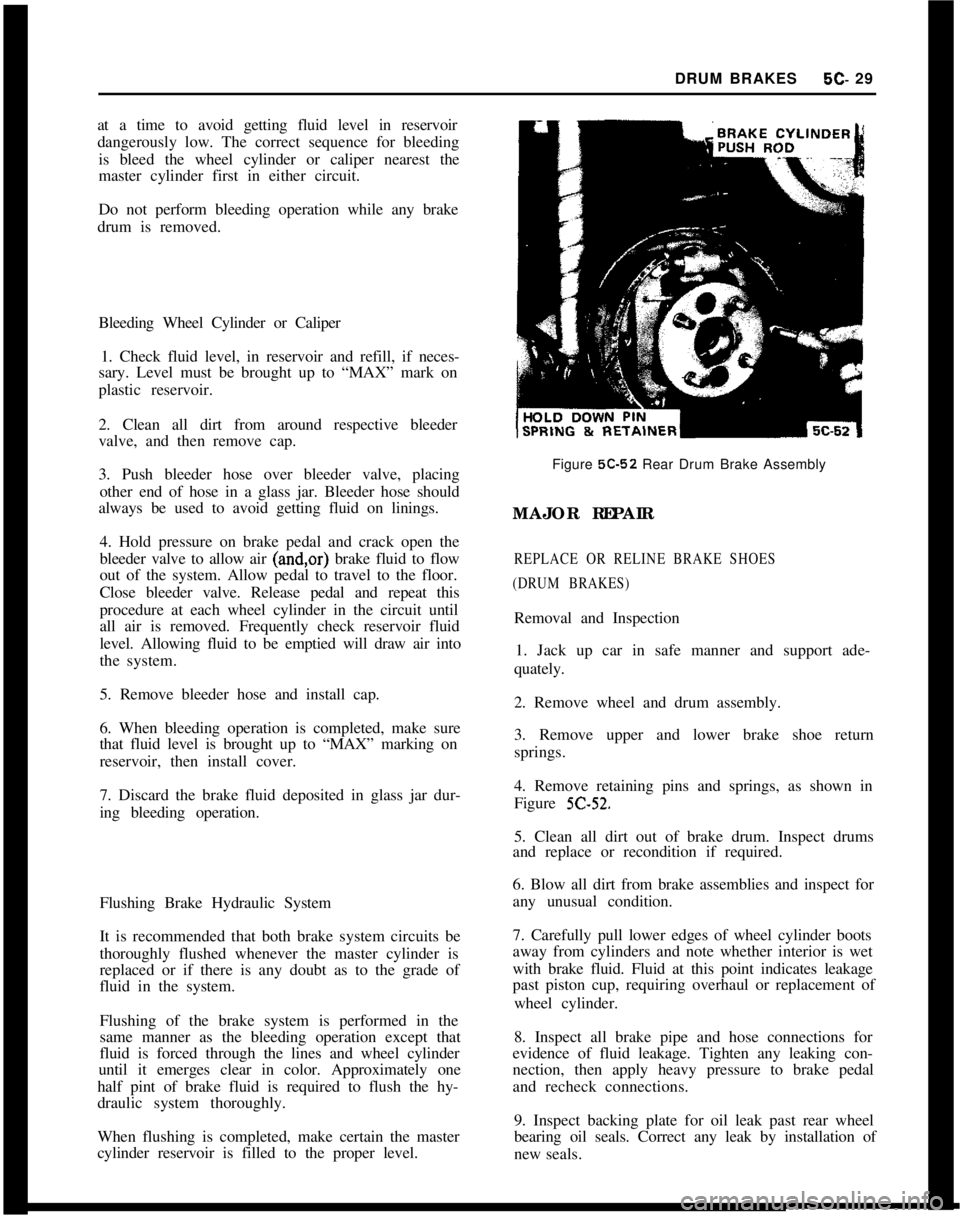
5C-52 Rear Drum Brake Assembly
MAJOR REPAIR
REPLACE OR RELINE BRAKE SHOES
(DRUM BRAKES)Removal and Inspection
1. Jack up car in safe manner and support ade-
quately.
2. Remove wheel and drum assembly.
3. Remove upper and lower brake shoe return
springs.
4. Remove retaining pins and springs, as shown in
Figure
5C-52.5. Clean all dirt out of brake drum. Inspect drums
and replace or recondition if required.
6. Blow all dirt from brake assemblies and inspect for
any unusual condition.
7. Carefully pull lower edges of wheel cylinder boots
away from cylinders and note whether interior is wet
with brake fluid. Fluid at this point indicates leakage
past piston cup, requiring overhaul or replacement of
wheel cylinder.
8. Inspect all brake pipe and hose connections for
evidence of fluid leakage. Tighten any leaking con-
nection, then apply heavy pressure to brake pedal
and recheck connections.
9. Inspect backing plate for oil leak past rear wheel
bearing oil seals. Correct any leak by installation of
new seals.
Page 289 of 625
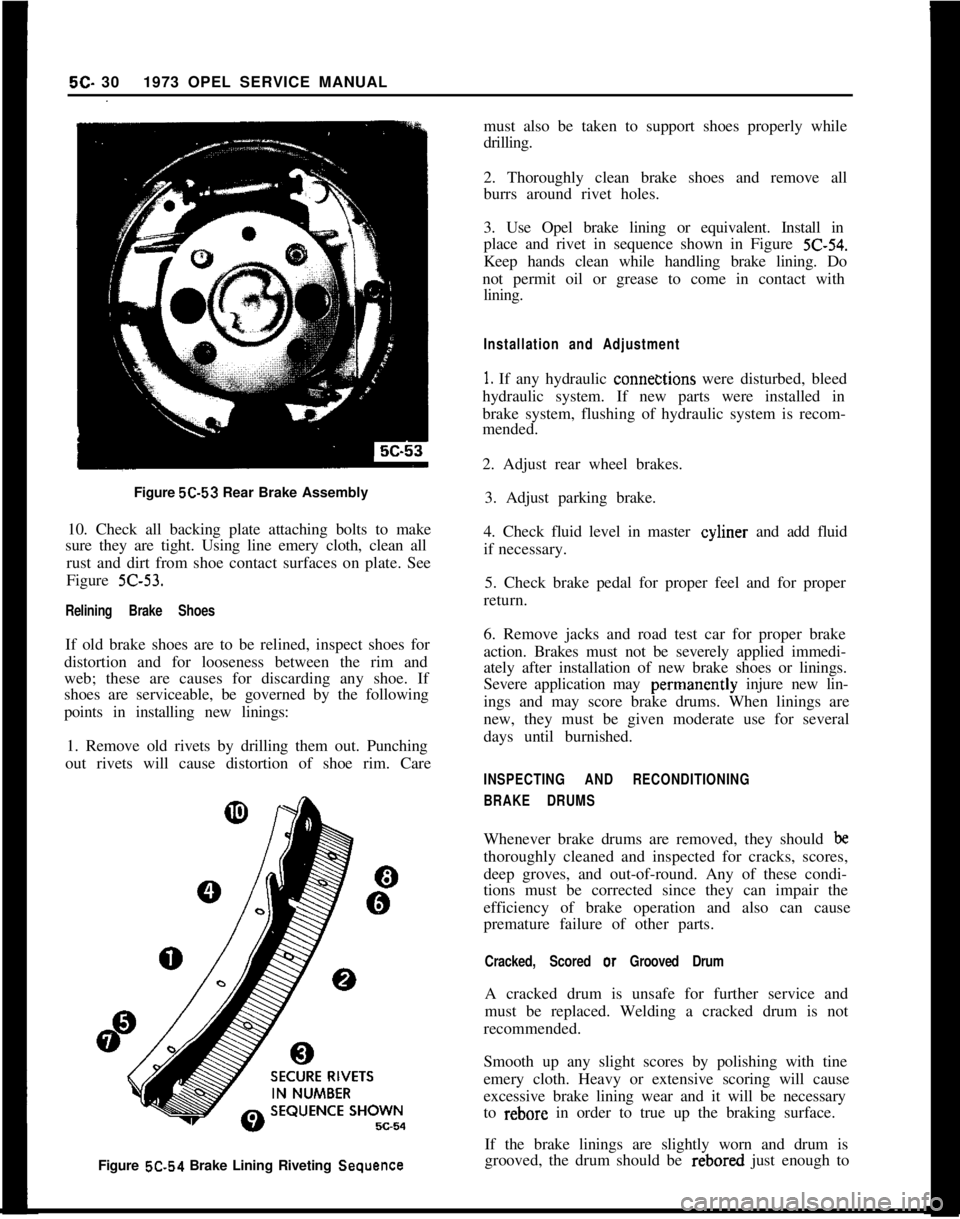
Figure 5C-53 Rear Brake Assembly
10. Check all backing plate attaching bolts to make
sure they are tight. Using line emery cloth, clean all
rust and dirt from shoe contact surfaces on plate. See
Figure Z-53.
Relining Brake ShoesIf old brake shoes are to be relined, inspect shoes for
distortion and for looseness between the rim and
web; these are causes for discarding any shoe. If
shoes are serviceable, be governed by the following
points in installing new linings:
1. Remove old rivets by drilling them out. Punching
out rivets will cause distortion of shoe rim. Care5C- 301973 OPEL SERVICE MANUAL
must also be taken to support shoes properly while
drilling.
2. Thoroughly clean brake shoes and remove all
burrs around rivet holes.
3. Use Opel brake lining or equivalent. Install in
place and rivet in sequence shown in Figure
Z-54.Keep hands clean while handling brake lining. Do
not permit oil or grease to come in contact with
lining.
Installation and Adjustment
1. If any hydraulic conne&tions were disturbed, bleed
hydraulic system. If new parts were installed in
brake system, flushing of hydraulic system is recom-
mended.
2. Adjust rear wheel brakes.
3. Adjust parking brake.
4. Check fluid level in master cyliner and add fluid
if necessary.
5. Check brake pedal for proper feel and for proper
return.
6. Remove jacks and road test car for proper brake
action. Brakes must not be severely applied immedi-
ately after installation of new brake shoes or linings.
Severe application may perinanently injure new lin-
ings and may score brake drums. When linings are
new, they must be given moderate use for several
days until burnished.
INSPECTING AND RECONDITIONING
BRAKE DRUMSWhenever brake drums are removed, they should
bethoroughly cleaned and inspected for cracks, scores,
deep groves, and out-of-round. Any of these condi-
tions must be corrected since they can impair the
efficiency of brake operation and also can cause
premature failure of other parts.
Cracked, Scored or Grooved DrumA cracked drum is unsafe for further service and
must be replaced. Welding a cracked drum is not
recommended.
Smooth up any slight scores by polishing with tine
emery cloth. Heavy or extensive scoring will cause
excessive brake lining wear and it will be necessary
to rebore in order to true up the braking surface.
Figure 5C.54 Brake Lining Riveting
SequenceIf the brake linings are slightly worn and drum is
grooved, the drum should be rebored just enough to