bores OPEL 1900 1973 Owner's Manual
[x] Cancel search | Manufacturer: OPEL, Model Year: 1973, Model line: 1900, Model: OPEL 1900 1973Pages: 625, PDF Size: 17.22 MB
Page 328 of 625
FUEL SYSTEMSC- 37
must always be removed before the distributor can be
removed.
EVAPORATION CONTROL SYSTEM1. The function of the fuel evaporation control sys-
tem is to absorb the fuel vapors developing in the fuel
tank, especially when vehicle is parked, due to at-
mospheric pressure and temperature influences, and
to release these fuel vapors during vehicle operation.
2. This system utilizes the property of the activated
carbon to absorb and expel fuel vapors. The activated
carbon container is installed on the left front side of
the engine compartment. The fuel tank has a
non-vented tiller cap. Vent hoses are joined in the area of
the tank. A plastic evaporation line leads from there
along vehicle underbody to the activated carbon con-
tainer.
3. A small tube above the throttle valve body con-
nects the carburetor to the activated carbon con-
tainer. In this way, the fuel vapor collected in the
activated carbon container is fed through the carbu-
retor into the combustion chambers during engine
operation.
4. The carburetor is provided with an internal and
outside ventilation, the activated carbon container is
also connected to the outside ventilation (only effec-
tive when engine is idling). In this way, the fuel
vapors escaping to the outside during engine idle are
collected by the activated carbon container and fed
into the combustion chambers.
5. The vent lines are connected to the upper part of
the activated carbon container. Fresh air enters
through a foam rubber filter at the lower part andflows, together with the fuel vapor, to the carburetor.
Metered bores in the hose fittings of the fuel tank
control the air
- and fuel vapor flow through the
activated carbon container to the carburetor, and the
pressure release in the fuel tank and ensure complete
purging of the carbon container.
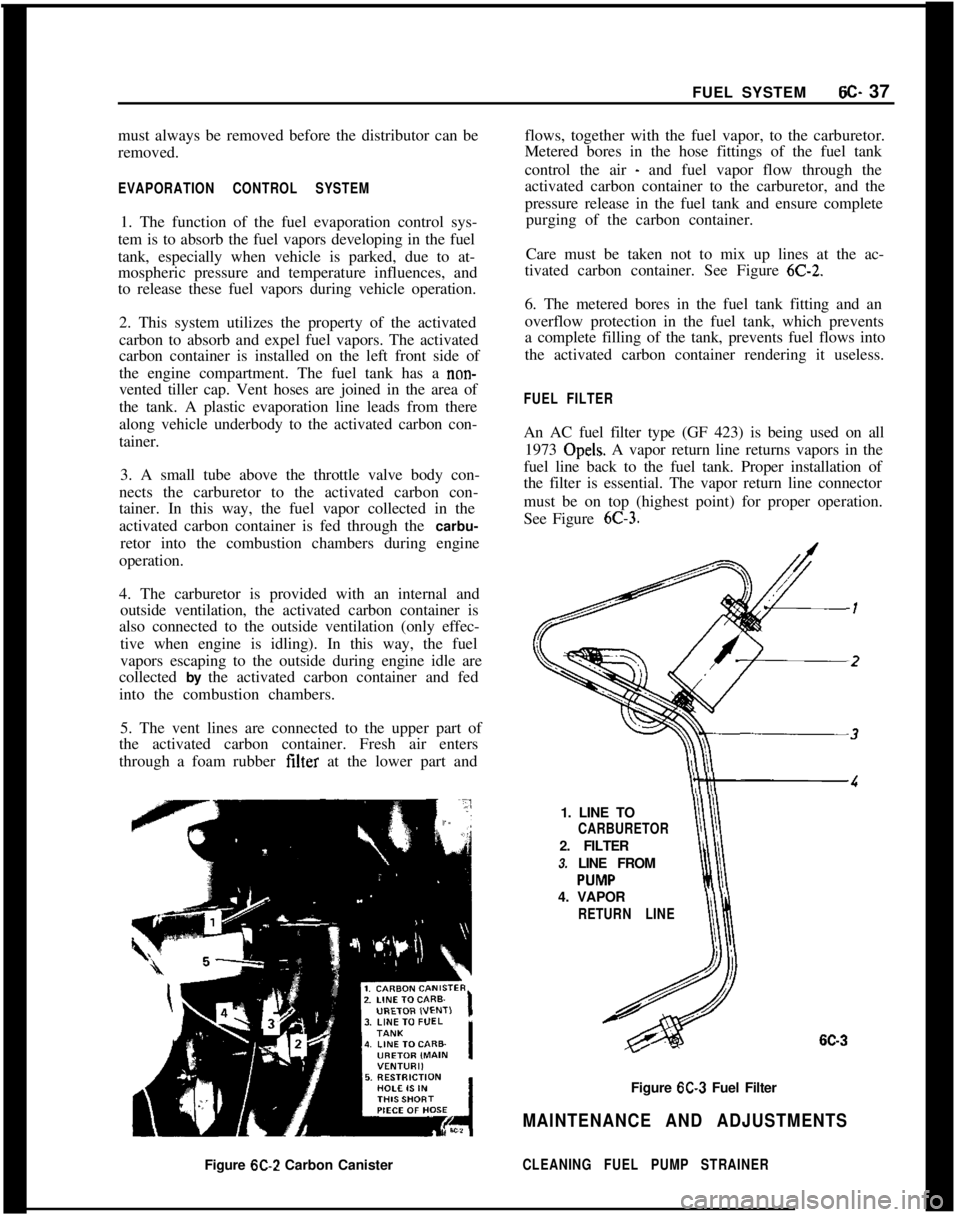
Care must be taken not to mix up lines at the ac-
tivated carbon container. See Figure
6C-2.6. The metered bores in the fuel tank fitting and an
overflow protection in the fuel tank, which prevents
a complete filling of the tank, prevents fuel flows into
the activated carbon container rendering it useless.
FUEL FILTERAn AC fuel filter type (GF 423) is being used on all
1973 Opels. A vapor return line returns vapors in the
fuel line back to the fuel tank. Proper installation of
the filter is essential. The vapor return line connector
must be on top (highest point) for proper operation.
See Figure
6C-3.1. LINE TO
CARBURETOR2. FILTER
3. LINE FROM
4. VAPOR
RETURN LINE
6C-3Figure
6C-3 Fuel Filter
MAINTENANCE AND ADJUSTMENTSFigure
6C-2 Carbon CanisterCLEANING FUEL PUMP STRAINER
Page 338 of 625
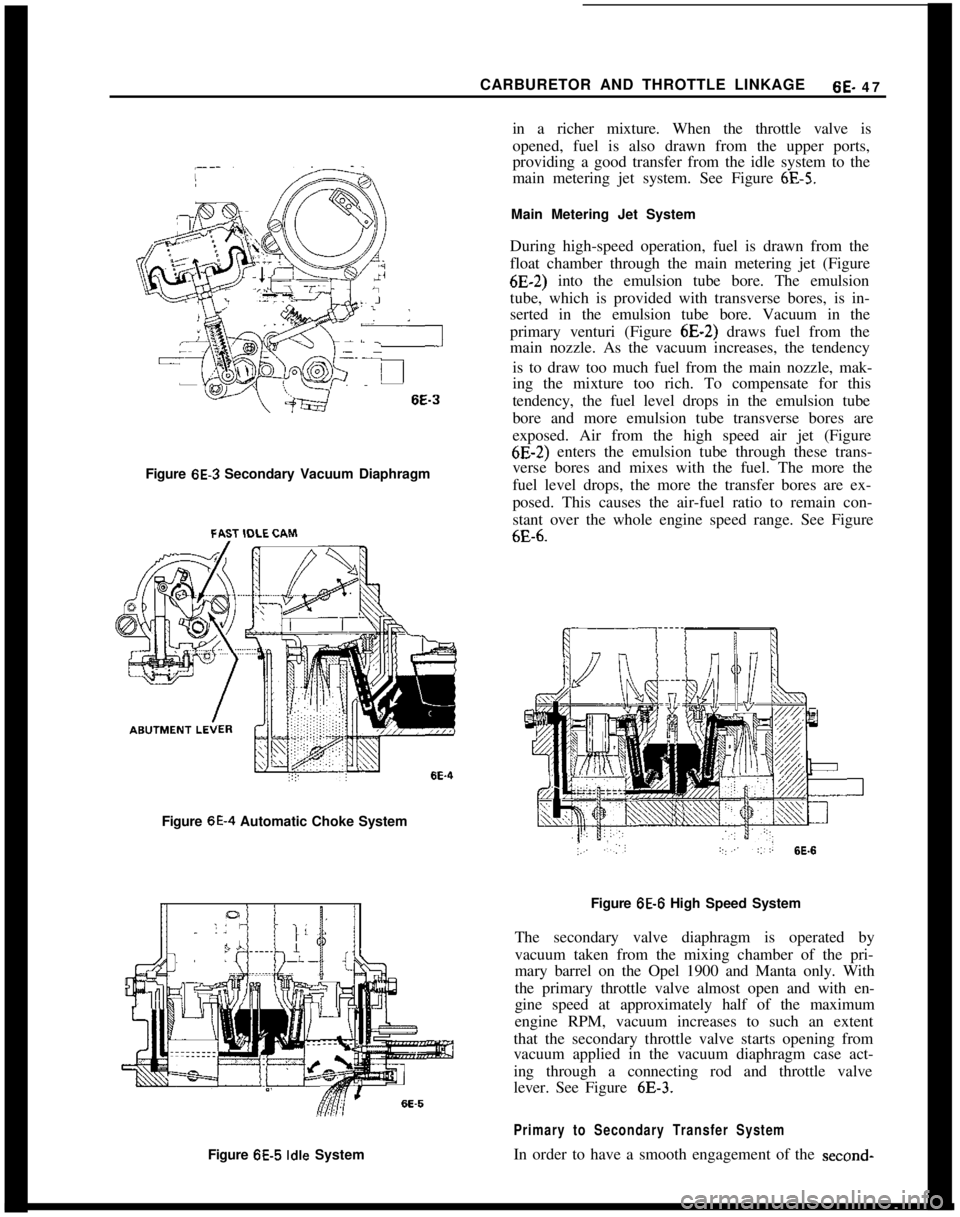
CARBURETOR AND THROTTLE LINKAGE65 47
Figure 6E.3 Secondary Vacuum Diaphragm
Figure
6E-4 Automatic Choke System
Figure
6E-5 Idle Systemin a richer mixture. When the throttle valve is
opened, fuel is also drawn from the upper ports,
providing a good transfer from the idle system to the
main metering jet system. See Figure
6E-5.Main Metering Jet System
During high-speed operation, fuel is drawn from the
float chamber through the main metering jet (Figure6E-2) into the emulsion tube bore. The emulsion
tube, which is provided with transverse bores, is in-
serted in the emulsion tube bore. Vacuum in the
primary venturi (Figure 6E-2) draws fuel from the
main nozzle. As the vacuum increases, the tendency
is to draw too much fuel from the main nozzle, mak-
ing the mixture too rich. To compensate for this
tendency, the fuel level drops in the emulsion tube
bore and more emulsion tube transverse bores are
exposed. Air from the high speed air jet (Figure6E-2) enters the emulsion tube through these trans-
verse bores and mixes with the fuel. The more the
fuel level drops, the more the transfer bores are ex-
posed. This causes the air-fuel ratio to remain con-
stant over the whole engine speed range. See Figure
6E-6.Figure
6E-6 High Speed System
The secondary valve diaphragm is operated by
vacuum taken from the mixing chamber of the pri-
mary barrel on the Opel 1900 and Manta only. With
the primary throttle valve almost open and with en-
gine speed at approximately half of the maximum
engine RPM, vacuum increases to such an extent
that the secondary throttle valve starts opening from
vacuum applied in the vacuum diaphragm case act-
ing through a connecting rod and throttle valve
lever. See Figure
6E-3.
Primary to Secondary Transfer SystemIn order to have a smooth engagement of the
second-
Page 470 of 625
AUTOMATIC TRANSMISSION 7C-109
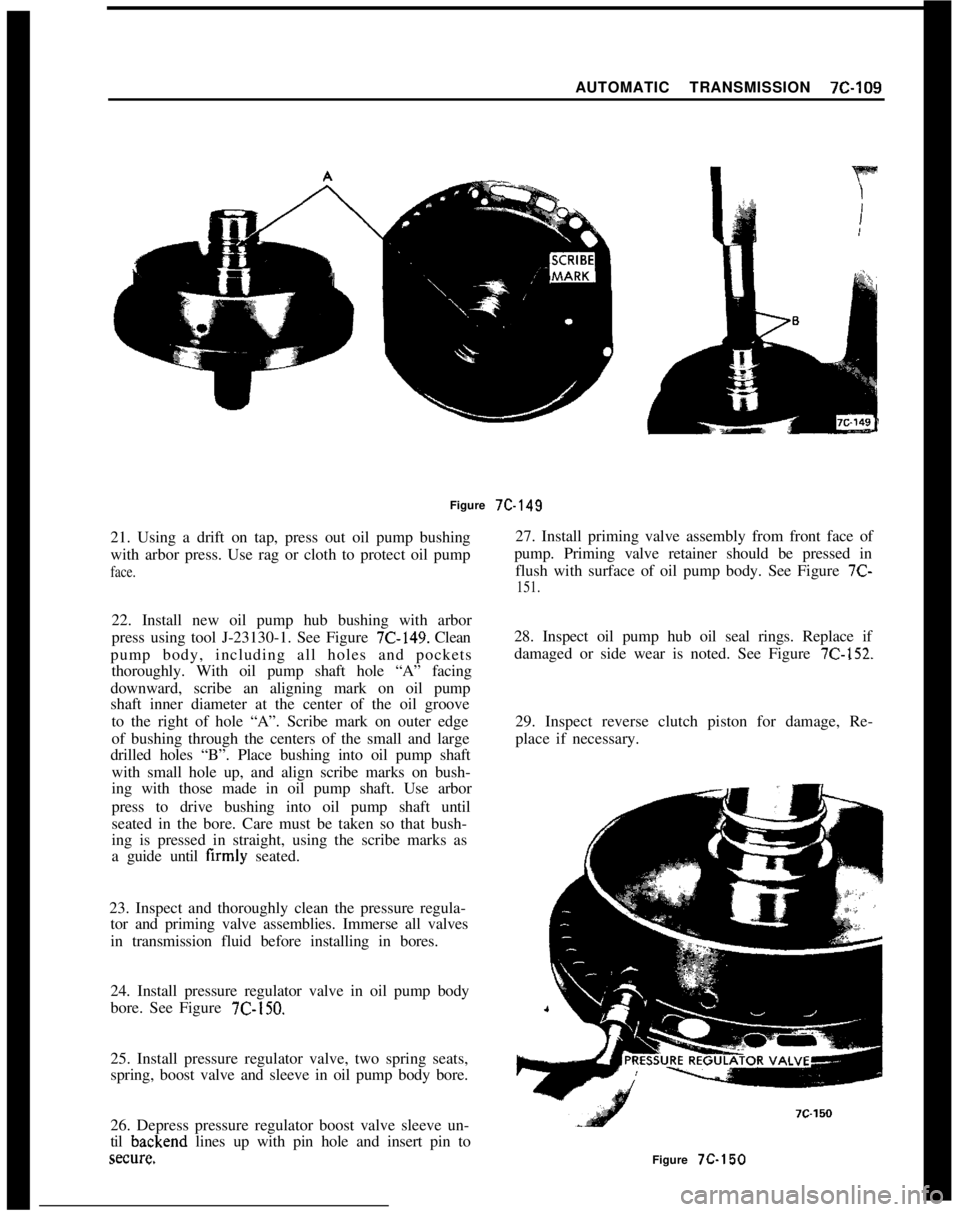
Figure 7C-149
21. Using a drift on tap, press out oil pump bushing
with arbor press. Use rag or cloth to protect oil pumpface.22. Install new oil pump hub bushing with arbor
press using tool J-23130-1. See Figure
7C-149. Clean
pump body, including all holes and pockets
thoroughly. With oil pump shaft hole “A” facing
downward, scribe an aligning mark on oil pump
shaft inner diameter at the center of the oil groove
to the right of hole “A”. Scribe mark on outer edge
of bushing through the centers of the small and large
drilled holes “B”. Place bushing into oil pump shaft
with small hole up, and align scribe marks on bush-
ing with those made in oil pump shaft. Use arbor
press to drive bushing into oil pump shaft until
seated in the bore. Care must be taken so that bush-
ing is pressed in straight, using the scribe marks as
a guide until firmly seated.
23. Inspect and thoroughly clean the pressure regula-
tor and priming valve assemblies. Immerse all valves
in transmission fluid before installing in bores.
24. Install pressure regulator valve in oil pump body
bore. See Figure
7C-150.25. Install pressure regulator valve, two spring seats,
spring, boost valve and sleeve in oil pump body bore.
26. Depress pressure regulator boost valve sleeve un-
til backend lines up with pin hole and insert pin to
XWP$.27. Install priming valve assembly from front face of
pump. Priming valve retainer should be pressed in
flush with surface of oil pump body. See Figure 7C-
151.28. Inspect oil pump hub oil seal rings. Replace if
damaged or side wear is noted. See Figure
7C-152.29. Inspect reverse clutch piston for damage, Re-
place if necessary.
Figure
7C-150
Page 481 of 625
7C-1201973 OPEL SERVICE MANUAL
4. Inspect the secondary valve spring for distortion
or breakage.
5. Clean in solvent, air clean, and blow out all oil
passages. Inspect all oil passages, valve bores for
nicks, burrs or varnish in governor body. Replace if
necessary.6. Install roll pin flush to
,010” below the front face.
7. Install primary valve in governor placing the small
portion of the valve in
first. Use liberal amount of
transmission fluid. There is no spring for the primary
valve.
8. Install secondary valve with small spool portion of
valve in
first.9. Install secondary valve spring.
10. Depress secondary valve spring with small screw
driver and install retainer.
Disassembly, Inspection and Reassembly of
Governor Hub1. Inspect the three oil seal rings. See Figure
7C-189.Figure 7C.189
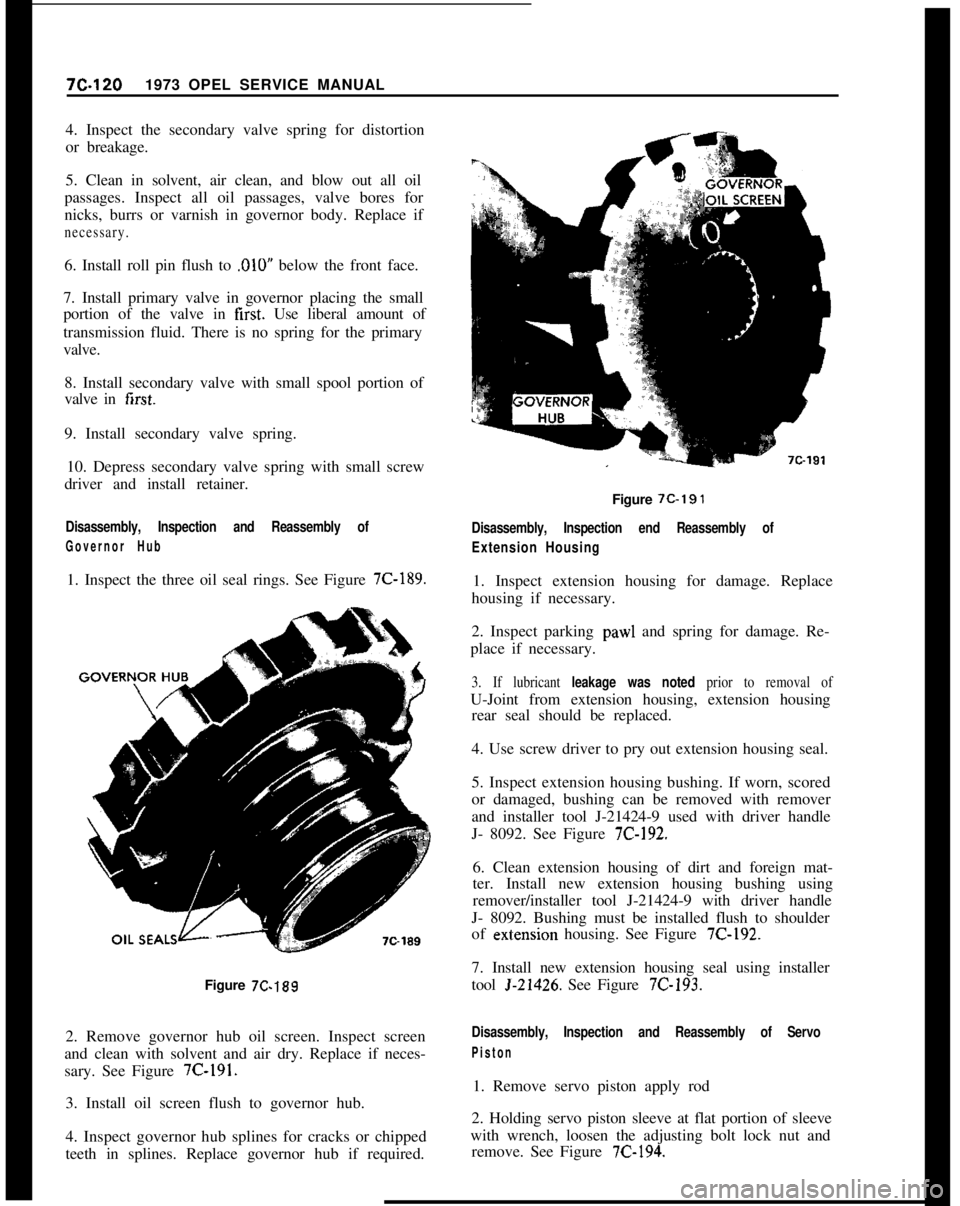
2. Remove governor hub oil screen. Inspect screen
and clean with solvent and air dry. Replace if neces-
sary. See Figure 7C-191.
3. Install oil screen flush to governor hub.
4. Inspect governor hub splines for cracks or chipped
teeth in splines. Replace governor hub if required.Figure 7C-191
Disassembly, Inspection end Reassembly of
Extension Housing1. Inspect extension housing for damage. Replace
housing if necessary.
2. Inspect parking
paw1 and spring for damage. Re-
place if necessary.
3. If lubricant leakage was noted prior to removal ofU-Joint from extension housing, extension housing
rear seal should be replaced.
4. Use screw driver to pry out extension housing seal.
5. Inspect extension housing bushing. If worn, scored
or damaged, bushing can be removed with remover
and installer tool J-21424-9 used with driver handle
J- 8092. See Figure
7C-192.6. Clean extension housing of dirt and foreign mat-
ter. Install new extension housing bushing using
remover/installer tool J-21424-9 with driver handle
J- 8092. Bushing must be installed flush to shoulder
of exi:ension housing. See Figure 7C-192.
7. Install new extension housing seal using installer
tool
Jo-21426. See Figure 7C-193.
Disassembly, Inspection and Reassembly of Servo
Piston1. Remove servo piston apply rod
2. Holding servo piston sleeve at flat portion of sleeve
with wrench, loosen the adjusting bolt lock nut and
remove. See Figure
7C-194.
Page 485 of 625
7C.1241973 OPEL SERVICE MANUAL
14. Remove the downshift timing valve plug retain-
ing pin and remove downshift timing valve plug.
Remove the low speed downshift timing valve and
spring.
15. Remove the manual low and r&erse control
valve retaining pin. Remove the spring and the
manual low control valve and the reverse control
valve.
16. Remove the l-2 accumulator valve retaining pin
and remove the l-2 accumulator valve plug, l-2 ac-
cumulator valve and spring.
17. A clean work area which is free of dirt and dust
should be used to inspect, clean and install the valves
in the valve body. Handle valve components with
clean hands and tools. Since most valve failures are
caused initially by dirt or other foreign matter pre-
venting a valve from functioning properly, a
thorough cleaning of all the components with a
cleaning solvent is essential. Do not use paraffin toclean out the valve body passages and valve bore.
Compressed air may be used to blow out the pas-
sages.18. Inspect each valve for free movement in its re-
spective bore in
t.he valve body. If necessary, use
crocus cloth to remove small burrs on a valve. Do
not remove the sharp edges of the valves as these
edges perform a cleaning action within the bore.
19. Inspect the valve springs for distortion or col-
lapsed coils. Replace the entire valve body assembly
if any parts are damaged.
20. Inspect the transfer plate for dents or distortion.
Replace transfer plate if necessary.
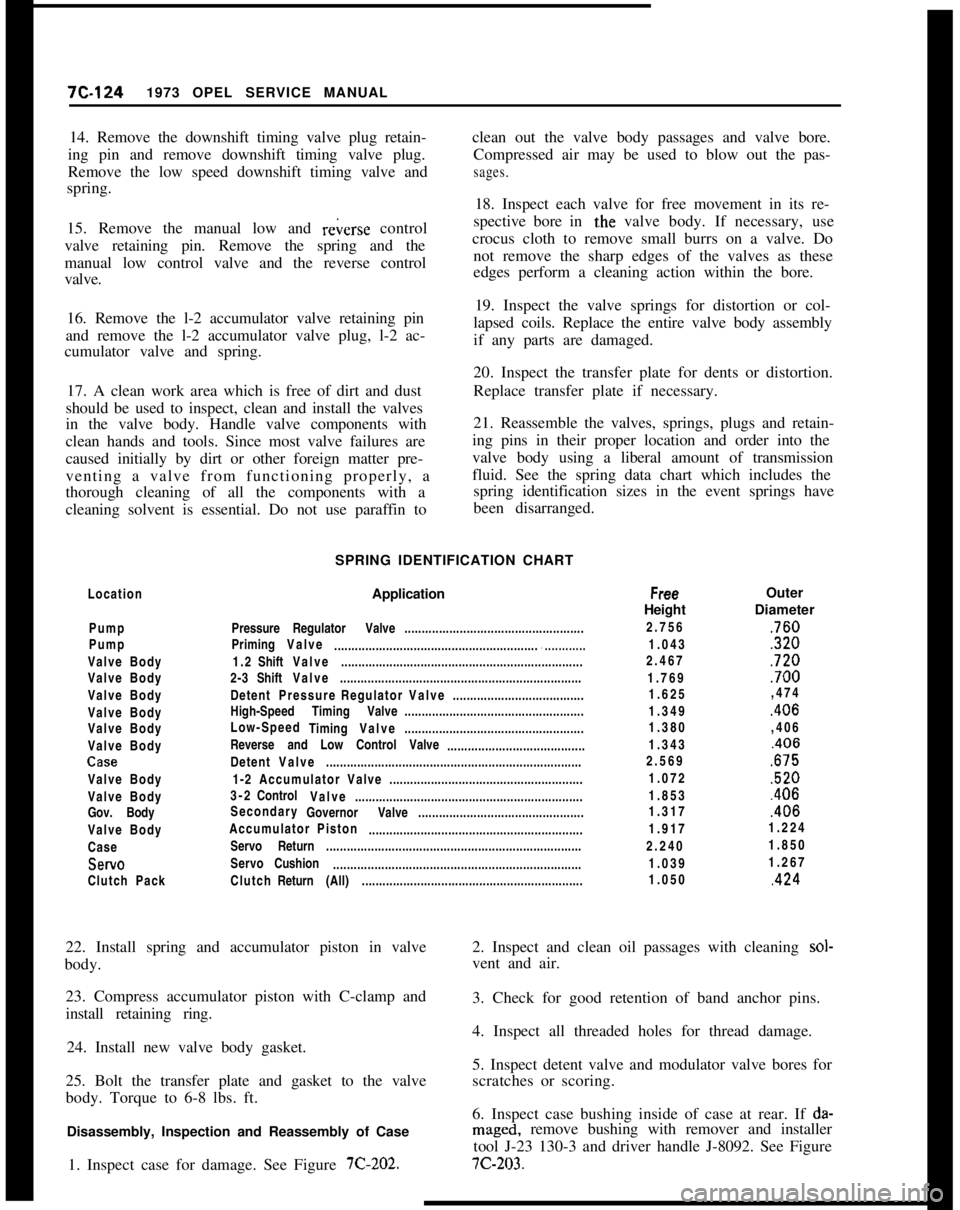
21. Reassemble the valves, springs, plugs and retain-
ing pins in their proper location and order into the
valve body using a liberal amount of transmission
fluid. See the spring data chart which includes the
spring identification sizes in the event springs have
been disarranged.
LocationApplication
PumpPressureRegulator Valve....................................................
PumpPrimingValve
...........................................................
.............Valve Body1.2ShiftValve......................................................................
Valve Body2-3ShiftValve......................................................................
Valve BodyDetentPressureRegulatorValve......................................
Valve BodyHigh-Speed Timing Valve....................................................
Valve BodyLow-Speed
TimingValve....................................................
Valve BodyReverse and Low Control Valve
........................................
CSSDetentValve..........................................................................
Valve Body1-2 Accumulator Valve........................................................
Valve Body3-2Control
Valve..................................................................
Gov. BodySecondary
Governor Valve................................................
Valve BodyAccumulator Piston
..............................................................
CaseServo Return..........................................................................SHVOServoCushion
........................................................................
Clutch PackClutchReturn(All)................................................................ SPRING IDENTIFICATION CHART
FreeOuter
HeightDiameter
2.756
,7601.043
,3202.467
,7201.769
,7001.625,474
1.349
,4061.380,406
1.343
,4062.569
,6751.072
,5201.853
.4061.317
,4061.9171.224
2.2401.850
1.0391.267
1.050
,42422. Install spring and accumulator piston in valve
body.
23. Compress accumulator piston with C-clamp and
install retaining ring.
24. Install new valve body gasket.2. Inspect and clean oil passages with cleaning sol-
vent and air.
3. Check for good retention of band anchor pins.
25. Bolt the transfer plate and gasket to the valve
body. Torque to 6-8 lbs. ft.
Disassembly, Inspection and Reassembly of Case
1. Inspect case for damage. See Figure
7C-202.4. Inspect all threaded holes for thread damage.
5. Inspect detent valve and modulator valve bores for
scratches or scoring.
6. Inspect case bushing inside of case at rear. If
da-maged, remove bushing with remover and installer
tool J-23 130-3 and driver handle J-8092. See Figure
7C-203.
Page 586 of 625
REFRIGERANT COMPONENTS ALL MODELS99.77
In order to tit the piston onto the wash plate and
into the cylinder bore, the wash plate must be raised
approximately l/2 inch, the front needle thrust bear-
ing and races must be held up against the hub of thewash plate, and the service piston rings must be
squeezed together (see Figure
9B-147). Lubricate
cylinder bore, piston assembly and wash plate with
No. 525 viscosity oil to facilitate reassembly.
4. Repeat procedure in Steps 1 and 2 for installation
of No. 2 and No. 3 pistons.
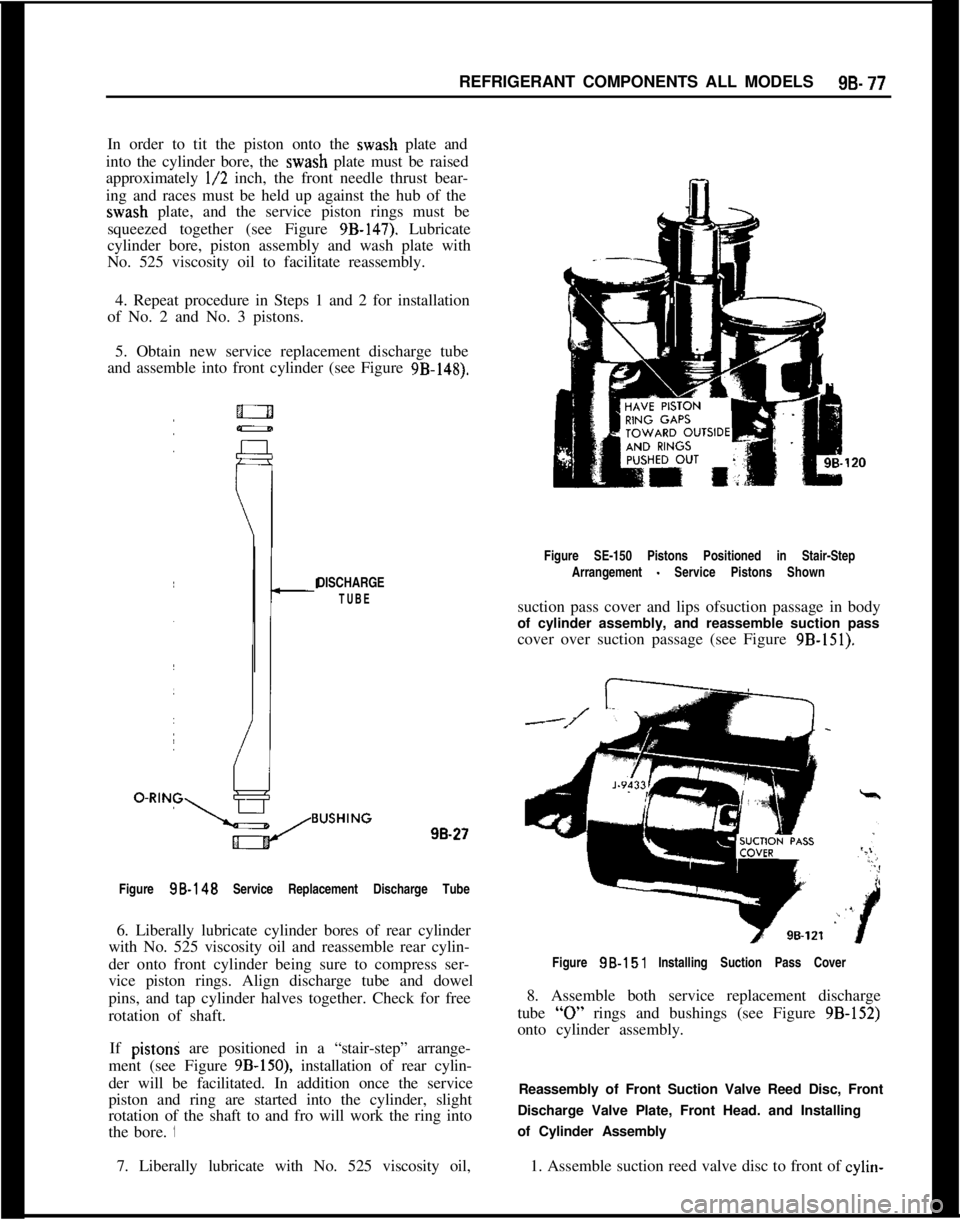
5. Obtain new service replacement discharge tube
and assemble into front cylinder (see Figure
9B-148).Figure SE-150 Pistons Positioned in Stair-Step
DISCHARGE
TUBEArrangement
- Service Pistons Shown
suction pass cover and lips ofsuction passage in body
of cylinder assembly, and reassemble suction pass
cover over suction passage (see Figure
9B-151).98.27
Figure
SB-148 Service Replacement Discharge Tube
6. Liberally lubricate cylinder bores of rear cylinder
with No. 525 viscosity oil and reassemble rear cylin-
der onto front cylinder being sure to compress ser-
vice piston rings. Align discharge tube and dowel
pins, and tap cylinder halves together. Check for free
rotation of shaft.
If pistoni are positioned in a “stair-step” arrange-
ment (see Figure
9B-150), installation of rear cylin-
der will be facilitated. In addition once the service
piston and ring are started into the cylinder, slight
rotation of the shaft to and fro will work the ring into
the bore. ‘IFigure
98.151 Installing Suction Pass Cover
8. Assemble both service replacement discharge
tube
“0” rings and bushings (see Figure 9B-152)
onto cylinder assembly.
Reassembly of Front Suction Valve Reed Disc, Front
Discharge Valve Plate, Front Head. and Installing
of Cylinder Assembly
7. Liberally lubricate with No. 525 viscosity oil,1. Assemble suction reed valve disc to front of cylin-