bores OPEL 1900 1973 User Guide
[x] Cancel search | Manufacturer: OPEL, Model Year: 1973, Model line: 1900, Model: OPEL 1900 1973Pages: 625, PDF Size: 17.22 MB
Page 275 of 625
5B- 19i973 OPEL SERVICE MANUAL
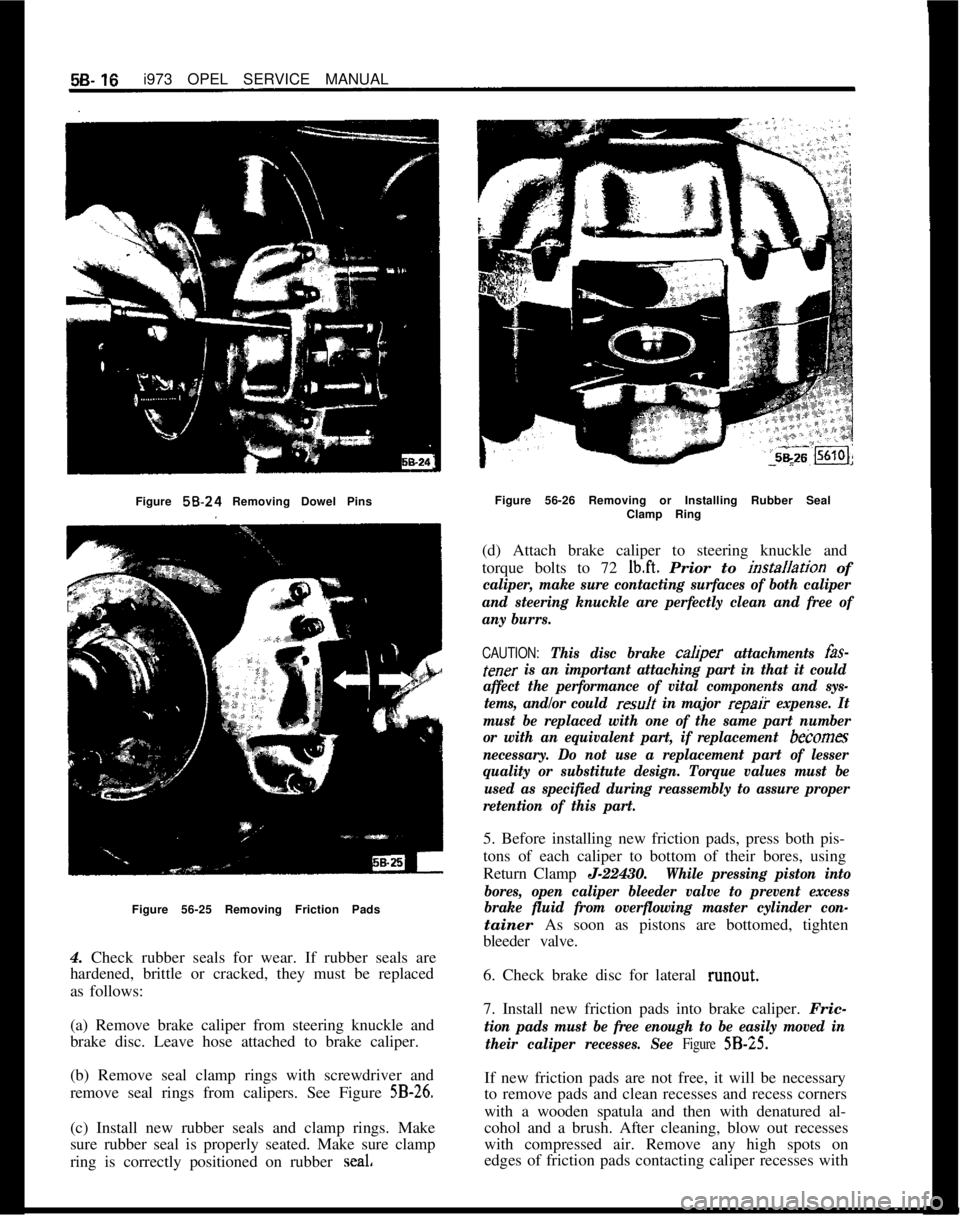
Figure
56-24 Removing Dowel Pins
Figure 56-25 Removing Friction Pads
4. Check rubber seals for wear. If rubber seals are
hardened, brittle or cracked, they must be replaced
as follows:
(a) Remove brake caliper from steering knuckle and
brake disc. Leave hose attached to brake caliper.
(b) Remove seal clamp rings with screwdriver and
remove seal rings from calipers. See Figure
5B-26.(c) Install new rubber seals and clamp rings. Make
sure rubber seal is properly seated. Make sure clamp
ring is correctly positioned on rubber seal,Figure 56-26 Removing or Installing Rubber Seal
Clamp Ring
(d) Attach brake caliper to steering knuckle and
torque bolts to 72
Ib.ft. Prior to installation of
caliper, make sure contacting surfaces of both caliper
and steering knuckle are perfectly clean and free of
any burrs.
CAUTION: This disc brake caliper attachments fas-
tener is an important attaching part in that it could
affect the performance of vital components and sys-
tems, and/or could
result in major repair expense. It
must be replaced with one of the same part number
or with an equivalent part, if replacement
becomes
necessary. Do not use a replacement part of lesser
quality or substitute design. Torque values must be
used as specified during reassembly to assure proper
retention of this part.5. Before installing new friction pads, press both pis-
tons of each caliper to bottom of their bores, using
Return Clamp J-22430.
While pressing piston into
bores, open caliper bleeder valve to prevent excess
brake fluid from overflowing master cylinder con-tainer As soon as pistons are bottomed, tighten
bleeder valve.
6. Check brake disc for lateral runout.
7. Install new friction pads into brake caliper. Fric-
tion pads must be free enough to be easily moved in
their caliper recesses. See
Figure X3-25.If new friction pads are not free, it will be necessary
to remove pads and clean recesses and recess corners
with a wooden spatula and then with denatured al-
cohol and a brush. After cleaning, blow out recesses
with compressed air. Remove any high spots on
edges of friction pads contacting caliper recesses with
Page 279 of 625
58.201973 OPEL SERVICE MANUAL
half, and blow out pistons, carefully regulating air
flow. When removing pistons, proceed with extreme
caution and always keep the fingers ofthe hand hold-
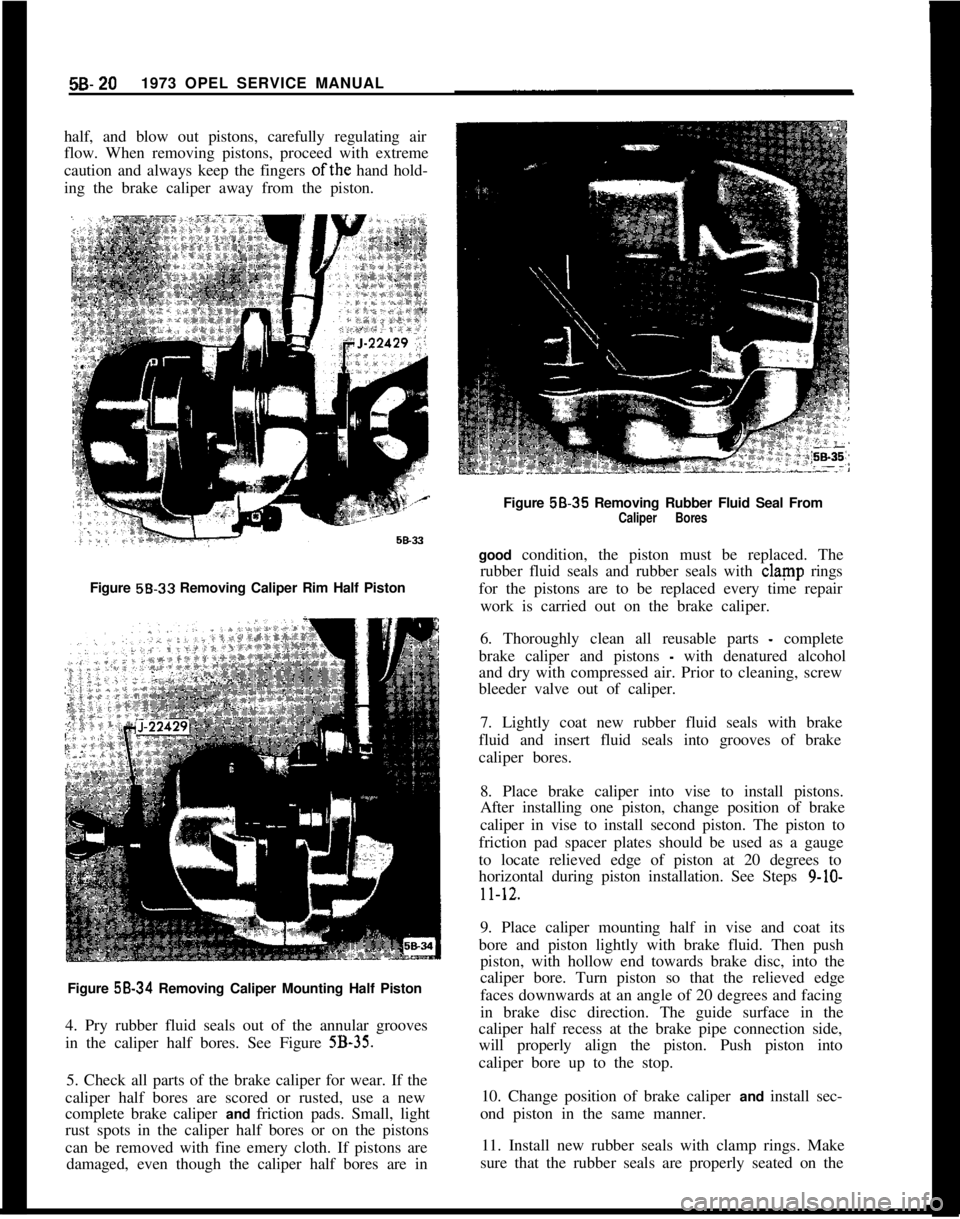
ing the brake caliper away from the piston.
Figure 55.33 Removing Caliper Rim Half Piston
Figure 58-34 Removing Caliper Mounting Half Piston
4. Pry rubber fluid seals out of the annular grooves
in the caliper half bores. See Figure
5B-35.5. Check all parts of the brake caliper for wear. If the
caliper half bores are scored or rusted, use a new
complete brake caliper and friction pads. Small, light
rust spots in the caliper half bores or on the pistons
can be removed with fine emery cloth. If pistons are
damaged, even though the caliper half bores are inFigure 58-35 Removing Rubber Fluid Seal From
Caliper Boresgood condition, the piston must be replaced. The
rubber fluid seals and rubber seals with
clapp rings
for the pistons are to be replaced every time repair
work is carried out on the brake caliper.
6. Thoroughly clean all reusable parts
- complete
brake caliper and pistons
- with denatured alcohol
and dry with compressed air. Prior to cleaning, screw
bleeder valve out of caliper.
7. Lightly coat new rubber fluid seals with brake
fluid and insert fluid seals into grooves of brake
caliper bores.
8. Place brake caliper into vise to install pistons.
After installing one piston, change position of brake
caliper in vise to install second piston. The piston to
friction pad spacer plates should be used as a gauge
to locate relieved edge of piston at 20 degrees to
horizontal during piston installation. See Steps
9-IO-
11-12.9. Place caliper mounting half in vise and coat its
bore and piston lightly with brake fluid. Then push
piston, with hollow end towards brake disc, into the
caliper bore. Turn piston so that the relieved edge
faces downwards at an angle of 20 degrees and facing
in brake disc direction. The guide surface in the
caliper half recess at the brake pipe connection side,
will properly align the piston. Push piston into
caliper bore up to the stop.
10. Change position of brake caliper and install sec-
ond piston in the same manner.
11. Install new rubber seals with clamp rings. Make
sure that the rubber seals are properly seated on the
Page 303 of 625
6A- 121973 OPEL SERVICE MANUALINTAKE AND EXHAUST MANIFOLD REMOVAL
AND
INSTALLATION
Removal1. Disconnect battery.
2. Remove air cleaner.
3. Disconnect throttle linkage at carburetor.
4. Disconnect vacuum advance line at carburetor.
5. Remove fuel line at carburetor inlet.
6. Remove positive crankcase ventilation hose at
rocker arm cover.
7. Disconnect E.G.R. lines from carburetor and in-
take manifold.
8. Disconnect exhaust pipe.
9. Remove six bolts attaching manifold assembly to
cylinder head and remove manifold and carburetor
as an assembly. Discard manifold gasket.
To separate intake and exhaust, manifold, remove
carburetor and four bolts using Tool J-23016, attach-
ing intake manifold to exhaust manifold. Always in-
stall a new manifold intermediate gasket when the
manifolds are separated.
Installation1. Install new manifold gasket and place manifold in
position.
2. Install manifold bolts. New manifold to cylinder
head gasket must be installed whenever a manifold
is removed.
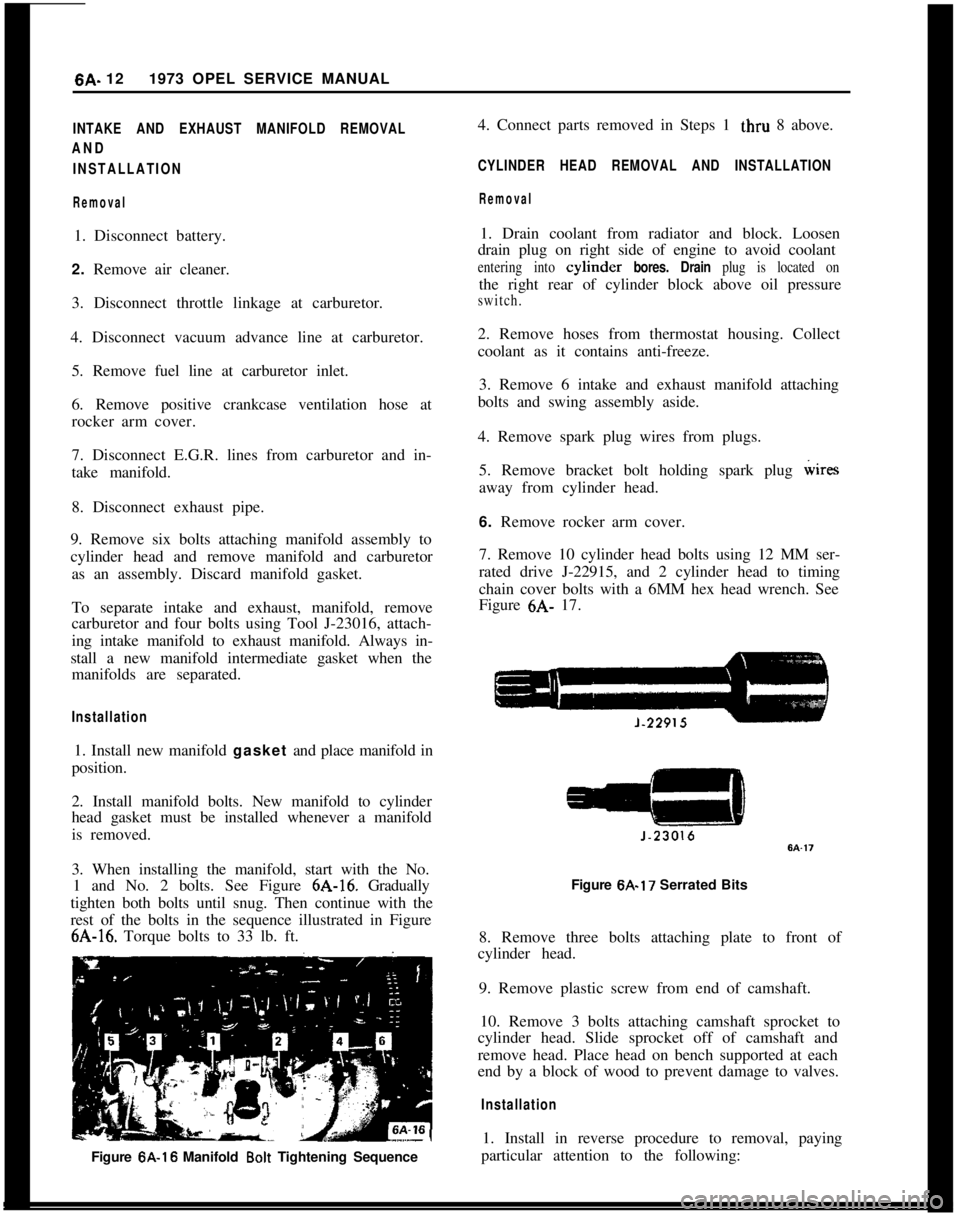
3. When installing the manifold, start with the No.
1 and No. 2 bolts. See Figure 6A-16. Gradually
tighten both bolts until snug. Then continue with the
rest of the bolts in the sequence illustrated in Figure6A-16. Torque bolts to 33 lb. ft.
Figure 6A-16 Manifold
Bolt Tightening Sequence4. Connect parts removed in Steps 1 thru 8 above.
CYLINDER HEAD REMOVAL AND INSTALLATION
Removal1. Drain coolant from radiator and block. Loosen
drain plug on right side of engine to avoid coolant
entering into cylmder bores. Drain plug is located onthe right rear of cylinder block above oil pressure
switch.2. Remove hoses from thermostat housing. Collect
coolant as it contains anti-freeze.
3. Remove 6 intake and exhaust manifold attaching
bolts and swing assembly aside.
4. Remove spark plug wires from plugs.
5. Remove bracket bolt holding spark plug wires
away from cylinder head.
6. Remove rocker arm cover.
7. Remove 10 cylinder head bolts using 12 MM ser-
rated drive J-22915, and 2 cylinder head to timing
chain cover bolts with a 6MM hex head wrench. See
Figure 6A- 17.
Figure 6A-17 Serrated Bits
8. Remove three bolts attaching plate to front of
cylinder head.
9. Remove plastic screw from end of camshaft.
10. Remove 3 bolts attaching camshaft sprocket to
cylinder head. Slide sprocket off of camshaft and
remove head. Place head on bench supported at each
end by a block of wood to prevent damage to valves.
Installation1. Install in reverse procedure to removal, paying
particular attention to the following:
Page 305 of 625
6A. 141973 OPEL SERVICE MANUAL
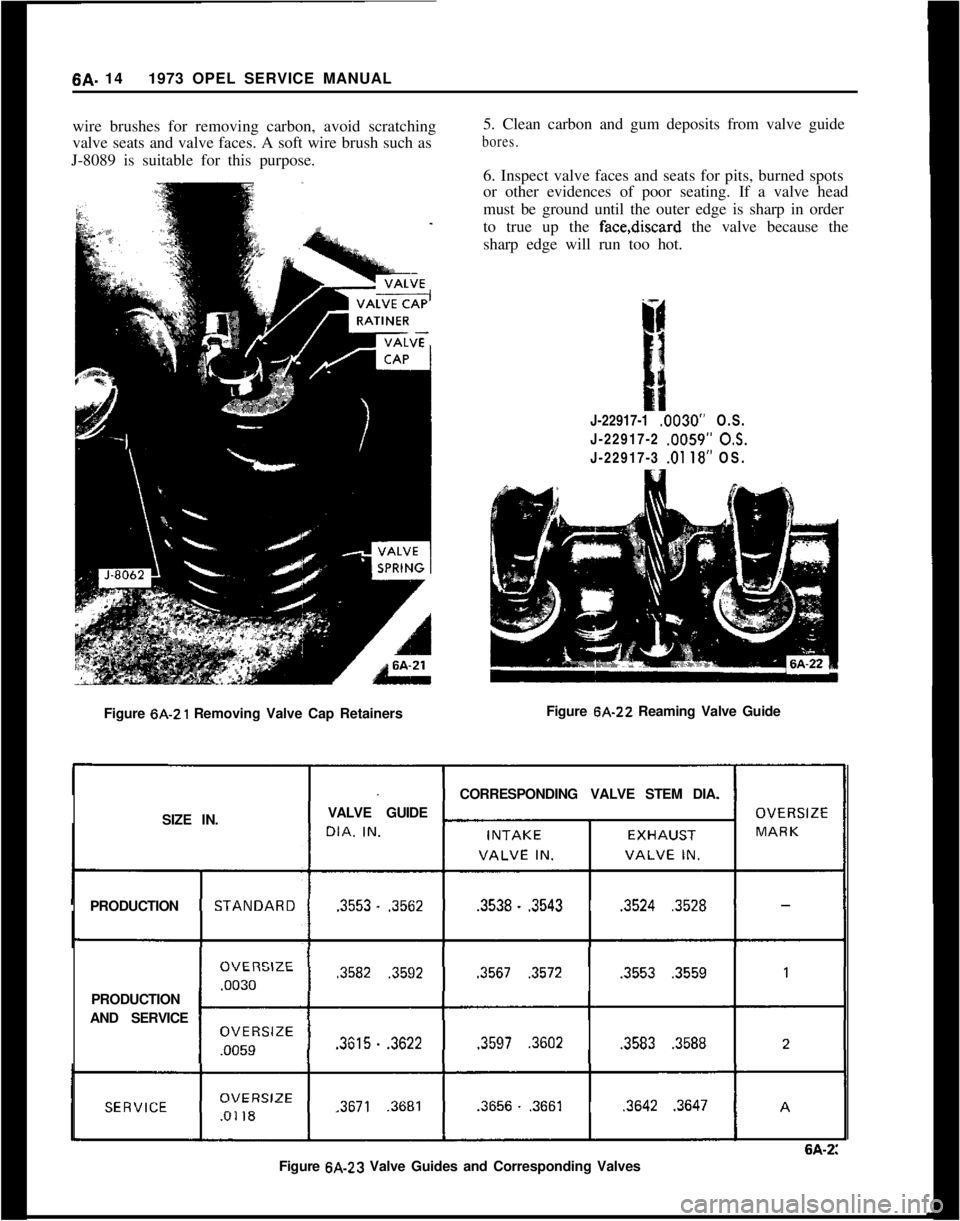
wire brushes for removing carbon, avoid scratching
valve seats and valve faces. A soft wire brush such as
J-8089 is suitable for this purpose.
Figure 6A-21 Removing Valve Cap Retainers5. Clean carbon and gum deposits from valve guide
bores.6. Inspect valve faces and seats for pits, burned spots
or other evidences of poor seating. If a valve head
must be ground until the outer edge is sharp in order
to true up the face,discard the valve because the
sharp edge will run too hot.
J-22917-1 .0030” O.S.
J-22917-2 .0059”
05.J-22917-3 .Ol 18” OS.
Figure 6A-22 Reaming Valve Guide
CORRESPONDINGVALVE STEM DIA.
SIZE IN.VALVE GUIDE
PRODUCTION.3553.
.3562.3538..3543.3524.3528PRODUCTION
AND SERVICE
.3582.3592.3567.3572.3553.3559.3615.
.3622.3597.3602.3583.3588
.3671.3681.3656..3661.3642.3647
6A-2:Figure 6A-23 Valve Guides and Corresponding Valves
Page 310 of 625
ENGINE MECHANICAL AND MOUNTS6A- 19
sion. When replacing flywheel use new bolts and
torque to 43 lb.ft.
PISTON, RINGS AND CONNECTING RODS
Removal and Disassembly of Piston
and Rod Assemblies
1. Drain oil.
2. Remove oil pan. 3. Remove cylinder head.
4. Examine the cylinder bores above the ring travel.
If bores are worn so a ridge exists, remove the ridges
with a ridge reamer to avoid damaging rings or
cracking ring lands in pistons during removal.
5. Mark the cylinder number on all pistons, connect-
ing rods and caps. Starting at the front end of the
crankcase, the cylinders are numbered l-2-3-4,
6. Remove cap and bearing shell from number 1
connecting rod.
7. Push the piston and
rod assembly up and out of
top cylinder. Then reinstall cap and bearing shell on
rod.
0
-J-23436-4
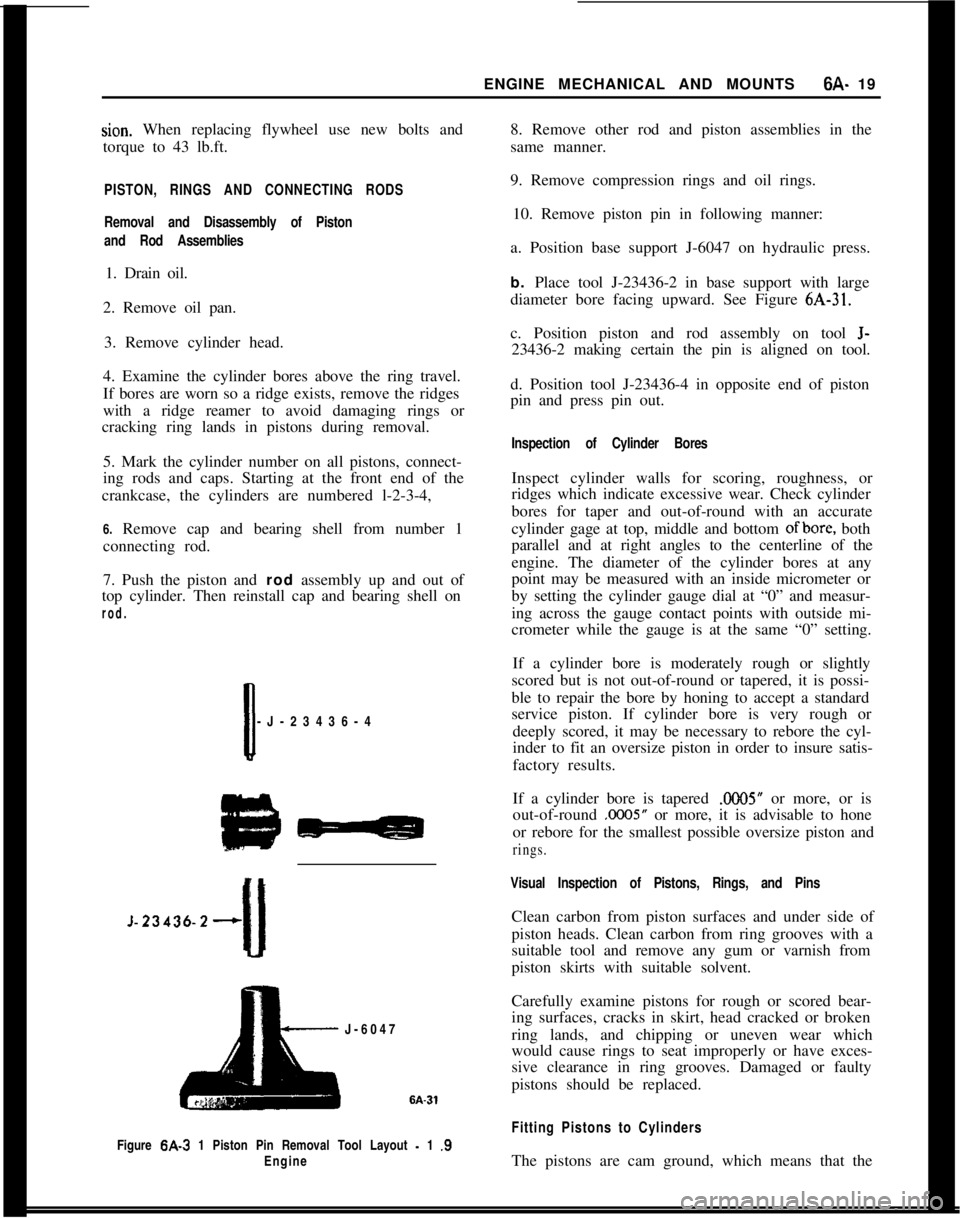
J-23436-2+
J-6047
Figure
6A-3 1 Piston Pin Removal Tool Layout - 1 .S
Engine
8. Remove other rod and piston assemblies in the
same manner.
9. Remove compression rings and oil rings.
10. Remove piston pin in following manner:
a. Position base support J-6047 on hydraulic press.
b. Place tool J-23436-2 in base support with large
diameter bore facing upward. See Figure
6A-31.
c. Position piston and rod assembly on tool
J-
23436-2 making certain the pin is aligned on tool.
d. Position tool J-23436-4 in opposite end of piston
pin and press pin out.
Inspection of Cylinder Bores
Inspect cylinder walls for scoring, roughness, or
ridges which indicate excessive wear. Check cylinder
bores for taper and out-of-round with an accurate
cylinder gage at top, middle and bottom
ofbore, both
parallel and at right angles to the centerline of the
engine. The diameter of the cylinder bores at any
point may be measured with an inside micrometer or
by setting the cylinder gauge dial at “0” and measur-
ing across the gauge contact points with outside mi-
crometer while the gauge is at the same “0” setting.
If a cylinder bore is moderately rough or slightly
scored but is not out-of-round or tapered, it is possi-
ble to repair the bore by honing to accept a standard
service piston. If cylinder bore is very rough or deeply scored, it may be necessary to rebore the cyl-
inder to fit an oversize piston in order to insure satis-
factory results.
If a cylinder bore is tapered
.ooO5” or more, or is
out-of-round
.0005” or more, it is advisable to hone
or rebore for the smallest possible oversize piston and
rings.
Visual Inspection of Pistons, Rings, and Pins
Clean carbon from piston surfaces and under side of
piston heads. Clean carbon from ring grooves with a
suitable tool and remove any gum or varnish from
piston skirts with suitable solvent.
Carefully examine pistons for rough or scored bear-
ing surfaces, cracks in skirt, head cracked or broken
ring lands, and chipping or uneven wear which
would cause rings to seat improperly or have exces-
sive clearance in ring grooves. Damaged or faulty
pistons should be replaced.
Fitting Pistons to Cylinders
The pistons are cam ground, which means that the
Page 311 of 625
6A. 201973 OPEL SERVICE MANUAL
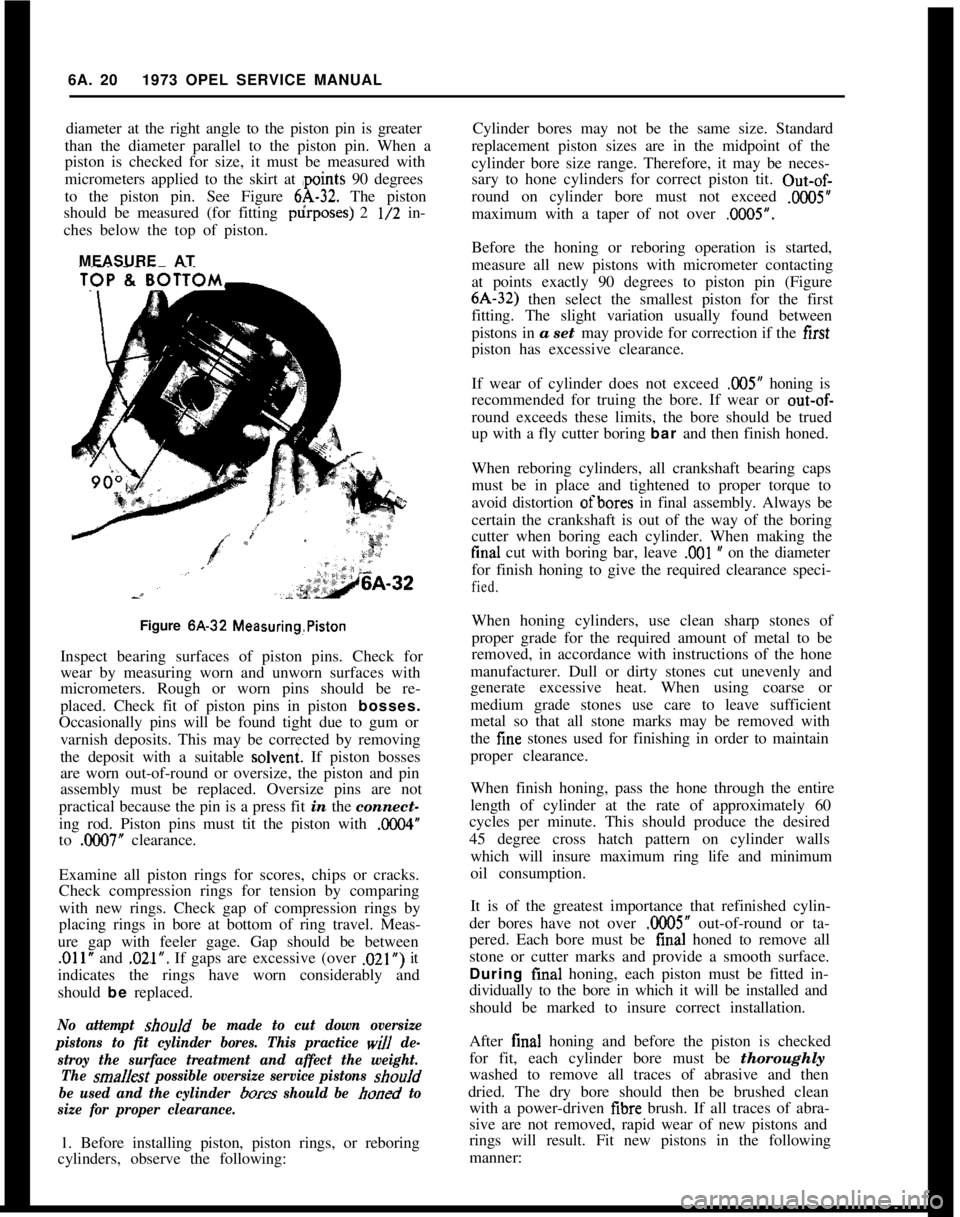
diameter at the right angle to the piston pin is greater
than the diameter parallel to the piston pin. When a
piston is checked for size, it must be measured with
micrometers applied to the skirt at ,points 90 degrees
to the piston pin. See Figure
6A-32. The piston
should be measured (for fitting p&poses) 2
l/2 in-
ches below the top of piston.
MEASURE AT
Figure 6A-32
Measuring,PistonInspect bearing surfaces of piston pins. Check for
wear by measuring worn and unworn surfaces with
micrometers. Rough or worn pins should be re-
placed. Check fit of piston pins in piston bosses.
Occasionally pins will be found tight due to gum or
varnish deposits. This may be corrected by removing
the deposit with a suitable solveni. If piston bosses
are worn out-of-round or oversize, the piston and pin
assembly must be replaced. Oversize pins are not
practical because the pin is a press fit in the connect-
ing rod. Piston pins must tit the piston with
0X4”to
.OCHl7” clearance.
Examine all piston rings for scores, chips or cracks.
Check compression rings for tension by comparing
with new rings. Check gap of compression rings by
placing rings in bore at bottom of ring travel. Meas-
ure gap with feeler gage. Gap should be between
,011” and .02.1”. If gaps are excessive (over .021”) it
indicates the rings have worn considerably and
should be replaced.
No attempt should be made to cut down oversize
pistons to fit cylinder bores. This practice
will de-
stroy the surface treatment and affect the weight.
The
sma/Jest possible oversize service pistons shouId
be used and the cylinder
bores should be honed to
size for proper clearance.1. Before installing piston, piston rings, or reboring
cylinders, observe the following:Cylinder bores may not be the same size. Standard
replacement piston sizes are in the midpoint of the
cylinder bore size range. Therefore, it may be neces-
sary to hone cylinders for correct piston tit. Out-of-
round on cylinder bore must not exceed
.ooO5”maximum with a taper of not over
.OilO5”.Before the honing or reboring operation is started,
measure all new pistons with micrometer contacting
at points exactly 90 degrees to piston pin (Figure6A-32) then select the smallest piston for the first
fitting. The slight variation usually found between
pistons in a set may provide for correction if the first
piston has excessive clearance.
If wear of cylinder does not exceed
.005” honing is
recommended for truing the bore. If wear or
out-of-round exceeds these limits, the bore should be trued
up with a fly cutter boring bar and then finish honed.
When reboring cylinders, all crankshaft bearing caps
must be in place and tightened to proper torque to
avoid distortion ofbores in final assembly. Always be
certain the crankshaft is out of the way of the boring
cutter when boring each cylinder. When making thefinal cut with boring bar, leave
,001 w on the diameter
for finish honing to give the required clearance speci-
fied.When honing cylinders, use clean sharp stones of
proper grade for the required amount of metal to be
removed, in accordance with instructions of the hone
manufacturer. Dull or dirty stones cut unevenly and
generate excessive heat. When using coarse or
medium grade stones use care to leave sufficient
metal so that all stone marks may be removed with
the fine stones used for finishing in order to maintain
proper clearance.
When finish honing, pass the hone through the entire
length of cylinder at the rate of approximately 60
cycles per minute. This should produce the desired
45 degree cross hatch pattern on cylinder walls
which will insure maximum ring life and minimum
oil consumption.
It is of the greatest importance that refinished cylin-
der bores have not over
.0005” out-of-round or ta-
pered. Each bore must be final honed to remove all
stone or cutter marks and provide a smooth surface.
During final honing, each piston must be fitted in-
dividually to the bore in which it will be installed and
should be marked to insure correct installation.
After final honing and before the piston is checked
for fit, each cylinder bore must be thoroughly
washed to remove all traces of abrasive and then
dried. The dry bore should then be brushed clean
with a power-driven iibre brush. If all traces of abra-
sive are not removed, rapid wear of new pistons and
rings will result. Fit new pistons in the following
manner:
Page 312 of 625

ENGINE MECHANICAL AND MOUNTS6A- 21
2.. Expand a telescope gage to fit the cylinder bore at
right angles to the piston pin 2-l/2” from top. See
Figure 6A-33.cylinders, the glazed cylinder walls should be slightly
dulled without increasing the bore diameter by
means of the finest grade honing stones.
TELESCOPE GAUGE1
Figure 6A-33 Checking Cylinder Bores
TELESCOPE/GAUGE
MICROMETER
Figure
6A-34 Measuring Telescope Gage3. Measure the piston to be installed. See Figure6A-32. The piston must be measured at right angles
to the piston pin
2-l/2” below the top of piston. The
piston must be between
.C008” and .0012” smaller
than the cylinder bore.
Both block and piston must be at approximately the
same temperature when measurements are made or
expansion errors will occur. A
dif.ference of 10 de-
grees F between parts is sufficient to produce a varia-
tion of .0005”.
Fitting New Piston RingsWhen new piston rings are installed without reboringNew piston rings must be checked for clearance in
piston grooves and for gap in cylinder bores; how-
ever, the flexible oil rings are not checked for gap.
The cylinder bores and piston grooves must be clean,
dry, and free of carbon and burrs.
To check the end gap of compression rings, place the
ring in the cylinder in which it will be used and
square it in the bore by tapping with the lower end
of a piston. Measure the gap with feeler gages.
Piston ring end gap should be
,014” - ,022” (top) and
,014” - ,022” (2nd) and the oil ring end gap should
be
.015” - ,055”.
If gap is less than specified, file the ends of rings
carefully with a smooth tile to obtain proper gap.
Install piston rings as follows:
1. Upper ring is chrome plated and can be installed
either way up. Number two (2) ring has to be in-
stalled with the marking “top” up. Oil ring can be
installed either way
up. See Figure 6A-35.
1. PISTON
2. NO.
I COMPRESSION RING - INSTALLED
WITH EITHER SIDE UP.
3. NO. 2 COMPRESSION RING - INSTALLED
WITH “TOP” MARKING TOWARDS THE TOP.
4. UPPER AND LOWER STEEL BAND RING
-
INSTALLED WITH EITHER SIDE UP.5. INTERMEDIATED RING
- INSTALLED WITH
EITHER SIDE UP.
6A-35
Figure 6A.35 Arrangement of Piston Rings2. Install piston rings so gaps are positioned as shown
in Figure 6A-36.
Page 313 of 625
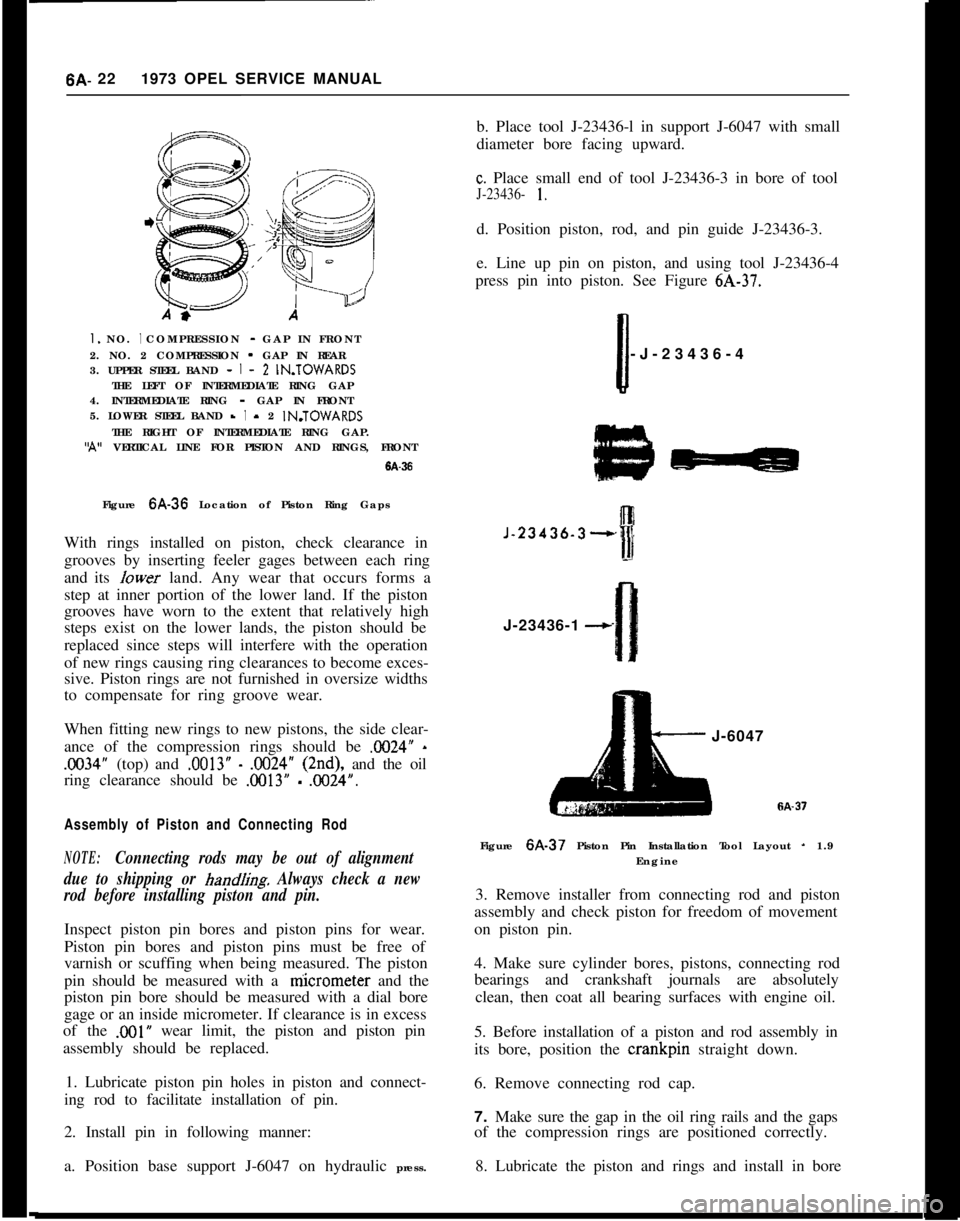
6A- 221973 OPEL SERVICE MANUALI. NO. I COMPRESSION - GAP IN FRONT
2. NO. 2 COMPRESSION - GAP IN REAR
3. UPPER STEEL BAND -
I - 2 IN.TOWARDS
THE LEFT OF INTERMEDIATE RING GAP
4. INTERMEDIATE RING - GAP IN FRONT
5. LOWER STEEL BAND -
I - 2 IN.TOWARDS
THE RIGHT OF INTERMEDIATE RING GAP.‘A” VERTICAL LINE FOR PISTON AND RINGS, FRONT
6A-36Figure 6A-36 Location of Piston Ring Gaps
With rings installed on piston, check clearance in
grooves by inserting feeler gages between each ring
and its Iower land. Any wear that occurs forms a
step at inner portion of the lower land. If the piston
grooves have worn to the extent that relatively high
steps exist on the lower lands, the piston should be
replaced since steps will interfere with the operation
of new rings causing ring clearances to become exces-
sive. Piston rings are not furnished in oversize widths
to compensate for ring groove wear.
When fitting new rings to new pistons, the side clear-
ance of the compression rings should be X024”
-
.1X34” (top) and .0013” - .OO24” (2nd), and the oil
ring clearance should be
.OO13” - .0024”.
Assembly of Piston and Connecting Rod
NOTE:Connecting rods may be out of alignment
due to shipping or
hand/i& Always check a new
rod before installing piston and pin.Inspect piston pin bores and piston pins for wear.
Piston pin bores and piston pins must be free of
varnish or scuffing when being measured. The piston
pin should be measured with a niicrometer and the
piston pin bore should be measured with a dial bore
gage or an inside micrometer. If clearance is in excess
of the
,001” wear limit, the piston and piston pin
assembly should be replaced.
1. Lubricate piston pin holes in piston and connect-
ing rod to facilitate installation of pin.
2. Install pin in following manner:
a. Position base support J-6047 on hydraulic press.b. Place tool J-23436-l in support J-6047 with small
diameter bore facing upward.
c. Place small end of tool J-23436-3 in bore of tool
J-23436- 1.d. Position piston, rod, and pin guide J-23436-3.
e. Line up pin on piston, and using tool J-23436-4
press pin into piston. See Figure 6A-37.
Ii-J-23436-4
J-23436-3--,J-23436-1
--cJ-6047
Figure 6A-37 Piston Pin Installation Tool Layout
- 1.9
Engine
3. Remove installer from connecting rod and piston
assembly and check piston for freedom of movement
on piston pin.
4. Make sure cylinder bores, pistons, connecting rod
bearings and crankshaft journals are absolutely
clean, then coat all bearing surfaces with engine oil.
5. Before installation of a piston and rod assembly in
its bore, position the crankpin straight down.
6. Remove connecting rod cap.
7. Make sure the gap in the oil ring rails and the gaps
of the compression rings are positioned correctly.
8. Lubricate the piston and rings and install in bore
Page 317 of 625
6A- 261973 OPEL SERVICE MANUAL
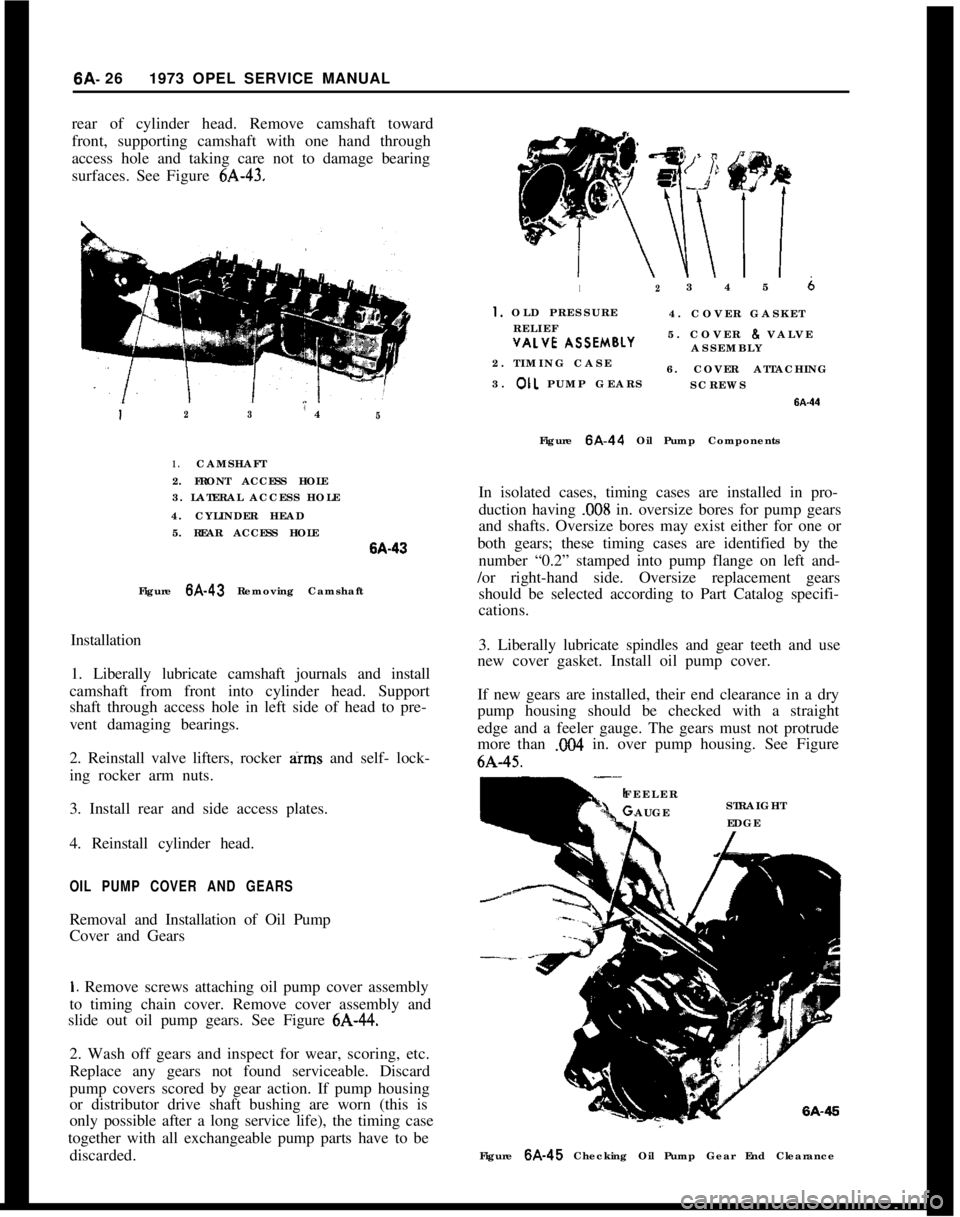
rear of cylinder head. Remove camshaft toward
front, supporting camshaft with one hand through
access hole and taking care not to damage bearing
surfaces. See Figure 6A-43.12345 6
I. OLD PRESSURE
4. COVER GASKET
RELIEF
~~- \SSEMBLY5. COVER 8 VALVE
ASSEMBLYVALVE I
2. TIMING CASE
6. COVER ATTACHING
3. OIL PUMP GEARS
SCREWS
123” 45Figure 6A-44 Oil Pump Components
1.CAMSHAFT
2. FRONT ACCESS HOLE
3. LATERAL ACCESS HOLE
4. CYLINDER HEAD
5. REAR ACCESS HOLEISA-43
Figure 6A-43 Removing Camshaft
Installation
1. Liberally lubricate camshaft journals and install
camshaft from front into cylinder head. Support
shaft through access hole in left side of head to pre-
vent damaging bearings.
2. Reinstall valve lifters, rocker arms and self- lock-
ing rocker arm nuts.
3. Install rear and side access plates.
4. Reinstall cylinder head.
OIL PUMP COVER AND GEARSRemoval and Installation of Oil Pump
Cover and Gears
1. Remove screws attaching oil pump cover assembly
to timing chain cover. Remove cover assembly and
slide out oil pump gears. See Figure 6A-44.
2. Wash off gears and inspect for wear, scoring, etc.
Replace any gears not found serviceable. Discard
pump covers scored by gear action. If pump housing
or distributor drive shaft bushing are worn (this is
only possible after a long service life), the timing case
together with all exchangeable pump parts have to be
discarded.In isolated cases, timing cases are installed in pro-
duction having
.008 in. oversize bores for pump gears
and shafts. Oversize bores may exist either for one or
both gears; these timing cases are identified by the
number “0.2” stamped into pump flange on left and-
/or right-hand side. Oversize replacement gears
should be selected according to Part Catalog specifi-
cations.
3. Liberally lubricate spindles and gear teeth and use
new cover gasket. Install oil pump cover.
If new gears are installed, their end clearance in a dry
pump housing should be checked with a straight
edge and a feeler gauge. The gears must not protrude
more than X04 in. over pump housing. See Figure6A-45.
FEELER
AUGESTRAIGHTIEDGE
Figure 6A-45 Checking Oil Pump Gear End Clearance
Page 320 of 625
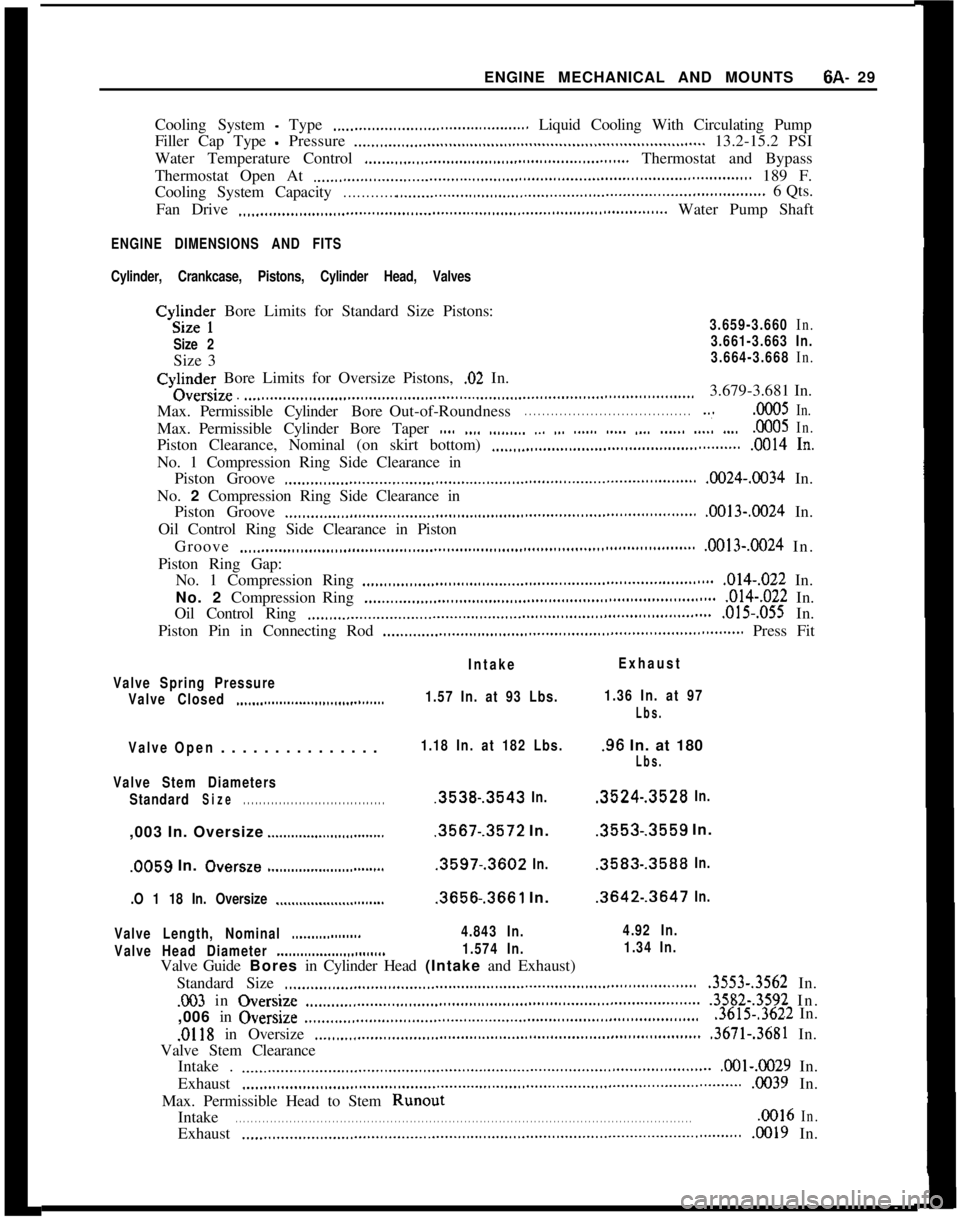
ENGINE MECHANICAL AND MOUNTS6A- 29
Cooling System - Type ,._...___..___..___........................... Liquid Cooling With Circulating Pump
Filler Cap Type
- Pressure _,._.,,._.,,...,,.........,..,.....,.,.................,,......................... 13.2-15.2 PSI
Water Temperature Control
._,..__,,._.,,__.,,...,.,.,,.,,.,,.,...............,,...,,,... Thermostat and Bypass
Thermostat Open At
._,,.,,.......,__.,.........,,...,...,,..,.,,.,,...................................................... 189 F.
Cooling System Capacity
. . . . . . . . . . . . .._...__..............,,.,,.,,..,...................................,,................6 Qts.
Fan Drive
.,,...,,,....,,.,..,..,,........,..,,..,,,.............,..,,.,..,,.................,,............... Water Pump Shaft
ENGINE DIMENSIONS AND FITS
Cylinder, Crankcase, Pistons, Cylinder Head, Valves
Cyg;te; Bore Limits for Standard Size Pistons:3.659-3.660 In.
Size 23.661-3.663 In.Size 3
3.664-3.668 In.Cylindey Bore Limits for Oversize Pistons,
.02 In.Oversm
. .._............,..,,...,................................,,.,,.,,.........................................3.679-3.681 In.
Max.PermissibleCylinderBoreOut-of-Roundness
. . . . . . . . . . . . . . . . . . . . . . . . . . . . . . . . . . . . . . ..~.OOO5In.Max.Permissible Cylinder Bore Taper
,.., ,.,, ,.,._,__. ,_, ,.. .__... ..__. ,__. .____. ..__. .._..0005In.Piston Clearance, Nominal (on skirt bottom)
_..__,,_.,.___.__.._...........,.......................... .0014 In.No. 1 Compression Ring Side Clearance in
Piston Groove
,...,,,.,,,.,,...,__..........,,..,,...,,...,..,.,,.,,..,,..,,..,,..................,,,..,,,..., .0024-.0034 In.
No. 2 Compression Ring Side Clearance in
Piston Groove
_..,,..,,,..,,..,,..,,....,.......,...,,,.,.,,,..,..,..,,..,,..,,,..,,,.,,,..,,,...,,,..,,,,..., .0013-.OO24 In.
Oil Control Ring Side Clearance in Piston
Groove
__..__..._..,,,..,...,,,..,....,..,,..,.........,..,,...,,.,,.,,..,..,,..,,...,,...,,,..,,,..,,,...,,..... .0013-X024 In.
Piston Ring Gap:
No. 1 Compression Ring
..,,.,,,..,,,..,,..,,,.,,.,,,..,......,,.,..............,......................... .014-,022 In.
No. 2 Compression Ring
_..___..__.,,..,,..,,,..,.,,,..,,.,,....................,......................... .014-,022 In.
Oil Control Ring
,...,,...,___.___.._..................,,,..,..,,..,,.,,,..,,,.,,..,,,..,,,...,,,,..,,,...,.... ,015.,055 In.
Piston Pin in Connecting Rod
..____.___..._,,__.,,,,,..,,.,,..,.................,,............................... Press Fit
IntakeExhaust
Valve Spring Pressure
Valve Closed
_______........___..,,,,,,............1.57 In. at 93 Lbs.1.36 In. at 97
Lbs.
ValveOpen. . . . . . . . . . . . . . .1.18 In. at 182 Lbs..96 In. at 180
Lbs.
Valve Stem Diameters
Standard
Size. . . . . . . . . . . . . . . . . . . . . . . . . . . . . . . . . . . ..3538-.3543 In..3524-.3528 In.,003 In. Oversize
____.....__.._..,,,,,,.........3567-.3572 In..3553-.3559 In..0059 In.
Oversze .__......_______...............3597-.3602 In..3583-.3588 In.
.O 1 18 In. Oversize
_._...._._____...............3656-.3661 In..3642-.3647 In.
Valve Length, Nominal
..___.............4.843 In.4.92 In.
Valve Head Diameter
___.......____...,,,........1.574 In.1.34 In.Valve Guide Bores in Cylinder Head (Intake and Exhaust)
Standard Size
,,...,,...,,..,,..,,,..,,....................................,..,,...,,.,,,,..,,,,..,,...,,,,.., .3553-.3562 In.003 in Oversjze
.,..__,,._.,__..___....,,...,,..,,...,,,,,,.,,.,,..,................,.....,................. .3582-.3592 In.
,006 in Overslze
..,...,,..,,.......................................,.........................................3615-.3622 In.
.0118 in Oversize ,._.,,..,............,,...,,........................................,,.................... .3671-.3681 In.
Valve Stem Clearance
Intake .
.._........___..___.....,............,...,,..........................................,,...................... .OOl-.0029 In.
Exhaust
._.,,........,,...,,..,,...........,,...,................,..,,..,,................,,.....,.,........................ 0039 In.
Max. Permissible Head to Stem Runout
Intake
. . . . . . . . . . . . . . . . . . . . . . . . . . . . . . . . . . . . . . . . . . . . . . . . . . . . . . . . . . . . . . . . . . . . . . . . . . . . . . . . . . . . . . . . . . . . . . . . . . . . . . . . . . . . . . . . . . . . . ..OO16In.Exhaust
.,...........,,...,...,.,,...........,,...,....,....,.,,,..,,.,,,........................................,.......... .0019 In.