brake light OPEL 1900 1973 Owner's Manual
[x] Cancel search | Manufacturer: OPEL, Model Year: 1973, Model line: 1900, Model: OPEL 1900 1973Pages: 625, PDF Size: 17.22 MB
Page 278 of 625
DISC BRAKES5B- 19
CAUTION:
Fasteners in Steps 7 and 9 are important
attachingparts in that they cooId affect theperfom-
ante of vital components and systems, and/or couJd
resuJt in major repair expense. They must be re-
placed with one of the same part number or with an
equivaJent part if repJacement becomes necessary.
Do not use a replacement part
or Jesser quaJity or
substitute design. Torque
vaJues must be used as
specified during
reassembJy to assure proper reten-
tion of these parts.7. Install brake disc on wheel hub and torque attach-
ing bolts to 36
Ib.ft. If old brake disc is reused, pay
attention to locator marks on brake disc and wheel
hub.8. Prior to installing brake disc and hub assembly to
steering knuckle, check lubrication of both roller
bearings and quantity of grease in cavity of wheel
hub. If necessary, repack front wheel bearings.
9. Adjust front wheel bearing clearance and tighten
brake caliper to steering knuckle, attaching bolts to
a torque of 72
lb.ft. Prior to installing brake caliper
to steering knuckle, ensure that all contacting sur-
faces are free of dirt and burrs. Also make sure that
the friction pads are not damaged when sliding the
brake caliper onto brake disc.
10. Install wheel assembly, remove supports and
lower front of car.
REMOVING AND INSTALLING
BRAKE DISC SHIELD
Removal
1. Remove brake disc.
2. Remove disc shield from steering knuckle by
removing one Phillips head screw on the outside and
on the inside, the lower steering arm and disc shield
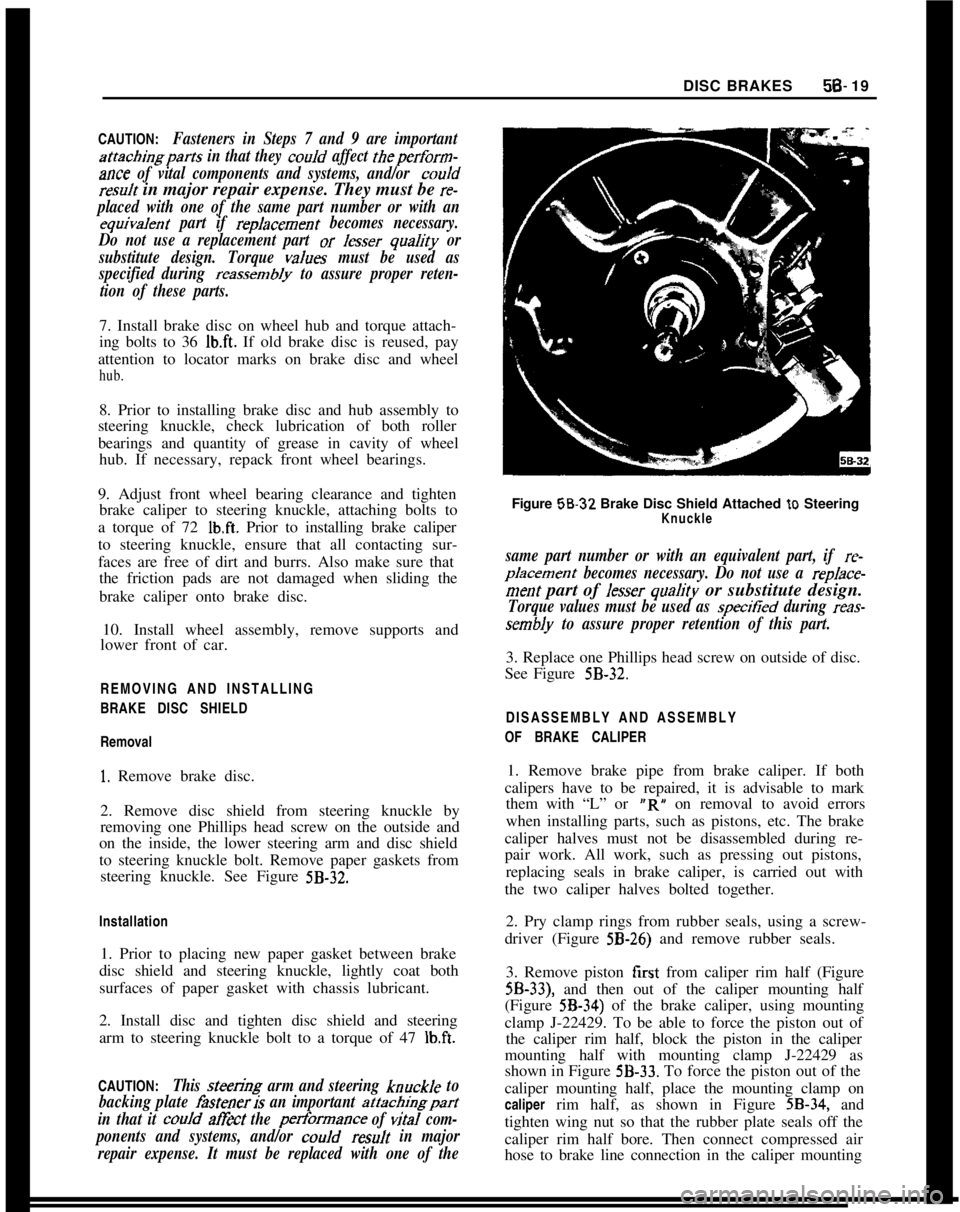
to steering knuckle bolt. Remove paper gaskets from
steering knuckle. See Figure
5B-32.Installation
1. Prior to placing new paper gasket between brake
disc shield and steering knuckle, lightly coat both
surfaces of paper gasket with chassis lubricant.
2. Install disc and tighten disc shield and steering
arm to steering knuckle bolt to a torque of 47
lb.ft.CAUTION:
This steen;Og arm and steering knuckJe to
backing plate
fisteneris an important attachingpart
in that it
couJd at&t the performance of viral com-
ponents and systems, and/or
couJd resuJt in major
repair expense. It must be replaced with one of theFigure 58-32 Brake Disc Shield Attached
to SteeringKnuckle
same part number or with an equivalent part, if re-
pJacement becomes necessary. Do not use a rep/ace-
merit part of Jesser quaJity or substitute design.
Torque values must be used as specitied during reas-
sembly to assure proper retention of this part.3. Replace one Phillips head screw on outside of disc.
See Figure
5B-32.DISASSEMBLY AND ASSEMBLY
OF BRAKE CALIPER
1. Remove brake pipe from brake caliper. If both
calipers have to be repaired, it is advisable to mark
them with “L” or “R” on removal to avoid errors
when installing parts, such as pistons, etc. The brake
caliper halves must not be disassembled during re-
pair work. All work, such as pressing out pistons,
replacing seals in brake caliper, is carried out with
the two caliper halves bolted together.
2. Pry clamp rings from rubber seals, using a screw-
driver (Figure
5B-26) and remove rubber seals.
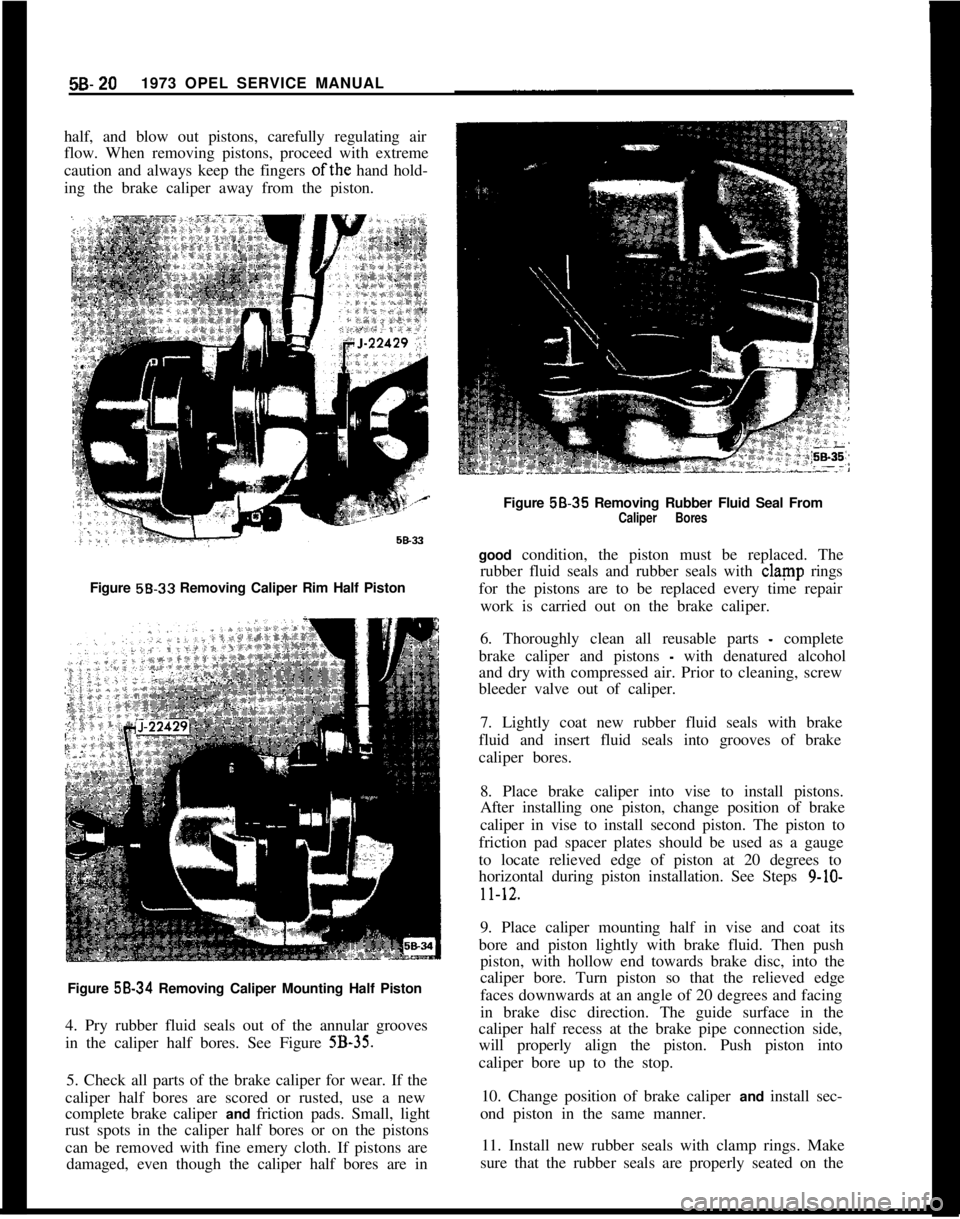
3. Remove piston first from caliper rim half (Figure
5B-33), and then out of the caliper mounting half
(Figure
5B-34) of the brake caliper, using mounting
clamp J-22429. To be able to force the piston out of
the caliper rim half, block the piston in the caliper
mounting half with mounting clamp J-22429 as
shown in Figure
5B-33. To force the piston out of the
caliper mounting half, place the mounting clamp on
caliper rim half, as shown in Figure
5B-34, and
tighten wing nut so that the rubber plate seals off the
caliper rim half bore. Then connect compressed air
hose to brake line connection in the caliper mounting
Page 279 of 625
58.201973 OPEL SERVICE MANUAL
half, and blow out pistons, carefully regulating air
flow. When removing pistons, proceed with extreme
caution and always keep the fingers ofthe hand hold-
ing the brake caliper away from the piston.
Figure 55.33 Removing Caliper Rim Half Piston
Figure 58-34 Removing Caliper Mounting Half Piston
4. Pry rubber fluid seals out of the annular grooves
in the caliper half bores. See Figure
5B-35.5. Check all parts of the brake caliper for wear. If the
caliper half bores are scored or rusted, use a new
complete brake caliper and friction pads. Small, light
rust spots in the caliper half bores or on the pistons
can be removed with fine emery cloth. If pistons are
damaged, even though the caliper half bores are inFigure 58-35 Removing Rubber Fluid Seal From
Caliper Boresgood condition, the piston must be replaced. The
rubber fluid seals and rubber seals with
clapp rings
for the pistons are to be replaced every time repair
work is carried out on the brake caliper.
6. Thoroughly clean all reusable parts
- complete
brake caliper and pistons
- with denatured alcohol
and dry with compressed air. Prior to cleaning, screw
bleeder valve out of caliper.
7. Lightly coat new rubber fluid seals with brake
fluid and insert fluid seals into grooves of brake
caliper bores.
8. Place brake caliper into vise to install pistons.
After installing one piston, change position of brake
caliper in vise to install second piston. The piston to
friction pad spacer plates should be used as a gauge
to locate relieved edge of piston at 20 degrees to
horizontal during piston installation. See Steps
9-IO-
11-12.9. Place caliper mounting half in vise and coat its
bore and piston lightly with brake fluid. Then push
piston, with hollow end towards brake disc, into the
caliper bore. Turn piston so that the relieved edge
faces downwards at an angle of 20 degrees and facing
in brake disc direction. The guide surface in the
caliper half recess at the brake pipe connection side,
will properly align the piston. Push piston into
caliper bore up to the stop.
10. Change position of brake caliper and install sec-
ond piston in the same manner.
11. Install new rubber seals with clamp rings. Make
sure that the rubber seals are properly seated on the
Page 280 of 625
DISC BRAKES5B- 21caliper half collars and the clamp rings are correctly
positioned on rubber seals.
12. Install brake caliper on steering knuckle, torqu-
ing bolts to 72 lb.ft.or with an equivalent part, if replacement becomes
necessary. Do not use a replacement part of lesser
quality or substitute design. Torque values must be
used as specified during reassembly to assure proper
retention of this part.
CAUTION: This disc brake caliper attachments fas-
tener is an important attaching part in that it couldatExt the performance of vital components and sys-
tems, and/or could result in
ma@r repair expense. It
must be replaced with one of the
same part number13. Attach brake pipe to caliper and torque to 22
lb.ft.14. Bleed brakes as necessary.
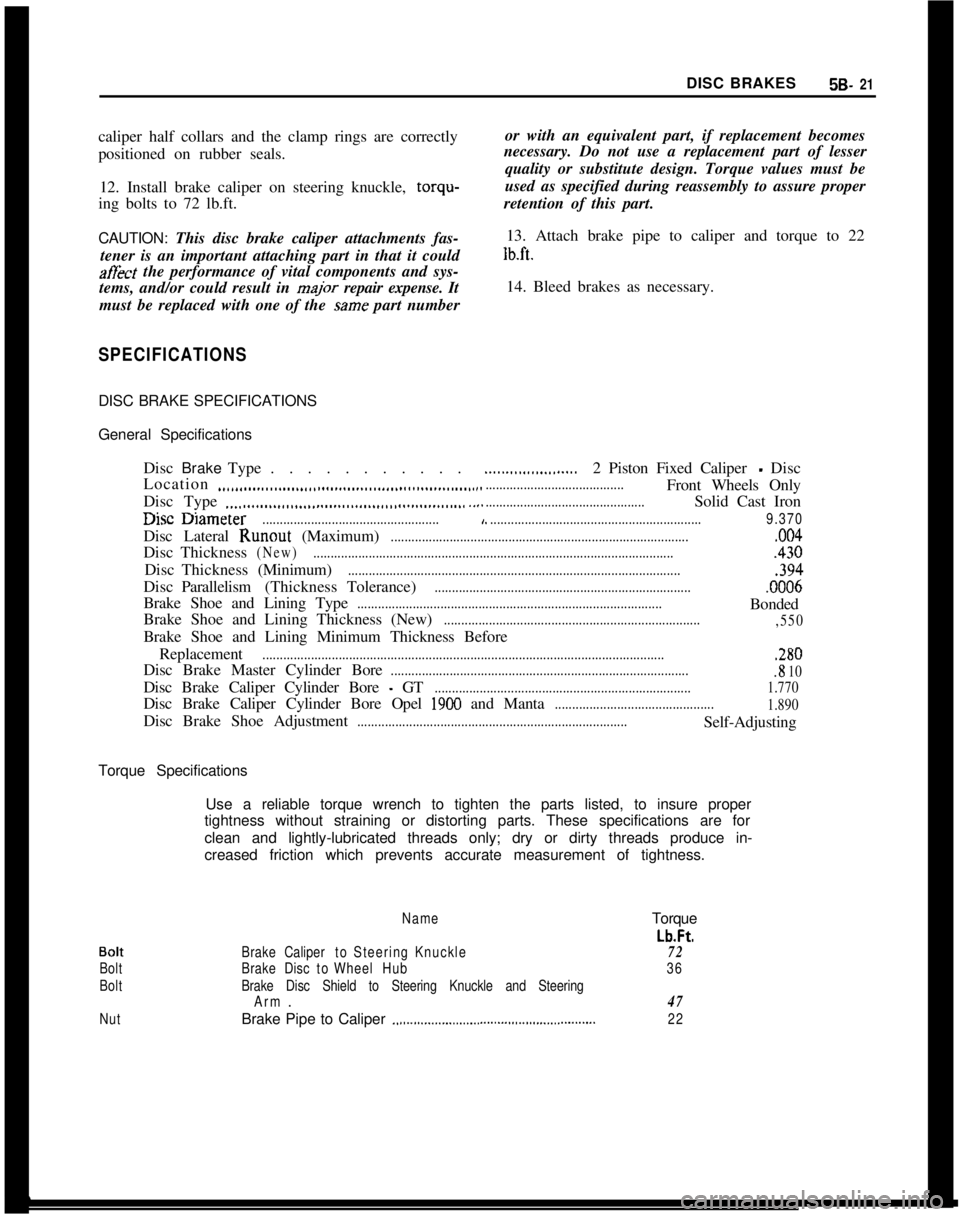
SPECIFICATIONSDISC BRAKE SPECIFICATIONS
General Specifications
DiscBrakeType. . . . . . . . . . .
Location
..,,.,..__....__.,,.,,,................,,,................,....Disc Type
.._.......................................................I.-. -.
......................2 Piston Fixed Caliper - Disc
........................................Front Wheels Only
..............................................Solid Cast Iron
useuameter...................................................,..............................................................9.370Disc Lateral Runout (Maximum)
......................................................................................,004DiscThickness
(New).........................................................................................................430DiscThickness(Minimum)
................................................................................................,394DiscParallelism(ThicknessTolerance)
...........................................................................0006Brake Shoe and Lining Type
........................................................................................Bonded
Brake Shoe and Lining Thickness (New)
..........................................................................
,550Brake Shoe and Lining Minimum Thickness Before
Replacement
....................................................................................................................,280Disc Brake Master Cylinder Bore
.......................................................................................8 10Disc Brake Caliper Cylinder Bore
- GT..........................................................................1.770Disc Brake Caliper Cylinder Bore Opel
1900 and Manta..............................................
1.890Disc Brake Shoe Adjustment
..............................................................................Self-Adjusting
Torque Specifications
Use a reliable torque wrench to tighten the parts listed, to insure proper
tightness without straining or distorting parts. These specifications are for
clean and lightly-lubricated threads only; dry or dirty threads produce in-
creased friction which prevents accurate measurement of tightness.
Bolt
Bolt
Bolt
NutName
BrakeCalipertoSteeringKnuckle
BrakeDisctoWheelHub
Brake Disc Shield to Steering Knuckle and Steering
Arm.
Brake Pipe to Caliper
.,.,...............................,......................Torque
Lb.Ft.
72
36
47
22
Page 282 of 625
DRUM BRAKES5C- 23
Parking Brake Control System
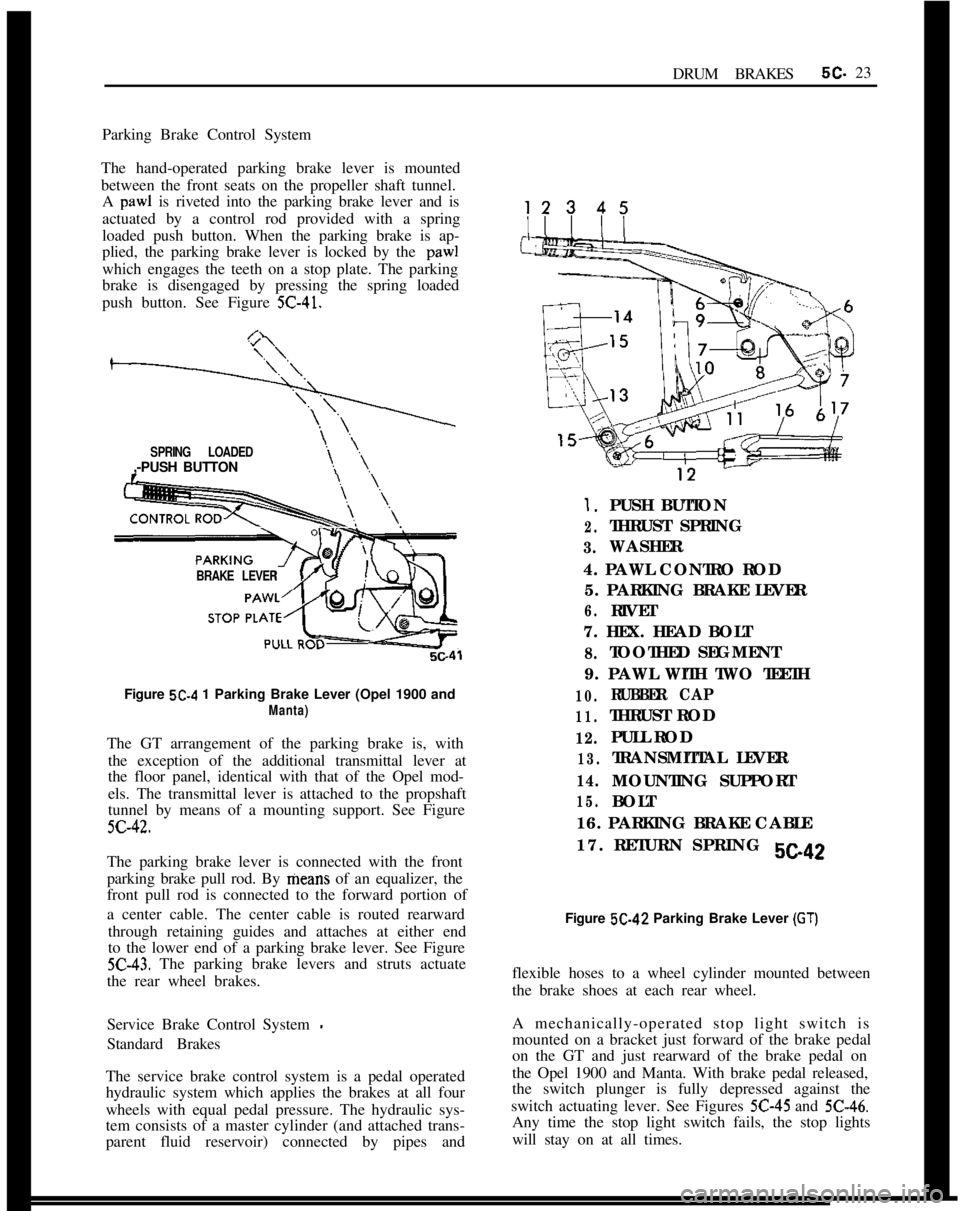
The hand-operated parking brake lever is mounted
between the front seats on the propeller shaft tunnel.
A paw1 is riveted into the parking brake lever and is
actuated by a control rod provided with a spring
loaded push button. When the parking brake is ap-
plied, the parking brake lever is locked by the
paw1which engages the teeth on a stop plate. The parking
brake is disengaged by pressing the spring loaded
push button. See Figure
5C-41.
SPRING LOADED,-PUSH BUTTON
BRAKE LEVER
s\., \\,Figure
5C-4 1 Parking Brake Lever (Opel 1900 and
Manta)The GT arrangement of the parking brake is, with
the exception of the additional transmittal lever at
the floor panel, identical with that of the Opel mod-
els. The transmittal lever is attached to the propshaft
tunnel by means of a mounting support. See Figure
5C-42.The parking brake lever is connected with the front
parking brake pull rod. By means of an equalizer, the
front pull rod is connected to the forward portion of
a center cable. The center cable is routed rearward
through retaining guides and attaches at either end
to the lower end of a parking brake lever. See Figure
5C-43. The parking brake levers and struts actuate
the rear wheel brakes.
Service Brake Control System
-Standard Brakes
The service brake control system is a pedal operated
hydraulic system which applies the brakes at all four
wheels with equal pedal pressure. The hydraulic sys-
tem consists of a master cylinder (and attached trans-
parent fluid reservoir) connected by pipes and
1.PUSH BUTTON
2.THRUST SPRING
3.WASHER
4. PAWL CONTRO ROD
5. PARKING BRAKE LEVER
6.RIVET
7. HEX. HEAD BOLT
8.TOOTHED SEGMENT
9. PAWL WITH TWO TEETH
10.RUBBER CAP
11.THRUST ROD
12.PULL ROD
13.TRANSMITTAL LEVER
14.MOUNTING SUPPORT
15.BOLT
16. PARKING BRAKE CABLE
17. RETURN SPRING
sea2Figure 5C-42 Parking Brake Lever
(GT)flexible hoses to a wheel cylinder mounted between
the brake shoes at each rear wheel.
A mechanically-operated stop light switch is
mounted on a bracket just forward of the brake pedal
on the GT and just rearward of the brake pedal on
the Opel 1900 and Manta. With brake pedal released,
the switch plunger is fully depressed against the
switch actuating lever. See Figures
5C-45 and 5C-46.Any time the stop light switch fails, the stop lights
will stay on at all times.
Page 283 of 625
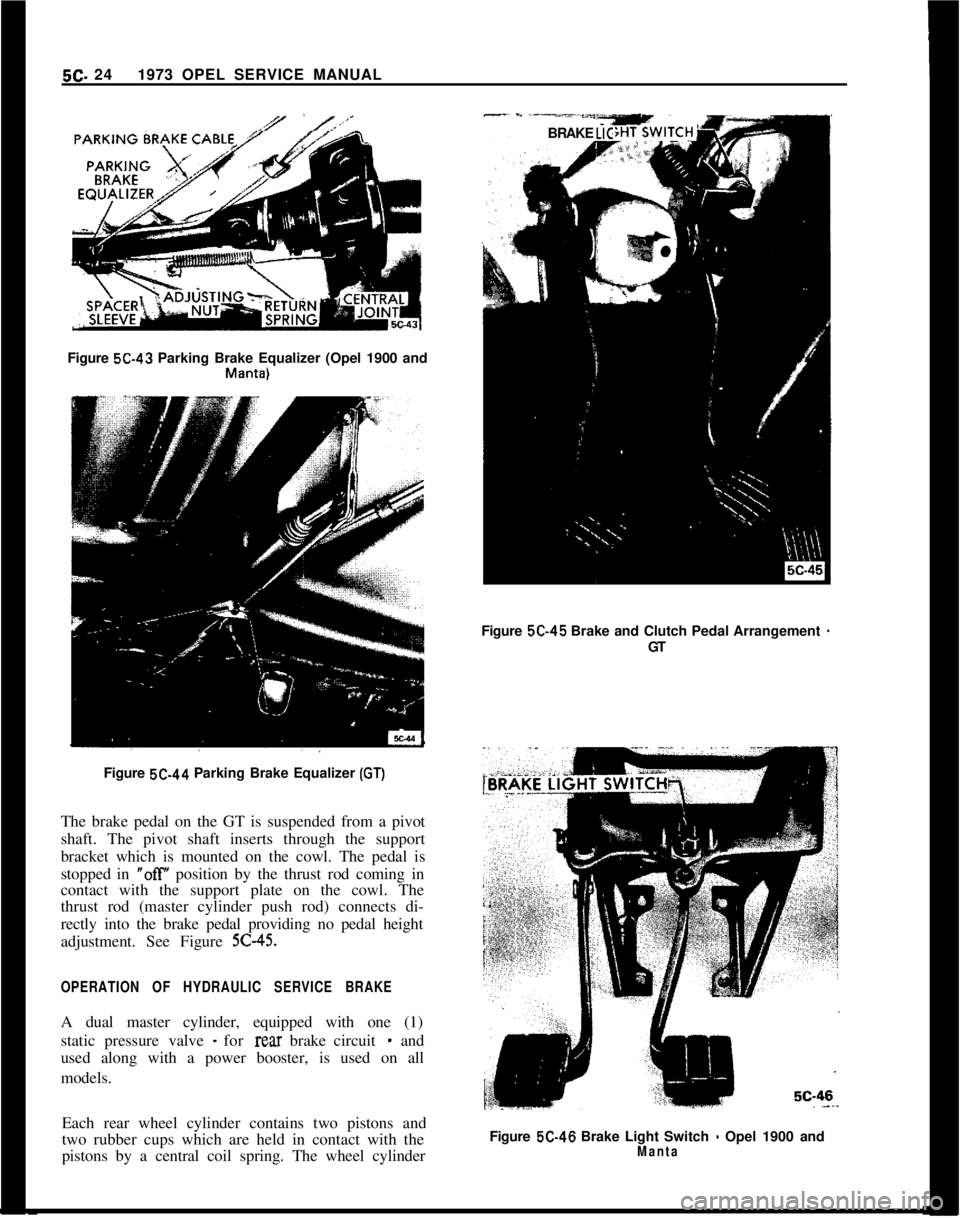
5C- 241973 OPEL SERVICE MANUAL-~ - -----*““YBRAKE LICFigure 5C-43 Parking Brake Equalizer (Opel 1900 and
Mallta)Figure 5C-45 Brake and Clutch Pedal Arrangement
-GT
Figure 5C-44 Parking Brake Equalizer
(GT)The brake pedal on the GT is suspended from a pivot
shaft. The pivot shaft inserts through the support
bracket which is mounted on the cowl. The pedal is
stopped in
“off position by the thrust rod coming in
contact with the support plate on the cowl. The
thrust rod (master cylinder push rod) connects di-
rectly into the brake pedal providing no pedal height
adjustment. See Figure
5C-45.
OPERATION OF HYDRAULIC SERVICE BRAKEA dual master cylinder, equipped with one (1)
static pressure valve
- for rear brake circuit - and
used along with a power booster, is used on all
models.
Each rear wheel cylinder contains two pistons and
two rubber cups which are held in contact with the
pistons by a central coil spring. The wheel cylinderFigure 5C-46 Brake Light Switch
- Opel 1900 andManta
Page 289 of 625
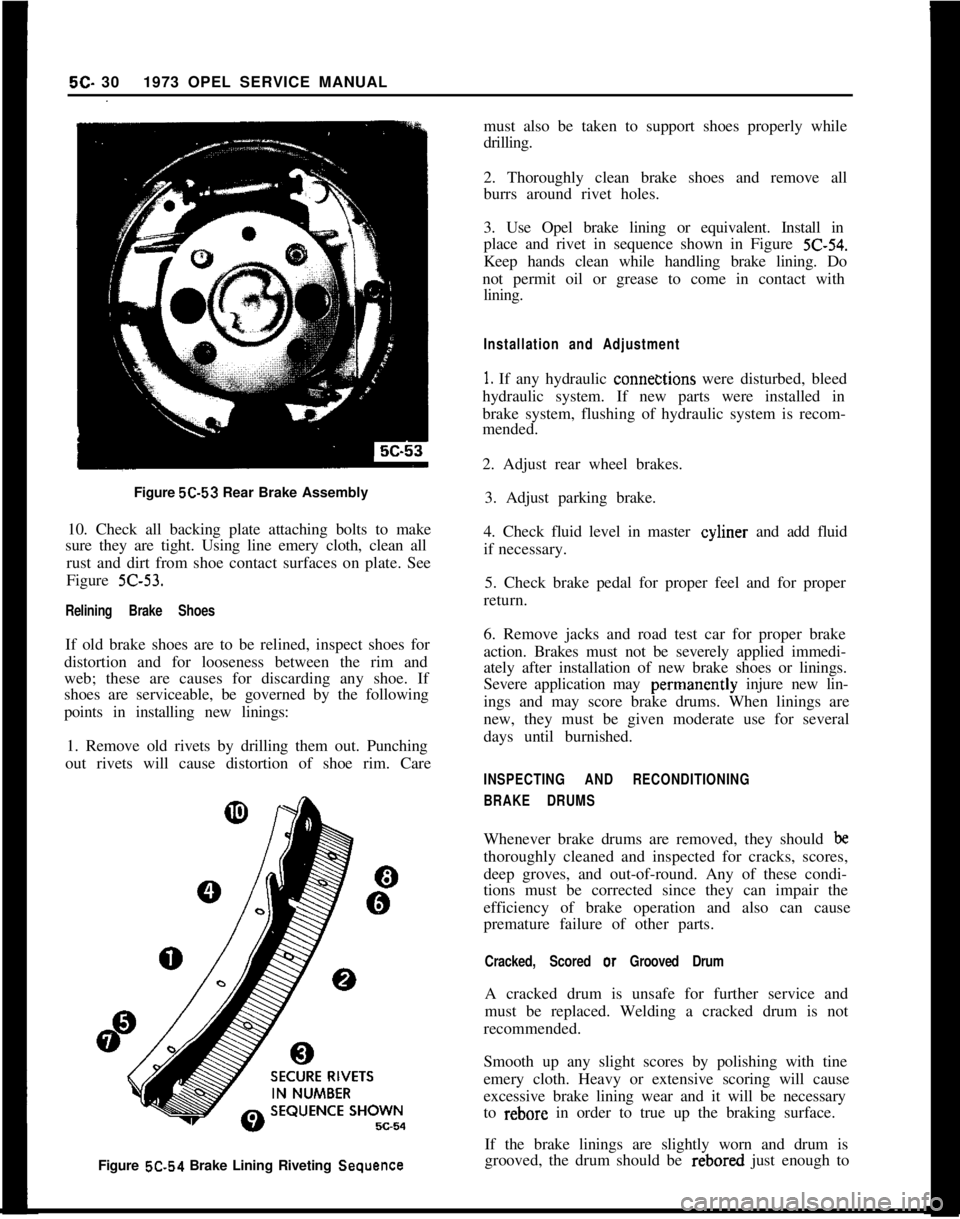
Figure 5C-53 Rear Brake Assembly
10. Check all backing plate attaching bolts to make
sure they are tight. Using line emery cloth, clean all
rust and dirt from shoe contact surfaces on plate. See
Figure Z-53.
Relining Brake ShoesIf old brake shoes are to be relined, inspect shoes for
distortion and for looseness between the rim and
web; these are causes for discarding any shoe. If
shoes are serviceable, be governed by the following
points in installing new linings:
1. Remove old rivets by drilling them out. Punching
out rivets will cause distortion of shoe rim. Care5C- 301973 OPEL SERVICE MANUAL
must also be taken to support shoes properly while
drilling.
2. Thoroughly clean brake shoes and remove all
burrs around rivet holes.
3. Use Opel brake lining or equivalent. Install in
place and rivet in sequence shown in Figure
Z-54.Keep hands clean while handling brake lining. Do
not permit oil or grease to come in contact with
lining.
Installation and Adjustment
1. If any hydraulic conne&tions were disturbed, bleed
hydraulic system. If new parts were installed in
brake system, flushing of hydraulic system is recom-
mended.
2. Adjust rear wheel brakes.
3. Adjust parking brake.
4. Check fluid level in master cyliner and add fluid
if necessary.
5. Check brake pedal for proper feel and for proper
return.
6. Remove jacks and road test car for proper brake
action. Brakes must not be severely applied immedi-
ately after installation of new brake shoes or linings.
Severe application may perinanently injure new lin-
ings and may score brake drums. When linings are
new, they must be given moderate use for several
days until burnished.
INSPECTING AND RECONDITIONING
BRAKE DRUMSWhenever brake drums are removed, they should
bethoroughly cleaned and inspected for cracks, scores,
deep groves, and out-of-round. Any of these condi-
tions must be corrected since they can impair the
efficiency of brake operation and also can cause
premature failure of other parts.
Cracked, Scored or Grooved DrumA cracked drum is unsafe for further service and
must be replaced. Welding a cracked drum is not
recommended.
Smooth up any slight scores by polishing with tine
emery cloth. Heavy or extensive scoring will cause
excessive brake lining wear and it will be necessary
to rebore in order to true up the braking surface.
Figure 5C.54 Brake Lining Riveting
SequenceIf the brake linings are slightly worn and drum is
grooved, the drum should be rebored just enough to
Page 290 of 625
DRUM BRAKES5c- 31
remove grooves, and the ridges in the lining should
be lightly removed with a lining grinder.
If brake linings are more than half worn, but do not
need replacement, the drum should be polished with
fine emery cloth but should not be rebored. At this
stage, eliminating the grooves in drum and smooth-
ing the ridges on lining would necessitate removal of
too much metal and lining, while if left alone, the
grooves and ridges match and satisfactory service
can be obtained.
If brake linings are to be replaced, a grooved drum
should be rebored for use with oversize linings. A
grooved drum, if used with new lining, will not only
wear the lining but will make it
diff%xlt, if not im-
possible, to obtain etXcient brake performance.
Out-of-Round DrumAn out-of-round drum makes accurate brake shoe
adjustment impossible and is likely to cause excessive
wear of other parts of brake mechanism due to its
eccentric action. An out-of-round drum can also
cause brake pulsation. Maximum permissible drumrunout is 004”. A drum that has more run-out than
this should be rebored. Runout can be accurately
checked by using an inside micrometer fitted with
proper extension rods.
When measuring a drum for run-out, take measure-
ments at open and closed edges of machined surface
and at right angles to each other.
Turning Brake DrumsIf a brake drum is to be turned, enough metal should
be removed to obtain a true, smooth braking surface.
Measure brake drum diameter; standard drum inner
diameter is 9.060”. Drums may be turned to an over-
size of ,030”. If maximum inner diameter after turn-
ing exceeds 9.090”, brake drum will have to be
replaced. Removal of more metal will affect dissipa-
tion of heat and may cause distortion of the drum.
1. Remove rear wheels and drums.
2. Mount brake drum on brake drum lathe and turn
drums as necessary, within limits.
3. After turning, check drum diameter. Inner diame-
ter not to exceed 9.090.
4. A newly-bored drum should always have center
contact with brake shoes. For this reason, arc grind
linings to
.OlO” under drum radius, or to ,020” under
drum diameter.
5. Clean and install drums and wheels.
BRAKE WHEEL CYLINDER OVERHAUL1. Remove wheel, drum, and brake shoes. Be careful
not to get grease or dirt on brake lining.
2. Disconnect brake pipe or hose from wheel cylinder
and cover opening with tape to prevent entrance of
dirt. Remove wheel cylinder from backing plate.
3. Remove boots, pistons, cups, and spring from cyl-
inder. Remove bleeder valve.
4. Discard rubber boots and piston cups. Thoroughly
clean all other parts with hydraulic brake fluid orDeclene. Do not use anti-freeze, alcohol, gasoline,
kerosene, or any other cleaning fluid that might con-
tain even a trace of mineral oil.
5. Inspect pistons and cylinder bore for scores, scrat-
ches, or corrosion. Light scratches may be polished
with crocus cloth. Do not use emery cloth or sandpa-
per.
Shght corro~on may be cleaned wth tine steel
wool. If scratches or corroded spots are too deep to
be polished satisfactorily, the cylinder should be re-
placed since honing is not recommended.
6. Dip internal parts in brake fluid and reassembly
wheel cylinder. When installing piston cups, use care
to avoid damaging the edges.
7. If the rear wheel backing plate is removed: Always
install new paper gaskets one on each side
- on the
backing plate. Prior to installation, lightly coat paper
gaskets with chassis lubricant. Torque backing plate
to rear axle housing bolts to 43
lb.ft. and wheel brake
cylinder to backing plate bolts to 5
lb.ft. Install wheel
cylinder on brake backing plate and connect brake
pipe or hose.
8. Install brake shoes, drum, and wheel, then flush
and bleed hydraulic system.
9. Adjust brakes, then road test car for brake per-
formance.
CAUTION:This brake backing plate to rear axle fis-
tener is an important attaching part in that it could
affect the performance of vital components and sys-
tems, and/or could result in major repair expense. It
must be replaced with one of the same part number
or with an equivalent part, if replacement becomes
necessary. Do not
use a replacement part of lesser
quahty or substitute design. Torque v&es must be
used as specified during reassembly to assure proper
retention of this part.
REPLACING BRAKE PIPESAny brake pipe assembly which is needed must be
made up from service bulk tubing and fittings. All
brake pipes must be made of tin or copper coated
wrapped steel tubing with the ends double lap flared.
Page 291 of 625
5C- 321973 OPEL SERVICE MANUAL
Never use copper tubing because copper is subject to
fatigue cracking which would result in brake failure.2. Cut tubing to length. The correct length may be
determined by measuring the old pipe using a cord
and adding l/8” for each double lap flare.
To make up a brake pipe assembly, proceed as fol-
lows:3. Double lap flare tubing ends, using a suitable flar-
ing tool such as J-8051. Follow the instructions in-
cluded in the tool set. Make sure fittings are installed
1. Procure the recommended tubing and fittings of
the correct size. (Outside diameter of tubing is used
to specify size.)before starting second flare.
4. Bend pipe assembly to match old pipe.
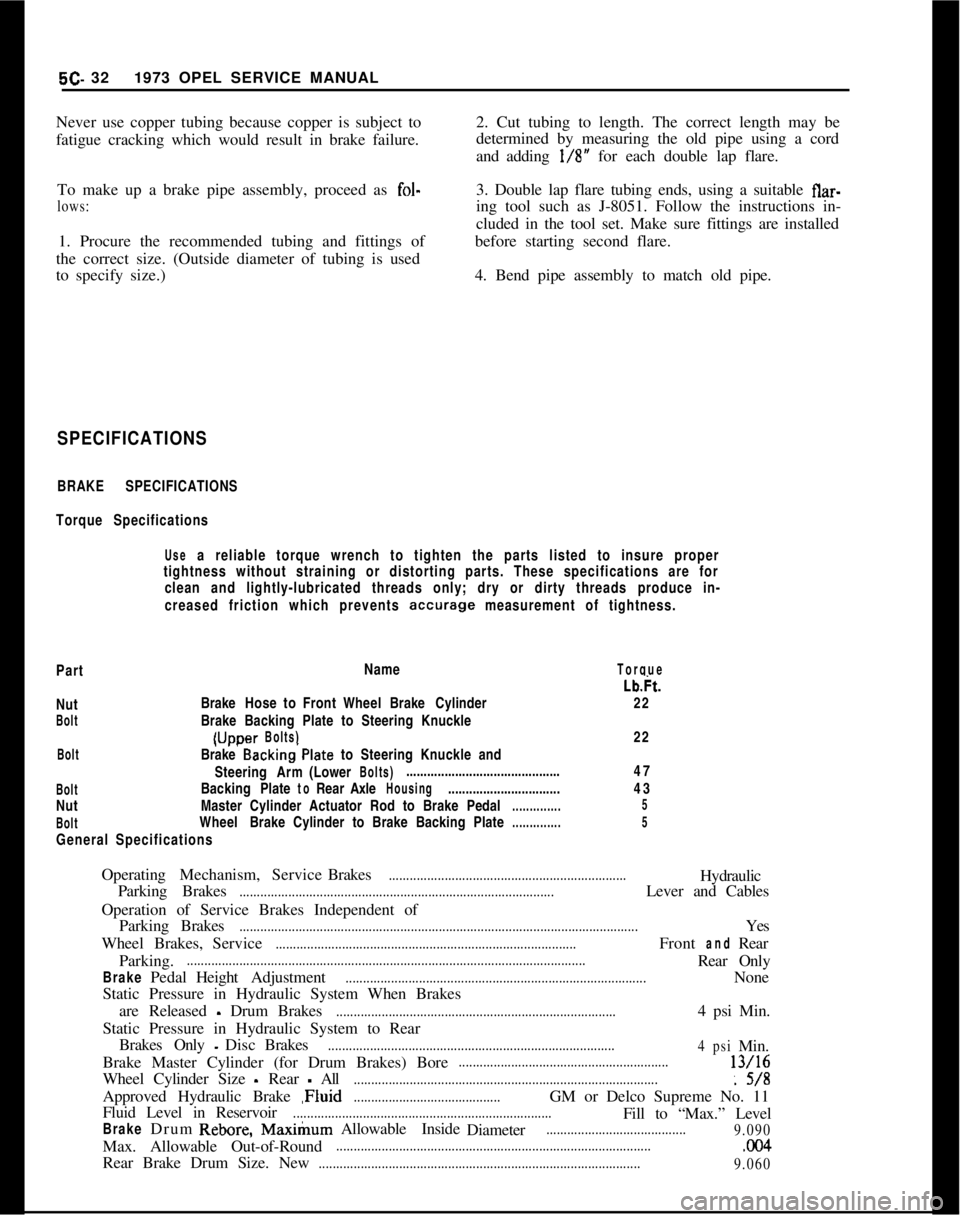
SPECIFICATIONS
BRAKE SPECIFICATIONS
Torque Specifications
Use a reliable torque wrench to tighten the parts listed to insure proper
tightness without straining or distorting parts. These specifications are for
clean and lightly-lubricated threads only; dry or dirty threads produce in-
creased friction which prevents
accurage measurement of tightness.
PartName
TorqueNut
BoltBrakeHose to Front WheelBrake Cylinder
Brake Backing Plate to Steering Knuckle(Uccer
Bolts)Lb&.
22
22...BoltBrake Backing’Plate to Steering Knuckle and
SteeringArm(Lower
Bolts)............................................
BoltBackingPlatetoRearAxleHousing................................
NutMaster Cylinder Actuator Rod to BrakePedal
..............
BoltWheelBrake Cylinder to Brake Backing Plate
..............
General Specifications47
43
5
5OperatingMechanism,ServiceBrakes
....................................................................Hydraulic
Parking Brakes
..........................................................................................Lever and Cables
Operation of Service Brakes Independent of
ParkingBrakes
..................................................................................................................Yes
WheelBrakes,Service
......................................................................................FrontandRear
Parking.
..................................................................................................................Rear Only
BrakePedalHeightAdjustment......................................................................................None
Static Pressure in Hydraulic System When Brakes
are Released
- Drum Brakes................................................................................4 psi Min.
Static Pressure in Hydraulic System to Rear
BrakesOnly
-DiscBrakes..................................................................................
4psiMin.
Brake Master Cylinder (for Drum Brakes) Bore
............................................................13/16
Wheel Cylinder Size
- Rear - All.......................................................................................: 5/8
Approved Hydraulic Brake ,Fluid
..........................................GM or Delco Supreme No. 11
Fluid Level in Reservoir
..........................................................................Fill to “Max.” Level
BrakeDrumRebore,Max&urnAllowable Inside
Diameter........................................
9.090Max. Allowable Out-of-Round
...........................................................................................CKl4Rear Brake Drum Size. New
............................................................................................
9.060
Page 299 of 625
6A- 8 1973 OPEL SERVICE MANUAL
Actual adjustment is made by backing off adjusting
nut at the rocker arm until clearance exists between the valve stem, rocker arm, and lifter. Then slowly
tighten adjusting nut until clearance is eliminated.
When clearance is eliminated, turn adjusting nut one
full turn (clockwise). This positions the hydraulic
piston of the hydraulic lifter mid-point in its total
available travel, and no further adjustment is re-
quired.
MAJOR REPAIR
ENGINE ASSEMBLY REMOVAL AND
INSTALLATION
Removal (Opel 1900 and Manta)’
The engine assembly on the Opel 1900 and Manta
can be removed together with the transmission
through the top of the engine compartment.
1. Remove hood (scribe hood hinge to hood mount-
ing location).
2. Disconnect battery negative cable.
3. Drain coolant at lower radiator hose.
4. Remove upper and lower radiator hoses.
5. Remove radiator and fan
shrbud.
6. Disconnect heater hoses.
7. Disconnect brake booster
vacuum hose.
8. Remove air cleaner.
9. Disconnect electrical connections and accelerator
linkage. 10. Remove console.
11. Remove shift lever boot, plate, and shift lever.
12. Raise car on hoist.
13. Disconnect fuel line at pump.
14. Remove front stone shield.
15. Disconnect speedo-cable, back-up light switch,
and clutch cable.
16. Remove drive shaft. I
17. Disconnect exhaust pipe
ar$l bell housing sup-
port.
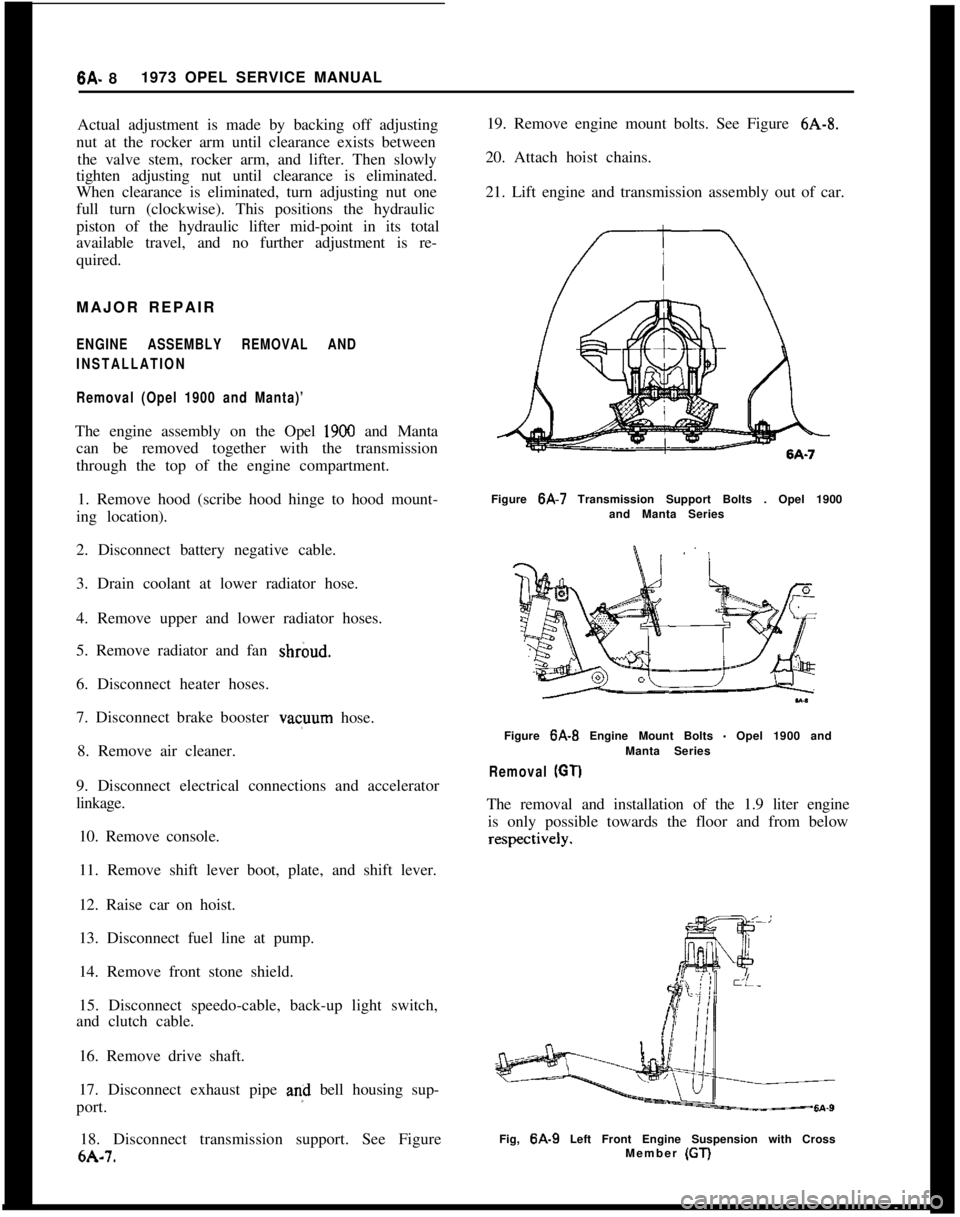
18. Disconnect transmission support. See Figure
6A-7. 19. Remove engine mount bolts. See Figure
6A-8.
20. Attach hoist chains.
21. Lift engine and transmission assembly out of car.
Figure 6A-7 Transmission Support Bolts . Opel 1900
and Manta Series
Figure
6A-B Engine Mount Bolts - Opel 1900 and
Manta Series
Removal (GT)
The removal and installation of the 1.9 liter engine is only possible towards the floor and from below
Fig, 6A-9 Left Front Engine Suspension with Cross
Member (GT)
Page 302 of 625
ENGINE MECHANICAL AND MOUNTS6A- 11
a. Attach left chain to alternator support rear bolt.
b. Bolt right chain to existing threaded hole at lower
right front of engine.
2. Assemble loose ends of chain to support device J-bolts and adjust to remove engine weight from motor
mounts.
3. Remove the two motor mount bracket to motor
mount retaining nuts.
4. Remove the two front suspension to frame rail bolt
retaining nuts.
5. Remove nut and bolt at lower end of steering shaft
U-joint.
6. With a floor jack under the center of the front
suspension cross member, raise car high enough for
wheels and suspension assembly to be rolled from
under car.
7. Position jack stands under both front jack brackets
on underbody to support car in this position.
8. Remove both front cross member support to frame
attaching bolts.
9. Remove brake pipe to brake hose retaining clips
at frame rails and disconnect brake hose from brake
pipes. Use an absorbent material or suitable con-
tainer for the brake fluid that will drain out.
10. Lower the front suspension assembly and remove
from under car.
11. Drain engine oil and remove oil pan and gasket.
Installation (Opel 1900 and Manta)1. Apply a light bead of sealer to the clean sealing
surfaces of the oil pan and affix a new gasket.
2. Bolt oil pan and gasket assembly to engine block.
3. Roll front suspension and floor jack under car and
raise into position careful to pilot the cross member
to frame rail attaching bolts and steering shaft to
their respective locations.
4. Install cross member’support to frame attaching
bolts and torque to 22 lb.ft.
5. Connect brake hose to brake pipes and install
retaining clips.
6. Bleed front brake system. Maintain brake fluid1Wd.
7. Remove jack stands and lower car.8. Install suspension to frame rail bolt retaining nuts.
9. Release and remove engine supporting device.
10. Install motor mount bracket to motor mount
retaining nuts.
11. Install steering shaft U-joint lower bolt and nut.
12. Replace engine oil.
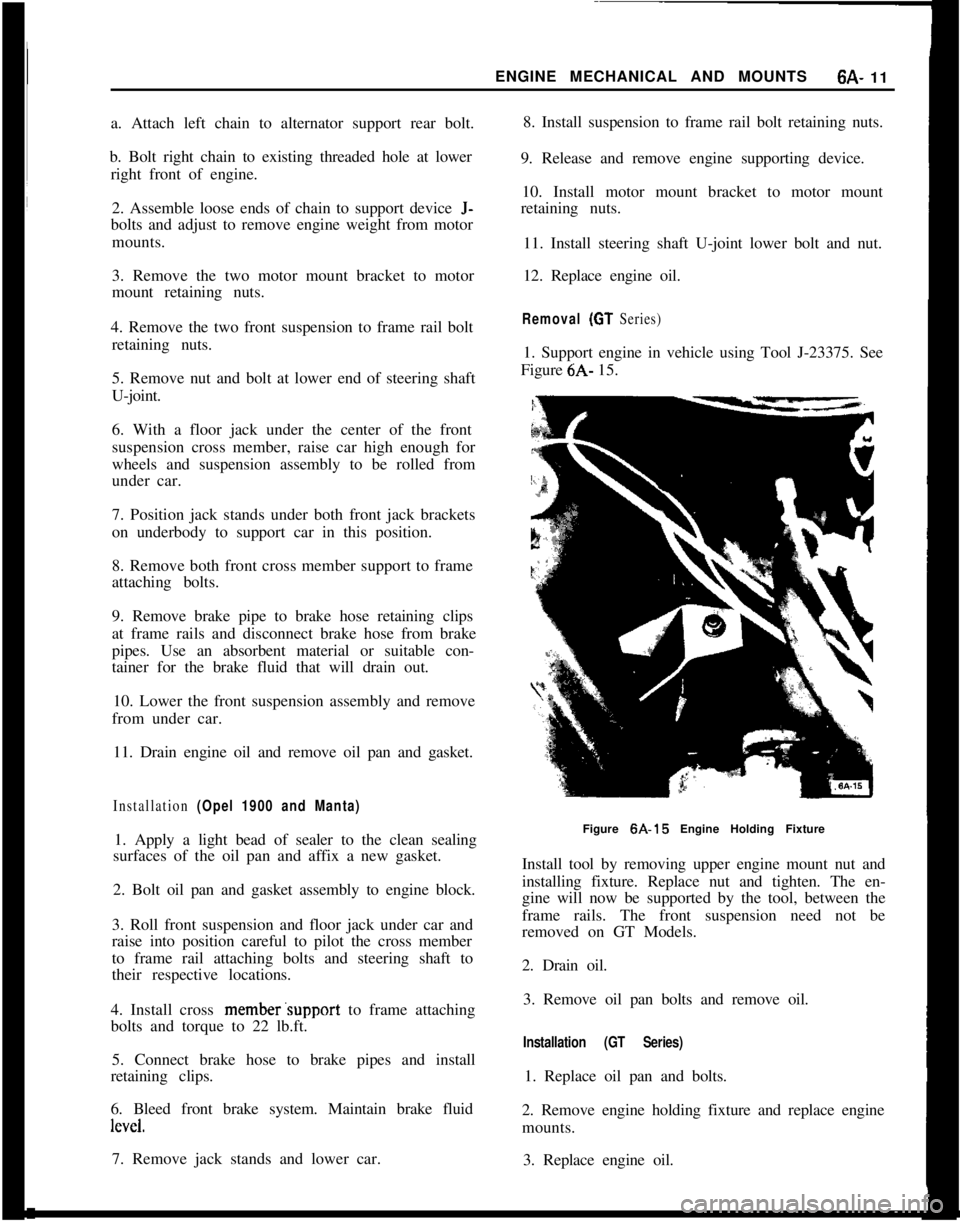
Removal (GT Series)1. Support engine in vehicle using Tool J-23375. See
Figure 6A- 15.
Figure 6A-15 Engine Holding Fixture
Install tool by removing upper engine mount nut and
installing fixture. Replace nut and tighten. The en-
gine will now be supported by the tool, between the
frame rails. The front suspension need not be
removed on GT Models.
2. Drain oil.
3. Remove oil pan bolts and remove oil.
Installation (GT Series)1. Replace oil pan and bolts.
2. Remove engine holding fixture and replace engine
mounts.
3. Replace engine oil.