oil OPEL 1900 1973 Workshop Manual
[x] Cancel search | Manufacturer: OPEL, Model Year: 1973, Model line: 1900, Model: OPEL 1900 1973Pages: 625, PDF Size: 17.22 MB
Page 247 of 625
48. 16
1973 OPEL SERVICE MANUAL
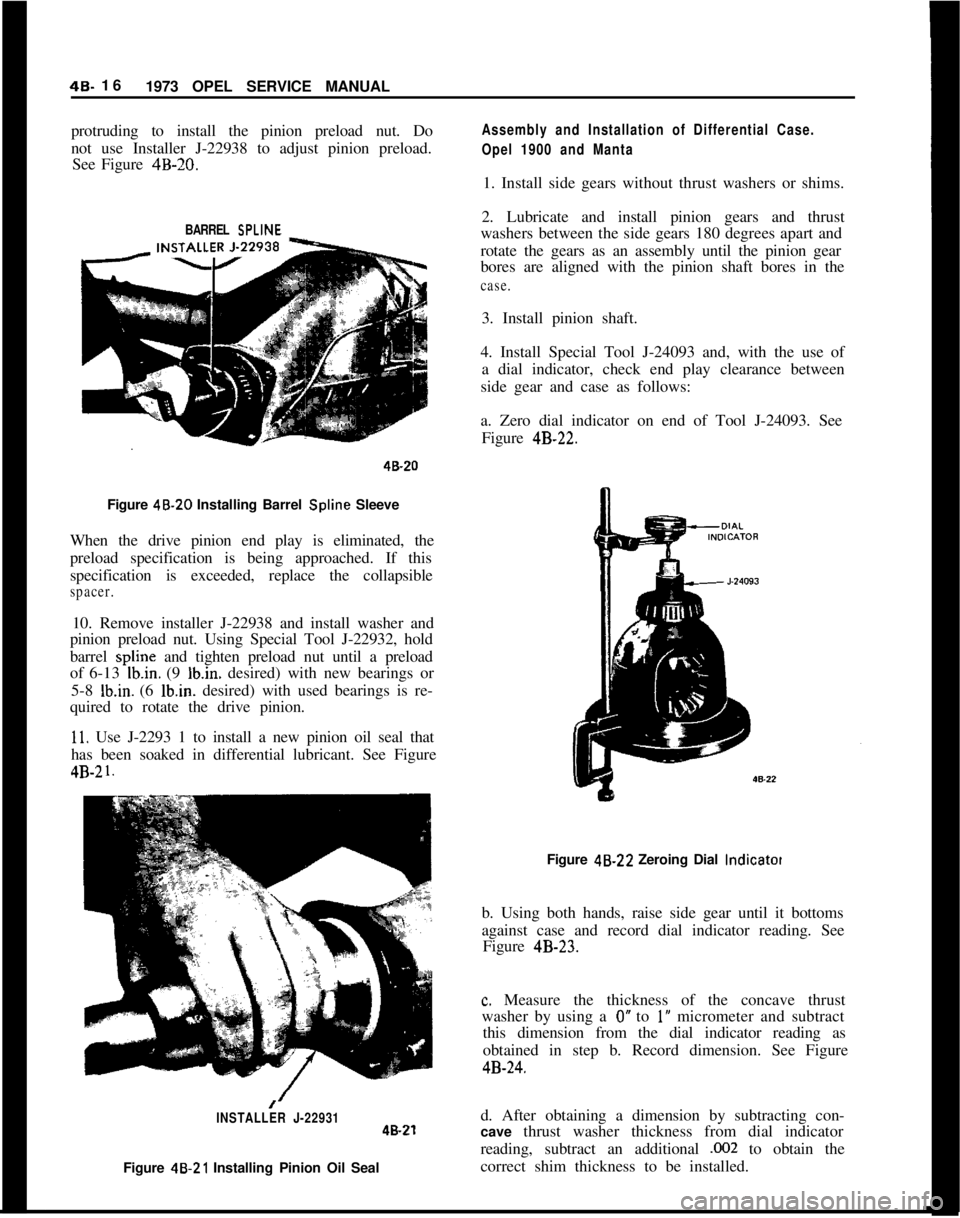
protruding to install the pinion preload nut. Do
not use Installer J-22938 to adjust pinion preload.
See Figure 4B-20.
Assembly and Installation of Differential Case.
Opel 1900 and Manta1. Install side gears without thrust washers or shims.
BARREL SPLINE2. Lubricate and install pinion gears and thrust
washers between the side gears 180 degrees apart and
rotate the gears as an assembly until the pinion gear
bores are aligned with the pinion shaft bores in the
case.3. Install pinion shaft.
4. Install Special Tool J-24093 and, with the use of
a dial indicator, check end play clearance between
side gear and case as follows:
40-20a. Zero dial indicator on end of Tool J-24093. See
Figure 4B-22.
Figure 48.20 Installing Barrel Spline Sleeve
When the drive pinion end play is eliminated, the
preload specification is being approached. If this
specification is exceeded, replace the collapsible
spacer.10. Remove installer J-22938 and install washer and
pinion preload nut. Using Special Tool J-22932, hold
barrel spline and tighten preload nut until a preload
of 6-13
Ib.in. (9 Ibin. desired) with new bearings or
5-8
Ib.in. (6 lb.in. desired) with used bearings is re-
quired to rotate the drive pinion.
11. Use J-2293 1 to install a new pinion oil seal that
has been soaked in differential lubricant. See Figure4B-2
1.Figure 48.22 Zeroing Dial
lndicatotb. Using both hands, raise side gear until it bottoms
against case and record dial indicator reading. See
Figure 4B-23.
c. Measure the thickness of the concave thrust
washer by using a
0” to 1’ micrometer and subtract
this dimension from the dial indicator reading as
obtained in step b. Record dimension. See Figure
4B-24.
/INSTALLER J-22931d. After obtaining a dimension by subtracting con-48-21cave thrust washer thickness from dial indicator
reading, subtract an additional
,002 to obtain the
Figure 46.21 Installing Pinion Oil Sealcorrect shim thickness to be installed.
Page 253 of 625
48. 221973 OPEL SERVICE MANUAL
9. Position
case assembly and outer races in the car-
rier. Use a soft-faced hammer to drive the case into
the carrier until the side bearing outer races bottom
in their bores.
10. Install side bearing caps in their original location
and torque the bolts to 33
lb.ft.IN. LB. TORQUL
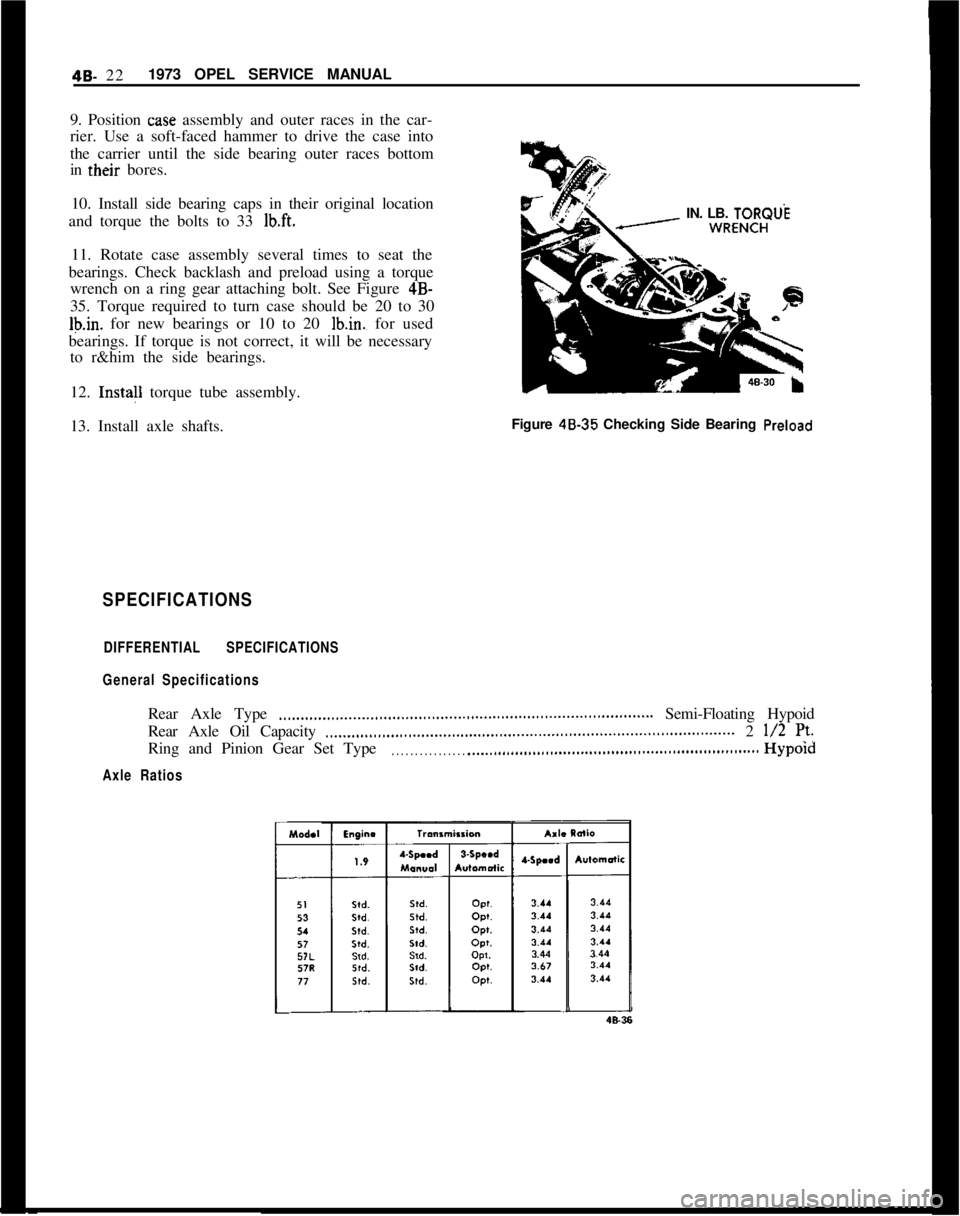
11. Rotate case assembly several times to seat the
bearings. Check backlash and preload using a torque
wrench on a ring gear attaching bolt. See Figure 4B-
35. Torque required to turn case should be 20 to 30
Ib.in. for new bearings or 10 to 20 lb.in., for used
bearings. If torque is not correct, it will be necessary
to r&him the side bearings.
12. Insta!l torque tube assembly.
13. Install axle shafts.Figure 48.35 Checking Side Bearing
Preload
SPECIFICATIONS
DIFFERENTIAL SPECIFICATIONS
General SpecificationsRear Axle Type
.,,...,,,...,,_...._..,,...,,,...,,,....,,.,...,,.,,...,,..,,,........................ Semi-Floating Hypoid
Rear Axle Oil Capacity
..____,,...,,,...,.,..,............,,..,,..,,................................................. 2 l/2 7’.Ring and Pinion Gear Set Type
. . . . . . . . . . . . . . . . . .._................................................................Hypold
Axle Ratios
Page 254 of 625
REAR AXLE49.23
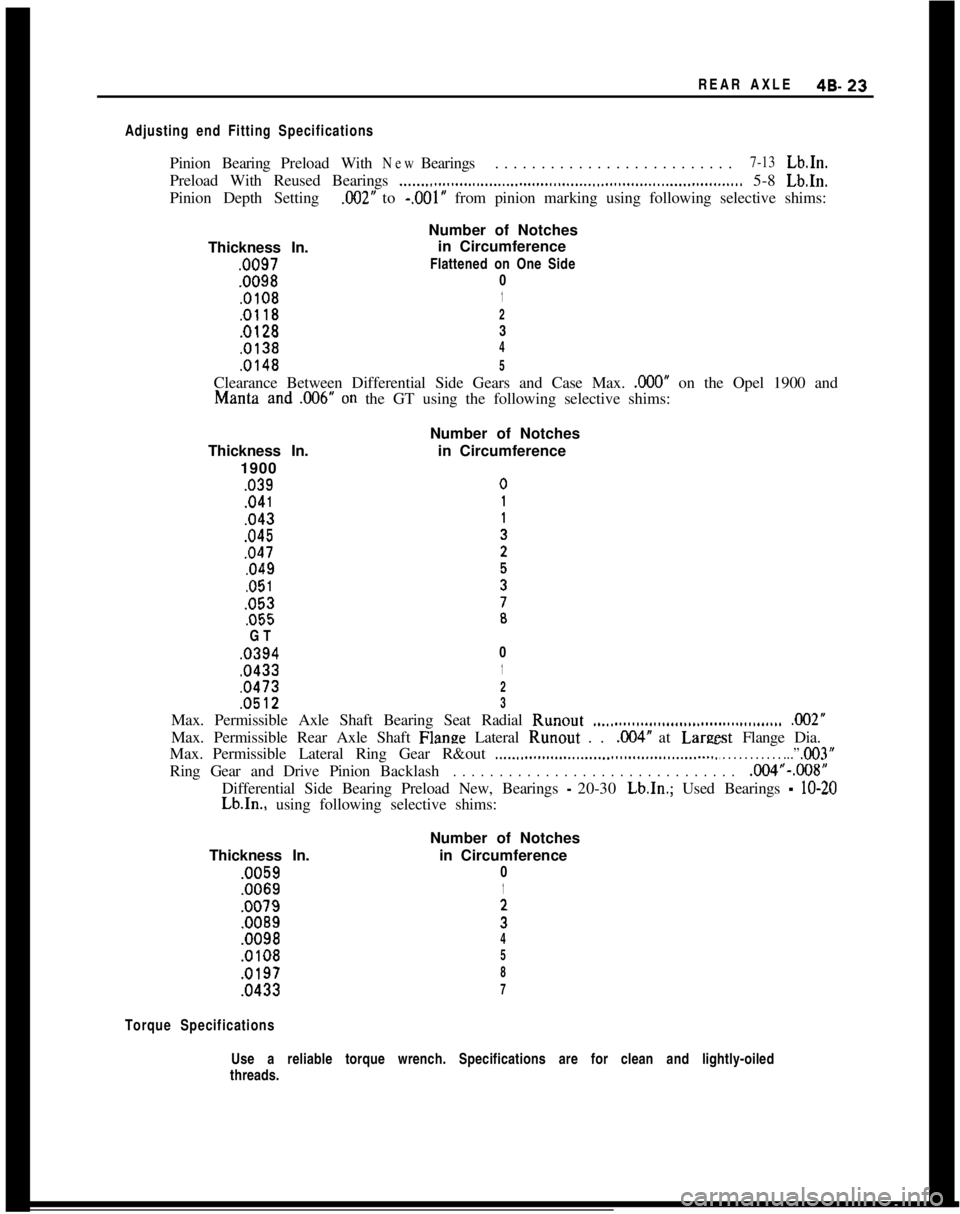
Adjusting end Fitting SpecificationsPinionBearingPreloadWith
NewBearings. . . . . . . . . . . . . . . . . . . . . . . . . .7-13Lb.In.
Preload With Reused Bearings
__.._..I...................,.................,,...................,,............ 5-8 Lb.In.
Pinion Depth Setting
.002” to -.OOl’ from pinion marking using following selective shims:
Number of Notches
Thickness In.in Circumference.0097Flattened on One Side
.00980
.01081
.01182
.01283
.01384
.01485Clearance Between Differential Side Gears and Case Max.
,000” on the Opel 1900 andManta and
,006” on the GT using the following selective shims:
Thickness In.
1900
,039.04
1,043,045,047,049.05
1,053,055
GT
.0394
.0433
.0473Number of Notches
in Circumference
0
1
2
.05123Max. Permissible Axle Shaft Bearing Seat Radial Runout
.._......................................... ,002”Max. Permissible Rear Axle Shaft Flanze Lateral Runout . .
,004” at Lareest Flange Dia.
Max.Permissible Lateral Ring Gear R&out
._.._,,.........._.....,........................... T . . . . . . . . . . . ...” ,003”RingGearandDrivePinionBacklash
. . . . . . . . . . . . . . . . . . . . . . . . . . . . . . .,004”-.008”
Differential Side Bearing Preload New, Bearings
- 20-30 Lb.In.; Used Bearings - lo-20Lb.In., using following selective shims:
Thickness In..0059.0069
.0079
.0089
.0098
.0108
.0197
.0433Number of Notches
in Circumference
0
1
;
4
5
8
7
Torque SpecificationsUse a reliable torque wrench. Specifications are for clean and lightly-oiled
threads.
Page 274 of 625
DISC BRAKES5B- 15
ConditionPossible Cause
2. Binding brake pedal
mechanism.Correction
2. Check and lubricate, ifnecessary.3. Corroded caliper
assembly.3. Clean and lubricate.
MAINTENANCE AND ADJUSTMENTSDISC BRAKE MAINTENANCE
Checking Brake Fluid Level
The brake fluid level in the brake fluid container
must be checked during predelivery inspection, then
every 3,000 miles during inspection and preventive
maintenance servicing.
The brake fluid level must not be higher than the
inscription “MAX” and must be at least up to
“MIN”. Replenish brake fluid, if necessary.
Because of the relatively large brake caliper bore
cross section and the self-adjustment of the disc
brakes, resulting in a greater piston travel to compen-
sate for friction pad wear, the brake fluid level drops
faster than in fluid containers for drum brakes with
their smaller wheel brake cylinders. For this reason
pay special attention to the fluid level in the brake
fluid container.
Drop of brake fluid level can be due to friction pad
wear and may not be due to leakage in the braking
system.On loss of brake fluid due to leakage, the brake sys-
tem must be checked thoroughly.
Friction Pad Adjustment
Friction pad adjustment is not necessary on the front
wheel disc brakes as this is done automatically by the
pistons in the brake calipers.
Lubricating Front Wheel Bearings
When removing one or both brake discs, check lu-
brication of front wheel bearings and the cavity of
the wheel hub and replenish if necessary (see operat-
ion
“Removing and Reinstalling Brake Disc”).
When carrying out other work on disc brakes which
does not necessitate the removal and installation of
the brake disc, lubricating wheel bearings is not
necessary.Checking Disc Brake Friction Pads for Wear
Whenever a disc brake equipped car is in for periodic
service, while the car is raised, the friction pads in
both brake calipers should be checked for wear by
making a simple measurement. Worn or oily friction
pads must be replaced.
Measure friction pad wear as follows:
1. Remove friction pads.
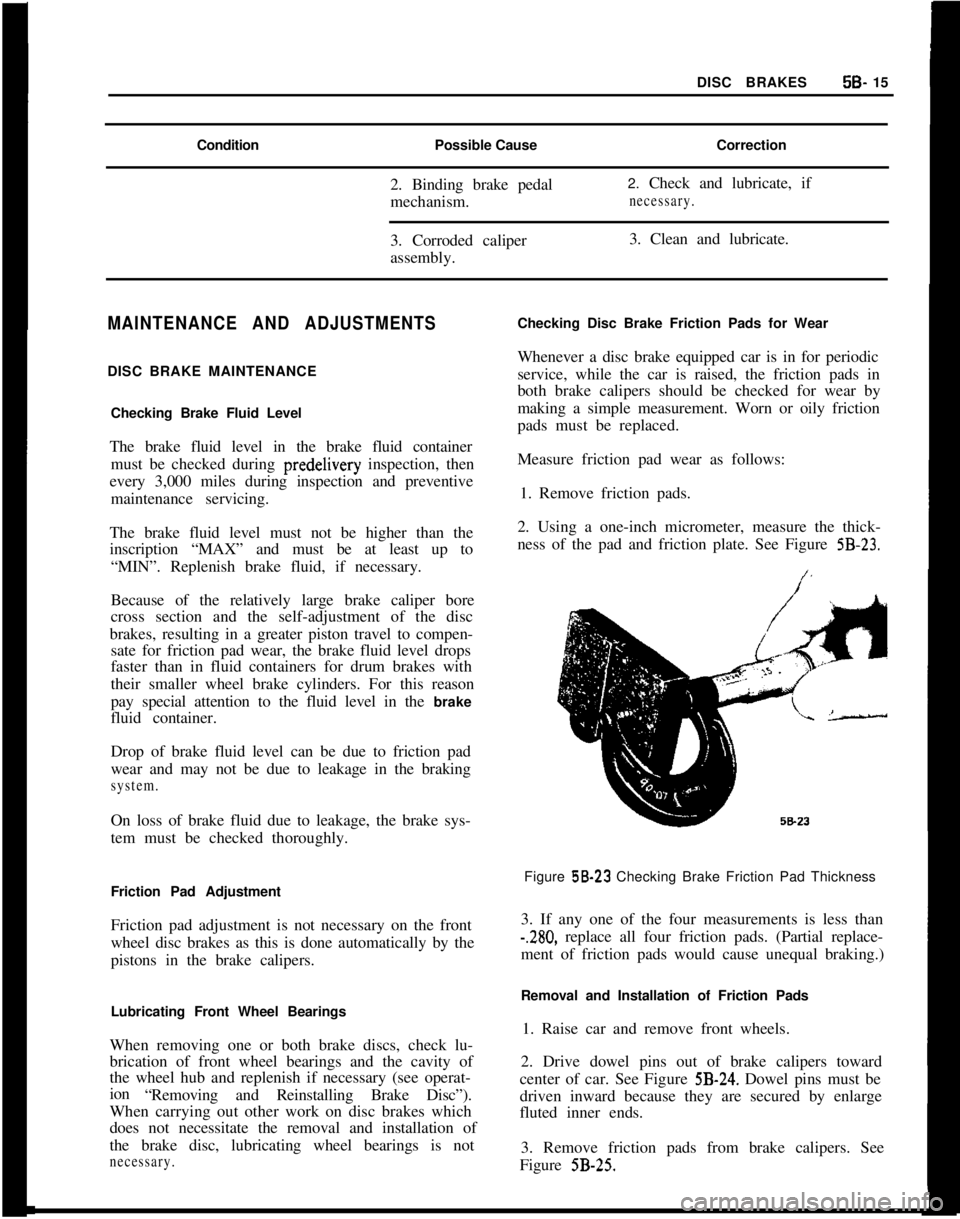
2. Using a one-inch micrometer, measure the thick-
ness of the pad and friction plate. See Figure
5B-23.Figure 58-23 Checking Brake Friction Pad Thickness
3. If any one of the four measurements is less than
-.280, replace all four friction pads. (Partial replace-
ment of friction pads would cause unequal braking.)
Removal and Installation of Friction Pads
1. Raise car and remove front wheels.
2. Drive dowel pins out of brake calipers toward
center of car. See Figure
5B-24. Dowel pins must be
driven inward because they are secured by enlarge
fluted inner ends.
3. Remove friction pads from brake calipers. See
Figure
5B-25.
Page 283 of 625
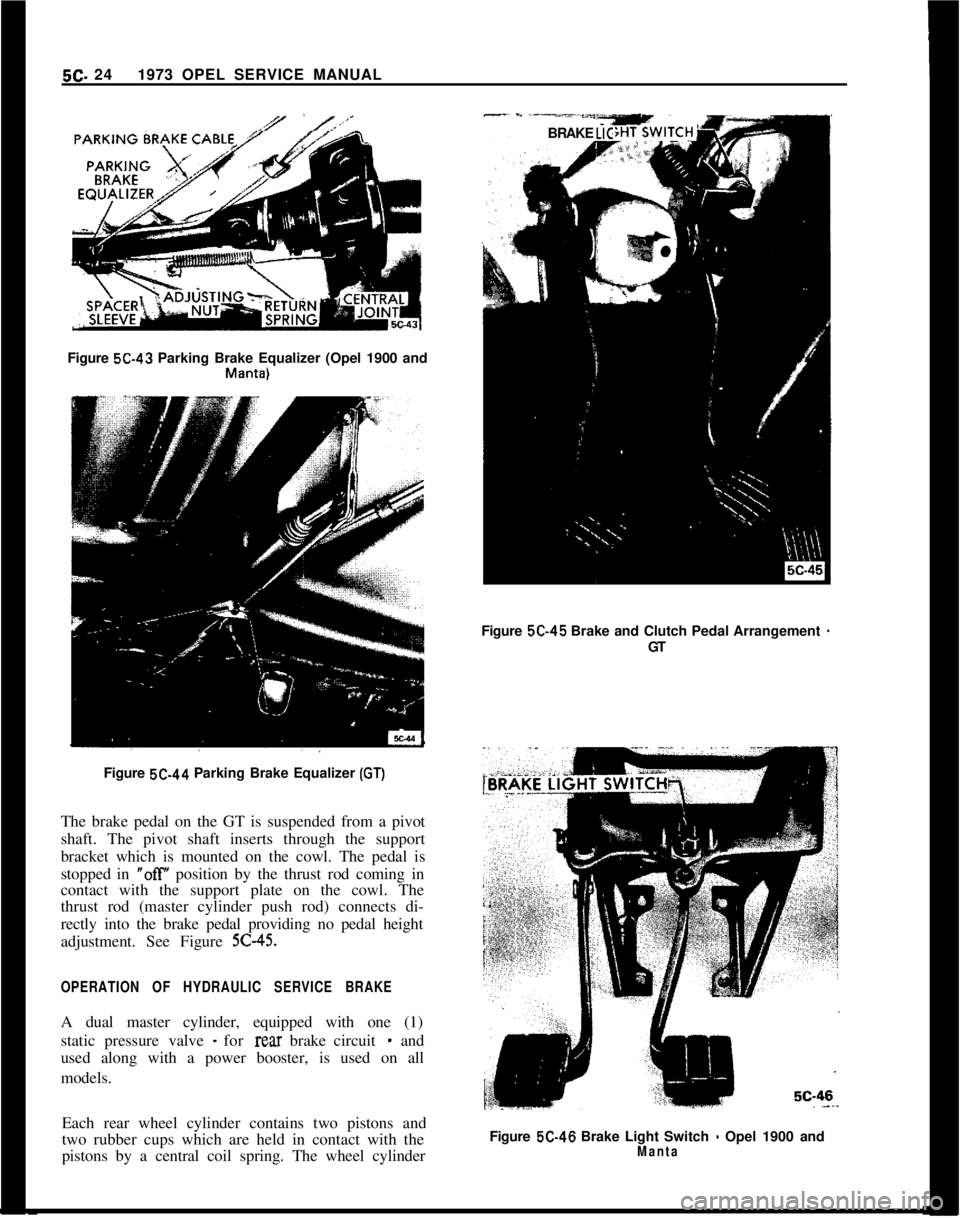
5C- 241973 OPEL SERVICE MANUAL-~ - -----*““YBRAKE LICFigure 5C-43 Parking Brake Equalizer (Opel 1900 and
Mallta)Figure 5C-45 Brake and Clutch Pedal Arrangement
-GT
Figure 5C-44 Parking Brake Equalizer
(GT)The brake pedal on the GT is suspended from a pivot
shaft. The pivot shaft inserts through the support
bracket which is mounted on the cowl. The pedal is
stopped in
“off position by the thrust rod coming in
contact with the support plate on the cowl. The
thrust rod (master cylinder push rod) connects di-
rectly into the brake pedal providing no pedal height
adjustment. See Figure
5C-45.
OPERATION OF HYDRAULIC SERVICE BRAKEA dual master cylinder, equipped with one (1)
static pressure valve
- for rear brake circuit - and
used along with a power booster, is used on all
models.
Each rear wheel cylinder contains two pistons and
two rubber cups which are held in contact with the
pistons by a central coil spring. The wheel cylinderFigure 5C-46 Brake Light Switch
- Opel 1900 andManta
Page 287 of 625
5C- 281973 OPEL SERVICE MANUAL
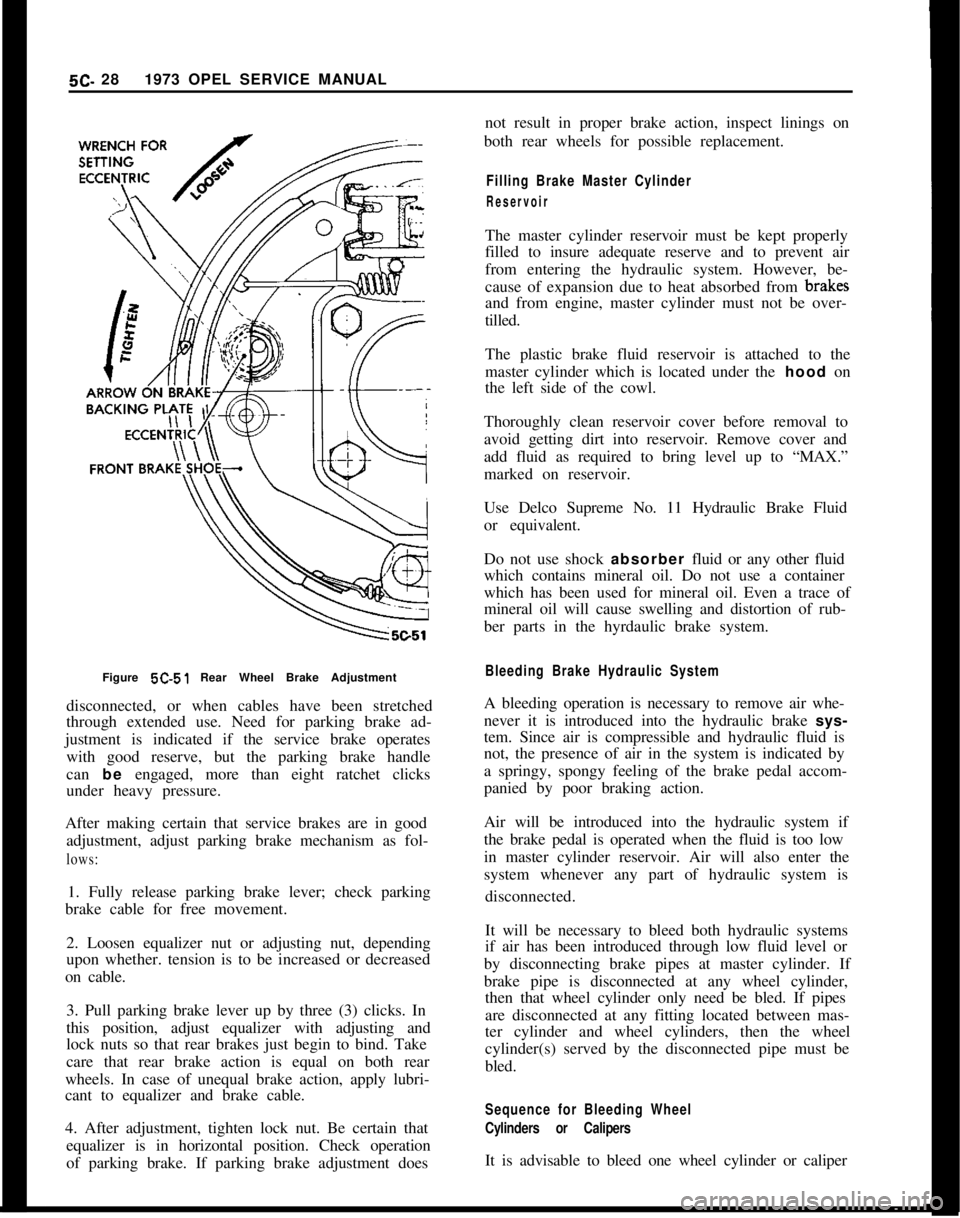
Figure 5C-51 Rear Wheel Brake Adjustment
disconnected, or when cables have been stretched
through extended use. Need for parking brake ad-
justment is indicated if the service brake operates
with good reserve, but the parking brake handle
can be engaged, more than eight ratchet clicks
under heavy pressure.
After making certain that service brakes are in good
adjustment, adjust parking brake mechanism as fol-lows:1. Fully release parking brake lever; check parking
brake cable for free movement.
2. Loosen equalizer nut or adjusting nut, depending
upon whether. tension is to be increased or decreased
on cable.
3. Pull parking brake lever up by three (3) clicks. In
this position, adjust equalizer with adjusting and
lock nuts so that rear brakes just begin to bind. Take
care that rear brake action is equal on both rear
wheels. In case of unequal brake action, apply lubri-
cant to equalizer and brake cable.
4. After adjustment, tighten lock nut. Be certain that
equalizer is in horizontal position. Check operation
of parking brake. If parking brake adjustment doesnot result in proper brake action, inspect linings on
both rear wheels for possible replacement.
Filling Brake Master Cylinder
ReservoirThe master cylinder reservoir must be kept properly
filled to insure adequate reserve and to prevent air
from entering the hydraulic system. However, be-
cause of expansion due to heat absorbed from brakff
and from engine, master cylinder must not be over-
tilled.
The plastic brake fluid reservoir is attached to the
master cylinder which is located under the hood on
the left side of the cowl.
Thoroughly clean reservoir cover before removal to
avoid getting dirt into reservoir. Remove cover and
add fluid as required to bring level up to “MAX.”
marked on reservoir.
Use Delco Supreme No. 11 Hydraulic Brake Fluid
or equivalent.
Do not use shock absorber fluid or any other fluid
which contains mineral oil. Do not use a container
which has been used for mineral oil. Even a trace of
mineral oil will cause swelling and distortion of rub-
ber parts in the hyrdaulic brake system.
Bleeding Brake Hydraulic SystemA bleeding operation is necessary to remove air whe-
never it is introduced into the hydraulic brake sys-
tem. Since air is compressible and hydraulic fluid is
not, the presence of air in the system is indicated by
a springy, spongy feeling of the brake pedal accom-
panied by poor braking action.
Air will be introduced into the hydraulic system if
the brake pedal is operated when the fluid is too low
in master cylinder reservoir. Air will also enter the
system whenever any part of hydraulic system is
disconnected.
It will be necessary to bleed both hydraulic systems
if air has been introduced through low fluid level or
by disconnecting brake pipes at master cylinder. If
brake pipe is disconnected at any wheel cylinder,
then that wheel cylinder only need be bled. If pipes
are disconnected at any fitting located between mas-
ter cylinder and wheel cylinders, then the wheel
cylinder(s) served by the disconnected pipe must be
bled.
Sequence for Bleeding Wheel
Cylinders or CalipersIt is advisable to bleed one wheel cylinder or caliper
Page 288 of 625
DRUM BRAKESBC- 29
at a time to avoid getting fluid level in reservoir
dangerously low. The correct sequence for bleeding
is bleed the wheel cylinder or caliper nearest the
master cylinder first in either circuit.
Do not perform bleeding operation while any brake
drum is removed.
Bleeding Wheel Cylinder or Caliper
1. Check fluid level, in reservoir and refill, if neces-
sary. Level must be brought up to “MAX” mark on
plastic reservoir.
2. Clean all dirt from around respective bleeder
valve, and then remove cap.
3. Push bleeder hose over bleeder valve, placing
other end of hose in a glass jar. Bleeder hose should
always be used to avoid getting fluid on linings.
4. Hold pressure on brake pedal and crack open the
bleeder valve to allow air (and,or) brake fluid to flow
out of the system. Allow pedal to travel to the floor.
Close bleeder valve. Release pedal and repeat this
procedure at each wheel cylinder in the circuit until
all air is removed. Frequently check reservoir fluid
level. Allowing fluid to be emptied will draw air into
the system.
5. Remove bleeder hose and install cap.
6. When bleeding operation is completed, make sure
that fluid level is brought up to “MAX” marking on
reservoir, then install cover.
7. Discard the brake fluid deposited in glass jar dur-
ing bleeding operation.
Flushing Brake Hydraulic System
It is recommended that both brake system circuits be
thoroughly flushed whenever the master cylinder is
replaced or if there is any doubt as to the grade of
fluid in the system.
Flushing of the brake system is performed in the
same manner as the bleeding operation except that
fluid is forced through the lines and wheel cylinder
until it emerges clear in color. Approximately one
half pint of brake fluid is required to flush the hy-
draulic system thoroughly.
When flushing is completed, make certain the master
cylinder reservoir is filled to the proper level.Figure
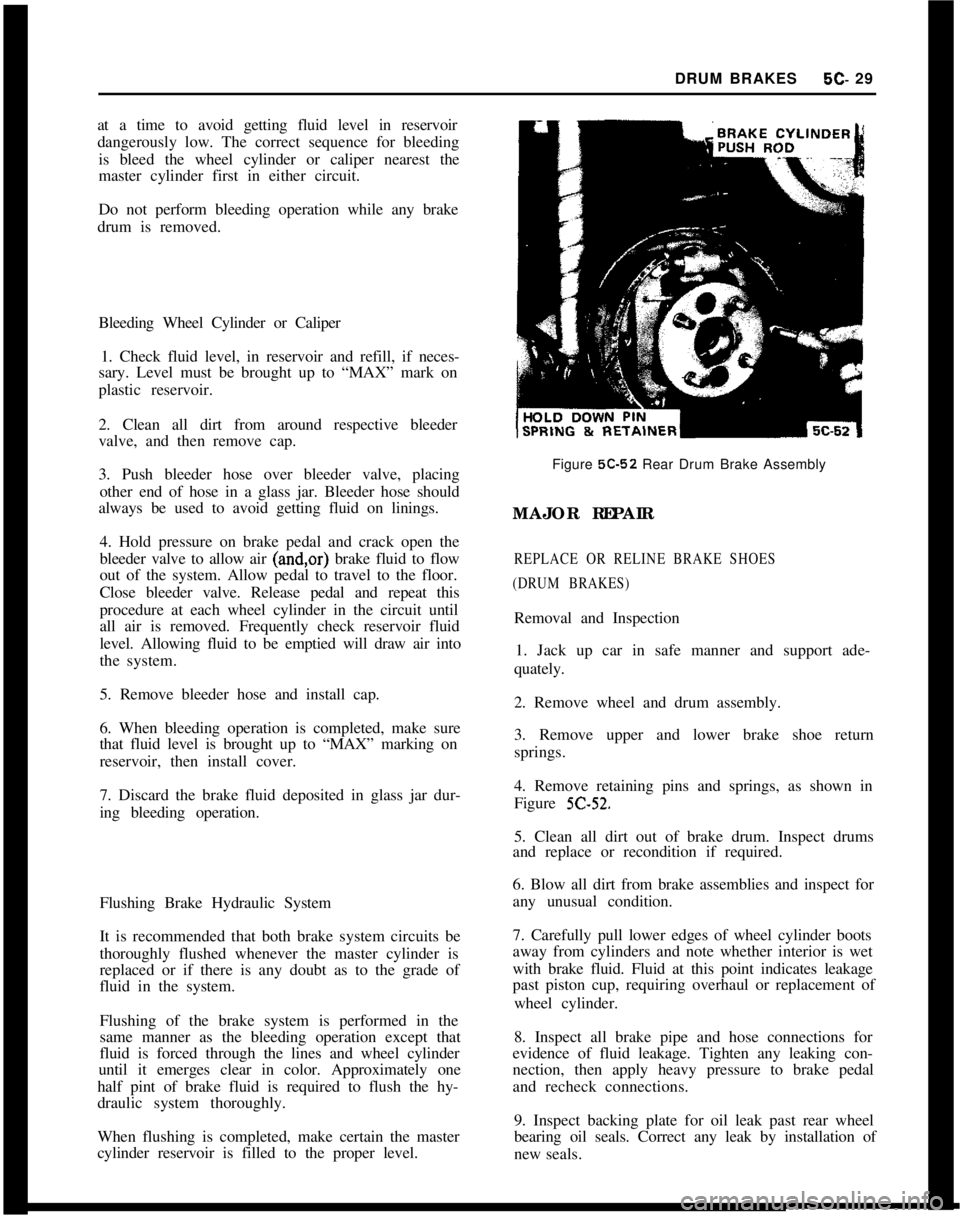
5C-52 Rear Drum Brake Assembly
MAJOR REPAIR
REPLACE OR RELINE BRAKE SHOES
(DRUM BRAKES)Removal and Inspection
1. Jack up car in safe manner and support ade-
quately.
2. Remove wheel and drum assembly.
3. Remove upper and lower brake shoe return
springs.
4. Remove retaining pins and springs, as shown in
Figure
5C-52.5. Clean all dirt out of brake drum. Inspect drums
and replace or recondition if required.
6. Blow all dirt from brake assemblies and inspect for
any unusual condition.
7. Carefully pull lower edges of wheel cylinder boots
away from cylinders and note whether interior is wet
with brake fluid. Fluid at this point indicates leakage
past piston cup, requiring overhaul or replacement of
wheel cylinder.
8. Inspect all brake pipe and hose connections for
evidence of fluid leakage. Tighten any leaking con-
nection, then apply heavy pressure to brake pedal
and recheck connections.
9. Inspect backing plate for oil leak past rear wheel
bearing oil seals. Correct any leak by installation of
new seals.
Page 289 of 625
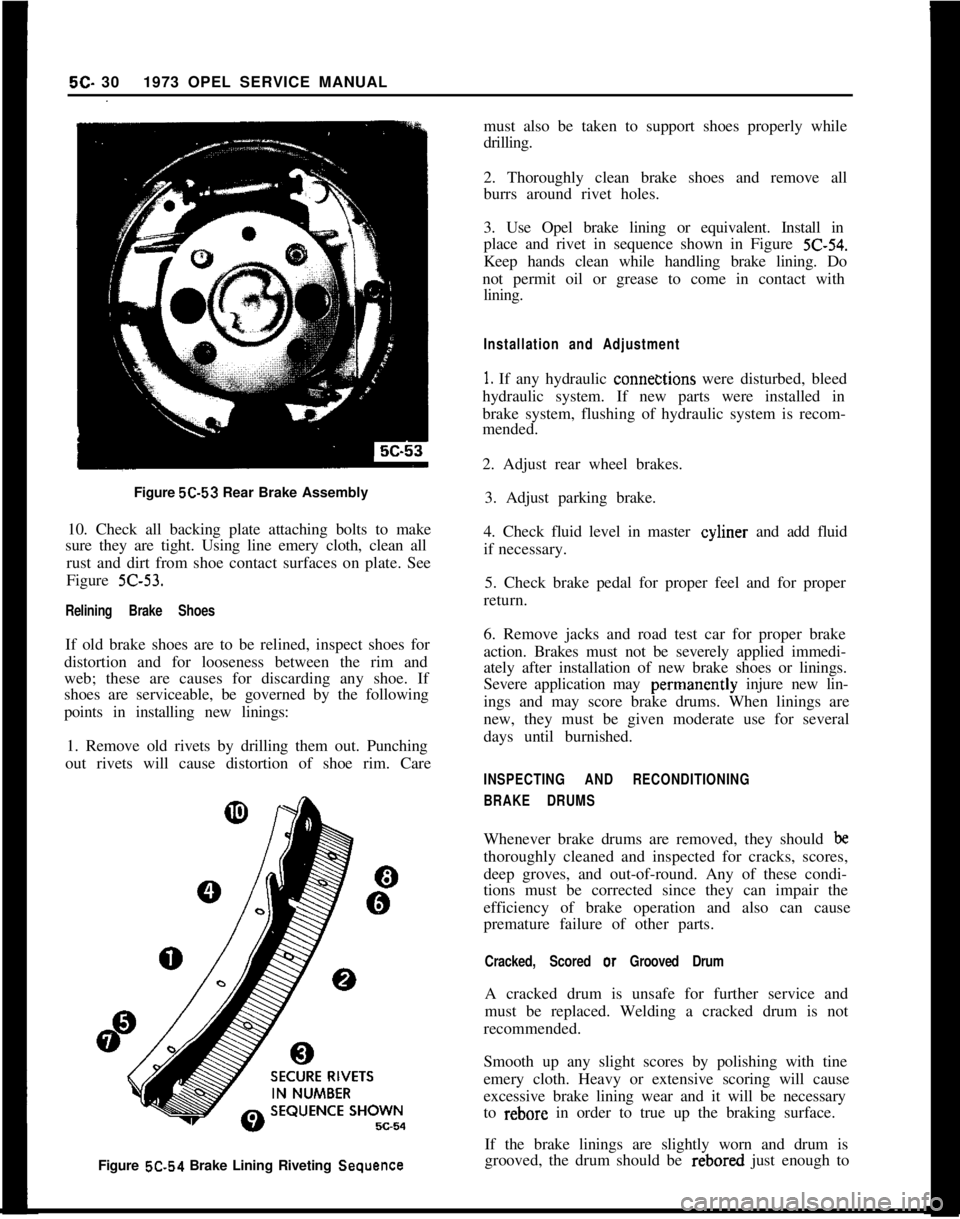
Figure 5C-53 Rear Brake Assembly
10. Check all backing plate attaching bolts to make
sure they are tight. Using line emery cloth, clean all
rust and dirt from shoe contact surfaces on plate. See
Figure Z-53.
Relining Brake ShoesIf old brake shoes are to be relined, inspect shoes for
distortion and for looseness between the rim and
web; these are causes for discarding any shoe. If
shoes are serviceable, be governed by the following
points in installing new linings:
1. Remove old rivets by drilling them out. Punching
out rivets will cause distortion of shoe rim. Care5C- 301973 OPEL SERVICE MANUAL
must also be taken to support shoes properly while
drilling.
2. Thoroughly clean brake shoes and remove all
burrs around rivet holes.
3. Use Opel brake lining or equivalent. Install in
place and rivet in sequence shown in Figure
Z-54.Keep hands clean while handling brake lining. Do
not permit oil or grease to come in contact with
lining.
Installation and Adjustment
1. If any hydraulic conne&tions were disturbed, bleed
hydraulic system. If new parts were installed in
brake system, flushing of hydraulic system is recom-
mended.
2. Adjust rear wheel brakes.
3. Adjust parking brake.
4. Check fluid level in master cyliner and add fluid
if necessary.
5. Check brake pedal for proper feel and for proper
return.
6. Remove jacks and road test car for proper brake
action. Brakes must not be severely applied immedi-
ately after installation of new brake shoes or linings.
Severe application may perinanently injure new lin-
ings and may score brake drums. When linings are
new, they must be given moderate use for several
days until burnished.
INSPECTING AND RECONDITIONING
BRAKE DRUMSWhenever brake drums are removed, they should
bethoroughly cleaned and inspected for cracks, scores,
deep groves, and out-of-round. Any of these condi-
tions must be corrected since they can impair the
efficiency of brake operation and also can cause
premature failure of other parts.
Cracked, Scored or Grooved DrumA cracked drum is unsafe for further service and
must be replaced. Welding a cracked drum is not
recommended.
Smooth up any slight scores by polishing with tine
emery cloth. Heavy or extensive scoring will cause
excessive brake lining wear and it will be necessary
to rebore in order to true up the braking surface.
Figure 5C.54 Brake Lining Riveting
SequenceIf the brake linings are slightly worn and drum is
grooved, the drum should be rebored just enough to
Page 290 of 625
DRUM BRAKES5c- 31
remove grooves, and the ridges in the lining should
be lightly removed with a lining grinder.
If brake linings are more than half worn, but do not
need replacement, the drum should be polished with
fine emery cloth but should not be rebored. At this
stage, eliminating the grooves in drum and smooth-
ing the ridges on lining would necessitate removal of
too much metal and lining, while if left alone, the
grooves and ridges match and satisfactory service
can be obtained.
If brake linings are to be replaced, a grooved drum
should be rebored for use with oversize linings. A
grooved drum, if used with new lining, will not only
wear the lining but will make it
diff%xlt, if not im-
possible, to obtain etXcient brake performance.
Out-of-Round DrumAn out-of-round drum makes accurate brake shoe
adjustment impossible and is likely to cause excessive
wear of other parts of brake mechanism due to its
eccentric action. An out-of-round drum can also
cause brake pulsation. Maximum permissible drumrunout is 004”. A drum that has more run-out than
this should be rebored. Runout can be accurately
checked by using an inside micrometer fitted with
proper extension rods.
When measuring a drum for run-out, take measure-
ments at open and closed edges of machined surface
and at right angles to each other.
Turning Brake DrumsIf a brake drum is to be turned, enough metal should
be removed to obtain a true, smooth braking surface.
Measure brake drum diameter; standard drum inner
diameter is 9.060”. Drums may be turned to an over-
size of ,030”. If maximum inner diameter after turn-
ing exceeds 9.090”, brake drum will have to be
replaced. Removal of more metal will affect dissipa-
tion of heat and may cause distortion of the drum.
1. Remove rear wheels and drums.
2. Mount brake drum on brake drum lathe and turn
drums as necessary, within limits.
3. After turning, check drum diameter. Inner diame-
ter not to exceed 9.090.
4. A newly-bored drum should always have center
contact with brake shoes. For this reason, arc grind
linings to
.OlO” under drum radius, or to ,020” under
drum diameter.
5. Clean and install drums and wheels.
BRAKE WHEEL CYLINDER OVERHAUL1. Remove wheel, drum, and brake shoes. Be careful
not to get grease or dirt on brake lining.
2. Disconnect brake pipe or hose from wheel cylinder
and cover opening with tape to prevent entrance of
dirt. Remove wheel cylinder from backing plate.
3. Remove boots, pistons, cups, and spring from cyl-
inder. Remove bleeder valve.
4. Discard rubber boots and piston cups. Thoroughly
clean all other parts with hydraulic brake fluid orDeclene. Do not use anti-freeze, alcohol, gasoline,
kerosene, or any other cleaning fluid that might con-
tain even a trace of mineral oil.
5. Inspect pistons and cylinder bore for scores, scrat-
ches, or corrosion. Light scratches may be polished
with crocus cloth. Do not use emery cloth or sandpa-
per.
Shght corro~on may be cleaned wth tine steel
wool. If scratches or corroded spots are too deep to
be polished satisfactorily, the cylinder should be re-
placed since honing is not recommended.
6. Dip internal parts in brake fluid and reassembly
wheel cylinder. When installing piston cups, use care
to avoid damaging the edges.
7. If the rear wheel backing plate is removed: Always
install new paper gaskets one on each side
- on the
backing plate. Prior to installation, lightly coat paper
gaskets with chassis lubricant. Torque backing plate
to rear axle housing bolts to 43
lb.ft. and wheel brake
cylinder to backing plate bolts to 5
lb.ft. Install wheel
cylinder on brake backing plate and connect brake
pipe or hose.
8. Install brake shoes, drum, and wheel, then flush
and bleed hydraulic system.
9. Adjust brakes, then road test car for brake per-
formance.
CAUTION:This brake backing plate to rear axle fis-
tener is an important attaching part in that it could
affect the performance of vital components and sys-
tems, and/or could result in major repair expense. It
must be replaced with one of the same part number
or with an equivalent part, if replacement becomes
necessary. Do not
use a replacement part of lesser
quahty or substitute design. Torque v&es must be
used as specified during reassembly to assure proper
retention of this part.
REPLACING BRAKE PIPESAny brake pipe assembly which is needed must be
made up from service bulk tubing and fittings. All
brake pipes must be made of tin or copper coated
wrapped steel tubing with the ends double lap flared.
Page 293 of 625
6A- 21973 OPEL SERVICE MANUAL
ENGINE
CONTENTS
Subject
DESCRIPTION AND OPERATION:
EngineConstruction..........................................................
LubricationSystem............................................................
DIAGNOSIS:
Excessive Oil Consumption............................................NoisyValvesandLifters..................................................
MAINTENANCE AND ADJUSTMENTS:
Valve
LifterAdjustment..................................................
MAJOR REPAIR:
Engine Removal and Installation..................................
Engine
OilPanRemoval
andInstallation..................
Manifold, Cylinder Head, Valve Train and
Lifters................................................................................
Connecting Rod Bearings................................................
Crankshaft Bearings and Seals....................................
Piston, Rings and Connecting Rods............................
TimingChainCoverandTimingChain......................
Camshaft..............................................................................
Oil Pump Cover and Gears............................................
SPECIFICATIONS:
BoltTorque.Specifications
..............................................General Specifications......................................................
Engine Dimension and Fits............................................Page No.
6A- 2
6A- 4
6A- 6
6A- 6
6A- 7
6A- 86A-106A-126A-156A-166A-196A-236A-256A-266A-276A-286A-29
DESCRIPTION AND OPERATION
ENGINE CONSTRUCTION
Engine UsageThe 1.9 liter engine is standard equipment on all 1973
Opel
1900, Manta and GT models. This engine has
a compression ratio of
7.6:1 and operates on“regular” low lead grade fuel.
Engine ConstructionThe
cyfinderhead is made of high-grade chromium
grey cast iron. The valve guides are cast intergal with
the head. The overhead camshaft is supported in four
bearings in the cylinder head.Location of the
vzllve seats in combustion chamber
is above the center of cylinder bore. The spark plug
is positioned in the center and near the highest point
of combustion chamber. This arrangement provides
for short flame travel, uniform combustion and good
cold start prop&ties. Exhaust valves have seat in-serts of highly heat and water resisting material. The
head surface is alumetized and so are the seats of the
inlet v&es Alumetizing makes the valve heads
non- scaling and promotes long life. All engines have“rota-caps”.
The forged, five main bearing crankshaft has large-
diameter main and connecting rod bearing journals
with considerable overlap for vibration-free operat-
ion. T&metal bearing shells are used for main and
connecting rod bearings. The crankshaft end play is
controlled by the rear main bearing.