service OPEL 1900 1973 Workshop Manual
[x] Cancel search | Manufacturer: OPEL, Model Year: 1973, Model line: 1900, Model: OPEL 1900 1973Pages: 625, PDF Size: 17.22 MB
Page 109 of 625

1 J- 88 1973 OPEL SERVICE MANUAL
!
I1.
Figure lJ-15’Headlamp and Fog Lights - Rallye
Page 113 of 625

1 J- 92 1973 OPEL SERVICE> MANUALd5
Figure 1~19 Starting,
lgniiion and Charging Opel 1900 Manta
Page 115 of 625

1 J- 94 1973 OPEL SERVICE MANUALi
I
IFigure lJ-21 Instrument Panel GT
Page 121 of 625

lJ-100 1973 OPEL SERVICES MANUAL
I
Figure 1 J-27 Heated Rear Glass
- Opel 1900 - Manta
Page 125 of 625
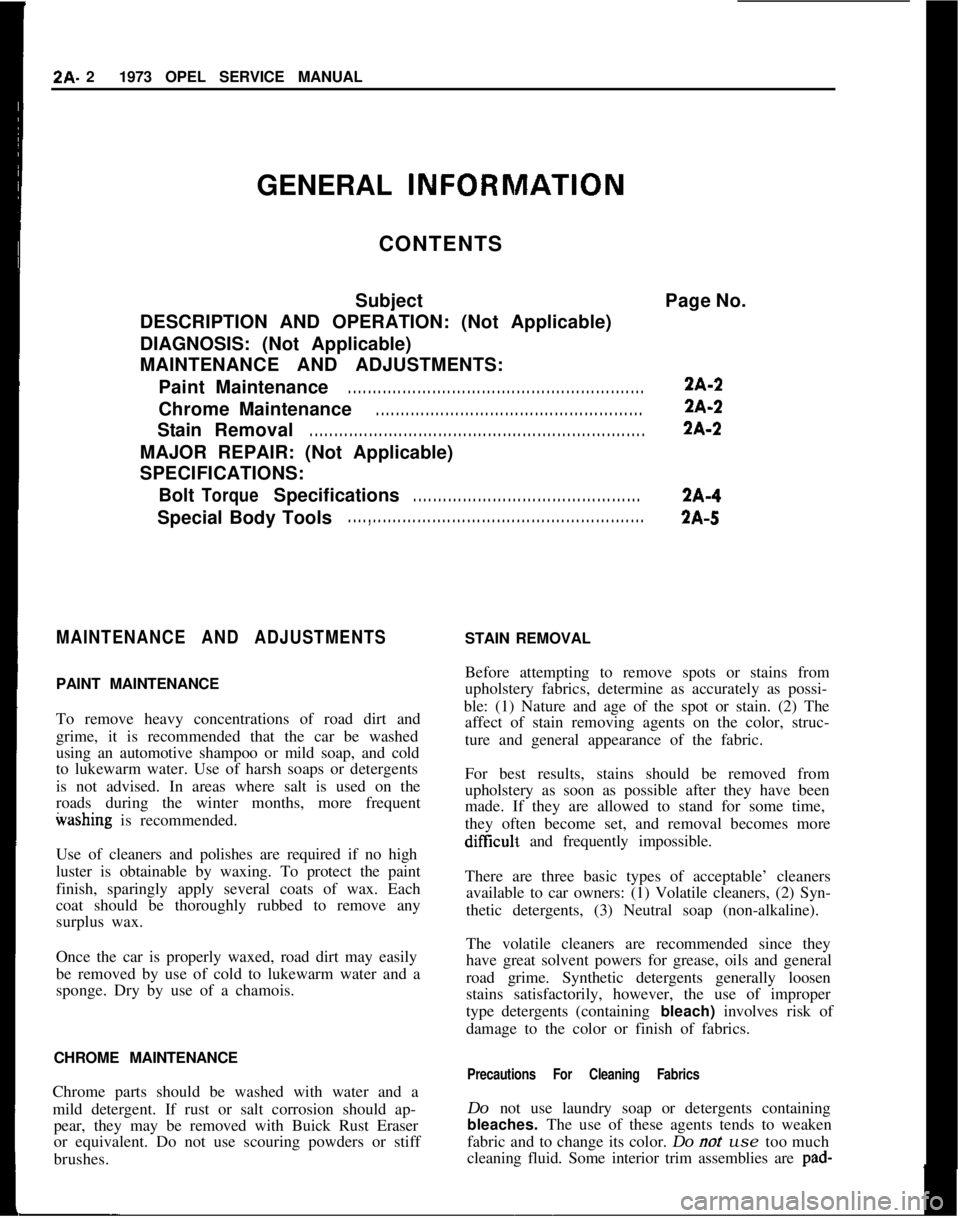
I2A- 21973 OPEL SERVICE MANUAL
GENERAL INFORlVlATION
CONTENTS
SubjectPage No.
DESCRIPTION AND OPERATION: (Not Applicable)
DIAGNOSIS: (Not Applicable)
MAINTENANCE AND ADJUSTMENTS:
PaintMaintenance. . . . . . . . . . . . . . . . . . . . . . . . . . . . . . . . . . . . . . . . . . . . . . . . . . . . . . . . . . . .2A-2
ChromeMaintenance
. . . . . . . . . . . . . . . . . . . . . . . . . . . . . . . . . . . . . . . . . . . . . . . . . . . . . .2A-2
StainRemoval
. . . . . . . . . . . . . . . . . . . . . . . . . . . . . . . . . . . . . . . . . . . . . . . . . . . . . . . . . . . . . . . . . . . .2A-2
MAJOR REPAIR: (Not Applicable)
SPECIFICATIONS:
Bolt
TorqueSpecifications. . . . . . . . . . . . . . . . . . . . . . . . . . . . . . . . . . . . . . . . . . . . . .2A-4
Special Body Tools
. . . . , . . . . . . . . . . . . . . . . . . . . . . . . . . . . . . . . . . . . . . . . . . . . . . . . . . . . . . .2A-5
MAINTENANCE AND ADJUSTMENTSPAINT MAINTENANCE
To remove heavy concentrations of road dirt and
grime, it is recommended that the car be washed
using an automotive shampoo or mild soap, and cold
to lukewarm water. Use of harsh soaps or detergents
is not advised. In areas where salt is used on the
roads during the winter months, more frequentwashing is recommended.
Use of cleaners and polishes are required if no high
luster is obtainable by waxing. To protect the paint
finish, sparingly apply several coats of wax. Each
coat should be thoroughly rubbed to remove any
surplus wax.
Once the car is properly waxed, road dirt may easily
be removed by use of cold to lukewarm water and a
sponge. Dry by use of a chamois.
CHROME MAINTENANCE
Chrome parts should be washed with water and a
mild detergent. If rust or salt corrosion should ap-
pear, they may be removed with Buick Rust Eraser
or equivalent. Do not use scouring powders or stiff
brushes.STAIN REMOVAL
Before attempting to remove spots or stains from
upholstery fabrics, determine as accurately as possi-
ble: (1) Nature and age of the spot or stain. (2) The
affect of stain removing agents on the color, struc-
ture and general appearance of the fabric.
For best results, stains should be removed from
upholstery as soon as possible after they have been
made. If they are allowed to stand for some time,
they often become set, and removal becomes more
diffxult and frequently impossible.
There are three basic types of acceptable’ cleaners
available to car owners: (1) Volatile cleaners, (2) Syn-
thetic detergents, (3) Neutral soap (non-alkaline).
The volatile cleaners are recommended since they
have great solvent powers for grease, oils and general
road grime. Synthetic detergents generally loosen
stains satisfactorily, however, the use of improper
type detergents (containing bleach) involves risk of
damage to the color or finish of fabrics.
Precautions For Cleaning FabricsDo not use laundry soap or detergents containing
bleaches. The use of these agents tends to weaken
fabric and to change its color. Do
not use too much
cleaning fluid. Some interior trim assemblies are pad-
Page 127 of 625

fabric to dry thoroughly; then rub lightly with a
clean cloth dipped in a volatile cleaner. This is the
only further treatment recommended.
Soap and water are not recommended since they will
probably set the stain and cause a permanent dis-
coloration. Drying the fabric by means of heat (such
as the use of an iron) is not recommended.
6. Grease and 02 If grease has been spilled on the
material, as much as possible should be remove by
scraping with a dull knife or spatula before further
treatment is attempted.
Grease and oil stains may be removed by rubbing
lightly with a clean cloth saturated with a volatile
cleaner. Be sure all motions are toward the center of
the stained area to decrease the possibility of spread-
ing the stain.
7. Ice Cream. The same procedure is recommended
for the removal of ice cream stains as that used in
removing fruit stains.
If the stain is persistent, rubbing the spot with a cloth
wet with soap suds (mild neutral soap) may be used
to some advantage after the initial treatment with hot
water. This soap treatment should be followed with
a rinsing, by rubbing with a clean cloth wet with cold
water. After this dries, rubbing lightly with a cloth
wet with volatile cleaner will clear up the last of the
stain, by removing fatty or oily matter.
8.Vomit. Sponge with a clean cloth, dipped in clear
cold water. After most of the stain has been removed
in this way wash lightly with soap (mild neutral),
using a clean cloth and lukewarm water. Then rub
with another clean cloth dipped in cold water. If any
of the stain remains after this treatment, gently rub
clean with a cloth moistened with a volatile cleaner.
SPECIFICATIONS
BOLT TORQUE SPECIFICATIONSLocation
DoorStriker toPillarPostr .^ ...r.ZA- 41973 OPEL SERVICE MANUAL
9. Shoe Polish and Dressings. On types of shoe
dressing which contain starch or dextrine or some
water soluble vehicle, allow the polish to dry; then
brush the spot vigorously with a brush. This will
probably be all the treatment that is necessary. If
further treatment is required moisten the spot with
cold water and after it has dried, repeat the brushing
operation.
Paste or wax type shoe polishes may require using a
volatile cleaner. Rub the stain gently with a cloth wet
with a volatile cleaner until the polish is removed.
Use
;a clean portion of the cloth for each rubbing
operation and rub the stained area from outside to
center.
10. Tar. Moisten the spot lightly with a volatile
cleaner, and then remove as much of the tar as possi-
ble with a dull knife. Follow this operation by rub-
bing the spot lightly with a cloth wet with the cleaner
until the stain is removed.
II. .X&e. Sponge the stain with a clean cloth satu-
rated with soap suds (mild neutral soap) and rinse
well by rubbing the stain with a clean cloth dipped
in cold water. Then saturate a clean cloth with a
solution of one part household ammonia water and
five parts water. Apply the cloth to the stain and
allow solution to remain on affected area for one
minute; then rinse by rubbing with a clean wet cloth.
I,?.
L,ipslick. The compositions of different brands of
lipsticks vary, making the stains very
diff%cult to
remove. In some instances a volatile cleaner may
remove the stain. If some stain remains after re-
peated applications of the volatile cleaner, it is best
to leave it rather thari try other measures.
Torque
Lb.Ft.
wont saar twacnment to war........................................Seat andShoulderBelt Anchor Attachment
................StationwagonTailgate
HingetoBody............................StationwagonTailgate
HingetoDoor............................Stationwagon Striker Plate on
Body................................Stationwagon
LatchHookonBody..................................Stationwagon Latch on Door
............................................14.18
_^ _^13-1036-46
13-16
13-16
3-4
13-16
3-4
Page 129 of 625

2B- 61973 OPEL SERVICE MANUAL
OPEL 1900, MANTA AND GT FRAME ANDBODY
MOUNTINGS
CONTENTS
Subject
DESCRIPTION AND OPERATION: (Not Applicable)
DIAGNOSIS: (Not Applicable)
MAINTENANCE AND ADJUSTMENTS: (Not
Applicable)
MAJOR REPAIR: (Not Applicable)
SPECIFICATIONS:
FrameandBodyMountingSpecifications. . . . . . . . . . . . . . . .Page No.28-6LOWER
I.
1.Ii
NOTE: TOLERANCES
NOTTOEXCEED*1,16I IDATUM LINEZB2
Figure
ZB-2 GT Frame Details
Page 131 of 625

28. B1973 OPEL SERVICE MANUAL
A
B
C
D
E
F
G
H
I
J
K-L
M
N
1 O-9/ 16”
14-9116”
71.7116”90-l/2”
S-3/16”
1 l-S/V
21-9/l 6”
30”
24-314”30-9/l 6”38-l/2”36-3/V
17-5116”Figure
28-3 Opel 1900 Manta Frame Details
1900
- MANTA 1900 - MANTA FRAME MEASUREMENTS
Mating surface of frame rail to horizontal line from center of front crossmember
to frame support bolt hole.
Centerline of front crossmember attaching bolt hole to centerline of front
crossmember to frame support bolt hole.
Centerline of front crossmember attaching bolt hole to center of lower control
arm to frame bolt hole.
Centerline of front crossmember attaching bolt hole to center of rear spring seat.
Rear spring seat to datum line.
Center of spring seat to center of track rod to body attaching bolt hole.
Centerline of front crossmember right attaching bolt hole to centerline of front
crossmember left attaching bolt hole.
Centerline of right front frame bolt hole to centerline of left front crossmember
to frame support bolt hole (inboard side of frame rail).
Distance between frame rails at front crossmember to frame support bolt holes.
Centerline to centerline of torque tube support to frame bolt holes.
Center qf spring seat to center of torque tube support to frame bolt hole
(inboard side of frame).
Centerline of right spring seat to centerline of left spring seat.
Centerline of car to centerline of track rod to body attaching bolt.
Page 133 of 625

2c-101973 OPEL SERVICE MANUAL
REMOVAL AND INSTALLATION OF WINDSHIELD
OR BACK WINDOW-WINDSHIELD SHOWN
1. Flap back windshield wiper arms,
2. Beginning at one end, pull molding out of rubber
channel.
3. Beginning at one corner, push out windshield
together with rubber channel. See Figure 2C-3.4. Place new windshield on glass holding fixture and
tit new rubber channel. See Figure
2C-4.5. Insert a thick string into large sealing lip of rubber
channel so that both ends are crossed at bottom cen-
ter of windshield. See Figure
2C-5.6. With a sealer gun, coat outside of pinchweld flange
with sealing compound. See Figure
2C-6./’
Figure
2C-4 Fitting Rubber Channel on Windshield
Figure
2C-5 String Inserted Into Rubber ChannelFigure 2C-6 Applying Sealer on Pinchweld Flange
7. Place windshield in body opening and, with in-
serted string, pull rubber channel lip over pinchweld
flange, always tapping windshield from outside with
a striking pad. See Figure
2C-7.Figure
2C-7 Pulling Rubber Channel Lip Over
Pinchweld Flange
Page 135 of 625

2C- 121973 OPEL SERVICE MANUAL
3. Install quarter window and fasten chromed mold-
ing. See Figure 2C-10.REMOVAL AND INSTALLATION OF REAR
QUARTER WINDOW OPEL 1900. MANTA
1. Unscrew rear quarter window
Iqck. See Figure2c-11.
Figure
2C-1 1 Quarter Window Lock Attaching Screws
2. Unscrew window hinge from lock pillar while
holding window. See Figure
2C-12.3. On installation, seal hinges with a plastic com-
pound.
Figure 2C-12
Cluarter Window Hinge AttachingSCW@S4. Carefully push rail off window. On rear quarter
window lock, drill off pin and unscrew retainer from
window. See Figure
2C-13.Figure 2C-13 Drilling Off Quarter Window Lock Pin
REMOVAL AND INSTALLATION OF HINGED
REAR QUARTER WINDOW
- GT
Removal1. Remove three screws securing lock to rear quarter
pillar. See Figure
2C-14. Swing window outward and
lift off rear quarter window. Care should betaken
that window does not fall off pivots when swung
outward.
Figure 2C-14 Rear Quarter Pillar Lock
- GT
2. Remove frame from glass
Installation1. Install frame to glass.
2. Install lock to rear quarter pillar, securing with
three (3) screws.