clutch OPEL 1900 1973 Repair Manual
[x] Cancel search | Manufacturer: OPEL, Model Year: 1973, Model line: 1900, Model: OPEL 1900 1973Pages: 625, PDF Size: 17.22 MB
Page 438 of 625
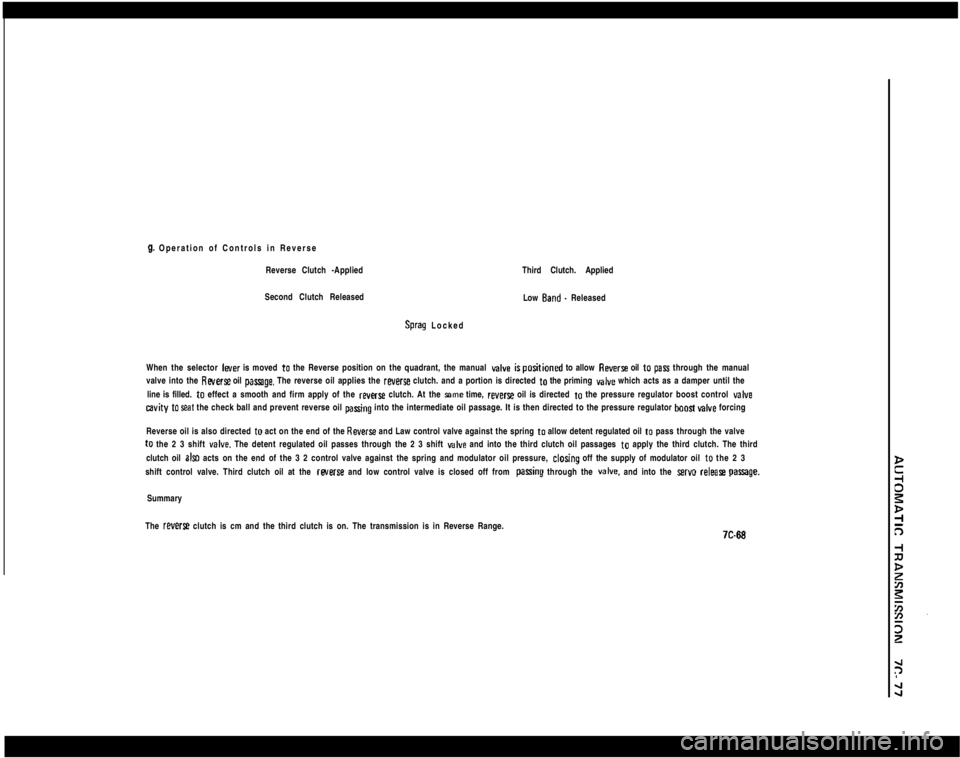
9. Operation of Controls in Reverse
Reverse Clutch -Applied
Second Clutch Released
Sprag LockedThird Clutch. Applied
Low Band. Released
When the selector leer is moved to the Reverse position on the quadrant, the manual
valve ispositioned to allow Revert oil to pars through the manual
valve into the
Reverse oil passage. The reverse oil applies the reverse clutch. and a portion is directed to the priming valve which acts as a damper until the
line is filled. to effect a smooth and firm apply of the
reverss clutch. At the wne time, reverse oil is directed to the pressure regulator boost control valve
cavity to seat the check ball and prevent reverse oil pasring into the intermediate oil passage. It is then directed to the pressure regulator boast valve forcing
Reverse oil is also directed to act on the end of the
Reverse and Law control valve against the spring to allow detent regulated oil to pass through the valveto the 2 3 shift
valve. The detent regulated oil passes through the 2 3 shift valve and into the third clutch oil passages to apply the third clutch. The third
clutch oil
al= acts on the end of the 3 2 control valve against the spring and modulator oil pressure, clodng off the supply of modulator oil to the 2 3
shift control valve. Third clutch oil at the rwerse and low control valve is closed off from
parring through the valve. and into the servo releal~ parrage.Summary
The
reverse clutch is cm and the third clutch is on. The transmission is in Reverse Range.
Page 440 of 625
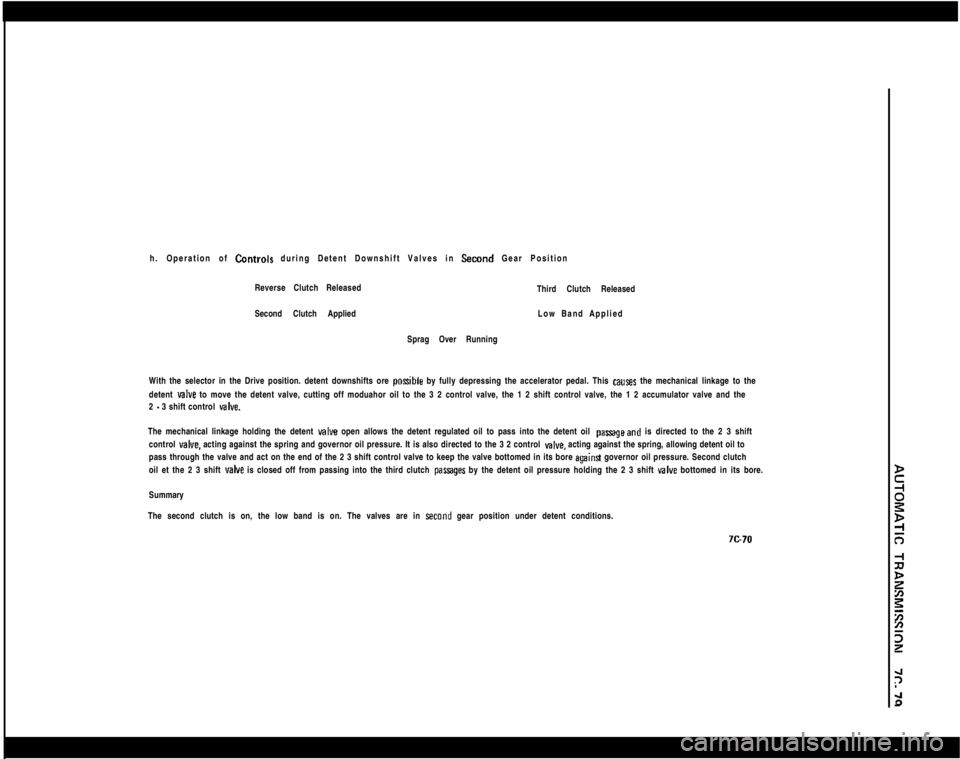
h. Operation of Controlr during Detent Downshift Valves in Second Gear Position
Reverse Clutch Released
Second Clutch Applied
Sprag Over RunningThird Clutch Released
Low Band Applied
With the selector in the Drive position. detent downshifts ore possible by fully depressing the accelerator pedal. This causes the mechanical linkage to the
detent
velve to move the detent valve, cutting off moduahor oil to the 3 2 control valve, the 1 2 shift control valve, the 1 2 accumulator valve and the
2 - 3 shift control velve.The mechanical linkage holding the detent nlve open allows the detent regulated oil to pass into the detent oil
passdgeand is directed to the 2 3 shift
control
valve. acting against the spring and governor oil pressure. It is also directed to the 3 2 control valve. acting against the spring, allowing detent oil to
pass through the valve and act on the end of the 2 3 shift control valve to keep the valve bottomed in its bore again* governor oil pressure. Second clutch
oil et the 2 3 shift
valve is closed off from passing into the third clutch passages by the detent oil pressure holding the 2 3 shift valve bottomed in its bore.
Summary
The second clutch is on, the low band is on. The valves are in
wand gear position under detent conditions.
Page 445 of 625

7C. 841973 OPEL SERVICE MANUALConditionCause8. No starting in “R” range
(proper driving in all other
ranges).a) Reverse clutch failure.
9. Drive in selector lever
position “N”.a) Inadequate selector lever linkage.
b) Planetary gear set broken.
c) Improper adjustment of band.
Gear Change1. No l-2 upshift in “D” and “S”
(transmission remains in 1st gear
at all speeds).a) Governor valves stuck.
b) 1-2 shift valve stuck in 1st gear
position.
c) Seal rings (oil pump hub) leaky.
d) Large leak in governor pressure circuit.
e) Governor screen clogged.
2. No 2-3 upshift in “D” (trans-
mission remains in 2nd gear at all
speeds).a) 2-3 shift valve stuck.
b) Large leak in governor pressure circuit.
3. Upshifts in “D” and “S” only
at full throttle.a) Failed vacuum modulator.
b) Modulator vacuum line leaky or
interrupted.
c) Leak in any part of engine or
accessory vacuum system.
d) Detent valve or cable stuck.
4. Upshifts in “D” and “S” only
at part throttle (no detent
upshift).a) Detent pressure regulator valve stuck.
b) Detent cable broken or misadjusted.
5. Driving only in 1st gear of
“D” and “S” range (transmission
blocks in 2nd gear and “R”).a) “L” and “R” control valve stuck in
“L” or “R” position.
6. No part throttle 3-2 downshift
at low vehicle speeds.a) 3-2 downshift control valve stuck.
7. No forced downshift.a) Detent cable broken or improperly
adjusted.
b) Detent pressure regulator valve stuck.
Page 446 of 625
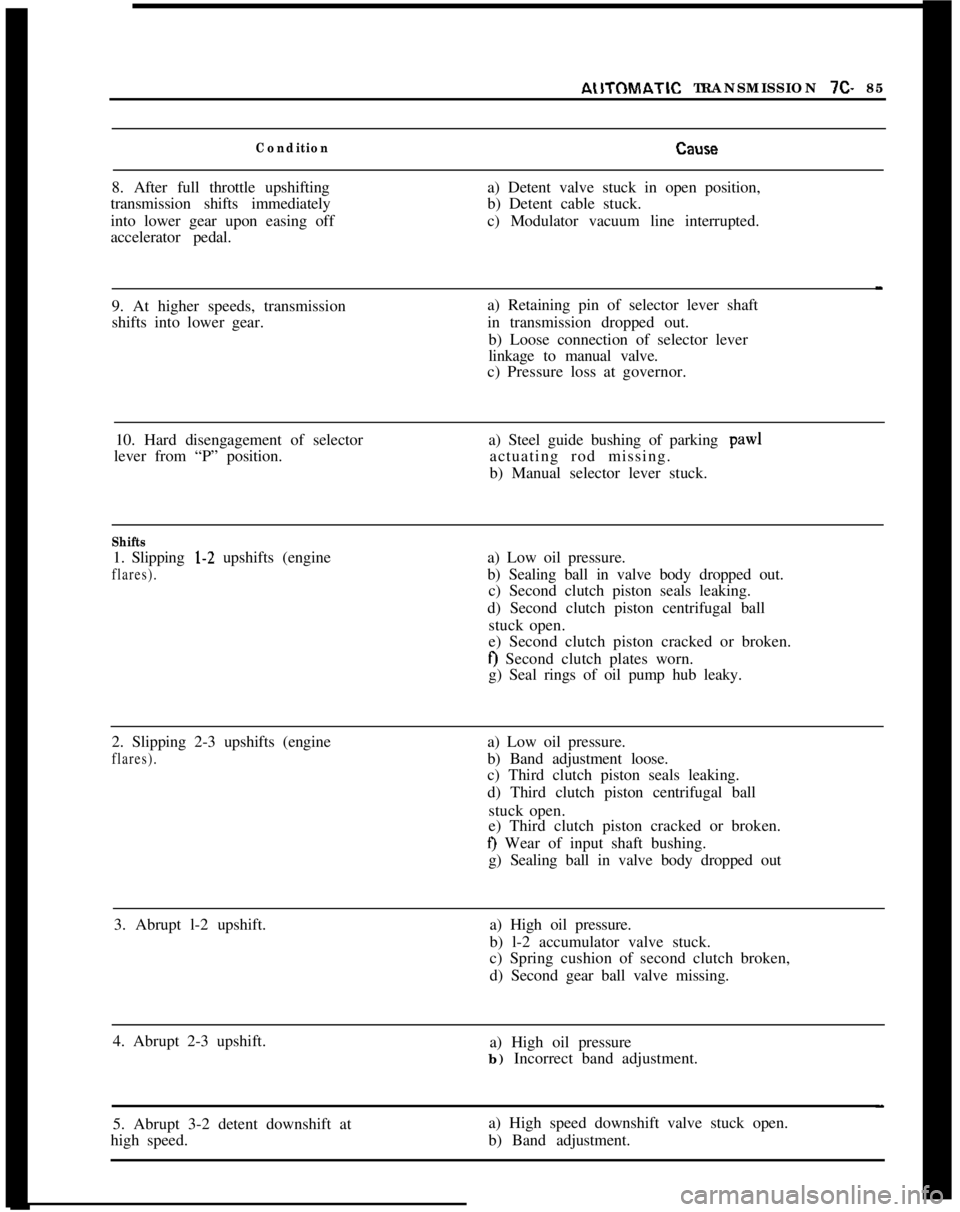
AlITOMATIC TRANSMISSION 7C- 85
ConditionCtSlSl?8. After full throttle upshifting
transmission shifts immediately
into lower gear upon easing off
accelerator pedal.a) Detent valve stuck in open position,
b) Detent cable stuck.
c) Modulator vacuum line interrupted.
9. At higher speeds, transmission
shifts into lower gear.a) Retaining pin of selector lever shaft
in transmission dropped out.
b) Loose connection of selector lever
linkage to manual valve.
c) Pressure loss at governor.
10. Hard disengagement of selector
lever from “P” position.a) Steel guide bushing of parking
paw1actuating rod missing.
b) Manual selector lever stuck.
Shifts1. Slipping l-2 upshifts (engine
flares).a) Low oil pressure.
b) Sealing ball in valve body dropped out.
c) Second clutch piston seals leaking.
d) Second clutch piston centrifugal ball
stuck open.
e) Second clutch piston cracked or broken.
f) Second clutch plates worn.
g) Seal rings of oil pump hub leaky.
2. Slipping 2-3 upshifts (engine
flares).a) Low oil pressure.
b) Band adjustment loose.
c) Third clutch piston seals leaking.
d) Third clutch piston centrifugal ball
stuck open.
e) Third clutch piston cracked or broken.
f) Wear of input shaft bushing.
g) Sealing ball in valve body dropped out
3. Abrupt l-2 upshift.a) High oil pressure.
b) l-2 accumulator valve stuck.
c) Spring cushion of second clutch broken,
d) Second gear ball valve missing.
4. Abrupt 2-3 upshift.
a) High oil pressure
b) Incorrect band adjustment.
5. Abrupt 3-2 detent downshift at
high speed.a) High speed downshift valve stuck open.
b) Band adjustment.
Page 447 of 625
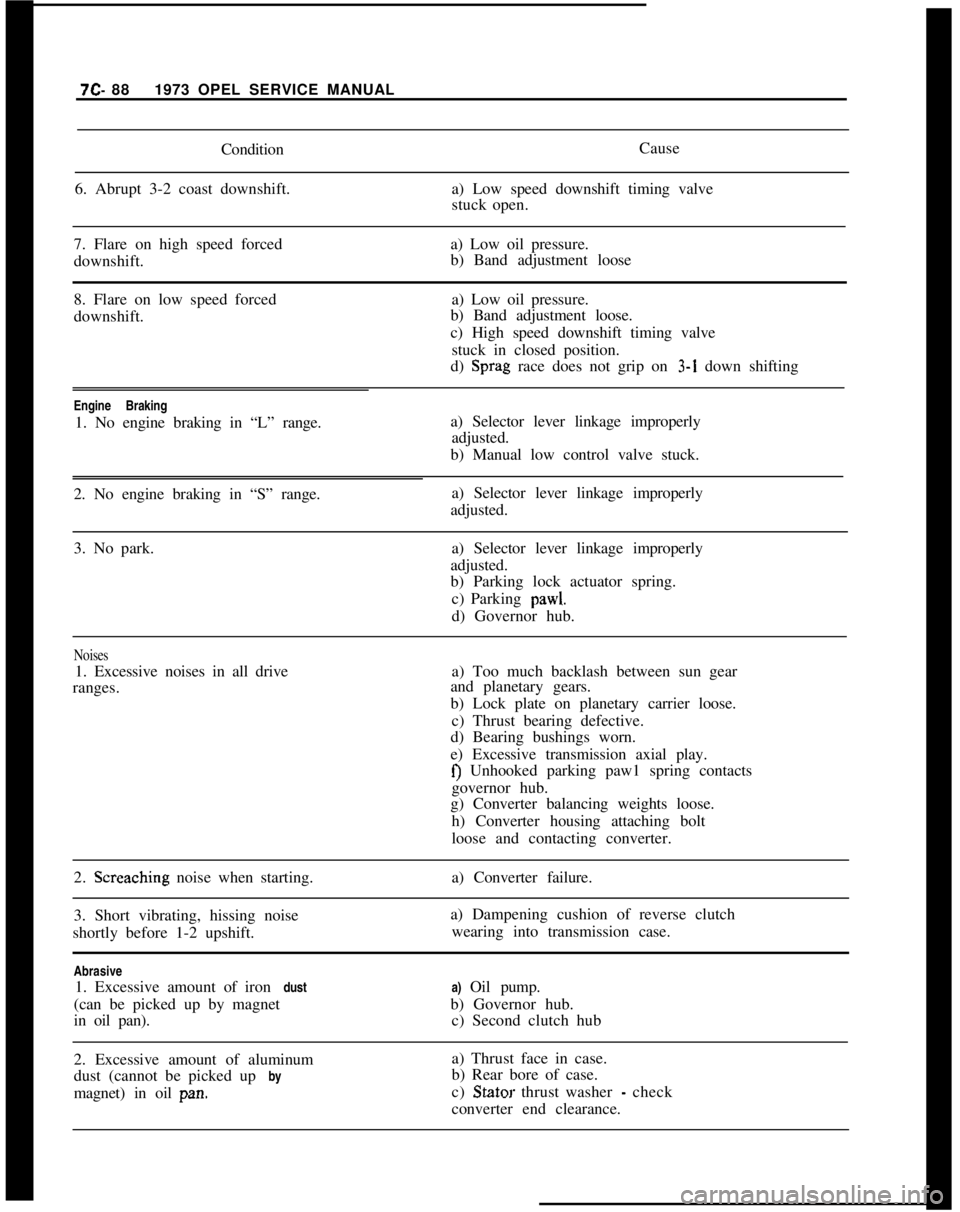
7C- 881973 OPEL SERVICE MANUAL
Condition
6. Abrupt 3-2 coast downshift.Cause
a) Low speed downshift timing valve
stuck open.
7. Flare on high speed forceda) Low oil pressure.
downshift.b) Band adjustment loose
8. Flare on low speed forced
downshift.a) Low oil pressure.
b) Band adjustment loose.
c) High speed downshift timing valve
stuck in closed position.
d) Sprag race does not grip on 3-1 down shifting
Engine Braking
1. No engine braking in “L” range.a) Selector lever linkage improperly
adjusted.
b) Manual low control valve stuck.
2. No engine braking in “S” range.a) Selector lever linkage improperly
adjusted.
3. No park.a) Selector lever linkage improperly
adjusted.
b) Parking lock actuator spring.
c) Parking pawl.
d) Governor hub.
Noises1. Excessive noises in all drive
ranges.a) Too much backlash between sun gear
and planetary gears.
b) Lock plate on planetary carrier loose.
c) Thrust bearing defective.
d) Bearing bushings worn.
e) Excessive transmission axial play.
f) Unhooked parking paw1 spring contacts
governor hub.
g) Converter balancing weights loose.
h) Converter housing attaching bolt
loose and contacting converter.
2. Screaching noise when starting.
3. Short vibrating, hissing noise
shortly before 1-2 upshift.a) Converter failure.
a) Dampening cushion of reverse clutch
wearing into transmission case.
Abrasive
1. Excessive amount of iron dust
(can be picked up by magnet
in oil pan).a) Oil pump.
b) Governor hub.
c) Second clutch hub
2. Excessive amount of aluminum
dust (cannot be picked up by
magnet) in oil pan.a) Thrust face in case.
b) Rear bore of case.
c) Stator thrust washer
- check
converter end clearance.
Page 449 of 625

7C- 881973 OPEL SERVICE MANUALCONVERTER
OUT\
/
2ND CLUTCHa!EI1
CONVERTER iOUT
x
PRIMING VALVE
BORE
\
REVERSE
CLUTCH
:. -q
MODULATOR -
EXHAUST
REVERSE CLUTCH
INTERMEDIATE
2ND CLUTCH
3RD CLUTCHBOOST
7674Figure 7C-74 Oil Pump Passages
Page 464 of 625
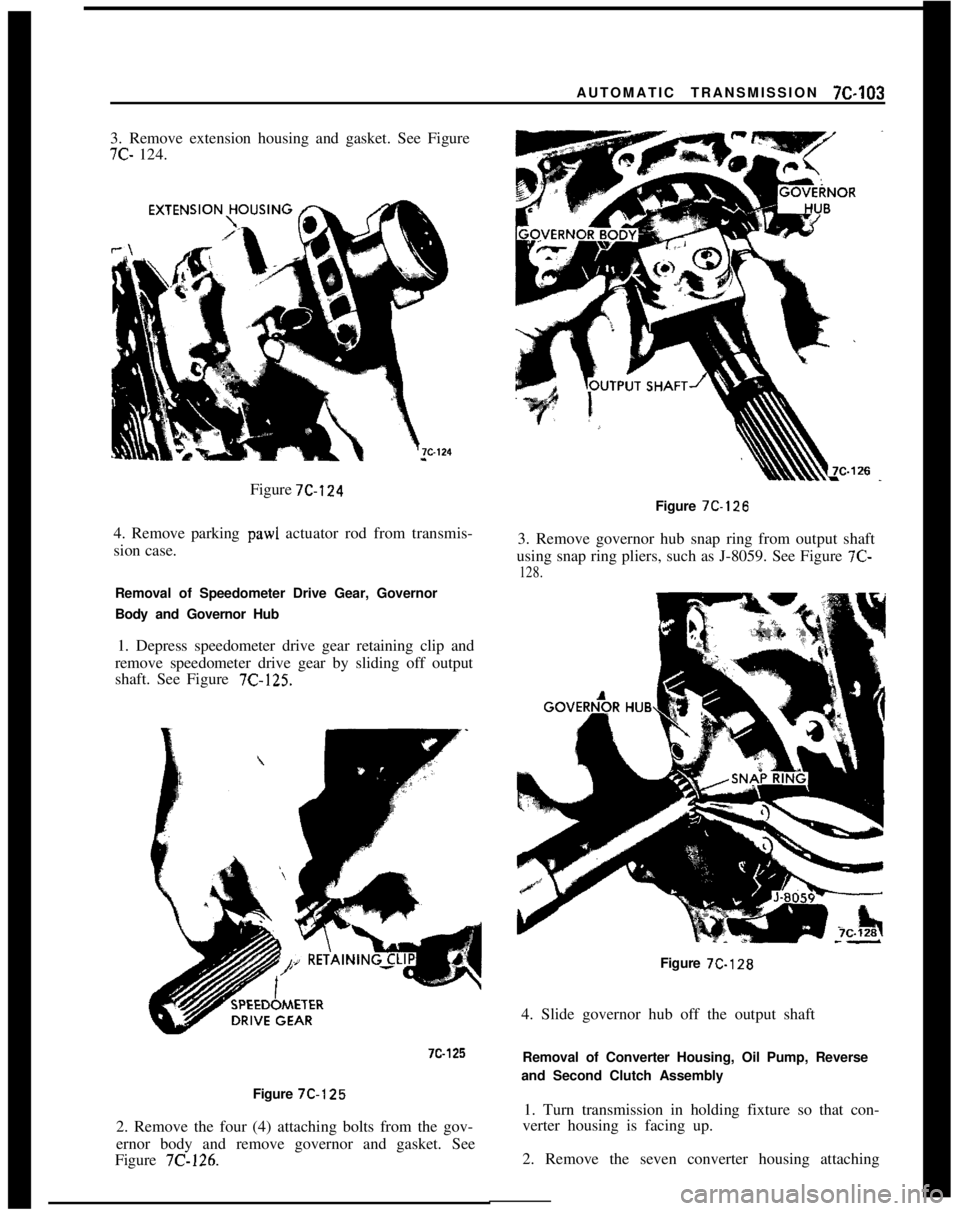
AUTOMATIC TRANSMISSION 712-1033. Remove extension housing and gasket. See Figure7C- 124.
Figure 7C-124
4. Remove parking
paw1 actuator rod from transmis-
sion case.
Removal of Speedometer Drive Gear, Governor
Body and Governor Hub
1. Depress speedometer drive gear retaining clip and
remove speedometer drive gear by sliding off output
shaft. See Figure
7C-125.
7c-125Figure 7C-125
2. Remove the four (4) attaching bolts from the gov-
ernor body and remove governor and gasket. See
Figure
7C-126.Figure 7C-126
3. Remove governor hub snap ring from output shaft
using snap ring pliers, such as J-8059. See Figure 7C-
128.Figure 7C-128
4. Slide governor hub off the output shaft
Removal of Converter Housing, Oil Pump, Reverse
and Second Clutch Assembly
1. Turn transmission in holding fixture so that con-
verter housing is facing up.
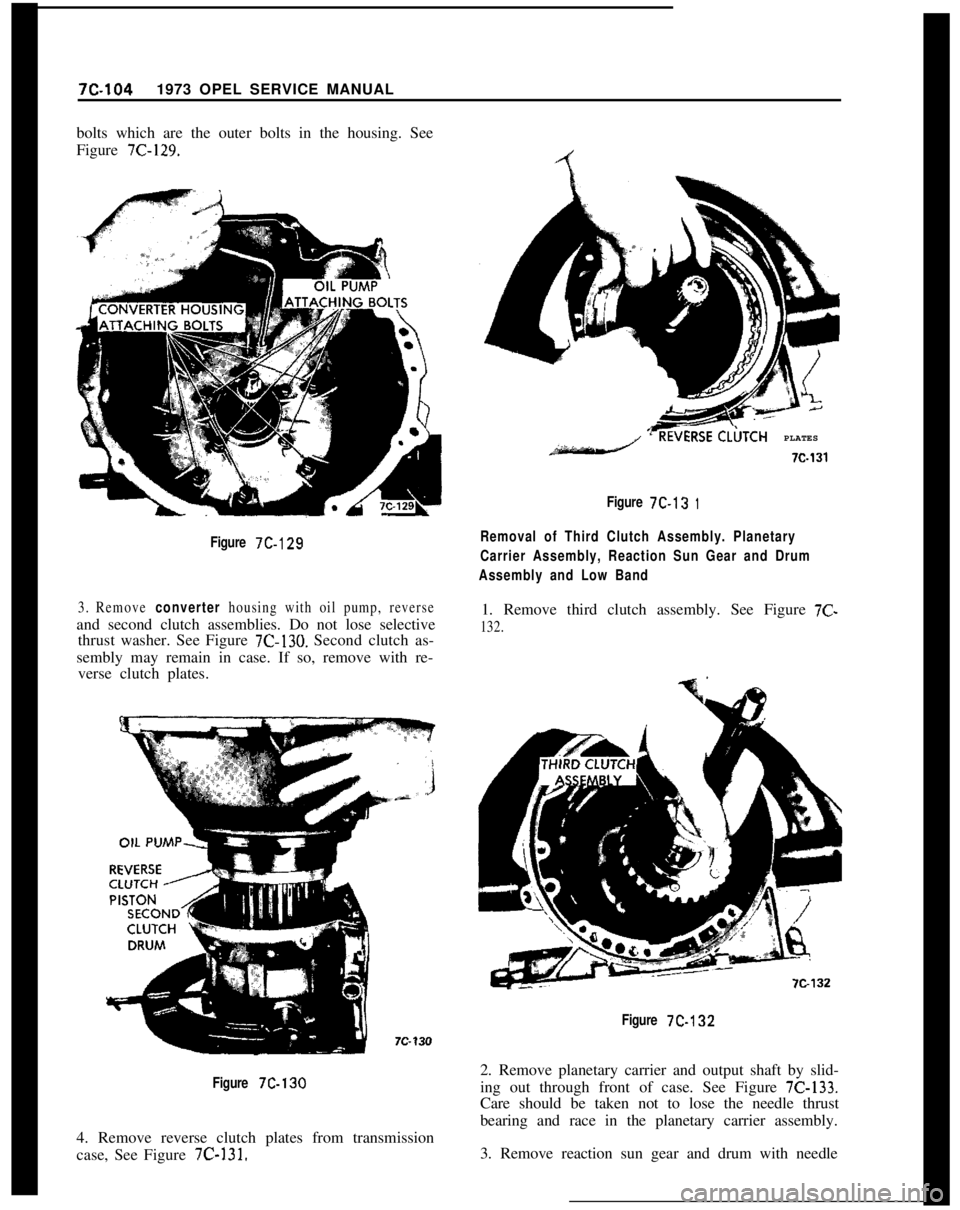
2. Remove the seven converter housing attaching
Page 465 of 625
7C-1041973 OPEL SERVICE MANUAL
bolts which are the outer bolts in the housing. See
Figure 7C-129.
Figure 7C-129
3. Remove converter housing with oil pump, reverseand second clutch assemblies. Do not lose selective
thrust washer. See Figure
7C-130. Second clutch as-
sembly may remain in case. If so, remove with re-
verse clutch plates.
Figure 7C-130
4. Remove reverse clutch plates from transmission
case, See Figure
7C-131.
T%RSE~L~~T~H PLATES
7c-131
Figure
7C-13 I
Removal of Third Clutch Assembly. Planetary
Carrier Assembly, Reaction Sun Gear and Drum
Assembly and Low Band1. Remove third clutch assembly. See Figure 7C-
132.
Figure 7C-132
2. Remove planetary carrier and output shaft by slid-
ing out through front of case. See Figure
7C-133.Care should be taken not to lose the needle thrust
bearing and race in the planetary carrier assembly.
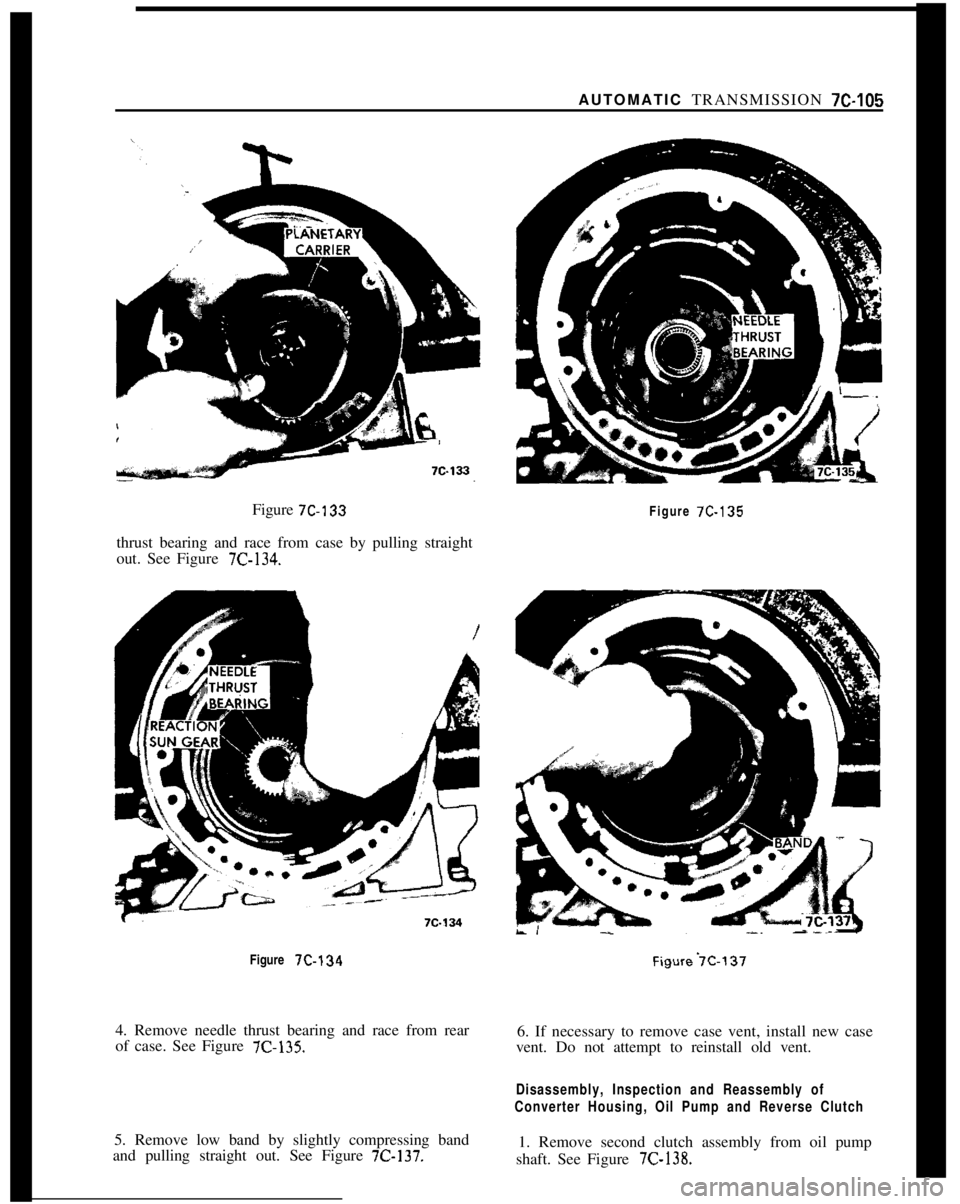
3. Remove reaction sun gear and drum with needle
Page 466 of 625
AUTOMATIC TRANSMISSION 7C-105
Figure 7C-133thrust bearing and race from case by pulling straight
out. See Figure
7C-134.Figure
7C-135Figure
7C-1344. Remove needle thrust bearing and race from rear
of case. See Figure
7C-135.5. Remove low band by slightly compressing band
and pulling straight out. See Figure
7C-137.6. If necessary to remove case vent, install new case
vent. Do not attempt to reinstall old vent.
Disassembly, Inspection and Reassembly of
Converter Housing, Oil Pump and Reverse Clutch1. Remove second clutch assembly from oil pump
shaft. See Figure
7C-138.
Page 468 of 625
J-8092
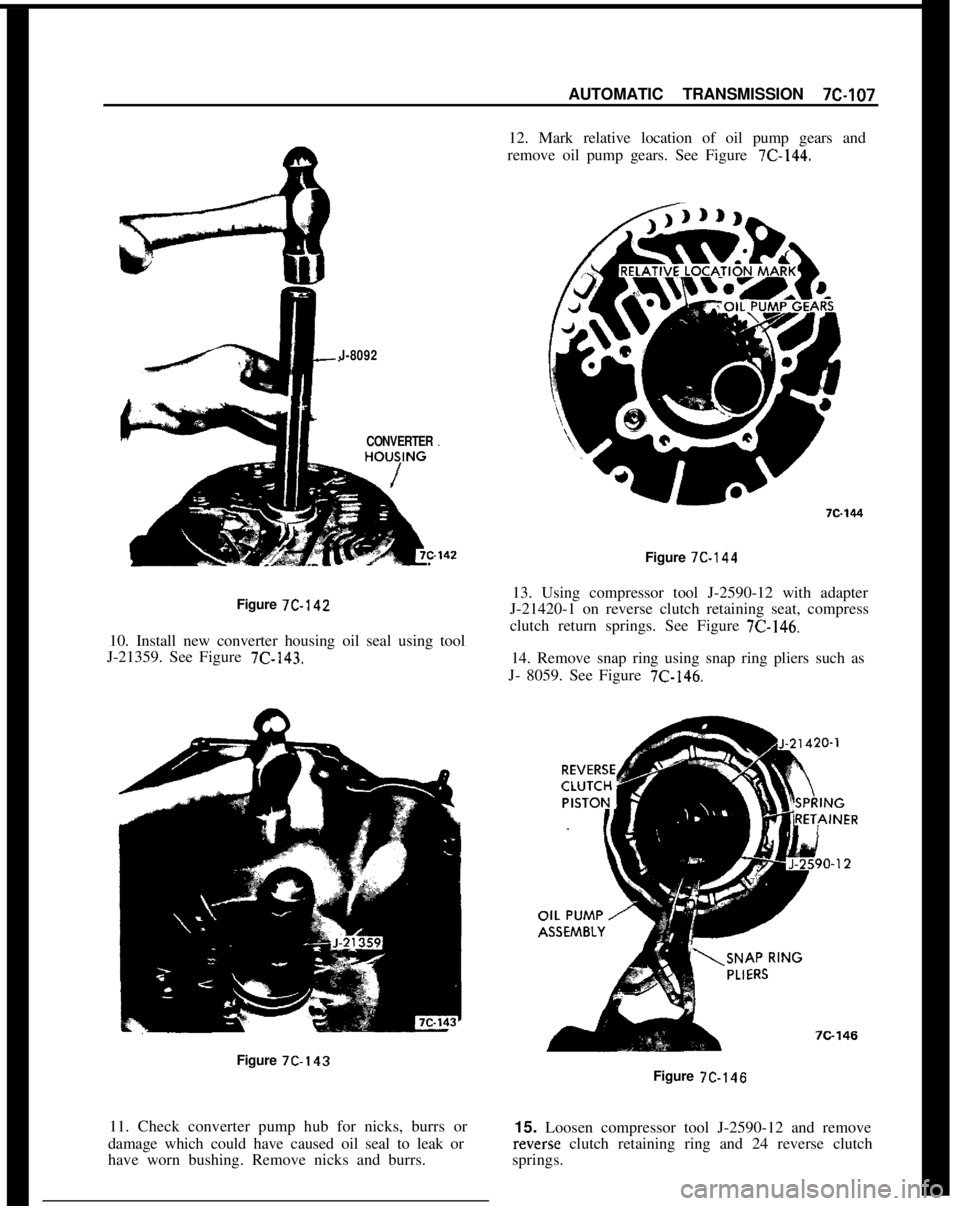
CONVERTERFigure 7C-142
10. Install new converter housing oil seal using tool
J-21359. See Figure
7C-143.12. Mark relative location of oil pump gears and
remove oil pump gears. See Figure
7C-144.AUTOMATIC TRANSMISSION
712.107Figure 7C-144
13. Using compressor tool J-2590-12 with adapter
J-21420-1 on reverse clutch retaining seat, compress
clutch return springs. See Figure
7C-146.14. Remove snap ring using snap ring pliers such as
J- 8059. See Figure
7C-146.Figure 7C-143
Figure 7C-146
11. Check converter pump hub for nicks, burrs or
damage which could have caused oil seal to leak or
have worn bushing. Remove nicks and burrs.15. Loosen compressor tool J-2590-12 and remove
reverse clutch retaining ring and 24 reverse clutch
springs.