engine oil OPEL 1900 1973 Repair Manual
[x] Cancel search | Manufacturer: OPEL, Model Year: 1973, Model line: 1900, Model: OPEL 1900 1973Pages: 625, PDF Size: 17.22 MB
Page 400 of 625
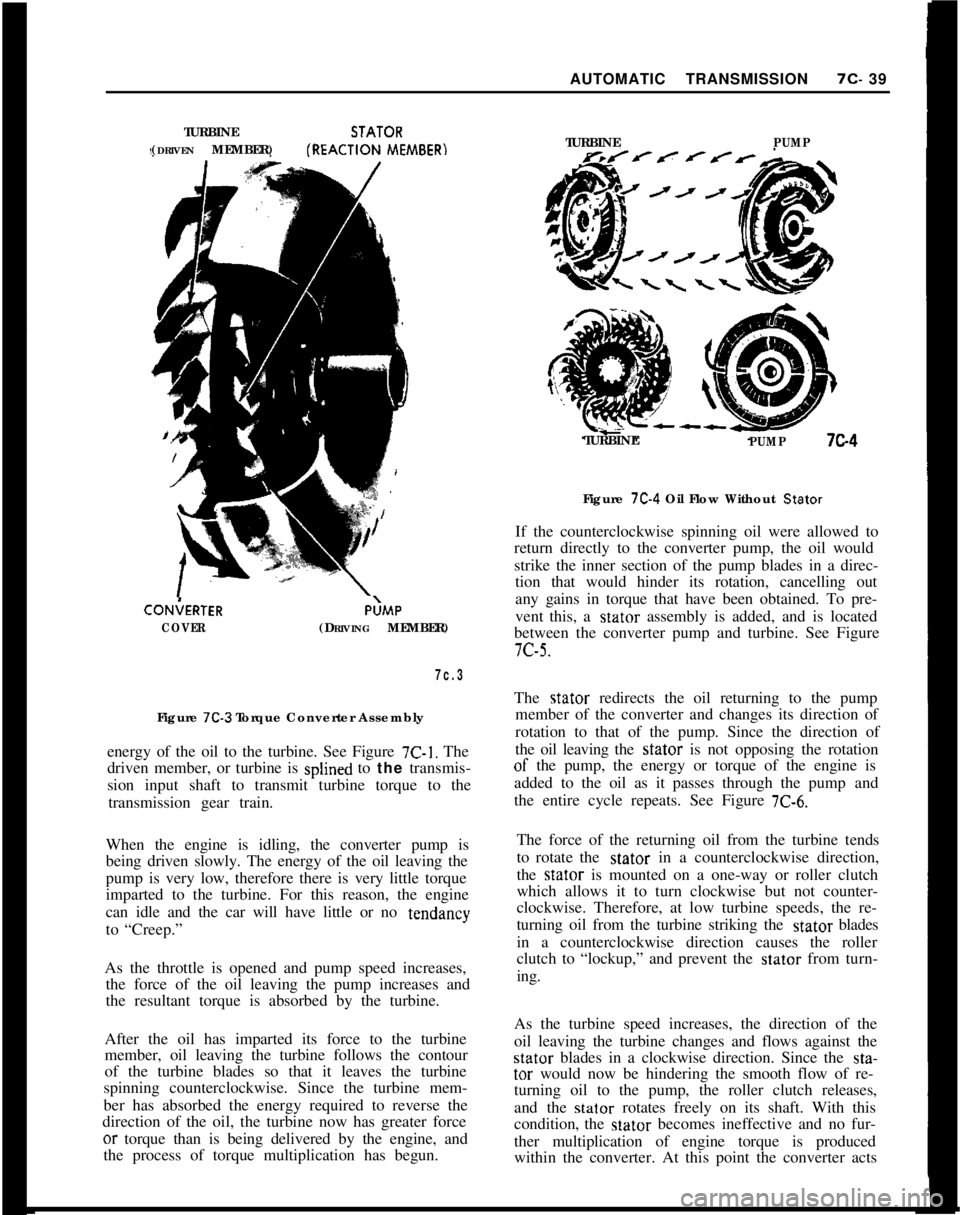
AUTOMATIC TRANSMISSION7c- 39
TURBINESTATOR
(DRIVEN MEMBER)fREACTION
MEMBER)CON;ERTER
COVERP;MP
(DRIVING MEMBER)
7c.3Figure
7C-3 Torque Converter Assembly
energy of the oil to the turbine. See Figure
7C-1. The
driven member, or turbine is splined to the transmis-
sion input shaft to transmit turbine torque to the
transmission gear train.
When the engine is idling, the converter pump is
being driven slowly. The energy of the oil leaving the
pump is very low, therefore there is very little torque
imparted to the turbine. For this reason, the engine
can idle and the car will have little or no tendancy
to “Creep.”
As the throttle is opened and pump speed increases,
the force of the oil leaving the pump increases and
the resultant torque is absorbed by the turbine.
After the oil has imparted its force to the turbine
member, oil leaving the turbine follows the contour
of the turbine blades so that it leaves the turbine
spinning counterclockwise. Since the turbine mem-
ber has absorbed the energy required to reverse the
direction of the oil, the turbine now has greater forceor torque than is being delivered by the engine, and
the process of torque multiplication has begun.TURBINE
PUMPTURBINE
PUMP7c4Figure
7C-4 Oil Flow Without Stator
If the counterclockwise spinning oil were allowed to
return directly to the converter pump, the oil would
strike the inner section of the pump blades in a direc-
tion that would hinder its rotation, cancelling out
any gains in torque that have been obtained. To pre-
vent this, a stator assembly is added, and is located
between the converter pump and turbine. See Figure7c-5.
The stator redirects the oil returning to the pump
member of the converter and changes its direction of
rotation to that of the pump. Since the direction of
the oil leaving the stator is not opposing the rotationof the pump, the energy or torque of the engine is
added to the oil as it passes through the
the entire cycle repeats. See Figure
7C-6.pump and
The force of the returning oil from the turbine tends
to rotate the stator in a counterclockwise direction,
the stator is mounted on a one-way or roller clutch
which allows it to turn clockwise but not counter-
clockwise. Therefore, at low turbine speeds, the re-
turning oil from the turbine striking the stator blades
in a counterclockwise direction causes the roller
clutch to “lockup,” and prevent the stator from turn-
ing.
As the turbine speed increases, the direction of the
oil leaving the turbine changes and flows against thestator blades in a clockwise direction. Since the sta-tar would now be hindering the smooth flow of re-
turning oil to the pump, the roller clutch releases,
and the stator rotates freely on its shaft. With this
condition, the stator becomes ineffective and no fur-
ther multiplication of engine torque is produced
within the converter. At this point the converter acts
Page 405 of 625
causes the sprags to wedge and prevent rotation in
one direction, and to allow free rotation in the oppo-
site direction.7C. 441973 OPEL SERVICE MANUAL
The clutch is released by exhausting the oil from
behind the piston. The release springs push the pis-
ton to the released position, thereby removing the
force from the plates. See Figure 7C-16.Band
A band is used to hold one planetary member sta-
tionary with relation to the other planetary mem-
bers.
!See Figure 7C-19. The band is connected to the
SPR
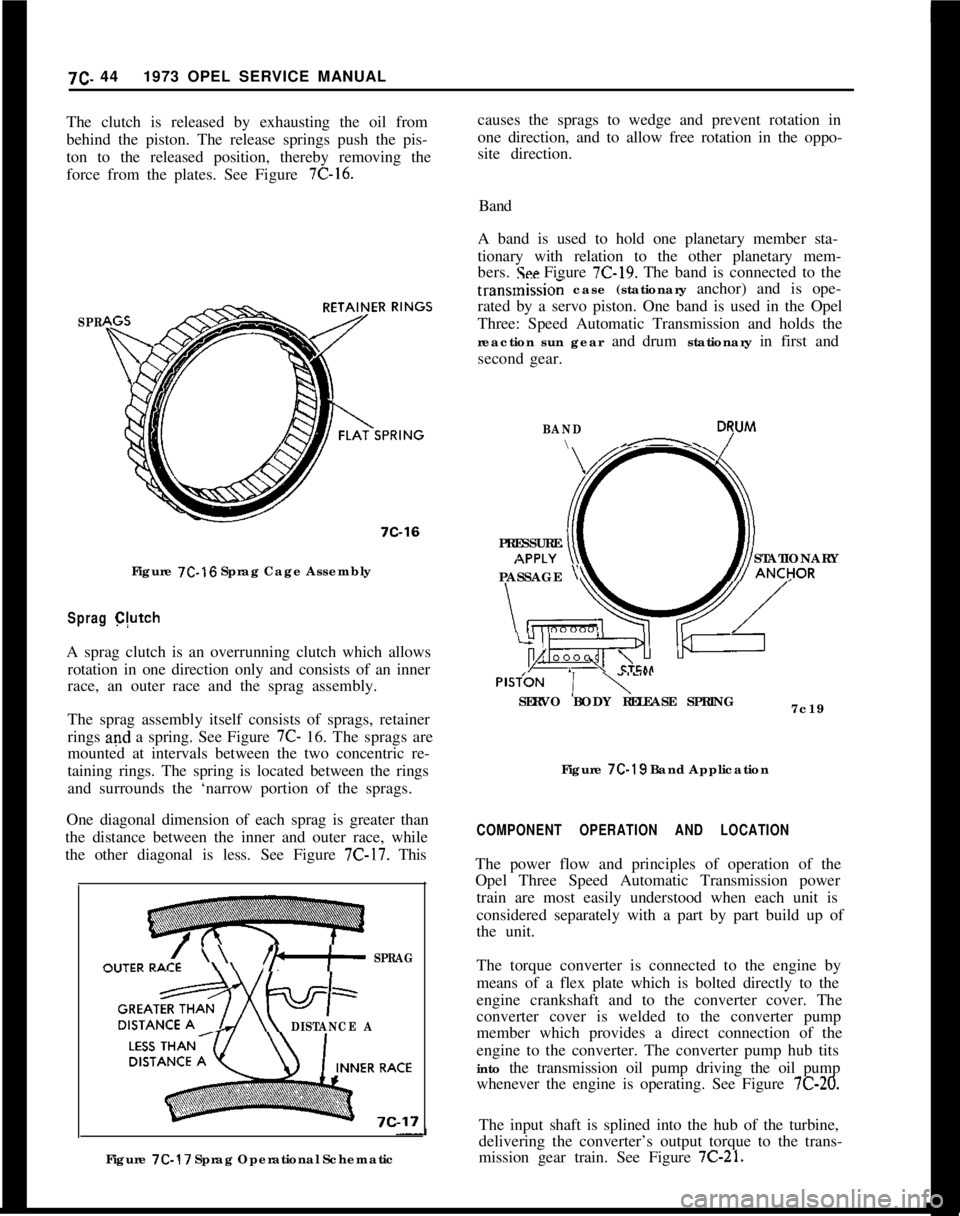
7C-16Figure
7C-16 Sprag Cage Assembly
Sprag C(utchA sprag clutch is an overrunning clutch which allows
rotation in one direction only and consists of an inner
race, an outer race and the sprag assembly.
The sprag assembly itself consists of sprags, retainer
rings and a spring. See Figure 7C- 16. The sprags are
mounted at intervals between the two concentric re-
taining rings. The spring is located between the rings
and surrounds the ‘narrow portion of the sprags.
One diagonal dimension of each sprag is greater than
the distance between the inner and outer race, while
the other diagonal is less. See Figure
7C-17. This
\ \I’b+ SPRAG
DISTANCE AFigure
7C-17 Sprag Operational Schematictransmissio; case (stationary anchor) and is ope-
rated by a servo piston. One band is used in the Opel
Three: Speed Automatic Transmission and holds the
reaction sun gear and drum stationary in first and
second gear.
BAND\- D7uM
PRESSURE
STATIONARY
PASSAGE
yPlSfON
1 y””SERVO BODY RELEASE SPRING
7c19
Figure
7C-19 Band Application
COMPONENT OPERATION AND LOCATIONThe power flow and principles of operation of the
Opel Three Speed Automatic Transmission power
train are most easily understood when each unit is
considered separately with a part by part build up of
the unit.
The torque converter is connected to the engine by
means of a flex plate which is bolted directly to the
engine crankshaft and to the converter cover. The
converter cover is welded to the converter pump
member which provides a direct connection of the
engine to the converter. The converter pump hub tits
into the transmission oil pump driving the oil pump
whenever the engine is operating. See Figure
7C-20.The input shaft is splined into the hub of the turbine,
delivering the converter’s output torque to the trans-
mission gear train. See Figure
7C-21.
Page 409 of 625
7C- 481973 OPEL SERVICE MANUAL
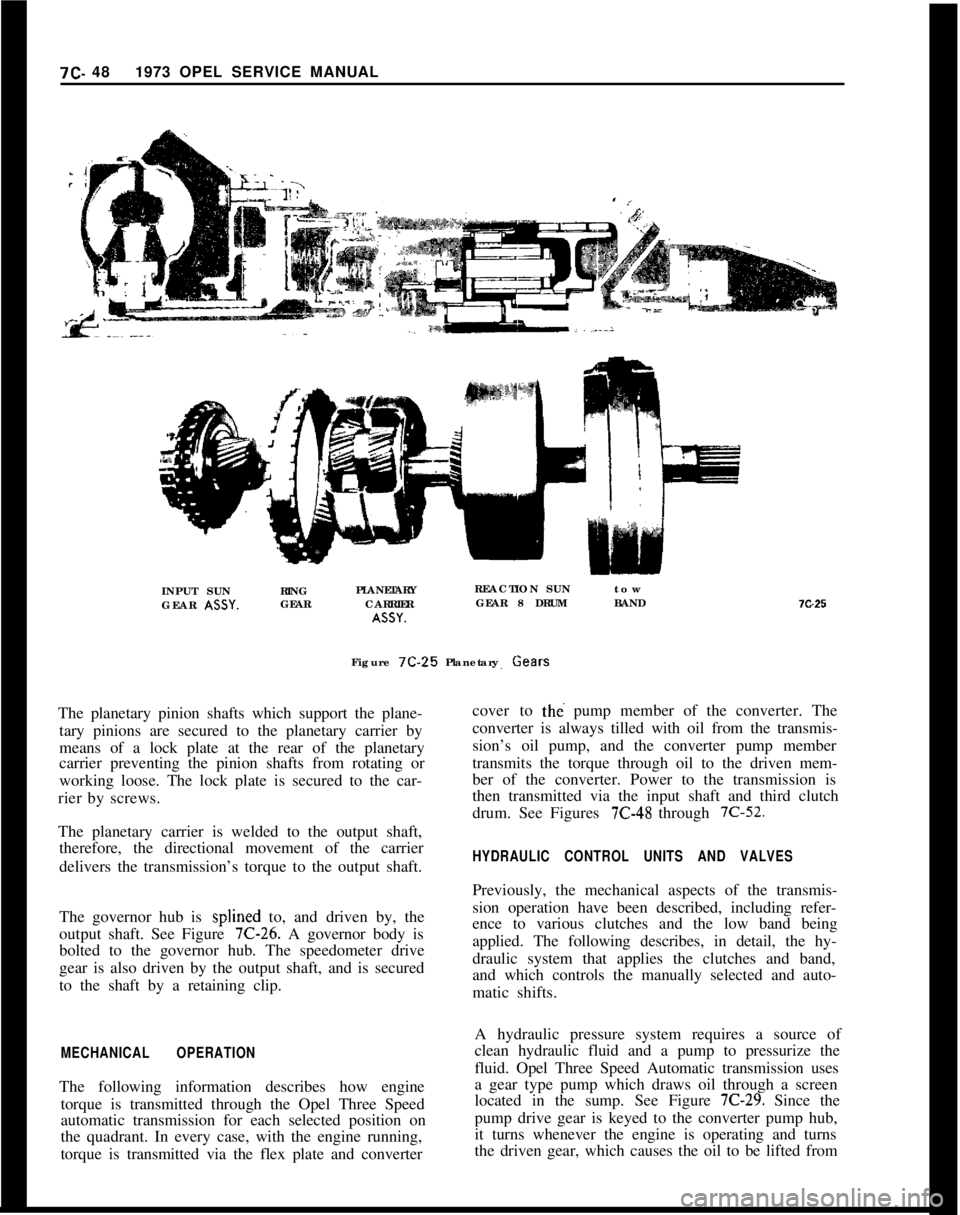
INPUT SUNRING
GEAR ASSY.GEARPLANETARY
CARRIERASSY.REACTION SUNtow
GEAR 8 DRUMBAND
Figure 7C-25Planetary Gears
The planetary pinion shafts which support the plane-
tary pinions are secured to the planetary carrier by
means of a lock plate at the rear of the planetary
carrier preventing the pinion shafts from rotating or
working loose. The lock plate is secured to the car-
rier by screws.
The planetary carrier is welded to the output shaft,
therefore, the directional movement of the carrier
delivers the transmission’s torque to the output shaft.
The governor hub is splined to, and driven by, the
output shaft. See Figure 7C-26. A governor body is
bolted to the governor hub. The speedometer drive
gear is also driven by the output shaft, and is secured
to the shaft by a retaining clip.
MECHANICAL OPERATIONThe following information describes how engine
torque is transmitted through the Opel Three Speed
automatic transmission for each selected position on
the quadrant. In every case, with the engine running,
torque is transmitted via the flex plate and converter7G25
cover to
tht? pump member of the converter. The
converter is always tilled with oil from the transmis-
sion’s oil pump, and the converter pump member
transmits the torque through oil to the driven mem-
ber of the converter. Power to the transmission is
then transmitted via the input shaft and third clutch
drum. See Figures
7C-48 through 7C-52.
HYDRAULIC CONTROL UNITS AND VALVESPreviously, the mechanical aspects of the transmis-
sion operation have been described, including refer-
ence to various clutches and the low band being
applied. The following describes, in detail, the hy-
draulic system that applies the clutches and band,
and which controls the manually selected and auto-
matic shifts.
A hydraulic pressure system requires a source of
clean hydraulic fluid and a pump to pressurize the
fluid. Opel Three Speed Automatic transmission uses
a gear type pump which draws oil through a screen
located in the sump. See Figure
7C-29. Since the
pump drive gear is keyed to the converter pump hub,
it turns whenever the engine is operating and turns
the driven gear, which causes the oil to be lifted from
Page 411 of 625
712.501973 OPEL SERVICE MANUAL
3. Detent pressure regulator valve.
4. 1 - 2 Accumulator valve.
5. Governor.
B. Selector valves (manually and hydraulically con-
trolled).
I. Manual valve.
2. Detent valve.
3. 1
- 2 Shift valve.
4. 2
- 3 Shift valve.
5. 3
- 2 Downshift control valve.
6. Manual low and reverse control valve.
7. Boost control valve.
C. Timing Valves.
1. Low speed downshift timing valve.
2. High speed downshift timing valve.
3. Second clutch orifice valve.
D. Accumulators.
1. 1
- 2 Accumulator.
2. Low servo piston.
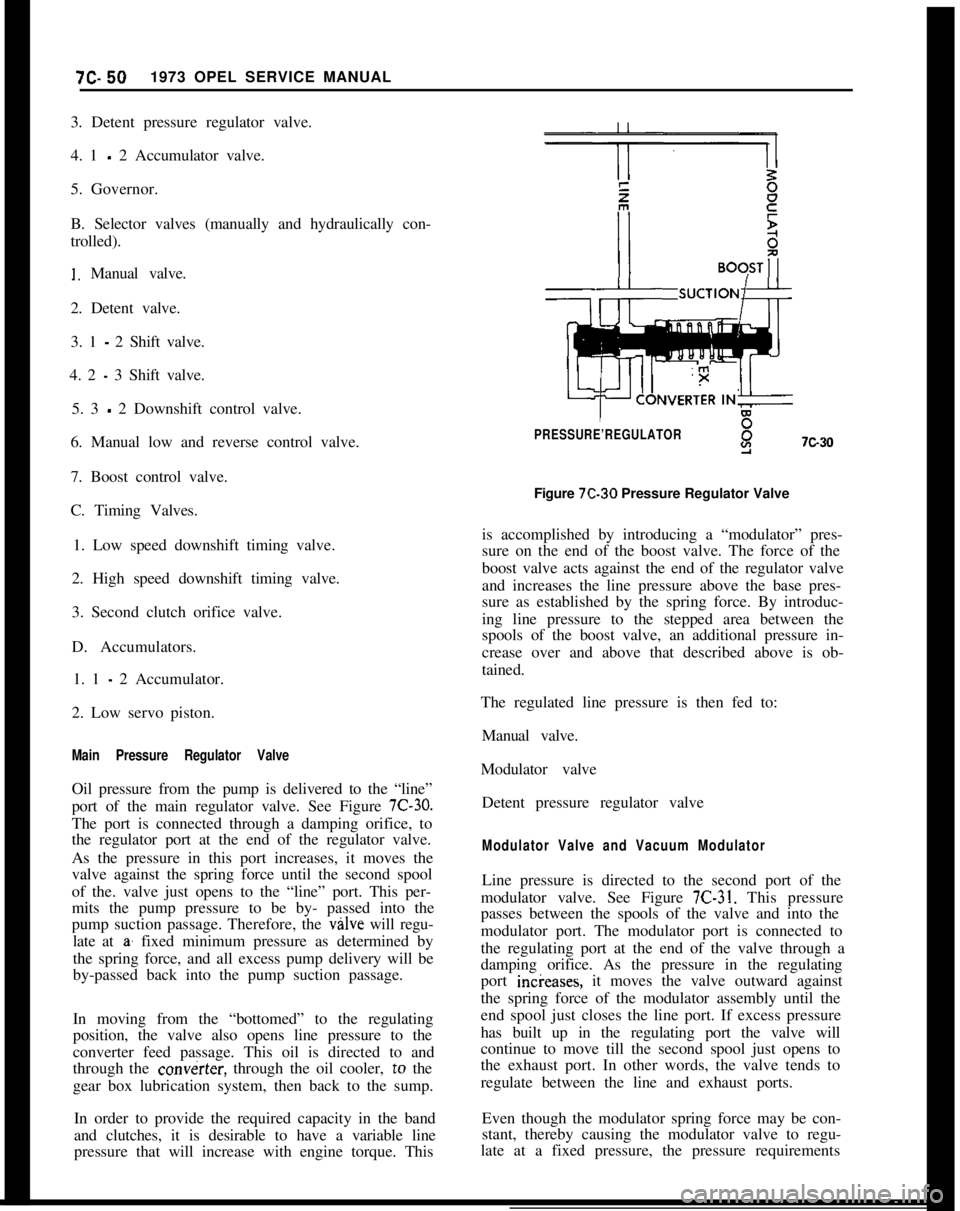
Main Pressure Regulator ValveOil pressure from the pump is delivered to the “line”
port of the main regulator valve. See Figure
7C-30.The port is connected through a damping orifice, to
the regulator port at the end of the regulator valve.
As the pressure in this port increases, it moves the
valve against the spring force until the second spool
of the. valve just opens to the “line” port. This per-
mits the pump pressure to be by- passed into the
pump suction passage. Therefore, the valve will regu-
late at
a’ fixed minimum pressure as determined by
the spring force, and all excess pump delivery will be
by-passed back into the pump suction passage.
In moving from the “bottomed” to the regulating
position, the valve also opens line pressure to the
converter feed passage. This oil is directed to and
through the
cow&x, through the oil cooler, to the
gear box lubrication system, then back to the sump.
In order to provide the required capacity in the band
and clutches, it is desirable to have a variable line
pressure that will increase with engine torque. This
PRESSURE’REGULATORY7c30Figure 7C-30 Pressure Regulator Valve
is accomplished by introducing a “modulator” pres-
sure on the end of the boost valve. The force of the
boost valve acts against the end of the regulator valve
and increases the line pressure above the base pres-
sure as established by the spring force. By introduc-
ing line pressure to the stepped area between the
spools of the boost valve, an additional pressure in-
crease over and above that described above is ob-
tained.
The regulated line pressure is then fed to:
Manual valve.
Modulator valve
Detent pressure regulator valve
Modulator Valve and Vacuum ModulatorLine pressure is directed to the second port of the
modulator valve. See Figure
7C-31. This pressure
passes between the spools of the valve and into the
modulator port. The modulator port is connected to
the regulating port at the end of the valve through a
damping orifice. As the pressure in the regulating
port incieases, it moves the valve outward against
the spring force of the modulator assembly until the
end spool just closes the line port. If excess pressure
has built up in the regulating port the valve will
continue to move till the second spool just opens to
the exhaust port. In other words, the valve tends to
regulate between the line and exhaust ports.
Even though the modulator spring force may be con-
stant, thereby causing the modulator valve to regu-
late at a fixed pressure, the pressure requirements
Page 413 of 625
7C- 521973 OPEL SERVICE MANUAL
CCUMULATOR
DRIVE:--7633
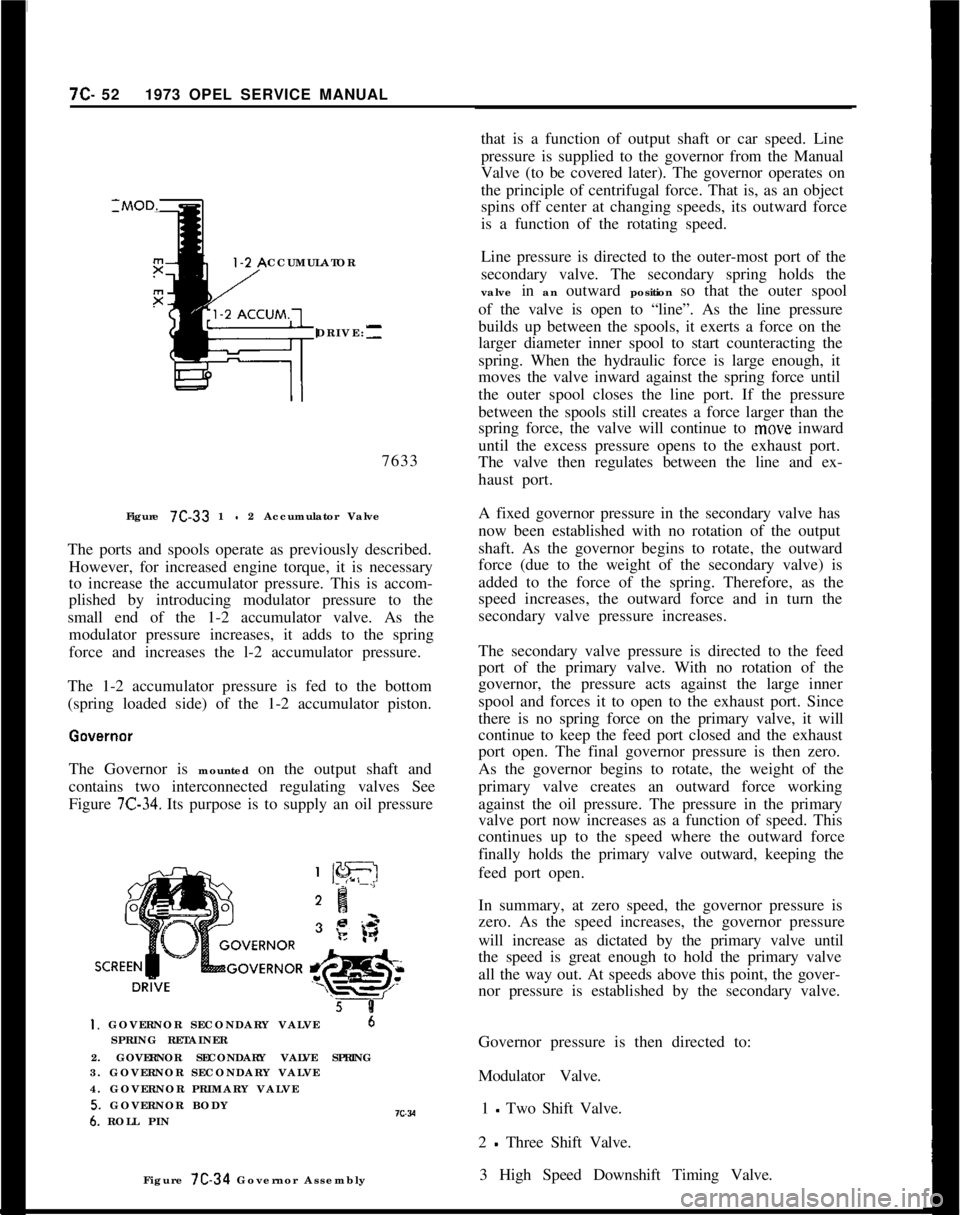
Figure 7C-33 1
- 2 Accumulator Valve
The ports and spools operate as previously described.
However, for increased engine torque, it is necessary
to increase the accumulator pressure. This is accom-
plished by introducing modulator pressure to the
small end of the 1-2 accumulator valve. As the
modulator pressure increases, it adds to the spring
force and increases the l-2 accumulator pressure.
The 1-2 accumulator pressure is fed to the bottom
(spring loaded side) of the 1-2 accumulator piston.
The Governor is mounted on the output shaft and
contains two interconnected regulating valves See
Figure
7C-34. Its purpose is to supply an oil pressure
5 8I. GOVERNOR SECONDARY VALVE6
SPRING RETAINER
2. GOVERNOR SECONDARY VALVE SPRING
3. GOVERNOR SECONDARY VALVE
4. GOVERNOR PRIMARY VALVE
5. GOVERNOR BODY6. ROLL PINIC~VFigure 7C-34 Governor Assemblythat is a function of output shaft or car speed. Line
pressure is supplied to the governor from the Manual
Valve (to be covered later). The governor operates on
the principle of centrifugal force. That is, as an object
spins off center at changing speeds, its outward force
is a function of the rotating speed.
Line pressure is directed to the outer-most port of the
secondary valve. The secondary spring holds the
valve in an outward position so that the outer spool
of the valve is open to “line”. As the line pressure
builds up between the spools, it exerts a force on the
larger diameter inner spool to start counteracting the
spring. When the hydraulic force is large enough, it
moves the valve inward against the spring force until
the outer spool closes the line port. If the pressure
between the spools still creates a force larger than the
spring force, the valve will continue to move inward
until the excess pressure opens to the exhaust port.
The valve then regulates between the line and ex-
haust port.
A fixed governor pressure in the secondary valve has
now been established with no rotation of the output
shaft. As the governor begins to rotate, the outward
force (due to the weight of the secondary valve) is
added to the force of the spring. Therefore, as the
speed increases, the outward force and in turn the
secondary valve pressure increases.
The secondary valve pressure is directed to the feed
port of the primary valve. With no rotation of the
governor, the pressure acts against the large inner
spool and forces it to open to the exhaust port. Since
there is no spring force on the primary valve, it will
continue to keep the feed port closed and the exhaust
port open. The final governor pressure is then zero.
As the governor begins to rotate, the weight of the
primary valve creates an outward force working
against the oil pressure. The pressure in the primary
valve port now increases as a function of speed. This
continues up to the speed where the outward force
finally holds the primary valve outward, keeping the
feed port open.
In summary, at zero speed, the governor pressure is
zero. As the speed increases, the governor pressure
will increase as dictated by the primary valve until
the speed is great enough to hold the primary valve
all the way out. At speeds above this point, the gover-
nor pressure is established by the secondary valve.
Governor pressure is then directed to:
Modulator Valve.
1 - Two Shift Valve.
2
- Three Shift Valve.
3 High Speed Downshift Timing Valve.
Page 426 of 625
a.Operation of Controls in Neutral Engine Running
Reverse Clutch ReleasedThird Clutch Released
Second Clutch ReleasedSprag LockedLow Band Released
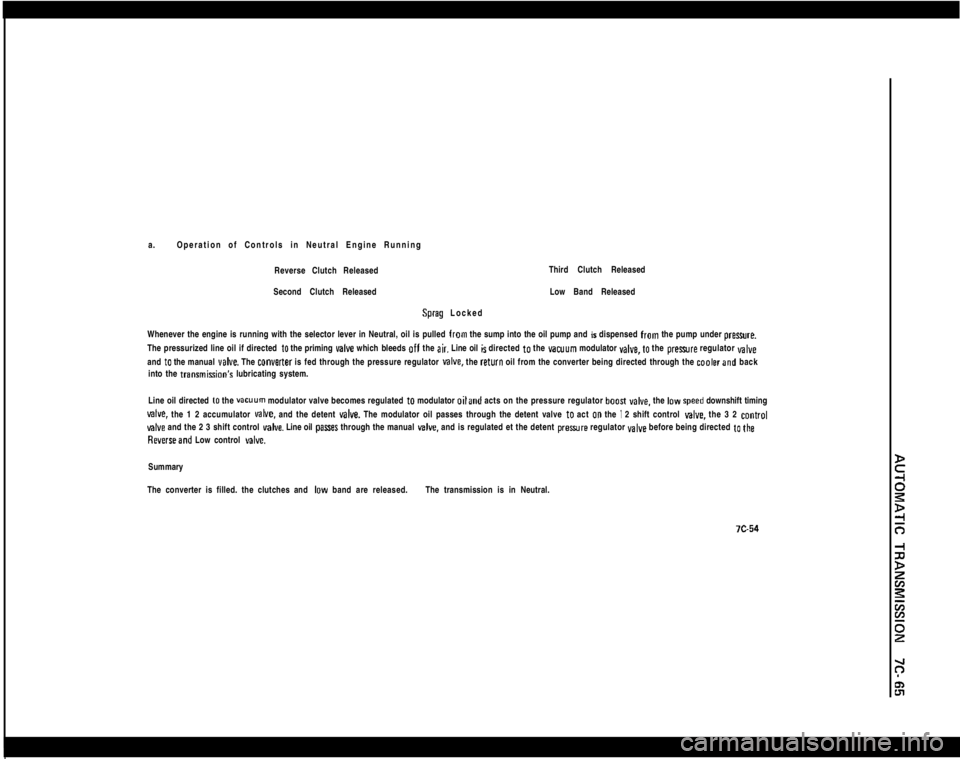
Whenever the engine is running with the selector lever in Neutral, oil is pulled from the sump into the oil pump and is dispensed from the pump under preure.
The pressurized line oil if directed
to the priming valve which bleeds off the air. Line oil is directed to the vacuum modulator YBIYB, to the prexwre regulator valveand
to the manual veIve. The converter is fed through the pressure regulator MIYB. the return oil from the converter being directed through the coalerand back
into the transmisGon’s lubricating system.
Line oil directed
to the vacuum modulator valve becomes regulated to modulator oiland acts on the pressure regulator boosI YBCB. the IDW speed downshift timing
valve. the 1 2 accumulator MIYB. and the detent valve. The modulator oil passes through the detent valve to act 00 the I 2 shift control give. the 3 2 control
valve and the 2 3 shift control valve. Line oil pasres through the manual v&e. and is regulated et the detent preaure regulator valve before being directed to the
Reverseand Low control delve.Summary
The converter is filled. the clutches and
IDW band are released.The transmission is in Neutral.
Page 442 of 625

DIAGNOSIS
SEQUENCE
1. Check and correct oil level. Refer to Specifications
for checking and refill procedures.
2. Check and correct vacuum line and fittings.
3. Check and correct manual linkage.
4. Road test car using all selective ranges, noting
when discrepancies in operation occur.
5. If engine performances indicates an engine tuneup
is required, this should be performed before road
testing is completed or transmission correction at-
tempted. Poor engine performance can result in
rough shifting or other malfunctions.
CHECKING PROCEDURESBefore diagnosis of any transmission complaint is
attempted, there must be an understanding of oil
checking procedure and what appearance the oil
should have. Many times a transmission malfunction
can be traced to low oil level, improper reading of
dipstick, or oil appearances; therefore, a careful anal-
ysis of the condition of oil and the level may elimi-
nate needless repairs.
When checking oil level in the Opel Three Speed
Automatic Transmission, the procedure outlined in
Specifications should be followed to obtain the most
accurate reading.
Also when the dipstick is removed, it should be noted
whether the oil is devoid of air bubbles or not. Oil
with air bubbles gives an indication of an air leak in
the suction lines, which can cause erractic operation
and slippage. Water in the oil imparts a milky, pink
cast to the oil and can cause spewing.
EXTERNAL OIL LEAKS
Determining source of oil leakBefore attempting to correct an oil leak, the actual
source of the leak must be determined. In many
cases, the source of the leak can be deceiving due to
“wind flow” around the engine and transmission.
The suspected area should be wiped clear of all oil
before inspecting for the source of the leak. Red dyeAUTOMATIC TRANSMISSION 7C- 81
is used in the transmission oil at the assembly plant
and will indicate if the oil leak is from the transmis-
sion.The use of a “Black Light” to locate the point at
which the oil is leaking is helpful. Comparing the oil
from the leak to that on the engine or transmission
dipstick, when viewed by Black Light, will determine
the source of the leak-engine or transmission.
Oil leaks around the engine and transmission are
generally carried toward the rear of the car by air
stream. For example, a transmission oil filler tube to
case leak will sometimes appear as a leak at the rear
of the transmission. In determining the source of a
leak, proceed as follows:
1. Degrease underside of transmission.
2. Road test to get unit at operating temperature.
3. Inspect for leak with engine running.
4. With engine off, check for oil leaks due to the
raised oil level caused by drain back.
Case Porosity RepairOpel Three-Speed Automatic Transmission external
oil leaks caused by case porosity can be successfully
repaired with the transmission in the car by using the
following recommended procedures:
1. Road test and bring the transmission to operating
temperature, approximately 180 degrees F.
2. Raise car on a hoist or jack stand, engine running,
and locate source of oil leak. Check for oil leaks in
low, drive, and reverse.
3. Shut engine off and thoroughly clean area to be
repaired with a suitable cleaning solvent and a
brush- air dry. A clean, dry soldering acid brush can
be used to clean the area and also to apply the epoxy
cement.
4. Using instructions of the manufacturer, mix a suf-
ficient amount of epoxy, BUICK Group 0.423, Part
No. 1360016, or equivalent, to make the repair. Ob-
serve cautions of manufacturer in handling.
5. While the transmission case is still HOT, apply the
epoxy to the area to be repaired. Make certain the
area to be repaired is fully covered.
6. Allow cement to cure for 3 hours before starting
engine.
7. Road test and check for leaks.
Page 443 of 625
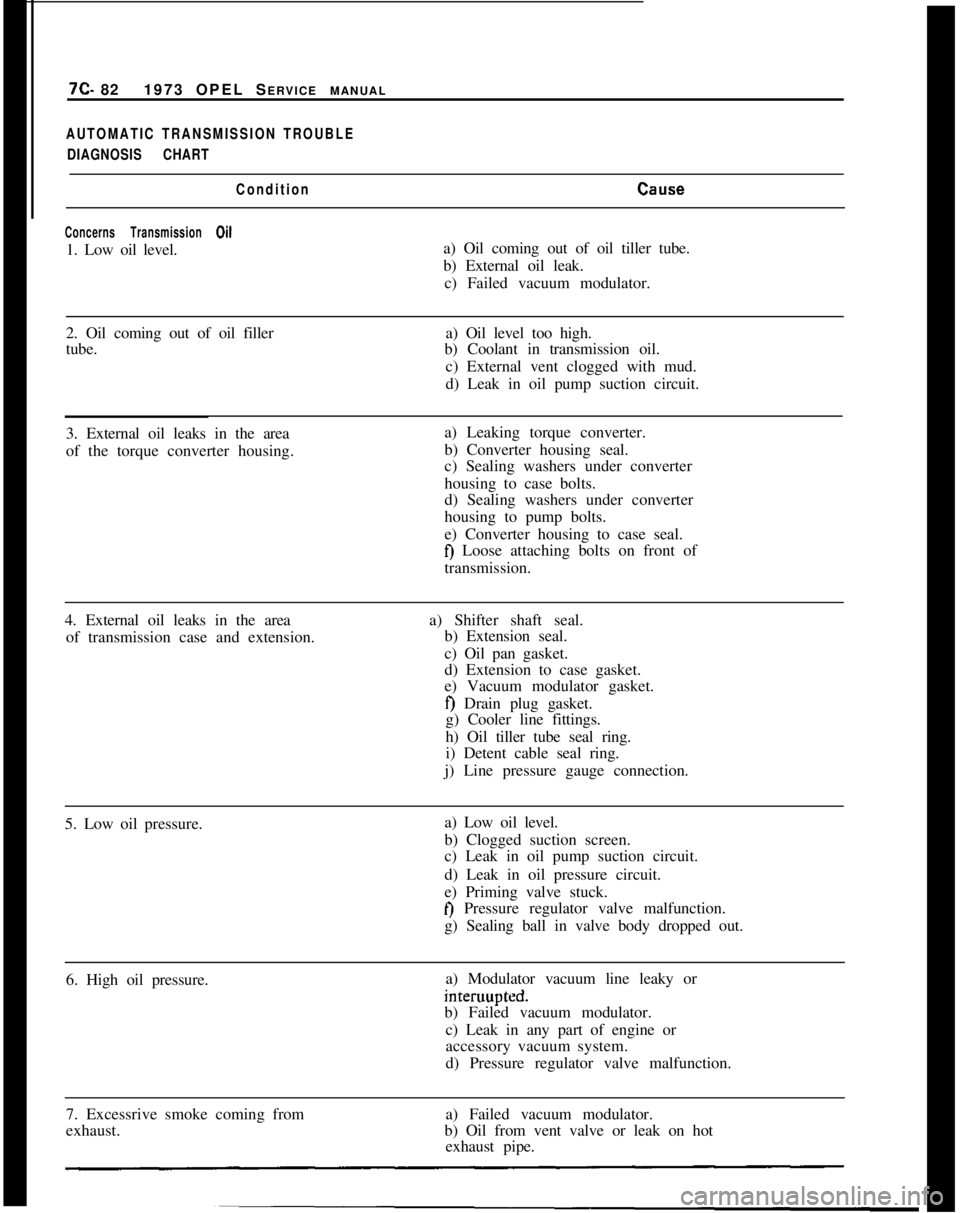
7C- 821973 OPEL SERVICE MANUALAUTOMATIC TRANSMISSION TROUBLE
DIAGNOSIS CHART
Condition
CEllE.e
Concerns Transmission Oil1. Low oil level.a) Oil coming out of oil tiller tube.
b) External oil leak.
c) Failed vacuum modulator.
2. Oil coming out of oil filler
tube.a) Oil level too high.
b) Coolant in transmission oil.
c) External vent clogged with mud.
d) Leak in oil pump suction circuit.
3. External oil leaks in the area
of the torque converter housing.a) Leaking torque converter.
b) Converter housing seal.
c) Sealing washers under converter
housing to case bolts.
d) Sealing washers under converter
housing to pump bolts.
e) Converter housing to case seal.
fj Loose attaching bolts on front of
transmission.
4. External oil leaks in the area
of transmission case and extension.a) Shifter shaft seal.
b) Extension seal.
c) Oil pan gasket.
d) Extension to case gasket.
e) Vacuum modulator gasket.
f) Drain plug gasket.
g) Cooler line fittings.
h) Oil tiller tube seal ring.
i) Detent cable seal ring.
j) Line pressure gauge connection.
5. Low oil pressure.a) Low oil level.
b) Clogged suction screen.
c) Leak in oil pump suction circuit.
d) Leak in oil pressure circuit.
e) Priming valve stuck.
t) Pressure regulator valve malfunction.
g) Sealing ball in valve body dropped out.
6. High oil pressure.a) Modulator vacuum line leaky orinteruupted.
b) Failed vacuum modulator.
c) Leak in any part of engine or
accessory vacuum system.
d) Pressure regulator valve malfunction.
7. Excessrive smoke coming from
exhaust.a) Failed vacuum modulator.
b) Oil from vent valve or leak on hot
exhaust pipe.
Page 444 of 625

AUTOMATIC TRANSMISSION 7C- 83
ConditionCause
Starting
1. No starting in any driverange.a) Low oil level.
b) Clogged suction screen.
c) Manual valve linkage or inner trans-
mission selector lever disconnected.
d) Input shaft broken.e) Pressure regulator valve stuck in open
position. -0 Failed oil pump.
2. No starting in any drive range
for a time. Driving possible only
after repeatedly moving selector
lever to and fro.Manual valve position does not coincide
with valve body channels:
a) Selector lever shaft retaining
pin dropped out.
b) Connecting rod to manual valve
shifting.
c) Selector lever shaft nut loose.
3. No starting after shifting
lever from “P” to “D”, “S”, or “L”
(inadequate engine acceleration).a) Parking
paw1 does not disengage.
4. Sudden starting only after
increase of engine RPM.a) Band servo piston jamming.
b) Low oil level.
c) Oil pump defective.
d) Oil screen missing.
e) Sealing ball in valve body dropped out
5. Heavy jerking when starting.a) Low oil pressure.
b) Wrong modulator valve.
c) Pressure regulator valve stuck.
d) Sealing ball in valve body dropped out.
6. No starting in “D” or “S”
range, but in “L” and “R” range.a) Input sprag installed backwards.
b) Input sprag failure.
7. No starting in “D” or “S” and
“L” (proper driving in “R”; see
also point 9).a) Band worn, does not grip.
b) Band servo piston jamming.
c) Excessive leak in band servo.
d) Parking
paw1 does not disengage.
Page 445 of 625
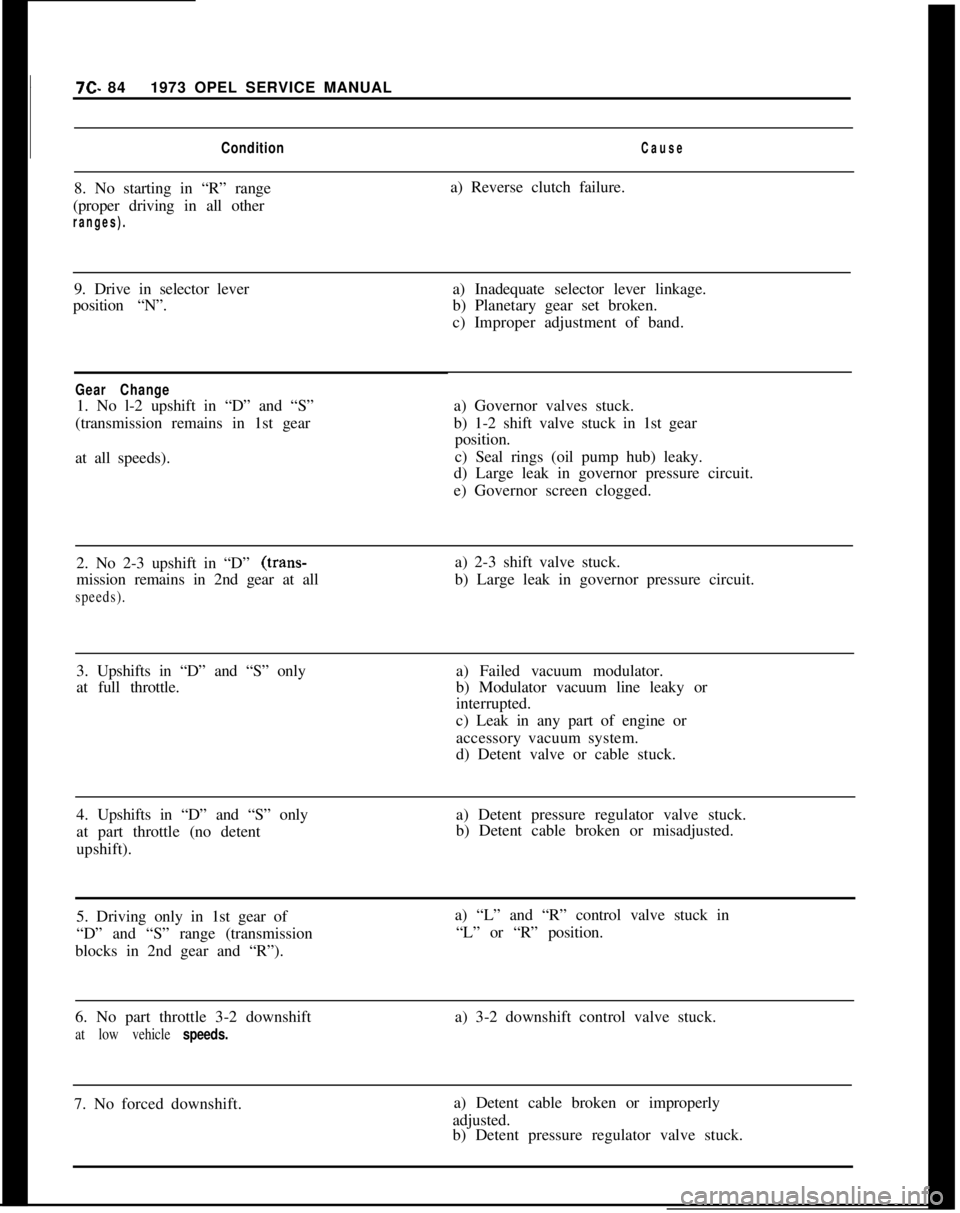
7C. 841973 OPEL SERVICE MANUALConditionCause8. No starting in “R” range
(proper driving in all other
ranges).a) Reverse clutch failure.
9. Drive in selector lever
position “N”.a) Inadequate selector lever linkage.
b) Planetary gear set broken.
c) Improper adjustment of band.
Gear Change1. No l-2 upshift in “D” and “S”
(transmission remains in 1st gear
at all speeds).a) Governor valves stuck.
b) 1-2 shift valve stuck in 1st gear
position.
c) Seal rings (oil pump hub) leaky.
d) Large leak in governor pressure circuit.
e) Governor screen clogged.
2. No 2-3 upshift in “D” (trans-
mission remains in 2nd gear at all
speeds).a) 2-3 shift valve stuck.
b) Large leak in governor pressure circuit.
3. Upshifts in “D” and “S” only
at full throttle.a) Failed vacuum modulator.
b) Modulator vacuum line leaky or
interrupted.
c) Leak in any part of engine or
accessory vacuum system.
d) Detent valve or cable stuck.
4. Upshifts in “D” and “S” only
at part throttle (no detent
upshift).a) Detent pressure regulator valve stuck.
b) Detent cable broken or misadjusted.
5. Driving only in 1st gear of
“D” and “S” range (transmission
blocks in 2nd gear and “R”).a) “L” and “R” control valve stuck in
“L” or “R” position.
6. No part throttle 3-2 downshift
at low vehicle speeds.a) 3-2 downshift control valve stuck.
7. No forced downshift.a) Detent cable broken or improperly
adjusted.
b) Detent pressure regulator valve stuck.