engine oil OPEL 1900 1973 Manual PDF
[x] Cancel search | Manufacturer: OPEL, Model Year: 1973, Model line: 1900, Model: OPEL 1900 1973Pages: 625, PDF Size: 17.22 MB
Page 446 of 625
AlITOMATIC TRANSMISSION 7C- 85
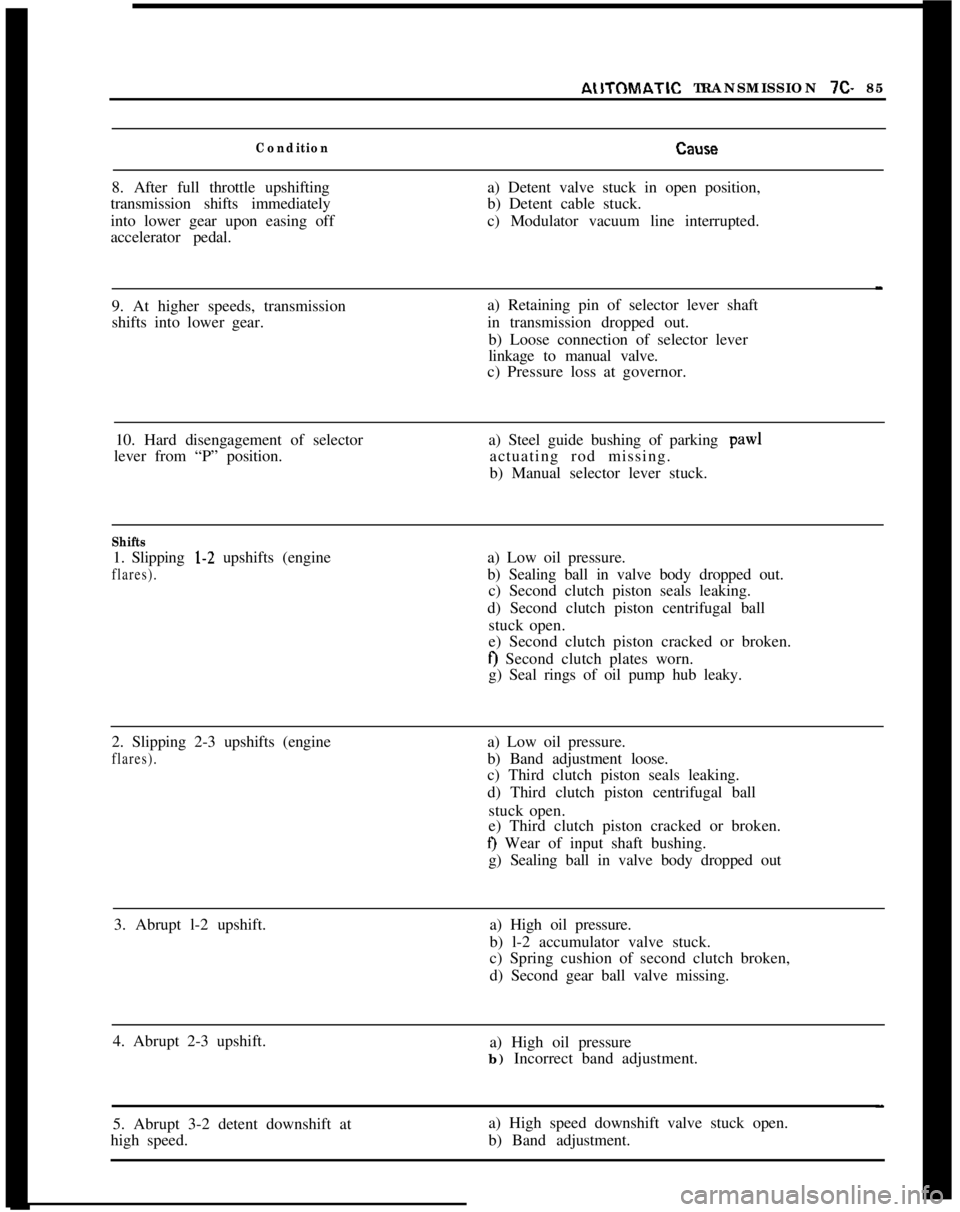
ConditionCtSlSl?8. After full throttle upshifting
transmission shifts immediately
into lower gear upon easing off
accelerator pedal.a) Detent valve stuck in open position,
b) Detent cable stuck.
c) Modulator vacuum line interrupted.
9. At higher speeds, transmission
shifts into lower gear.a) Retaining pin of selector lever shaft
in transmission dropped out.
b) Loose connection of selector lever
linkage to manual valve.
c) Pressure loss at governor.
10. Hard disengagement of selector
lever from “P” position.a) Steel guide bushing of parking
paw1actuating rod missing.
b) Manual selector lever stuck.
Shifts1. Slipping l-2 upshifts (engine
flares).a) Low oil pressure.
b) Sealing ball in valve body dropped out.
c) Second clutch piston seals leaking.
d) Second clutch piston centrifugal ball
stuck open.
e) Second clutch piston cracked or broken.
f) Second clutch plates worn.
g) Seal rings of oil pump hub leaky.
2. Slipping 2-3 upshifts (engine
flares).a) Low oil pressure.
b) Band adjustment loose.
c) Third clutch piston seals leaking.
d) Third clutch piston centrifugal ball
stuck open.
e) Third clutch piston cracked or broken.
f) Wear of input shaft bushing.
g) Sealing ball in valve body dropped out
3. Abrupt l-2 upshift.a) High oil pressure.
b) l-2 accumulator valve stuck.
c) Spring cushion of second clutch broken,
d) Second gear ball valve missing.
4. Abrupt 2-3 upshift.
a) High oil pressure
b) Incorrect band adjustment.
5. Abrupt 3-2 detent downshift at
high speed.a) High speed downshift valve stuck open.
b) Band adjustment.
Page 447 of 625
7C- 881973 OPEL SERVICE MANUAL
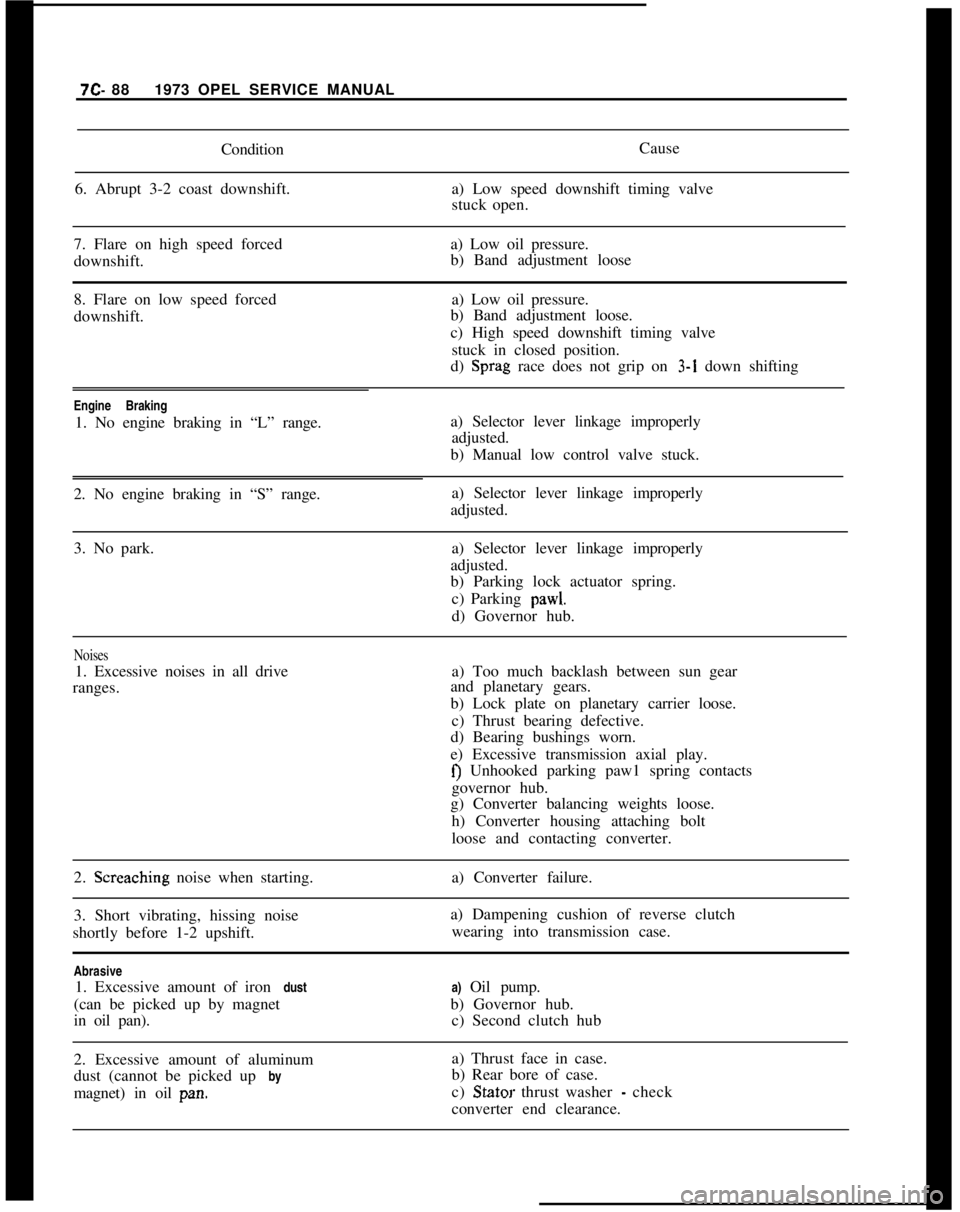
Condition
6. Abrupt 3-2 coast downshift.Cause
a) Low speed downshift timing valve
stuck open.
7. Flare on high speed forceda) Low oil pressure.
downshift.b) Band adjustment loose
8. Flare on low speed forced
downshift.a) Low oil pressure.
b) Band adjustment loose.
c) High speed downshift timing valve
stuck in closed position.
d) Sprag race does not grip on 3-1 down shifting
Engine Braking
1. No engine braking in “L” range.a) Selector lever linkage improperly
adjusted.
b) Manual low control valve stuck.
2. No engine braking in “S” range.a) Selector lever linkage improperly
adjusted.
3. No park.a) Selector lever linkage improperly
adjusted.
b) Parking lock actuator spring.
c) Parking pawl.
d) Governor hub.
Noises1. Excessive noises in all drive
ranges.a) Too much backlash between sun gear
and planetary gears.
b) Lock plate on planetary carrier loose.
c) Thrust bearing defective.
d) Bearing bushings worn.
e) Excessive transmission axial play.
f) Unhooked parking paw1 spring contacts
governor hub.
g) Converter balancing weights loose.
h) Converter housing attaching bolt
loose and contacting converter.
2. Screaching noise when starting.
3. Short vibrating, hissing noise
shortly before 1-2 upshift.a) Converter failure.
a) Dampening cushion of reverse clutch
wearing into transmission case.
Abrasive
1. Excessive amount of iron dust
(can be picked up by magnet
in oil pan).a) Oil pump.
b) Governor hub.
c) Second clutch hub
2. Excessive amount of aluminum
dust (cannot be picked up by
magnet) in oil pan.a) Thrust face in case.
b) Rear bore of case.
c) Stator thrust washer
- check
converter end clearance.
Page 455 of 625
7C. 941973 OPEL SERVICE MANUAL
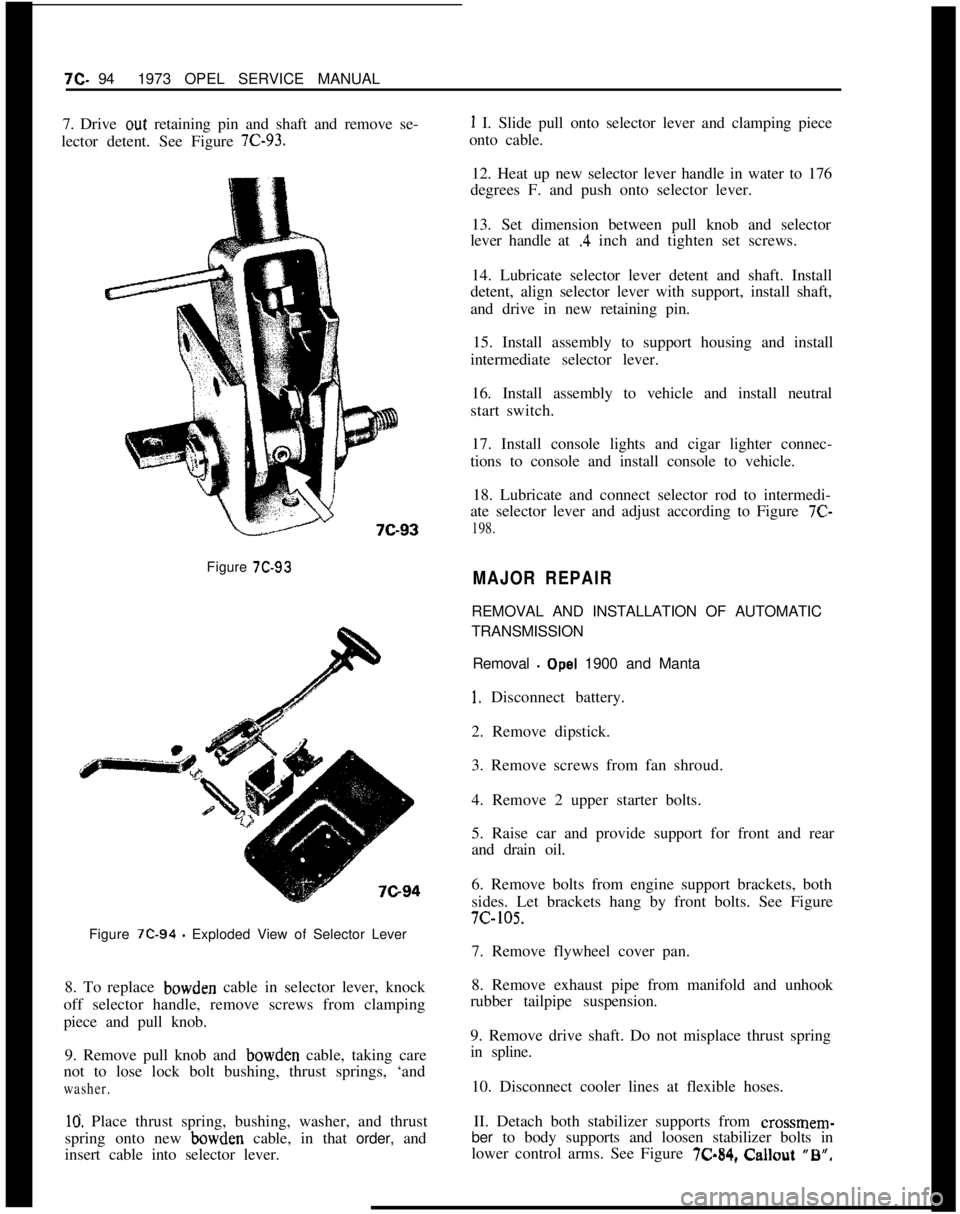
7. Drive out retaining pin and shaft and remove se-
lector detent. See Figure 7C-93.Figure
7C-93Figure
7C-94 - Exploded View of Selector Lever
8. To replace bowden cable in selector lever, knock
off selector handle, remove screws from clamping
piece and pull knob.
9. Remove pull knob and bowden cable, taking care
not to lose lock bolt bushing, thrust springs, ‘and
washer.
10. Place thrust spring, bushing, washer, and thrust
spring onto new bowden cable, in that order, and
insert cable into selector lever.
1 I. Slide pull onto selector lever and clamping piece
onto cable.
12. Heat up new selector lever handle in water to 176
degrees F. and push onto selector lever.
13. Set dimension between pull knob and selector
lever handle at
.4 inch and tighten set screws.
14. Lubricate selector lever detent and shaft. Install
detent, align selector lever with support, install shaft,
and drive in new retaining pin.
15. Install assembly to support housing and install
intermediate selector lever.
16. Install assembly to vehicle and install neutral
start switch.
17. Install console lights and cigar lighter connec-
tions to console and install console to vehicle.
18. Lubricate and connect selector rod to intermedi-
ate selector lever and adjust according to Figure 7C-
198.
MAJOR REPAIRREMOVAL AND INSTALLATION OF AUTOMATIC
TRANSMISSION
Removal
- Opel 1900 and Manta
I. Disconnect battery.
2. Remove dipstick.
3. Remove screws from fan shroud.
4. Remove 2 upper starter bolts.
5. Raise car and provide support for front and rear
and drain oil.
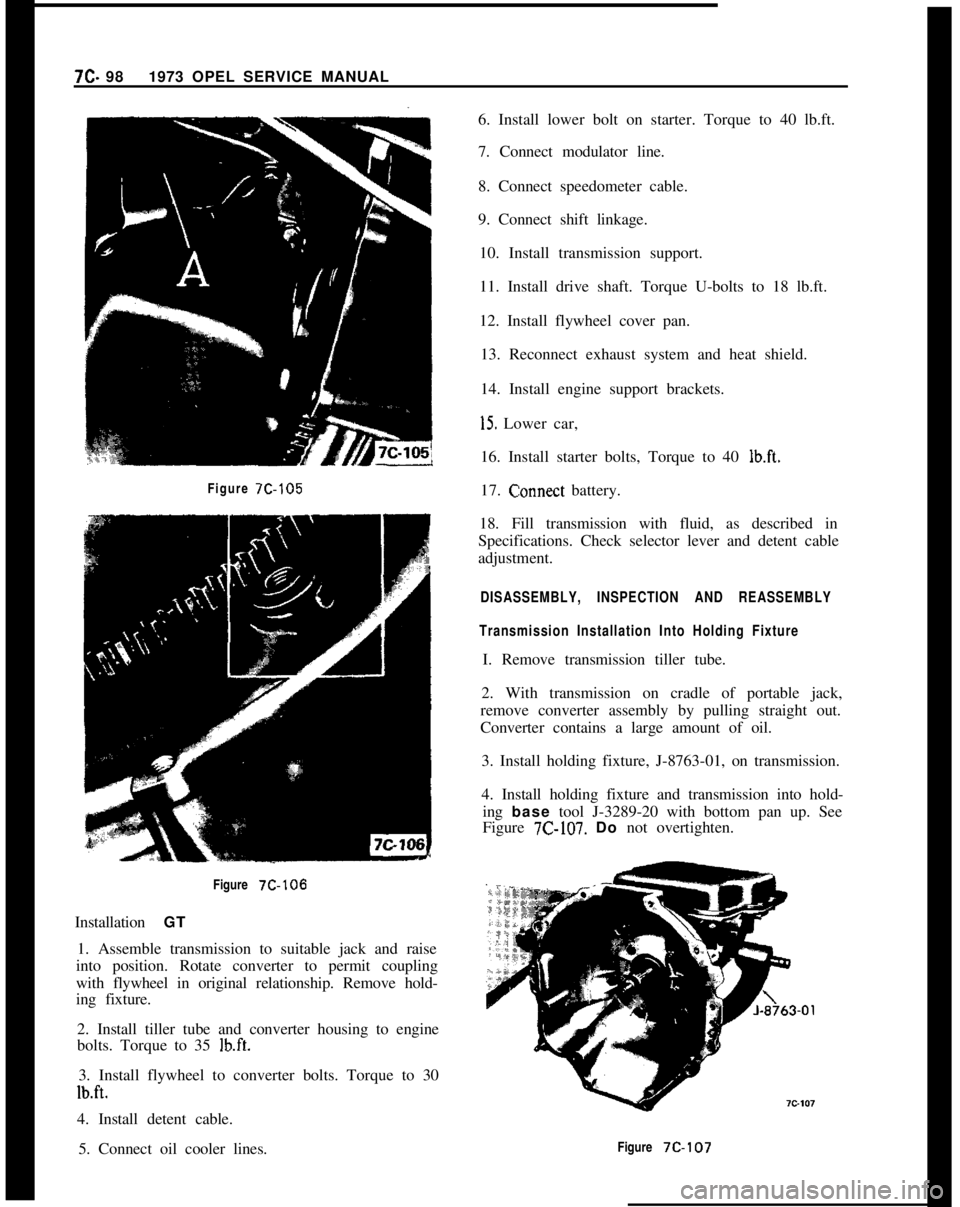
6. Remove bolts from engine support brackets, both
sides. Let brackets hang by front bolts. See Figure7c-105.
7. Remove flywheel cover pan.
8. Remove exhaust pipe from manifold and unhook
rubber tailpipe suspension.
9. Remove drive shaft. Do not misplace thrust spring
in spline.
10. Disconnect cooler lines at flexible hoses.
II. Detach both stabilizer supports from
crossmem-ber to body supports and loosen stabilizer bolts in
lower control arms. See Figure X-84, Callout “B”,
Page 456 of 625
AUTOMATIC TRANSMISSION 7C- 95
12. Place suitable jack under transmission and
remove transmission support bolts.
13. Lower transmission enough to remove detent
cable and modulator vacuum line.
14. Remove speedometer cable.
15. Remove selector lever.
16. Mark flywheel and converter for reassembly in
same position, and remove converter to flywheel
bolts. See Figure 7C-106.17. Remove converter housing to engine bolts and
tiller tube.
18. Pry transmission loose from engine.
19. Keep rear of transmission lower than front to
prevent converter from falling and install converter
holding fixture J-21366. Lower transmission and
move to bench.
Installation. Opel 1900 and Manta1. Assemble transmission to suitable jack and raise
transmission into position. Rotate converter to per-
mit coupling of fly wheel and converter with original
relationship. Remove J-21366.
2. Install tiller tube and converter housing to engine
block bolts. Torque to 35 lb. ft. DO NOT over
torque.
3. Install flywheel to converter bolts. Torque to 30 lb.
ft.4. Install detent cable to transmission.
5. Connect oil cooler lines.
6. Install lower bolt on starter. Torque to 40 lb. ft.
7. Connect shift linkage to transmission.
8. Connect modulator line.
9. Connect speedometer cable.
10. Install transmission support.
11. Install drive shaft. Torque U-Bolts to 18 lb. ft.
12. Install flywheel cover pan. Torque to 15 lb. ft.
13. Install engine support brackets.
14. Reconnect exhaust system.15. Attach stabilizer supports and tighten stabilizer
bolts in lower control arms.
16. Lower car.
17. Install starter bolts. Torque to 40 lb. ft.
18. Reconnect battery.
19. Fill transmission with fluid as described in
Specifications. Check selector lever and detent cable
adjustment.
Removal GT1. Disconnect battery.
2. Remove dipstick.
3. Pull throttle control rod off ball pin.
4. Remove screws from fan shroud.
5. Raise car and provide support for front and rear.
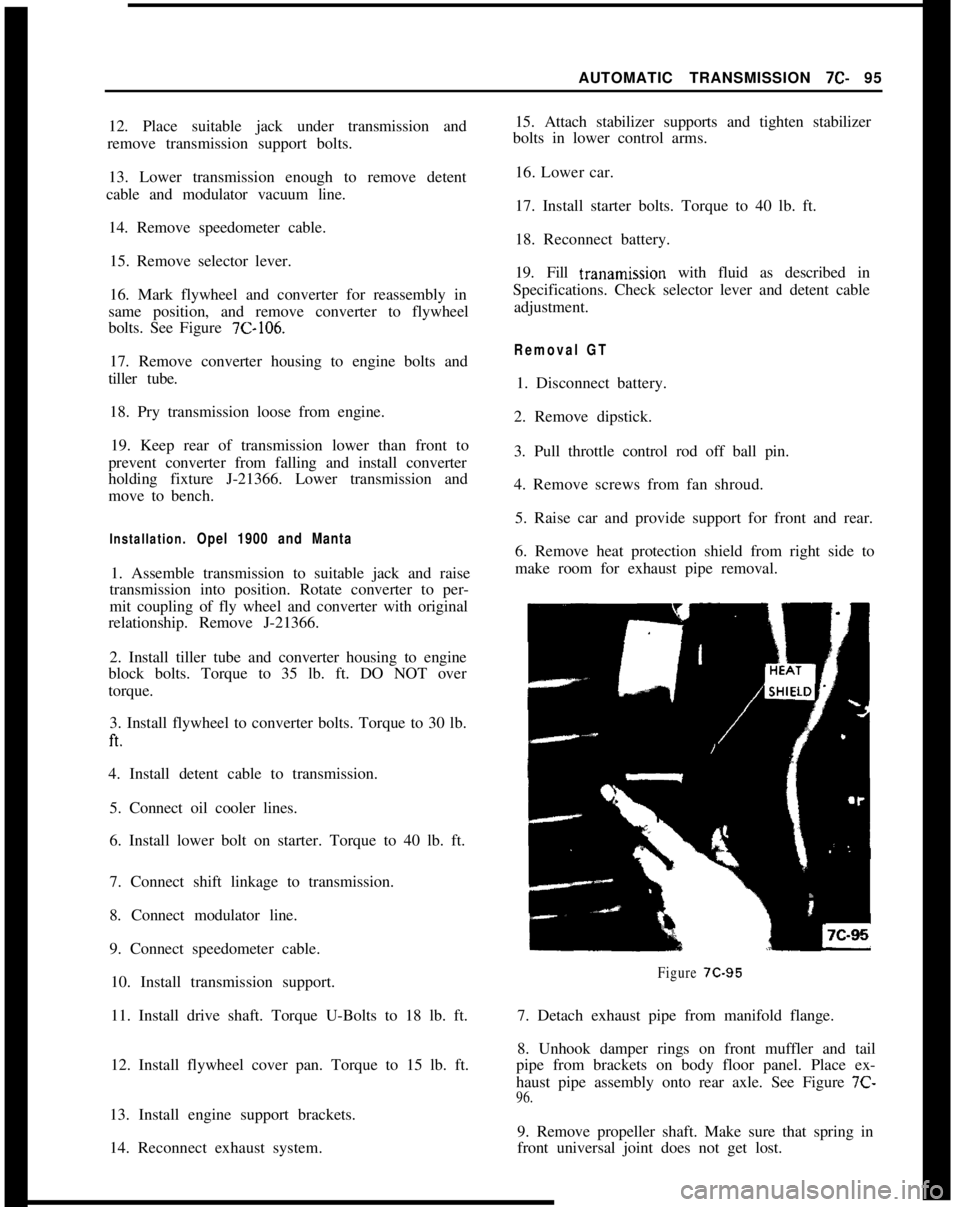
6. Remove heat protection shield from right side to
make room for exhaust pipe removal.
Figure 7C-957. Detach exhaust pipe from manifold flange.
8. Unhook damper rings on front muffler and tail
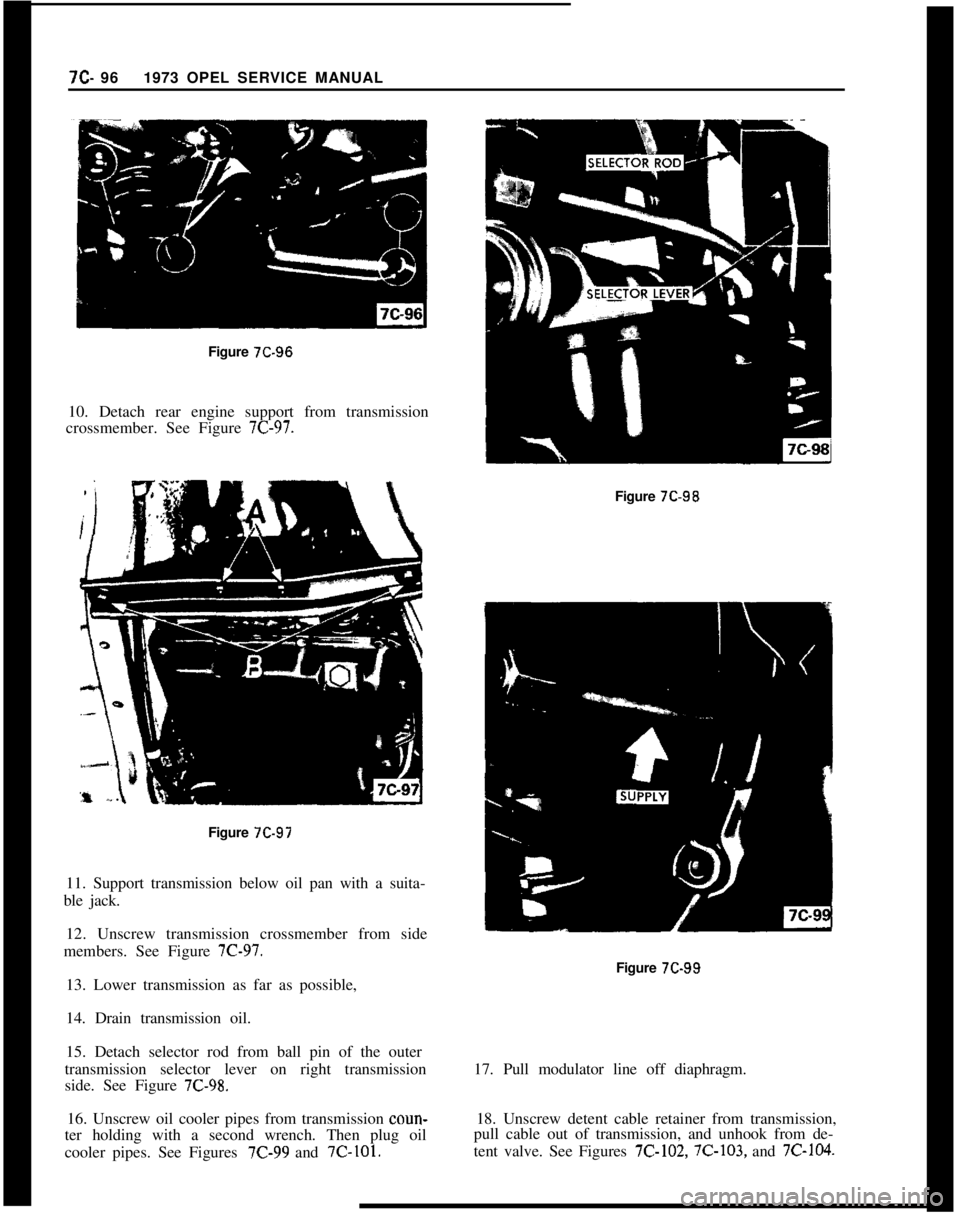
pipe from brackets on body floor panel. Place ex-
haust pipe assembly onto rear axle. See Figure 7C-
96.9. Remove propeller shaft. Make sure that spring in
front universal joint does not get lost.
Page 457 of 625
7C- 961973 OPEL SERVICE MANUAL
Figure 7C-96
10. Detach rear engine support from transmission
crossmember. See Figure 7C-97.Figure 7C-98
Figure
7C-9711. Support transmission below oil pan with a suita-
ble jack.
12. Unscrew transmission crossmember from side
members. See Figure
7C-97.13. Lower transmission as far as possible,
14. Drain transmission oil.
15. Detach selector rod from ball pin of the outer
transmission selector lever on right transmission
side. See Figure
7C-98.16. Unscrew oil cooler pipes from transmission cow-
ter holding with a second wrench. Then plug oil
cooler pipes. See Figures 7C-99 and
7C-101.Figure 7C-99
17. Pull modulator line off diaphragm.
18. Unscrew detent cable retainer from transmission,
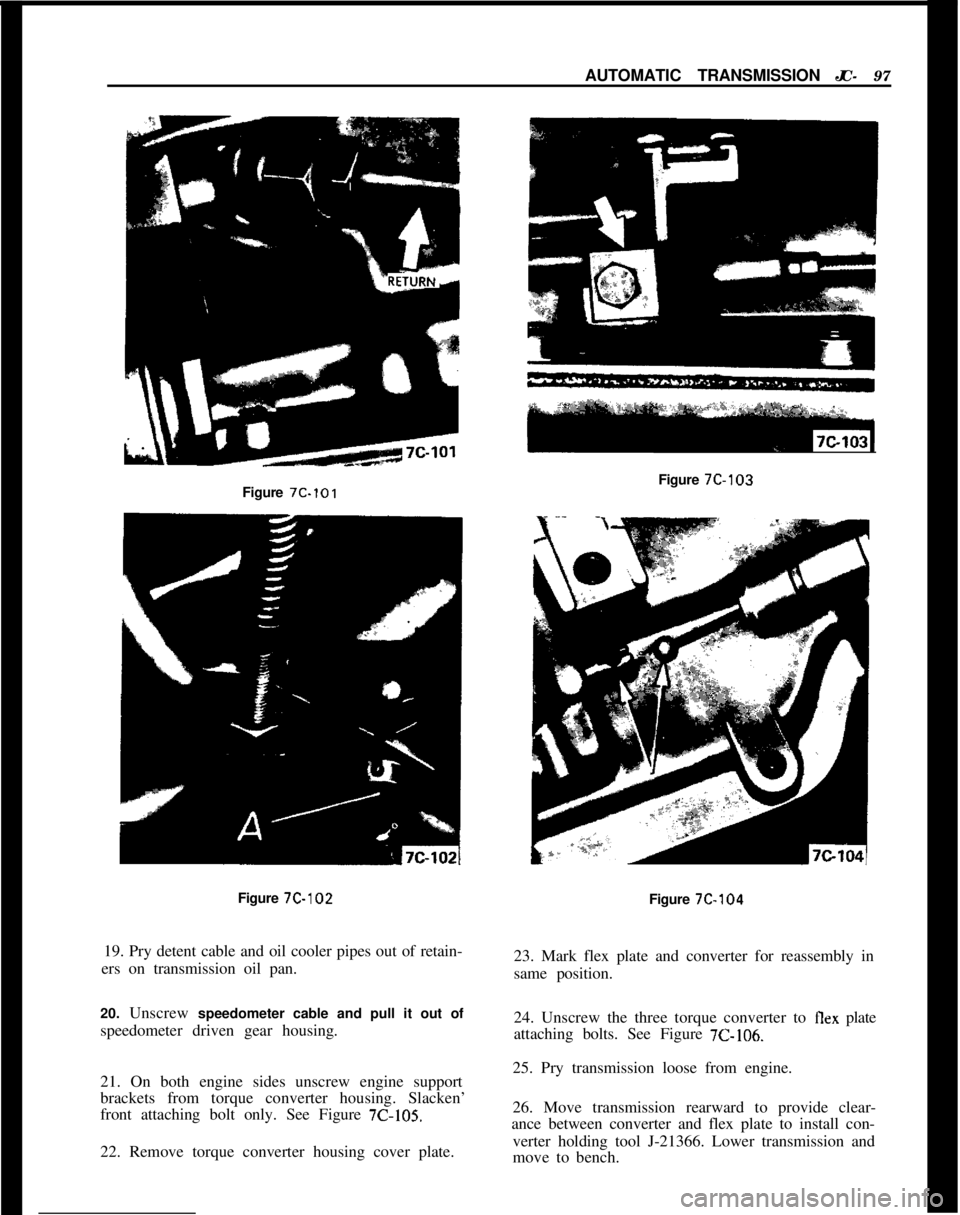
pull cable out of transmission, and unhook from de-
tent valve. See Figures 7C-102, 7C-103, and 7C-104.
Page 458 of 625
AUTOMATIC TRANSMISSION JC- 97
Figure 7C-101Figure 7C-103
Figure 7C-102
19. Pry detent cable and oil cooler pipes out of retain-
ers on transmission oil pan.
20. Unscrew speedometer cable and pull it out of
speedometer driven gear housing.
21. On both engine sides unscrew engine support
brackets from torque converter housing. Slacken’
front attaching bolt only. See Figure
7C-105.22. Remove torque converter housing cover plate.Figure 7C-104
23. Mark flex plate and converter for reassembly in
same position.
24. Unscrew the three torque converter to
flex plate
attaching bolts. See Figure
7C-106.25. Pry transmission loose from engine.
26. Move transmission rearward to provide clear-
ance between converter and flex plate to install con-
verter holding tool J-21366. Lower transmission and
move to bench.
Page 459 of 625
7C- 981973 OPEL SERVICE MANUAL
Figure 7C-105Figure
7C-106Installation GT
1. Assemble transmission to suitable jack and raise
into position. Rotate converter to permit coupling
with flywheel in original relationship. Remove hold-
ing fixture.
2. Install tiller tube and converter housing to engine
bolts. Torque to 35
lb.ft.3. Install flywheel to converter bolts. Torque to 30
lb.ft.4. Install detent cable.
5. Connect oil cooler lines.6. Install lower bolt on starter. Torque to 40 lb.ft.
7. Connect modulator line.
8. Connect speedometer cable.
9. Connect shift linkage.
10. Install transmission support.
11. Install drive shaft. Torque U-bolts to 18 lb.ft.
12. Install flywheel cover pan.
13. Reconnect exhaust system and heat shield.
14. Install engine support brackets.
15. Lower car,
16. Install starter bolts, Torque to 40
lb.ft.17.
C:onnect battery.
18. Fill transmission with fluid, as described in
Specifications. Check selector lever and detent cable
adjustment.
DISASSEMBLY, INSPECTION AND REASSEMBLY
Transmission Installation Into Holding FixtureI. Remove transmission tiller tube.
2. With transmission on cradle of portable jack,
remove converter assembly by pulling straight out.
Converter contains a large amount of oil.
3. Install holding fixture, J-8763-01, on transmission.
4. Install holding fixture and transmission into hold-
ing base tool J-3289-20 with bottom pan up. See
Figure
7C-107. Do not overtighten.
Figure
7C-107
Page 495 of 625
7C-1341973 OPEL SERVICE MANUAL
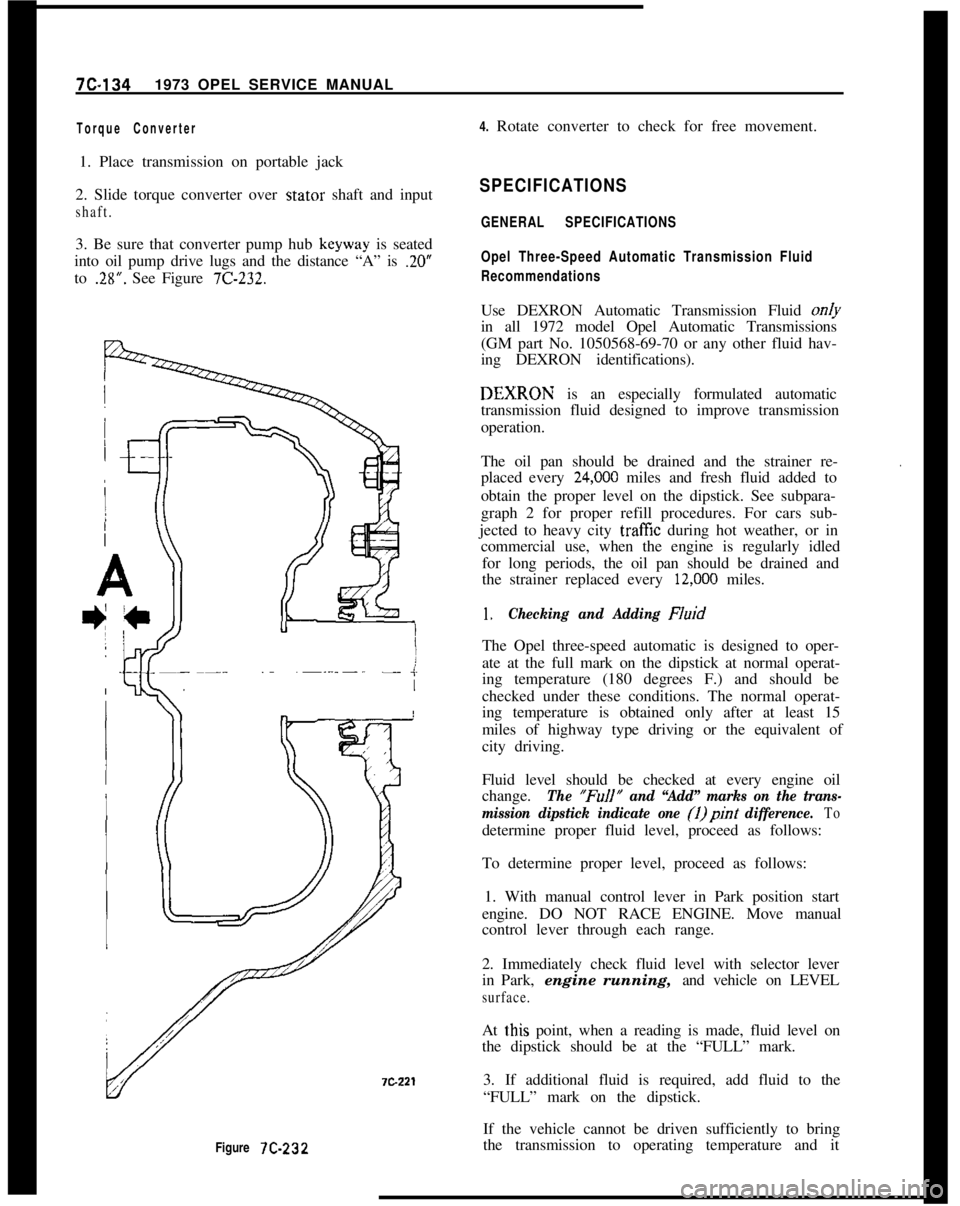
Figure 7C-232
Torque Converter4. Rotate converter to check for free movement.
1. Place transmission on portable jack
2. Slide torque converter over stator shaft and input
shaft.3. Be sure that converter pump hub keyway is seated
into oil pump drive lugs and the distance “A” is
.20”to
.28”. See Figure 7C-232.
SPECIFICATIONS
GENERAL SPECIFICATIONS
Opel Three-Speed Automatic Transmission Fluid
RecommendationsUse DEXRON Automatic Transmission Fluid on/y
in all 1972 model Opel Automatic Transmissions
(GM part No. 1050568-69-70 or any other fluid hav-
ing DEXRON identifications).DEXIRON is an especially formulated automatic
transmission fluid designed to improve transmission
operation.
The oil pan should be drained and the strainer re-
placed every
24,ooO miles and fresh fluid added to
obtain the proper level on the dipstick. See subpara-
graph 2 for proper refill procedures. For cars sub-
jected to heavy city
traff%z during hot weather, or in
commercial use, when the engine is regularly idled
for long periods, the oil pan should be drained and
the strainer replaced every
12,ooO miles.
.
1.Checking and Adding FluidThe Opel three-speed automatic is designed to oper-
ate at the full mark on the dipstick at normal operat-
ing temperature (180 degrees F.) and should be
checked under these conditions. The normal operat-
ing temperature is obtained only after at least 15
miles of highway type driving or the equivalent of
city driving.
Fluid level should be checked at every engine oil
change.
The “FuIl” and “Add” marks on the trans-
mission dipstick indicate one (1)pint
difference. Todetermine proper fluid level, proceed as follows:
To determine proper level, proceed as follows:
1. With manual control lever in Park position start
engine. DO NOT RACE ENGINE. Move manual
control lever through each range.
2. Immediately check fluid level with selector lever
in Park, engine running, and vehicle on LEVEL
surface.At
t,his point, when a reading is made, fluid level on
the dipstick should be at the “FULL” mark.
3. If additional fluid is required, add fluid to the
“FULL” mark on the dipstick.
If the vehicle cannot be driven sufficiently to bring
the transmission to operating temperature and it
Page 496 of 625
AUTOMATIC TRANSMISSION 7C-135
becomes necessary to check the fluid level, the trans-
mission may be checked at room temperature (70
degrees F.) as follows:
1. With manual control lever in Park position start
engine. DO NOT RACE ENGINE. Move manual
control lever through each range.
2. lmmediately check fluid level with selector lever
in Park, engine running, and vehicle on LEVEL sur-
face.At this point, when a reading is made, fluid level on
the dipstick should be I/4” below the “ADD” mark.
3. If additional fluid is required add fluid to bring
level to
l/4” below the “ADD” mark on the dip-
stick.If transmission fluid level is correctly established at
70 degrees F. it will appear at the “FULL” mark on
the dipstick when the transmission reaches normal
operating temperature (180 degrees F.) The fluid
level is set
l/4” below the “ADD” mark on the
dipstick to allow for expansion of the fluid which
occurs as transmission temperatures rise to normal
operating temperature of 180 degrees F.
Do not overfill, as foaming and loss of fluid through
the vent pipe might occur as fluid heats up. If fluid
is too low especially when cold, complete loss
of’drive may result which can cause transmission fail-
ure.
2.Draining oilpan and rep/a&g strainer assembly.
(a) Raise car on hoist or p/ace OnJxk stands, and
provide container to collect draining fluid.
(b) Remove oil pan and gasket. Discard gasket.
(c) Drain fluid from oil pan. Clean pan with solvent
and dry thoroughly with clean compressed air.
(d) Remove strainer assembly, strainer gasket and
discard.
(e) Install new oil strainer gasket. Install new strainer
assembly.
(f) Install new gasket on oil pan and install pan.
Tighten attaching bolts to 7-10 lb. ft.
(g) Lower car and add approximately three (3) pints
of transmission fluid through filler tube.
(h) With manual control lever in Park position, start
engine. DO NOT RACE ENGINE. Move manual
control lever through each range.
(i) Immediately check fluid level with selector leverin Park, engine running, and vehicle on LEVEL
sur-
face.(i) Add additional fluid to bring level to
l/4” below
the “ADD” mark on the dipstick. Do not overfill.
3.Adding Fluid to Fill Dry Transmission and Con-
verter Assembly
The fluid capacity of the Opel Three Speed Auto-
matic transmission and converter assembly is ap-
proximately IO-l/2 pints, but correct level is
determined by the mark on the dipstick rather than
by amount added. In cases of transmission overhaul,
when a complete fill is required, including a new
converter proceed as follows:
(a) Add approximately 10-l/2 pints of transmission
fluid through tiller tube.
The converter should be replaced on any major fail-
ure, such as a clutch or gearset, and an excessive
amount of foreign material is indicated in the pan. If
installation of a new converter is not required add
approximately five (5) pints of transmission fluid.
(b) With manual control lever in Park position start
engine and run at 1000 RPM. DO NOT RACE EN-
GINE. Move manual control lever through each
range.
(c) Immediately check fluid level with selector lever
in Park, engine running, and vehicle on LEVEL
sur-
face.(d) Add additional fluid to bring level to
l/4” below
the “ADD” mark on the dipstick. Do not overfill.
Opel Three Speed Automatic Transmission Towing
Instructions
If an Opel equipped with an automatic transmission
must be towed, the following precautions must be
observed:
The car may be towed safely on its rear wheels with
the shift lever in neutral position at speeds of 35 miles
per hour or less under most conditions.
However, the drive shaft must be disconnected or the
car towed on its front wheels if:
a. Tow speeds in excess of 35 mph are necessary.
b. Car must be towed for extended distances (over 50
miles).
c. Transmission is not operating properly.
If car is towed on its front wheels, the steering wheel
Page 497 of 625

7C-1361973 OPEL SERVICE MANUALshould be secured to keep the front wheels in a
straight-ahead position.sand,. mud, or snow, move the selector lever from
“D” to “R” in a repeat pattern while simultaneously
applying moderate pressure to the accelerator. DoRocking Carnot race engine. Avoid spinning wheels when trying
If it becomes necessary to rock the car to free it fromto free the car.
Model DesignationsTrans.
converterReverse Clutch
ModelAssemblyPlates Required2nd Gear
Clutch3rd Gear Clutch
Plates Required
Plates RequiredOpel
1900
OG
GT
CIHInformation
Drive
(Composition Faced:
Drive3Drive3
Green
(Composition
Faced)(CompositionFaced)
Dot ofDriven (Steel)4Driven (Steel) 4
Driven (Steel) 4
PaintWaved1Waved1Waved.1Pressure1Pressure1Pressure1-.
Bolt Torque Specifications
Location
Oil Pan to Case......................................................................Transfer Plate to Valve Body............................................
ReinforcementPlatetoCase..............................................
ValveBodytoCase..............................................................
ServoCovertoCase............................................................
Modulator Assembly............................................................
ConverterHousingtoOilPump........................................
Converter Housing to Case................................................
Selector Lever Jam Nut......................................................
Governor Body to Governor..............................................
ExtensionHousing to Case................................................
Servo AdjustingBolt Lock Nut..........................................
Planetary Carrier Lock Plate..............................................
OilPressureCheckPlug......................................................
Flex Plate to Crankshaft......................................................
Converter to Flex Plate........................................................
ConverterHousingtoCylinderBlock..............................
intermediate Selector Lever to Console
Selector Lever Shaft........................................................
Rear Engine Support to Transmission
CaseExtension..................................................................
Outer Transmission Selector Lever to
TransmissionSelectorLeverShaft..............................
Oil Cooler Line Connector..................................................
Oil Cooler Line to Connector............................................
Oil Cooler Line to Oil Cooler Hose..................................
Oil Cooler Hose to Oil Cooler............................................
Torque
Lb.Ft.7-10
6-8
13.15
13.1516-1812.15
13.17
22.26
8-l 1
6-8
20.30
12.15
20.35
5-736.5
138.42
38.42
Thread
Size
5/16-18
l/6-20
5/16-18
5/16-18
5/16-18
5/16-18
5/16-18
l/4-20
3/8-l 6
18.20
18.22
13.1610-13
1 l-15
1 l-15
11.15