oil OPEL AGILA 2009 User Guide
[x] Cancel search | Manufacturer: OPEL, Model Year: 2009, Model line: AGILA, Model: OPEL AGILA 2009Pages: 153, PDF Size: 1.82 MB
Page 104 of 153
10-4 Vehicle care
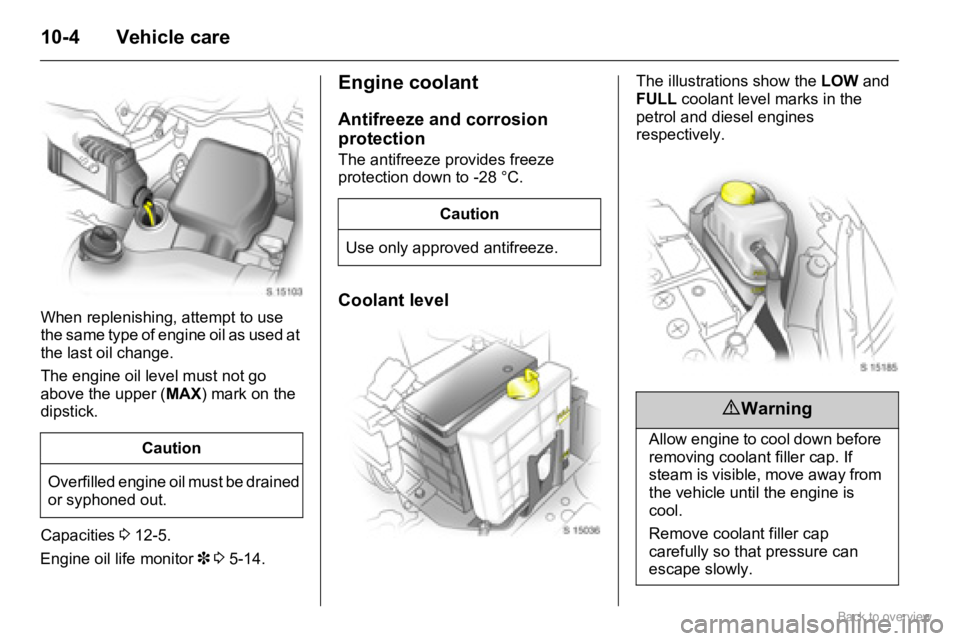
When replenishing, attempt to use
the same type of engine oil as used at
the last oil change.
The engine oil level must not go
above the upper (MAX) mark on the
dipstick.
Capacities 3 12-5.
Engine oil life monitor 3 3 5-14.
Engine coolant
Antifreeze and corrosion
protection
The antifreeze provides freeze
protection down to -28 °C.
Coolant level
The illustrations show the LOW and
FULL coolant level marks in the
petrol and diesel engines
respectively.
Caution
Overfilled engine oil must be drained
or syphoned out.
Caution
Use only approved antifreeze.
9 Warning
Allow engine to cool down before
removing coolant filler cap. If
steam is visible, move away from
the vehicle until the engine is
cool.
Remove coolant filler cap
carefully so that pressure can
escape slowly.
Page 113 of 153
10-13Vehicle care
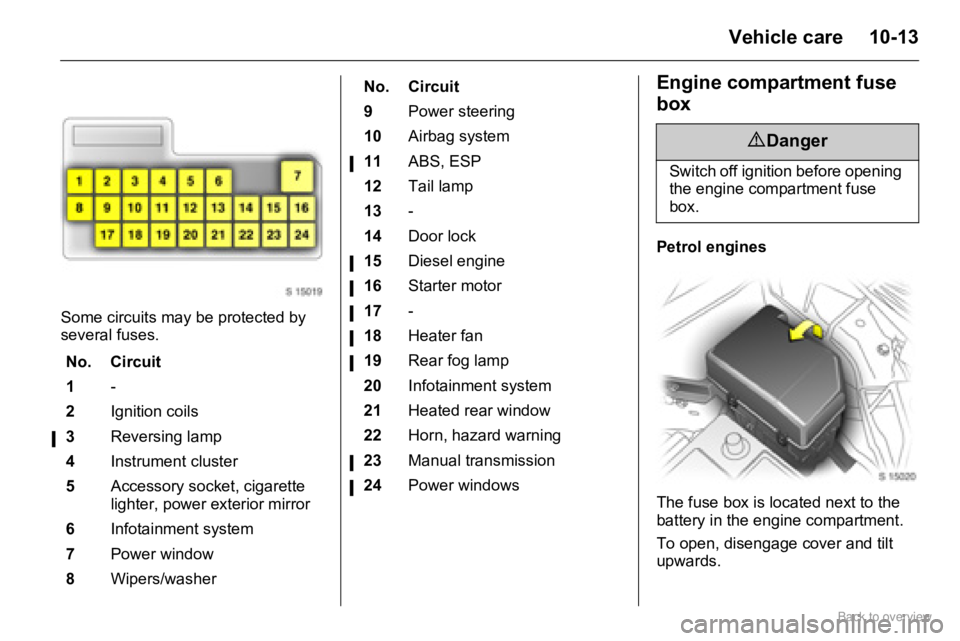
Some circuits may be protected by
several fuses.
Engine compartment fuse
box
Petrol engines
The fuse box is located next to the
battery in the engine compartment.
To open, disengage cover and tilt
upwards. No. Circuit
1-
2Ignition coils
3Reversing lamp
4Instrument cluster
5Accessory socket, cigarette
lighter, power exterior mirror
6Infotainment system
7Power window
8Wipers/washer
9Power steering
10Airbag system
11ABS, ESP
12Tail lamp
13-
14Door lock
15Diesel engine
16Starter motor
17-
18Heater fan
19Rear fog lamp
20Infotainment system
21Heated rear window
22Horn, hazard warning
23Manual transmission
24Power windows No. Circuit
9 Danger
Switch off ignition before opening
the engine compartment fuse
box.
Page 123 of 153
10-23Vehicle care
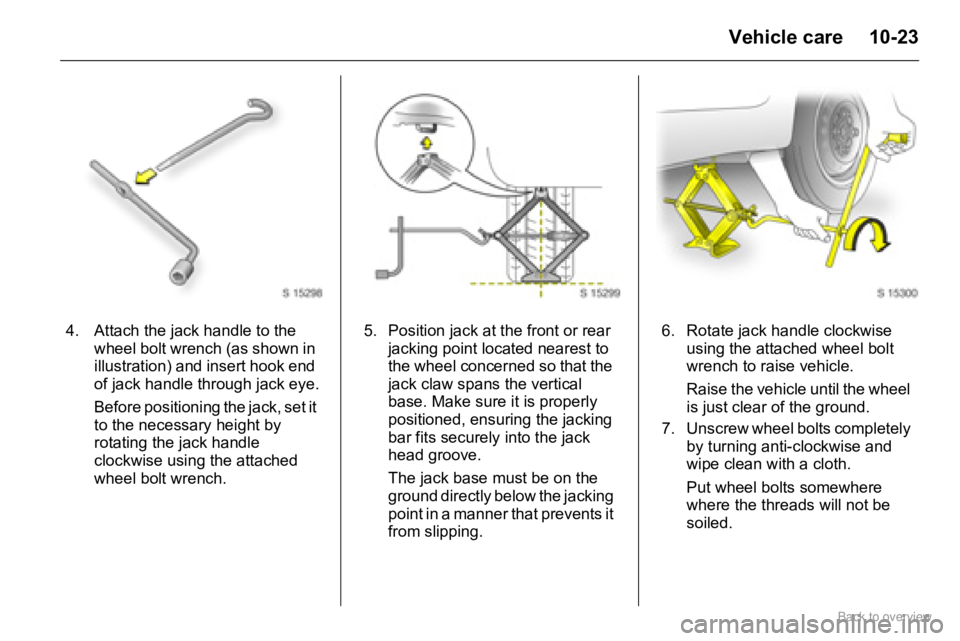
4. Attach the jack handle to the
wheel bolt wrench (as shown in
illustration) and insert hook end
of jack handle through jack eye.
Before positioning the jack, set it
to the necessary height by
rotating the jack handle
clockwise using the attached
wheel bolt wrench.5. Position jack at the front or rear
jacking point located nearest to
the wheel concerned so that the
jack claw spans the vertical
base. Make sure it is properly
positioned, ensuring the jacking
bar fits securely into the jack
head groove.
The jack base must be on the
ground directly below the jacking
point in a manner that prevents it
from slipping.6. Rotate jack handle clockwise
using the attached wheel bolt
wrench to raise vehicle.
Raise the vehicle until the wheel
is just clear of the ground.
7. Unscrew wheel bolts completely
by turning anti-clockwise and
wipe clean with a cloth.
Put wheel bolts somewhere
where the threads will not be
soiled.
Page 133 of 153

11-1Service and maintenance
Service and
maintenanceScheduled
maintenance
Service intervals
Interim Service
Due every 15,000 km (10,000 miles)
or 1 year, whichever occurs first.
Main Service
Due every 30,000 km (20,000 miles)
or 2 years, whichever occurs first.
The service intervals are based on
average operating conditions. For
severe operating conditions 311-5.
Service interval display 35-14.
Engine oil life monitor 35-14.Confirmations
Confirmation of Service is recorded in
the spaces provided in the Service
and Warranty Booklet. The date and
kilometre/mileage reading is
completed with the stamp and
signature of the Servicing Workshop.
Make sure that the Service and
Warranty Booklet is completed
correctly as continuous proof of
service is essential if any warranty or
goodwill claims are to be met, and is
also a benefit when you come to sell
the vehicle. Scheduled maintenance ....... 11-1
Service schedule .................. 11-2
Additional servicing ............... 11-5
Recommended fluids and
lubricants ............................ 11-5
Page 135 of 153

11-3 Service and maintenance
Service operations by year 1)
km ( x 1000)1)
miles ( x 1000)1)
1)Whichever occurs first.⊕Additional operations.o Under extreme operating conditions and if required by country-specific conditions, the intervals are reduced.
1
15
102
30
203
45
304
60
405
75
506
90
60
Ribbed V-belt: visual check - petrol engines only x x
⊕ Replace every 6 years/90,000 km/60,000 miles
Ribbed V-belt and tensioner: visual check - diesel engines only x x x
⊕ Replace every 10 years/150,000 km/100,000 miles
⊕Valve clearances: check, adjust - petrol engines only x x x
Engine oil and oil filter: replace x x x x x x
oDiesel fuel filter: drain water x x x x x x
Diesel fuel filter: replace and bleed x x x
⊕Manual transmission: oil level check, correct x
Oil changexx
Parking brake cable: check, adjust x
Parking brake: check and adjust
Wheel mounting and suspension front and rear, brake lines, brake
pressure hoses, fuel lines, fuel tank and exhaust system: visual checkxxx
Corrosion protection: check and record in Service and Warranty Booklet annually
Front and rear wheel brakes: check visually x x x x x x
Page 136 of 153

11-4 Service and maintenance
⊕Additional operations.o Under extreme operating conditions and if required by country-specific conditions, the intervals are reduced.
Service operations by year 1)
km ( x 1000)1)
miles ( x 1000)1)
1
15
102
30
203
45
304
60
405
75
506
90
60
o⊕Automatic transmission fluid level: check correct x x x
Fluid hose: inspectx
Fluid: change every 165,000 km/110,000 miles
Engine, transmission, A/C compressor: check for leaks x x x x x x
oBrake drum: remove, clean, visual check x
Steering system boots, track rods, final drive: visual check x x
Track rod end and supporting ball joint: check x x x
⊕Brake and clutch fluid: change every 2 years
Wheel fastening: loosen and tighten to torque
Tyre condition and pressures: check, correctxxxxxx
First aid kit: visual check every 2 years
Headlamp aiming: check, adjust x x x
Door hinges, door stop, lock cylinder, lock striker, bonnet catch, tailgate
hinges and check links: lubricate xxx
Test drive, final check
Service interval display and oil life monitor: reset - if applicablexxxxxx
1)Whichever occurs first.
Page 137 of 153
11-5Service and maintenance
Additional servicing
Additional operations ⊕
Additional work is work that is not
required every service but can be
performed in conjunction with a
regular service.
Time allowances for such work are
not included in the scope of regular
services and will be charged for
additionally. It is more economic if
these operations are performed as
part of a scheduled service than
having them performed separately.
Severe operating conditions o
Operating conditions are classified as
severe when one or more of the
following occurs frequently:
„cold starts,
„stop and go,
„trailer/caravan towing,
„gradients and/or high altitudes,
„poor road surfaces,
„sand and dust,
„extreme temperature fluctuations. Police vehicles, taxis and driving
school vehicles are also classified as
operating under severe conditions.
Under severe operating conditions, it
may be necessary to have certain
scheduled service work done more
frequently than the scheduled
intervals.
For example, if fuel is used that does
not comply with required standards,
the fuel filter may need more frequent
draining or replacement and it may
also be necessary to change other
components more often (e.g. spark
plugs).
It is recommended to seek technical
advice on the servicing requirements
dependent on the specific operating
conditions of your vehicle.
Recommended fluids
and lubricants
Only use products that have been
tested and approved. Damage
resulting from the use of non-
approved materials will not be
covered by the warranty.
Checking and topping up fluids
3 10-3.
9 Warning
Operating materials are
hazardous and must be handled
with the appropriate level of care.
If consumed, seek medical
attention immediately. Do not
inhale fumes and avoid skin
contact. Keep out of reach of
children. Do not allow operating
materials to contaminate the
sewage system, surface water,
ground water or soil. Dispose of
empty containers properly.
Always bear in mind that
operating materials are
hazardous to your health.
Page 138 of 153
11-6 Service and maintenance
Engine oil
Engine oil is identified by its quality
and also its viscosity. Quality is more
important than viscosity when
selecting which engine oil to use.
Engine oil quality
Opel engine oil meets classifications
GM-LL-A-025 and GM-LL-B-025 and
is therefore suitable for both petrol
and diesel engines.
Topping up engine oil
Oils of different manufacturers and
brands can be mixed as long as you
comply with the specified engine oil
criteria (quality and viscosity).Not every engine oil available on the
market meets the quality
requirements, always check the
required specification and rating is
marked on the container.
If engine oil of the required quality is
not available, a maximum of 1 litre of
ACEA A3/B4 or A3/B3 grade may be
used (only once between each oil
change). The viscosity should be of
the correct rating.
Use of ACEA A1/B1 and A5/B5
engine oil is expressly forbidden,
since they can cause long-term
engine damage under certain
operating conditions.
Engine oil additives
The use of engine oil additives could
cause damage and invalidate the
warranty.
Engine oil viscosity
Diesel engines:
SAE 0W-30, 0W-40, 5W-30 or 5W-40
Petrol engines:
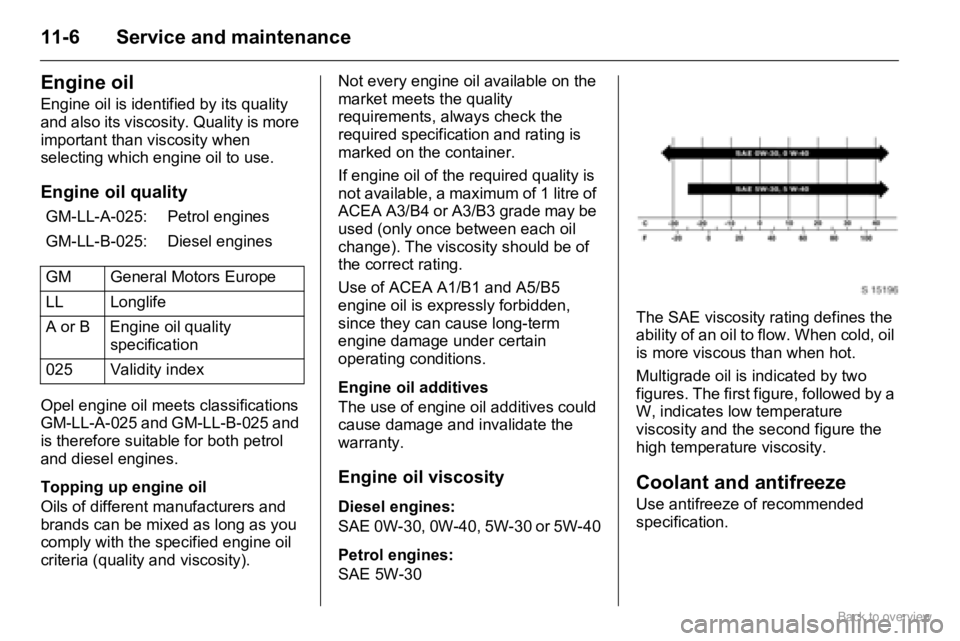
SAE 5W-30The SAE viscosity rating defines the
ability of an oil to flow. When cold, oil
is more viscous than when hot.
Multigrade oil is indicated by two
figures. The first figure, followed by a
W, indicates low temperature
viscosity and the second figure the
high temperature viscosity.
Coolant and antifreeze
Use antifreeze of recommended
specification. GM-LL-A-025: Petrol engines
GM-LL-B-025: Diesel engines
GM General Motors Europe
LL Longlife
A or B Engine oil quality
specification
025 Validity index
Page 139 of 153
11-7Service and maintenance
The system is factory-filled with
coolant designed for frost protection
down to approx. -28 °C. This
concentration should be maintained
all year-round.
Coolant additives intended to give
additional corrosion protection or seal
against minor leaks can cause
function problems. Liability for
consequences resulting from the use
of coolant additives will be rejected.
Brake and clutch fluid
Only use DOT4 brake fluid.
Over time, brake fluid absorbs
moisture which will reduce braking
effectiveness. The brake fluid should
therefore be replaced at the specified
interval.
Brake fluid should be stored in a
sealed container to avoid water
absorption. Ensure it does not become
contaminated with fluids containing
mineral oil (oil, petrol, cleaner) as this
can damage the seals and sleeves of
the brake system.Transmission fluid
Use fluid meeting specification
Grade: API GL-4
Viscosity: 75W-85 or 75W-90.
Automatic transmission fluid
Use fluid meeting specification
ATF3309.
9 Warning
Brake fluid is poisonous!
Caution
Due to its corrosive nature, it must
not come in contact with the
paintwork. Flush any escaped
brake fluid with plenty of water.
Page 142 of 153

12-3 Technical data
Capacities and specifications
Engine data
Sales designation
Engine identifier code1.0 Petrol
K 10 B1.2 Petrol
K 12 B1.3 Diesel
D 13 A
Number of cylinders 3 4 4
Bore dia. (mm) 73 73 69.6
Stroke (mm) 79.4 74.2 82.0
Piston displacement (cm
3) 996 1242 1248
Max. engine power (kW)
at rpm48
600063
550055
4000
Torque (Nm)
at rpm90
4800114
4400190
1750
Compression ratio 11.0 11.0 17.6
Cetane requirement (CN) - - 51 (D)
Octane requirement (RON)
unleaded
or unleaded91
9591
95-
Engine oil consumption (l/1000 km) 1.0 1.0 1.0