warning OPEL AGILA 2009 User Guide
[x] Cancel search | Manufacturer: OPEL, Model Year: 2009, Model line: AGILA, Model: OPEL AGILA 2009Pages: 153, PDF Size: 1.82 MB
Page 27 of 153
3-1Seats, restraints and interior
Seats, restraints
and interiorHead restraints
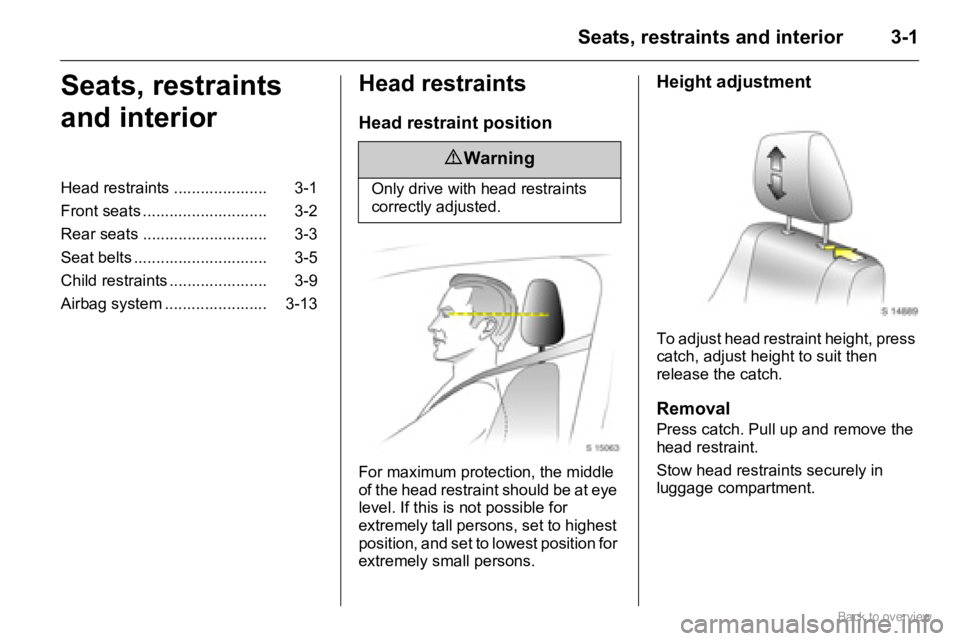
Head restraint position
For maximum protection, the middle
of the head restraint should be at eye
level. If this is not possible for
extremely tall persons, set to highest
position, and set to lowest position for
extremely small persons.
Height adjustment
To adjust head restraint height, press
catch, adjust height to suit then
release the catch.
Removal
Press catch. Pull up and remove the
head restraint.
Stow head restraints securely in
luggage compartment. Head restraints ..................... 3-1
Front seats ............................ 3-2
Rear seats ............................ 3-3
Seat belts .............................. 3-5
Child restraints ...................... 3-9
Airbag system ....................... 3-13
9 Warning
Only drive with head restraints
correctly adjusted.
Page 28 of 153
3-2 Seats, restraints and interior
Front seats
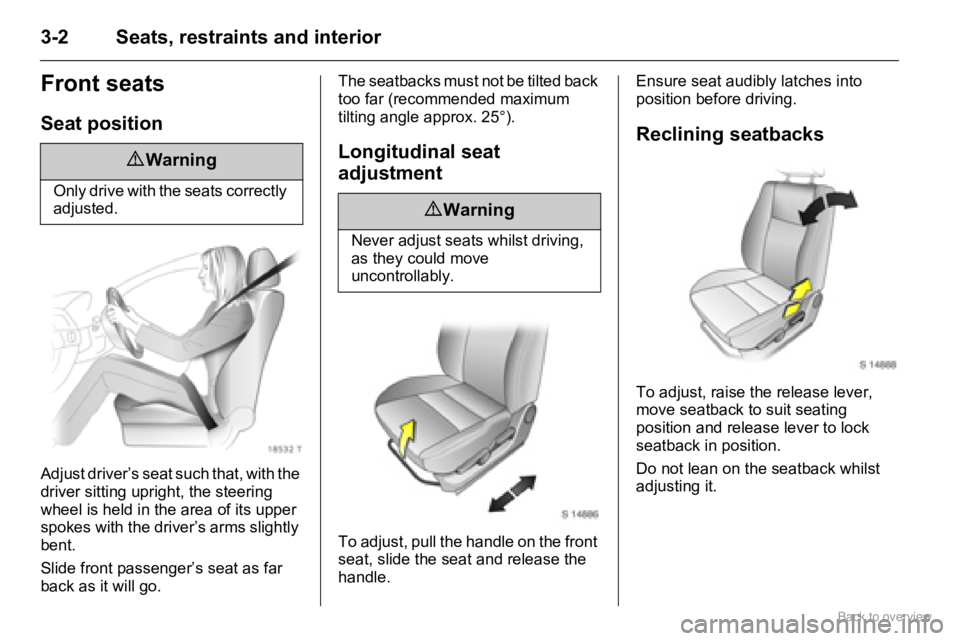
Seat position
Adjust driver’s seat such that, with the
driver sitting upright, the steering
wheel is held in the area of its upper
spokes with the driver’s arms slightly
bent.
Slide front passenger’s seat as far
back as it will go.The seatbacks must not be tilted back
too far (recommended maximum
tilting angle approx. 25°).
Longitudinal seat
adjustment
To adjust, pull the handle on the front
seat, slide the seat and release the
handle.Ensure seat audibly latches into
position before driving.
Reclining seatbacks
To adjust, raise the release lever,
move seatback to suit seating
position and release lever to lock
seatback in position.
Do not lean on the seatback whilst
adjusting it.
9 Warning
Only drive with the seats correctly
adjusted.
9 Warning
Never adjust seats whilst driving,
as they could move
uncontrollably.
Page 29 of 153
3-3Seats, restraints and interior
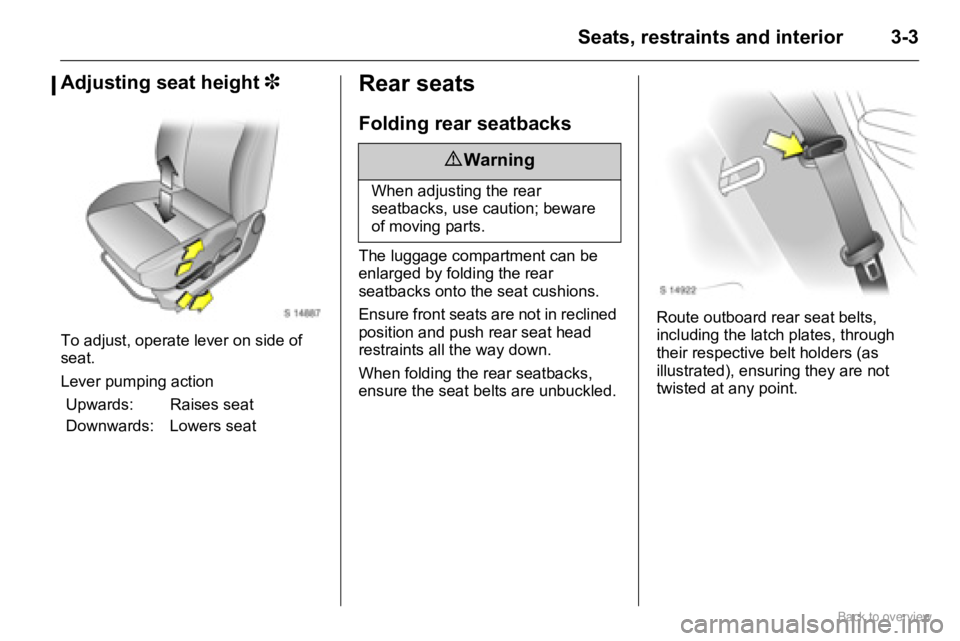
Adjusting seat height 3
To adjust, operate lever on side of
seat.
Lever pumping action
Rear seats
Folding rear seatbacks
The luggage compartment can be
enlarged by folding the rear
seatbacks onto the seat cushions.
Ensure front seats are not in reclined
position and push rear seat head
restraints all the way down.
When folding the rear seatbacks,
ensure the seat belts are unbuckled.Route outboard rear seat belts,
including the latch plates, through
their respective belt holders (as
illustrated), ensuring they are not
twisted at any point.
Upwards: Raises seat
Downwards: Lowers seat
9 Warning
When adjusting the rear
seatbacks, use caution; beware
of moving parts.
Page 32 of 153
3-6 Seats, restraints and interior
In the event of an accident, persons
not wearing seat belts endanger their
fellow occupants and themselves.
Control indicator X for driver’s seat
belt reminder 35-9.
Seat belts are designed to be used by
only one person at a time. They are
only suitable for children aged up to
12 years or smaller than 150 cm if
used in conjunction with a child
restraint 3.
Belt force limiters
Load limiters on the front seats
reduce the impact on the seat
occupant’s body from a tensioning
belt, in the event of frontal collisions
or rear impacts of a certain severity.
The belt force is controlled, to reduce
the risk of belt-inflicted injury.
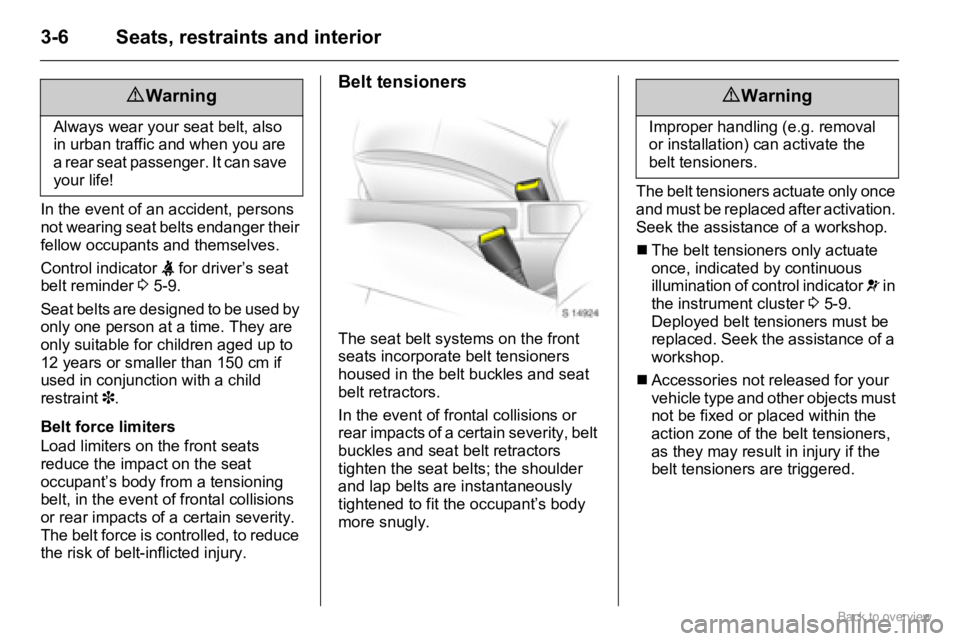
Belt tensioners
The seat belt systems on the front
seats incorporate belt tensioners
housed in the belt buckles and seat
belt retractors.
In the event of frontal collisions or
rear impacts of a certain severity, belt
buckles and seat belt retractors
tighten the seat belts; the shoulder
and lap belts are instantaneously
tightened to fit the occupant’s body
more snugly.The belt tensioners actuate only once
and must be replaced after activation.
Seek the assistance of a workshop.
„The belt tensioners only actuate
once, indicated by continuous
illumination of control indicator v in
the instrument cluster 35-9.
Deployed belt tensioners must be
replaced. Seek the assistance of a
workshop.
„Accessories not released for your
vehicle type and other objects must
not be fixed or placed within the
action zone of the belt tensioners,
as they may result in injury if the
belt tensioners are triggered.
9 Warning
Always wear your seat belt, also
in urban traffic and when you are
a rear seat passenger. It can save
your life!
9 Warning
Improper handling (e.g. removal
or installation) can activate the
belt tensioners.
Page 33 of 153
3-7Seats, restraints and interior
How to wear seat belts
properly
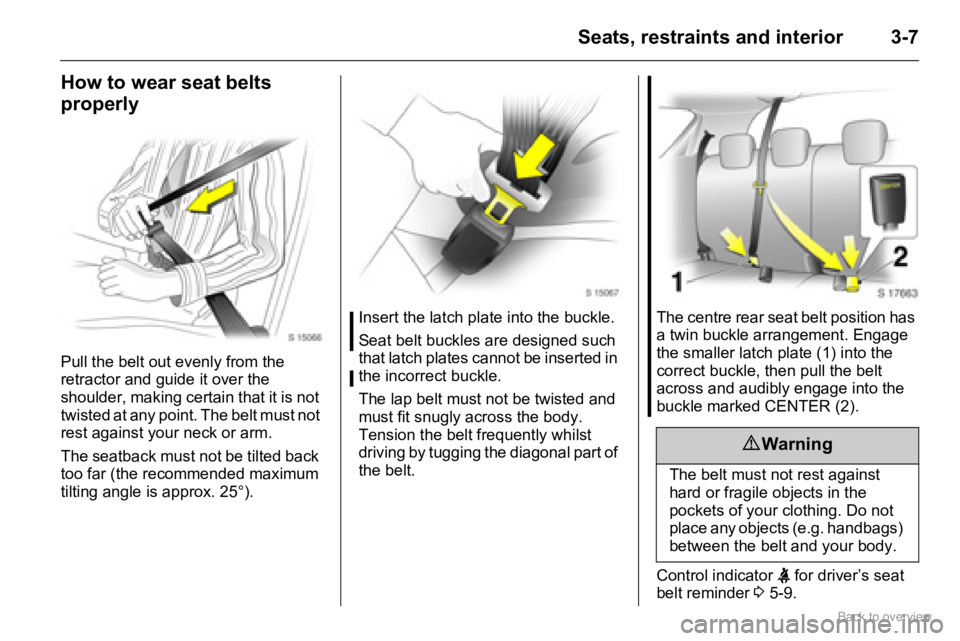
Pull the belt out evenly from the
retractor and guide it over the
shoulder, making certain that it is not
twisted at any point. The belt must not
rest against your neck or arm.
The seatback must not be tilted back
too far (the recommended maximum
tilting angle is approx. 25°).Insert the latch plate into the buckle.
Seat belt buckles are designed such
that latch plates cannot be inserted in
the incorrect buckle.
The lap belt must not be twisted and
must fit snugly across the body.
Tension the belt frequently whilst
driving by tugging the diagonal part of
the belt.The centre rear seat belt position has
a twin buckle arrangement. Engage
the smaller latch plate (1) into the
correct buckle, then pull the belt
across and audibly engage into the
buckle marked CENTER (2).
Control indicator X for driver’s seat
belt reminder 3 5-9.
9 Warning
The belt must not rest against
hard or fragile objects in the
pockets of your clothing. Do not
place any objects (e.g. handbags)
between the belt and your body.
Page 34 of 153
3-8 Seats, restraints and interior
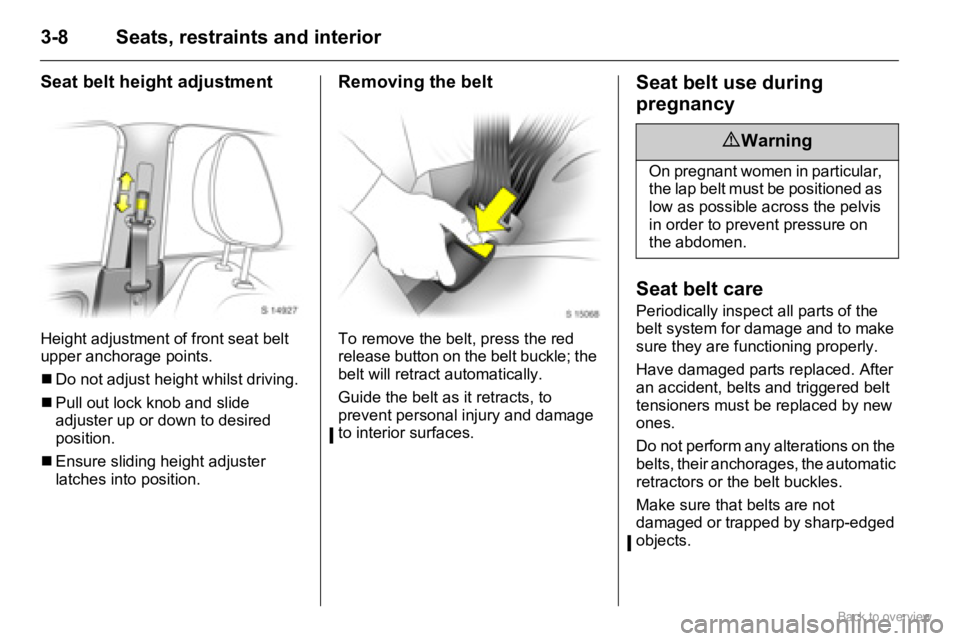
Seat belt height adjustment
Height adjustment of front seat belt
upper anchorage points.
„Do not adjust height whilst driving.
„Pull out lock knob and slide
adjuster up or down to desired
position.
„Ensure sliding height adjuster
latches into position.
Removing the belt
To remove the belt, press the red
release button on the belt buckle; the
belt will retract automatically.
Guide the belt as it retracts, to
prevent personal injury and damage
to interior surfaces.
Seat belt use during
pregnancy
Seat belt care
Periodically inspect all parts of the
belt system for damage and to make
sure they are functioning properly.
Have damaged parts replaced. After
an accident, belts and triggered belt
tensioners must be replaced by new
ones.
Do not perform any alterations on the
belts, their anchorages, the automatic
retractors or the belt buckles.
Make sure that belts are not
damaged or trapped by sharp-edged
objects.
9 Warning
On pregnant women in particular,
the lap belt must be positioned as
low as possible across the pelvis
in order to prevent pressure on
the abdomen.
Page 35 of 153

3-9Seats, restraints and interior
Child restraints
Child restraint systems 3
When a child restraint system is
being used, pay attention to the
following usage and installation
instructions and also those supplied
with the child restraint system.
The country in which you are driving
could require the use of child restraint
systems at specific seats. Follow all
local and national regulations.Selecting the right system
Your child should be transported
facing rearwards in the vehicle for as
long as possible. It is appropriate to
change the system when the child’s
head can no longer be properly
supported at eye height. The child’s
cervical vertebrae are still very weak
and in an accident they suffer less
stress in the semi-prone rearward
position than when sitting upright.
„Children under 12 years or under
150 cm tall should only travel in an
appropriate child safety seat.
„Never carry a child whilst travelling
in the vehicle. The child will
become too heavy to hold in the
event of a collision.
„When transporting children, use a
child restraint system that is
suitable for the child's weight, age
and height.
„Ensure that the child restraint
system to be installed is compatible
with the vehicle type.
„Ensure that the mounting location
of the child restraint system within
the vehicle is correct.„Only allow children to enter and exit
the vehicle at the side facing away
from the traffic.
„When the child restraint system is
not in use, secure the seat with a
seat belt or remove it from the
vehicle.
„A child restraint system which has
been subjected to stress in an
accident must be replaced.
„Opel produce a range of child
restraint systems. We recommend
you consult an Opel Service
Partner.
9 Warning
When using a child restraint
system on the front passenger’s
seat, the airbag systems for the
front passenger’s seat must be
deactivated; if not, the triggering
of the airbags poses a risk of fatal
injury to the child.
This is especially the case if rear-
facing child restraint systems are
used on the front passenger’s
seat.
Page 39 of 153
3-13Seats, restraints and interior
Airbag system
The airbag system consists of several
individual systems.
When triggered, the driver’s and front
passenger’s airbags inflate to form
safety cushions for the driver and
front passenger.
When triggered, the side airbag
inflates to form a safety cushion for
the driver and/or front passenger in
the respective door area.
When triggered, the curtain airbag
inflates to provide a safety barrier in
the head area on the respective side
of the vehicle.
No impairment of view will occur, as
airbags inflate and deflate so quickly
that they are often not noticed in an
accident.„The airbag system and belt
tensioner control electronics can be
found in the centre console area. In
order to avoid malfunctions, do not
store magnetic objects in this area.
„Do not stick or place anything on
the steering wheel, instrument
panel, front seatbacks in the vicinity
of the airbags and seat areas or
cover them with other materials.
„Each airbag can be triggered only
once. Once triggered, an airbag
must be replaced immediately.
Seek the assistance of a workshop.
„Do not perform any modifications to
the components of the airbag
system, as this will render the
vehicle unroadworthy.
„We recommend having the
steering wheel, the instrument
panel, all panelling parts, the door
seals, handles and the front seats
removed by a workshop.
Control indicator for airbag systems
35-9.
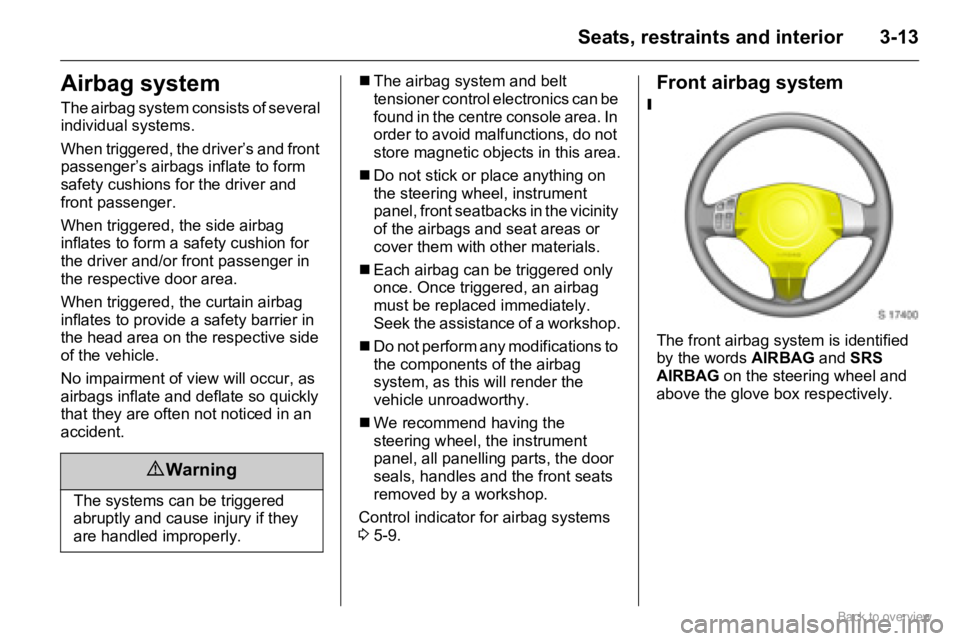
Front airbag system
The front airbag system is identified
by the words AIRBAG and SRS
AIRBAG on the steering wheel and
above the glove box respectively.
9 Warning
The systems can be triggered
abruptly and cause injury if they
are handled improperly.
Page 40 of 153
3-14 Seats, restraints and interior
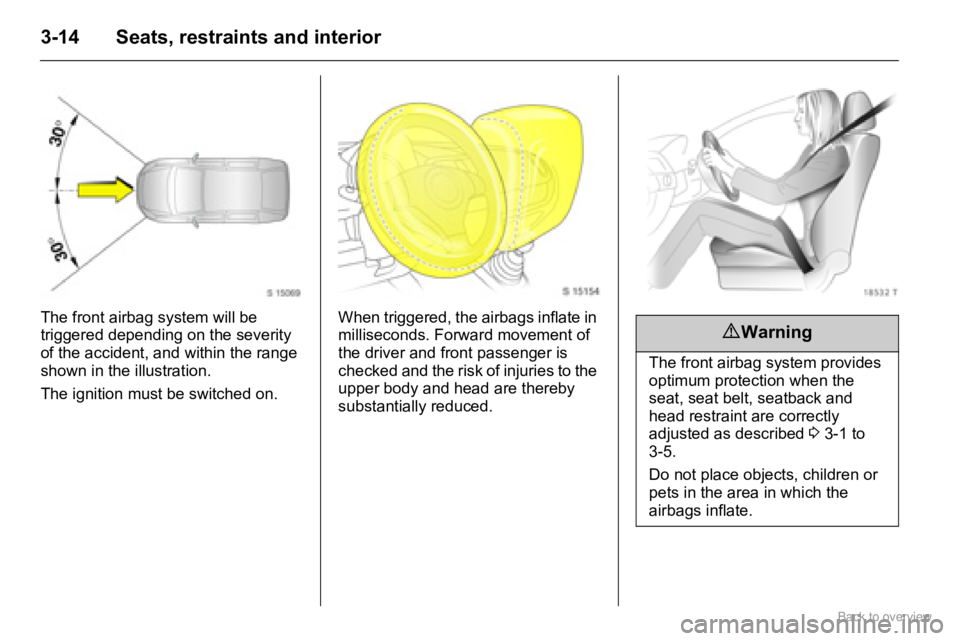
The front airbag system will be
triggered depending on the severity
of the accident, and within the range
shown in the illustration.
The ignition must be switched on.When triggered, the airbags inflate in
milliseconds. Forward movement of
the driver and front passenger is
checked and the risk of injuries to the
upper body and head are thereby
substantially reduced.9 Warning
The front airbag system provides
optimum protection when the
seat, seat belt, seatback and
head restraint are correctly
adjusted as described 33-1 to
3-5.
Do not place objects, children or
pets in the area in which the
airbags inflate.
Page 41 of 153
3-15Seats, restraints and interior
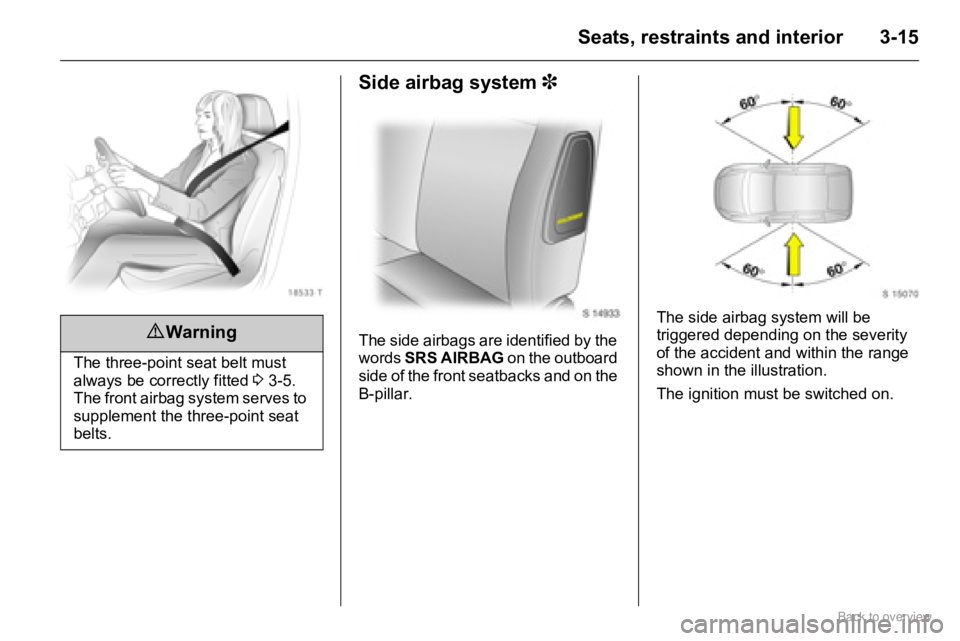
Side airbag system 3
The side airbags are identified by the
words SRS AIRBAG on the outboard
side of the front seatbacks and on the
B-pillar.The side airbag system will be
triggered depending on the severity
of the accident and within the range
shown in the illustration.
The ignition must be switched on.9 Warning
The three-point seat belt must
always be correctly fitted 33-5.
The front airbag system serves to
supplement the three-point seat
belts.