warning OPEL AGILA 2009 Service Manual
[x] Cancel search | Manufacturer: OPEL, Model Year: 2009, Model line: AGILA, Model: OPEL AGILA 2009Pages: 153, PDF Size: 1.82 MB
Page 106 of 153
10-6 Vehicle care
Replacing rear window wiper
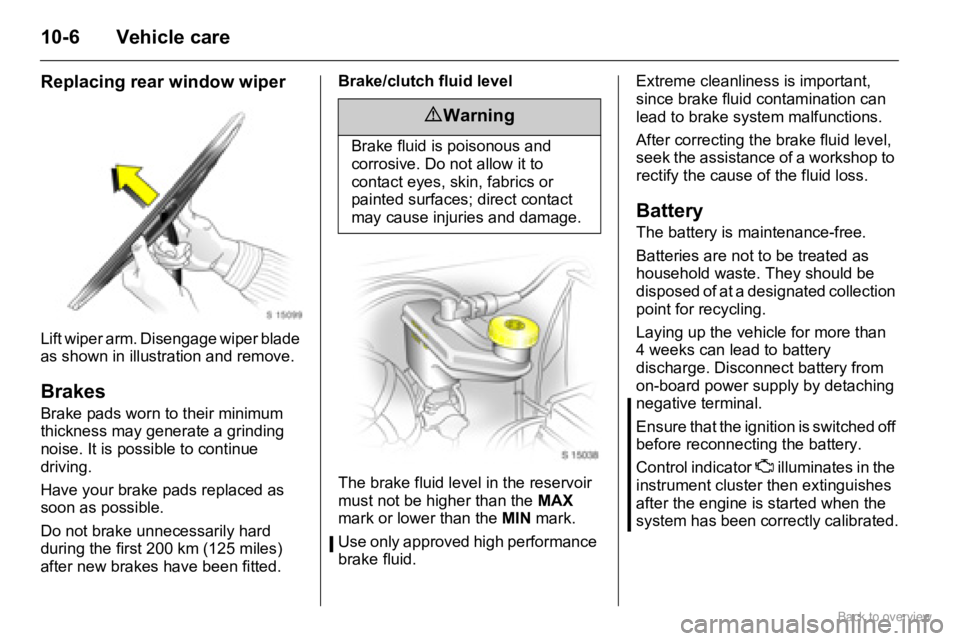
Lift wiper arm. Disengage wiper blade
as shown in illustration and remove.
Brakes
Brake pads worn to their minimum
thickness may generate a grinding
noise. It is possible to continue
driving.
Have your brake pads replaced as
soon as possible.
Do not brake unnecessarily hard
during the first 200 km (125 miles)
after new brakes have been fitted.Brake/clutch fluid level
The brake fluid level in the reservoir
must not be higher than the MAX
mark or lower than the MIN mark.
Use only approved high performance
brake fluid.Extreme cleanliness is important,
since brake fluid contamination can
lead to brake system malfunctions.
After correcting the brake fluid level,
seek the assistance of a workshop to
rectify the cause of the fluid loss.
Battery
The battery is maintenance-free.
Batteries are not to be treated as
household waste. They should be
disposed of at a designated collection
point for recycling.
Laying up the vehicle for more than
4 weeks can lead to battery
discharge. Disconnect battery from
on-board power supply by detaching
negative terminal.
Ensure that the ignition is switched off
before reconnecting the battery.
Control indicator Z illuminates in the
instrument cluster then extinguishes
after the engine is started when the
system has been correctly calibrated.
9 Warning
Brake fluid is poisonous and
corrosive. Do not allow it to
contact eyes, skin, fabrics or
painted surfaces; direct contact
may cause injuries and damage.
Page 113 of 153
10-13Vehicle care
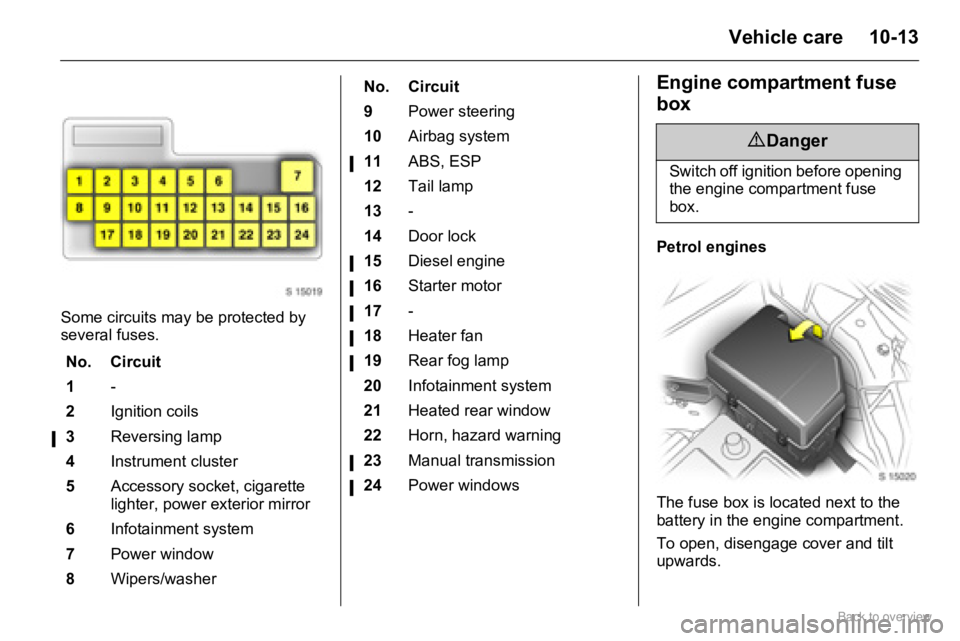
Some circuits may be protected by
several fuses.
Engine compartment fuse
box
Petrol engines
The fuse box is located next to the
battery in the engine compartment.
To open, disengage cover and tilt
upwards. No. Circuit
1-
2Ignition coils
3Reversing lamp
4Instrument cluster
5Accessory socket, cigarette
lighter, power exterior mirror
6Infotainment system
7Power window
8Wipers/washer
9Power steering
10Airbag system
11ABS, ESP
12Tail lamp
13-
14Door lock
15Diesel engine
16Starter motor
17-
18Heater fan
19Rear fog lamp
20Infotainment system
21Heated rear window
22Horn, hazard warning
23Manual transmission
24Power windows No. Circuit
9 Danger
Switch off ignition before opening
the engine compartment fuse
box.
Page 117 of 153
10-17Vehicle care
Tyre condition
Drive over edges slowly and at a right
angle if possible. When parking,
ensure that the tyres are not pressed
against the edge of the kerb.
Check tyres regularly for damage
(foreign bodies, punctures, cuts,
cracks, bulges in sidewalls). Check
wheels for damage. In the event of
damage or abnormal wear, seek the
assistance of a workshop.
Different tyre and wheel
types
If tyres of a different size to those
fitted at the factory are used (this
includes winter tyres), the electronic speedometer may possibly need to
be reprogrammed, to ensure that the
speed displayed is correct.
Wheel covers 3
Wheel covers and tyres that are
approved for the vehicle and comply
with all of the relevant wheel and tyre
combination requirements must be
used.
If the wheel covers and tyres used
are not approved, make sure that the
tyres do not have a beaded edge.
Remove wheel covers before fitting
tyre chains, to avoid damaging the
wheel covers.
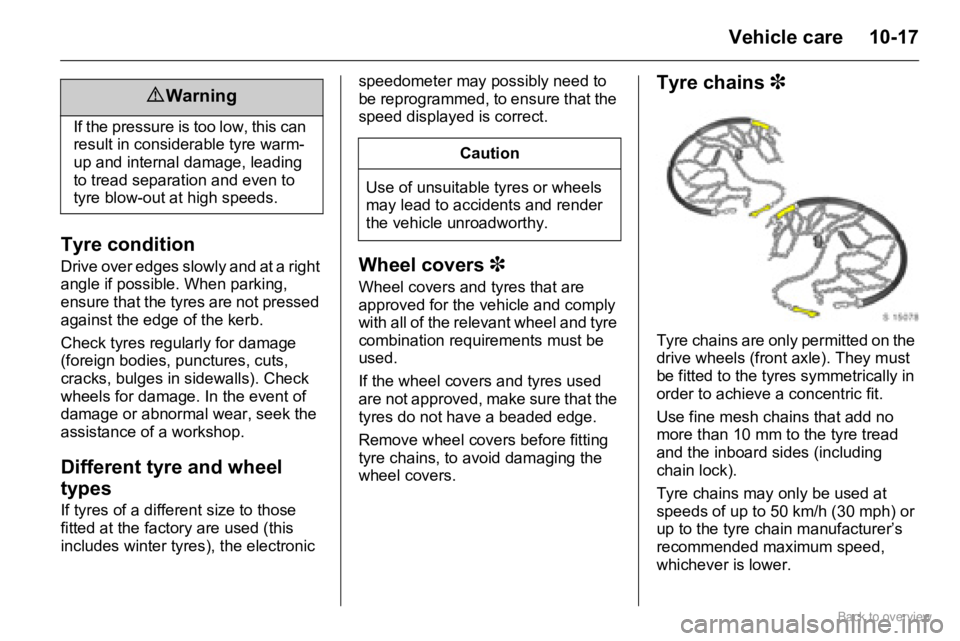
Tyre chains 3
Tyre chains are only permitted on the
drive wheels (front axle). They must
be fitted to the tyres symmetrically in
order to achieve a concentric fit.
Use fine mesh chains that add no
more than 10 mm to the tyre tread
and the inboard sides (including
chain lock).
Tyre chains may only be used at
speeds of up to 50 km/h (30 mph) or
up to the tyre chain manufacturer’s
recommended maximum speed,
whichever is lower.
9 Warning
If the pressure is too low, this can
result in considerable tyre warm-
up and internal damage, leading
to tread separation and even to
tyre blow-out at high speeds.
Caution
Use of unsuitable tyres or wheels
may lead to accidents and render
the vehicle unroadworthy.
Page 118 of 153
10-18 Vehicle care
Tyre chains must not be used on the
temporary spare wheel.
Tyre repair kit 3
Minor damage to the tyre tread can
be temporarily repaired with the tyre
repair kit.
Do not remove foreign bodies from
the tyres. Damaged areas bigger
than 4 mm and damage at the tyre
rim cannot be repaired using the tyre
repair kit.
Never use the liquid sealant on more
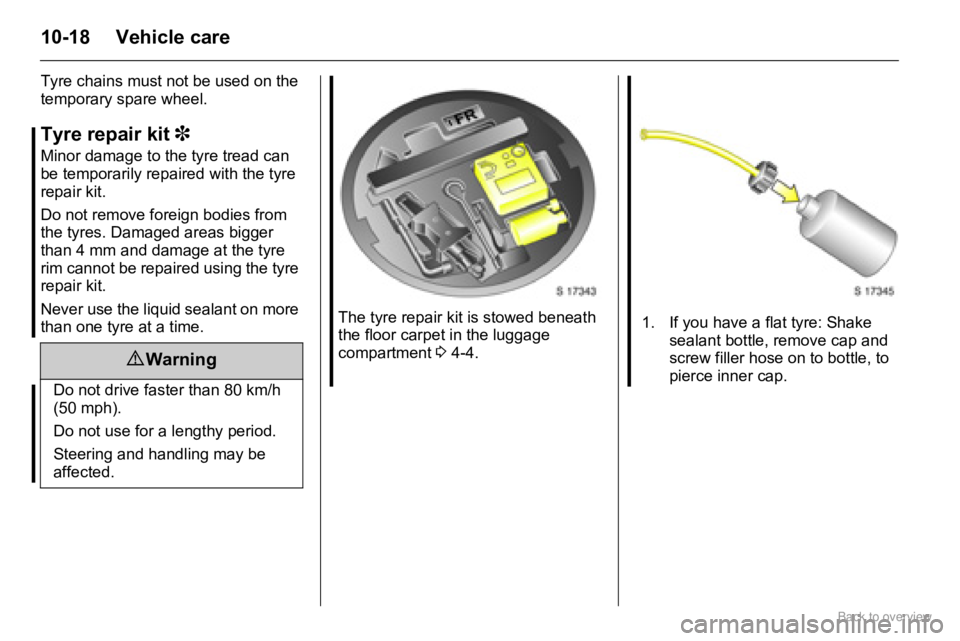
than one tyre at a time.The tyre repair kit is stowed beneath
the floor carpet in the luggage
compartment 3 4-4.
9 Warning
Do not drive faster than 80 km/h
(50 mph).
Do not use for a lengthy period.
Steering and handling may be
affected.
1. If you have a flat tyre: Shake
sealant bottle, remove cap and
screw filler hose on to bottle, to
pierce inner cap.
Page 119 of 153
10-19Vehicle care
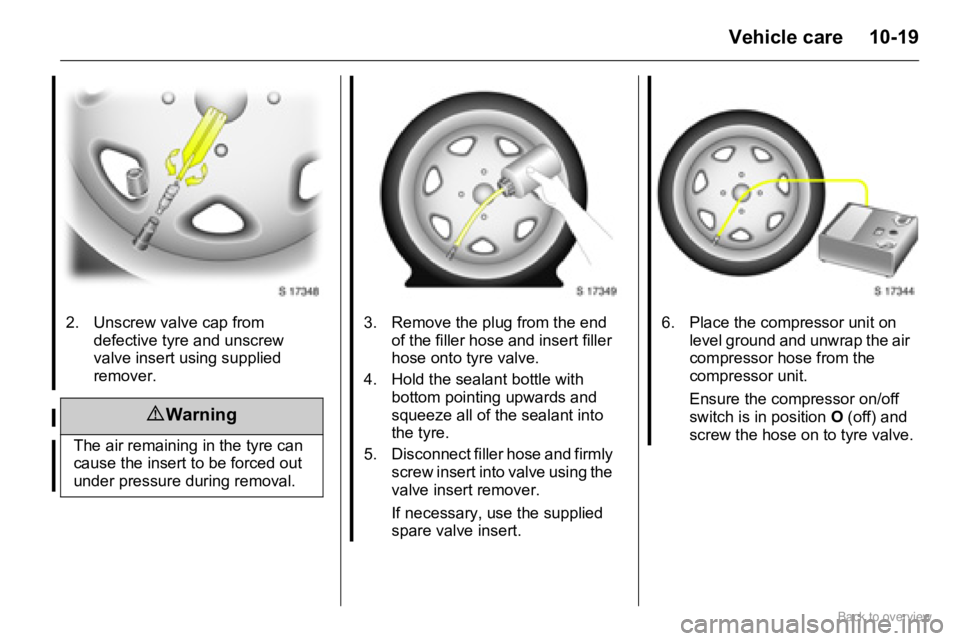
2. Unscrew valve cap from
defective tyre and unscrew
valve insert using supplied
remover.
9 Warning
The air remaining in the tyre can
cause the insert to be forced out
under pressure during removal.
3. Remove the plug from the end
of the filler hose and insert filler
hose onto tyre valve.
4. Hold the sealant bottle with
bottom pointing upwards and
squeeze all of the sealant into
the tyre.
5. Disconnect filler hose and firmly
screw insert into valve using the
valve insert remover.
If necessary, use the supplied
spare valve insert.6. Place the compressor unit on
level ground and unwrap the air
compressor hose from the
compressor unit.
Ensure the compressor on/off
switch is in position O (off) and
screw the hose on to tyre valve.
Page 122 of 153
10-22 Vehicle care
Wheel changing
In order to reduce the chance of
possible injuries, make the following
preparations and note the procedure:
„Park on a level, firm and non-
slippery surface.
„Switch on hazard warning lamps
and apply parking brake. Engage
reverse gear (automatic
transmission 3 in P).
„Take the spare wheel from under
the luggage compartment floor
cover 3 10-24.
„Before raising the vehicle, turn front
wheels to straight-ahead position.
„Never change more than one
wheel at a time.
„Block wheel diagonally opposite
the wheel to be changed, by
placing wedge blocks or equivalent
in front and behind the wheel.
„Use jack only when changing
wheels.
„If the ground on which the vehicle is
parked is soft, a solid board (max.
1 cm thick) should be placed under the jack. Using a thicker board
could lead to damage of the jack
and the vehicle.
„Do not raise the vehicle more than
is necessary to change a wheel.
„No people or animals may be in the
vehicle when it is jacked-up.
„Never start or run the engine or
crawl under a jacked-up vehicle.
„Before screwing on the wheel bolts
when changing a wheel, apply a
light coating of grease to the cone
of each wheel bolt.
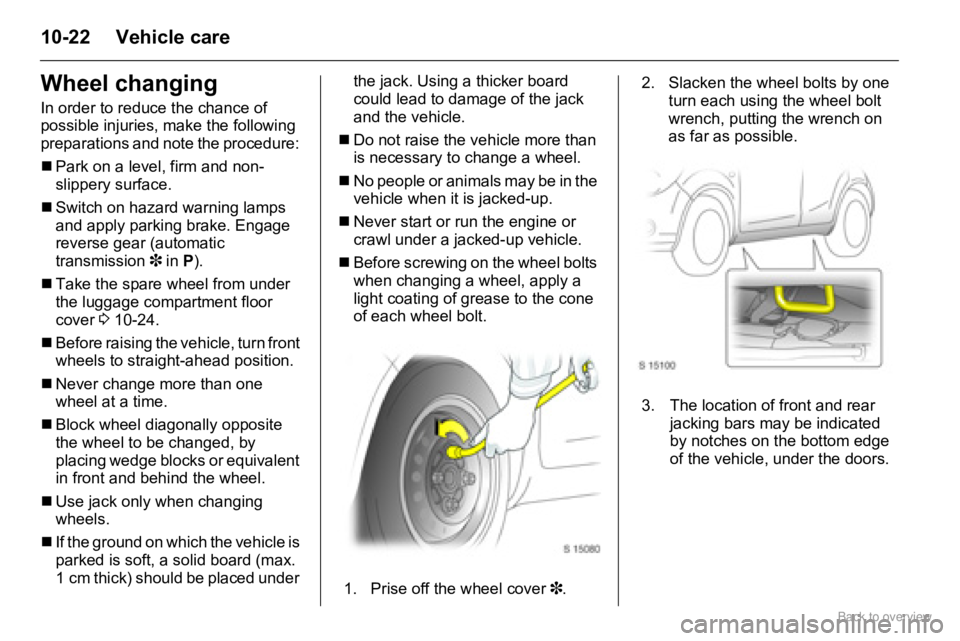
1. Prise off the wheel cover 3.
2. Slacken the wheel bolts by one
turn each using the wheel bolt
wrench, putting the wrench on
as far as possible.
3. The location of front and rear
jacking bars may be indicated
by notches on the bottom edge
of the vehicle, under the doors.
Page 124 of 153
10-24 Vehicle care
Temporary spare wheel
The temporary spare wheel is
designed for use on your vehicle only.
Do not attempt to use the spare tyre
on a different wheel, or use a different
tyre on the spare wheel, as they will
not fit.
Ensure the temporary spare wheel is
inflated to the correct tyre pressure 3
12-8.The temporary spare wheel is located
in the luggage compartment and is
secured with a screw-in retainer.
To access the spare wheel, open
tailgate and pull up luggage
compartment floor carpet using the
central strap located near the tailgate
latch and hang the string on the hook
provided 3 4-4.
If equipped, remove the under floor
storage compartment 3 from the
luggage compartment by pulling it up
by the handle located near the
tailgate latch, to access the spare
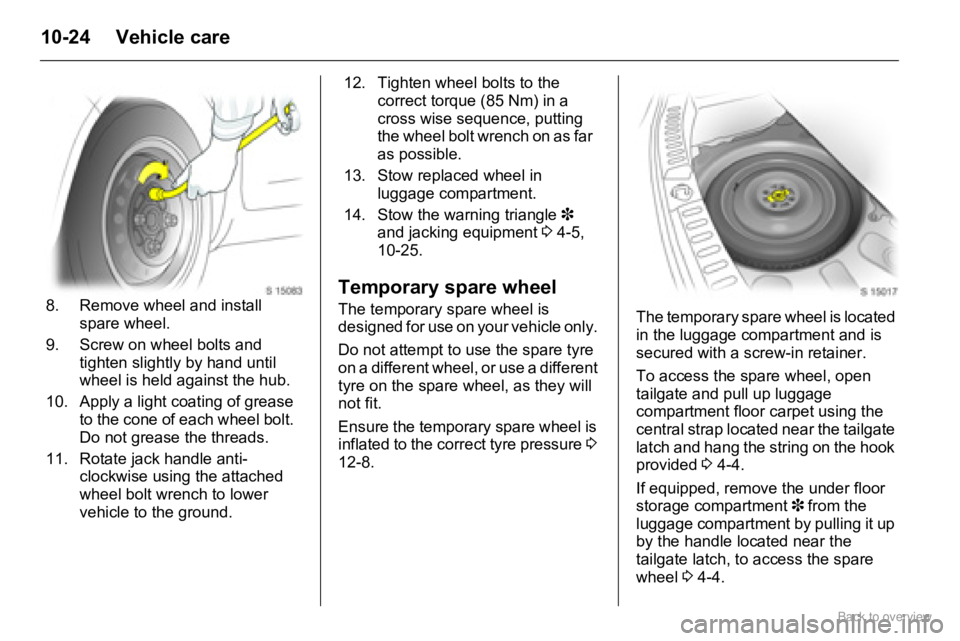
wheel 3 4-4. 8. Remove wheel and install
spare wheel.
9. Screw on wheel bolts and
tighten slightly by hand until
wheel is held against the hub.
10. Apply a light coating of grease
to the cone of each wheel bolt.
Do not grease the threads.
11. Rotate jack handle anti-
clockwise using the attached
wheel bolt wrench to lower
vehicle to the ground.
12. Tighten wheel bolts to the
correct torque (85 Nm) in a
cross wise sequence, putting
the wheel bolt wrench on as far
as possible.
13. Stow replaced wheel in
luggage compartment.
14. Stow the warning triangle 3
and jacking equipment 3 4-5,
10-25.
Page 126 of 153
10-26 Vehicle care
Rotate jack shaft anti-clockwise and
remove jack from storage bracket.
To stow the jack after use, place it in
its storage bracket and turn jack shaft
clockwise until jack is held securely in
place.Jump starting 3
Do not start with quick charger, to
prevent damage to electronic
components.
Never expose the battery to naked
flames or sparks.
„A discharged battery can freeze at
temperatures of 0 °C. Defrost the
battery in a warm room before
connecting the jump leads.
„Do not allow battery fluid to contact
eyes, skin, fabrics or painted
surfaces. The fluid contains
sulphuric acid which can cause
injuries and damage in the event of
direct contact.„Wear eye protection and protective
clothing when handling a battery.
„Use auxiliary battery with same
voltage (12 volts). Its capacity (Ah)
must not be considerably less than
that of the discharged battery.
Voltage and capacity information
can be found on the batteries.
„Use jump leads with insulated
terminals and a width of at least
16 mm
2 (25 mm2 for diesel
engines).
„Do not disconnect the discharged
battery from the vehicle.
„Switch off all unnecessary
electrical consumers. Infotainment
system may be damaged if
switched on while jump starting.
„Do not lean over the battery during
jump starting procedure.
„Do not allow the terminals of one
lead to touch those of the other
lead.
„The vehicles should not touch while
jump starting.
„Apply parking brake.
9 Warning
This must be done with extreme
care. Any deviation from the
following instructions could lead
to personal injury or damage
resulting from battery explosion,
as well as to damage to the
electrical systems in both
vehicles.
Page 127 of 153
10-27Vehicle care
„Manual transmission in neutral,
automatic transmission 3 in P.
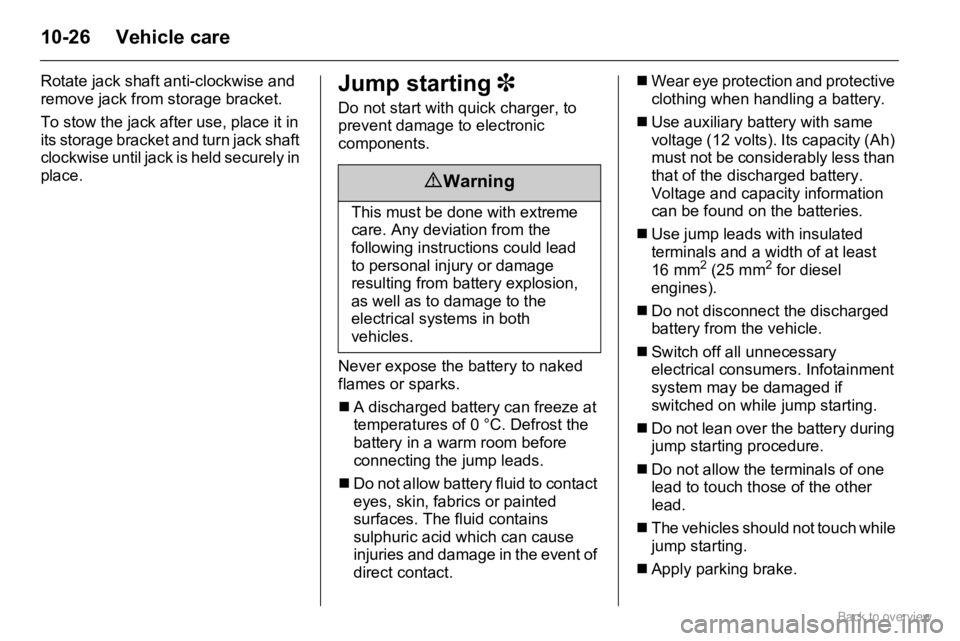
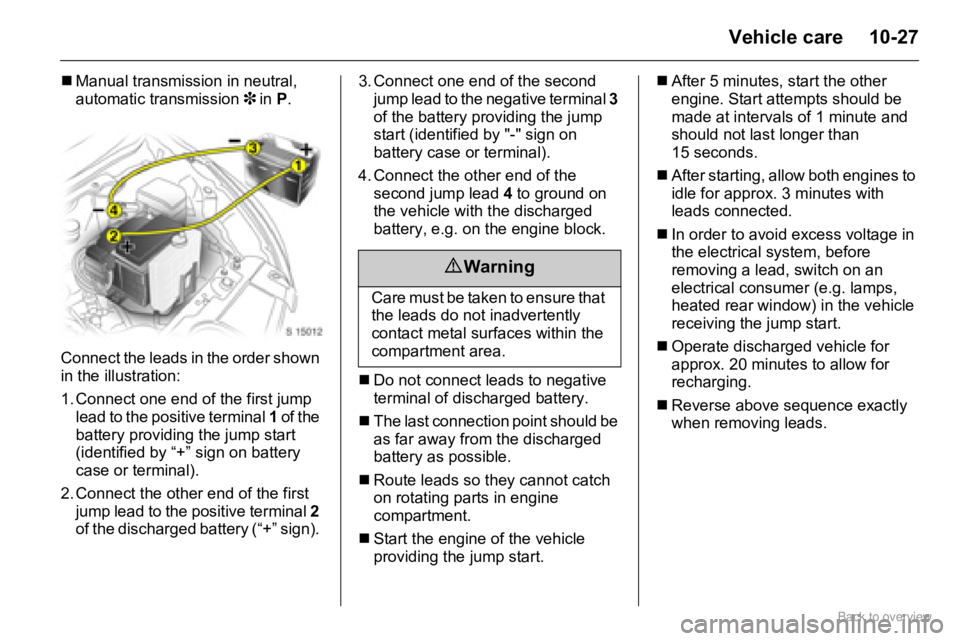
Connect the leads in the order shown
in the illustration:
1. Connect one end of the first jump
lead to the positive terminal 1 of the
battery providing the jump start
(identified by “+” sign on battery
case or terminal).
2. Connect the other end of the first
jump lead to the positive terminal 2
of the discharged battery (“+” sign). 3. Connect one end of the second
jump lead to the negative terminal 3
of the battery providing the jump
start (identified by "-" sign on
battery case or terminal).
4. Connect the other end of the
second jump lead 4 to ground on
the vehicle with the discharged
battery, e.g. on the engine block.
„Do not connect leads to negative
terminal of discharged battery.
„The last connection point should be
as far away from the discharged
battery as possible.
„Route leads so they cannot catch
on rotating parts in engine
compartment.
„Start the engine of the vehicle
providing the jump start.„After 5 minutes, start the other
engine. Start attempts should be
made at intervals of 1 minute and
should not last longer than
15 seconds.
„After starting, allow both engines to
idle for approx. 3 minutes with
leads connected.
„In order to avoid excess voltage in
the electrical system, before
removing a lead, switch on an
electrical consumer (e.g. lamps,
heated rear window) in the vehicle
receiving the jump start.
„Operate discharged vehicle for
approx. 20 minutes to allow for
recharging.
„Reverse above sequence exactly
when removing leads.
9 Warning
Care must be taken to ensure that
the leads do not inadvertently
contact metal surfaces within the
compartment area.
Page 137 of 153

11-5Service and maintenance
Additional servicing
Additional operations ⊕
Additional work is work that is not
required every service but can be
performed in conjunction with a
regular service.
Time allowances for such work are
not included in the scope of regular
services and will be charged for
additionally. It is more economic if
these operations are performed as
part of a scheduled service than
having them performed separately.
Severe operating conditions o
Operating conditions are classified as
severe when one or more of the
following occurs frequently:
„cold starts,
„stop and go,
„trailer/caravan towing,
„gradients and/or high altitudes,
„poor road surfaces,
„sand and dust,
„extreme temperature fluctuations. Police vehicles, taxis and driving
school vehicles are also classified as
operating under severe conditions.
Under severe operating conditions, it
may be necessary to have certain
scheduled service work done more
frequently than the scheduled
intervals.
For example, if fuel is used that does
not comply with required standards,
the fuel filter may need more frequent
draining or replacement and it may
also be necessary to change other
components more often (e.g. spark
plugs).
It is recommended to seek technical
advice on the servicing requirements
dependent on the specific operating
conditions of your vehicle.
Recommended fluids
and lubricants
Only use products that have been
tested and approved. Damage
resulting from the use of non-
approved materials will not be
covered by the warranty.
Checking and topping up fluids
3 10-3.
9 Warning
Operating materials are
hazardous and must be handled
with the appropriate level of care.
If consumed, seek medical
attention immediately. Do not
inhale fumes and avoid skin
contact. Keep out of reach of
children. Do not allow operating
materials to contaminate the
sewage system, surface water,
ground water or soil. Dispose of
empty containers properly.
Always bear in mind that
operating materials are
hazardous to your health.