wheel OPEL AGILA 2009 Owner's Manual
[x] Cancel search | Manufacturer: OPEL, Model Year: 2009, Model line: AGILA, Model: OPEL AGILA 2009Pages: 153, PDF Size: 1.82 MB
Page 92 of 153
9-5 Driving and operating
Stopping the vehicle
Engage parking brake and move
selector lever to position P. It will not
be possible to turn the ignition key to
the LOCK position unless the selector
lever is in positionP.
Rocking the vehicle
If it becomes necessary to rock the
vehicle to free it from water, ice, sand,
mud, snow or a dip, observe the
following:
Move the selector lever between R
and a forward gear in a repeat pattern
while applying light pressure to the
accelerator pedal when the vehicle is
in gear.
Do not spin the wheels or race the
engine and avoid sudden
acceleration.
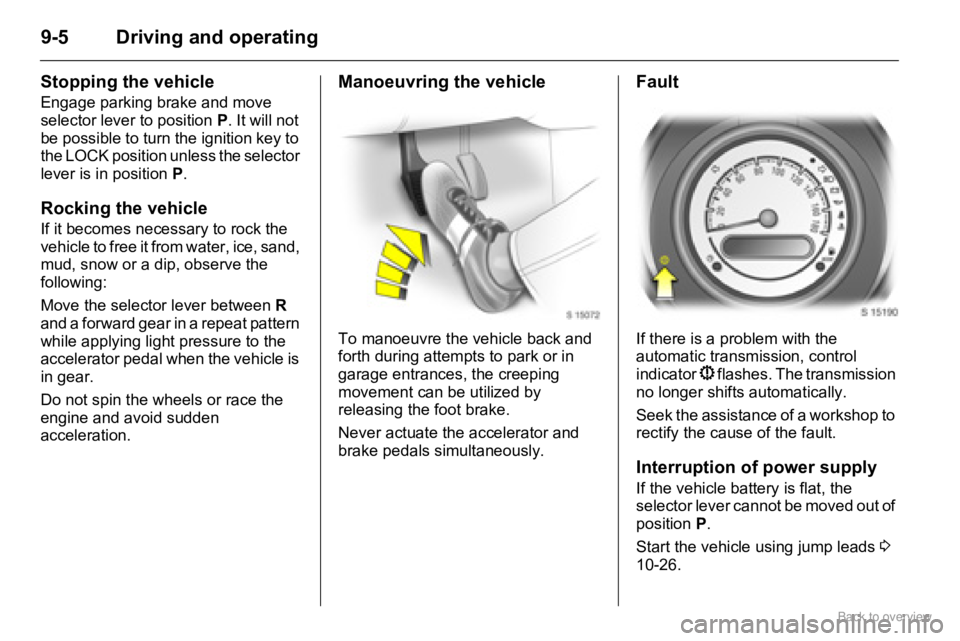
Manoeuvring the vehicle
To manoeuvre the vehicle back and
forth during attempts to park or in
garage entrances, the creeping
movement can be utilized by
releasing the foot brake.
Never actuate the accelerator and
brake pedals simultaneously.
Fault
If there is a problem with the
automatic transmission, control
indicator
s flashes. The transmission
no longer shifts automatically.
Seek the assistance of a workshop to
rectify the cause of the fault.
Interruption of power supply
If the vehicle battery is flat, the
selector lever cannot be moved out of
position P.
Start the vehicle using jump leads 3
10-26.
Page 96 of 153
9-9 Driving and operating
Brakes
Foot brake
The brake system comprises two
separate brake circuits.
If one brake circuit should fail, the
vehicle can still be braked with the
second remaining circuit.
If this happens, the brake pedal must
be fully depressed with greater pedal
pressure. The distance required for
braking will be greater. Seek the
assistance of a workshop.
In order to utilise the full pedal travel,
particularly in the event of a brake
circuit fault, there must be no mats in
the area of the pedals 3 9-1.
With the engine stopped, the brake
servo assistance is discontinued after
the brake pedal has been depressed
once or twice. The braking effect is
not reduced, but increased foot
pressure will be necessary. Take
extra care if the vehicle is being
towed.
Brake system control indicator 3 5-9.
Anti-lock Brake System
(ABS) u
The ABS prevents the wheels from
locking during heavy braking.
It starts to regulate braking pressure
as soon as a wheel shows a tendency
to lock. The vehicle remains
steerable, even during heavy braking,
e.g. on bends or when swerving to
avoid an obstacle. Even in the case of
extreme braking, ABS makes it
possible to drive round obstacles
without releasing the foot brake.
ABS control indicator 3 5-9.
Fault
Have the cause of the fault remedied
by a workshop.
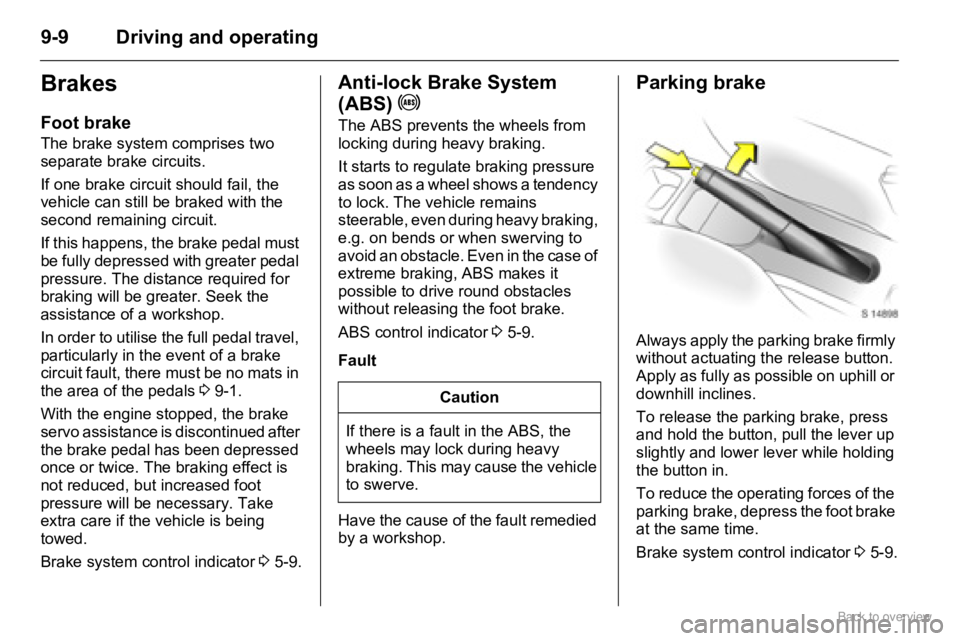
Parking brake
Always apply the parking brake firmly
without actuating the release button.
Apply as fully as possible on uphill or
downhill inclines.
To release the parking brake, press
and hold the button, pull the lever up
slightly and lower lever while holding
the button in.
To reduce the operating forces of the
parking brake, depress the foot brake
at the same time.
Brake system control indicator 3 5-9.
Caution
If there is a fault in the ABS, the
wheels may lock during heavy
braking. This may cause the vehicle
to swerve.
Page 97 of 153

9-10Driving and operating
Brake assist
Rapid powerful application of the
brake pedal automatically applies
maximum brake force amplification to
achieve the shortest possible braking
distance under full braking (brake
assist).
Maintain steady pressure on the
brake pedal for as long as full-on
braking is to continue. When the
brake pedal is released, the
maximum brake force amplification is
taken away.
Ride control systems
Electronic Stability Program
(ESP®) 3
The Electronic Stability Program
improves driving stability when
necessary, independently of the type
of road surface and the tyre grip. It
also prevents the drive wheels from
spinning.
The system monitors vehicle
movements. As soon as the vehicle
starts to swerve (understeers/
oversteers), engine output is reduced
(the sound of the engine changes)
and individual wheels are specifically
braked. This considerably improves
the driving stability of the vehicle on
snow and ice and on wet or slippery
road surfaces.
ESP
® is ready for operation as soon
as the ignition is switched on and the
control indicators
R, ESP and TCSS OFF extinguish.
When the ESP® comes into action,
control indicator
R flashes rapidly in
the instrument cluster. Some noise or
vibration may be apparent.ESP active control indicator 3 5-10.
Interruption of power supply
If the vehicle’s battery has been
disconnected and reconnected,
ESP
® is deactivated and control
indicator R flashes once per second.
Reactivate ESP® by driving in a
straight line at over 15 km/h (9 mph)
for a few seconds until flashing
ceases. Several seconds may lapse
before the control indicator
extinguishes, depending on road
conditions.
Caution
Do not let this special safety feature
tempt you into taking risks when
driving.
Traffic safety can only be achieved
by adopting a responsible driving
style.
Page 98 of 153
9-11 Driving and operating
Fault
Control indicator
ESP illuminates
during driving if there is a fault with
ESP
®. Seek the assistance of a
workshop to have the cause of the
fault remedied.
ESP fault control indicator 3 5-10.
Traction Control Support
System (TCSS) 3
TCSS is a component part of the
Electronic Stability Program (ESP®)
which helps to maintain driving
stability and prevents the drive
wheels from spinning.
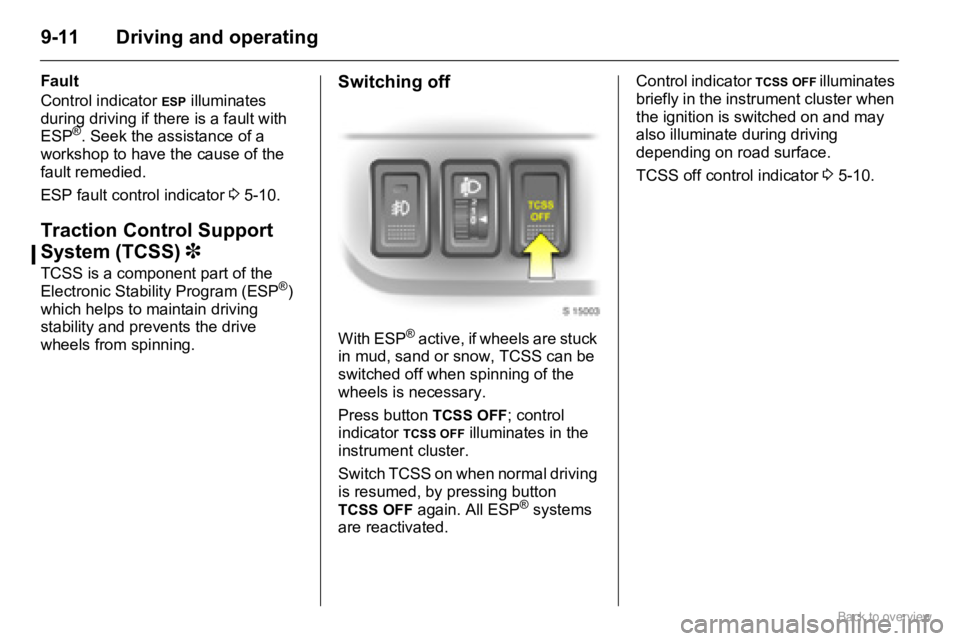
Switching off
With ESP® active, if wheels are stuck
in mud, sand or snow, TCSS can be
switched off when spinning of the
wheels is necessary.
Press button
TCSS OFF; control
indicator TCSS OFF illuminates in the
instrument cluster.
Switch TCSS on when normal driving
is resumed, by pressing button
TCSS OFF again. All ESP® systems
are reactivated.Control indicator
TCSS OFF illuminates
briefly in the instrument cluster when
the ignition is switched on and may
also illuminate during driving
depending on road surface.
TCSS off control indicator 3 5-10.
Page 101 of 153

10-1Vehicle care
Vehicle care General information
Accessories and vehicle
modifications
We recommend the use of ‘Opel
genuine parts and accessories’
expressly released for your vehicle
type. Do not make any changes to the
vehicle’s electrical systems.
End-of-life vehicle recovery
Information on end-of-life vehicle
recovery centres and the recycling of
end-of-life vehicles is available at
www.opel.com.
Vehicle checks
Bonnet .................................. 10-2
Engine oil .............................. 10-3
Engine coolant ...................... 10-4
Windscreen/rear window
washer fluid ........................ 10-5
Windscreen/rear window
wipers ................................. 10-5
Brakes ................................... 10-6
Battery .................................. 10-6
Diesel fuel system, bleeding . 10-7
Bulb replacement .................. 10-7
Fuses .................................... 10-11
Wheels .................................. 10-15
Tyre repair kit 3 ..................... 10-18
Wheel changing .................... 10-22
Jump starting 3 ..................... 10-26
Towing .................................. 10-28
Interior care........................... 10-29
Exterior care ......................... 10-30
9 Warning
Only carry out engine
compartment checks when the
ignition is switched off.
The cooling fan can start to
operate unexpectedly, even when
the ignition is switched off.
9 Danger
Electronic ignition systems
generate very high voltages. Do
not touch the ignition system; high
voltage can be fatal.
Page 115 of 153

10-15Vehicle care
Some circuits may be protected by
several fuses.
Wheels
Tyres
Factory-fitted tyres are matched to
the chassis and offer optimum driving
comfort and safety.
Winter tyres 3
Tyres of size 165/70 R 14 and
185/60 R 15 may be used as winter
tyres.
Winter tyres improve safety at
temperatures below 7
°C and should
therefore be fitted on all the wheels.
Depending on national regulations, a
notice indicating the maximum
permissible speed for the tyres must
be affixed within the driver's field of
vision.
The maximum permissible speed
varies from country to country on
account of national regulations.
Ensure that winter tyres are inflated
to the correct pressure specified by
the tyre manufacturer. No. Circuit
1Starter motor
2Air conditioning compressor
3Fuel pump
4Fuel injection
5Heater fan
6Radiator fan
7Power steering control
module
8ABS, ESP
9ABS, ESP
10Brake lamp switch
11Headlamp (right)
12Headlamp (left)
13Front fog lamps
14Ignition switch
15Ignition switch, power
windows, wipers, starter No. Circuit
Page 117 of 153

10-17Vehicle care
Tyre condition
Drive over edges slowly and at a right
angle if possible. When parking,
ensure that the tyres are not pressed
against the edge of the kerb.
Check tyres regularly for damage
(foreign bodies, punctures, cuts,
cracks, bulges in sidewalls). Check
wheels for damage. In the event of
damage or abnormal wear, seek the
assistance of a workshop.
Different tyre and wheel
types
If tyres of a different size to those
fitted at the factory are used (this
includes winter tyres), the electronic speedometer may possibly need to
be reprogrammed, to ensure that the
speed displayed is correct.
Wheel covers 3
Wheel covers and tyres that are
approved for the vehicle and comply
with all of the relevant wheel and tyre
combination requirements must be
used.
If the wheel covers and tyres used
are not approved, make sure that the
tyres do not have a beaded edge.
Remove wheel covers before fitting
tyre chains, to avoid damaging the
wheel covers.
Tyre chains 3
Tyre chains are only permitted on the
drive wheels (front axle). They must
be fitted to the tyres symmetrically in
order to achieve a concentric fit.
Use fine mesh chains that add no
more than 10 mm to the tyre tread
and the inboard sides (including
chain lock).
Tyre chains may only be used at
speeds of up to 50 km/h (30 mph) or
up to the tyre chain manufacturer’s
recommended maximum speed,
whichever is lower.
9 Warning
If the pressure is too low, this can
result in considerable tyre warm-
up and internal damage, leading
to tread separation and even to
tyre blow-out at high speeds.
Caution
Use of unsuitable tyres or wheels
may lead to accidents and render
the vehicle unroadworthy.
Page 118 of 153
10-18 Vehicle care
Tyre chains must not be used on the
temporary spare wheel.
Tyre repair kit 3
Minor damage to the tyre tread can
be temporarily repaired with the tyre
repair kit.
Do not remove foreign bodies from
the tyres. Damaged areas bigger
than 4 mm and damage at the tyre
rim cannot be repaired using the tyre
repair kit.
Never use the liquid sealant on more
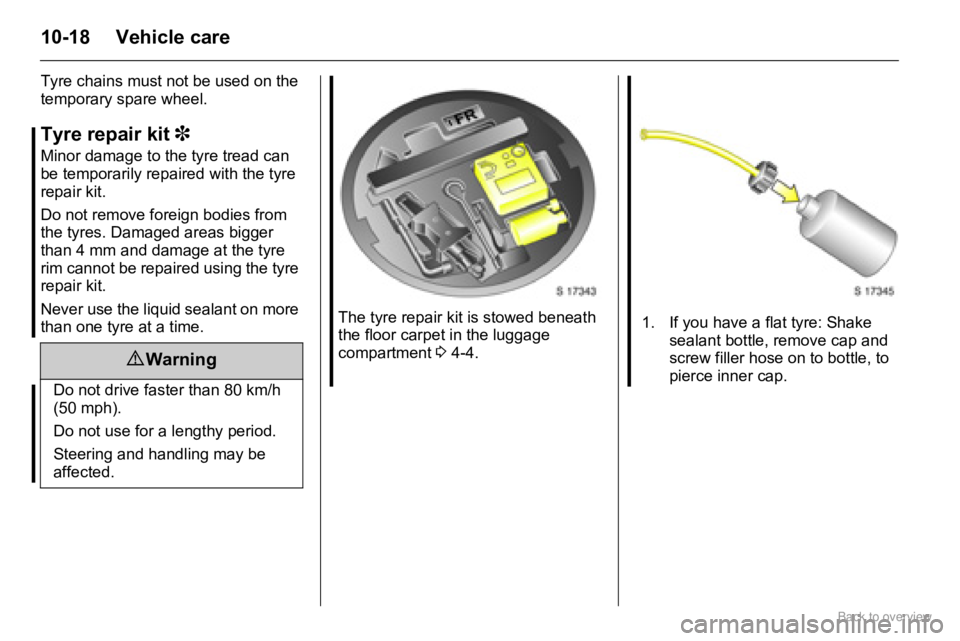
than one tyre at a time.The tyre repair kit is stowed beneath
the floor carpet in the luggage
compartment 3 4-4.
9 Warning
Do not drive faster than 80 km/h
(50 mph).
Do not use for a lengthy period.
Steering and handling may be
affected.
1. If you have a flat tyre: Shake
sealant bottle, remove cap and
screw filler hose on to bottle, to
pierce inner cap.
Page 122 of 153
10-22 Vehicle care
Wheel changing
In order to reduce the chance of
possible injuries, make the following
preparations and note the procedure:
„Park on a level, firm and non-
slippery surface.
„Switch on hazard warning lamps
and apply parking brake. Engage
reverse gear (automatic
transmission 3 in P).
„Take the spare wheel from under
the luggage compartment floor
cover 3 10-24.
„Before raising the vehicle, turn front
wheels to straight-ahead position.
„Never change more than one
wheel at a time.
„Block wheel diagonally opposite
the wheel to be changed, by
placing wedge blocks or equivalent
in front and behind the wheel.
„Use jack only when changing
wheels.
„If the ground on which the vehicle is
parked is soft, a solid board (max.
1 cm thick) should be placed under the jack. Using a thicker board
could lead to damage of the jack
and the vehicle.
„Do not raise the vehicle more than
is necessary to change a wheel.
„No people or animals may be in the
vehicle when it is jacked-up.
„Never start or run the engine or
crawl under a jacked-up vehicle.
„Before screwing on the wheel bolts
when changing a wheel, apply a
light coating of grease to the cone
of each wheel bolt.
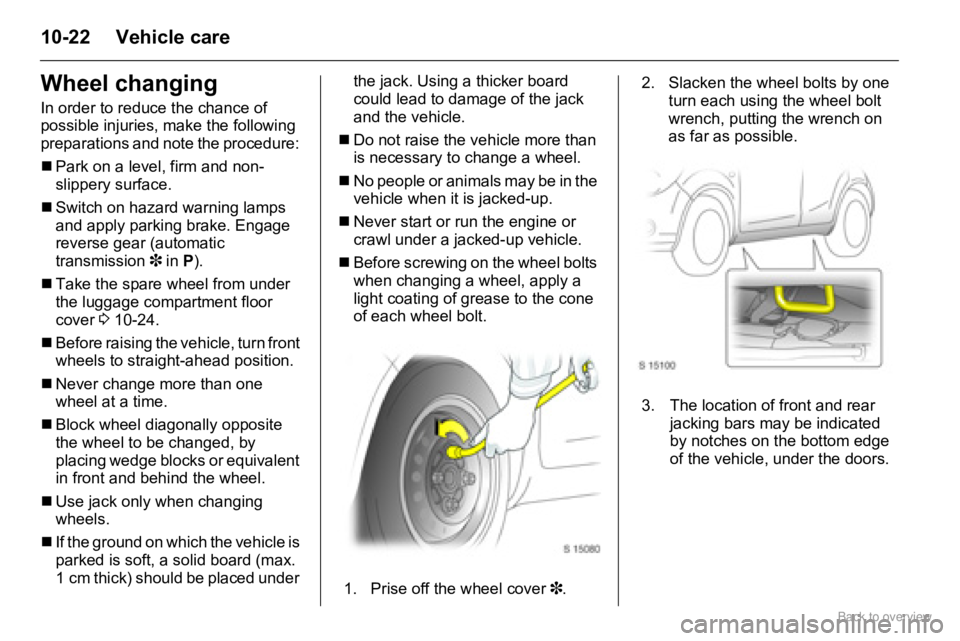
1. Prise off the wheel cover 3.
2. Slacken the wheel bolts by one
turn each using the wheel bolt
wrench, putting the wrench on
as far as possible.
3. The location of front and rear
jacking bars may be indicated
by notches on the bottom edge
of the vehicle, under the doors.
Page 123 of 153
10-23Vehicle care
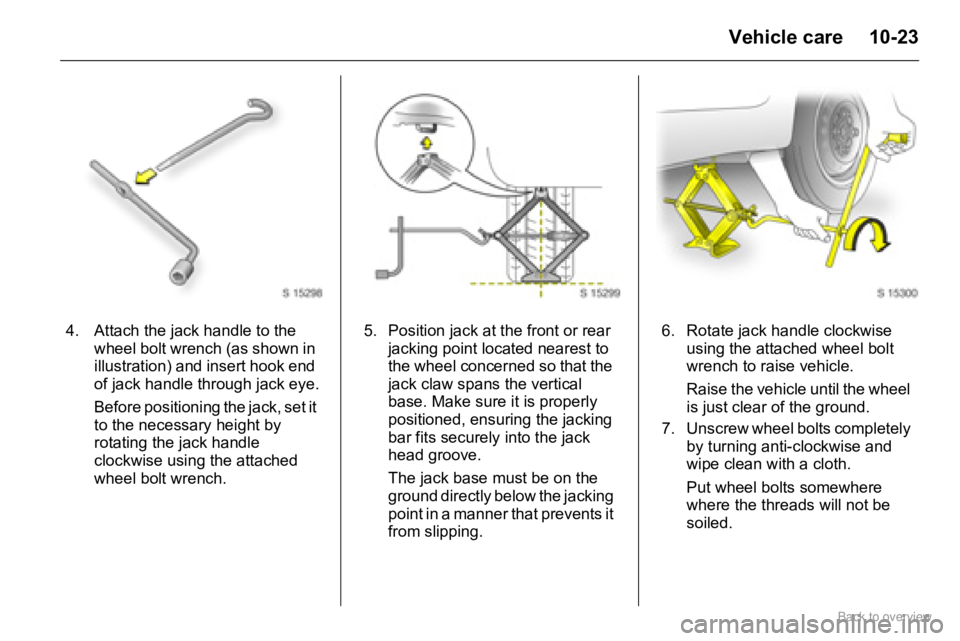
4. Attach the jack handle to the
wheel bolt wrench (as shown in
illustration) and insert hook end
of jack handle through jack eye.
Before positioning the jack, set it
to the necessary height by
rotating the jack handle
clockwise using the attached
wheel bolt wrench.5. Position jack at the front or rear
jacking point located nearest to
the wheel concerned so that the
jack claw spans the vertical
base. Make sure it is properly
positioned, ensuring the jacking
bar fits securely into the jack
head groove.
The jack base must be on the
ground directly below the jacking
point in a manner that prevents it
from slipping.6. Rotate jack handle clockwise
using the attached wheel bolt
wrench to raise vehicle.
Raise the vehicle until the wheel
is just clear of the ground.
7. Unscrew wheel bolts completely
by turning anti-clockwise and
wipe clean with a cloth.
Put wheel bolts somewhere
where the threads will not be
soiled.