wheel OPEL AGILA 2009 Owner's Guide
[x] Cancel search | Manufacturer: OPEL, Model Year: 2009, Model line: AGILA, Model: OPEL AGILA 2009Pages: 153, PDF Size: 1.82 MB
Page 124 of 153
10-24 Vehicle care
Temporary spare wheel
The temporary spare wheel is
designed for use on your vehicle only.
Do not attempt to use the spare tyre
on a different wheel, or use a different
tyre on the spare wheel, as they will
not fit.
Ensure the temporary spare wheel is
inflated to the correct tyre pressure 3
12-8.The temporary spare wheel is located
in the luggage compartment and is
secured with a screw-in retainer.
To access the spare wheel, open
tailgate and pull up luggage
compartment floor carpet using the
central strap located near the tailgate
latch and hang the string on the hook
provided 3 4-4.
If equipped, remove the under floor
storage compartment 3 from the
luggage compartment by pulling it up
by the handle located near the
tailgate latch, to access the spare
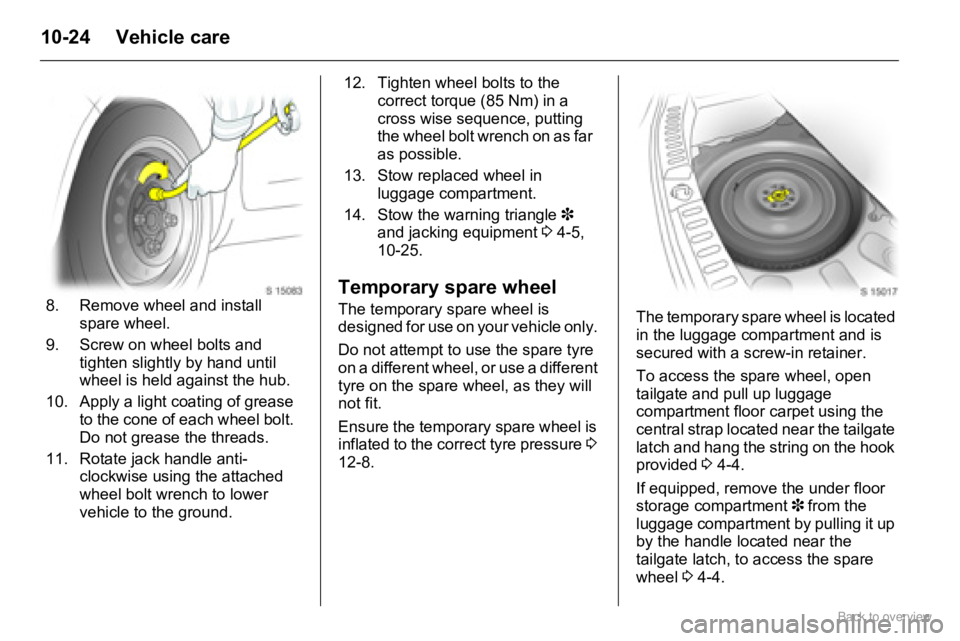
wheel 3 4-4. 8. Remove wheel and install
spare wheel.
9. Screw on wheel bolts and
tighten slightly by hand until
wheel is held against the hub.
10. Apply a light coating of grease
to the cone of each wheel bolt.
Do not grease the threads.
11. Rotate jack handle anti-
clockwise using the attached
wheel bolt wrench to lower
vehicle to the ground.
12. Tighten wheel bolts to the
correct torque (85 Nm) in a
cross wise sequence, putting
the wheel bolt wrench on as far
as possible.
13. Stow replaced wheel in
luggage compartment.
14. Stow the warning triangle 3
and jacking equipment 3 4-5,
10-25.
Page 125 of 153

10-25Vehicle care
Remove the retainer by rotating it
anti-clockwise, and remove spare
wheel from the spare wheel well.
General information
If you use winter tyres 3, the spare
wheel may still be fitted with a
summer tyre.
If you use the spare wheel when it is
fitted with a summer tyre, the
vehicle's driveability may be affected,
especially on slippery road surfaces.
Obtain a replacement for the faulty
tyre as soon as possible, and have
the wheel balanced and fitted to the
vehicle.
„Using a temporary spare wheel
may change the driving behaviour
of the vehicle, particularly if using
winter tyres3. Replace defective
tyre as quickly as possible, balance
wheel and fit to vehicle.
„Fit only one temporary spare
wheel.
„Do not drive faster than 80 km/h
(50 mph).
„Take curves slowly.„Do not use the temporary spare
wheel for a lengthy period.
„Replace temporary spare wheel
with full specification wheel without
delay.
„When temporary spare wheel is
fitted, do not take the vehicle
through an automatic car wash with
guide rails. The temporary spare
wheel may get caught on the rails,
causing damage to the tyre, wheel
and other vehicle parts.
„Tyre chains are not permitted on
the temporary spare wheel.
„If tyre chains are necessary after a
front wheel puncture, fit the
temporary spare wheel to the rear
and a rear wheel to the front. Check
tyre pressure and adjust if
necessary 3 12-8.Tools
To access the jack, vehicle tools and
tyre repair kit 3 (3 10-18), open
tailgate and pull up luggage
compartment floor carpet using the
central strap located near the tailgate
latch and hang the string on the hook
provided 3 4-4.
The jack and vehicle tools are located
below the spare wheel.
If equipped, remove the under floor
storage compartment 3 from the
luggage compartment by pulling it up
by the handle located near the
tailgate latch 3 4-4.
Page 128 of 153
10-28 Vehicle care
Towing
Towing the vehicle
Towing from the front is permissible
in emergency situations only.
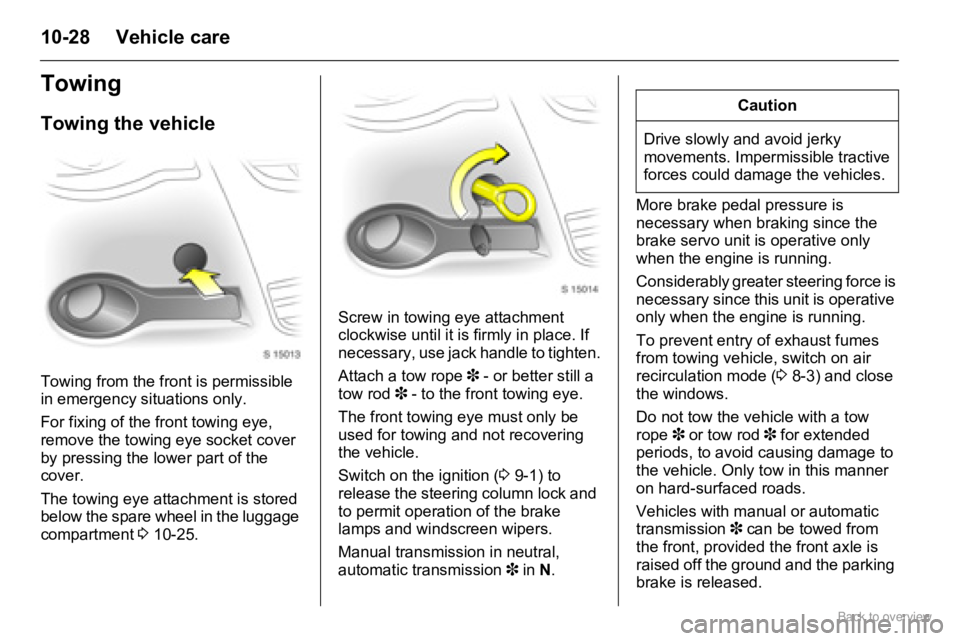
For fixing of the front towing eye,
remove the towing eye socket cover
by pressing the lower part of the
cover.
The towing eye attachment is stored
below the spare wheel in the luggage
compartment 3 10-25.Screw in towing eye attachment
clockwise until it is firmly in place. If
necessary, use jack handle to tighten.
Attach a tow rope 3 - or better still a
tow rod 3 - to the front towing eye.
The front towing eye must only be
used for towing and not recovering
the vehicle.
Switch on the ignition (3 9-1) to
release the steering column lock and
to permit operation of the brake
lamps and windscreen wipers.
Manual transmission in neutral,
automatic transmission 3 in N.More brake pedal pressure is
necessary when braking since the
brake servo unit is operative only
when the engine is running.
Considerably greater steering force is
necessary since this unit is operative
only when the engine is running.
To prevent entry of exhaust fumes
from towing vehicle, switch on air
recirculation mode (3 8-3) and close
the windows.
Do not tow the vehicle with a tow
rope3 or tow rod 3 for extended
periods, to avoid causing damage to
the vehicle. Only tow in this manner
on hard-surfaced roads.
Vehicles with manual or automatic
transmission3 can be towed from
the front, provided the front axle is
raised off the ground and the parking
brake is released.
Caution
Drive slowly and avoid jerky
movements. Impermissible tractive
forces could damage the vehicles.
Page 129 of 153
10-29Vehicle care
Vehicles with manual transmission
can also be towed from the front with
all four wheels on the ground. In this
case, the gearshift lever must be in
neutral with the parking brake
released and the key in ignition
switch position ACC, to permit
release of the steering column lock
before towing.
Seek the assistance of a workshop.
After towing, unscrew the towing eye
attachment anti-clockwise and refit
the cover.Towing another vehicleInterior care
Interior and upholstery
Clean the vehicle interior regularly,
including the instrument panel facia,
using Interior/Upholstery Cleaner.
Clean fabric upholstery with a
vacuum cleaner and brush. To
remove stains, use a cleaner that is
suitable for both fabrics and vinyl.
Clean seat belts only with lukewarm
water or Interior/Upholstery Cleaner.
Caution
Never tow the vehicle with the front
wheels on the ground, to avoid
causing damage to the automatic
transmission 3.
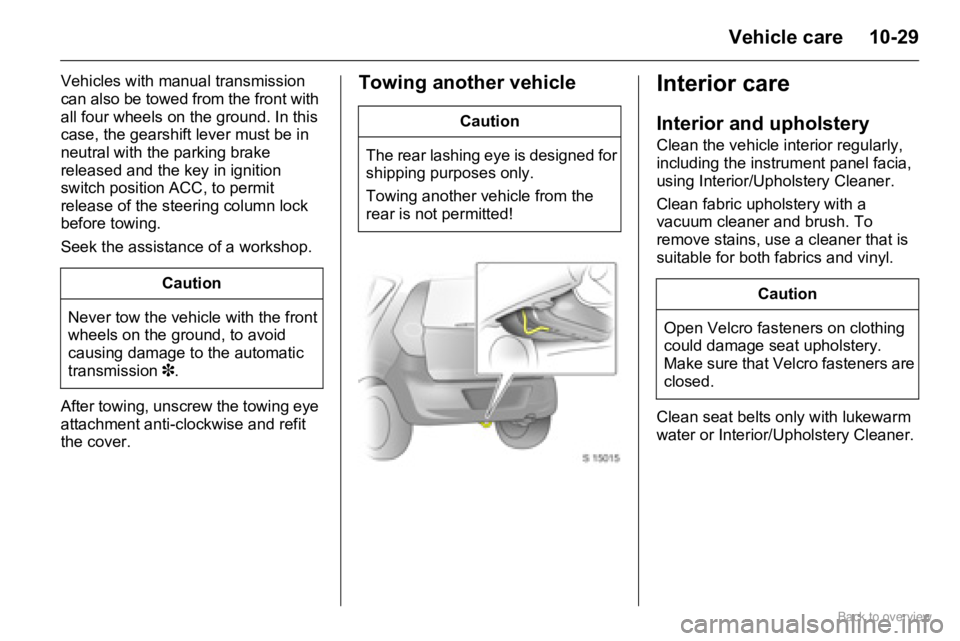
Caution
The rear lashing eye is designed for
shipping purposes only.
Towing another vehicle from the
rear is not permitted!
Caution
Open Velcro fasteners on clothing
could damage seat upholstery.
Make sure that Velcro fasteners are
closed.
Page 131 of 153

10-31Vehicle care
Polishing
Polishing is necessary only if the
paint has become dull or if solid
deposits have become attached to it.
Paintwork polish with silicone forms a
protective film, making waxing
unnecessary.
Plastic body parts should not be
treated with wax and polish.
Use Metallic Paintwork Wax on
vehicles with a metallic-effect paint
finish.
Plastic and rubber parts
For additional cleaning of plastic and
rubber parts, use a cleaner suitable
for vehicle interiors. Do not use any
other agent, and in particular do not
use solvents or petrol.
Windows and wiper blades
When cleaning the heated rear
window, make sure that the heating
element on the inside of the window
is not damaged. Never place stickers
on the inside of the rear window.Use a soft, lint-free cloth or chamois
leather, in conjunction with Window
Cleaning Spray and Insect Remover.
Do not use sharp instruments or
abrasive cleaners.
Windscreen Wash Solvent is suitable
for de-icing windows.
For mechanical removal of ice, use a
commercially available sharp-edged
ice scraper. Press the scraper firmly
against the glass so that no dirt can
get under it and scratch the glass.
Wax, such as that used in car
washes, can cause streaks to form on
the windscreen when the wipers are
used.
Wiper blades can be cleaned with a
soft cloth and Windscreen Wash
Solvent. Do not use abrasive
cleaners.Tyres and wheels
Do not use high-pressure jet cleaners
on wheels and tyres.
Use a pH-neutral wheel cleaning
agent to clean the wheels.Avoid using abrasive materials and
brushes that can damage the finish.
Wheels are painted and can be
treated with the same agents as the
body. For alloy wheels 3, we
recommend the use of Alloy Wheel
Preserver.
Paint damage
Repair small areas of paint damage
such as stone impacts, scratches etc.
before rust can form. If rust has
already formed, have the cause
remedied. Seek the assistance of a
workshop.
Underbody
Your vehicle has a factory-applied
PVC undercoating in the wheel
arches (including the longitudinal
members) which provides permanent
protection and needs no special
maintenance. The surfaces of the
vehicle underbody not covered by
PVC are provided with a durable
protective wax coating in critical
areas.
Page 135 of 153

11-3 Service and maintenance
Service operations by year 1)
km ( x 1000)1)
miles ( x 1000)1)
1)Whichever occurs first.⊕Additional operations.o Under extreme operating conditions and if required by country-specific conditions, the intervals are reduced.
1
15
102
30
203
45
304
60
405
75
506
90
60
Ribbed V-belt: visual check - petrol engines only x x
⊕ Replace every 6 years/90,000 km/60,000 miles
Ribbed V-belt and tensioner: visual check - diesel engines only x x x
⊕ Replace every 10 years/150,000 km/100,000 miles
⊕Valve clearances: check, adjust - petrol engines only x x x
Engine oil and oil filter: replace x x x x x x
oDiesel fuel filter: drain water x x x x x x
Diesel fuel filter: replace and bleed x x x
⊕Manual transmission: oil level check, correct x
Oil changexx
Parking brake cable: check, adjust x
Parking brake: check and adjust
Wheel mounting and suspension front and rear, brake lines, brake
pressure hoses, fuel lines, fuel tank and exhaust system: visual checkxxx
Corrosion protection: check and record in Service and Warranty Booklet annually
Front and rear wheel brakes: check visually x x x x x x
Page 136 of 153

11-4 Service and maintenance
⊕Additional operations.o Under extreme operating conditions and if required by country-specific conditions, the intervals are reduced.
Service operations by year 1)
km ( x 1000)1)
miles ( x 1000)1)
1
15
102
30
203
45
304
60
405
75
506
90
60
o⊕Automatic transmission fluid level: check correct x x x
Fluid hose: inspectx
Fluid: change every 165,000 km/110,000 miles
Engine, transmission, A/C compressor: check for leaks x x x x x x
oBrake drum: remove, clean, visual check x
Steering system boots, track rods, final drive: visual check x x
Track rod end and supporting ball joint: check x x x
⊕Brake and clutch fluid: change every 2 years
Wheel fastening: loosen and tighten to torque
Tyre condition and pressures: check, correctxxxxxx
First aid kit: visual check every 2 years
Headlamp aiming: check, adjust x x x
Door hinges, door stop, lock cylinder, lock striker, bonnet catch, tailgate
hinges and check links: lubricate xxx
Test drive, final check
Service interval display and oil life monitor: reset - if applicablexxxxxx
1)Whichever occurs first.
Page 145 of 153

12-6 Technical data
Dimensions
(approx.)
Overall length (mm) 3740
Width (mm) 1680
Overall height (mm) 1590
Wheelbase (mm) 2360
Turning circle diameter, kerb to kerb (m) 9.6
Page 149 of 153

13-2Index
Changing the battery
Remote control ....................... 2-2
Changing tyre/wheel type
...... 10-17
Changing wheels
................... 10-22
Charging system ........................ 5-9
Chassis number, see Vehicle
Identification Number
......12-1, 12-2
Child restraint systems ............... 3-9
Child safety locks
....................... 2-4
Cigarette lighter
.......................... 5-5
Cleaning ................................. 10-30
Climate controls
......................... 8-1
Clock
.......................................... 5-3
Clutch fluid ............................... 10-6
Clutch operation
..................9-2, 9-6
Cold starts
.................................. 9-8
Control indicators ....................... 5-5
ABS
........................................ 5-9
Airbags
................................... 5-9
Belt tensioners ........................ 5-9
Brake system
.......................... 5-9
Charging system
..................... 5-9
Diesel particle filter ........5-13, 9-7
Door ajar
........................2-5, 5-12
Driver’s seat belt
..............3-7, 5-9
Electronic Stability Program .5-10
Engine coolant temperature
.5-11
Engine electronics
................ 5-13
Engine oil change ........5-12, 5-14Engine oil pressure
............... 5-11
ESP .............................5-10, 9-11
Exhaust
................................. 5-11
Exhaust emissions
................ 5-11
Front fog lamps ..............5-12, 6-3
Fuel level
............. 5-7, 5-11, 5-13
Headlamp range adjustment
5-12
High beam .....................5-12, 6-2
Immobiliser
....................2-7, 5-12
Passenger airbag status
....... 3-18
Power steering ...................... 5-10
Preheating
............................ 5-11
Rear fog lamp
................5-12, 6-3
Service transmission .......5-9, 9-5
Service vehicle soon
............. 5-12
Theft-deterrent
...............2-7, 5-12
Traction Control Support
System off
....................5-10, 9-11
Turn signal lamps
................. 5-13
Coolant ............................10-4, 11-6
Coolant level
............................ 10-4
Coolant temperature
................ 5-11
Cooling ....................................... 8-3
Cooling fan
................ 9-3, 9-7, 10-1
Correcting time
........................... 5-3
Corrosion
protection
............ 10-4, 10-31, 11-6
Courtesy lamps
.......................... 6-4
Bulb replacement ................ 10-11Cup holders
................................4-1
Curtain airbags .........................3-16
D
Dashboard - see
Instrument panel
........................1-5
Data
..........................................12-1
Demisting and defrosting
...........8-2
Diesel .......................................9-12
Diesel fuel system
....................10-7
Diesel particle filter (DPF)
5-13, 9-7
Dimensions ..............................12-6
Dipped beam
..............................6-2
Bulb replacement
..................10-7
Display ............................... 5-6, 5-7
Door locks
..............................10-30
Doors
................................ 2-5, 5-12
Driver’s airbag ..........................3-13
Driving abroad
............................6-3
Driving hints
...............................9-1
E
Electric throttle body system
....5-11
Electrical system
....................10-11
Electronic Stability Program .....9-10
Emissions
....................... 9-13, 12-4
Engine braking assistance
.........9-4
Engine code ................... 12-2, 12-3
Engine coolant temperature
.....5-11
Engine data
..............................12-3
Page 150 of 153

13-3 Index
Engine oil ........................ 10-3, 11-6
Additives ............................... 11-6
Topping up
.................. 10-3, 11-6
Viscosity
............................... 11-6
Engine oil level and
consumption
............................ 10-3
Engine oil life monitor
.............. 5-14
Engine oil pressure .................. 5-11
Engine speed
............................. 5-6
Engine wash
.......................... 10-32
Environmental protection ....... 10-30
ESP (Electronic Stability
Program)
.................................. 9-10
Exhaust gases ........................... 9-8
Exhaust system
......................... 9-8
Exterior care
.......................... 10-30
Exterior lamps ............................ 6-1
Exterior mirrors
.......................... 2-8
F
Fan
............................................ 8-2
Filling station
Capacities
............................ 12-5
Engine oil level ..................... 10-3
Fuel
............................. 9-12, 12-3
Opening the bonnet
.............. 10-2
Tyre pressure ....................... 12-8
Vehicle data
......................... 12-1
Windscreen washer system
. 10-5
First aid kit ................................. 4-5Flat tyre
.................................. 10-24
Foot brake ................................. 9-9
Front airbags
........................... 3-13
Front fog lamps
.......................... 6-3
Bulb replacement ................. 10-8
Front passenger’s airbag
......... 3-13
Deactivation
......................... 3-17
Front turn signal lamps
Bulb replacement
................. 10-8
Fuel
.......................................... 9-12
Fuel consumption ........... 9-13, 12-4
Fuel filler cap
........................... 9-13
Fuel gauge
................................. 5-7
Fuse extractor ........................ 10-12
Fuses
..................................... 10-11
G
Gears
......................................... 9-6
Generator, see Charging system
5-9
Glove box
.................................. 4-1
Gross Vehicle Weight ..... 9-12, 12-7
H
Hand brake, see Parking brake
.9-9
Hazard warning lamps ............... 6-2
Head restraints
.......................... 3-1
Headlamp flash
.......................... 6-2
Headlamp range adjustment ..... 6-1Headlamps
................................ 6-1
Bulb replacement ................. 10-7
Driving abroad
........................ 6-3
Front fog lamps
...................... 6-3
Warning chime ..................... 5-13
Heated exterior mirrors
.............. 8-5
Heated rear window
................... 8-5
Heating ...................................... 8-1
Exterior mirrors
....................... 8-5
Rear window
.......................... 8-5
Height adjustment
Head restraints
....................... 3-1
Seat belts
............................... 3-8
Steering wheel ....................... 5-1
High beam
................................. 6-2
Bulb replacement
................. 10-7
High-pressure cleaners 10-30, 10-31
Horn
........................................... 5-2
I
Identification plate
.................... 12-1
Ignition switch
............................ 9-1
Ignition system
........................... 9-2
Immobiliser ................................ 2-7
Infotainment system
.................. 7-1
Instrument cluster
...................... 5-8
Instrument panel ........................ 1-5
Instruments
................................ 5-1
Interior care
........................... 10-29