ABS OPEL AGILA 2009 Owners Manual
[x] Cancel search | Manufacturer: OPEL, Model Year: 2009, Model line: AGILA, Model: OPEL AGILA 2009Pages: 153, PDF Size: 1.82 MB
Page 59 of 153

5-9Instruments and controls
X Driver’s seat belt
Will illuminate in red when ignition is
switched on if driver’s seat belt is not
engaged.
If vehicle speed exceeds 15 km/h
(9 mph) and driver’s seat belt is not
engaged, the control indicator will
flash for approx. 90 seconds along
with a warning chime and then
illuminate until driver’s seat belt is
fastened correctly.
Seat belts 3 3-5.
v Airbag systems, belt
tensioners
Will flash in red several times when
the ignition is switched on, then
extinguish.
If it does not flash when the ignition is
switched on, stays lit, illuminates or
flashes whilst driving, there is a fault
with the airbag systems or with the
belt tensioners. The systems might
not therefore be triggered in the event
of an accident. Seek the assistance
of a workshop immediately.
Belt tensioners 3 3-6, airbags 3 3-13.
p Charging system
Will illuminate in red when ignition is
switched on. Extinguishes after
engine is started.
If it stays lit after the ignition is
switched on or illuminates during
driving: stop vehicle and switch off
engine. The battery is not being
charged and the engine cooling may
be interrupted. The brake servo unit
may cease to be effective. Interrupt
your journey immediately.
Remove ignition key and check drive
belt condition and tensioning before
seeking the assistance of a
workshop.
s Service transmission 3
Will illuminate briefly in yellow when
the ignition is switched on.
If it flashes, there is a fault in the
automatic transmission. Seek the
assistance of a workshop
immediately.
Automatic transmission 39-3.
R Brake system
Will illuminate in red when ignition is
switched on. Extinguishes after
engine is started.
Illuminates when engine is running if
parking brake is applied and/or fluid
level for brake hydraulics is too low.
Further information 3 9-9,
brake fluid level 3 10-6.
u Anti-lock Brake System
(ABS)
Will illuminate briefly in yellow when
ignition is switched on.
At the same time, the system
performs a self-check. When the
control indicator extinguishes, the
system is ready for operation.
Caution
If it illuminates when the parking
brake is not applied: stop vehicle;
interrupt your journey immediately.
Seek the assistance of a workshop.
Page 60 of 153

5-10 Instruments and controls
If it does not illuminate when the
ignition is switched on, stays lit or
illuminates during driving, there is a
fault in the ABS. The vehicle’s brake
system may remain operational
without ABS regulation.
If it illuminates during driving along
with brake system control indicator
R, there is a serious fault in the
brake system. Seek the assistance of
a workshop immediately, to have the
system checked.
Further information 3 9-9.
2 Power steering
Will illuminate in yellow when ignition
is switched on. Extinguishes after
engine is started.
If it does not illuminate when the
ignition is switched on, stays lit or
illuminates during driving, there is a
fault in the system. Seek the
assistance of a workshop as soon as
possible.
TCSS OFF Traction Control
Support System off 3
Will illuminate briefly in yellow when
the ignition is switched on.
When the TCSS OFF switch (located
on the lower instrument panel) is
pressed, the control indicator
illuminates. The traction control
aspect of the Electronic Stability
Program (ESP
®) is switched off.
With ESP® active, if wheels are
slipping on wet, snowy or icy roads,
the traction control aspect of ESP
®
may switch off automatically and the
control indicator will illuminate. It will
extinguish automatically when
prevailing road conditions improve.
Further information 3 9-11.
R Electronic Stability
Program (ESP®) active 3
Will illuminate briefly in yellow when
the ignition is switched on.
If it stays lit or illuminates during
driving, there may be a fault with
ESP
®. Seek the assistance of a
workshop.If it flashes 5 times per second when
the engine is running, the system has
come into action. The engine output
may be reduced (the sound of the
engine changes) and the vehicle may
be braked automatically to a small
degree.
If it remains illuminated whilst driving,
there may be a fault with ESP
®. The
vehicle’s brake system remains
operational without ESP
® regulation.
Seek the assistance of a workshop to
have the cause of the fault remedied.
If the vehicle’s battery has been
disconnected and reconnected,
ESP
® is deactivated and the control
indicator flashes once per second.
Reactivate ESP
® by driving in a
straight line at over 15 km/h (9 mph)
for a few seconds until flashing
ceases.
Further information 3 9-10.
ESP
Electronic Stability
Program (ESP®) fault 3
Will illuminate briefly in yellow when
the ignition is switched on.
Page 96 of 153
9-9 Driving and operating
Brakes
Foot brake
The brake system comprises two
separate brake circuits.
If one brake circuit should fail, the
vehicle can still be braked with the
second remaining circuit.
If this happens, the brake pedal must
be fully depressed with greater pedal
pressure. The distance required for
braking will be greater. Seek the
assistance of a workshop.
In order to utilise the full pedal travel,
particularly in the event of a brake
circuit fault, there must be no mats in
the area of the pedals 3 9-1.
With the engine stopped, the brake
servo assistance is discontinued after
the brake pedal has been depressed
once or twice. The braking effect is
not reduced, but increased foot
pressure will be necessary. Take
extra care if the vehicle is being
towed.
Brake system control indicator 3 5-9.
Anti-lock Brake System
(ABS) u
The ABS prevents the wheels from
locking during heavy braking.
It starts to regulate braking pressure
as soon as a wheel shows a tendency
to lock. The vehicle remains
steerable, even during heavy braking,
e.g. on bends or when swerving to
avoid an obstacle. Even in the case of
extreme braking, ABS makes it
possible to drive round obstacles
without releasing the foot brake.
ABS control indicator 3 5-9.
Fault
Have the cause of the fault remedied
by a workshop.
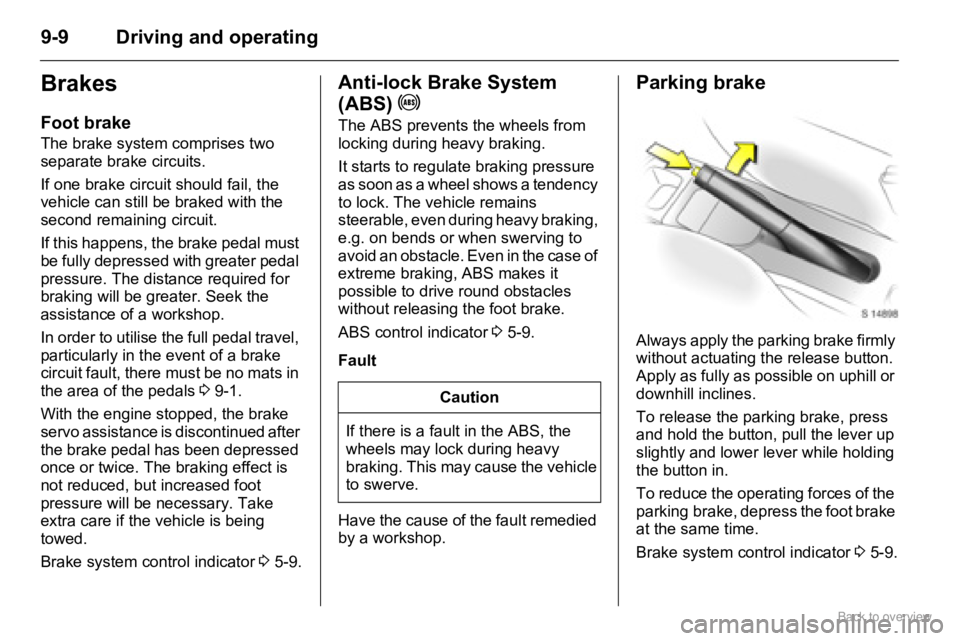
Parking brake
Always apply the parking brake firmly
without actuating the release button.
Apply as fully as possible on uphill or
downhill inclines.
To release the parking brake, press
and hold the button, pull the lever up
slightly and lower lever while holding
the button in.
To reduce the operating forces of the
parking brake, depress the foot brake
at the same time.
Brake system control indicator 3 5-9.
Caution
If there is a fault in the ABS, the
wheels may lock during heavy
braking. This may cause the vehicle
to swerve.
Page 113 of 153
10-13Vehicle care
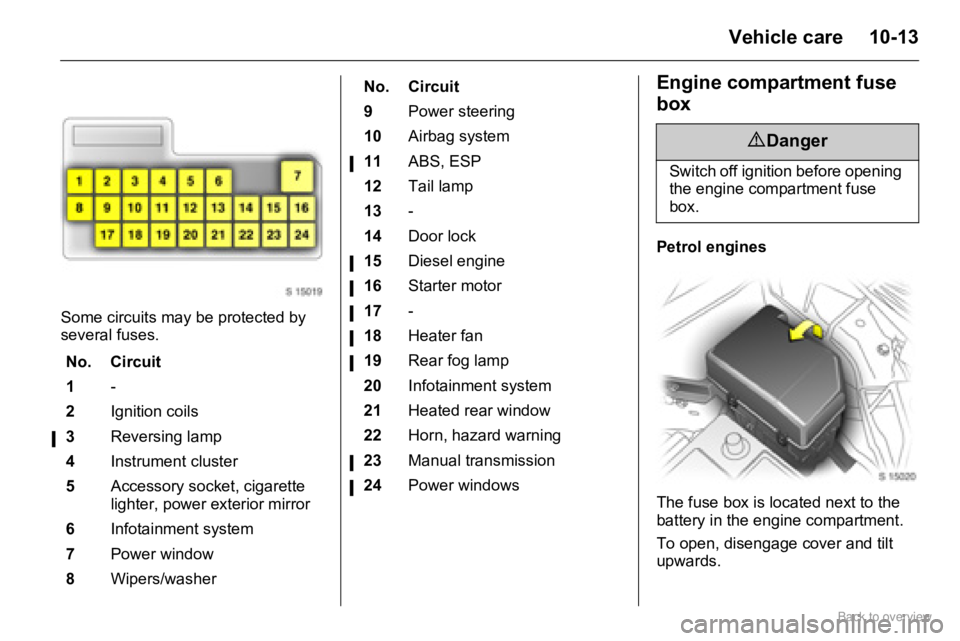
Some circuits may be protected by
several fuses.
Engine compartment fuse
box
Petrol engines
The fuse box is located next to the
battery in the engine compartment.
To open, disengage cover and tilt
upwards. No. Circuit
1-
2Ignition coils
3Reversing lamp
4Instrument cluster
5Accessory socket, cigarette
lighter, power exterior mirror
6Infotainment system
7Power window
8Wipers/washer
9Power steering
10Airbag system
11ABS, ESP
12Tail lamp
13-
14Door lock
15Diesel engine
16Starter motor
17-
18Heater fan
19Rear fog lamp
20Infotainment system
21Heated rear window
22Horn, hazard warning
23Manual transmission
24Power windows No. Circuit
9 Danger
Switch off ignition before opening
the engine compartment fuse
box.
Page 114 of 153
10-14 Vehicle care
Do not store any objects behind the
cover.
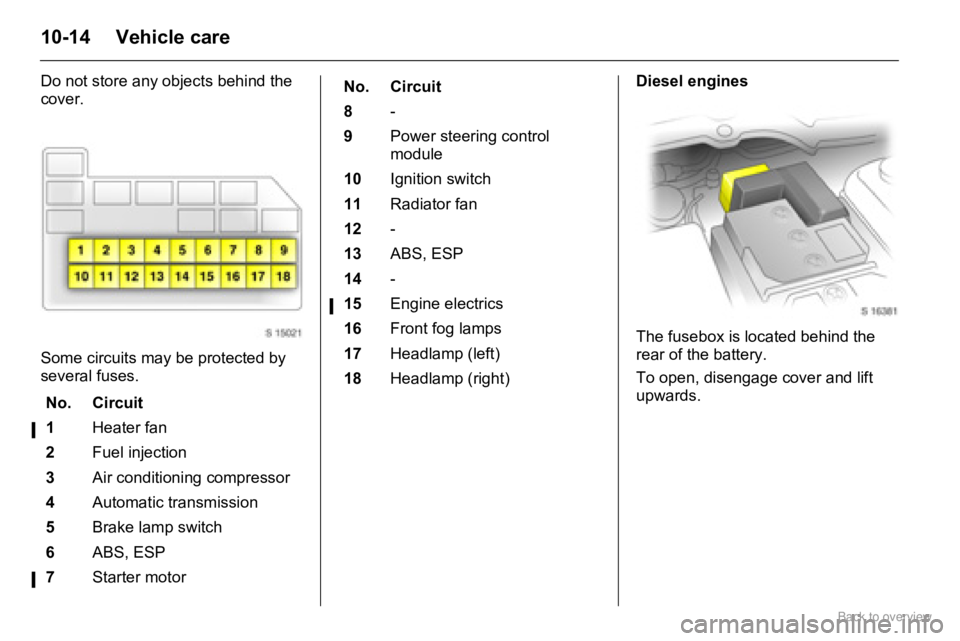
Some circuits may be protected by
several fuses.Diesel engines
The fusebox is located behind the
rear of the battery.
To open, disengage cover and lift
upwards.
No. Circuit
1Heater fan
2Fuel injection
3Air conditioning compressor
4Automatic transmission
5Brake lamp switch
6ABS, ESP
7Starter motor
8-
9Power steering control
module
10Ignition switch
11Radiator fan
12-
13ABS, ESP
14-
15Engine electrics
16Front fog lamps
17Headlamp (left)
18Headlamp (right) No. Circuit
Page 115 of 153
10-15Vehicle care
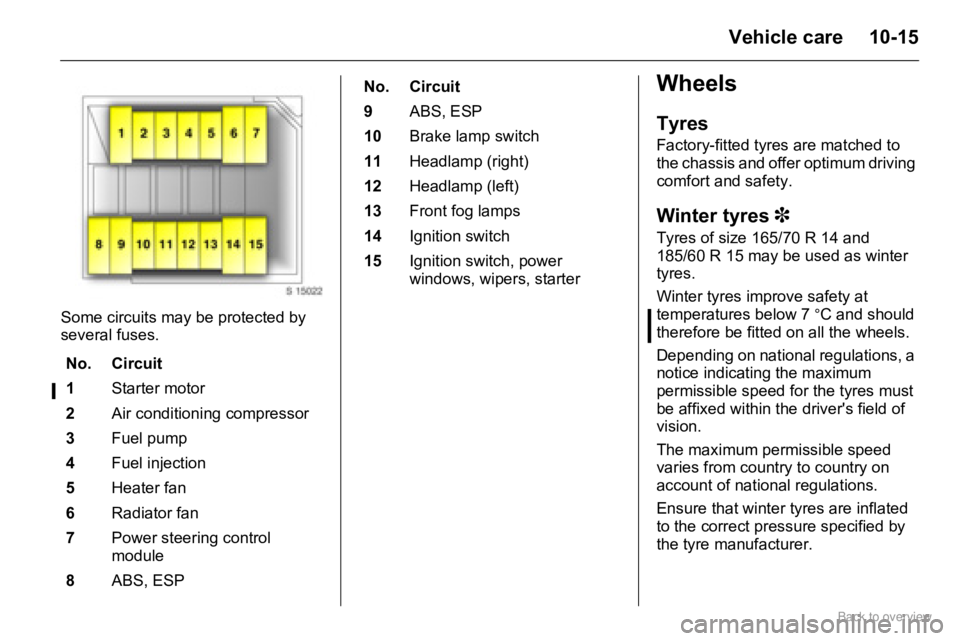
Some circuits may be protected by
several fuses.
Wheels
Tyres
Factory-fitted tyres are matched to
the chassis and offer optimum driving
comfort and safety.
Winter tyres 3
Tyres of size 165/70 R 14 and
185/60 R 15 may be used as winter
tyres.
Winter tyres improve safety at
temperatures below 7
°C and should
therefore be fitted on all the wheels.
Depending on national regulations, a
notice indicating the maximum
permissible speed for the tyres must
be affixed within the driver's field of
vision.
The maximum permissible speed
varies from country to country on
account of national regulations.
Ensure that winter tyres are inflated
to the correct pressure specified by
the tyre manufacturer. No. Circuit
1Starter motor
2Air conditioning compressor
3Fuel pump
4Fuel injection
5Heater fan
6Radiator fan
7Power steering control
module
8ABS, ESP
9ABS, ESP
10Brake lamp switch
11Headlamp (right)
12Headlamp (left)
13Front fog lamps
14Ignition switch
15Ignition switch, power
windows, wipers, starter No. Circuit
Page 132 of 153

10-32 Vehicle care
On vehicles which are washed
frequently in automatic car washes
with underbody washing facility, the
protective wax coating may be
impaired by dirt-dissolving additives.
Check the underbody after washing
and have it waxed if necessary.
Before the start of the cold weather
season, check the PVC coating and
protective wax coating and, if
necessary, have them restored to
perfect condition.
The underbody should be washed
following the end of the cold weather
season to remove any dirt adhering to
the underbody since this may also
contain salt. Check protective wax
coating and, if necessary, have it
restored to perfect condition.
Engine compartment
Areas of the engine compartment that
are painted in the same colour as the
vehicle must be looked after like any
other painted surface.
It is advisable to wash the engine
compartment before and after winter
and preserve it with wax. Cover alternator and fluid reservoirs with
plastic sheets before washing the
engine.
When washing the engine with a
steam-jet cleaner, do not direct the
steam-jet at components of the
Anti-lock Brake System (ABS), the air
conditioning system 3 or the belt
drive and its components.
Protective wax that has been applied
is also removed during the engine
wash. For this reason, have the
engine, brake system components in
the engine compartment, axle
components with steering, body parts
and cavities thoroughly preserved
with protective wax after the wash.
An engine wash can be performed in
the spring in order to remove dirt that
has adhered to the engine
compartment, which may also have a
high salt content. Check protective
wax layer and make good if
necessary.
Page 139 of 153
11-7Service and maintenance
The system is factory-filled with
coolant designed for frost protection
down to approx. -28 °C. This
concentration should be maintained
all year-round.
Coolant additives intended to give
additional corrosion protection or seal
against minor leaks can cause
function problems. Liability for
consequences resulting from the use
of coolant additives will be rejected.
Brake and clutch fluid
Only use DOT4 brake fluid.
Over time, brake fluid absorbs
moisture which will reduce braking
effectiveness. The brake fluid should
therefore be replaced at the specified
interval.
Brake fluid should be stored in a
sealed container to avoid water
absorption. Ensure it does not become
contaminated with fluids containing
mineral oil (oil, petrol, cleaner) as this
can damage the seals and sleeves of
the brake system.Transmission fluid
Use fluid meeting specification
Grade: API GL-4
Viscosity: 75W-85 or 75W-90.
Automatic transmission fluid
Use fluid meeting specification
ATF3309.
9 Warning
Brake fluid is poisonous!
Caution
Due to its corrosive nature, it must
not come in contact with the
paintwork. Flush any escaped
brake fluid with plenty of water.
Page 148 of 153

13-1 Index
IndexA
ABS ........................................... 9-9
Accessories
............... 3-9, 4-5, 10-6
Accessory socket
....................... 5-4
Air conditioning system ....... 8-1, 8-3
Air intake
.................................... 8-6
Air recirculation
.......................... 8-3
Air vents ..................................... 8-4
Airbags
.................................... 3-13
Alternator, see Charging system
5-9
Antenna .......................... 7-6, 10-30
Antifreeze
....................... 10-4, 11-6
Antifreeze protection
....... 10-4, 10-5
Anti-knock quality of fuel .......... 9-12
Octane number
.................... 12-3
Anti-theft locking system
............ 2-6
Anti-theft protection ................... 9-2
Ashtrays
..................................... 5-5
Automatic transmission
............. 9-3
Automatic mode ..................... 9-4
Engine braking assistance
..... 9-4
Fault
....................................... 9-5
Interruption of power supply ... 9-5
Kickdown
................................ 9-4
Rocking the vehicle
................ 9-5
Selector lever ......................... 9-4
Transmission display
.............. 9-3
Automatic wiping
....................... 5-3B
Battery
..................................... 10-6
Interruption of power supply
... 9-5
Before starting-off
...................... 9-2
Belt force limiters ....................... 3-6
Belt tensioners
........................... 3-6
Belts
................................ 3-5, 10-29
Bleeding, diesel fuel system .... 10-7
Bonnet
..................................... 10-2
Boot, see Luggage compartment
3-3
Brake assist ............................. 9-10
Brake fluid
................................ 11-7
Brake system
............................. 9-9
Brakes ....................................... 9-9
ABS
........................................ 9-9
Brake assist
.......................... 9-10
Brake fluid ............................ 10-6
Brake lamps
......................... 10-9
Foot brake
.............................. 9-9
Parking brake ......................... 9-9
Bulb replacement
..................... 10-7
C
Capacities
................................ 12-5
Care
....................................... 10-29
Catalytic converter
..................... 9-8
Central locking system ....... 2-3, 2-4
Centre high-mounted
stoplamp (CHMSL)
Bulb replacement
............... 10-10
Page 149 of 153

13-2Index
Changing the battery
Remote control ....................... 2-2
Changing tyre/wheel type
...... 10-17
Changing wheels
................... 10-22
Charging system ........................ 5-9
Chassis number, see Vehicle
Identification Number
......12-1, 12-2
Child restraint systems ............... 3-9
Child safety locks
....................... 2-4
Cigarette lighter
.......................... 5-5
Cleaning ................................. 10-30
Climate controls
......................... 8-1
Clock
.......................................... 5-3
Clutch fluid ............................... 10-6
Clutch operation
..................9-2, 9-6
Cold starts
.................................. 9-8
Control indicators ....................... 5-5
ABS
........................................ 5-9
Airbags
................................... 5-9
Belt tensioners ........................ 5-9
Brake system
.......................... 5-9
Charging system
..................... 5-9
Diesel particle filter ........5-13, 9-7
Door ajar
........................2-5, 5-12
Driver’s seat belt
..............3-7, 5-9
Electronic Stability Program .5-10
Engine coolant temperature
.5-11
Engine electronics
................ 5-13
Engine oil change ........5-12, 5-14Engine oil pressure
............... 5-11
ESP .............................5-10, 9-11
Exhaust
................................. 5-11
Exhaust emissions
................ 5-11
Front fog lamps ..............5-12, 6-3
Fuel level
............. 5-7, 5-11, 5-13
Headlamp range adjustment
5-12
High beam .....................5-12, 6-2
Immobiliser
....................2-7, 5-12
Passenger airbag status
....... 3-18
Power steering ...................... 5-10
Preheating
............................ 5-11
Rear fog lamp
................5-12, 6-3
Service transmission .......5-9, 9-5
Service vehicle soon
............. 5-12
Theft-deterrent
...............2-7, 5-12
Traction Control Support
System off
....................5-10, 9-11
Turn signal lamps
................. 5-13
Coolant ............................10-4, 11-6
Coolant level
............................ 10-4
Coolant temperature
................ 5-11
Cooling ....................................... 8-3
Cooling fan
................ 9-3, 9-7, 10-1
Correcting time
........................... 5-3
Corrosion
protection
............ 10-4, 10-31, 11-6
Courtesy lamps
.......................... 6-4
Bulb replacement ................ 10-11Cup holders
................................4-1
Curtain airbags .........................3-16
D
Dashboard - see
Instrument panel
........................1-5
Data
..........................................12-1
Demisting and defrosting
...........8-2
Diesel .......................................9-12
Diesel fuel system
....................10-7
Diesel particle filter (DPF)
5-13, 9-7
Dimensions ..............................12-6
Dipped beam
..............................6-2
Bulb replacement
..................10-7
Display ............................... 5-6, 5-7
Door locks
..............................10-30
Doors
................................ 2-5, 5-12
Driver’s airbag ..........................3-13
Driving abroad
............................6-3
Driving hints
...............................9-1
E
Electric throttle body system
....5-11
Electrical system
....................10-11
Electronic Stability Program .....9-10
Emissions
....................... 9-13, 12-4
Engine braking assistance
.........9-4
Engine code ................... 12-2, 12-3
Engine coolant temperature
.....5-11
Engine data
..............................12-3