service interval OPEL AGILA 2009 Owners Manual
[x] Cancel search | Manufacturer: OPEL, Model Year: 2009, Model line: AGILA, Model: OPEL AGILA 2009Pages: 153, PDF Size: 1.82 MB
Page 11 of 153

1-6In brief
1Side air vents .................... 3 8-5
2Door window defroster
vents ................................. 3 8-5
3Steering wheel mounted
remote control 3............... 3 7-2
4Parking lamps ................... 3 6-1
Turn signal lamps .............. 3 6-2
High beam......................... 3 6-2
Dipped beam ..................... 3 6-2
Headlamp flash ................. 3 6-2
Rear fog lamp ................... 3 6-3
5Central information display
for time and outside
temperature .............. 3 5-3, 5-4
Instrument cluster ............. 3 5-8
Speedometer .................... 3 5-5
Odometer ......................... 3 5-6
Fuel gauge ........................ 3 5-7
Service interval display 3 3 5-14
Transmission display 3..... 3 5-7
Trip computer 3.............. 3 5-146Driver’s airbag ................. 3 3-13
Horn .................................. 3 5-2
7Windscreen wiper/washer . 3 5-2
Rear window wiper/washer 3 5-3
8Tachometer ....................... 3 5-6
9Centre air vents ................. 3 8-4
10Hazard warning ................. 3 6-2
Control indicator for
front passenger airbag
deactivation 3................. 3
3-18
11Upper tray ......................... 3 4-2
12Infotainment system .......... 3 7-1
13Front passenger’s airbag 3 3-13
14Storage tray....................... 3 4-2
15Passenger airbag deactivation
switch 3........................... 3 3-17
16Glove box .......................... 3 4-1
17Climate controls................ 3 8-1
18Power outlet ...................... 3 5-4
Cigarette lighter 3............. 3 5-519Gearshift lever ........... 3 9-4, 9-6
20Storage tray
21Ignition switch................... 3 9-1
22Steering wheel adjustment 3 5-1
23Fuse box ...................... 3 10-12
24Bonnet release ............... 3 10-2
25Front fog lamps 3............. 3 6-3
Headlamp range
adjustment 3.................... 3 6-1
TCSS deactivation 3...... 3 9-11
Page 51 of 153
5-1Instruments and controls
Instruments and
controlsSteering wheel adjustment
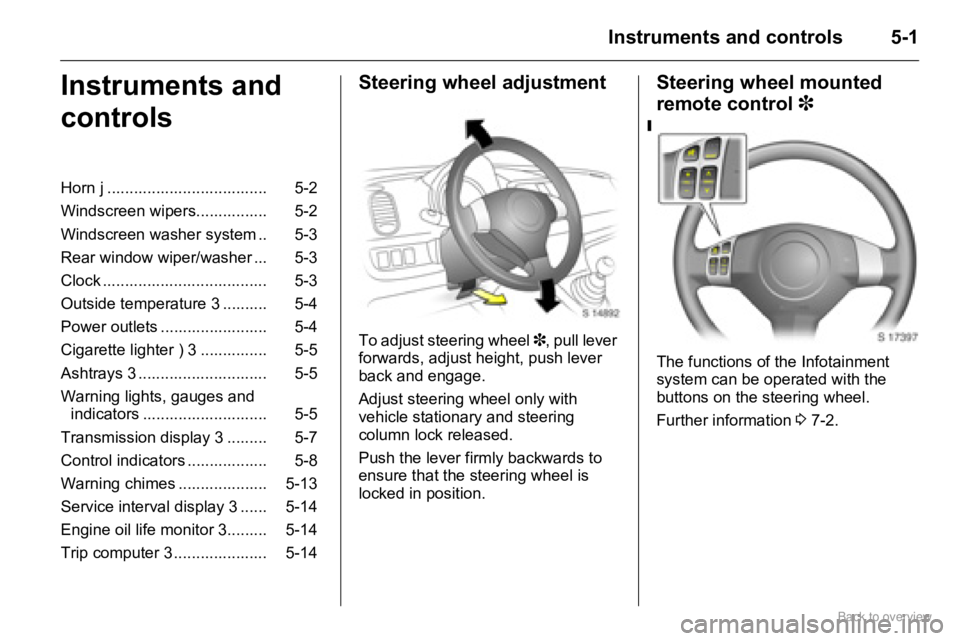
To adjust steering wheel 3, pull lever
forwards, adjust height, push lever
back and engage.
Adjust steering wheel only with
vehicle stationary and steering
column lock released.
Push the lever firmly backwards to
ensure that the steering wheel is
locked in position.
Steering wheel mounted
remote control 3
The functions of the Infotainment
system can be operated with the
buttons on the steering wheel.
Further information 3 7-2. Horn j .................................... 5-2
Windscreen wipers................ 5-2
Windscreen washer system .. 5-3
Rear window wiper/washer ... 5-3
Clock ..................................... 5-3
Outside temperature 3 .......... 5-4
Power outlets ........................ 5-4
Cigarette lighter ) 3 ............... 5-5
Ashtrays 3 ............................. 5-5
Warning lights, gauges and
indicators ............................ 5-5
Transmission display 3 ......... 5-7
Control indicators .................. 5-8
Warning chimes .................... 5-13
Service interval display 3 ...... 5-14
Engine oil life monitor 3......... 5-14
Trip computer 3 ..................... 5-14
Page 64 of 153
5-14 Instruments and controls
Service interval display 3
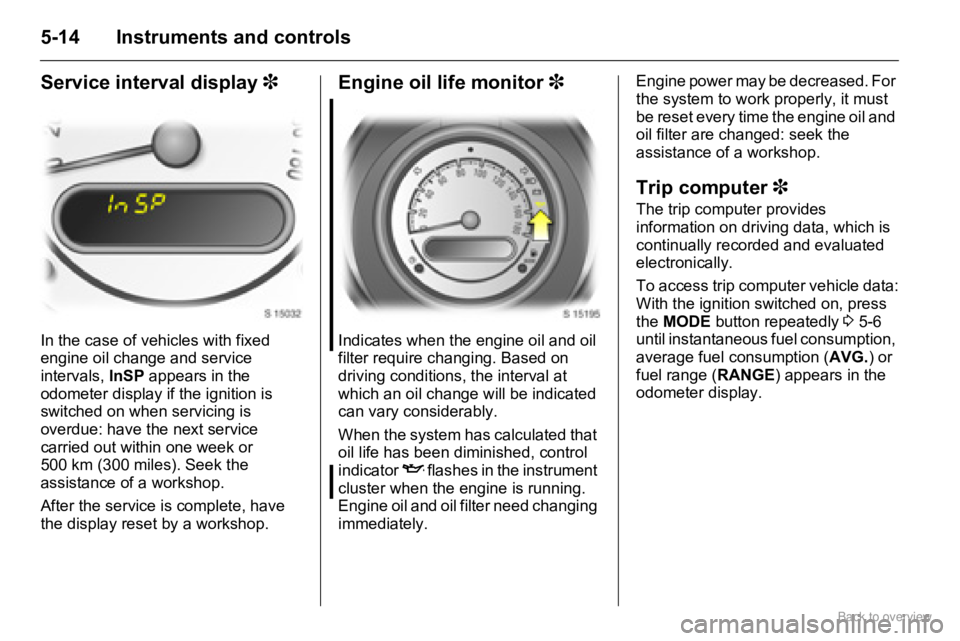
In the case of vehicles with fixed
engine oil change and service
intervals, InSP appears in the
odometer display if the ignition is
switched on when servicing is
overdue: have the next service
carried out within one week or
500 km (300 miles). Seek the
assistance of a workshop.
After the service is complete, have
the display reset by a workshop.
Engine oil life monitor 3
Indicates when the engine oil and oil
filter require changing. Based on
driving conditions, the interval at
which an oil change will be indicated
can vary considerably.
When the system has calculated that
oil life has been diminished, control
indicator
I flashes in the instrument
cluster when the engine is running.
Engine oil and oil filter need changing
immediately. Engine power may be decreased. For
the system to work properly, it must
be reset every time the engine oil and
oil filter are changed: seek the
assistance of a workshop.
Trip computer 3
The trip computer provides
information on driving data, which is
continually recorded and evaluated
electronically.
To access trip computer vehicle data:
With the ignition switched on, press
the MODE button repeatedly 3 5-6
until instantaneous fuel consumption,
average fuel consumption (AVG.) or
fuel range (RANGE) appears in the
odometer display.
Page 87 of 153
8-6Climate controls
Maintenance
Air intake
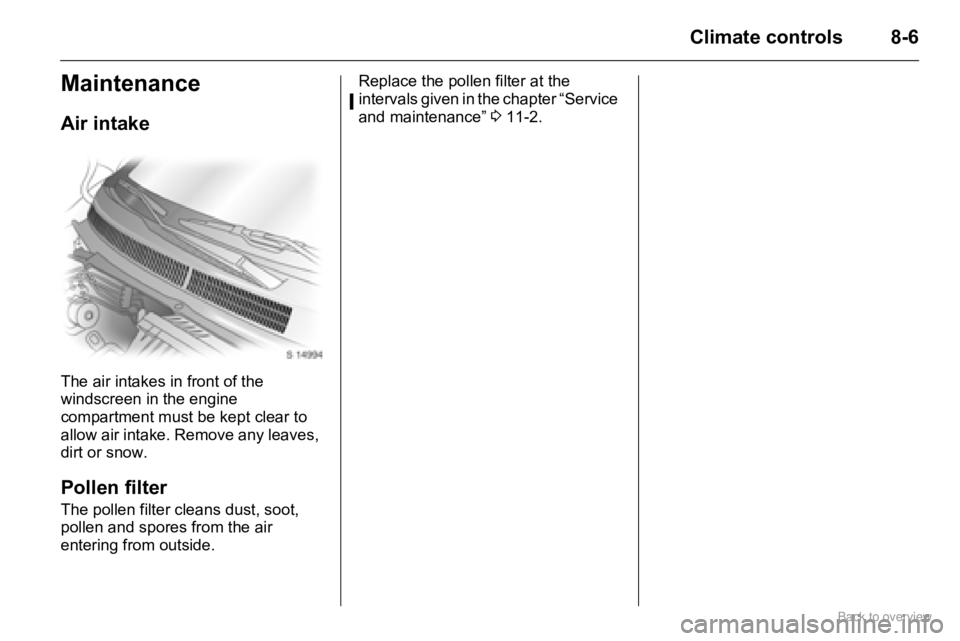
The air intakes in front of the
windscreen in the engine
compartment must be kept clear to
allow air intake. Remove any leaves,
dirt or snow.
Pollen filter
The pollen filter cleans dust, soot,
pollen and spores from the air
entering from outside. Replace the pollen filter at the
intervals given in the chapter “Service
and maintenance” 311-2.
Page 133 of 153

11-1Service and maintenance
Service and
maintenanceScheduled
maintenance
Service intervals
Interim Service
Due every 15,000 km (10,000 miles)
or 1 year, whichever occurs first.
Main Service
Due every 30,000 km (20,000 miles)
or 2 years, whichever occurs first.
The service intervals are based on
average operating conditions. For
severe operating conditions 311-5.
Service interval display 35-14.
Engine oil life monitor 35-14.Confirmations
Confirmation of Service is recorded in
the spaces provided in the Service
and Warranty Booklet. The date and
kilometre/mileage reading is
completed with the stamp and
signature of the Servicing Workshop.
Make sure that the Service and
Warranty Booklet is completed
correctly as continuous proof of
service is essential if any warranty or
goodwill claims are to be met, and is
also a benefit when you come to sell
the vehicle. Scheduled maintenance ....... 11-1
Service schedule .................. 11-2
Additional servicing ............... 11-5
Recommended fluids and
lubricants ............................ 11-5
Page 134 of 153

11-2 Service and maintenance
Service schedule
⊕Additional operations.o Under extreme operating conditions and if required by country-specific conditions, the intervals are reduced.
Service operations by year 1)
km ( x 1000)1)
miles ( x 1000)1)
1)Whichever occurs first.
1
15
102
30
203
45
304
60
405
75
506
90
60
Controls, lighting, signalling equipment and airbags: visual checkxxxxxx
Remote control batteries: replace every 2 years
Windscreen wipers, windscreen washer system: check, correctxxxxxx
Coolant level and antifreeze: check, correct
Hoses: check for tightness and secure seatingxxxxxx
Coolant: change every 3 years/45,000 km/30,000 miles
Brake fluid level: check, correct x x x
Battery terminals: check for secure connections and battery eyexxxxxx
Pollen filter: replace x x x
oMore often for when dust, sand or pollen is in the air agreement with customer
oAir cleaner element: inspect - petrol engines only xxxxxx
Air cleaner element: replace - petrol and diesel engines x x
⊕Spark plugs: replace every 7 years/105,000 km/70,000 miles
Page 135 of 153

11-3 Service and maintenance
Service operations by year 1)
km ( x 1000)1)
miles ( x 1000)1)
1)Whichever occurs first.⊕Additional operations.o Under extreme operating conditions and if required by country-specific conditions, the intervals are reduced.
1
15
102
30
203
45
304
60
405
75
506
90
60
Ribbed V-belt: visual check - petrol engines only x x
⊕ Replace every 6 years/90,000 km/60,000 miles
Ribbed V-belt and tensioner: visual check - diesel engines only x x x
⊕ Replace every 10 years/150,000 km/100,000 miles
⊕Valve clearances: check, adjust - petrol engines only x x x
Engine oil and oil filter: replace x x x x x x
oDiesel fuel filter: drain water x x x x x x
Diesel fuel filter: replace and bleed x x x
⊕Manual transmission: oil level check, correct x
Oil changexx
Parking brake cable: check, adjust x
Parking brake: check and adjust
Wheel mounting and suspension front and rear, brake lines, brake
pressure hoses, fuel lines, fuel tank and exhaust system: visual checkxxx
Corrosion protection: check and record in Service and Warranty Booklet annually
Front and rear wheel brakes: check visually x x x x x x
Page 136 of 153

11-4 Service and maintenance
⊕Additional operations.o Under extreme operating conditions and if required by country-specific conditions, the intervals are reduced.
Service operations by year 1)
km ( x 1000)1)
miles ( x 1000)1)
1
15
102
30
203
45
304
60
405
75
506
90
60
o⊕Automatic transmission fluid level: check correct x x x
Fluid hose: inspectx
Fluid: change every 165,000 km/110,000 miles
Engine, transmission, A/C compressor: check for leaks x x x x x x
oBrake drum: remove, clean, visual check x
Steering system boots, track rods, final drive: visual check x x
Track rod end and supporting ball joint: check x x x
⊕Brake and clutch fluid: change every 2 years
Wheel fastening: loosen and tighten to torque
Tyre condition and pressures: check, correctxxxxxx
First aid kit: visual check every 2 years
Headlamp aiming: check, adjust x x x
Door hinges, door stop, lock cylinder, lock striker, bonnet catch, tailgate
hinges and check links: lubricate xxx
Test drive, final check
Service interval display and oil life monitor: reset - if applicablexxxxxx
1)Whichever occurs first.
Page 137 of 153

11-5Service and maintenance
Additional servicing
Additional operations ⊕
Additional work is work that is not
required every service but can be
performed in conjunction with a
regular service.
Time allowances for such work are
not included in the scope of regular
services and will be charged for
additionally. It is more economic if
these operations are performed as
part of a scheduled service than
having them performed separately.
Severe operating conditions o
Operating conditions are classified as
severe when one or more of the
following occurs frequently:
„cold starts,
„stop and go,
„trailer/caravan towing,
„gradients and/or high altitudes,
„poor road surfaces,
„sand and dust,
„extreme temperature fluctuations. Police vehicles, taxis and driving
school vehicles are also classified as
operating under severe conditions.
Under severe operating conditions, it
may be necessary to have certain
scheduled service work done more
frequently than the scheduled
intervals.
For example, if fuel is used that does
not comply with required standards,
the fuel filter may need more frequent
draining or replacement and it may
also be necessary to change other
components more often (e.g. spark
plugs).
It is recommended to seek technical
advice on the servicing requirements
dependent on the specific operating
conditions of your vehicle.
Recommended fluids
and lubricants
Only use products that have been
tested and approved. Damage
resulting from the use of non-
approved materials will not be
covered by the warranty.
Checking and topping up fluids
3 10-3.
9 Warning
Operating materials are
hazardous and must be handled
with the appropriate level of care.
If consumed, seek medical
attention immediately. Do not
inhale fumes and avoid skin
contact. Keep out of reach of
children. Do not allow operating
materials to contaminate the
sewage system, surface water,
ground water or soil. Dispose of
empty containers properly.
Always bear in mind that
operating materials are
hazardous to your health.
Page 139 of 153
11-7Service and maintenance
The system is factory-filled with
coolant designed for frost protection
down to approx. -28 °C. This
concentration should be maintained
all year-round.
Coolant additives intended to give
additional corrosion protection or seal
against minor leaks can cause
function problems. Liability for
consequences resulting from the use
of coolant additives will be rejected.
Brake and clutch fluid
Only use DOT4 brake fluid.
Over time, brake fluid absorbs
moisture which will reduce braking
effectiveness. The brake fluid should
therefore be replaced at the specified
interval.
Brake fluid should be stored in a
sealed container to avoid water
absorption. Ensure it does not become
contaminated with fluids containing
mineral oil (oil, petrol, cleaner) as this
can damage the seals and sleeves of
the brake system.Transmission fluid
Use fluid meeting specification
Grade: API GL-4
Viscosity: 75W-85 or 75W-90.
Automatic transmission fluid
Use fluid meeting specification
ATF3309.
9 Warning
Brake fluid is poisonous!
Caution
Due to its corrosive nature, it must
not come in contact with the
paintwork. Flush any escaped
brake fluid with plenty of water.