winter tyres OPEL AGILA 2009 Owners Manual
[x] Cancel search | Manufacturer: OPEL, Model Year: 2009, Model line: AGILA, Model: OPEL AGILA 2009Pages: 153, PDF Size: 1.82 MB
Page 2 of 153

0-1 Introduction
Introduction
Vehicle specific data
Please enter your vehicle’s data here to keep it easily accessible. This information is available under the chapters
“Service and maintenance” and "Technical data" as well as on the identification plate.
FuelDesignation
Engine oil
Grade
Viscosity
Tyre pressureTyre size with up to 3 persons with full load
Summer tyres Front Rear Front Rear
Winter tyres Front Rear Front Rear
WeightsPermissible Gross
Vehicle Weight
– EC kerb
weight
= Payload
Page 115 of 153

10-15Vehicle care
Some circuits may be protected by
several fuses.
Wheels
Tyres
Factory-fitted tyres are matched to
the chassis and offer optimum driving
comfort and safety.
Winter tyres 3
Tyres of size 165/70 R 14 and
185/60 R 15 may be used as winter
tyres.
Winter tyres improve safety at
temperatures below 7
°C and should
therefore be fitted on all the wheels.
Depending on national regulations, a
notice indicating the maximum
permissible speed for the tyres must
be affixed within the driver's field of
vision.
The maximum permissible speed
varies from country to country on
account of national regulations.
Ensure that winter tyres are inflated
to the correct pressure specified by
the tyre manufacturer. No. Circuit
1Starter motor
2Air conditioning compressor
3Fuel pump
4Fuel injection
5Heater fan
6Radiator fan
7Power steering control
module
8ABS, ESP
9ABS, ESP
10Brake lamp switch
11Headlamp (right)
12Headlamp (left)
13Front fog lamps
14Ignition switch
15Ignition switch, power
windows, wipers, starter No. Circuit
Page 116 of 153
10-16 Vehicle care
Tyre designations
Meanings:
e.g. 185/60 R 15 84 T
Speed code letters:
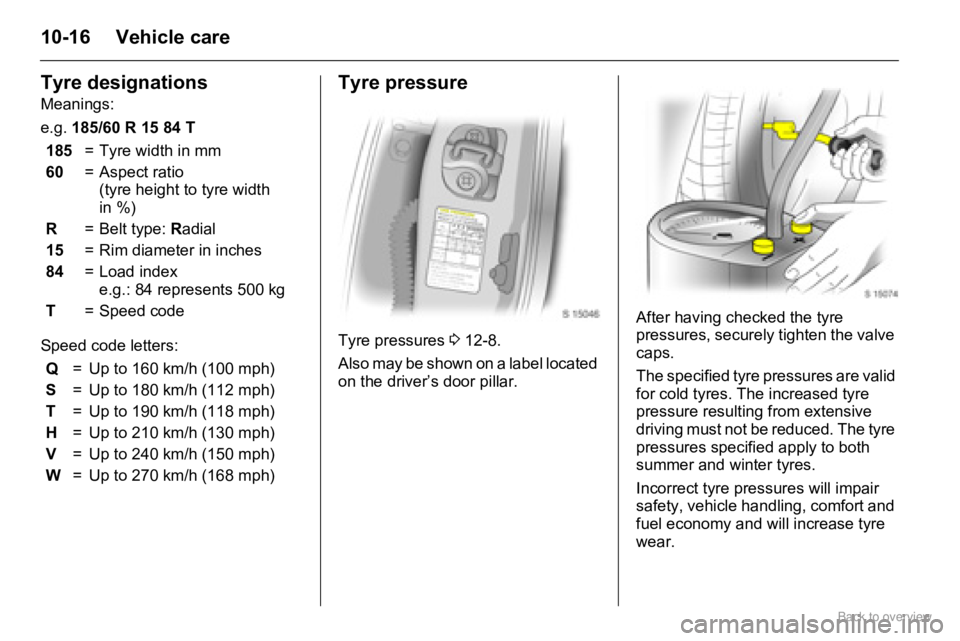
Tyre pressure
Tyre pressures 3 12-8.
Also may be shown on a label located
on the driver’s door pillar.After having checked the tyre
pressures, securely tighten the valve
caps.
The specified tyre pressures are valid
for cold tyres. The increased tyre
pressure resulting from extensive
driving must not be reduced. The tyre
pressures specified apply to both
summer and winter tyres.
Incorrect tyre pressures will impair
safety, vehicle handling, comfort and
fuel economy and will increase tyre
wear. 185= Tyre width in mm
60= Aspect ratio
(tyre height to tyre width
in %)
R= Belt type: Radial
15= Rim diameter in inches
84= Load index
e.g.: 84 represents 500 kg
T= Speed code
Q= Up to 160 km/h (100 mph)
S= Up to 180 km/h (112 mph)
T= Up to 190 km/h (118 mph)
H= Up to 210 km/h (130 mph)
V= Up to 240 km/h (150 mph)
W= Up to 270 km/h (168 mph)
Page 117 of 153

10-17Vehicle care
Tyre condition
Drive over edges slowly and at a right
angle if possible. When parking,
ensure that the tyres are not pressed
against the edge of the kerb.
Check tyres regularly for damage
(foreign bodies, punctures, cuts,
cracks, bulges in sidewalls). Check
wheels for damage. In the event of
damage or abnormal wear, seek the
assistance of a workshop.
Different tyre and wheel
types
If tyres of a different size to those
fitted at the factory are used (this
includes winter tyres), the electronic speedometer may possibly need to
be reprogrammed, to ensure that the
speed displayed is correct.
Wheel covers 3
Wheel covers and tyres that are
approved for the vehicle and comply
with all of the relevant wheel and tyre
combination requirements must be
used.
If the wheel covers and tyres used
are not approved, make sure that the
tyres do not have a beaded edge.
Remove wheel covers before fitting
tyre chains, to avoid damaging the
wheel covers.
Tyre chains 3
Tyre chains are only permitted on the
drive wheels (front axle). They must
be fitted to the tyres symmetrically in
order to achieve a concentric fit.
Use fine mesh chains that add no
more than 10 mm to the tyre tread
and the inboard sides (including
chain lock).
Tyre chains may only be used at
speeds of up to 50 km/h (30 mph) or
up to the tyre chain manufacturer’s
recommended maximum speed,
whichever is lower.
9 Warning
If the pressure is too low, this can
result in considerable tyre warm-
up and internal damage, leading
to tread separation and even to
tyre blow-out at high speeds.
Caution
Use of unsuitable tyres or wheels
may lead to accidents and render
the vehicle unroadworthy.
Page 125 of 153

10-25Vehicle care
Remove the retainer by rotating it
anti-clockwise, and remove spare
wheel from the spare wheel well.
General information
If you use winter tyres 3, the spare
wheel may still be fitted with a
summer tyre.
If you use the spare wheel when it is
fitted with a summer tyre, the
vehicle's driveability may be affected,
especially on slippery road surfaces.
Obtain a replacement for the faulty
tyre as soon as possible, and have
the wheel balanced and fitted to the
vehicle.
„Using a temporary spare wheel
may change the driving behaviour
of the vehicle, particularly if using
winter tyres3. Replace defective
tyre as quickly as possible, balance
wheel and fit to vehicle.
„Fit only one temporary spare
wheel.
„Do not drive faster than 80 km/h
(50 mph).
„Take curves slowly.„Do not use the temporary spare
wheel for a lengthy period.
„Replace temporary spare wheel
with full specification wheel without
delay.
„When temporary spare wheel is
fitted, do not take the vehicle
through an automatic car wash with
guide rails. The temporary spare
wheel may get caught on the rails,
causing damage to the tyre, wheel
and other vehicle parts.
„Tyre chains are not permitted on
the temporary spare wheel.
„If tyre chains are necessary after a
front wheel puncture, fit the
temporary spare wheel to the rear
and a rear wheel to the front. Check
tyre pressure and adjust if
necessary 3 12-8.Tools
To access the jack, vehicle tools and
tyre repair kit 3 (3 10-18), open
tailgate and pull up luggage
compartment floor carpet using the
central strap located near the tailgate
latch and hang the string on the hook
provided 3 4-4.
The jack and vehicle tools are located
below the spare wheel.
If equipped, remove the under floor
storage compartment 3 from the
luggage compartment by pulling it up
by the handle located near the
tailgate latch 3 4-4.
Page 153 of 153

13-6Index
Transmission display ..........5-7, 9-3
Trip computer ........................... 5-14
Trip odometer
............................. 5-6
Turn signal lamps
....................... 6-2
Bulb replacement .................. 10-8
Tyre chains
............................ 10-17
Tyre condition
........................ 10-17
Tyre pressure ................10-16, 12-8
Tyre repair kit
......................... 10-18
U
Units of measure
...................... 5-16
Unleaded fuel
..................9-12, 12-3
V
Vehicle care
............................. 10-1
Vehicle checks
......................... 10-1
Vehicle dimensions
.................. 12-6
Vehicle Identification
Number
...........................12-1, 12-2
Vehicle keys, see Key
................ 2-1
Vehicle tools ........................... 10-25
Vehicle weights
........................ 12-7
Ventilation
...........................8-1, 8-4
W
Warning chimes
....................... 5-13
Warning triangle
......................... 4-5
Washer fluid reservoir .............. 10-5
Washing the vehicle
............... 10-30
Weights
.................................... 12-7
Wheel condition ..................... 10-17Wheel covers
......................... 10-17
Wheels, tyres ......................... 10-15
Windows
...........................2-10, 8-5
Demisting and defrosting
........ 8-2
Windscreen washer
system
...............................5-3, 10-5
Antifreeze protection
............. 10-5
Capacities ............................. 12-5
Washer fluid reservoir
........... 10-5
Windscreen wipers
............5-2, 10-5
Winter operation
Coolant, antifreeze
............... 10-4
Fuel for diesel engines
......... 9-12
Heating ............................8-1, 8-3
Locks
.................................. 10-30
Tyre chains
......................... 10-17
Window demisting and
defrosting
................................ 8-2
Winter tyres
........................ 10-15