ECU OPEL ANTARA 2009 User Guide
[x] Cancel search | Manufacturer: OPEL, Model Year: 2009, Model line: ANTARA, Model: OPEL ANTARA 2009Pages: 234, PDF Size: 3.01 MB
Page 64 of 234

Seats, interior64
zClose the luggage compartment cover to
prevent the objects from being reflected
in the rear window.
z If the backrests are not folded down
when transporting objects in the
luggage compartment, they must be
engaged in their upright position -
see page 41.
z Do not allow the load to protrude above
the upper edge of the rear seat
backrests, or if the rear seat backrests
have been folded down onto the seat
cushions, above the upper edge of the
front seat backrests.
z The warning triangle 3 and first aid kit 3
should always be freely accessible.
z No objects should be placed on the
luggage compartment cover or the
instrument panel. They are reflected in
the glass, obstruct the driver’s view and
will be thrown through the vehicle in the
event of heavy braking, for example.
z No objects should be stored in any of the
airbag inflation zones, as injuries may be
caused when the airbag is triggered. z
The load must not obstruct the operation
of the pedals, hand brake and gearshift
lever or hinder the freedom of movement
of the driver. Do not place any unsecured
objects in the interior.
z Bulky objects should not be transported
with the tailgate open or ajar, otherwise
poisonous exhaust fumes may enter the
vehicle.
z Weights, payload and roof load -
see page 221.
z Driving with a roof load (see also
page 127) increases the sensitivity of the
vehicle to crosswinds and has a
detrimental effect on vehicle handling
owing to the higher centre of gravity of
the vehicle. Stowage compartments
Glove compartment
To open, pull handle upwards.
The glove compartment will illuminate
when opened.
The glove compartment partition can be
removed from its groove.
Store the partition in the groove on the far
left-hand side of the glove compartment.
Glove compartment cooling
3 -
see page 105.
9 Warning
Disregard of these instructions may lead
to injuries or endanger life. Vehicle
passengers must be informed
accordingly.
9 Warning
Do not drive with glove compartment
open; risk of injury in the event of heavy
braking or a collision.
Page 72 of 234

Instruments, controls72
o
Electronic immobiliser
Illuminates in red when ignition is
switched on, then extinguishes.
If it remains illuminated after the ignition is
on, there is a fault in the immobiliser
system; the engine cannot be started -
see page 22.
9Door open
Illuminates in red when a door is open.
3Engine electronics,
transmission electronics 3
Illuminates in yellow when ignition is
switched on, then extinguishes.
If it illuminates
during driving;
there may be a fault in the engine or
transmission electronics: interrupt your
journey and consult a workshop as soon as
possible.
Further information - see page 134.
vAirbag systems 3 , belt tensioners
see pages 44, 52.
1Tailgate open
Illuminates in red when ignition is
switched on, then extinguishes.
Illuminates when tailgate is open or not
securely latched.
Tailgate - see page 26.
XDriver’s seat belt reminder
Illuminates in red when ignition is
switched on, then extinguishes.
When the engine is runn ing, if driver’s seat
belt is not engaged, it will flash for approx.
90 seconds and then illuminate until
driver’s seat belt is fastened.
If vehicle speed exceeds approx. 22 km/h
(14 mph), control indicator will flash for
approx. 90 seconds along with a warning
chime and then remains illuminated until
driver’s seat belt is fastened.
Seat belts - see page 43.
OTurn signal lamps
The relevant control indicator flashes in
green when the turn signal is on.
Rapid flash; failure of a turn signal bulb or
the corresponding fuse or failure of a trailer
turn signal bulb 3. Both control indicators
flash when the hazard warning lamps are
active.
Further information - see pages 14, 95.
Bulb replacement - see page 185.
Fuses - see page 181.
YLow fuel level
Illuminates in yellow when ignition is
switched on, then extinguishes.
If it illuminates during dr iving; fuel level low:
fill up fuel tank as soon as possible.
Never let the tank run dry.
Erratic fuel supply can cause catalytic
converter to overheat - see page 133.
Diesel engines: if the tank has been run dry,
bleed the fuel system as described on
page 171.
Refuelling - see page 132.
Fuel tank capacity - see page 225.
Page 83 of 234
Instruments, controls83
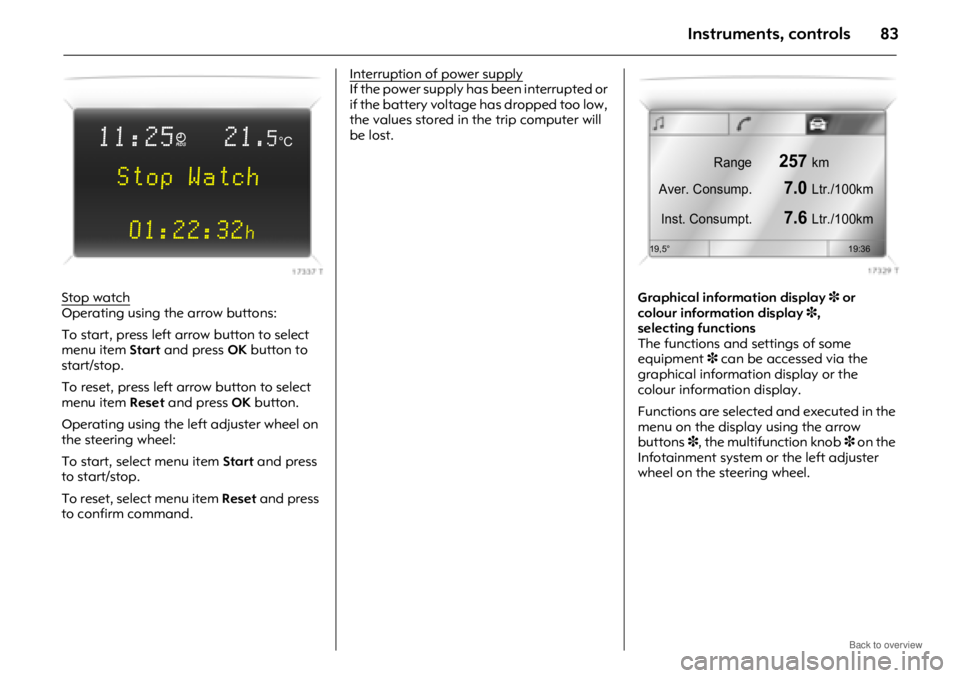
Stop watchOperating using the arrow buttons:
To start, press left arrow button to select
menu item Start and press OK button to
start/stop.
To reset, press left arrow button to select
menu item Reset and press OK button.
Operating using the left adjuster wheel on
the steering wheel:
To start, select menu item Start and press
to start/stop.
To reset, select menu item Reset and press
to confirm command. Interruption of power supply
If the power supply has been interrupted or
if the battery voltage
has dropped too low,
the values stored in the trip computer will
be lost.
Graphical information display3 or
colour information display 3,
selecting functions
The functions and settings of some
equipment 3 can be accessed via the
graphical information display or the
colour information display.
Functions are selected and executed in the
menu on the display using the arrow
buttons 3, the multifunction knob 3 on the
Infotainment system or the left adjuster
wheel on the steering wheel.
11:25}21.5°C
Stop Watch
01:22:32
h
Range257km
Aver. Consump.
7.0Ltr./100km
Inst. Consumpt.
7.6Ltr./100km
19,5° 19:36
Page 123 of 234
Driving and operation123
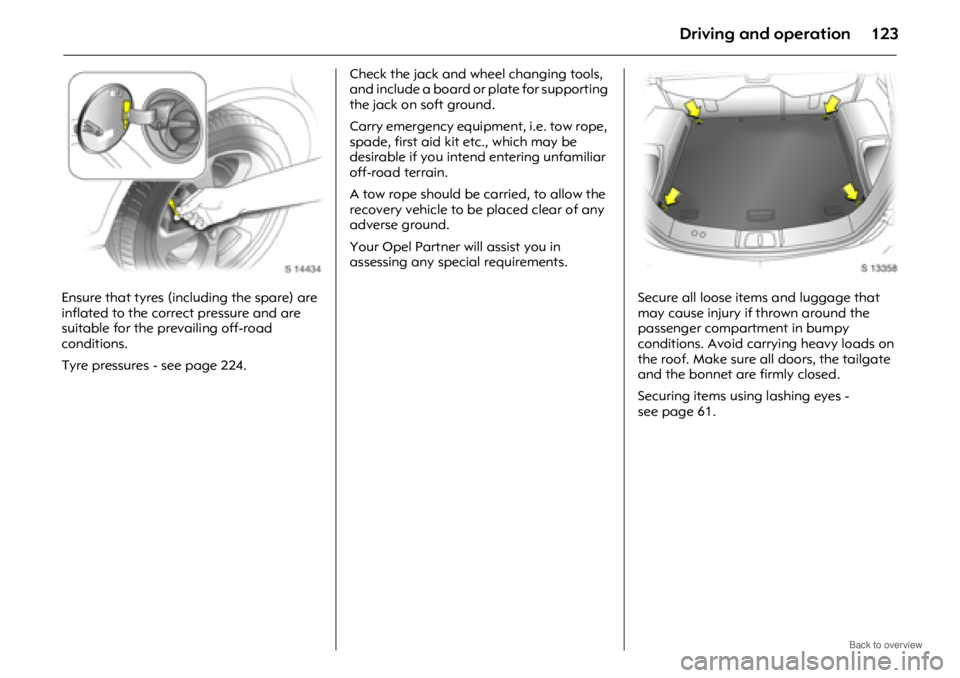
Ensure that tyres (including the spare) are
inflated to the correct pressure and are
suitable for the prevailing off-road
conditions.
Tyre pressures - see page 224.Check the jack and wheel changing tools,
and include a board or plate for supporting
the jack on soft ground.
Carry emergency equipment, i.e. tow rope,
spade, first aid kit etc., which may be
desirable if you intend entering unfamiliar
off-road terrain.
A tow rope should be carried, to allow the
recovery vehicle to be placed clear of any
adverse ground.
Your Opel Partner will assist you in
assessing any special requirements.
Secure all loose items and luggage that
may cause injury if thrown around the
passenger compartment in bumpy
conditions. Avoid carrying heavy loads on
the roof. Make sure all doors, the tailgate
and the bonnet are firmly closed.
Securing items using lashing eyes -
see page 61.
Page 127 of 234

Driving and operation127
Driving hints
The first 1000 km (600 miles)
Drive your vehicle at various speeds. Do
not use full throttle. Never allow the engine
to labour at low revs.
Make good use of all gears. Depress the
accelerator pedal a maximum of around
three quarters of the available pedal travel
in all gears and drive ranges.
Do not drive faster than three quarters of
maximum speed.
Avoid quick starts, su dden acceleration
and prolonged high-speed driving, to
avoid engine damage and to conserve
fuel.
Do not brake unnecessarily hard for the
first 200 km (125 miles).
If possible, avoid towing another vehicle.
Never coast with engine not running
Many units may then not function (e.g.
brake servo unit, power steering, airbag
system). Driving in this manner is a danger
to yourself and others. Brake servo unit
With the engine not running, the brake
servo unit is no longer effective once the
brake pedal has been depressed once or
twice. The braking effect is not reduced,
but substantially greater foot pressure is
necessary to stop the vehicle.
Power steering
Never leave the steering wheel on full lock
when the vehicle is stationary, as this may
damage the power steering pump.
If the power steering should fail - e.g. when
the vehicle is being towed with the engine
switched off - the vehicle can still be
properly steered, but considerably greater
effort is necessary.
Driving in mountainous terrain or with a
caravan/trailer
Electrically driven fan; the fan cooling
capacity is not dependent on engine
speed. It is not necessary, therefore, when
driving uphill to shif
t down into a lower
gear if the vehicle can climb in a higher
gear. Driving in extreme conditions
When driving in hazard
ous conditions, e.g.
in snow, ice, mud, sand or water, drive
slowly and cautiously to allow for greater
braking distances.
If stuck, use 2nd gear (automatic
transmission in drive range 2) to avoid
spinning the front wheels.
Use sand, tyre chains or other non-slip
materials to provide traction when stuck in
snow, mud or ice.
Driving through water
Before attempting to drive through water,
check the depth. If the depth is slightly
lower than the underbody of your vehicle,
do not attempt to drive through it.
Driving too quickly through water can
cause water to enter the engine through
the air intake, causing severe damage.
Drive slowly, in a high engine rpm in as low
a gear as possible.
Driving with a roof load
Do not exceed the permissible roof load -
see page 221. For safety reasons,
distribute the load evenly and secure it
tightly with straps so that it cannot slip. Set
the tyre pressure to the value given for full
load. Do not drive faster than 120 km/h
(75 mph). Check and retighten straps at
frequent intervals.
Page 150 of 234
Driving and operation150
Tyre pressure
Check tyre pressures when cold, at least
every 14 days and prior to any long
journey. Don't forget to check the spare.
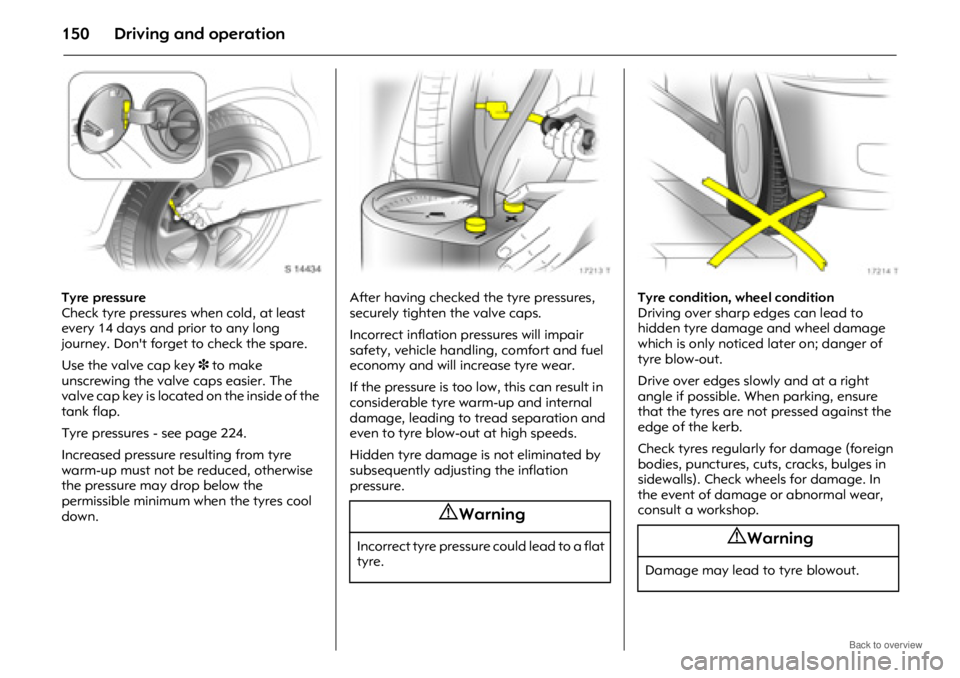
Use the valve cap key 3 to make
unscrewing the valve caps easier. The
valve cap key is located on the inside of the
tank flap.
Tyre pressures - see page 224.
Increased pressure resulting from tyre
warm-up must not be reduced, otherwise
the pressure may drop below the
permissible minimum when the tyres cool
down. After having checked the tyre pressures,
securely tighten the valve caps.
Incorrect inflation pressures will impair
safety, vehicle handling, comfort and fuel
economy and will increase tyre wear.
If the pressure is too low, this can result in
considerable tyre warm-up and internal
damage, leading to tread separation and
even to tyre blow-out at high speeds.
Hidden tyre damage is not eliminated by
subsequently adjusting the inflation
pressure.
Tyre condition, wheel condition
Driving over sharp edges can lead to
hidden tyre damage and wheel damage
which is only noticed later on; danger of
tyre blow-out.
Drive over edges slowly and at a right
angle if possible. When parking, ensure
that the tyres are not pressed against the
edge of the kerb.
Check tyres regularly for damage (foreign
bodies, punctures, cuts, cracks, bulges in
sidewalls). Check wheels for damage. In
the event of damage
or abnormal wear,
consult a workshop.
9 Warning
Incorrect tyre pressure could lead to a flat
tyre.9 Warning
Damage may lead to tyre blowout.
Page 153 of 234

Driving and operation153
Always use fine-linked chains that add no
more than 15 mm to the tyre tread and the
inboard sides (including chain lock).
Tyre chains may only be used at speeds of
up to 50 km/h (30 mph)
1) or up to the tyre
chain manufacturer’s recommended
maximum speed, whichever is lower.
When travelling on road s that are free of
snow, they may only be used for brief
periods since they are subject to rapid wear
on a hard road and may snap.
Avoid sharp turns, bumps and holes and
do not lock the wheels when braking, to
avoid damaging the tyre chains.
Retighten the chains after driving for
approx. 1 km (0.6 miles). If, at any time,
you hear or suspect that the chains are
contacting the vehicle, stop and retighten
the chains.
Always read the instructions supplied with
the tyre chains. Temporary spare wheel
The temporary spare wheel is designed for
use on your vehicle only.
Do not attempt to use the spare tyre on a
different wheel, or use a different tyre on
the spare wheel, as they will not fit.
For notes on the temporary spare wheel -
see page 178.
Ensure the temporary spare wheel is
inflated to the correct tyre pressure -
see page 224.
Wheel changing - see page 178.
Roof racks 3
For reasons of safety and to avoid
damaging the roof, we recommend that
you use the Opel roof rack system
approved for your vehicle.
Fasten the roof rack to the roof rails
following the instructions that accompany
the system, ensuring that the roof load is
evenly distributed over the side or cross
rails. Loads must not be placed on the roof
surface.
To prevent damage or loss, check
frequently that roof loads are securely
fastened.
Driving with a roof load affects the
vehicle’s centre of gravity; drive carefully in
crosswinds and do not drive at high
speeds.
Driving hints - see page 127.
1)Varies from country to country on account of
national regulations.
9 Warning
Disregard of the instructions may lead to
injuries or endanger life. Vehicle
passengers must be informed
accordingly.
Page 156 of 234
Driving and operation156
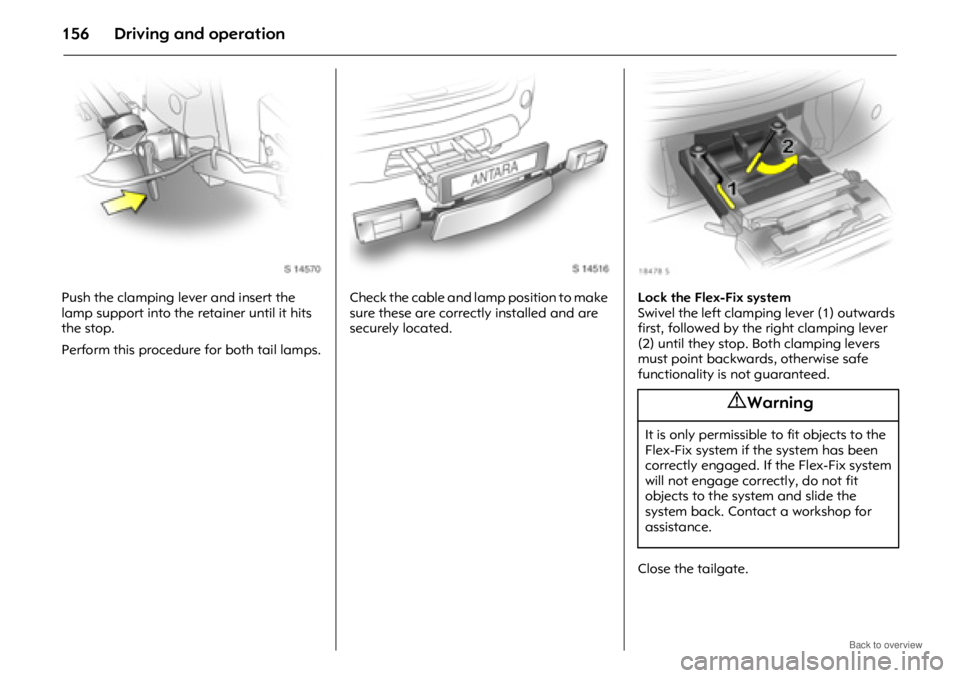
Push the clamping lever and insert the
lamp support into the retainer until it hits
the stop.
Perform this procedure for both tail lamps.Check the cable and lamp position to make
sure these are correctly installed and are
securely located.
Lock the Flex-Fix system
Swivel the left clamping lever (1) outwards
first, followed by the right clamping lever
(2) until they stop. Both clamping levers
must point backwards, otherwise safe
functionality is not guaranteed.
Close the tailgate.
9 Warning
It is only permissible to fit objects to the
Flex-Fix system if the system has been
correctly engaged. If the Flex-Fix system
will not engage correctly, do not fit
objects to the system and slide the
system back. Contact a workshop for
assistance.
Page 161 of 234
Driving and operation161
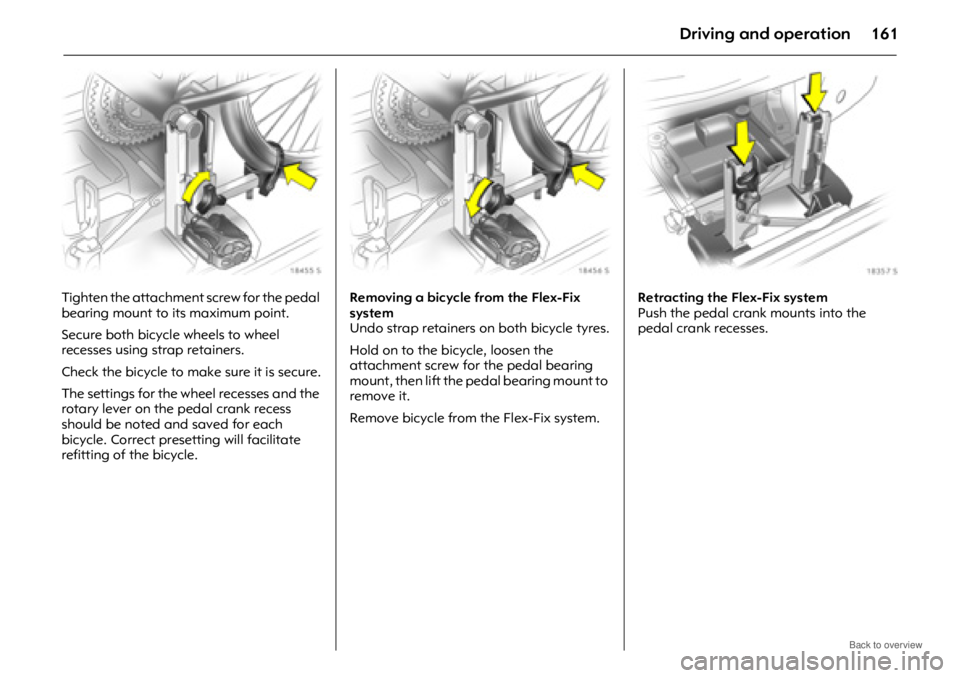
Tighten the attachment screw for the pedal
bearing mount to its maximum point.
Secure both bicycle wheels to wheel
recesses using strap retainers.
Check the bicycle to make sure it is secure.
The settings for the wheel recesses and the
rotary lever on the pedal crank recess
should be noted and saved for each
bicycle. Correct presetting will facilitate
refitting of the bicycle. Removing a bicycle from the Flex-Fix
system
Undo strap retainers on both bicycle tyres.
Hold on to the bicycle, loosen the
attachment screw for the pedal bearing
mount, then lift the pedal bearing mount to
remove it.
Remove bicycle from the Flex-Fix system.
Retracting the Flex-Fix system
Push the pedal crank mounts into the
pedal crank recesses.
Page 162 of 234
Driving and operation162
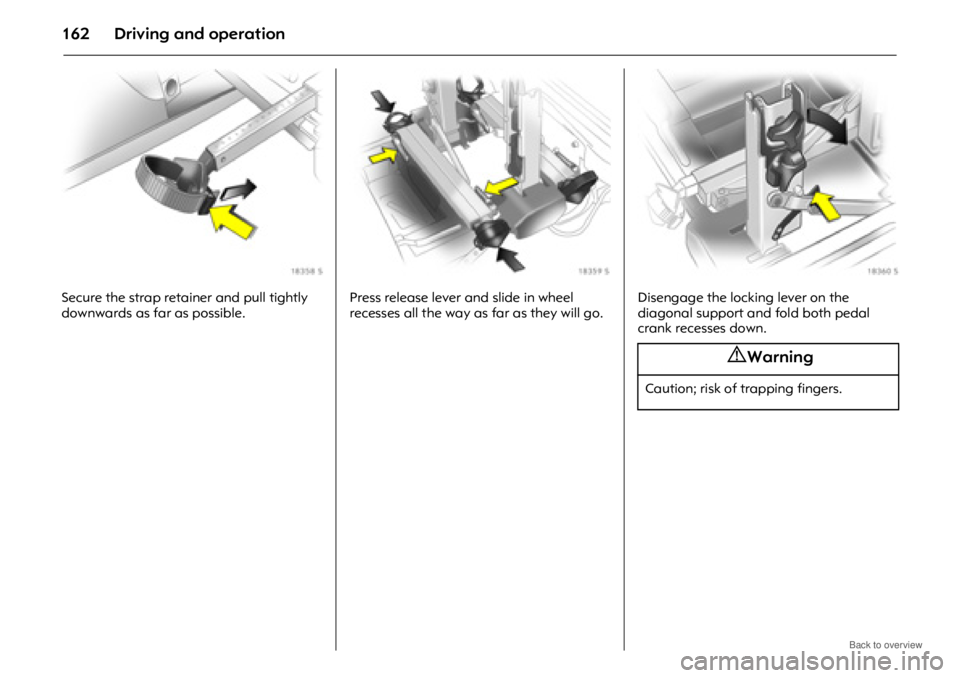
Secure the strap retainer and pull tightly
downwards as far as possible.Press release lever and slide in wheel
recesses all the way as far as they will go.Disengage the locking lever on the
diagonal support and fold both pedal
crank recesses down.
9 Warning
Caution; risk of trapping fingers.