ECU OPEL ANTARA 2009 Owner's Manual
[x] Cancel search | Manufacturer: OPEL, Model Year: 2009, Model line: ANTARA, Model: OPEL ANTARA 2009Pages: 234, PDF Size: 3.01 MB
Page 169 of 234

Driving and operation169
Driving characteristics, towing tips
In the case of caravans/trailers with
brakes3, attach the breakaway stopping
cable to the eye 3 or loop around coupling
ball bar if no eye is available.
Ensure cable is crossed under the coupling
socket to ensure the caravan/trailer nose
cannot drop to the ground if it becomes
separated from the trailer hitch.
Do not allow the cable to drag along the
ground and always allow enough slack to
permit full turning. Fo llow the instructions
supplied with the towing equipment.
Before coupling the caravan/trailer,
lubricate the ball of the caravan/trailer
towing device. However, do not do so if a
stabilizer which acts on the coupling ball is
being used to damp rolling motions.
Handling is greatly influenced by the
loading of the caravan/trailer. Loads
should therefore be secured so that they
cannot slip and should be placed in the
centre of the caravan/trailer if possible,
i.e. above the axle.
Opel genuine parts an d accessories which
can be subsequently fitted aid trailer
operation, e.g. larg e mirrors for wide
caravans/trailers. In the case of caravans/trailers with low
directional stability, it is advisable to use a
friction-type stabilizer to damp rolling
motions.
Do not drive faster than 80 km/h (50 mph),
even in countries where higher speeds are
permitted.
When driving uphill, do not drive faster
than 30 km/h (20 mph) in 1st gear, or
50 km/h (30 mph) in 2nd gear.
Make sure that you have enough room
when cornering and avoid sudden
manoeuvres.
If the caravan/trailer starts to sway, drive
more slowly, do not attempt to correct the
steering and brake sharply if necessary.
If it is necessary to apply the brakes fully,
depress the brake pedal as hard as
possible.
The cooling fan is electrically operated.
The fan cooling capacity is not, therefore,
dependent on engine speed. It is not
necessary, when drivin
g uphill, to shift
down into a lower gear if the vehicle can
climb in a higher gear. When coupled to a caravan/trailer, the
vehicle requires more
braking effort when
driving down long grad ients, so select the
same gear as you would when driving
uphill and drive at roughly the same speed.
Automatic transmission in automatic mode
will select the drivin g program with the
optimum engine braking effect.
Remember that brak ing distances for
vehicles towing carava ns/trailers with and
without brakes is always greater than for
vehicles not towing a caravan/trailer. For
caravans/trailers with brakes, follow the
instructions carefully. Do not make any
modifications to the brake system.
Always check lamps on caravans/trailers
before towing. Ensure national regulations
are observed.
The fog tail lamp on the vehicle is
deactivated when towing a caravan/
trailer.
When reversing, if possible, have someone
provide assistance.
Drive slowly and shift down into a lower
gear when descending steep gradients
rather than holding the foot brake
depressed, to avoid overheating and
reduced brake efficiency.
Page 175 of 234
Self-help, vehicle care175
Keep tow rope 3 clear of front bumper,
and ensure it is secure ly fixed to the towing
eye at both ends. Pull on the tow rope 3 to
check.
To prevent entry of exhaust fumes from
towing vehicle, switch on air recirculation
mode (see page 109) and close the
windows.
Never let passengers ride in a vehicle that
is being towed.
Never tow a vehicle with damaged parts
that are not secured to the vehicle or if
wheels, brakes or steering are damaged.
Do not tow the vehicle with a tow rope 3 or
tow rod 3 for extended periods, to avoid
damage to the vehicle. Only tow in this
manner on hard-surfaced roads.
For vehicles with automatic transmission 3:
use flatbed or wheel lift equipment only.
Towing can cause severe damage to the
transmission.
Seek the assistance of a workshop. Towing service
Entrust your vehicle only to the towing
service of your choice and obtain an
estimate on towing costs before employing
any towing service. This will prevent
unnecessary expense and possible
insurance problems during claim
processing.
Use flatbed equipment whenever possible.
If vehicle is to be towed using a wheel lift,
tow with all wheels off the road, using a
towing dolly.
Never use sling-type equipment to tow the
vehicle or tow the vehicle with the front or
rear wheels on the road, to avoid causing
serious damage to the vehicle.
Place the gearshift lever in neutral
(automatic transmission 3
in N), switch on
hazard warning lamps, turn key to ignition
switch position ACC and release the
hand brake before towing the vehicle. Towing another vehicle
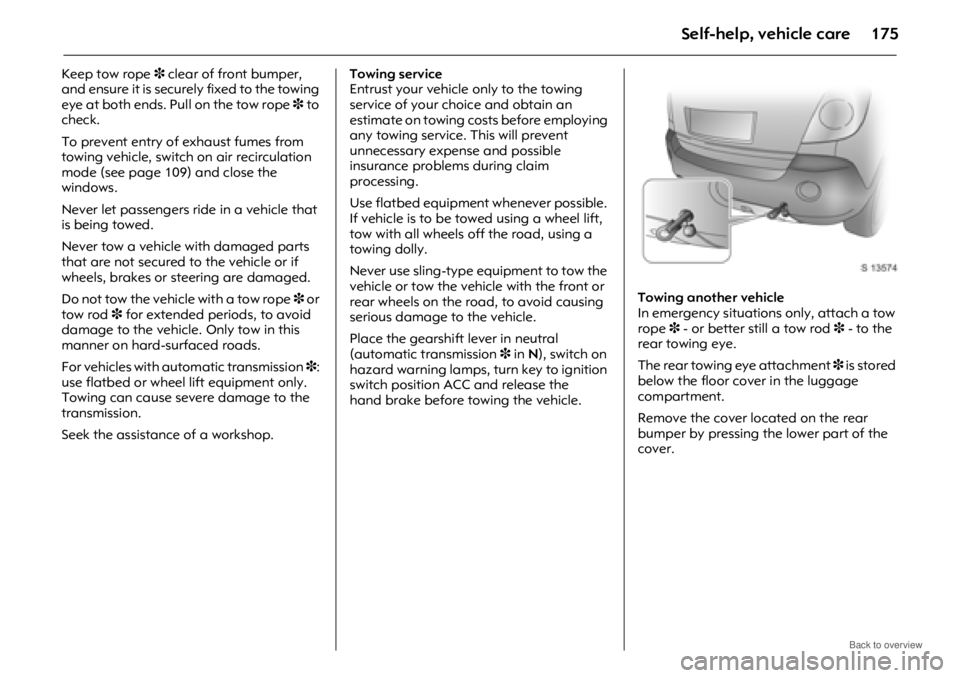
In emergency situations only, attach a tow
rope
3 - or better still a tow rod 3 - to the
rear towing eye.
The rear towing eye attachment 3 is stored
below the floor cover in the luggage
compartment.
Remove the cover located on the rear
bumper by pressing the lower part of the
cover.
Page 176 of 234
Self-help, vehicle care176
Screw the rear towing eye attachment anti-
clockwise until it is firmly in place.
Drive off slowly and avoid jerky
movements. Impermissible tractive forces
could damage the vehicles.
To prevent damage, do not take up slack
in the tow rope too quickly.
After towing, unscrew the rear towing eye
attachment clockwise to remove, and
reinstall the cover.
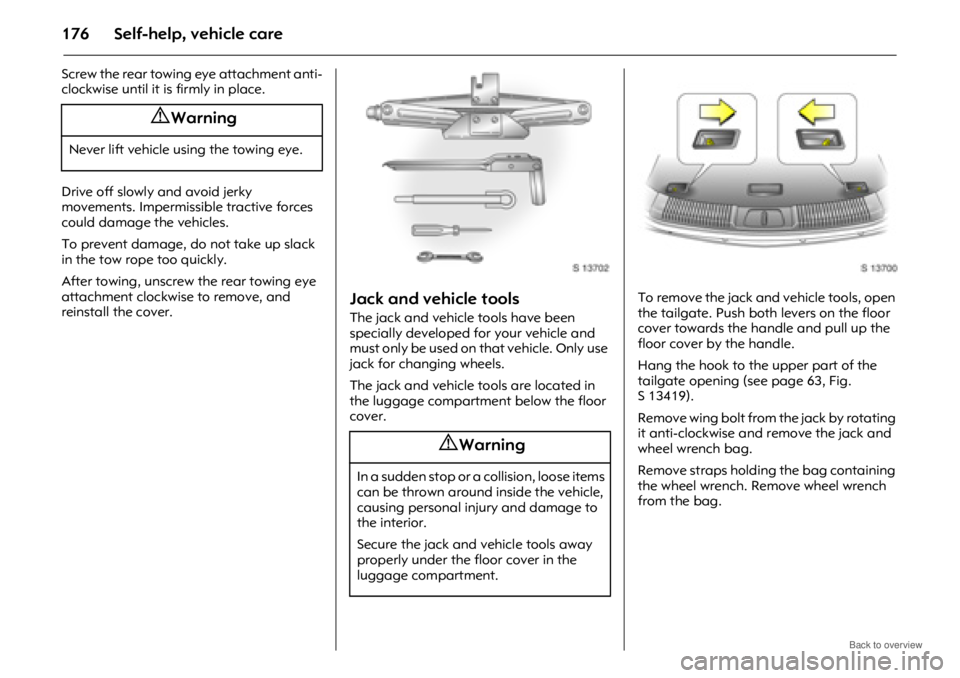
Jack and vehicle tools
The jack and vehicle tools have been
specially developed for your vehicle and
must only be used on that vehicle. Only use
jack for changing wheels.
The jack and vehicle tools are located in
the luggage compartment below the floor
cover. To remove the jack and vehicle tools, open
the tailgate. Push both levers on the floor
cover towards the handle and pull up the
floor cover by the handle.
Hang the hook to the upper part of the
tailgate opening (see page 63, Fig.
S 13419).
Remove wing bolt from the jack by rotating
it anti-clockwise and remove the jack and
wheel wrench bag.
Remove straps holding the bag containing
the wheel wrench. Remove wheel wrench
from the bag.
9 Warning
Never lift vehicle using the towing eye.
9 Warning
In a sudden stop or a collision, loose items
can be thrown around inside the vehicle,
causing personal injury and damage to
the interior.
Secure the jack and vehicle tools away
properly under the floor cover in the
luggage compartment.
Page 177 of 234
Self-help, vehicle care177
Warning triangle
¨ 3 ,
First aid kit
+3
Your first aid kit and warning triangle can
be accommodated below the floor cover in
the luggage compartment.
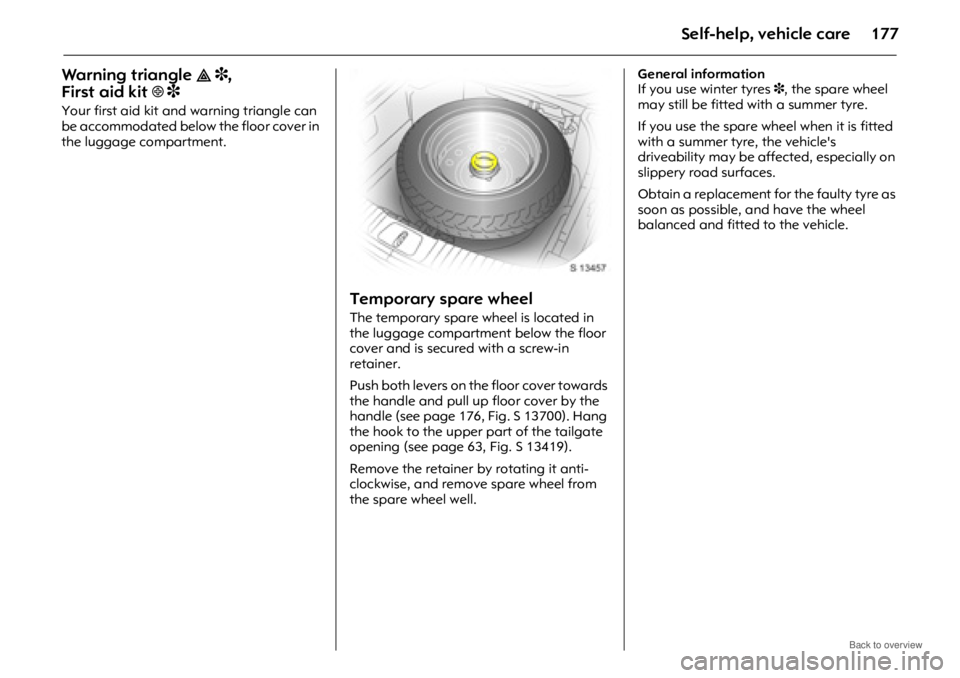
Temporary spare wheel
The temporary spare wheel is located in
the luggage compartment below the floor
cover and is secured with a screw-in
retainer.
Push both levers on the floor cover towards
the handle and pull up floor cover by the
handle (see page 176, Fig. S 13700). Hang
the hook to the upper part of the tailgate
opening (see page 63, Fig. S 13419).
Remove the retainer by rotating it anti-
clockwise, and remove spare wheel from
the spare wheel well. General information
If you use winter tyres
3, the spare wheel
may still be fitted with a summer tyre.
If you use the spare wheel when it is fitted
with a summer tyre, the vehicle's
driveability may be affected, especially on
slippery road surfaces.
Obtain a replacement for the faulty tyre as
soon as possible, and have the wheel
balanced and fitted to the vehicle.
Page 188 of 234
Self-help, vehicle care188
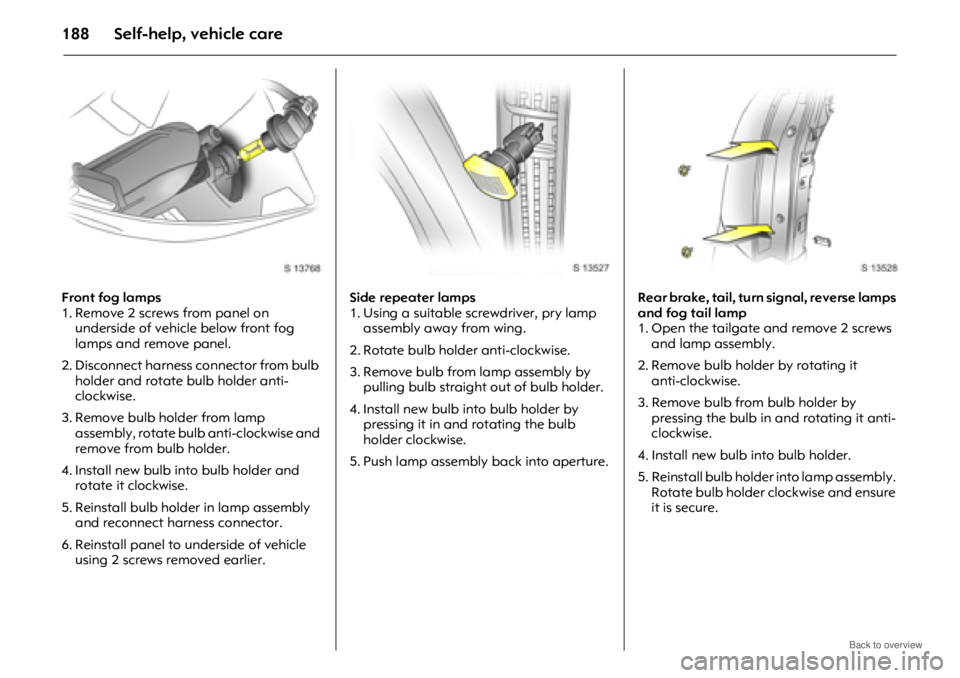
Front fog lamps
1. Remove 2 screws from panel on underside of vehicle below front fog
lamps and remove panel.
2. Disconnect harness connector from bulb holder and rotate bulb holder anti-
clockwise.
3. Remove bulb holder from lamp assembly, rotate bulb anti-clockwise and
remove from bulb holder.
4. Install new bulb in to bulb holder and
rotate it clockwise.
5. Reinstall bulb holder in lamp assembly
and reconnect harness connector.
6. Reinstall panel to underside of vehicle using 2 screws removed earlier. Side repeater lamps
1. Using a suitable screwdriver, pry lamp
assembly away from wing.
2. Rotate bulb holder anti-clockwise.
3. Remove bulb from lamp assembly by pulling bulb straight out of bulb holder.
4. Install new bulb into bulb holder by pressing it in and rotating the bulb
holder clockwise.
5. Push lamp assembly back into aperture. Rear brake, tail, turn signal, reverse lamps
and fog tail lamp
1. Open the tailgate and remove 2 screws
and lamp assembly.
2. Remove bulb holder by rotating it anti-clockwise.
3. Remove bulb from bulb holder by pressing the bulb in and rotating it anti-
clockwise.
4. Install new bulb into bulb holder.
5. Reinstall bulb holder into lamp assembly. Rotate bulb holder clockwise and ensure
it is secure.
Page 189 of 234
Self-help, vehicle care189
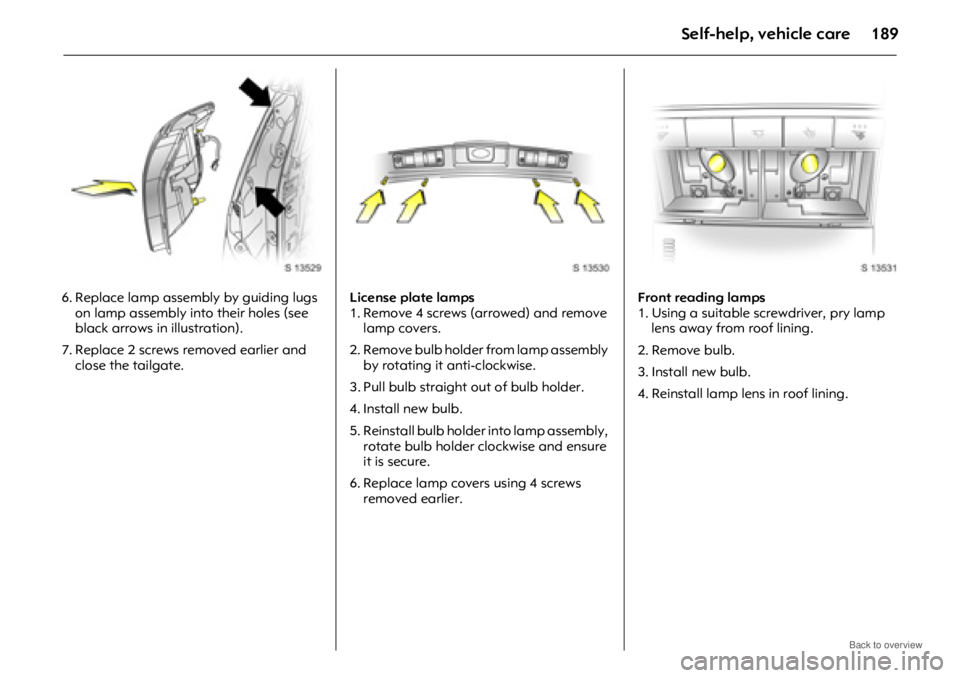
6. Replace lamp assembly by guiding lugs on lamp assembly into their holes (see
black arrows in illustration).
7. Replace 2 screws removed earlier and close the tailgate. License plate lamps
1. Remove 4 screws (arrowed) and remove
lamp covers.
2. Remove bulb holder from lamp assembly by rotating it anti-clockwise.
3. Pull bulb straight out of bulb holder.
4. Install new bulb.
5. Reinstall bulb holder into lamp assembly, rotate bulb holder clockwise and ensure
it is secure.
6. Replace lamp covers using 4 screws removed earlier. Front reading lamps
1. Using a suitable screwdriver, pry lamp
lens away from roof lining.
2. Remove bulb.
3. Install new bulb.
4. Reinstall lamp lens in roof lining.
Page 207 of 234

Service, maintenance 207
European service schedule
(Antara Z 20 DM, Z 20 DMH, Z 24 XE, Z 32 SE) Service operations by year 1)
km ( x 1000)1)
miles ( x 1000)1)
1)Whichever occurs first.
15
101
30
20 45
30 2
60
40 75
50 3
90
60
Controls, lighting, signalling equi pment and airbags: visual check
steering lock and ignition lock: check xxx
Remote control batteries: replace Every 2 years
Windscreen wipers, windscreen washer system: check, correct xxx
Coolant level and antifreeze: check, correct
Hoses: check for tightness and secure seating xxx
Brake fluid level: check, correct xxx
Battery terminals: check for secu re connections and battery eye xxx
Vehicle system check with TECH2 xxx
Pollen filter: replace xxx
oMore often for when dust, sand or polle n is in the air Agreement with customer
Air cleaner element: replace
xxx
⊕Spark plugs and plug leads: replace Every 90 000 km/60 000 miles
Ribbed V-belt: visual check xxx
⊕Toothed belt and tension roller: visual check xxx
Toothed belt and tension roller: replace - Z 24 XE Every 8 years/120 000 km/80 000 miles
Toothed belt and tension roller: replace - Z 20 DM, Z 20 DMH Every 6 years/90 000 km/60 000 miles
Power steering system: check for leak s. Fluid level: check, correct xxx
Engine oil and oil filter: replace - fixed interval Z 24 XE
2)
2)On vehicles with oil life monitoring, it may be necessary to change the engine oil earlier (control indicator illuminates).
xxxxxx
Z 20 DM, Z 20 DMH, Z 32 SE, except2)xxx
Page 209 of 234

Service, maintenance 209
International service schedule
(All except Z 24 XE) Service operations by year 1)
km ( x 1000)1)
miles ( x 1000)1)
1)Whichever occurs first.
15
101
30
20 45
30 2
60
40 75
50 3
90
60
Controls, lighting, signalling equi pment and airbags: visual check
steering lock and ignition lock: check xxxxxx
Remote control batteries: replace Every 2 years
Windscreen wipers, windscreen wa sher system: check, correct x x x x x x
Coolant level and antifreeze: check, correct
Hoses: check for tightness and secure seating Annually
Brake fluid level: check, correct xx
Battery terminals: check for secure connections and battery eye Annually
Vehicle system check with TECH2 Annually
Pollen filter: replace xxx
oMore often for when dust, sand or pollen is in the air Annually/15 000 km/10 000 miles
Air cleaner element: replace
xxx
oMore often for when dust or sand is in the air Annually/15 000 km/10 000 miles
⊕Spark plugs and plug leads: replace Every 90 000 km/60 000 miles
Ribbed V-belt: visual check xxx
⊕Toothed belt and tension roller: visual check Annually/15 000 km/10 000 miles
Toothed belt and tension roller: replace - Z 20 DM, Z 20 DMH Every 6 years/90 000 km/60 000 miles
Power steering system: check for leaks. Fluid level: check, correct Annually
Engine oil and oil filter: replace x x x x x x
Page 211 of 234

Service, maintenance 211
International service schedule
(Antara Z 24 XE) Service operations by month 1)
km ( x 1000)1)
miles ( x 1000)1)
1)Whichever occurs first.
6
10
6.5 12
20
1318
30
2024
40
26.5 30
50
3336
60
40
Controls, lighting, signalling equi pment and airbags: visual check
steering lock and ignition lock: check xxx
Remote control batteries: replace Every 2 years
Windscreen wipers, windscreen washer system: check, correct xxx
Coolant level and antifreeze: check, correct
Hoses: check for tightness and secure seating xxx
Brake fluid level: check, correct xxx
Battery terminals: check for secu re connections and battery eye xxx
Vehicle system check with TECH2 xxx
Pollen filter: replace Annually/30 000 km/20 000 miles
oMore often for when dust, sand or pollen is in the air Agreement with customer
Air cleaner element: replace
Annually/30 000 km/20 000 miles
⊕Spark plugs and plug leads: replace Every 90 000 km/60 000 miles
Ribbed V-belt: visual check xxx
⊕Toothed belt and tension roller: visual check Annually/30 000 km/20 000 miles
Toothed belt and tension roller: replace Every 8 years/120 000 km/80 000 miles
Power steering system: check for leak s. Fluid level: check, correct xxx
Engine oil and oil filter: replace - fixed interval
2)
2)On vehicles with oil life monitoring, it may be necessary to change the engine oil earlier (control indicator illuminates).
xxxxxx