air condition OPEL ANTARA 2009 User Guide
[x] Cancel search | Manufacturer: OPEL, Model Year: 2009, Model line: ANTARA, Model: OPEL ANTARA 2009Pages: 234, PDF Size: 3.01 MB
Page 113 of 234
Climate control113
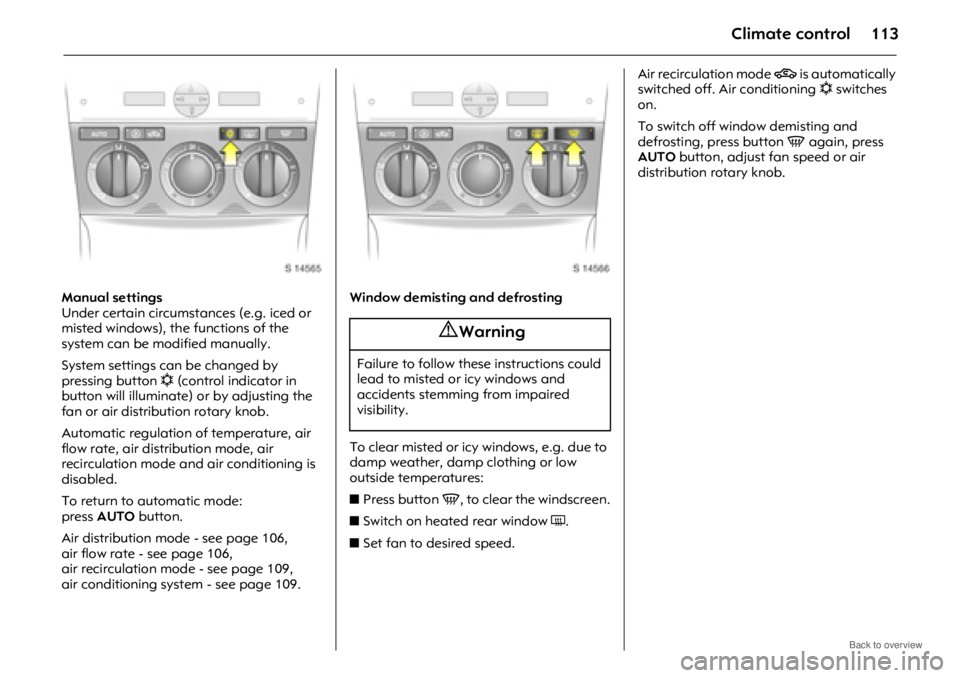
Manual settings
Under certain circumstances (e.g. iced or
misted windows), the functions of the
system can be modified manually.
System settings can be changed by
pressing button n (control indicator in
button will illuminate) or by adjusting the
fan or air distribution rotary knob.
Automatic regulation of temperature, air
flow rate, air distribution mode, air
recirculation mode and air conditioning is
disabled.
To return to automatic mode:
press AUTO button.
Air distribution mode - see page 106,
air flow rate - see page 106,
air recirculation mode - see page 109,
air conditioning system - see page 109. Window demisting and defrosting
To clear misted or icy
windows, e.g. due to
damp weather, damp clothing or low
outside temperatures:
z Press button V, to clear the windscreen.
z Switch on heated rear window Ü.
z Set fan to desired speed. Air recirculation mode
4 is automatically
switched off. Air conditioning n switches
on.
To switch off window demisting and
defrosting, press button V again, press
AUTO button, adjust fan speed or air
distribution rotary knob.
9 Warning
Failure to follow thes e instructions could
lead to misted or icy windows and
accidents stemming from impaired
visibility.
Page 114 of 234

Climate control114
Air intake
The air intakes in front of the windscreen in
the engine compartment must be kept
clear to allow air intake. Remove any
leaves, dirt or snow.
Pollen filter
The pollen filter cleans dust, soot, pollen
and spores from the air entering from
outside. The active carbon layer 3
eliminates most odours and harmful
ambient gases from the air.
Replace the pollen filter at the intervals
given on pages 206 to 212.
Note
If the windscreen mists up in damp
weather, temporarily set the system as
described under "Window demisting and
defrosting" - see pages 108, 113.
Cooling is most efficient when the windows
are closed. If the interior is extremely hot
due to a long period in strong sunlight,
briefly open the windows and sun roof 3 to
allow hot air to escape quickly.
When cooling (air conditioning
compressor) is switched on, condensation
forms, which is expelled from the underside
of the vehicle.
When cooling is switched on, at least one of
the adjustable centre or side air vents must
be open so that the evaporator does not
ice up due to lack of air movement.
Cooling switches off automatically at low
outside temperatures.
Do not cover the interior temperature
sensor (located below the fan switch) or the
sunlight sensor (located in front of
windscreen defroster vents) as this could
cause the Electronic Climate Control (ECC)
system 3 to malfunction.
Maintenance
To ensure continuously efficient
performance and prolong the life of the air
conditioning system, it must be switched on
for a few minutes once a week, irrespective
of the weather and time of year.
Electronic Climate Control (ECC) 3 handles
this automatically while driving. Air
conditioning compressor operation is not
possible at low outside temperatures.
Malfunctions in the system must not be
rectified by the owner: consult a workshop.
Page 124 of 234

Driving and operation124
The ground clearance, ramp angle, angle
of approach and departure and wading
depth need to be considered, especially in
hilly conditions and when wading, to
prevent the vehicle becoming stuck and
possibly damaged.
Technical data - see page 215. Driving through water
Do not exceed th
e maximum wading
depth.
Check the depth of water: choose the
lowest entry and departure angles before
entering.
Maintain a steady engine speed, to help
prevent water from entering the exhaust
system, but do not exceed 5 km/h (3 mph),
to avoid splashing the water.
Drive with the flow wherever possible, not
against it. If you have to drive against the
flow, try to drive at an angle to it, so that
the leading corner of the vehicle will help
deflect water from the engine
compartment.
Avoid splashing the water - if the ignition
system becomes wet, the engine may stall. Avoid water entering the air intake system.
Test the brakes after leaving the water -
wet brakes are less effective than dry ones.
Perform the service operations for wading,
involving checks for water contamination,
at the earliest opportunity.
Service checks after wading -
see page 126.
9 Warning
If water enters the air intake system,
engine seizure with severe costly damage
may result.
Page 126 of 234

Driving and operation126
Maintenance
Certain maintenance operations, e.g.
changes of engine oil, oil filter, air cleaner
element and brake pads, are required
more frequently for severe operating
conditions, e.g. driving on unsurfaced
roads, during thick dust or mud
accumulation, etc.
If the vehicle is driven off-road to a great
extent, the chassis will need regular
inspection.
Your Opel Partner will inform you which
additional service is required between the
normal service intervals, after
consideration of the specific operating
conditions of your vehicle.
Further information - see page 206.
Service checks after wading
After wading, check for the ingress of water
into the following:
zBrake fluid reservoir,
z Air cleaner element,
z Engine,
z Transmission,
z Axles,
z Interior of vehicle.
Renew any lubricating oil or hydraulic fluid
that has a milky appearance, indicating
contamination with water. All Wheel Drive summary
Do
z
Check fuel and tyres, water and oil levels
before venturing off-road.
z Survey on foot before driving off-road,
especially when traversing hillsides,
wading, driving in deep snow and over
ridges.
z Select the correct gear for the conditions.
z Use the engine’s power of acceleration
and deceleration with the correct gear,
to control the vehicle.
z Keep a firm grip on the outer rim of the
steering wheel - keep your thumbs away
from the spokes.
z Drive carefully and be prepared for
emergencies.
z Drive slower under crosswind conditions.
z Approach obstacles and conditions
off-road at the correct angles and with
sufficient momentum to negotiate the
obstacle, but do not put undue strain on
the vehicle.
z Use caution - if you are not sure, do not
do it. Don’tz
Do not venture off-road unless you are
certain that the conditions are capable
of being negotiated safely by you and
your vehicle.
z Do not take unnecessary risks.
z Do not use the brakes excessively, to
maintain steering control.
z Do not change gear on difficult terrain -
depressing the clutch may cause the
vehicle to stop because of drag on the
wheels - or accelerate backwards or
forwards when on a hill.
z Do not ride or slip the clutch.
z Do not spin the wheels if stuck in mud,
sand or snow - they will only dig in
deeper.
z Do not drive at an excessive speed,
especially into corners. Your All Wheel
Drive vehicle has a higher centre of
gravity than conventional vehicles.
Sudden changes of direction can lead to
loss of control.
Page 127 of 234

Driving and operation127
Driving hints
The first 1000 km (600 miles)
Drive your vehicle at various speeds. Do
not use full throttle. Never allow the engine
to labour at low revs.
Make good use of all gears. Depress the
accelerator pedal a maximum of around
three quarters of the available pedal travel
in all gears and drive ranges.
Do not drive faster than three quarters of
maximum speed.
Avoid quick starts, su dden acceleration
and prolonged high-speed driving, to
avoid engine damage and to conserve
fuel.
Do not brake unnecessarily hard for the
first 200 km (125 miles).
If possible, avoid towing another vehicle.
Never coast with engine not running
Many units may then not function (e.g.
brake servo unit, power steering, airbag
system). Driving in this manner is a danger
to yourself and others. Brake servo unit
With the engine not running, the brake
servo unit is no longer effective once the
brake pedal has been depressed once or
twice. The braking effect is not reduced,
but substantially greater foot pressure is
necessary to stop the vehicle.
Power steering
Never leave the steering wheel on full lock
when the vehicle is stationary, as this may
damage the power steering pump.
If the power steering should fail - e.g. when
the vehicle is being towed with the engine
switched off - the vehicle can still be
properly steered, but considerably greater
effort is necessary.
Driving in mountainous terrain or with a
caravan/trailer
Electrically driven fan; the fan cooling
capacity is not dependent on engine
speed. It is not necessary, therefore, when
driving uphill to shif
t down into a lower
gear if the vehicle can climb in a higher
gear. Driving in extreme conditions
When driving in hazard
ous conditions, e.g.
in snow, ice, mud, sand or water, drive
slowly and cautiously to allow for greater
braking distances.
If stuck, use 2nd gear (automatic
transmission in drive range 2) to avoid
spinning the front wheels.
Use sand, tyre chains or other non-slip
materials to provide traction when stuck in
snow, mud or ice.
Driving through water
Before attempting to drive through water,
check the depth. If the depth is slightly
lower than the underbody of your vehicle,
do not attempt to drive through it.
Driving too quickly through water can
cause water to enter the engine through
the air intake, causing severe damage.
Drive slowly, in a high engine rpm in as low
a gear as possible.
Driving with a roof load
Do not exceed the permissible roof load -
see page 221. For safety reasons,
distribute the load evenly and secure it
tightly with straps so that it cannot slip. Set
the tyre pressure to the value given for full
load. Do not drive faster than 120 km/h
(75 mph). Check and retighten straps at
frequent intervals.
Page 129 of 234

Driving and operation129
Save fuel, protect the
environment
Trend-setting technology
When developing and manufacturing your
vehicle, Opel used environment-friendly
and, in the main, recyclable materials. The
production methods used to make your
vehicle are likewise environmentally-
compatible.
Recycling of production wastes keeps the
circulation of material closed. Reduction of
energy and water requirements also helps
to conserve natural resources.
A highly advanced design means that your
vehicle can be easily disassembled at the
end of its working life, and the individual
materials separated for subsequent re-use.
Materials such as as bestos and cadmium
are not used. The refrigerant in the air
conditioning system is CFC-free.
New painting techniques employ water as
a solvent. End-of-life vehicle recovery
Information on end-of-life vehicle recovery
centres and the recycling of end-of-life
vehicles is available at www.opel.com.
Drive in an energy and
environment-conscious way
z
High fuel consumption, noise levels and
exhaust emissions are often caused by a
driving style that is not energy and
environment-conscious.
z You should therefore drive with energy in
mind: "more kilometres/miles with less
fuel".
z Reduce the noise level and exhaust
emissions by adopting an environment-
conscious driving style. This is extremely
worthwhile and improves quality of life.
Fuel consumption depends to a great
extent on your own personal driving style.
The following hints are intended to help
you consume fuel at a rate that is as close
as possible to the specified levels.
Check your vehicle’s fuel consumption
every time you refuel. This facilitates early
detection of any irregularities causing
increased fuel consumption. Warming up
z
Full throttle and warming up at idle
speed increase wear, fuel consumption,
fuel emission, the amount of pollutant in
the exhaust and the amount of noise.
z Drive off immediately after starting.
Warm up the engine by running it at
moderate engine speeds.
Uniform speed
z Hectic driving significantly increases fuel
consumption, the quantity of emission
and the proportion of pollutant in the
exhaust.
z Do not accelerate and brake
unnecessarily. Drive at uniform speed.
Avoid frequent starting-off and
stopping, e.g. at tra ffic lights, in short
distance traffic and in queues of traffic,
by means of clever planning. Select
roads with good traffic flow.
Idling
z The engine also consumes fuel when
idling.
z If you have to wait for more than
1 minute, it is worthwhile switching off
the engine. Five minutes of idling
corresponds to approx. one kilometre
(0.6 miles) of driving.
z Idling for more than 5 minutes can cause
excessive temperatures and damage to
the exhaust system.
Page 130 of 234

Driving and operation130
Overrun
zThe fuel supply is automatically shut off
during overrun, e.g. when the vehicle is
being driven down long gradients or
during braking - see page 128.
z To enable the overrun cut-off to take
effect and save fuel, do not accelerate or
declutch.
Correct gear selection
z High revs increase engine wear and fuel
consumption.
z Do not race your engine. Avoid driving at
high engine speeds.
Driving with an eye on the tachometer
saves fuel. If possible, drive at low revs in
each gear and at a constant speed.
Drive in top gear as much as possible,
shift up as soon as possible and do not
shift down prematurely.
High speed
z The faster the speed, the higher the fuel
consumption and noise level. Driving at
full throttle uses up a great deal of fuel
and generates excessive noise and high
emission levels.
z Slightly releasing the accelerator pedal
results in distinct fu el savings with no
major loss of speed.
Drive at no more than around three
quarters of maximum speed and you will
use up to 50% less fuel, without losing a
great deal of time. Tyre pressure
z
Inadequate tyre pressure, leading to
higher road resistance, costs money in
two ways; for more fuel and increased
tyre wear.
z Regular checks (every 14 days) pay off.
Electrical loads
z The power consumption of electrical
equipment increases fuel consumption.
z Switch off all additional consumers (e.g.
air conditioning, heated rear window)
when they are no longer required.
Roof racks 3
z Roof racks can increase fuel
consumption by approx. 1 l/100 km
(3.5 gal./1000 miles) due to air
resistance.
z Remove them if they are not being used. Repair and maintenance
z
Improper repairs or adjustment and
maintenance work can increase fuel
consumption. Do not carry out work on
the engine yourself.
You may, out of ignorance, infringe
environmental laws by not disposing of
materials properly.
Appropriate parts might not be recycled.
Contact with some of the materials
involved may pose a health hazard.
z We recommend that repairs and
maintenance be entrusted to an
Opel Partner.
Extreme driving conditions
z Driving up steep gradients, cornering,
driving on poor roads, and winter driving
all increase fuel consumption.
Fuel consumption increases dramatically
in urban traffic and at winter
temperatures, especially on short trips
when the engine operating temperature
is not reached.
z Follow the hints given above to keep fuel
consumption to a minimum under such
conditions.
Page 135 of 234

Driving and operation135
Exhaust gases
Do not run engine in enclosed spaces, e.g.
in a garage, or sit in a parked vehicle for an
extended period with the engine running.
Do not drive with tailgate open. If driving
with the tailgate open is necessary, set fan
to highest speed, close windows and
ensure air recirculation mode is off, to allow
entry of outside air.
If the underbody or rear of vehicle is
damaged or corroded, you notice a
change in the sound of the exhaust system,
or whenever you suspect exhaust gases are
penetrating the vehicle interior, consult a
workshop immediately.
When the vehicle is driven for the first time,
wax and oil on the exhaust system may
evaporate, producing smoke-like emissions
which should not be inhaled. Allow wax
and oil to evaporate while the vehicle is in
the open air. Diesel particle filter (DPF) 3
The diesel particle filter removes polluting
soot particles out of the exhaust.
The system contains a self-cleaning
function at certain intervals. The filter is
cleaned by burning the soot particles at
high temperature. This procedure runs
automatically under certain vehicle
conditions and can take up to 15 minutes,
during which time fuel consumption may
increase. The smell and the noise that
occur are normal.
The system cannot automatically clean
itself under certain vehicle conditions, such
as driving short distances.
If control indicator
I illuminates, you
should continue driving, and as soon as the
road and traffic situation permits it,
increase speed to more than 50 km/h
(30 mph) and diesel particle filter cleaning
will start.
Cleaning is quicker at faster speeds and
under load. The engine speed should not
drop below 2000 rpm. The control indicator
extinguishes as soon as cleaning is
complete.
We recommend that you do not turn the
ignition off during cleaning. Maintenance
Have all maintenance work carried out at
the intervals specified by Opel. We
recommend that you entrust this work to
your Opel Partner, who has proper
equipment and trained personnel
available. Electronic testing of systems
permits rapid diagnosis and remedy of
faults. This way, you can be certain that all
components of the vehicle’s electrical,
injection and ignition systems operate
correctly, that your ve
hicle has a low level
of pollutant emission and that the catalytic
converter system will have a long service
life.
You are thereby making an important
contribution towards keeping the air clean
and compliance with emissions legislation.
Checking and adjustment of the fuel-
injection and ignition systems is part of the
scope of a Service. For this reason, you
should have all maintenance work carried
out at the intervals specified in the chapter
"Service, Maintanance" on page 206.
9 Warning
Engine exhaust gases contain poisonous
carbon monoxide, which has no colour or
odour and can be lethal if inhaled.
If exhaust fumes penetrate the vehicle
interior, open the windows and consult a
workshop immediately.
Page 136 of 234
Driving and operation136
Drive control systems
Electronic Stability Control (ESC)
The Electronic Stability Control improves
driving stability when necessary,
independently of the type of road surface
and the tyre grip. It also prevents the drive
wheels from spinning.
The system monitors vehicle movements.
As soon as the vehicle starts to swerve
(understeers/oversteers), engine output is
reduced (the sound of the engine changes)
and individual wheels are specifically
braked. This considerably improves the
driving stability of the vehicle on snow and
ice and on wet or slippery road surfaces.
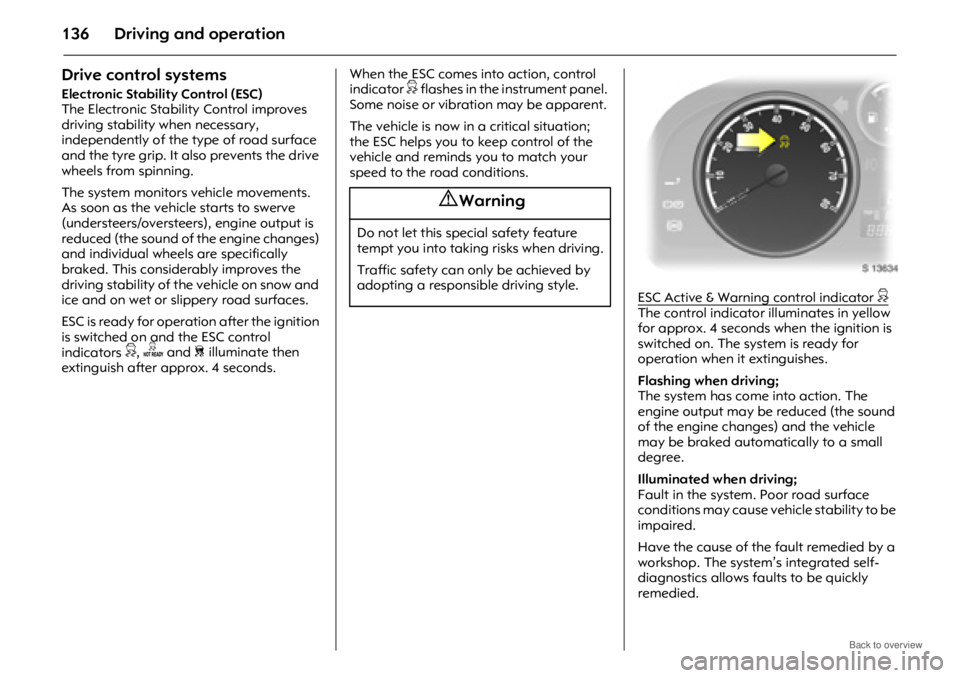
ESC is ready for operation after the ignition
is switched on and the ESC control
indicators
7, A and J illuminate then
extinguish after approx. 4 seconds. When the ESC comes into action, control
indicator
7 flashes in the instrument panel.
Some noise or vibration may be apparent.
The vehicle is now in a critical situation;
the ESC helps you to keep control of the
vehicle and reminds you to match your
speed to the road conditions.
ESC A
ctive & Warning control indicator 7The control indicator illuminates in yellow
for approx. 4 seconds when the ignition is
switched on. The system is ready for
operation when it extinguishes.
Flashing when driving;
The system has come into action. The
engine output may be reduced (the sound
of the engine changes) and the vehicle
may be braked automatically to a small
degree.
Illuminated when driving;
Fault in the system. Poor road surface
conditions may cause vehicle stability to be
impaired.
Have the cause of the fault remedied by a
workshop. The system’s integrated self-
diagnostics allows faults to be quickly
remedied.
9 Warning
Do not let this special safety feature
tempt you into taking risks when driving.
Traffic safety can only be achieved by
adopting a responsible driving style.
Page 150 of 234
Driving and operation150
Tyre pressure
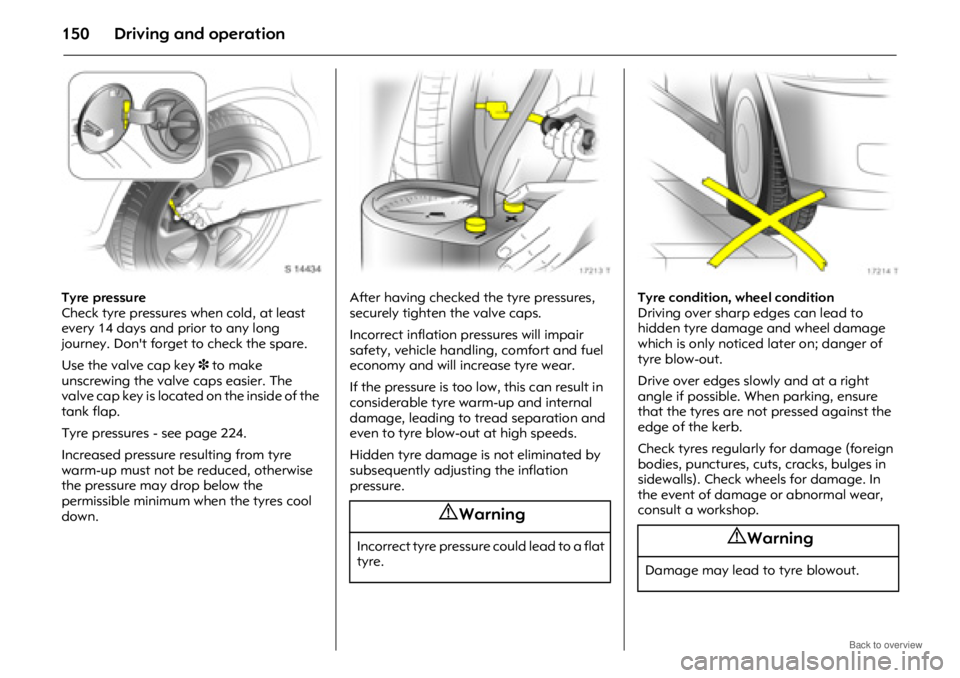
Check tyre pressures when cold, at least
every 14 days and prior to any long
journey. Don't forget to check the spare.
Use the valve cap key 3 to make
unscrewing the valve caps easier. The
valve cap key is located on the inside of the
tank flap.
Tyre pressures - see page 224.
Increased pressure resulting from tyre
warm-up must not be reduced, otherwise
the pressure may drop below the
permissible minimum when the tyres cool
down. After having checked the tyre pressures,
securely tighten the valve caps.
Incorrect inflation pressures will impair
safety, vehicle handling, comfort and fuel
economy and will increase tyre wear.
If the pressure is too low, this can result in
considerable tyre warm-up and internal
damage, leading to tread separation and
even to tyre blow-out at high speeds.
Hidden tyre damage is not eliminated by
subsequently adjusting the inflation
pressure.
Tyre condition, wheel condition
Driving over sharp edges can lead to
hidden tyre damage and wheel damage
which is only noticed later on; danger of
tyre blow-out.
Drive over edges slowly and at a right
angle if possible. When parking, ensure
that the tyres are not pressed against the
edge of the kerb.
Check tyres regularly for damage (foreign
bodies, punctures, cuts, cracks, bulges in
sidewalls). Check wheels for damage. In
the event of damage
or abnormal wear,
consult a workshop.
9 Warning
Incorrect tyre pressure could lead to a flat
tyre.9 Warning
Damage may lead to tyre blowout.