air condition OPEL ANTARA 2009 Owner's Manual
[x] Cancel search | Manufacturer: OPEL, Model Year: 2009, Model line: ANTARA, Model: OPEL ANTARA 2009Pages: 234, PDF Size: 3.01 MB
Page 170 of 234
Driving and operation170
Block the wheels of both the caravan/trailer
and the vehicle when parking and always
apply the hand brake firmly. If possible, do
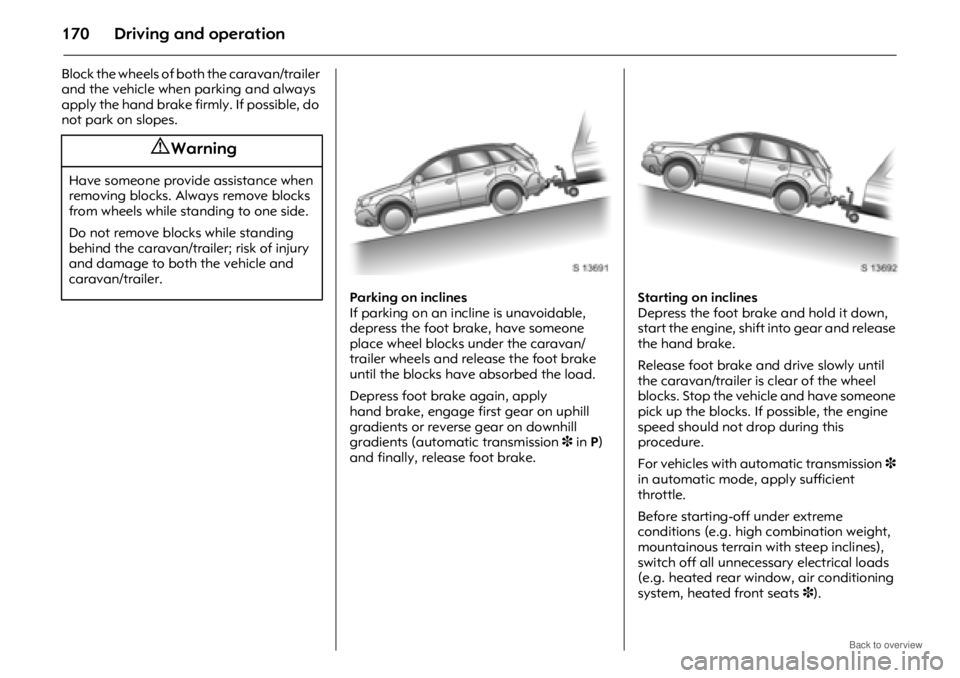
not park on slopes. Parking on inclines
If parking on an incline is unavoidable,
depress the foot brake, have someone
place wheel blocks under the caravan/
trailer wheels and release the foot brake
until the blocks have absorbed the load.
Depress foot brake again, apply
hand brake, engage first gear on uphill
gradients or reverse gear on downhill
gradients (automatic transmission 3 in P)
and finally, release foot brake. Starting on inclines
Depress the foot brake and hold it down,
start the engine, shift into gear and release
the hand brake.
Release foot brake and drive slowly until
the caravan/trailer is clear of the wheel
blocks. Stop the vehicle and have someone
pick up the blocks. If possible, the engine
speed should not drop during this
procedure.
For vehicles with automatic transmission
3
in automatic mode, apply sufficient
throttle.
Before starting-off under extreme
conditions (e.g. high combination weight,
mountainous terrain with steep inclines),
switch off all unnecessary electrical loads
(e.g. heated rear window, air conditioning
system, heated front seats 3).
9 Warning
Have someone provide assistance when
removing blocks. Always remove blocks
from wheels while standing to one side.
Do not remove blocks while standing
behind the caravan/trailer; risk of injury
and damage to both the vehicle and
caravan/trailer.
Page 183 of 234
Self-help, vehicle care 183
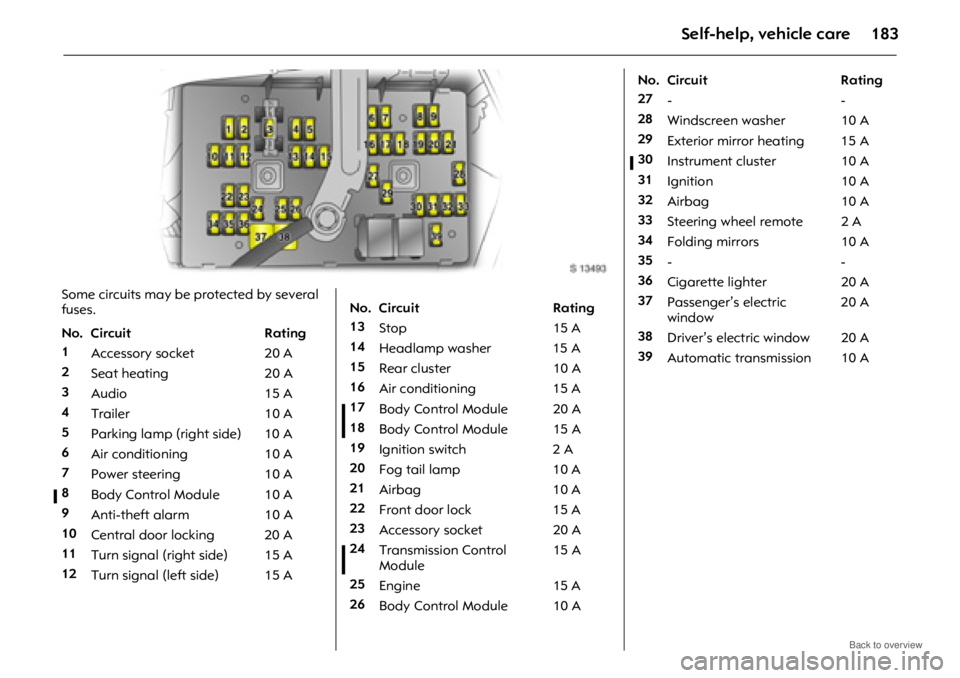
Some circuits may be protected by several
fuses.
No. Circuit Rating
1Accessory socket 20 A
2 Seat heating 20 A
3 Audio 15 A
4 Trailer 10 A
5 Parking lamp (right side) 10 A
6 Air conditioning 10 A
7 Power steering 10 A
8 Body Control Module 10 A
9 Anti-theft alarm 10 A
10 Central door locking 20 A
11 Turn signal (right side) 15 A
12 Turn signal (left side) 15 ANo. Circuit Rating
13 Stop 15 A
14 Headlamp washer 15 A
15 Rear cluster 10 A
16 Air conditioning 15 A
17 Body Control Module 20 A
18 Body Control Module 15 A
19 Ignition switch 2 A
20 Fog tail lamp 10 A
21 Airbag 10 A
22 Front door lock 15 A
23 Accessory socket 20 A
24 Transmission Control
Module 15 A
25 Engine 15 A
26 Body Control Module 10 A
No. Circuit Rating
27 --
28 Windscreen washer 10 A
29 Exterior mirror heating 15 A
30 Instrument cluster 10 A
31 Ignition 10 A
32 Airbag 10 A
33 Steering wheel remote 2 A
34 Folding mirrors 10 A
35 --
36 Cigarette lighter 20 A
37 Passenger’s electric
window 20 A
38 Driver’s electric window 20 A
39 Automatic transmission 10 A
Page 184 of 234
184 Self-help, vehicle care
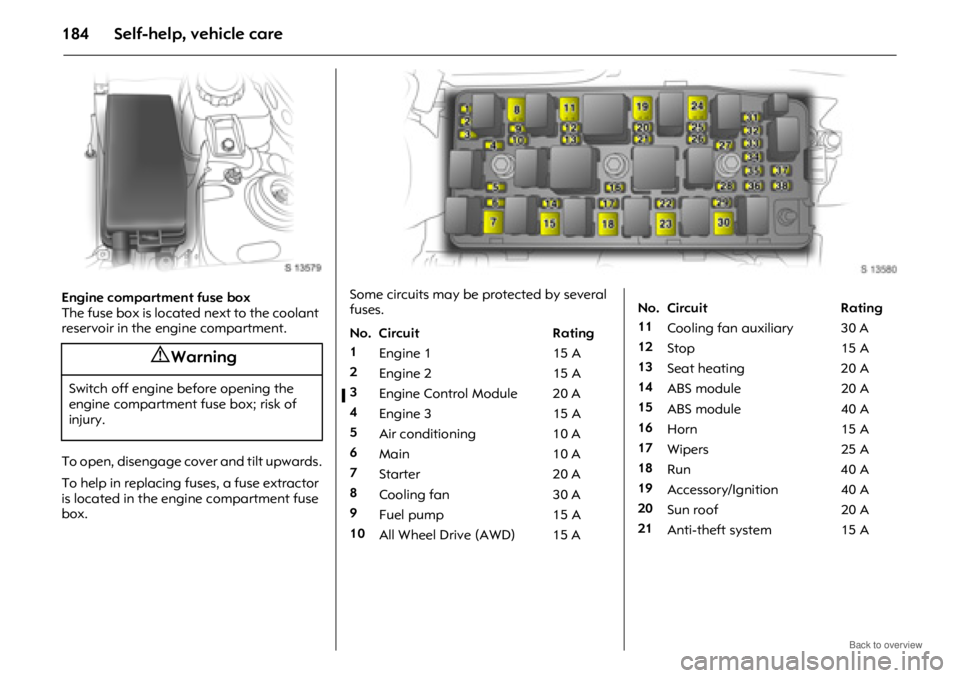
Engine compartment fuse box
The fuse box is located next to the coolant
reservoir in the engine compartment.
To open, disengage cover and tilt upwards.
To help in replacing fuses, a fuse extractor
is located in the engine compartment fuse
box.
9 Warning
Switch off engine before opening the
engine compartment fuse box; risk of
injury.
Some circuits may be protected by several
fuses.
No. Circuit Rating
1 Engine 1 15 A
2 Engine 2 15 A
3 Engine Control Module 20 A
4 Engine 3 15 A
5 Air conditioning 10 A
6 Main 10 A
7 Starter 20 A
8 Cooling fan 30 A
9 Fuel pump 15 A
10 All Wheel Drive (AWD) 15 ANo. Circuit Rating
11 Cooling fan auxiliary 30 A
12 Stop 15 A
13 Seat heating 20 A
14 ABS module 20 A
15 ABS module 40 A
16 Horn 15 A
17 Wipers 25 A
18 Run 40 A
19 Accessory/Ignition 40 A
20 Sun roof 20 A
21 Anti-theft system 15 A
Page 194 of 234
Self-help, vehicle care194
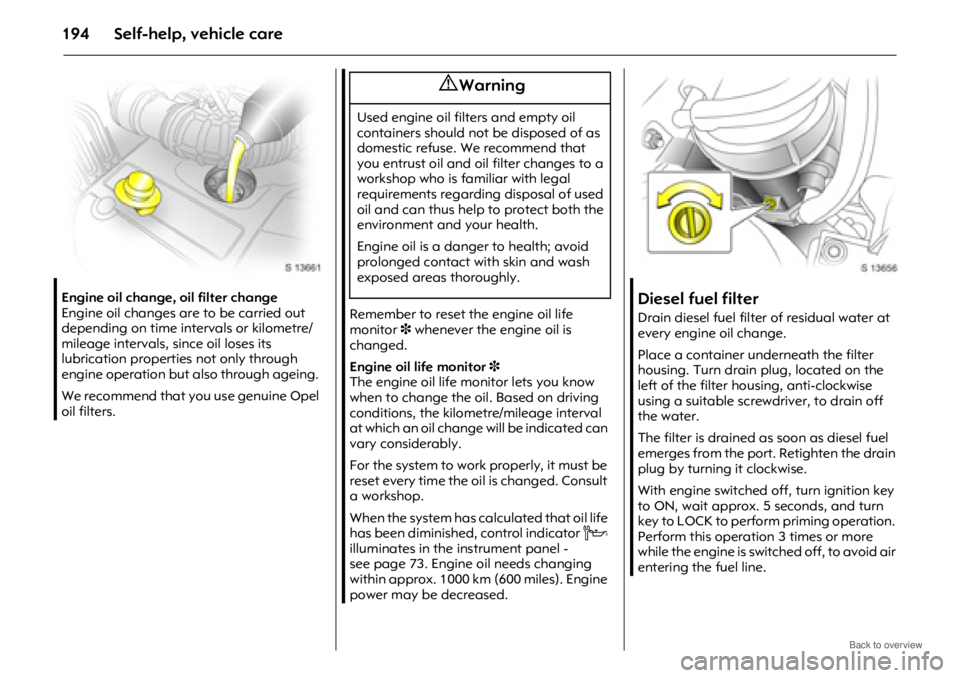
Engine oil change, oil filter change
Engine oil changes are to be carried out
depending on time intervals or kilometre/
mileage intervals, since oil loses its
lubrication properties not only through
engine operation but also through ageing.
We recommend that you use genuine Opel
oil filters.
Remember to reset the engine oil life
monitor 3 whenever the engine oil is
changed.
Engine oil life monitor 3
The engine oil life monitor lets you know
when to change the oil. Based on driving
conditions, the kilometre/mileage interval
at which an oil change will be indicated can
vary considerably.
For the system to work properly, it must be
reset every time the oil is changed. Consult
a workshop.
When the system has calculated that oil life
has been diminished, control indicator C
illuminates in the instrument panel -
see page 73. Engine oil needs changing
within approx. 1000 km (600 miles). Engine
power may be decreased.Diesel fuel filter
Drain diesel fuel filter of residual water at
every engine oil change.
Place a container underneath the filter
housing. Turn drain plug, located on the
left of the filter housing, anti-clockwise
using a suitable screwdriver, to drain off
the water.
The filter is drained as soon as diesel fuel
emerges from the port. Retighten the drain
plug by turning it clockwise.
With engine switched off, turn ignition key
to ON, wait approx. 5 seconds, and turn
key to LOCK to perform priming operation.
Perform this operation 3 times or more
while the engine is switched off, to avoid air
entering the fuel line.
9 Warning
Used engine oil filters and empty oil
containers should not be disposed of as
domestic refuse. We recommend that
you entrust oil and oil filter changes to a
workshop who is familiar with legal
requirements regarding disposal of used
oil and can thus help to protect both the
environment and your health.
Engine oil is a danger to health; avoid
prolonged contact with skin and wash
exposed areas thoroughly.
Page 199 of 234
Self-help, vehicle care199
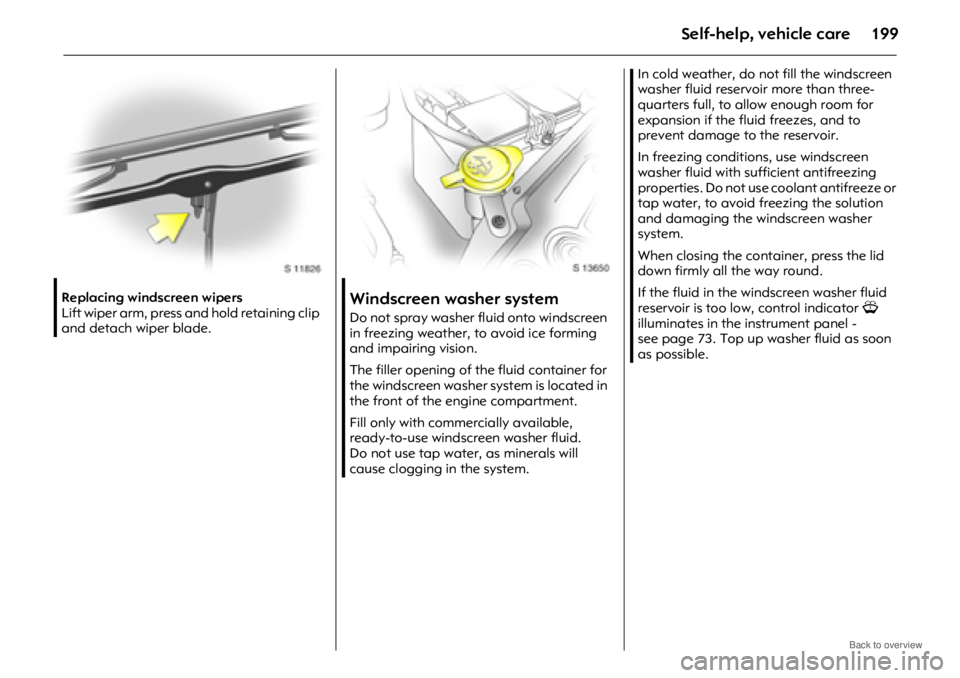
Replacing windscreen wipers
Lift wiper arm, press and hold retaining clip
and detach wiper blade.Windscreen washer system
Do not spray washer fluid onto windscreen
in freezing weather, to avoid ice forming
and impairing vision.
The filler opening of the fluid container for
the windscreen washer system is located in
the front of the engine compartment.
Fill only with commercially available,
ready-to-use windscreen washer fluid.
Do not use tap water, as minerals will
cause clogging in the system.In cold weather, do no
t fill the windscreen
washer fluid reservoir more than three-
quarters full, to allow enough room for
expansion if the fluid freezes, and to
prevent damage to the reservoir.
In freezing conditions, use windscreen
washer fluid with sufficient antifreezing
properties. Do not use coolant antifreeze or
tap water, to avoid freezing the solution
and damaging the windscreen washer
system.
When closing the cont ainer, press the lid
down firmly all the way round.
If the fluid in the windscreen washer fluid
reservoir is too low, control indicator G
illuminates in the instrument panel -
see page 73. Top up washer fluid as soon
as possible.
Page 202 of 234

Self-help, vehicle care202
Vehicle care aids 3
Vehicle wash:
z Car Shampoo
z Sponges
z Chamois Leather
z Wheel Cleaners
z Engine Cleaners
z Glass Cleaners
Exterior care:
z Touch-up Applicator
z Spray and Touch-up Paint
z Car Polishes/Colour Restorers
z Car Waxes/Sealers
z Alloy Wheel Cleaner
z Alloy Wheel Preserver
z Metallic Paintwork Wax
z Rust Preventative
z Lubricant Sprays
z Lock Cylinder Grease
z De-icer Sprays
z Tar Removal Spray
z Insect Remover
z Window Cleaning Spray
z Cleaning Solvent and Antifreeze
Interior care:
z Interior/Upholstery Cleaner Washing
The paintwork of your vehicle is exposed to
environmental influences, e.g. continuous
changes in weather conditions, industrial
waste gases and dust or thawing salts, so
wash and wax your vehicle regularly. When
using automatic car washes, select a
program which includes waxing.
Bird droppings, dead insects, resin, pollen
and the like should be cleaned off
immediately, as they contain aggressive
constituents which can cause paint
damage.
If using a car wash, comply with the
pertinent instructions of the car wash
manufacturer. The windscreen wipers and
tailgate wipers must be switched off –
see pages 92, 93. Remove detachable rod
antenna by unscrewing it.
Do not use high-pressure jet cleaners.
If you wash your vehicle by hand, make
sure that the insides of the wings are also
thoroughly rinsed out. Do not use
household dishwashing liquid, to avoid
removing wax from the paintwork.
Clean edges and folds on opened doors
and flaps as well as the areas they cover.
Thoroughly rinse off and leather-off the
vehicle. Rinse leather frequently. Use
separate leathers for paint and window
surfaces; remnants of wax on the windows
will impair vision.
Also wash aluminium trim parts, avoiding
the use of abrasive materials such as
automotive or chrome polish, steam or
caustic soap. Washing with water is
normally sufficient.
Observe national regulations.
Page 205 of 234

Self-help, vehicle care205
Windscreen wiper blades
Wax, such as that used in car washes, can
cause streaks to form on the windscreen
when the wipers are used.
Smearing wiper blades can be cleaned with
a soft cloth and Opel Cleaning Solvent and
Antifreeze, and replaced if necessary –
see page 198. Do not use abrasive
cleaners.
Locks
The locks are lubricated with a high-grade
lock cylinder grease at the factory. Opel
Lock Cylinder Grease prevents the locks
from freezing up.
Only use de-icing agents in emergencies,
as they have a degreasing effect and will
impair the function of the locks. After using
a de-icing agent, have the locks re-greased
by a workshop. Engine compartment
Areas of the engine compartment that are
painted in the same colour as the vehicle
must be looked after
like any other painted
surface.
It is advisable to wash the engine
compartment before and after winter and
preserve it with wax. Cover alternator and
fluid reservoirs with plastic sheets before
washing the engine.
When washing the engine with a steam-jet
cleaner, do not direct the steam-jet at
components of the Anti-lock Brake System
(ABS), the air conditioning system or the
belt drive and its components.
Protective wax that has been applied is
also removed during the engine wash. For
this reason, have the engine, brake system
components in the engine compartment,
axle components with steering, body parts
and cavities thoroughly preserved with
protective wax after the wash.
An engine wash can be performed in the
spring in order to remove dirt that has
adhered to the engine compartment,
which may also have a high salt content.
Check protective wax layer and make good
if necessary. Underbody
Your vehicle has a factory-applied PVC
undercoating in the wheel arches
(including the longitudinal members) which
provides permanent protection and needs
no special maintenance. The surfaces of
the vehicle underbody not covered by PVC
are provided with a durable protective wax
coating in critical areas.
On vehicles which are washed frequently
in automatic car wash
es with underbody
washing facility, the protective wax
coating may be impaire d by dirt-dissolving
additives. Check the underbody after
washing and have it waxed if necessary.
Before the start of the cold weather season,
check the PVC coating and protective wax
coating and, if necessary, have them
restored to perfect condition.
Caution
– commercially available bitumen/
rubber materials can damage the PVC
coating. We recommend that you have
underbody work carried out by a
workshop, who knows the prescribed
materials and has experience in the use
thereof.
The underbody should be washed
following the end of the cold weather
season to remove any dirt adhering to the
underbody since this may also contain salt.
Check protective wax coating and, if
necessary, have it restored to perfect
condition.
Page 208 of 234

208 Service, maintenance
Service operations by year 1)
km ( x 1000)1)
miles ( x 1000)1)
1)Whichever occurs first.
⊕ Additional operations.
o Under extreme operating conditions and if required by country-specific conditions, the intervals are reduced.
15
10 1
30
20 45
30 2
60
40 75
50 3
90
60
⊕o Diesel fuel filter: drain water
(If relative humidity is high an
d/or fuel is of lower quality) Annually
Fuel filter: replace and drain water - diesel (g rade EN 590) Every 2 years/60 000 km/40 000 miles
Parking brake: check and adjust
Wheel mounting and suspension front an d rear, brake lines, brake pressure
hoses, fuel lines and exhaust system: visual check xxx
Corrosion protection: check and record in Service and Warranty Booklet Annually
Front and rear wheel br akes: check visually xxx
o
⊕Annual service check if annual mileage exceeds 20 000 km Annually
Engine, transmission, PTO, rear differential, A/C compressor: check for leaks xxx
Steering system boots, track rods , final drive: visual check xxx
Track rod end and supporting ball joint: check xxx
⊕Brake and clutch fluid: change Every 2 years
Wheel fastening: loosen and tighten to torque
Tyre condition and pressures: check, correct xxx
⊕Annual service check if annual
mileage exceeds 20 000 km Annually
First aid kit, tyre repair kit and lash ing eyes: visual check Every 2 years
Headlamp aiming: check, adjust x x x
Door hinges, door stop, lock cylinder, lock striker, bonnet catch, tailgate
hinges and check links: lubricate xxx
Test drive, final check
Service interval display and oil life monitor: reset - if applicable xxx
Page 210 of 234

210 Service, maintenance
Service operations by year 1)
km ( x 1000)1)
miles ( x 1000)1)
1)Whichever occurs first.
⊕ Additional operations.
o Under extreme operating conditions and if required by country-specific conditions, the intervals are reduced.
15
10 1
30
20 45
30 2
60
40 75
50 3
90
60
⊕o Diesel fuel filter: drain water
(If relative humidity is high an
d/or fuel is of lower quality) Annually
Fuel filter: replace and drain water - diesel (g rade EN 590) Every 2 years/60 000 km/40 000 miles
Parking brake: check and adjust
Wheel mounting and suspension front an d rear, brake lines, brake pressure
hoses, fuel lines and exhaust system: visual check Every 2 years/60 000 km/40 000 miles
Corrosion protection: check and record in Service and Warranty Booklet Annually
Front and rear wheel brakes: check visually Every 2 years/60 000 km/40 000 miles
o
⊕Annual service check if annual mileage exceeds 20 000 km Annually
o
⊕Automatic transmission oil: change Every 4 years/60 000 km/40 000 miles
Engine, transmission, A/C compressor: check for leaks Annually
Steering system boots, track rods, final drive: visual check Annually
Track rod end and supporting ball joint: check Annually
⊕Brake and clutch fluid: change Every 2 years
Wheel fastening: loosen and tighten to torque
Tyre condition and pressures: check, correct Every 2 years/60 000 km/40 000 miles
⊕Annual service check if annual
mileage exceeds 20 000 km Annually
First aid kit, tyre repair kit and lash ing eyes: visual check Every 2 years
Headlamp aiming: check, adjust Every 2 years/60 000 km/40 000 miles
Door hinges, door stop, lock cylinder, lock striker, bonnet catch, tailgate
hinges and check links: lubricate Every 2 years/60 000 km/40 000 miles
Test drive, final check
Service interval display and oil life monitor: reset - if applicable xxxxxx
Page 212 of 234

212 Service, maintenance
Service operations by month 1)
km ( x 1000)1)
miles ( x 1000)1)
1)Whichever occurs first.
⊕ Additional operations.
o Under extreme operating conditions and if required by country-specific conditions, the intervals are reduced.
6
10
6.5 12
20
1318
30
2024
40
26.5 30
50
3336
60
40
Parking brake: check and adjust
Wheel mounting and suspension front an d rear, brake lines, brake pressure
hoses, fuel lines and exhaust system: visual check xxx
Corrosion protection: check and record in Service and Warranty Booklet Annually
Front and rear wheel br akes: check visually x x x
Engine, transmission, PTO, rear differential, A/C compressor: check for leaks xxx
Steering system boots, track rods , final drive: visual check xxx
Track rod end and supporting ball joint: check xxx
⊕Brake and clutch fluid: change Every 2 years
Wheel fastening: loosen and tighten to torque
Tyre condition and pressures: check, correct xxx
First aid kit, tyre repair kit and lash ing eyes: visual check Every 2 years
Headlamp aiming: check, adjust xxx
Door hinges, door stop, lock cylinder, lock striker, bonnet catch, tailgate
hinges and check links: lubricate xxx
Test drive, final check
Service interval display and oil life monitor: reset - if applicable xxx