cooling OPEL ANTARA 2009 User Guide
[x] Cancel search | Manufacturer: OPEL, Model Year: 2009, Model line: ANTARA, Model: OPEL ANTARA 2009Pages: 234, PDF Size: 3.01 MB
Page 112 of 234

Climate control112
Automatic air recirculation
The automatic air recirculation system has
an air quality sensor to detect harmful
ambient gases, in which case it will switch
automatically to air recirculation mode.
Press automatic air recirculation button t;
the system provides the optimum settings
for almost all conditions. Control indicator
in the button illuminates when automatic
air recirculation is enabled.
Press button t again to turn automatic air
recirculation system off; control indicator in
the button extinguishes and outside air is
drawn into the vehicle.
The system is only operational when the
engine is running. Automatic mode
Basic setting for maximum comfort:
z
Press AUTO button.
z Open all air vents.
z Set temperature using central rotary
knob.
All air vents are actuated automatically in
automatic mode. The air vents should
therefore always be open - see page 104.
The control indicator in the AUTO button
illuminates when automatic mode has
been selected.
To switch the system off, set fan to x .Temperature preset
The central rotary knob can be used to set
the temperature; 22 °C, 24 °C and 26 °C
appear on the rotary
knob. Intermediate
settings are possible.
The selected temperature is maintained.
At the lowest or highest temperature
setting, the system works at maximum
cooling or heating.
Page 114 of 234

Climate control114
Air intake
The air intakes in front of the windscreen in
the engine compartment must be kept
clear to allow air intake. Remove any
leaves, dirt or snow.
Pollen filter
The pollen filter cleans dust, soot, pollen
and spores from the air entering from
outside. The active carbon layer 3
eliminates most odours and harmful
ambient gases from the air.
Replace the pollen filter at the intervals
given on pages 206 to 212.
Note
If the windscreen mists up in damp
weather, temporarily set the system as
described under "Window demisting and
defrosting" - see pages 108, 113.
Cooling is most efficient when the windows
are closed. If the interior is extremely hot
due to a long period in strong sunlight,
briefly open the windows and sun roof 3 to
allow hot air to escape quickly.
When cooling (air conditioning
compressor) is switched on, condensation
forms, which is expelled from the underside
of the vehicle.
When cooling is switched on, at least one of
the adjustable centre or side air vents must
be open so that the evaporator does not
ice up due to lack of air movement.
Cooling switches off automatically at low
outside temperatures.
Do not cover the interior temperature
sensor (located below the fan switch) or the
sunlight sensor (located in front of
windscreen defroster vents) as this could
cause the Electronic Climate Control (ECC)
system 3 to malfunction.
Maintenance
To ensure continuously efficient
performance and prolong the life of the air
conditioning system, it must be switched on
for a few minutes once a week, irrespective
of the weather and time of year.
Electronic Climate Control (ECC) 3 handles
this automatically while driving. Air
conditioning compressor operation is not
possible at low outside temperatures.
Malfunctions in the system must not be
rectified by the owner: consult a workshop.
Page 125 of 234

Driving and operation125
Self-help
Recovery and towing
When recovering or towing a vehicle
off-road, observe the following:
zA greater force is required to move a
vehicle from or through mud than when
on a hard surfaced road.
z Attach a tow rope to the towing eye of
the vehicle, not to the axle -
see pages 164, 174.
z Where possible, drive both vehicles
forward to affect a recovery, using an
appropriate gear to avoid wheelspin.
z Avoid the use of reverse gear because of
possible resultant wheelspin.
z Stay clear of the tow rope.
Wheel changing
Place a board or plate beneath the jack, to
prevent it from sinking into soft ground.
Further information - see page 178. Cleaning
Clean the vehicle thoroughly and as soon
as possible after driving off-road.
Do not let mud remain dry on any part of
the vehicle as it becomes abrasive and can
damage paint, glass, seals, bearings and
brake components.
If left to build up, mud can seriously affect
the air flow through and over mechanical
components and cause localised
overheating and failure of parts, especially
in the engine compartment.
Ensure the radiator core and the area
between the radiator and intercooler/oil
cooler (where installed) is cleaned, to
maintain proper cooling air flow.
Check the radiator and cooler cores for
blockage (sand, silt etc.).
Check the tyre treads.
Clean and check the mechanical parts of
the vehicle, particularly the following
areas:
z
Driveshafts, including sealing bellows,
z Front brake calipers, pads and discs,
z Front suspension,
z Clutch fork sealing bellows,
z Rear brake calipers, pads and discs,
z Rear suspension,
z Fuel tank and underguard,
z Breathers, axles and fuel tank,
z Load sensing valve,
z Transfer box and underguard,
z Engine oil pan and underguard.
Observe the following:
z Do not spray high-pressure water
directly at the vehicle seals.
z The wheels must be removed to clean all
mud and stones from the brake calipers
and to check brake pad wear.
z The areas on the upper side of the
underguards must be cleared of stones,
to prevent damage to the engine oil pan
and the fuel tank.
9 Warning
Breaking ropes can cause serious injury.
Page 127 of 234

Driving and operation127
Driving hints
The first 1000 km (600 miles)
Drive your vehicle at various speeds. Do
not use full throttle. Never allow the engine
to labour at low revs.
Make good use of all gears. Depress the
accelerator pedal a maximum of around
three quarters of the available pedal travel
in all gears and drive ranges.
Do not drive faster than three quarters of
maximum speed.
Avoid quick starts, su dden acceleration
and prolonged high-speed driving, to
avoid engine damage and to conserve
fuel.
Do not brake unnecessarily hard for the
first 200 km (125 miles).
If possible, avoid towing another vehicle.
Never coast with engine not running
Many units may then not function (e.g.
brake servo unit, power steering, airbag
system). Driving in this manner is a danger
to yourself and others. Brake servo unit
With the engine not running, the brake
servo unit is no longer effective once the
brake pedal has been depressed once or
twice. The braking effect is not reduced,
but substantially greater foot pressure is
necessary to stop the vehicle.
Power steering
Never leave the steering wheel on full lock
when the vehicle is stationary, as this may
damage the power steering pump.
If the power steering should fail - e.g. when
the vehicle is being towed with the engine
switched off - the vehicle can still be
properly steered, but considerably greater
effort is necessary.
Driving in mountainous terrain or with a
caravan/trailer
Electrically driven fan; the fan cooling
capacity is not dependent on engine
speed. It is not necessary, therefore, when
driving uphill to shif
t down into a lower
gear if the vehicle can climb in a higher
gear. Driving in extreme conditions
When driving in hazard
ous conditions, e.g.
in snow, ice, mud, sand or water, drive
slowly and cautiously to allow for greater
braking distances.
If stuck, use 2nd gear (automatic
transmission in drive range 2) to avoid
spinning the front wheels.
Use sand, tyre chains or other non-slip
materials to provide traction when stuck in
snow, mud or ice.
Driving through water
Before attempting to drive through water,
check the depth. If the depth is slightly
lower than the underbody of your vehicle,
do not attempt to drive through it.
Driving too quickly through water can
cause water to enter the engine through
the air intake, causing severe damage.
Drive slowly, in a high engine rpm in as low
a gear as possible.
Driving with a roof load
Do not exceed the permissible roof load -
see page 221. For safety reasons,
distribute the load evenly and secure it
tightly with straps so that it cannot slip. Set
the tyre pressure to the value given for full
load. Do not drive faster than 120 km/h
(75 mph). Check and retighten straps at
frequent intervals.
Page 169 of 234

Driving and operation169
Driving characteristics, towing tips
In the case of caravans/trailers with
brakes3, attach the breakaway stopping
cable to the eye 3 or loop around coupling
ball bar if no eye is available.
Ensure cable is crossed under the coupling
socket to ensure the caravan/trailer nose
cannot drop to the ground if it becomes
separated from the trailer hitch.
Do not allow the cable to drag along the
ground and always allow enough slack to
permit full turning. Fo llow the instructions
supplied with the towing equipment.
Before coupling the caravan/trailer,
lubricate the ball of the caravan/trailer
towing device. However, do not do so if a
stabilizer which acts on the coupling ball is
being used to damp rolling motions.
Handling is greatly influenced by the
loading of the caravan/trailer. Loads
should therefore be secured so that they
cannot slip and should be placed in the
centre of the caravan/trailer if possible,
i.e. above the axle.
Opel genuine parts an d accessories which
can be subsequently fitted aid trailer
operation, e.g. larg e mirrors for wide
caravans/trailers. In the case of caravans/trailers with low
directional stability, it is advisable to use a
friction-type stabilizer to damp rolling
motions.
Do not drive faster than 80 km/h (50 mph),
even in countries where higher speeds are
permitted.
When driving uphill, do not drive faster
than 30 km/h (20 mph) in 1st gear, or
50 km/h (30 mph) in 2nd gear.
Make sure that you have enough room
when cornering and avoid sudden
manoeuvres.
If the caravan/trailer starts to sway, drive
more slowly, do not attempt to correct the
steering and brake sharply if necessary.
If it is necessary to apply the brakes fully,
depress the brake pedal as hard as
possible.
The cooling fan is electrically operated.
The fan cooling capacity is not, therefore,
dependent on engine speed. It is not
necessary, when drivin
g uphill, to shift
down into a lower gear if the vehicle can
climb in a higher gear. When coupled to a caravan/trailer, the
vehicle requires more
braking effort when
driving down long grad ients, so select the
same gear as you would when driving
uphill and drive at roughly the same speed.
Automatic transmission in automatic mode
will select the drivin g program with the
optimum engine braking effect.
Remember that brak ing distances for
vehicles towing carava ns/trailers with and
without brakes is always greater than for
vehicles not towing a caravan/trailer. For
caravans/trailers with brakes, follow the
instructions carefully. Do not make any
modifications to the brake system.
Always check lamps on caravans/trailers
before towing. Ensure national regulations
are observed.
The fog tail lamp on the vehicle is
deactivated when towing a caravan/
trailer.
When reversing, if possible, have someone
provide assistance.
Drive slowly and shift down into a lower
gear when descending steep gradients
rather than holding the foot brake
depressed, to avoid overheating and
reduced brake efficiency.
Page 184 of 234
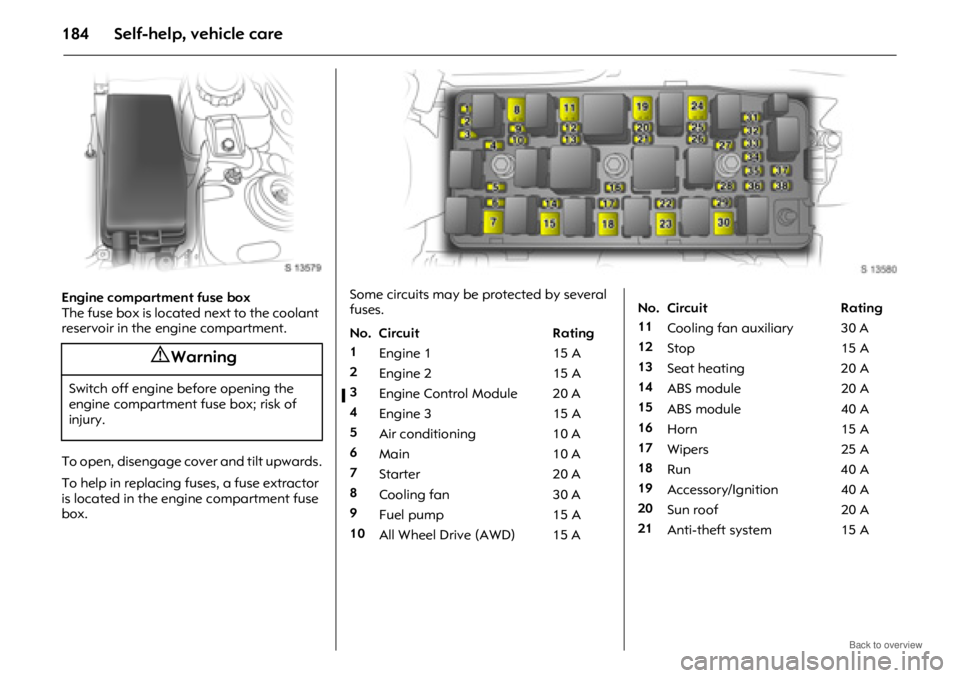
184 Self-help, vehicle care
Engine compartment fuse box
The fuse box is located next to the coolant
reservoir in the engine compartment.
To open, disengage cover and tilt upwards.
To help in replacing fuses, a fuse extractor
is located in the engine compartment fuse
box.
9 Warning
Switch off engine before opening the
engine compartment fuse box; risk of
injury.
Some circuits may be protected by several
fuses.
No. Circuit Rating
1 Engine 1 15 A
2 Engine 2 15 A
3 Engine Control Module 20 A
4 Engine 3 15 A
5 Air conditioning 10 A
6 Main 10 A
7 Starter 20 A
8 Cooling fan 30 A
9 Fuel pump 15 A
10 All Wheel Drive (AWD) 15 ANo. Circuit Rating
11 Cooling fan auxiliary 30 A
12 Stop 15 A
13 Seat heating 20 A
14 ABS module 20 A
15 ABS module 40 A
16 Horn 15 A
17 Wipers 25 A
18 Run 40 A
19 Accessory/Ignition 40 A
20 Sun roof 20 A
21 Anti-theft system 15 A
Page 191 of 234

Self-help, vehicle care191
Centre high-mounted stop lamp,
instrument panel and glove compartment
illumination
We recommend having bulb replacements
carried out by a workshop.
Opel genuine parts and
accessories
We recommend the use of “Opel genuine
parts and accessories” and conversion
parts released expressly for your vehicle
type. These parts have undergone special
tests to establish their reliability, safety and
specific suitability for your vehicle. Despite
continuous market monitoring, we cannot
assess or guarantee these attributes for
other products, even if they have been
granted approval by the relevant
authorities or in some other form.
“Opel genuine parts and accessories” and
conversion parts approved by Opel can be
obtained from your Op el Partner, who can
provide comprehensive advice about
permitted technical changes and ensure
that the part is installed correctly.
A note on safety
To avoid the possibility of injury, only carry
out engine compartment checks (e.g.
checking the brake fluid level or the engine
oil level) when the igni tion is switched off. Never carry out any re
pairs or adjustment
and maintenance work on the vehicle
yourself. This especially applies to the
engine, chassis and safety parts. You may,
out of ignorance, infringe the provisions of
the law and, by not performing the work
properly, you may endanger yourself and
other road users.
Checking and topping up fluids
To aid identification, the engine oil filler
cap, the coolant filler cap, the lid of the
fluid container for the windscreen washer
system and the handle of the engine oil
gauge (dipstick) may be coloured yellow.
9 Warning
The cooling fan may be operated by a
thermoswitch and can therefore start to
operate unexpectedly, even when the
ignition is switched off; risk of injury.
Electronic ignition systems generate very
high voltages. Do not touch the ignition
system; high voltage can be fatal.
Page 195 of 234

Self-help, vehicle care195
Check diesel fuel filter at shorter intervals if
the vehicle is subjected to extreme
operating conditions such as high humidity
(primarily in coastal areas), extremely high
or low outside temperatures and
substantially varying daytime and night-
time temperatures.
If there is water in the diesel fuel filter,
control indicator
N illuminates in the
instrument panel - see page 73. Drain the
water immediately.
Coolant
During operation, the system is
pressurized. The temperature may
therefore rise to over 100 °C.
The antifreeze provides excellent corrosion
protection for the cooling and heating
system, as well as freeze protection down
to -28 °C.
Certain types of antifreeze can lead to
engine damage. We therefore strongly
recommend the use of antifreeze that has
been approved by Opel.
Antifreeze and corrosion protection
Before the start of the cold weather season,
have the coolant checked for correct
concentration by a workshop. The amount
of antifreeze must provide protection down
to approx. –28 °C. If the antifreeze
concentration is too low, this reduces
protection from fr eezing and corrosion.
Top up antifreeze if necessary.
If coolant loss is topped up with
demineralised water, have antifreeze
concentration checked and more
antifreeze added as necessary. Coolant level
Hardly any losses occur since the cooling
system is sealed and it is thus rarely
necessary to top up the coolant.
The coolant level in the expansion tank
should be between the
MIN and MAX
marks when the system is cold.
9 Warning
Antifreeze is a danger to health: it must
therefore be kept in the original container
and out of the reach of children.
Page 229 of 234

Index229
Brakes ..................................................... 145
ABS
..................................................... 148
Brake assist
........................................ 146
Brake fluid
.......................................... 196
Brake lamps
....................................... 188
Brake servo unit
................................. 127
Foot brake
.......................................... 146
Hand brake
........................................ 147
Bulb replacement
.................................. 185
Bulbs
....................................................... 185
C
Capacities .............................................. 225
Car Pass
................................................... 21
Caravan/trailer towing
.................. 127, 167
Card holder
.............................................. 67
Care
........................................................ 201
Catalytic converter
............... 133, 135, 172
Central locking switch
............................. 25
Central locking system
............................ 25
Centre high-mounted stop lamp Bulb replacement
.............................. 191
Changing the battery Remote control
.................................... 24
Changing tyre/wheel type
.................... 149
Changing wheels
................................... 178
Chassis number, see Vehicle
Identification Number
................... 215, 216
Check control
........................................... 91
Child restraint system
....................... 47, 58
Child safety locks
.................................... 30
Cigarette lighter
...................................... 68
Cleaning
................................................. 201
Climate control
...................................... 103 Clock
......................................................... 76
Clutch fluid
............................................. 197
Clutch operation
................................... 128
CO
2 emissions ........................................ 219
Coin storage
............................................ 67
Cold starts
...................................... 128, 133
Colour information display
............... 77, 83
Console box
............................................. 65
Console net
.............................................. 66
Contrast
................................................... 87
Control indicators
.............................. 12, 70
ABS
............................................... 70, 148
Airbags
........................................... 56, 72
All Wheel Drive
............................ 71, 121
Alternator
............................................. 74
Anti-theft alarm system
.......... 28, 29, 74
Automatic headlamp
range adjustment
.......................... 71, 97
Automatic transmission
.................... 120
Belt tensioners
............................... 45, 72
Brake system
....................... 70, 147, 197
Change engine oil
....................... 73, 194
Coolant temperature
.................. 71, 196
Cruise control
............................... 73, 140
Descent Control System
...... 71, 138, 139
Diesel particle filter
..................... 73, 135
Doors
.................................................... 72
Driver’s seat belt reminder
................. 72
Electronic immobiliser
................... 22, 72
Electronic Stability Control
......... 71, 136
Engine electronics
....................... 72, 134
Engine oil level
..................................... 73
Engine oil pressure
.............................. 74
Exhaust
........................................ 74, 134 Fog tail lamp
................................. 73, 96
Front fog lamps
............................. 73, 96
Front passenger’s seat belt reminder
46
Fuel level
........................................ 72, 76
Headlamp main beam
................. 73, 95
Park pilot
...................................... 71, 143
Power steering
..................................... 73
Preheating
........................................... 73
Tailgate
................................................ 72
Trailer
................................................... 70
Transmission electronics
..................... 72
Turn signal lamps
................................ 72
Water in diesel fuel
..................... 73, 195
Windscreen washer fluid
............ 73, 199
Winter program
........................... 74, 117
Coolant
.................................. 195, 214, 216
Coolant level
......................................... 195
Coolant temperature
...................... 71, 195
Cooled glove compartment
................. 105
Cooling
........................................... 110, 111
Correcting time
....................................... 86
Corrosion protection
............................. 214
Coupling socket load
............................ 168
Courtesy lamps
....................................... 98
Bulb replacement
.............................. 189
Switching off
........................................ 99
Cruise control
........................................ 140
Curtain airbags
....................................... 55
Page 231 of 234

Index231
Fuel gauge ............................................... 76
Fuel system, diesel
................................ 194
Fuse extractor
........................................ 182
Fuses
....................................................... 181
G
Gears ........................................................ 17
Generator, see Alternator
....................... 74
Glasses compartment
............................. 65
Glove compartment
................................ 64
Bulb replacement
.............................. 191
Cooling
............................................... 105
Lighting
........................................ 64, 100
Graphical information display
......... 77, 83
Gross Vehicle Weight
........... 131, 167, 221
H
Halogen headlamp system .................. 185
Bulb replacement
.............................. 185
Hand brake
...................................... 19, 147
Hazard warning lamps
..................... 14, 97
Head restraints
.................................... 8, 39
Active head restraints
......................... 39
Head restraint position
....................... 39
Height adjustment
.............................. 39
Headlamp aiming
................................. 185
Headlamp flash
................................. 14, 95
Headlamp main beam
..................... 14, 95
Bulb replacement
.............................. 186
Control indicator
............................ 73, 95
Headlamp range adjustment
......... 97, 185
Automatic
............................................ 97
Manual
................................................. 97
Headlamp switch
.............................. 13, 94 Headlamp washer system
........ 16, 93, 199
Antifreeze protection
........................ 199
Capacities
.......................................... 225
Washer fluid reservoir
....................... 199
Headlamps
........................................ 13, 94
Bulb replacement
...................... 186, 187
Daytime running lamps
...................... 94
Driving abroad
.................................. 100
Front fog lamps
................................... 96
Warning device
............................. 92, 94
Wiper activated lighting
..................... 94
Heated exterior mirrors
.................. 16, 105
Heated front seats
................................ 105
Heated rear window
....................... 16, 105
Heating
.......................................... 103, 107
Exterior mirrors
.................................. 105
Rear window
...................................... 105
Seats
................................................... 105
With air conditioning system
.... 107, 108
With Electronic Climate Control
112, 113
Heating the footwell
............................. 108
Height adjustment Head restraints
................................ 8, 39
Seat belts
............................................. 47
Steering wheel
..................................... 13
High-pressure cleaners
143, 167, 202, 204
Horn
......................................................... 15
Hydraulic Brake Assist (HBA)
............... 138
I
Identification plate ............................... 215
Ignition logic
...................................... 80, 87
Ignition switch
......................................... 13
Illumination
........................................ 100
Ignition system
........................................ 19
Immobiliser
.............................................. 22
Information display
................................ 76
Bulb replacement
.............................. 191
Illumination
.......................................... 98
Infotainment system
..................... 101, 102
Inspection system
................................. 206
Instrument display
.................................. 75
Bulb replacement
.............................. 191
Illumination
.......................................... 98
Instrument panel
..................................... 10
Instruments
.............................................. 70
Interior lamps
.......................................... 98
Front reading lamps
........................... 99
Rear interior lamps
.............................. 99
Interior mirror
...................................... 9, 31
Interruption of power supply
... 83, 90, 120
Selector lever lock
............................. 120
ISOFIX
.......................................... 50, 51, 52
J
Jack ........................................................ 176
Jump leads
............................................ 172