filter OPEL ANTARA 2009 User Guide
[x] Cancel search | Manufacturer: OPEL, Model Year: 2009, Model line: ANTARA, Model: OPEL ANTARA 2009Pages: 234, PDF Size: 3.01 MB
Page 135 of 234

Driving and operation135
Exhaust gases
Do not run engine in enclosed spaces, e.g.
in a garage, or sit in a parked vehicle for an
extended period with the engine running.
Do not drive with tailgate open. If driving
with the tailgate open is necessary, set fan
to highest speed, close windows and
ensure air recirculation mode is off, to allow
entry of outside air.
If the underbody or rear of vehicle is
damaged or corroded, you notice a
change in the sound of the exhaust system,
or whenever you suspect exhaust gases are
penetrating the vehicle interior, consult a
workshop immediately.
When the vehicle is driven for the first time,
wax and oil on the exhaust system may
evaporate, producing smoke-like emissions
which should not be inhaled. Allow wax
and oil to evaporate while the vehicle is in
the open air. Diesel particle filter (DPF) 3
The diesel particle filter removes polluting
soot particles out of the exhaust.
The system contains a self-cleaning
function at certain intervals. The filter is
cleaned by burning the soot particles at
high temperature. This procedure runs
automatically under certain vehicle
conditions and can take up to 15 minutes,
during which time fuel consumption may
increase. The smell and the noise that
occur are normal.
The system cannot automatically clean
itself under certain vehicle conditions, such
as driving short distances.
If control indicator
I illuminates, you
should continue driving, and as soon as the
road and traffic situation permits it,
increase speed to more than 50 km/h
(30 mph) and diesel particle filter cleaning
will start.
Cleaning is quicker at faster speeds and
under load. The engine speed should not
drop below 2000 rpm. The control indicator
extinguishes as soon as cleaning is
complete.
We recommend that you do not turn the
ignition off during cleaning. Maintenance
Have all maintenance work carried out at
the intervals specified by Opel. We
recommend that you entrust this work to
your Opel Partner, who has proper
equipment and trained personnel
available. Electronic testing of systems
permits rapid diagnosis and remedy of
faults. This way, you can be certain that all
components of the vehicle’s electrical,
injection and ignition systems operate
correctly, that your ve
hicle has a low level
of pollutant emission and that the catalytic
converter system will have a long service
life.
You are thereby making an important
contribution towards keeping the air clean
and compliance with emissions legislation.
Checking and adjustment of the fuel-
injection and ignition systems is part of the
scope of a Service. For this reason, you
should have all maintenance work carried
out at the intervals specified in the chapter
"Service, Maintanance" on page 206.
9 Warning
Engine exhaust gases contain poisonous
carbon monoxide, which has no colour or
odour and can be lethal if inhaled.
If exhaust fumes penetrate the vehicle
interior, open the windows and consult a
workshop immediately.
Page 194 of 234
Self-help, vehicle care194
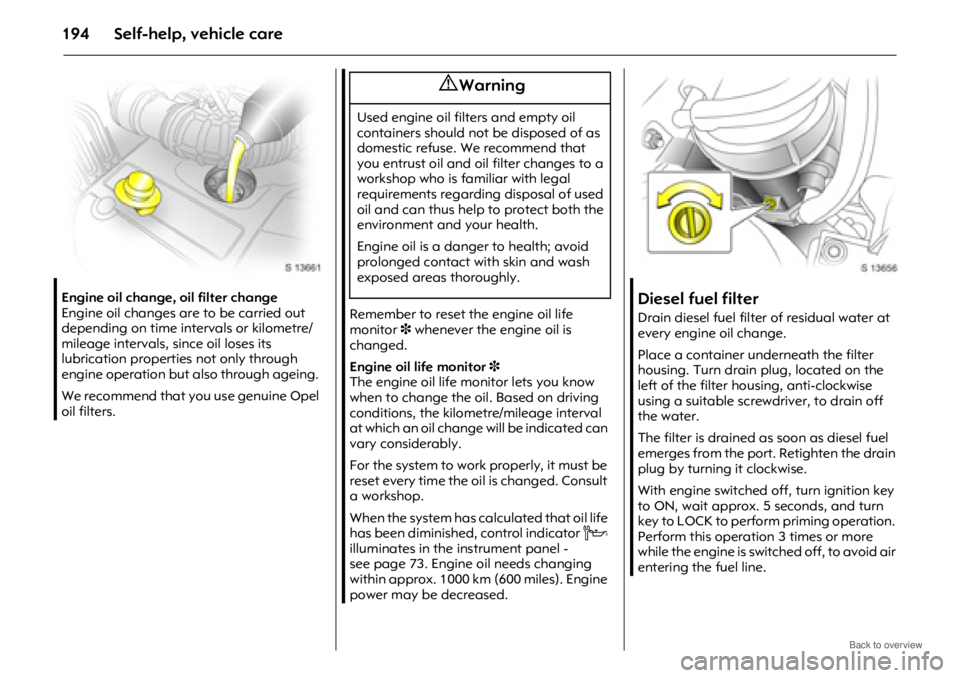
Engine oil change, oil filter change
Engine oil changes are to be carried out
depending on time intervals or kilometre/
mileage intervals, since oil loses its
lubrication properties not only through
engine operation but also through ageing.
We recommend that you use genuine Opel
oil filters.
Remember to reset the engine oil life
monitor 3 whenever the engine oil is
changed.
Engine oil life monitor 3
The engine oil life monitor lets you know
when to change the oil. Based on driving
conditions, the kilometre/mileage interval
at which an oil change will be indicated can
vary considerably.
For the system to work properly, it must be
reset every time the oil is changed. Consult
a workshop.
When the system has calculated that oil life
has been diminished, control indicator C
illuminates in the instrument panel -
see page 73. Engine oil needs changing
within approx. 1000 km (600 miles). Engine
power may be decreased.Diesel fuel filter
Drain diesel fuel filter of residual water at
every engine oil change.
Place a container underneath the filter
housing. Turn drain plug, located on the
left of the filter housing, anti-clockwise
using a suitable screwdriver, to drain off
the water.
The filter is drained as soon as diesel fuel
emerges from the port. Retighten the drain
plug by turning it clockwise.
With engine switched off, turn ignition key
to ON, wait approx. 5 seconds, and turn
key to LOCK to perform priming operation.
Perform this operation 3 times or more
while the engine is switched off, to avoid air
entering the fuel line.
9 Warning
Used engine oil filters and empty oil
containers should not be disposed of as
domestic refuse. We recommend that
you entrust oil and oil filter changes to a
workshop who is familiar with legal
requirements regarding disposal of used
oil and can thus help to protect both the
environment and your health.
Engine oil is a danger to health; avoid
prolonged contact with skin and wash
exposed areas thoroughly.
Page 195 of 234

Self-help, vehicle care195
Check diesel fuel filter at shorter intervals if
the vehicle is subjected to extreme
operating conditions such as high humidity
(primarily in coastal areas), extremely high
or low outside temperatures and
substantially varying daytime and night-
time temperatures.
If there is water in the diesel fuel filter,
control indicator
N illuminates in the
instrument panel - see page 73. Drain the
water immediately.
Coolant
During operation, the system is
pressurized. The temperature may
therefore rise to over 100 °C.
The antifreeze provides excellent corrosion
protection for the cooling and heating
system, as well as freeze protection down
to -28 °C.
Certain types of antifreeze can lead to
engine damage. We therefore strongly
recommend the use of antifreeze that has
been approved by Opel.
Antifreeze and corrosion protection
Before the start of the cold weather season,
have the coolant checked for correct
concentration by a workshop. The amount
of antifreeze must provide protection down
to approx. –28 °C. If the antifreeze
concentration is too low, this reduces
protection from fr eezing and corrosion.
Top up antifreeze if necessary.
If coolant loss is topped up with
demineralised water, have antifreeze
concentration checked and more
antifreeze added as necessary. Coolant level
Hardly any losses occur since the cooling
system is sealed and it is thus rarely
necessary to top up the coolant.
The coolant level in the expansion tank
should be between the
MIN and MAX
marks when the system is cold.
9 Warning
Antifreeze is a danger to health: it must
therefore be kept in the original container
and out of the reach of children.
Page 207 of 234

Service, maintenance 207
European service schedule
(Antara Z 20 DM, Z 20 DMH, Z 24 XE, Z 32 SE) Service operations by year 1)
km ( x 1000)1)
miles ( x 1000)1)
1)Whichever occurs first.
15
101
30
20 45
30 2
60
40 75
50 3
90
60
Controls, lighting, signalling equi pment and airbags: visual check
steering lock and ignition lock: check xxx
Remote control batteries: replace Every 2 years
Windscreen wipers, windscreen washer system: check, correct xxx
Coolant level and antifreeze: check, correct
Hoses: check for tightness and secure seating xxx
Brake fluid level: check, correct xxx
Battery terminals: check for secu re connections and battery eye xxx
Vehicle system check with TECH2 xxx
Pollen filter: replace xxx
oMore often for when dust, sand or polle n is in the air Agreement with customer
Air cleaner element: replace
xxx
⊕Spark plugs and plug leads: replace Every 90 000 km/60 000 miles
Ribbed V-belt: visual check xxx
⊕Toothed belt and tension roller: visual check xxx
Toothed belt and tension roller: replace - Z 24 XE Every 8 years/120 000 km/80 000 miles
Toothed belt and tension roller: replace - Z 20 DM, Z 20 DMH Every 6 years/90 000 km/60 000 miles
Power steering system: check for leak s. Fluid level: check, correct xxx
Engine oil and oil filter: replace - fixed interval Z 24 XE
2)
2)On vehicles with oil life monitoring, it may be necessary to change the engine oil earlier (control indicator illuminates).
xxxxxx
Z 20 DM, Z 20 DMH, Z 32 SE, except2)xxx
Page 208 of 234

208 Service, maintenance
Service operations by year 1)
km ( x 1000)1)
miles ( x 1000)1)
1)Whichever occurs first.
⊕ Additional operations.
o Under extreme operating conditions and if required by country-specific conditions, the intervals are reduced.
15
10 1
30
20 45
30 2
60
40 75
50 3
90
60
⊕o Diesel fuel filter: drain water
(If relative humidity is high an
d/or fuel is of lower quality) Annually
Fuel filter: replace and drain water - diesel (g rade EN 590) Every 2 years/60 000 km/40 000 miles
Parking brake: check and adjust
Wheel mounting and suspension front an d rear, brake lines, brake pressure
hoses, fuel lines and exhaust system: visual check xxx
Corrosion protection: check and record in Service and Warranty Booklet Annually
Front and rear wheel br akes: check visually xxx
o
⊕Annual service check if annual mileage exceeds 20 000 km Annually
Engine, transmission, PTO, rear differential, A/C compressor: check for leaks xxx
Steering system boots, track rods , final drive: visual check xxx
Track rod end and supporting ball joint: check xxx
⊕Brake and clutch fluid: change Every 2 years
Wheel fastening: loosen and tighten to torque
Tyre condition and pressures: check, correct xxx
⊕Annual service check if annual
mileage exceeds 20 000 km Annually
First aid kit, tyre repair kit and lash ing eyes: visual check Every 2 years
Headlamp aiming: check, adjust x x x
Door hinges, door stop, lock cylinder, lock striker, bonnet catch, tailgate
hinges and check links: lubricate xxx
Test drive, final check
Service interval display and oil life monitor: reset - if applicable xxx
Page 209 of 234

Service, maintenance 209
International service schedule
(All except Z 24 XE) Service operations by year 1)
km ( x 1000)1)
miles ( x 1000)1)
1)Whichever occurs first.
15
101
30
20 45
30 2
60
40 75
50 3
90
60
Controls, lighting, signalling equi pment and airbags: visual check
steering lock and ignition lock: check xxxxxx
Remote control batteries: replace Every 2 years
Windscreen wipers, windscreen wa sher system: check, correct x x x x x x
Coolant level and antifreeze: check, correct
Hoses: check for tightness and secure seating Annually
Brake fluid level: check, correct xx
Battery terminals: check for secure connections and battery eye Annually
Vehicle system check with TECH2 Annually
Pollen filter: replace xxx
oMore often for when dust, sand or pollen is in the air Annually/15 000 km/10 000 miles
Air cleaner element: replace
xxx
oMore often for when dust or sand is in the air Annually/15 000 km/10 000 miles
⊕Spark plugs and plug leads: replace Every 90 000 km/60 000 miles
Ribbed V-belt: visual check xxx
⊕Toothed belt and tension roller: visual check Annually/15 000 km/10 000 miles
Toothed belt and tension roller: replace - Z 20 DM, Z 20 DMH Every 6 years/90 000 km/60 000 miles
Power steering system: check for leaks. Fluid level: check, correct Annually
Engine oil and oil filter: replace x x x x x x
Page 210 of 234

210 Service, maintenance
Service operations by year 1)
km ( x 1000)1)
miles ( x 1000)1)
1)Whichever occurs first.
⊕ Additional operations.
o Under extreme operating conditions and if required by country-specific conditions, the intervals are reduced.
15
10 1
30
20 45
30 2
60
40 75
50 3
90
60
⊕o Diesel fuel filter: drain water
(If relative humidity is high an
d/or fuel is of lower quality) Annually
Fuel filter: replace and drain water - diesel (g rade EN 590) Every 2 years/60 000 km/40 000 miles
Parking brake: check and adjust
Wheel mounting and suspension front an d rear, brake lines, brake pressure
hoses, fuel lines and exhaust system: visual check Every 2 years/60 000 km/40 000 miles
Corrosion protection: check and record in Service and Warranty Booklet Annually
Front and rear wheel brakes: check visually Every 2 years/60 000 km/40 000 miles
o
⊕Annual service check if annual mileage exceeds 20 000 km Annually
o
⊕Automatic transmission oil: change Every 4 years/60 000 km/40 000 miles
Engine, transmission, A/C compressor: check for leaks Annually
Steering system boots, track rods, final drive: visual check Annually
Track rod end and supporting ball joint: check Annually
⊕Brake and clutch fluid: change Every 2 years
Wheel fastening: loosen and tighten to torque
Tyre condition and pressures: check, correct Every 2 years/60 000 km/40 000 miles
⊕Annual service check if annual
mileage exceeds 20 000 km Annually
First aid kit, tyre repair kit and lash ing eyes: visual check Every 2 years
Headlamp aiming: check, adjust Every 2 years/60 000 km/40 000 miles
Door hinges, door stop, lock cylinder, lock striker, bonnet catch, tailgate
hinges and check links: lubricate Every 2 years/60 000 km/40 000 miles
Test drive, final check
Service interval display and oil life monitor: reset - if applicable xxxxxx
Page 211 of 234

Service, maintenance 211
International service schedule
(Antara Z 24 XE) Service operations by month 1)
km ( x 1000)1)
miles ( x 1000)1)
1)Whichever occurs first.
6
10
6.5 12
20
1318
30
2024
40
26.5 30
50
3336
60
40
Controls, lighting, signalling equi pment and airbags: visual check
steering lock and ignition lock: check xxx
Remote control batteries: replace Every 2 years
Windscreen wipers, windscreen washer system: check, correct xxx
Coolant level and antifreeze: check, correct
Hoses: check for tightness and secure seating xxx
Brake fluid level: check, correct xxx
Battery terminals: check for secu re connections and battery eye xxx
Vehicle system check with TECH2 xxx
Pollen filter: replace Annually/30 000 km/20 000 miles
oMore often for when dust, sand or pollen is in the air Agreement with customer
Air cleaner element: replace
Annually/30 000 km/20 000 miles
⊕Spark plugs and plug leads: replace Every 90 000 km/60 000 miles
Ribbed V-belt: visual check xxx
⊕Toothed belt and tension roller: visual check Annually/30 000 km/20 000 miles
Toothed belt and tension roller: replace Every 8 years/120 000 km/80 000 miles
Power steering system: check for leak s. Fluid level: check, correct xxx
Engine oil and oil filter: replace - fixed interval
2)
2)On vehicles with oil life monitoring, it may be necessary to change the engine oil earlier (control indicator illuminates).
xxxxxx
Page 213 of 234

Service, maintenance213
Additional servicing
Additional operations ⊕
Additional work is work that is not required
every service but can be performed in
conjunction with a regular service.
Time allowances for such work are not
included in the scope of regular services
and will be charged for additionally. It is
more economic if these operations are
performed as part of a scheduled service
than having them performed separately.
Severe operating conditions o
Operating conditions are classified as
severe when one or more of the following
occurs frequently:
z cold starts,
z stop and go,
z trailer/caravan towing,
z gradients and/or high altitudes,
z poor road surfaces,
z sand and dust,
z extreme temperature fluctuations.
Police vehicles, taxis and driving school
vehicles are also cla ssified as operating
under severe conditions.
Under severe operating conditions, it may
be necessary to have certain scheduled
service work done more frequently than the
scheduled intervals.
For example, if fuel is used that does not
comply with required standards, the fuel
filter may need more frequent draining or
replacement and it may also be necessary
to change other components more often
(e.g. spark plugs). It is recommended to seek technical advice
on the servicing requirements dependent
on the specific operating conditions of your
vehicle.
Recommended fluids and
lubricants
Only use products that have been tested
and approved. Damage resulting from the
use of non-approved materials will not be
covered by the warranty.
Checking and topping up fluids
see page 191.
Engine oil
Engine oil is identified by its quality and
also its viscosity. Quality is more important
than viscosity when selecting which engine
oil to use.
Engine oil quality
European specifications
Opel engine oil m
eets classifications
GM-LL-A-025 and GM-LL-B-025 and is
therefore suitable for both petrol and
diesel engines.
International specifications
The above specification is valid only if the
service interval is reduced to that shown for
the international service schedule -
see pages 209 to 212.
Topping up engine oil
Oils of different manufacturers and brands
can be mixed as long as you comply with
the specified engine oil criteria (quality and
viscosity).
9 Warning
Operating materials are hazardous and
must be handled with the appropriate
level of care. If consumed, seek medical
attention immediatel y. Do not inhale
fumes and avoid skin contact. Keep out
of reach of children. Do not allow
operating materials to contaminate the
sewage system, surface water, ground
water or soil. Dispose of empty containers
properly. Always bear in mind that
operating materials are hazardous to
your health.
GM-LL-A-025: Petrol engines
GM-LL-B-025: Diesel engines without DPF
ACEA-C3 Diesel engines with DPF
GM General Motors Europe
LL Longlife
A or B Engine oil quality specification
025 Validity index
ACEA-A3: Petrol engines
ACEA-B4: Diesel engines without DPF
ACEA-C3: Diesel engines with DPF
Page 225 of 234

Technical data 225
Electrical system
Capacities
(approx. in litres) Engine
1)
1)Sales designation - see page 217.
Z 24 XE Z 32 SE Z 20 DMH Z 20 DM
B a tte ry V olt a g e1 2 V1 2 V1 2 V1 2 V
Amp hours 60 Ah70 Ah90 Ah90 Ah
Battery for radio frequency
remote control CR 2032 or
equivalentCR 2032 or
equivalentCR 2032 or
equivalentCR 2032 or
equivalent
Engine
1)
1)Sales designation - see page 217.
Z 24 XE Z 32 SE Z 20 DMH Z 20 DM
Engine coolant 9.010.09.09.0
Fuel tank 65656565
Engine oil with filter change 4.77.4 6.26.2
Engine oil between MIN and MAX on dipstick 1.0 1.01.01.0
Washer fluid reservoir for windscreen and tailgate
washer system 4.0
4.04.04.0
Washer fluid reservoir for windscreen, headlamp
and tailgate washer system 6.7
6.76.76.7