filter OPEL ANTARA 2009 Owners Manual
[x] Cancel search | Manufacturer: OPEL, Model Year: 2009, Model line: ANTARA, Model: OPEL ANTARA 2009Pages: 234, PDF Size: 3.01 MB
Page 12 of 234

In brief12
Control indicators
uABS (Anti-lock Brake System):
see page 148.
gTrailer indicator 3:
see page 70.
4Brake system:
see pages 70, 145.
rPark pilot 3:
see pages 71, 142.
5DCS (Descent Control System):
see pages 71, 138.
BAWD (All Wheel Drive):
see pages 71, 121.
7ESC Active & Warning
(Electronic Stability Control):
see page 136.
AESC Not Ready:
see page 136.
JESC OFF:
see page 136.
qAutomatic headlamp range
adjustment 3 :
see pages 71, 97.
WCoolant temperature:
see pages 71, 195.
oElectronic immobiliser:
see pages 22, 72.
9Door open:
see page 72.
3Engine electronics,
transmission electronics 3:
see pages 72, 134.
vAirbag systems 3,
belt tensioners:
see pages 44, 52.
1Tailgate open:
see page 72.
XDriver’s seat belt reminder:
see page 72.
OTurn signal lamps:
see pages 14, 72, 95.
YLow fuel level:
see pages 72, 76, 132, 225.
>Front fog lamps:
see pages 73, 96.
rFog tail lamp:
see pages 73, 96.
PHeadlamp main beam:
see pages 14, 73, 95.
GLow windscreen washer fluid:
see page 73.
NWater in diesel fuel filter 3:
see pages 73, 194.
CChange engine oil 3:
see page 73.
NPreheating for diesel engines 3:
see pages 19, 73.
IDPF (Diesel particle filter) 3:
see pages 73, 135.
mCruise control 3:
see page 140.
SEngine oil level 3:
see page 73.
2Power steering:
see page 73.
aAnti-theft alarm system activation
without monitoring of passenger
compartment and vehicle tilt 3:
see page 28.
IEngine oil pressure:
see page 74.
pAlternator:
see page 74.
ZExhaust emissions:
see pages 74, 134.
0Winter program:
see pages 74, 117.
Page 73 of 234

Instruments, controls73
>
Front fog lamps
Illuminates in green when front fog lamps
are switched on - see page 96.
rFog tail lamp
Illuminates in yellow when the fog tail lamp
is switched on - see page 96.
PHeadlamp main beam
Illuminates in blue when main beam is on
and when headlamp flash is operated -
see pages 14, 95.
GLow windscreen washer fluid
Illuminates in yellow when ignition is
switched on, then extinguishes.
If it illuminates: wi ndscreen washer fluid
level low, add washer fluid as soon as
possible - see page 199.
NWater in diesel fuel filter 3
Illuminates in yellow when water level in
diesel fuel filter exc eeds a specified level.
Residual water in the diesel fuel filter will
need to be drained - see page 194 . Consult
a workshop as soon as possible.
CChange engine oil 3
Illuminates in yellow when ignition is
switched on, then extinguishes.
Illuminates to indica te that engine oil
needs changing within approx. 1000 km
(600 miles). Engine power may be
decreased.
Once the engine oil has been changed, the
engine oil life monitor needs to be reset -
see page 194.
NPreheating for diesel engines 3
Illuminated in yellow during preheating.
Preheating system switches on only if
outside temperature is low.
If it comes on during driving or if the engine
cannot be started, consult a workshop as
soon as possible.
Starting the engine - see page 19.
IDPF (Diesel particle filter) 3
Illuminates in yellow when diesel particle
filter requires cleaning.
As soon as the road and traffic situation
permits it, increase speed to more than
50 km/h (30 mph) for approx. 15 minutes.
The control indicator extinguishes as soon
as cleaning is complete.
Further information - see page 135.
mCruise control 3
see page 140.
SEngine oil level 3
Illuminates in yellow when ignition is
switched on, then extinguishes.
If it illuminates during driving;
oil level low: top up oil to specified level -
see page 192.
2Power steering
Illuminates in yellow when ignition is
switched on, then extinguishes.
If it does not illuminate when the ignition is
switched on, stay s illuminated or
illuminates during driving, there is a fault in
the system. Consult a workshop as soon as
possible.
Page 74 of 234

Instruments, controls74
aAnti-theft alarm system activation
without monitoring of passenger
compartment and vehicle tilt 3
see page 28.
IEngine oil pressure
Illuminates in red when ignition is switched
on. Extinguishes after engine is started.
Can illuminate intermit tently when idling
with hot engine; must extinguish when
engine speed is increased.
If
it illuminates during driving;
engine oil pressure may be dangerously
low, interrupting engine lubrication and
resulting in damage to the engine and/or
locking of the driving wheels:
z Move out of the flow of traffic as quickly
as possible without impeding other
vehicles,
z Depress clutch,
z Move gearshift lever to neutral
(automatic transmission to N),
z Switch off ignition. Check engine oil level before consulting
a workshop. If the oil level is low, top up
using the specified engine oil - see pages
192, 213, 217.
If the oil level is normal, have a workshop
check the vehicle’s lubricating system.
pAlternator
Illuminates in red when ignition is switched
on. Extinguishes after engine is started.
If
it illuminates during driving:
stop vehicle and switch off engine. The
battery is not being charged and the
engine cooling may be interrupted. The
brake servo unit may cease to be effective.
Interrupt your journey immediately.
Remove key and check drive belt condition
and tensioning before consulting a
workshop.
ZExhaust emissions
Illuminates in yellow when ignition is
switched on. Extinguishes after engine is
started. Can illuminate briefly when
driving; this is normal and does not
indicate a system fault.
If it illuminates when the engine is running
;
fault in emission control system.
The permitted emission limits may be
exceeded. Fuel economy and vehicle
driveability may be impaired.
The control indicator also illuminates if
there is a fault in the diesel particle filter 3.
Consult a workshop as soon as possible.
If it flashes when the engine is running
;
for a fault that can lead to destruction of
the catalytic converter, see page 134.
Consult a workshop as soon as possible.
0Winter program 3
Illuminates in yellow when Winter program
for the automatic transmission is enabled -
see page 117.
9 Warning
When the engine is off, considerably
greater force will be required for braking
and steering.
Do not remove key until vehicle has come
to a standstill, otherwise the steering
column lock could engage unexpectedly.
Page 103 of 234
Climate control103
Climate control
Heating and ventilation system,
air conditioning system
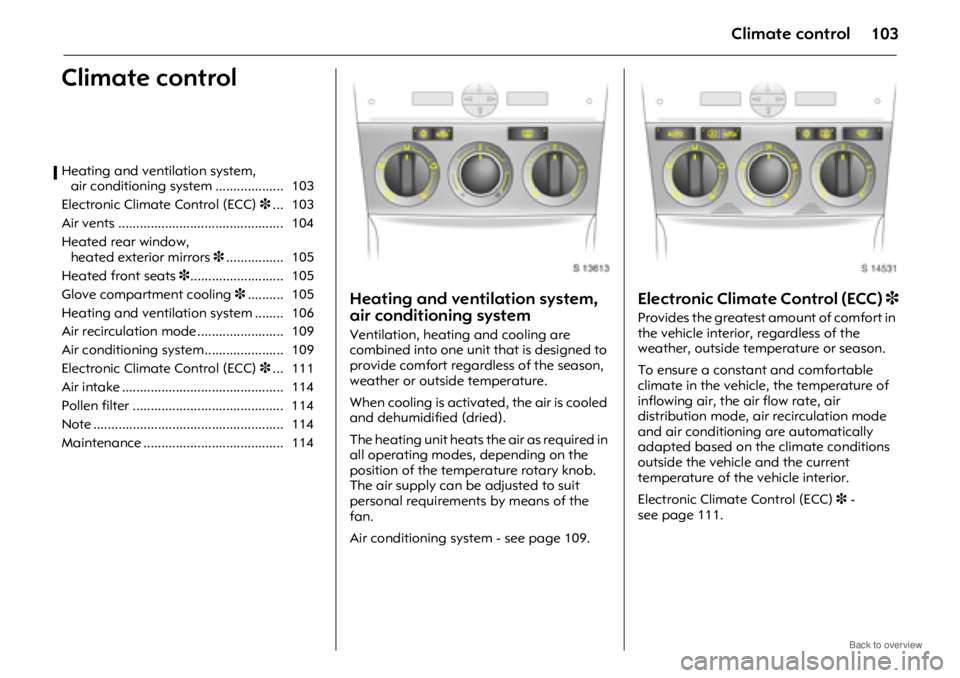
Ventilation, heating and cooling are
combined into one unit that is designed to
provide comfort regardless of the season,
weather or outside temperature.
When cooling is activated, the air is cooled
and dehumidified (dried).
The heating unit heats the air as required in
all operating modes, depending on the
position of the temperature rotary knob.
The air supply can be adjusted to suit
personal requirements by means of the
fan.
Air conditioning system - see page 109.
Electronic Climate Control (ECC) 3
Provides the greatest amount of comfort in
the vehicle interior, regardless of the
weather, outside temperature or season.
To ensure a constant and comfortable
climate in the vehicle, the temperature of
inflowing air, the air flow rate, air
distribution mode, air recirculation mode
and air conditioning are automatically
adapted based on the climate conditions
outside the vehicle and the current
temperature of the vehicle interior.
Electronic Climate Control (ECC) 3 -
see page 111.
Heating and ventilation system,
air conditioning system ................... 103
Electronic Climate Control (ECC) 3... 103
Air vents .............................................. 104
Heated rear window, heated exterior mirrors 3................ 105
Heated front seats 3.......................... 105
Glove compartment cooling 3.......... 105
Heating and ventilation system ........ 106
Air recirculation mode ........................ 109
Air conditioning system...................... 109
Electronic Climate Control (ECC) 3... 111
Air intake ............................................. 114
Pollen filter .......................................... 114
Note ..................................................... 114
Maintenance ....................................... 114
Page 105 of 234
Climate control105
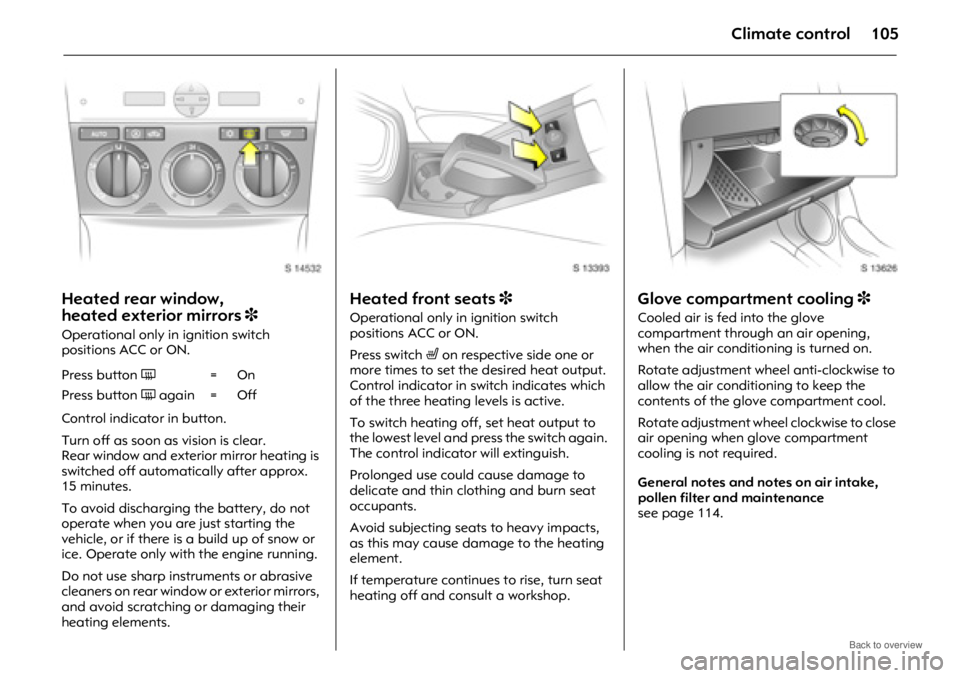
Heated rear window,
heated exterior mirrors 3
Operational only in ignition switch
positions ACC or ON.
Control indicator in button.
Turn off as soon as vision is clear.
Rear window and exterior mirror heating is
switched off automatically after approx.
15 minutes.
To avoid discharging the battery, do not
operate when you are just starting the
vehicle, or if there is a build up of snow or
ice. Operate only with the engine running.
Do not use sharp instruments or abrasive
cleaners on rear window or exterior mirrors,
and avoid scratching or damaging their
heating elements.
Heated front seats 3
Operational only in ignition switch
positions ACC or ON.
Press switch ß on respective side one or
more times to set the desired heat output.
Control indicator in switch indicates which
of the three heating levels is active.
To switch heating off, set heat output to
the lowest level and press the switch again.
The control indicato r will extinguish.
Prolonged use could cause damage to
delicate and thin clothing and burn seat
occupants.
Avoid subjecting seats to heavy impacts,
as this may cause damage to the heating
element.
If temperature continues to rise, turn seat
heating off and consult a workshop.
Glove compartment cooling 3
Cooled air is fed into the glove
compartment through an air opening,
when the air conditioning is turned on.
Rotate adjustment wheel anti-clockwise to
allow the air conditioning to keep the
contents of the glove compartment cool.
Rotate adjustment wheel clockwise to close
air opening when glove compartment
cooling is not required.
General notes and notes on air intake,
pollen filter and maintenance
see page 114.
Press button
Ü=On
Press button Ü again = Off
Page 111 of 234
Climate control111
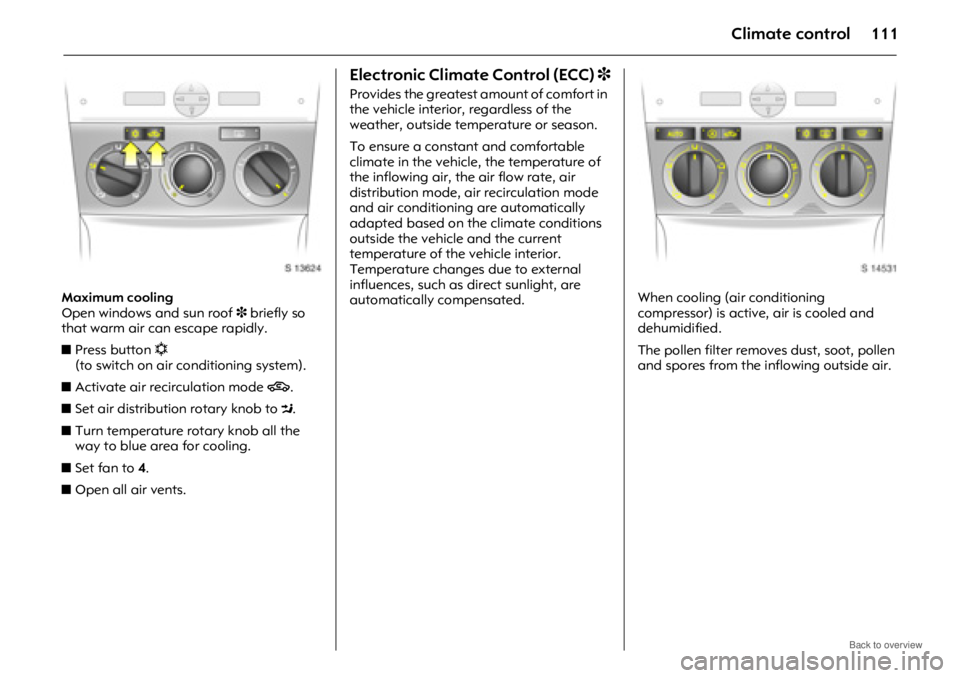
Maximum cooling
Open windows and sun roof 3 briefly so
that warm air can escape rapidly.
z Press button n
(to switch on air co nditioning system).
z Activate air recirculation mode 4.
z Set air distribution rotary knob to M.
z Turn temperature rotary knob all the
way to blue area for cooling.
z Set fan to 4.
z Open all air vents.
Electronic Climate Control (ECC) 3
Provides the greatest amount of comfort in
the vehicle interior, regardless of the
weather, outside temperature or season.
To ensure a constant and comfortable
climate in the vehicle, the temperature of
the inflowing air, the air flow rate, air
distribution mode, air recirculation mode
and air conditioning are automatically
adapted based on the climate conditions
outside the vehicle and the current
temperature of the vehicle interior.
Temperature changes due to external
influences, such as direct sunlight, are
automatically compensated. When cooling (air conditioning
compressor) is active, air is cooled and
dehumidified.
The pollen filter removes dust, soot, pollen
and spores from the
inflowing outside air.
Page 114 of 234

Climate control114
Air intake
The air intakes in front of the windscreen in
the engine compartment must be kept
clear to allow air intake. Remove any
leaves, dirt or snow.
Pollen filter
The pollen filter cleans dust, soot, pollen
and spores from the air entering from
outside. The active carbon layer 3
eliminates most odours and harmful
ambient gases from the air.
Replace the pollen filter at the intervals
given on pages 206 to 212.
Note
If the windscreen mists up in damp
weather, temporarily set the system as
described under "Window demisting and
defrosting" - see pages 108, 113.
Cooling is most efficient when the windows
are closed. If the interior is extremely hot
due to a long period in strong sunlight,
briefly open the windows and sun roof 3 to
allow hot air to escape quickly.
When cooling (air conditioning
compressor) is switched on, condensation
forms, which is expelled from the underside
of the vehicle.
When cooling is switched on, at least one of
the adjustable centre or side air vents must
be open so that the evaporator does not
ice up due to lack of air movement.
Cooling switches off automatically at low
outside temperatures.
Do not cover the interior temperature
sensor (located below the fan switch) or the
sunlight sensor (located in front of
windscreen defroster vents) as this could
cause the Electronic Climate Control (ECC)
system 3 to malfunction.
Maintenance
To ensure continuously efficient
performance and prolong the life of the air
conditioning system, it must be switched on
for a few minutes once a week, irrespective
of the weather and time of year.
Electronic Climate Control (ECC) 3 handles
this automatically while driving. Air
conditioning compressor operation is not
possible at low outside temperatures.
Malfunctions in the system must not be
rectified by the owner: consult a workshop.
Page 126 of 234

Driving and operation126
Maintenance
Certain maintenance operations, e.g.
changes of engine oil, oil filter, air cleaner
element and brake pads, are required
more frequently for severe operating
conditions, e.g. driving on unsurfaced
roads, during thick dust or mud
accumulation, etc.
If the vehicle is driven off-road to a great
extent, the chassis will need regular
inspection.
Your Opel Partner will inform you which
additional service is required between the
normal service intervals, after
consideration of the specific operating
conditions of your vehicle.
Further information - see page 206.
Service checks after wading
After wading, check for the ingress of water
into the following:
zBrake fluid reservoir,
z Air cleaner element,
z Engine,
z Transmission,
z Axles,
z Interior of vehicle.
Renew any lubricating oil or hydraulic fluid
that has a milky appearance, indicating
contamination with water. All Wheel Drive summary
Do
z
Check fuel and tyres, water and oil levels
before venturing off-road.
z Survey on foot before driving off-road,
especially when traversing hillsides,
wading, driving in deep snow and over
ridges.
z Select the correct gear for the conditions.
z Use the engine’s power of acceleration
and deceleration with the correct gear,
to control the vehicle.
z Keep a firm grip on the outer rim of the
steering wheel - keep your thumbs away
from the spokes.
z Drive carefully and be prepared for
emergencies.
z Drive slower under crosswind conditions.
z Approach obstacles and conditions
off-road at the correct angles and with
sufficient momentum to negotiate the
obstacle, but do not put undue strain on
the vehicle.
z Use caution - if you are not sure, do not
do it. Don’tz
Do not venture off-road unless you are
certain that the conditions are capable
of being negotiated safely by you and
your vehicle.
z Do not take unnecessary risks.
z Do not use the brakes excessively, to
maintain steering control.
z Do not change gear on difficult terrain -
depressing the clutch may cause the
vehicle to stop because of drag on the
wheels - or accelerate backwards or
forwards when on a hill.
z Do not ride or slip the clutch.
z Do not spin the wheels if stuck in mud,
sand or snow - they will only dig in
deeper.
z Do not drive at an excessive speed,
especially into corners. Your All Wheel
Drive vehicle has a higher centre of
gravity than conventional vehicles.
Sudden changes of direction can lead to
loss of control.
Page 131 of 234

Driving and operation131
Fuels, refuelling
Fuel consumption
Optional equipment (e.g. wide tyres,
towing equipment) increases the kerb
weight and, in some cases, also the
permissible Gross Vehicle Weight.
This in turn increases fuel consumption and
reduces the maximum speed of the vehicle.
When the vehicle is new, there is increased
friction between the engine and
transmission components lasting for
several thousand kilometres. This also
increases fuel consumption. Fuel for petrol engines
Commercially available high-quality fuels
are suitable (see page 217). Fuel quality
has a decisive influence on the power
output, driveability and life of the engine.
The additives contained in the fuel play an
important role in this
regard. You should
therefore use only high-quality fuels
containing additives.
Petrol with too low an octane number can
cause pinking. Opel cannot be held liable
for resulting damage.
Petrol with a higher octane number can
always be used.
A dispensing pump for leaded fuel cannot
be inserted in the fuel tank of a vehicle that
must be operated on unleaded fuel only.
Use of petrol with an octane rating of 95
will ensure economical driving Fuel for diesel engines
Diesel engines must be operated only on
commercially available diesel fuel meeting
the specifications of DIN EN 590.
Marine diesel fuel, fuel oils, diesel fuels,
which are entirely or partially plant based
such as rape seed oil or bio-diesel,
Aquazole and similar diesel-water
emulsions must not be used.
The flow and filterability of diesel fuels are
insufficient at low temperatures, as a result
of crystallized paraffins.
Diesel fuels with improved low-
temperature properties are therefore
available on the market during the winter
months. Make sure that you use winter fuel
before the start of the cold weather
season.
Use of diesel fuels with manufacturer-
guaranteed winter properties eliminates
the need for additives.
Page 134 of 234
Driving and operation134
Controlling exhaust emission
Through design-related measures,
primarily in the fuel injection and ignition
systems (in combination with the catalytic
converter), the proportion of noxious
materials in the exhaust, such as carbon
monoxide (CO), hydrocarbons (CH) and
nitrogen oxides (NO
x), is reduced to a
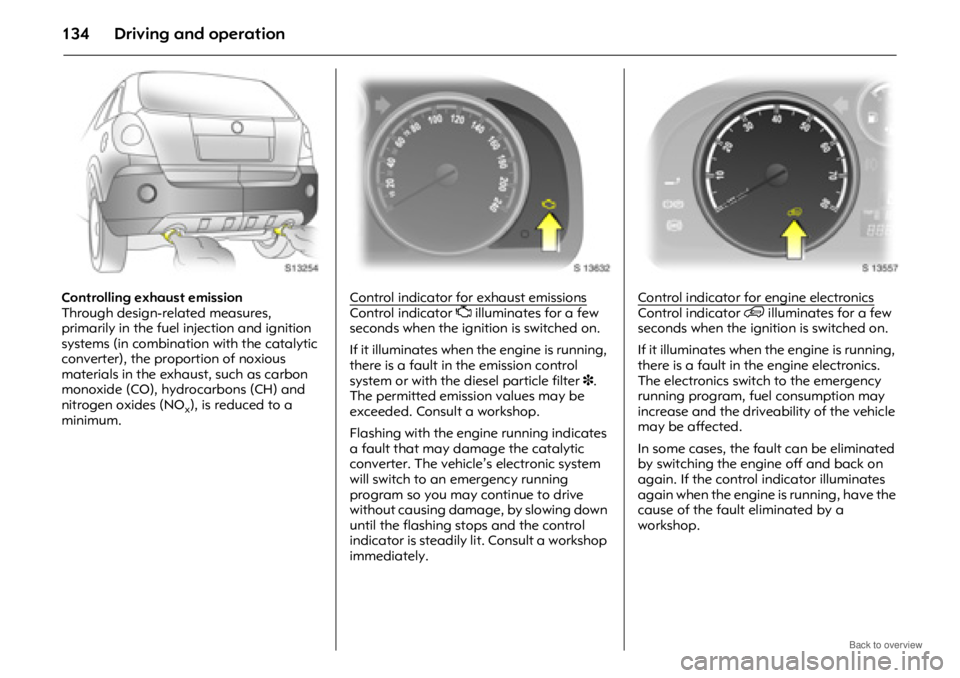
minimum. Control indicator for exhaust emissions
Control indicator
Z illuminates for a few
seconds when the ignition is switched on.
If it illuminates when the engine is running,
there is a fault in the emission control
system or with the diesel particle filter 3.
The permitted emission values may be
exceeded. Consult a workshop.
Flashing with the engine running indicates
a fault that may damage the catalytic
converter. The vehicle’ s electronic system
will switch to an emergency running
program so you may continue to drive
without causing damage, by slowing down
until the flashing stops and the control
indicator is steadily lit. Consult a workshop
immediately. Control indicator for engine electronicsControl indicator
3 illuminates for a few
seconds when the ignition is switched on.
If it illuminates when the engine is running,
there is a fault in the engine electronics.
The electronics switch to the emergency
running program, fuel consumption may
increase and the driveability of the vehicle
may be affected.
In some cases, the fault can be eliminated
by switching the engi ne off and back on
again. If the control indicator illuminates
again when the engine is running, have the
cause of the fault eliminated by a
workshop.