roof OPEL ANTARA 2009 User Guide
[x] Cancel search | Manufacturer: OPEL, Model Year: 2009, Model line: ANTARA, Model: OPEL ANTARA 2009Pages: 234, PDF Size: 3.01 MB
Page 100 of 234

Lighting100
Luggage compartment lamps
Come on when a door or the tailgate is
opened. Front door lamps
Come on when a door is opened.
Once all doors are closed, the front door
lamps extinguish after approx. 10 seconds.
If the doors are left open, the lamps will
stay on for approx. 10 minutes.
Front door lamps can
also be turned off
immediately by pressing button
K in the
roof lining.
Ignition switch illumination
Comes on when you open a door.
Ignition switch illumination can also be
turned off immediately by pressing
button
K in the roof lining.
Sun visor lamps 3
Come on when vanity mirror covers are
opened. See page 34.
Ashtray illumination
The portable front ashtray, located in the
front drink holder, illuminates depending
on outside light conditions. See page 68.
Glove compartment illumination
Comes on when the glove compartment is
opened. See page 64.
Battery discharge protection
To prevent battery from becoming
discharged, the extern al lamps turn off
automatically approx. 10 minutes after the
ignition is switched off.
Battery discharge protecti on will not work if
the lamps are turned on 10 minutes after
the ignition has been switched off; the key
cannot be removed from the ignition switch
until the battery is recharged.
Headlamps when driving abroad
The asymmetrical dipped beam increases
the field of vision on the near side of the
lane.
When driving in coun tries which drive on
the opposite side of the road, this causes
glare for oncoming traffic.
For temporary periods, to avoid glare the
headlamp pattern should be adjusted
down to the horizontal position.
Have the headlamps adjusted by a
workshop.
Page 110 of 234
Climate control110
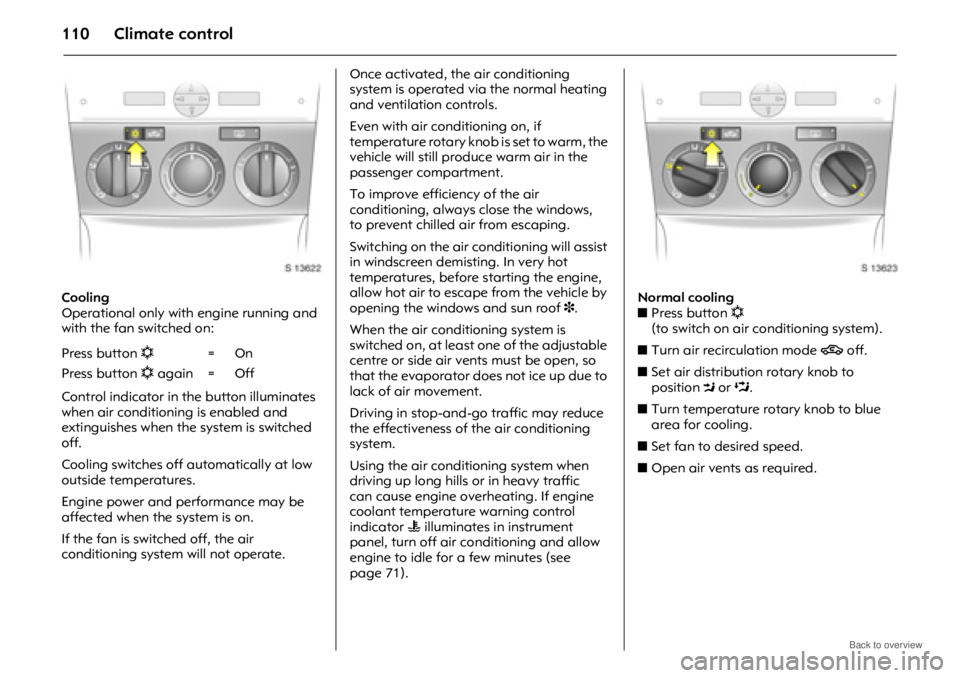
Cooling
Operational only with engine running and
with the fan switched on:
Control indicator in the button illuminates
when air conditioning is enabled and
extinguishes when the system is switched
off.
Cooling switches off automatically at low
outside temperatures.
Engine power and performance may be
affected when the system is on.
If the fan is switched off, the air
conditioning system will not operate. Once activated, the air conditioning
system is operated via the normal heating
and ventilation controls.
Even with air conditioning on, if
temperature rotary knob is set to warm, the
vehicle will still produce warm air in the
passenger compartment.
To improve efficiency of the air
conditioning, always close the windows,
to prevent chilled air from escaping.
Switching on the air conditioning will assist
in windscreen demisting. In very hot
temperatures, before starting the engine,
allow hot air to escape from the vehicle by
opening the windows and sun roof
3.
When the air conditioning system is
switched on, at least one of the adjustable
centre or side air vents must be open, so
that the evaporator does not ice up due to
lack of air movement.
Driving in stop-and-go traffic may reduce
the effectiveness of the air conditioning
system.
Using the air conditioning system when
driving up long hills or in heavy traffic
can cause engine overheating. If engine
coolant temperature warning control
indicator W illuminates in instrument
panel, turn off air co nditioning and allow
engine to idle for a few minutes (see
page 71). Normal cooling
z
Press button n
(to switch on air co nditioning system).
z Turn air recirculation mode 4 off.
z Set air distribution rotary knob to
position M or L.
z Turn temperature rotary knob to blue
area for cooling.
z Set fan to desired speed.
z Open air vents as required.
Press button
n=On
Press button n again = Off
Page 111 of 234
Climate control111
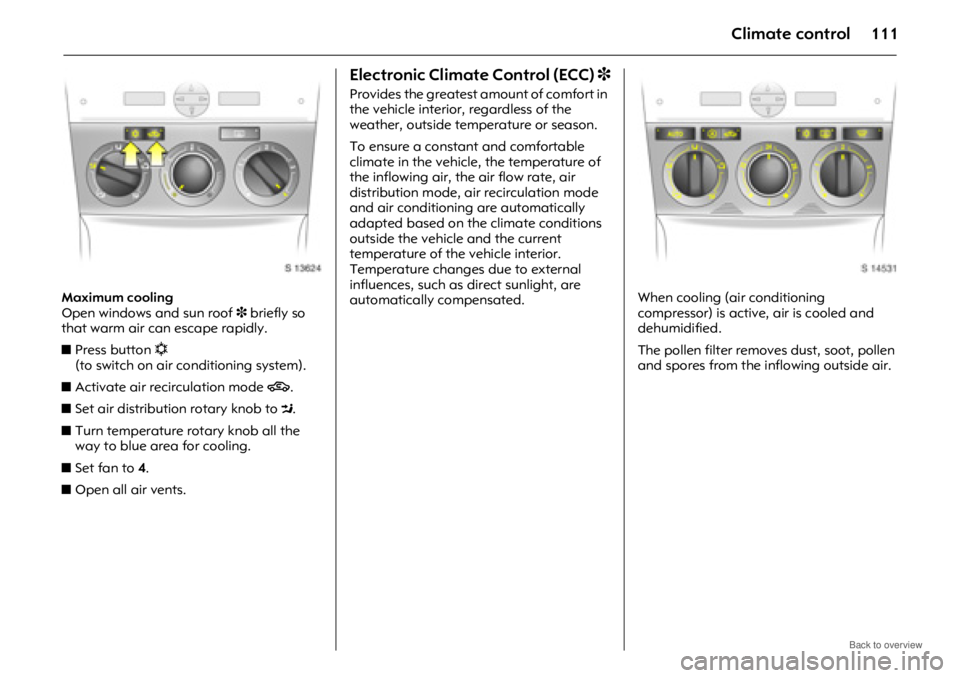
Maximum cooling
Open windows and sun roof 3 briefly so
that warm air can escape rapidly.
z Press button n
(to switch on air co nditioning system).
z Activate air recirculation mode 4.
z Set air distribution rotary knob to M.
z Turn temperature rotary knob all the
way to blue area for cooling.
z Set fan to 4.
z Open all air vents.
Electronic Climate Control (ECC) 3
Provides the greatest amount of comfort in
the vehicle interior, regardless of the
weather, outside temperature or season.
To ensure a constant and comfortable
climate in the vehicle, the temperature of
the inflowing air, the air flow rate, air
distribution mode, air recirculation mode
and air conditioning are automatically
adapted based on the climate conditions
outside the vehicle and the current
temperature of the vehicle interior.
Temperature changes due to external
influences, such as direct sunlight, are
automatically compensated. When cooling (air conditioning
compressor) is active, air is cooled and
dehumidified.
The pollen filter removes dust, soot, pollen
and spores from the
inflowing outside air.
Page 114 of 234

Climate control114
Air intake
The air intakes in front of the windscreen in
the engine compartment must be kept
clear to allow air intake. Remove any
leaves, dirt or snow.
Pollen filter
The pollen filter cleans dust, soot, pollen
and spores from the air entering from
outside. The active carbon layer 3
eliminates most odours and harmful
ambient gases from the air.
Replace the pollen filter at the intervals
given on pages 206 to 212.
Note
If the windscreen mists up in damp
weather, temporarily set the system as
described under "Window demisting and
defrosting" - see pages 108, 113.
Cooling is most efficient when the windows
are closed. If the interior is extremely hot
due to a long period in strong sunlight,
briefly open the windows and sun roof 3 to
allow hot air to escape quickly.
When cooling (air conditioning
compressor) is switched on, condensation
forms, which is expelled from the underside
of the vehicle.
When cooling is switched on, at least one of
the adjustable centre or side air vents must
be open so that the evaporator does not
ice up due to lack of air movement.
Cooling switches off automatically at low
outside temperatures.
Do not cover the interior temperature
sensor (located below the fan switch) or the
sunlight sensor (located in front of
windscreen defroster vents) as this could
cause the Electronic Climate Control (ECC)
system 3 to malfunction.
Maintenance
To ensure continuously efficient
performance and prolong the life of the air
conditioning system, it must be switched on
for a few minutes once a week, irrespective
of the weather and time of year.
Electronic Climate Control (ECC) 3 handles
this automatically while driving. Air
conditioning compressor operation is not
possible at low outside temperatures.
Malfunctions in the system must not be
rectified by the owner: consult a workshop.
Page 115 of 234

Driving and operation115
Driving and operationAutomatic transmission 3
The automatic transmission permits
manual gearshifting (manual mode) or
automatic gearshifting ( automatic mode)
with fully automatic clutch control.
The engine can only be started when the
selector lever is in position P or N. When
starting in P, turn key in ignition switch to
ACC or ON, depress foot brake and press
selector lever button before selecting a
gear.
Do not accelerate whilst gearshifting. If a
gear has been selected and the foot brake
is released without accelerating, the
vehicle will "creep".
Never operate the brake pedal and
accelerator simultaneously. Selecting
D puts the transmission in
automatic mode.
If the selector lever is moved to the left from
position D, manual mode is activated.
Forward gear changes only can then be
made manually by tipping the selector
lever towards + or -.
Automatic transmission
3................. 115
All Wheel Drive.................................... 121
Driving hints ........................................ 127
Save fuel, protect the environment ... 129
Fuels, refuelling ................................... 131
Catalytic converter, exhaust emissions........................................... 133
Drive control systems ......................... 136
Brake system ....................................... 145
Anti-lock Brake System (ABS) u....... 148
Wheels, tyres ....................................... 149
Roof racks 3........................................ 153
Flex-Fix system 3................................ 154
Towing equipment 3 .......................... 164
Towing ................................................. 1679 Warning
Disregard of these instructions may
cause damage to the vehicle and lead to
injuries or endanger life.
Page 121 of 234
Driving and operation121
All Wheel Drive
All Wheel Drive (AWD) is an active-on-
demand system that engages
automatically, with no action required by
the driver. Depending on the driving
environment, the vehicle switches between
two-wheel drive and four-wheel drive, to
give the vehicle more traction and stability
when necessary.
If the front wheels begin to slip, the rear
wheels will automatically begin to drive the
vehicle as required.
More torque is transferred to the wheels
that have the most traction, so the vehicle
has optimum grip at all times.
There may be a slight engagement noise
during hard use.
As well as enabling the vehicle to be driven
off-road, this system also enables the
vehicle to be driven on normal roads
without incurring excessive tyre and
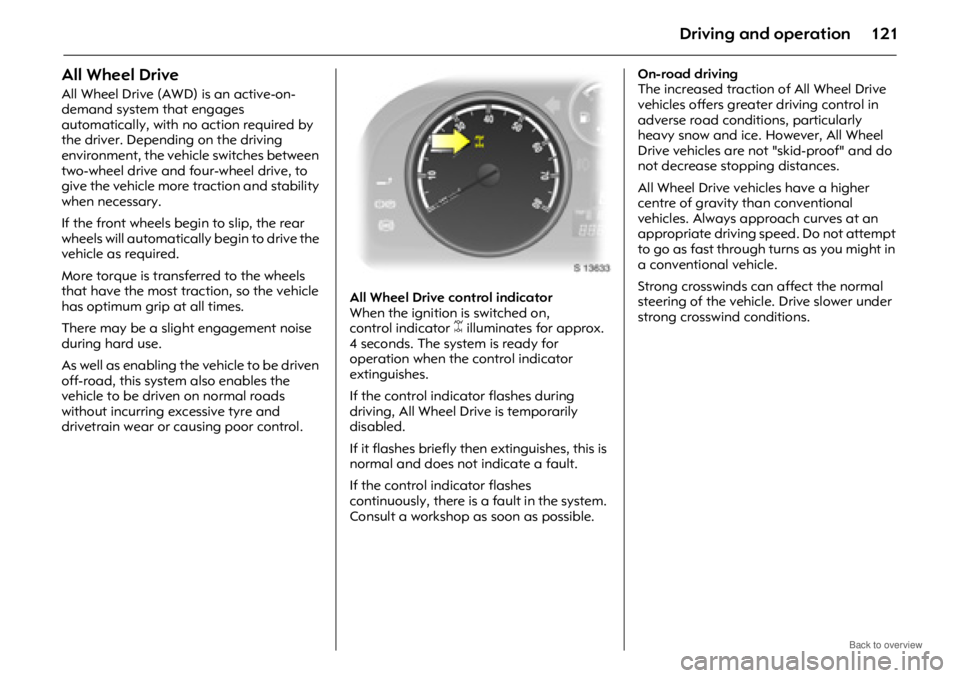
drivetrain wear or causing poor control. All Wheel Drive control indicator
When the ignition is switched on,
control indicator
B illuminates for approx.
4 seconds. The system is ready for
operation when the control indicator
extinguishes.
If the control indicator flashes during
driving, All Wheel Drive is temporarily
disabled.
If it flashes briefly then extinguishes, this is
normal and does not indicate a fault.
If the control indicator flashes
continuously, there is a fault in the system.
Consult a workshop as soon as possible. On-road driving
The increased traction
of All Wheel Drive
vehicles offers greate r driving control in
adverse road condit ions, particularly
heavy snow and ice. However, All Wheel
Drive vehicles are not "skid-proof" and do
not decrease stopping distances.
All Wheel Drive vehicles have a higher
centre of gravity than conventional
vehicles. Always approach curves at an
appropriate driving speed. Do not attempt
to go as fast through turns as you might in
a conventional vehicle.
Strong crosswinds can affect the normal
steering of the vehicle. Drive slower under
strong crosswind conditions.
Page 123 of 234
Driving and operation123
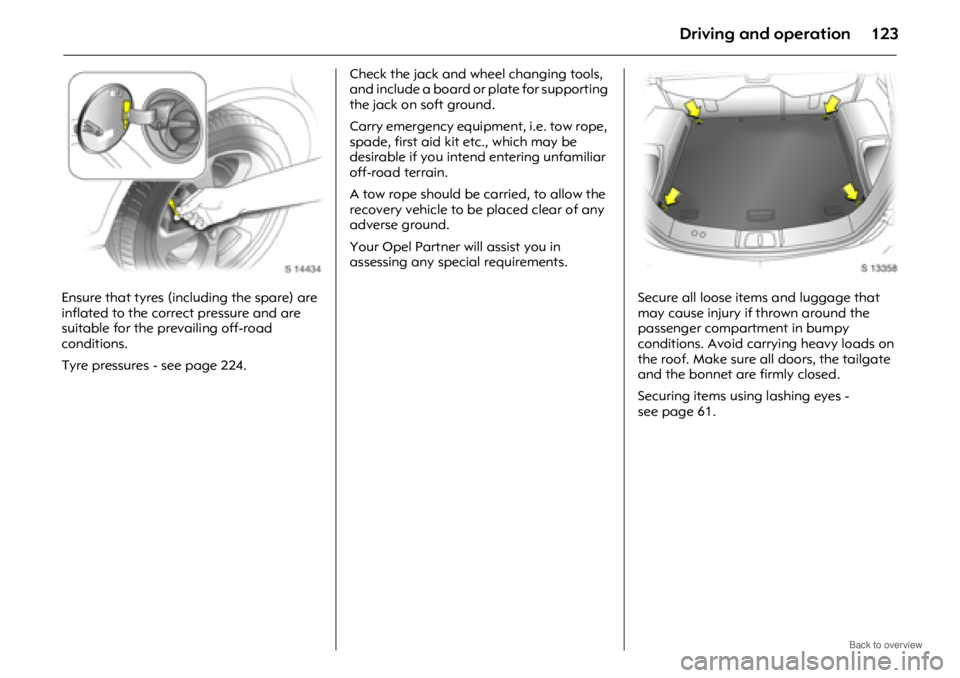
Ensure that tyres (including the spare) are
inflated to the correct pressure and are
suitable for the prevailing off-road
conditions.
Tyre pressures - see page 224.Check the jack and wheel changing tools,
and include a board or plate for supporting
the jack on soft ground.
Carry emergency equipment, i.e. tow rope,
spade, first aid kit etc., which may be
desirable if you intend entering unfamiliar
off-road terrain.
A tow rope should be carried, to allow the
recovery vehicle to be placed clear of any
adverse ground.
Your Opel Partner will assist you in
assessing any special requirements.
Secure all loose items and luggage that
may cause injury if thrown around the
passenger compartment in bumpy
conditions. Avoid carrying heavy loads on
the roof. Make sure all doors, the tailgate
and the bonnet are firmly closed.
Securing items using lashing eyes -
see page 61.
Page 127 of 234

Driving and operation127
Driving hints
The first 1000 km (600 miles)
Drive your vehicle at various speeds. Do
not use full throttle. Never allow the engine
to labour at low revs.
Make good use of all gears. Depress the
accelerator pedal a maximum of around
three quarters of the available pedal travel
in all gears and drive ranges.
Do not drive faster than three quarters of
maximum speed.
Avoid quick starts, su dden acceleration
and prolonged high-speed driving, to
avoid engine damage and to conserve
fuel.
Do not brake unnecessarily hard for the
first 200 km (125 miles).
If possible, avoid towing another vehicle.
Never coast with engine not running
Many units may then not function (e.g.
brake servo unit, power steering, airbag
system). Driving in this manner is a danger
to yourself and others. Brake servo unit
With the engine not running, the brake
servo unit is no longer effective once the
brake pedal has been depressed once or
twice. The braking effect is not reduced,
but substantially greater foot pressure is
necessary to stop the vehicle.
Power steering
Never leave the steering wheel on full lock
when the vehicle is stationary, as this may
damage the power steering pump.
If the power steering should fail - e.g. when
the vehicle is being towed with the engine
switched off - the vehicle can still be
properly steered, but considerably greater
effort is necessary.
Driving in mountainous terrain or with a
caravan/trailer
Electrically driven fan; the fan cooling
capacity is not dependent on engine
speed. It is not necessary, therefore, when
driving uphill to shif
t down into a lower
gear if the vehicle can climb in a higher
gear. Driving in extreme conditions
When driving in hazard
ous conditions, e.g.
in snow, ice, mud, sand or water, drive
slowly and cautiously to allow for greater
braking distances.
If stuck, use 2nd gear (automatic
transmission in drive range 2) to avoid
spinning the front wheels.
Use sand, tyre chains or other non-slip
materials to provide traction when stuck in
snow, mud or ice.
Driving through water
Before attempting to drive through water,
check the depth. If the depth is slightly
lower than the underbody of your vehicle,
do not attempt to drive through it.
Driving too quickly through water can
cause water to enter the engine through
the air intake, causing severe damage.
Drive slowly, in a high engine rpm in as low
a gear as possible.
Driving with a roof load
Do not exceed the permissible roof load -
see page 221. For safety reasons,
distribute the load evenly and secure it
tightly with straps so that it cannot slip. Set
the tyre pressure to the value given for full
load. Do not drive faster than 120 km/h
(75 mph). Check and retighten straps at
frequent intervals.
Page 130 of 234

Driving and operation130
Overrun
zThe fuel supply is automatically shut off
during overrun, e.g. when the vehicle is
being driven down long gradients or
during braking - see page 128.
z To enable the overrun cut-off to take
effect and save fuel, do not accelerate or
declutch.
Correct gear selection
z High revs increase engine wear and fuel
consumption.
z Do not race your engine. Avoid driving at
high engine speeds.
Driving with an eye on the tachometer
saves fuel. If possible, drive at low revs in
each gear and at a constant speed.
Drive in top gear as much as possible,
shift up as soon as possible and do not
shift down prematurely.
High speed
z The faster the speed, the higher the fuel
consumption and noise level. Driving at
full throttle uses up a great deal of fuel
and generates excessive noise and high
emission levels.
z Slightly releasing the accelerator pedal
results in distinct fu el savings with no
major loss of speed.
Drive at no more than around three
quarters of maximum speed and you will
use up to 50% less fuel, without losing a
great deal of time. Tyre pressure
z
Inadequate tyre pressure, leading to
higher road resistance, costs money in
two ways; for more fuel and increased
tyre wear.
z Regular checks (every 14 days) pay off.
Electrical loads
z The power consumption of electrical
equipment increases fuel consumption.
z Switch off all additional consumers (e.g.
air conditioning, heated rear window)
when they are no longer required.
Roof racks 3
z Roof racks can increase fuel
consumption by approx. 1 l/100 km
(3.5 gal./1000 miles) due to air
resistance.
z Remove them if they are not being used. Repair and maintenance
z
Improper repairs or adjustment and
maintenance work can increase fuel
consumption. Do not carry out work on
the engine yourself.
You may, out of ignorance, infringe
environmental laws by not disposing of
materials properly.
Appropriate parts might not be recycled.
Contact with some of the materials
involved may pose a health hazard.
z We recommend that repairs and
maintenance be entrusted to an
Opel Partner.
Extreme driving conditions
z Driving up steep gradients, cornering,
driving on poor roads, and winter driving
all increase fuel consumption.
Fuel consumption increases dramatically
in urban traffic and at winter
temperatures, especially on short trips
when the engine operating temperature
is not reached.
z Follow the hints given above to keep fuel
consumption to a minimum under such
conditions.
Page 153 of 234

Driving and operation153
Always use fine-linked chains that add no
more than 15 mm to the tyre tread and the
inboard sides (including chain lock).
Tyre chains may only be used at speeds of
up to 50 km/h (30 mph)
1) or up to the tyre
chain manufacturer’s recommended
maximum speed, whichever is lower.
When travelling on road s that are free of
snow, they may only be used for brief
periods since they are subject to rapid wear
on a hard road and may snap.
Avoid sharp turns, bumps and holes and
do not lock the wheels when braking, to
avoid damaging the tyre chains.
Retighten the chains after driving for
approx. 1 km (0.6 miles). If, at any time,
you hear or suspect that the chains are
contacting the vehicle, stop and retighten
the chains.
Always read the instructions supplied with
the tyre chains. Temporary spare wheel
The temporary spare wheel is designed for
use on your vehicle only.
Do not attempt to use the spare tyre on a
different wheel, or use a different tyre on
the spare wheel, as they will not fit.
For notes on the temporary spare wheel -
see page 178.
Ensure the temporary spare wheel is
inflated to the correct tyre pressure -
see page 224.
Wheel changing - see page 178.
Roof racks 3
For reasons of safety and to avoid
damaging the roof, we recommend that
you use the Opel roof rack system
approved for your vehicle.
Fasten the roof rack to the roof rails
following the instructions that accompany
the system, ensuring that the roof load is
evenly distributed over the side or cross
rails. Loads must not be placed on the roof
surface.
To prevent damage or loss, check
frequently that roof loads are securely
fastened.
Driving with a roof load affects the
vehicle’s centre of gravity; drive carefully in
crosswinds and do not drive at high
speeds.
Driving hints - see page 127.
1)Varies from country to country on account of
national regulations.
9 Warning
Disregard of the instructions may lead to
injuries or endanger life. Vehicle
passengers must be informed
accordingly.