brake OPEL ANTARA 2009 Owners Manual
[x] Cancel search | Manufacturer: OPEL, Model Year: 2009, Model line: ANTARA, Model: OPEL ANTARA 2009Pages: 234, PDF Size: 3.01 MB
Page 11 of 234

In brief11
Page
1 Side air vents ................................... 104
2 Door window defroster vents ......... 104
3 Headlamp flash and main beam .... 14
turn signal lamps .............................. 14
Peripheral lighting............................. 98
cruise control 3............................... 140
4 Infotainment system
remote control buttons ................... 101
Trip computer 3.......................... 81, 88
5 Horn ................................................... 15
6 Instruments ........................................ 70
7 Windscreen and tailgate
wipers and washers .................... 15, 16
headlamp washers 3........................ 16
8 Central information display for time,
date, outside temperature,
Infotainment system,
check control 3................................. 91
Trip computer 3.......................... 81, 88 Page
9 Centre air vents ............................... 104
10 Hazard warning ................................ 14
Park pilot 3..................................... 142
Descent Control System (DCS) ....... 138
Electronic Stability Control (ESC) ... 136
Front passenger’s
seat belt reminder 3......................... 46
Fold in exterior mirrors 3................. 30
Control indicator for
anti-theft alarm system 3................ 29
11 Infotainment system ....................... 101
12 Front passenger’s airbag ................. 52
13 Glove compartment.................. 64, 105
14 Fuse box .......................................... 182
15 Climate control................................ 103
16 Ignition switch ................................... 13 Page
17 Accelerator pedal ........................... 127
18 Driver’s airbag .................................. 52
19 Brake pedal............................. 127, 146
20 Clutch pedal 3........................ 127, 128
21 Steering wheel adjustment .............. 13
22 Bonnet release ................................ 171
23 Coin storage...................................... 67
24 Card holder ....................................... 67
25 Parking lamps ................................... 94
dipped beam .............................. 14, 95
automatic dipped beam
activation 3...................................... 95
headlamp range adjustment 3....... 97
front fog lamps ................................. 96
fog tail lamp ..................................... 96
instrument illumination .................... 98
Page 12 of 234

In brief12
Control indicators
uABS (Anti-lock Brake System):
see page 148.
gTrailer indicator 3:
see page 70.
4Brake system:
see pages 70, 145.
rPark pilot 3:
see pages 71, 142.
5DCS (Descent Control System):
see pages 71, 138.
BAWD (All Wheel Drive):
see pages 71, 121.
7ESC Active & Warning
(Electronic Stability Control):
see page 136.
AESC Not Ready:
see page 136.
JESC OFF:
see page 136.
qAutomatic headlamp range
adjustment 3 :
see pages 71, 97.
WCoolant temperature:
see pages 71, 195.
oElectronic immobiliser:
see pages 22, 72.
9Door open:
see page 72.
3Engine electronics,
transmission electronics 3:
see pages 72, 134.
vAirbag systems 3,
belt tensioners:
see pages 44, 52.
1Tailgate open:
see page 72.
XDriver’s seat belt reminder:
see page 72.
OTurn signal lamps:
see pages 14, 72, 95.
YLow fuel level:
see pages 72, 76, 132, 225.
>Front fog lamps:
see pages 73, 96.
rFog tail lamp:
see pages 73, 96.
PHeadlamp main beam:
see pages 14, 73, 95.
GLow windscreen washer fluid:
see page 73.
NWater in diesel fuel filter 3:
see pages 73, 194.
CChange engine oil 3:
see page 73.
NPreheating for diesel engines 3:
see pages 19, 73.
IDPF (Diesel particle filter) 3:
see pages 73, 135.
mCruise control 3:
see page 140.
SEngine oil level 3:
see page 73.
2Power steering:
see page 73.
aAnti-theft alarm system activation
without monitoring of passenger
compartment and vehicle tilt 3:
see page 28.
IEngine oil pressure:
see page 74.
pAlternator:
see page 74.
ZExhaust emissions:
see pages 74, 134.
0Winter program:
see pages 74, 117.
Page 18 of 234

In brief18
Automatic transmission 3:
Starting is only possible in P or N. To move
from P or N, switch on ignition, depress foot
brake and press selector lever button.
Engage P or R: press selector lever button.
6 Automatic transmission - see page
115. Manual mode:
6
Further information - see page 117.
Before starting-off, check:
zTyre pressures and condition.
z Engine oil level and fluid levels in engine
compartment (see page 192).
z All windows, mirrors, exterior lighting
and license plates are free from dirt,
snow and ice and are operational.
z Objects are securely located and will not
be thrown forward in the event of
sudden braking.
z Seats, seat belts and mirrors are
correctly adjusted.
z All gauges and control indicators.
z Brake operation.
P=Park position
R = Reverse
N = Neutral (idle)
D = Automatic gear selection
P: Only with vehicle stationary,
first apply hand brake
R : Only with vehicle stationary.
<= Shift to higher gear
]=Shift to lower gear
Page 19 of 234

In brief19
Starting the engine:
Manual transmission in neutral,
Depress clutch and foot brake,
Automatic transmission in P or N,
Do not accelerate
Petrol engines:
TurnkeytoSTARTand release it
Diesel engines:
Turn key to ON, when preheating
control indicator N
extinguishes
1), turn key to START
and release it
Key returns automatically to ON position
when released. Start attempts should not last longer than
15 seconds. If engine does not start, wait
10 seconds before repeating starting
procedure.
The increased engine
speed automatically
returns to normal idling speed as the
engine temperature rises.
Drive at a moderate speed, especially in
cold weather, until normal engine
operating temperatures have been
reached.
6 Electronic immobiliser - see page 22,
diesel fuel system - see page 171,
further information - see pages 127, 129,
131.
Releasing the hand brake:
Raise lever slightly,
press release button,
lower lever fully
To reduce operating forces, depress foot
brake at the same time.
Do not drive with hand brake on, to avoid
damage to brakes on the rear wheels. Do
not apply hand brake while vehicle is in
motion or as a substitute for the foot brake.
Drive carefully, economically and with the
environment in mind. While driving, do not
do anything that could distract you.
6 Hand brake - see page 147.
1)Preheating system switches on only if outside
temperature is low.
Page 20 of 234

In brief20
Parking the vehicle:
Apply hand brake firmly,
close windows,
switch off engine, remove key,
engage steering column lock,
lock vehicle
6Further information - see pages 22, 128,
radio frequency remote control -
see page 23,
central locking system - see page 25,
anti-theft alarm system - see page 27.
Advice when parking:
z Always apply hand brake firmly and as
firmly as possible on slopes.
z Push key into igniti on switch before
removing (vehicles with automatic
transmission 3: depress foot brake and
shift into P before removing key). Turn
steering wheel until lock is felt to engage
(anti-theft protection).
z If the vehicle is parked on a level surface
or a hill, select 1st gear before switching
ignition off (vehicles with automatic
transmission 3: move selector lever to P ).
Also turn front wheels away from kerb if
parked on an uphill slope.
If the vehicle is parked on a downhill
slope, select reverse gear before
switching ignition off (vehicles with
automatic transmission 3: move selector
lever to P). Also turn front wheels
towards kerb.
z Switch off exterior lamps, otherwise the
headlamp warning device will sound
when the driver’s door is opened.
z Cooling fans may run on after the engine
has been switched off.
z Do not park on easily ignitable surfaces
as hot exhaust system temperatures
could cause the surface to ignite.
That was the most important
information for your first drive in
your Antara in brief.
Your vehicle has still more
instruments and controls,
possibly also optional equipment.
The remaining chapters of the
Owner’s Manual contain
important information on
operation, safety and
maintenance as well as a
complete index.
Page 26 of 234
Locks, doors, windows26
Tailgate
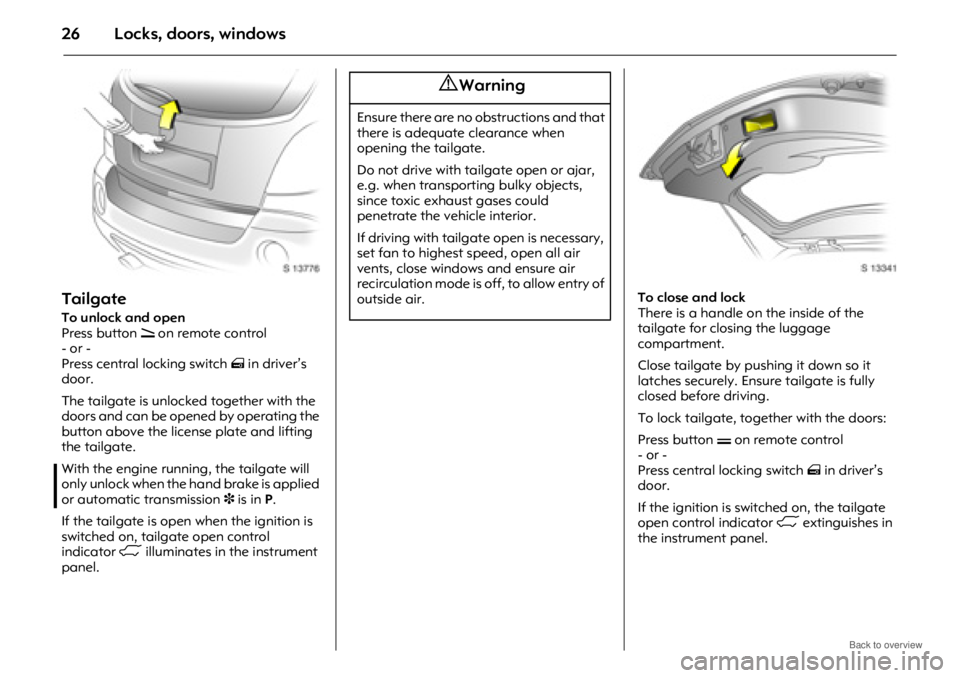
To unlock and open
Press button q on remote control
- or -
Press central locking switch
m in driver’s
door.
The tailgate is unlocked together with the
doors and can be opened by operating the
button above the license plate and lifting
the tailgate.
With the engine running, the tailgate will
only unlock when the hand brake is applied
or automatic transmission 3 is in P.
If the tailgate is open when the ignition is
switched on, tailg ate open control
indicator 1 illuminates in the instrument
panel. To close and lock
There is a handle on the inside of the
tailgate for closing the luggage
compartment.
Close tailgate by push
ing it down so it
latches securely. Ensure tailgate is fully
closed before driving.
To lock tailgate, together with the doors:
Press button p on remote control
- or -
Press central locking switch
m in driver’s
door.
If the ignition is switched on, the tailgate
open control indicator 1 extinguishes in
the instrument panel.
9 Warning
Ensure there are no obstructions and that
there is adequate clearance when
opening the tailgate.
Do not drive with tailgate open or ajar,
e.g. when transporting bulky objects,
since toxic exhaust gases could
penetrate the vehicle interior.
If driving with tailgat e open is necessary,
set fan to highest speed, open all air
vents, close windows and ensure air
recirculation mode is off, to allow entry of
outside air.
Page 39 of 234
Seats, interior39
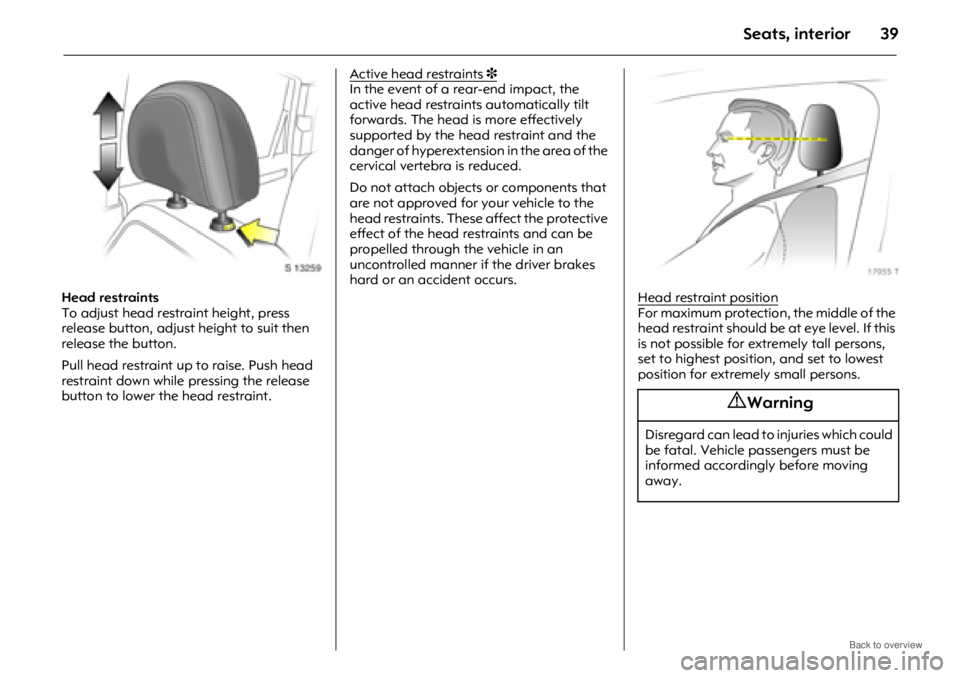
Head restraints
To adjust head restraint height, press
release button, adjust height to suit then
release the button.
Pull head restraint up to raise. Push head
restraint down while pressing the release
button to lower the head restraint. Activ
e head restraints 3In the event of a re
ar-end impact, the
active head restraints automatically tilt
forwards. The head is more effectively
supported by the head restraint and the
danger of hyperextension in the area of the
cervical vertebra is reduced.
Do not attach objects or components that
are not approved for your vehicle to the
head restraints. These affect the protective
effect of the head re straints and can be
propelled through the vehicle in an
uncontrolled manner if the driver brakes
hard or an accident occurs.
Head restraint position
For maximum protection, the middle of the
head restraint should be at eye level. If this
is not possible for extremely tall persons,
set to highest position, and set to lowest
position for extremely small persons.
9 Warning
Disregard can lead to injuries which could
be fatal. Vehicle passengers must be
informed accordingly before moving
away.
Page 41 of 234

Seats, interior41
To raise the seat, lift backrest release lever
and push backrest to upright position.
Push and pull on seat backrest to ensure it
is locked, thus avoiding excessive forward
movement in the event of a collision.
Rear seats
To adjust backrests, lift release lever
located on top of backrest and move
backrest forwards or backwards to desired
position.
Do not lean on seat backrest whilst
adjusting it or make adjustments while the
vehicle is moving.
When folding the rear seat backrests,
ensure the seat belts are unbuckled. Folding rear seat backrests
The luggage compartment can be
enlarged by folding the rear seat backrests
onto the seat cushions.
To fold rear seat backrests separately,
unbuckle all three rear seat belts and
ensure front seats are not in reclined
position.
Push head restraints
all the way down, lift
backrest release lever and fold backrest
forwards and down onto seat cushion.
Do not allow passengers to sit on folded
backrest, or place an y unrestrained loads
on it.
9 Warning
If longer objects, e.g. skis, are to be
carried on the back of the front
passenger’s seat backrest, ensure they
are not in the area in which the front
passenger’s airbag inflates or in the area
between the seat backrest and the
vehicle body. In the event of a collision,
such objects may be thrown through the
vehicle.
The load must not hinder hand brake
operation or gearshifting.
Disregard of these notes can lead to
injuries which may be fatal.
Page 63 of 234

Seats, interior63
Luggage compartment storage 3
Trays on both sides of the luggage
compartment floor. Luggage compartment under floor
storage 3
To access the under floor storage, push
both levers on floor cover towards the
handle - see page 176. Pull floor cover
upwards by the handle and hang the hook
to the upper part of the tailgate opening.Notes on loading the vehicle
z
Heavy objects in the luggage
compartment should be placed as far
forward as possible. If objects are to be
stacked, the heavier objects should be
placed at the bottom.
With rear seats in the folded position, or
with safety net 3 installed behind rear
seats, objects must not be stacked
higher than the seat backrests.
Unsecured objects in the luggage
compartment would be thrown forward
with great force in the event of heavy
braking, for example.
z Secure heavy objects with lashing
straps 3 attached to the lashing eyes. If
heavy loads slip when the vehicle is
braked heavily or driven around a bend,
the handling of the vehicle may change.
z Secure loose items in luggage
compartment using FlexOrganizer 3 or
luggage floor net 3 to prevent sliding.
z When transporting objects in the
luggage compartment, fit safety net 3 -
see page 60.
9 Warning
Do not allow objects to protrude above
the top of the under floor storage, to
avoid damage to the storage area and
the luggage compartment floor.
Page 64 of 234

Seats, interior64
zClose the luggage compartment cover to
prevent the objects from being reflected
in the rear window.
z If the backrests are not folded down
when transporting objects in the
luggage compartment, they must be
engaged in their upright position -
see page 41.
z Do not allow the load to protrude above
the upper edge of the rear seat
backrests, or if the rear seat backrests
have been folded down onto the seat
cushions, above the upper edge of the
front seat backrests.
z The warning triangle 3 and first aid kit 3
should always be freely accessible.
z No objects should be placed on the
luggage compartment cover or the
instrument panel. They are reflected in
the glass, obstruct the driver’s view and
will be thrown through the vehicle in the
event of heavy braking, for example.
z No objects should be stored in any of the
airbag inflation zones, as injuries may be
caused when the airbag is triggered. z
The load must not obstruct the operation
of the pedals, hand brake and gearshift
lever or hinder the freedom of movement
of the driver. Do not place any unsecured
objects in the interior.
z Bulky objects should not be transported
with the tailgate open or ajar, otherwise
poisonous exhaust fumes may enter the
vehicle.
z Weights, payload and roof load -
see page 221.
z Driving with a roof load (see also
page 127) increases the sensitivity of the
vehicle to crosswinds and has a
detrimental effect on vehicle handling
owing to the higher centre of gravity of
the vehicle. Stowage compartments
Glove compartment
To open, pull handle upwards.
The glove compartment will illuminate
when opened.
The glove compartment partition can be
removed from its groove.
Store the partition in the groove on the far
left-hand side of the glove compartment.
Glove compartment cooling
3 -
see page 105.
9 Warning
Disregard of these instructions may lead
to injuries or endanger life. Vehicle
passengers must be informed
accordingly.
9 Warning
Do not drive with glove compartment
open; risk of injury in the event of heavy
braking or a collision.