tailgate OPEL ANTARA 2009 User Guide
[x] Cancel search | Manufacturer: OPEL, Model Year: 2009, Model line: ANTARA, Model: OPEL ANTARA 2009Pages: 234, PDF Size: 3.01 MB
Page 64 of 234

Seats, interior64
zClose the luggage compartment cover to
prevent the objects from being reflected
in the rear window.
z If the backrests are not folded down
when transporting objects in the
luggage compartment, they must be
engaged in their upright position -
see page 41.
z Do not allow the load to protrude above
the upper edge of the rear seat
backrests, or if the rear seat backrests
have been folded down onto the seat
cushions, above the upper edge of the
front seat backrests.
z The warning triangle 3 and first aid kit 3
should always be freely accessible.
z No objects should be placed on the
luggage compartment cover or the
instrument panel. They are reflected in
the glass, obstruct the driver’s view and
will be thrown through the vehicle in the
event of heavy braking, for example.
z No objects should be stored in any of the
airbag inflation zones, as injuries may be
caused when the airbag is triggered. z
The load must not obstruct the operation
of the pedals, hand brake and gearshift
lever or hinder the freedom of movement
of the driver. Do not place any unsecured
objects in the interior.
z Bulky objects should not be transported
with the tailgate open or ajar, otherwise
poisonous exhaust fumes may enter the
vehicle.
z Weights, payload and roof load -
see page 221.
z Driving with a roof load (see also
page 127) increases the sensitivity of the
vehicle to crosswinds and has a
detrimental effect on vehicle handling
owing to the higher centre of gravity of
the vehicle. Stowage compartments
Glove compartment
To open, pull handle upwards.
The glove compartment will illuminate
when opened.
The glove compartment partition can be
removed from its groove.
Store the partition in the groove on the far
left-hand side of the glove compartment.
Glove compartment cooling
3 -
see page 105.
9 Warning
Disregard of these instructions may lead
to injuries or endanger life. Vehicle
passengers must be informed
accordingly.
9 Warning
Do not drive with glove compartment
open; risk of injury in the event of heavy
braking or a collision.
Page 72 of 234

Instruments, controls72
o
Electronic immobiliser
Illuminates in red when ignition is
switched on, then extinguishes.
If it remains illuminated after the ignition is
on, there is a fault in the immobiliser
system; the engine cannot be started -
see page 22.
9Door open
Illuminates in red when a door is open.
3Engine electronics,
transmission electronics 3
Illuminates in yellow when ignition is
switched on, then extinguishes.
If it illuminates
during driving;
there may be a fault in the engine or
transmission electronics: interrupt your
journey and consult a workshop as soon as
possible.
Further information - see page 134.
vAirbag systems 3 , belt tensioners
see pages 44, 52.
1Tailgate open
Illuminates in red when ignition is
switched on, then extinguishes.
Illuminates when tailgate is open or not
securely latched.
Tailgate - see page 26.
XDriver’s seat belt reminder
Illuminates in red when ignition is
switched on, then extinguishes.
When the engine is runn ing, if driver’s seat
belt is not engaged, it will flash for approx.
90 seconds and then illuminate until
driver’s seat belt is fastened.
If vehicle speed exceeds approx. 22 km/h
(14 mph), control indicator will flash for
approx. 90 seconds along with a warning
chime and then remains illuminated until
driver’s seat belt is fastened.
Seat belts - see page 43.
OTurn signal lamps
The relevant control indicator flashes in
green when the turn signal is on.
Rapid flash; failure of a turn signal bulb or
the corresponding fuse or failure of a trailer
turn signal bulb 3. Both control indicators
flash when the hazard warning lamps are
active.
Further information - see pages 14, 95.
Bulb replacement - see page 185.
Fuses - see page 181.
YLow fuel level
Illuminates in yellow when ignition is
switched on, then extinguishes.
If it illuminates during dr iving; fuel level low:
fill up fuel tank as soon as possible.
Never let the tank run dry.
Erratic fuel supply can cause catalytic
converter to overheat - see page 133.
Diesel engines: if the tank has been run dry,
bleed the fuel system as described on
page 171.
Refuelling - see page 132.
Fuel tank capacity - see page 225.
Page 93 of 234

Instruments, controls93
Automatic wiping with rain sensor3
To activate, move lever upwards to
automatic wiping with rain sensor
position $.
The rain sensor detects the amount of
water on the windscreen and automatically
regulates the windscreen wipers.
The wipers operate for one cycle to check
the system when the ignition switch is
turned to ACC.
To turn wipers off, move lever to position J.
Keep the rain sensor area clean by
activating the windsc reen washer system.
Further information - see pages 198, 202,
205. Windscreen and headlamp washer
systems
3
To activate, pull lever towards steering
wheel. Washer fluid is sprayed onto the
windscreen. If the lever is held longer, the
wipers operate for two cycles after the lever
has been released and once more after a
3 second delay 3.
The headlamp washer system 3 can only
be operated when the headlamps are on.
Washer fluid is sprayed onto the
headlamps. The headlamp washer system
can only be operated again after a short
delay. If washer fluid level is low then this
delay is increased.
On vehicles fitted with rain sensor 3, keep
the sensor area clean by activating the
windscreen washer system.
Further information - see pages 199, 202,
205. Tailgate wiper and washer systems
Activate wipers and washer as follows:
Washer fluid is sprayed on to tailgate
window when the button on the end of the
lever is pressed. When the button is
released, the washer will stop, but the
wipers will continue to swipe for approx.
3cycles.
Further information - see pages 198, 199,
202, 205.
Wipers on = Push lever forwards
Wipers off = Pull lever back towards
steering wheel
Wash = Press and hold button
Page 98 of 234

Lighting98
Peripheral lighting
The dipped beam and reversing lamps
illuminate for approx. 30 seconds after the
driver exits the vehicle and closes the door.
To activate function:
If the driver’s door is left open, the lamps
will extinguish after two minutes.
Peripheral lighting can be deactivated by
inserting the key in the ignition switch or by
pulling the turn signal lever towards the
steering wheel again while the driver’s door
is open.
Instrument illumination,
information display illumination
Comes on when ignition is switched on.
Brightness can be adjusted when the
exterior lamps are on: turn wheel to the
right or left until the desired brightness is
obtained.
If driver’s door is opened or q is pressed on
the remote control, instrument panel lamps
will illuminate automatically and stay on
for approx. 30 seconds until ignition switch
is turned to the ACC position.
Display mode 3 - see page 87.
Interior courtesy lamps
Front reading lamps, rear interior lamps
and luggage compartm ent lamps function
as courtesy lighting and illuminate when
the doors or tailgate are opened.
If doors or tailgate remain opened, the
lamps stay illuminated for approx.
10 minutes.
Once all doors and the tailgate are closed,
the courtesy lamps dim gradually after
approx. 10 seconds.
By pressing button d, both front reading
lamps and the rear interior lamps
illuminate.
Press the button again to turn the lamps
off.
1. Switch off ignition.
2. Remove ignition key.
3. Open driver’s door.
4. Pull turn signal lever towards
steering wheel.
Page 100 of 234

Lighting100
Luggage compartment lamps
Come on when a door or the tailgate is
opened. Front door lamps
Come on when a door is opened.
Once all doors are closed, the front door
lamps extinguish after approx. 10 seconds.
If the doors are left open, the lamps will
stay on for approx. 10 minutes.
Front door lamps can
also be turned off
immediately by pressing button
K in the
roof lining.
Ignition switch illumination
Comes on when you open a door.
Ignition switch illumination can also be
turned off immediately by pressing
button
K in the roof lining.
Sun visor lamps 3
Come on when vanity mirror covers are
opened. See page 34.
Ashtray illumination
The portable front ashtray, located in the
front drink holder, illuminates depending
on outside light conditions. See page 68.
Glove compartment illumination
Comes on when the glove compartment is
opened. See page 64.
Battery discharge protection
To prevent battery from becoming
discharged, the extern al lamps turn off
automatically approx. 10 minutes after the
ignition is switched off.
Battery discharge protecti on will not work if
the lamps are turned on 10 minutes after
the ignition has been switched off; the key
cannot be removed from the ignition switch
until the battery is recharged.
Headlamps when driving abroad
The asymmetrical dipped beam increases
the field of vision on the near side of the
lane.
When driving in coun tries which drive on
the opposite side of the road, this causes
glare for oncoming traffic.
For temporary periods, to avoid glare the
headlamp pattern should be adjusted
down to the horizontal position.
Have the headlamps adjusted by a
workshop.
Page 123 of 234
Driving and operation123
Ensure that tyres (including the spare) are
inflated to the correct pressure and are
suitable for the prevailing off-road
conditions.
Tyre pressures - see page 224.Check the jack and wheel changing tools,
and include a board or plate for supporting
the jack on soft ground.
Carry emergency equipment, i.e. tow rope,
spade, first aid kit etc., which may be
desirable if you intend entering unfamiliar
off-road terrain.
A tow rope should be carried, to allow the
recovery vehicle to be placed clear of any
adverse ground.
Your Opel Partner will assist you in
assessing any special requirements.
Secure all loose items and luggage that
may cause injury if thrown around the
passenger compartment in bumpy
conditions. Avoid carrying heavy loads on
the roof. Make sure all doors, the tailgate
and the bonnet are firmly closed.
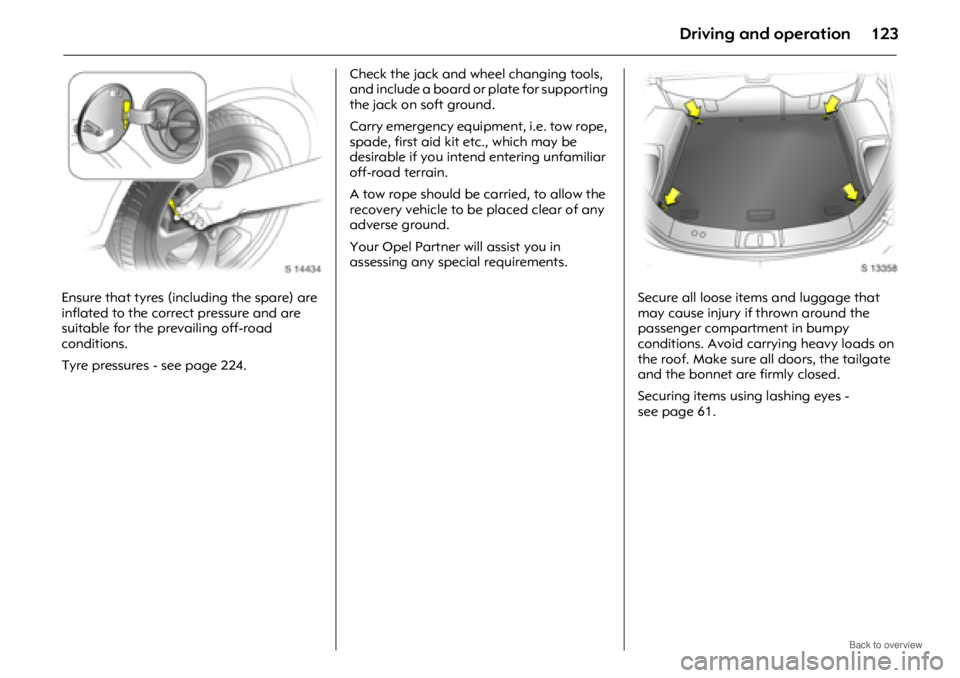
Securing items using lashing eyes -
see page 61.
Page 132 of 234
Driving and operation132
Fuel filler cap
If replacing the fuel filler cap, be sure to use
the original fuel filler cap for your model, to
ensure full functionality.
Refuelling
Ensure suitable fuel is available before
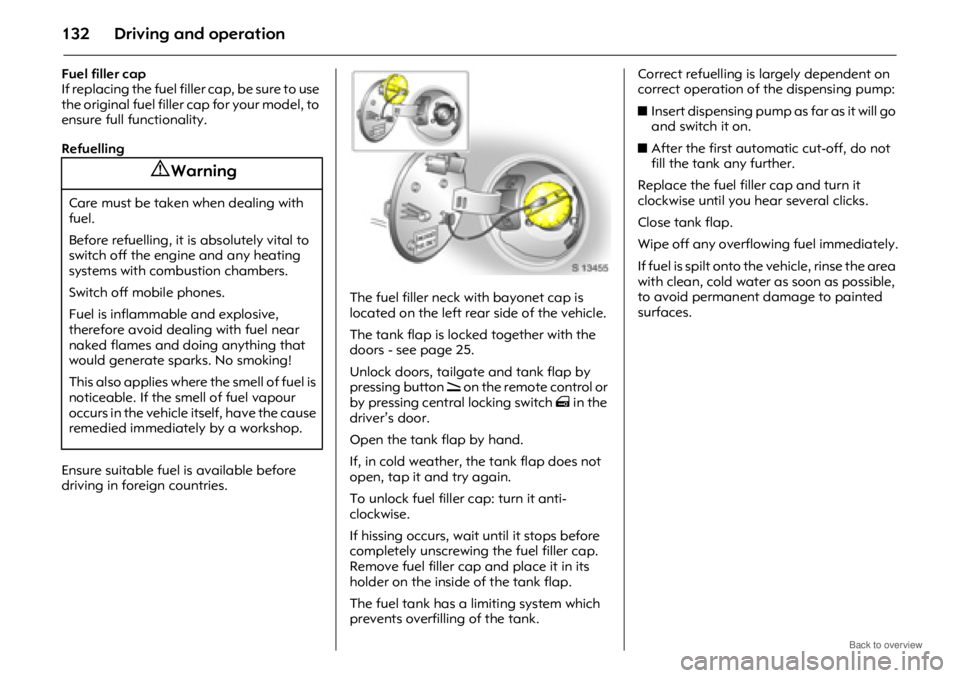
driving in foreign countries. The fuel filler neck with bayonet cap is
located on the left rear side of the vehicle.
The tank flap is locked together with the
doors - see page 25.
Unlock doors, tailgate and tank flap by
pressing button q
on the remote control or
by pressing central locking switch m in the
driver’s door.
Open the tank flap by hand.
If, in cold weather, the tank flap does not
open, tap it and try again.
To unlock fuel filler cap: turn it anti-
clockwise.
If hissing occurs, wait until it stops before
completely unscrewing the fuel filler cap.
Remove fuel filler cap and place it in its
holder on the inside of the tank flap.
The fuel tank has a limiting system which
prevents overfilling of the tank. Correct refuelling is largely dependent on
correct operation of the dispensing pump:
z
Insert dispensing pump as far as it will go
and switch it on.
z After the first automatic cut-off, do not
fill the tank any further.
Replace the fuel filler cap and turn it
clockwise until you hear several clicks.
Close tank flap.
Wipe off any overflowing fuel immediately.
If fuel is spilt onto the vehicle, rinse the area
with clean, cold water as soon as possible,
to avoid permanent damage to painted
surfaces.
9 Warning
Care must be taken when dealing with
fuel.
Before refuelling, it is absolutely vital to
switch off the engi ne and any heating
systems with combustion chambers.
Switch off mobile phones.
Fuel is inflammable and explosive,
therefore avoid dealing with fuel near
naked flames and doing anything that
would generate sparks. No smoking!
This also applies where the smell of fuel is
noticeable. If the smell of fuel vapour
occurs in the vehicle itself, have the cause
remedied immediately by a workshop.
Page 135 of 234

Driving and operation135
Exhaust gases
Do not run engine in enclosed spaces, e.g.
in a garage, or sit in a parked vehicle for an
extended period with the engine running.
Do not drive with tailgate open. If driving
with the tailgate open is necessary, set fan
to highest speed, close windows and
ensure air recirculation mode is off, to allow
entry of outside air.
If the underbody or rear of vehicle is
damaged or corroded, you notice a
change in the sound of the exhaust system,
or whenever you suspect exhaust gases are
penetrating the vehicle interior, consult a
workshop immediately.
When the vehicle is driven for the first time,
wax and oil on the exhaust system may
evaporate, producing smoke-like emissions
which should not be inhaled. Allow wax
and oil to evaporate while the vehicle is in
the open air. Diesel particle filter (DPF) 3
The diesel particle filter removes polluting
soot particles out of the exhaust.
The system contains a self-cleaning
function at certain intervals. The filter is
cleaned by burning the soot particles at
high temperature. This procedure runs
automatically under certain vehicle
conditions and can take up to 15 minutes,
during which time fuel consumption may
increase. The smell and the noise that
occur are normal.
The system cannot automatically clean
itself under certain vehicle conditions, such
as driving short distances.
If control indicator
I illuminates, you
should continue driving, and as soon as the
road and traffic situation permits it,
increase speed to more than 50 km/h
(30 mph) and diesel particle filter cleaning
will start.
Cleaning is quicker at faster speeds and
under load. The engine speed should not
drop below 2000 rpm. The control indicator
extinguishes as soon as cleaning is
complete.
We recommend that you do not turn the
ignition off during cleaning. Maintenance
Have all maintenance work carried out at
the intervals specified by Opel. We
recommend that you entrust this work to
your Opel Partner, who has proper
equipment and trained personnel
available. Electronic testing of systems
permits rapid diagnosis and remedy of
faults. This way, you can be certain that all
components of the vehicle’s electrical,
injection and ignition systems operate
correctly, that your ve
hicle has a low level
of pollutant emission and that the catalytic
converter system will have a long service
life.
You are thereby making an important
contribution towards keeping the air clean
and compliance with emissions legislation.
Checking and adjustment of the fuel-
injection and ignition systems is part of the
scope of a Service. For this reason, you
should have all maintenance work carried
out at the intervals specified in the chapter
"Service, Maintanance" on page 206.
9 Warning
Engine exhaust gases contain poisonous
carbon monoxide, which has no colour or
odour and can be lethal if inhaled.
If exhaust fumes penetrate the vehicle
interior, open the windows and consult a
workshop immediately.
Page 154 of 234
Driving and operation154
Flex-Fix system 3
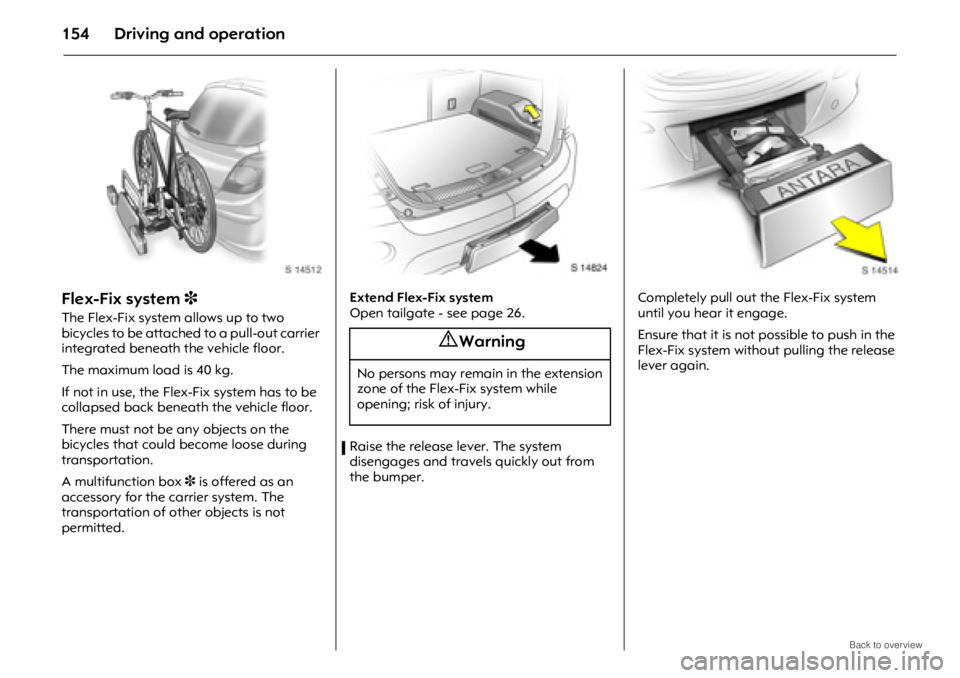
The Flex-Fix system allows up to two
bicycles to be attached to a pull-out carrier
integrated beneath the vehicle floor.
The maximum load is 40 kg.
If not in use, the Flex-Fix system has to be
collapsed back beneath the vehicle floor.
There must not be any objects on the
bicycles that could become loose during
transportation.
A multifunction box 3 is offered as an
accessory for the carrier system. The
transportation of other objects is not
permitted. Extend Flex-Fix system
Open tailgate - see page 26.
Raise the release lever. The system
disengages and travels quickly out from
the bumper.
Completely pull out
the Flex-Fix system
until you hear it engage.
Ensure that it is not possible to push in the
Flex-Fix system without pulling the release
lever again.
9 Warning
No persons may remain in the extension
zone of the Flex-Fix system while
opening; risk of injury.
Page 156 of 234
Driving and operation156
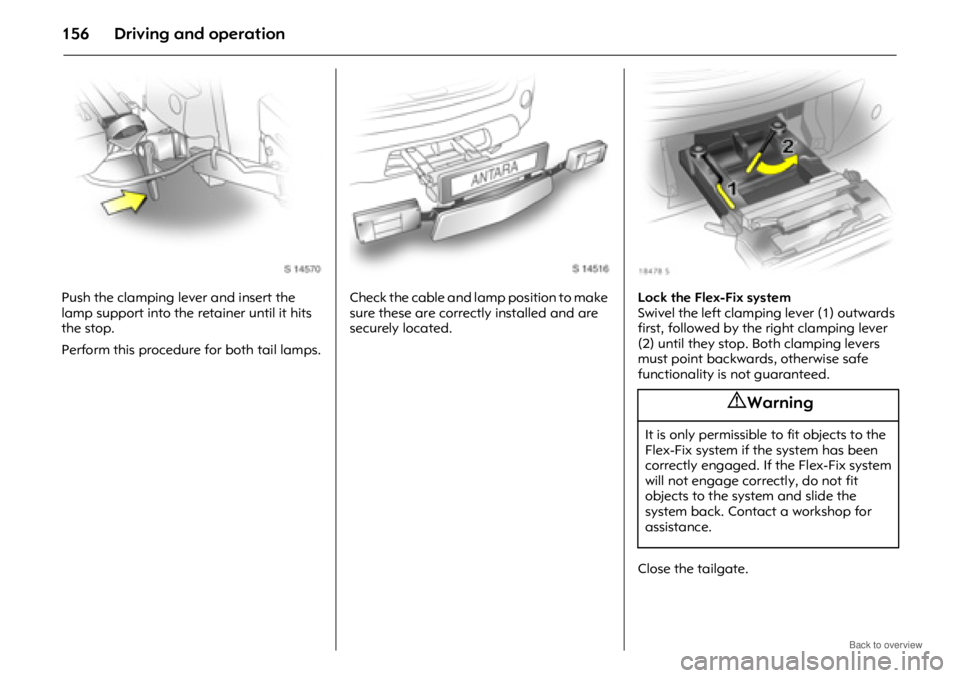
Push the clamping lever and insert the
lamp support into the retainer until it hits
the stop.
Perform this procedure for both tail lamps.Check the cable and lamp position to make
sure these are correctly installed and are
securely located.
Lock the Flex-Fix system
Swivel the left clamping lever (1) outwards
first, followed by the right clamping lever
(2) until they stop. Both clamping levers
must point backwards, otherwise safe
functionality is not guaranteed.
Close the tailgate.
9 Warning
It is only permissible to fit objects to the
Flex-Fix system if the system has been
correctly engaged. If the Flex-Fix system
will not engage correctly, do not fit
objects to the system and slide the
system back. Contact a workshop for
assistance.