tyre pressure OPEL ANTARA 2009 User Guide
[x] Cancel search | Manufacturer: OPEL, Model Year: 2009, Model line: ANTARA, Model: OPEL ANTARA 2009Pages: 234, PDF Size: 3.01 MB
Page 145 of 234
Driving and operation145
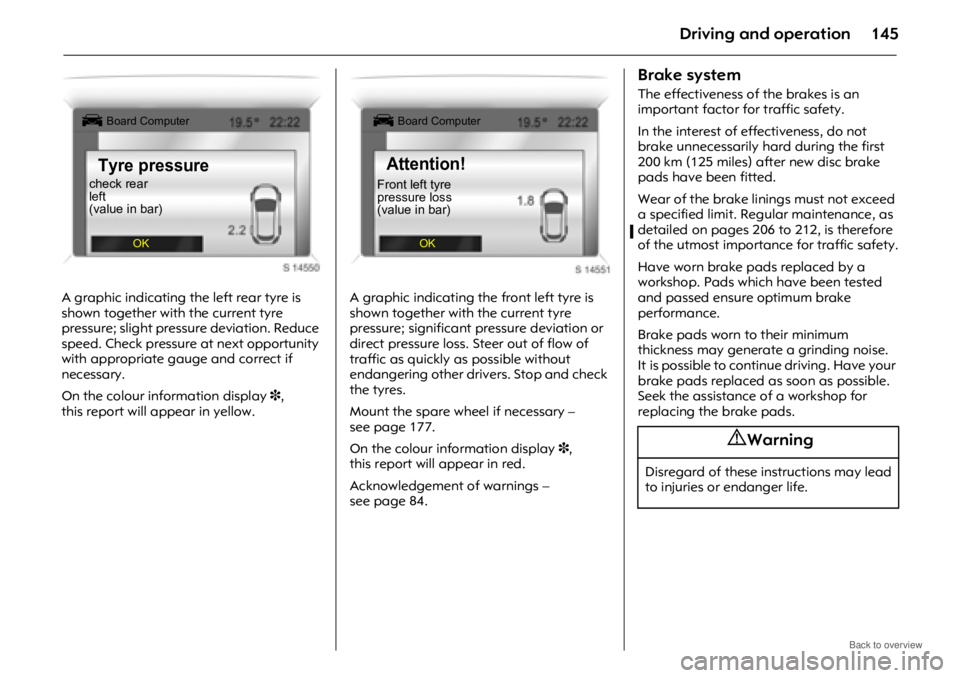
A graphic indicating the left rear tyre is
shown together with the current tyre
pressure; slight pressure deviation. Reduce
speed. Check pressure at next opportunity
with appropriate gauge and correct if
necessary.
On the colour information display 3,
this report will appear in yellow. A graphic indicating the front left tyre is
shown together with the current tyre
pressure; significant pressure deviation or
direct pressure loss. Steer out of flow of
traffic as quickly as possible without
endangering other drivers. Stop and check
the tyres.
Mount the spare wheel if necessary –
see page 177.
On the colour information display
3,
this report will appear in red.
Acknowledgement of warnings –
see page 84.
Brake system
The effectiveness of the brakes is an
important factor for traffic safety.
In the interest of effectiveness, do not
brake unnecessarily hard during the first
200 km (125 miles) after new disc brake
pads have been fitted.
Wear of the brake linings must not exceed
a specified limit. Regular maintenance, as
detailed on pages 206 to 212, is therefore
of the utmost importance for traffic safety.
Have worn brake pads replaced by a
workshop. Pads which have been tested
and passed ensure optimum brake
performance.
Brake pads worn to their minimum
thickness may generate a grinding noise.
It is possible to continue driving. Have your
brake pads replaced as soon as possible.
Seek the assistance of a workshop for
replacing the brake pads.
Ü Board Computer
Tyre pressure
OK
check rear
left
(value in bar)
Ü Board Computer
Attention!
OK
Front left tyre
pressure loss
(value in bar)
9 Warning
Disregard of these instructions may lead
to injuries or endanger life.
Page 148 of 234
Driving and operation148
Anti-lock Brake System (ABS)
u
The ABS continually monitors the vehicle's
brake system and prevents the wheels from
locking, irrespective of the road condition
and tyre grip.
It starts to regulate the braking pressure as
soon as a wheel shows a tendency to lock.
The vehicle remains steerable, even in the
event of very heavy braking, e.g. on bends
or when swerving to avoid an obstacle.
Even in the case of full-on braking, the ABS
makes it possible to drive round an
obstacle without releasing the brakes.
ABS control is made apparent through a
pulse in the brake pedal and the noise of
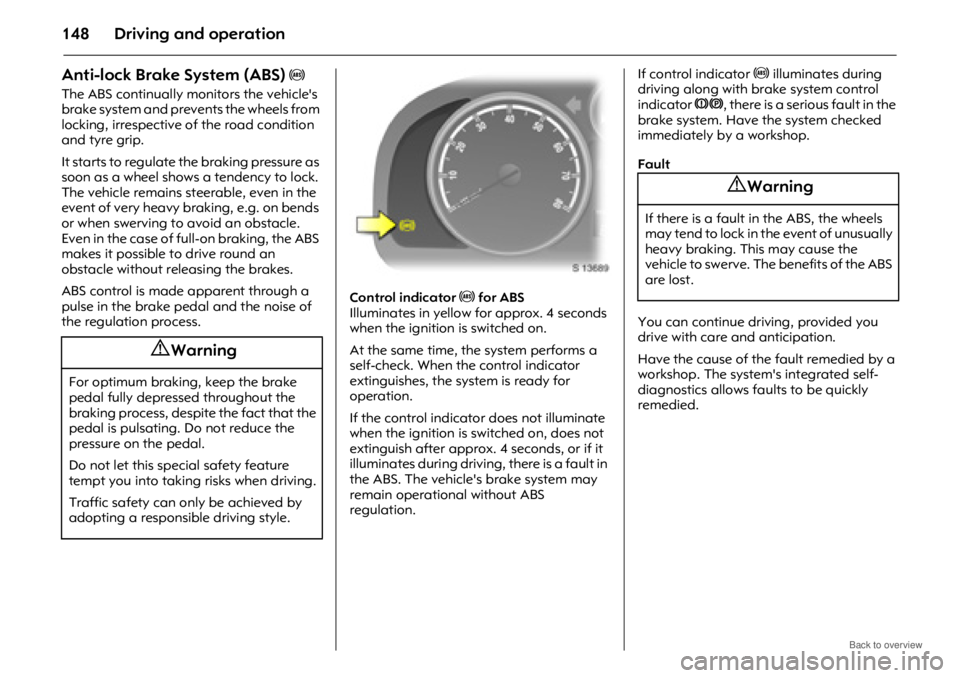
the regulation process. Control indicator
u for ABS
Illuminates in yellow for approx. 4 seconds
when the ignition is switched on.
At the same time, the system performs a
self-check. When the control indicator
extinguishes, the system is ready for
operation.
If the control indicato r does not illuminate
when the ignition is switched on, does not
extinguish after approx. 4 seconds, or if it
illuminates during driving, there is a fault in
the ABS. The vehicle's brake system may
remain operational without ABS
regulation. If control indicator
u illuminates during
driving along with brake system control
indicator 4, there is a serious fault in the
brake system. Have the system checked
immediately by a workshop.
Fault
You can continue driving, provided you
drive with care and anticipation.
Have the cause of the fault remedied by a
workshop. The system's integrated self-
diagnostics allows faults to be quickly
remedied.
9 Warning
For optimum braking, keep the brake
pedal fully depresse d throughout the
braking process, despite the fact that the
pedal is pulsating. Do not reduce the
pressure on the pedal.
Do not let this special safety feature
tempt you into taking risks when driving.
Traffic safety can only be achieved by
adopting a responsible driving style.
9 Warning
If there is a fault in the ABS, the wheels
may tend to lock in the event of unusually
heavy braking. This may cause the
vehicle to swerve. The benefits of the ABS
are lost.
Page 149 of 234

Driving and operation149
Wheels, tyres
See page 223 for suitable tyres and
restrictions.
Factory-fitted tyres are matched to the
chassis and offer optimum driving comfort
and safety.
Changing tyre/wheel type
Note the necessary modifications before
switching to different tyres or wheels.
If wheel rims of a different type are to be
installed, the wheel nuts may also need to
be changed. We recommend you consult
an Opel Partner.
If tyres of a different size to those fitted at
the factory are used (this includes winter
tyres), the electron ic speedometer may
possibly need to be reprogrammed, to
ensure that the speed displayed is correct. Vehicles with tyre pressure monitoring
system
3
When using winter tyres, or when switching
to different tyre sizes, sensors for the tyre
pressure monitoring syst em can be fitted at
a later date by a workshop, upon request.
Otherwise, the system would not indicate
tyre pressure deviations.
Tyre pressure monitoring system -
see page 144.
Fitting new tyres
New tyres should be fitted in pairs, or, for
preference, in sets. Make sure that both
tyres on an axle are:
z the same size,
z the same design,
z the same make,
z and have the same tread pattern.
Fit directional tyres such that they roll in the
direction of travel. The rolling direction is
indicated by a symbol (e.g. an arrow) on
the sidewall.
Tyres fitted opposing the rolling direction
(e.g. when a tyre is changed) should be
refitted as soon as possible. This is the only
way to obtain full benefit from the design
properties of the tyre.
Observe legal requirements when
disposing of tyres. Some brands of tyres have a beaded edge
for alloy wheels, to protect against
damage. If wheel trims are used on steel
wheels with beaded-edge tyres, the
following procedure must be followed:
z
Wheel trims and tyres that are approved
by Opel for the respective vehicle and
comply with all of the relevant wheel and
tyre combination requ irements must be
used.
z If the wheel trims and tyres used are not
Opel-approved, the tyres must not have
a beaded edge.
9 Warning
Use of unsuitable tyres or wheels may
lead to accidents and render the vehicle
unroadworthy.
9 Warning
Use of unsuitable tyres or wheel trims
could lead to sudden pressure loss and
thereby accidents.
Page 150 of 234
Driving and operation150
Tyre pressure
Check tyre pressures when cold, at least
every 14 days and prior to any long
journey. Don't forget to check the spare.
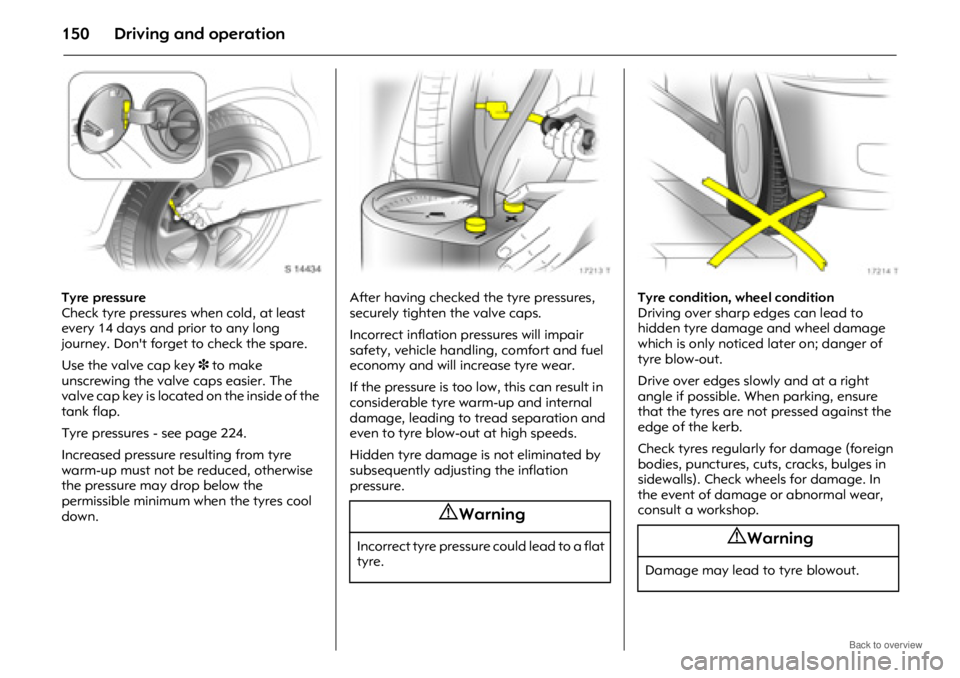
Use the valve cap key 3 to make
unscrewing the valve caps easier. The
valve cap key is located on the inside of the
tank flap.
Tyre pressures - see page 224.
Increased pressure resulting from tyre
warm-up must not be reduced, otherwise
the pressure may drop below the
permissible minimum when the tyres cool
down. After having checked the tyre pressures,
securely tighten the valve caps.
Incorrect inflation pressures will impair
safety, vehicle handling, comfort and fuel
economy and will increase tyre wear.
If the pressure is too low, this can result in
considerable tyre warm-up and internal
damage, leading to tread separation and
even to tyre blow-out at high speeds.
Hidden tyre damage is not eliminated by
subsequently adjusting the inflation
pressure.
Tyre condition, wheel condition
Driving over sharp edges can lead to
hidden tyre damage and wheel damage
which is only noticed later on; danger of
tyre blow-out.
Drive over edges slowly and at a right
angle if possible. When parking, ensure
that the tyres are not pressed against the
edge of the kerb.
Check tyres regularly for damage (foreign
bodies, punctures, cuts, cracks, bulges in
sidewalls). Check wheels for damage. In
the event of damage
or abnormal wear,
consult a workshop.
9 Warning
Incorrect tyre pressure could lead to a flat
tyre.9 Warning
Damage may lead to tyre blowout.
Page 151 of 234
Driving and operation151
Tread depth
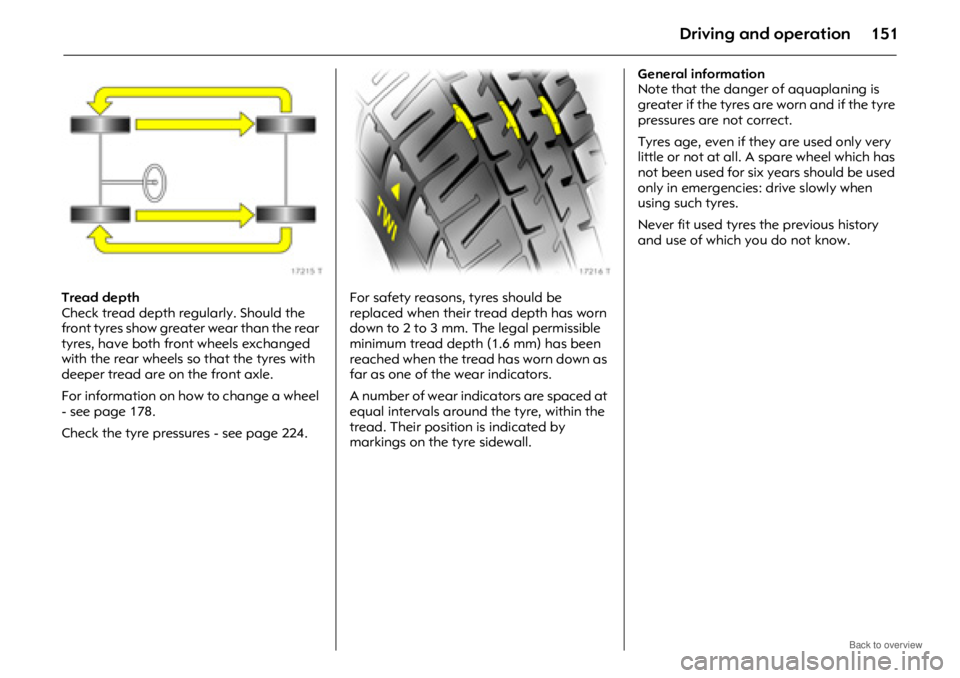
Check tread depth regularly. Should the
front tyres show greater wear than the rear
tyres, have both front wheels exchanged
with the rear wheels so that the tyres with
deeper tread are on the front axle.
For information on how to change a wheel
- see page 178.
Check the tyre pressures - see page 224.For safety reasons, tyres should be
replaced when their tread depth has worn
down to 2 to 3 mm. The legal permissible
minimum tread depth (1.6 mm) has been
reached when the tread has worn down as
far as one of the wear indicators.
A number of wear indicators are spaced at
equal intervals around the tyre, within the
tread. Their position is indicated by
markings on the tyre sidewall.General information
Note that the danger
of aquaplaning is
greater if the tyres are worn and if the tyre
pressures are not correct.
Tyres age, even if they are used only very
little or not at all. A spare wheel which has
not been used for six years should be used
only in emergencies: drive slowly when
using such tyres.
Never fit used tyres the previous history
and use of which you do not know.
Page 152 of 234

Driving and operation152
Tyre designations
Meanings:
e.g. 235/60 R 17 102 H
Speed code letters: Winter tyres
3
See page 223 for restrictions.
Winter tyres improve safety at extremely
low outside temperatures and should
therefore be fitted on all wheels.
The design of summer tyres means they
have limited qualities for winter driving.
If the maximum permissible speed for the
winter tyres is less than that of the vehicle,
a notice indicating the maximum
permissible speed for the tyres must be
affixed within the driver's field of vision 3
1).
If you use the spare wheel when it is fitted
with a summer tyre; the vehicle's
driveability may be affected, especially on
slippery road surfaces. Obtain a
replacement for the faulty tyre as soon as
possible, and have the wheel balanced
and fitted to the vehicle.
Ensure that winter tyres are inflated to the
correct pressure specified by the tyre
manufacturer.
If winter tyres are installed that have not
been approved for your vehicle, ESC
performance may be affected. Consult a
workshop regarding availability of
approved winter tyres.
Wheel trims 3
If the wheel trims and tyres used are not
Opel-approved, make sure the tyres do not
have a beaded edge - see page 149. Tyre chains
3
See page 223 for restrictions.
Tyre chains must not be used on the
temporary spare wheel. If you need to use
tyre chains after suffering a flat front tyre,
fit the temporary spare wheel on the rear
axle and transfer one of the rear wheels to
the front axle.
235
=Tyre width inmm
60 =Aspect ratio
(tyre height to tyre width in %)
R =Belt type: Radial
17 = Rim diameter in inches
102 =Load index
e.g.: 91 represents 618 kg
H = Speed code
Q Up to 160 km/h (100 mph)
S Up to 180 km/h (112 mph)
T Up to 190 km/h (118 mph)
H Up to 210 km/h (130 mph)
V Up to 240 km/h (150 mph)
W Up to 270 km/h (168 mph)
1)Varies from country to country on account of
national regulations.
Page 153 of 234

Driving and operation153
Always use fine-linked chains that add no
more than 15 mm to the tyre tread and the
inboard sides (including chain lock).
Tyre chains may only be used at speeds of
up to 50 km/h (30 mph)
1) or up to the tyre
chain manufacturer’s recommended
maximum speed, whichever is lower.
When travelling on road s that are free of
snow, they may only be used for brief
periods since they are subject to rapid wear
on a hard road and may snap.
Avoid sharp turns, bumps and holes and
do not lock the wheels when braking, to
avoid damaging the tyre chains.
Retighten the chains after driving for
approx. 1 km (0.6 miles). If, at any time,
you hear or suspect that the chains are
contacting the vehicle, stop and retighten
the chains.
Always read the instructions supplied with
the tyre chains. Temporary spare wheel
The temporary spare wheel is designed for
use on your vehicle only.
Do not attempt to use the spare tyre on a
different wheel, or use a different tyre on
the spare wheel, as they will not fit.
For notes on the temporary spare wheel -
see page 178.
Ensure the temporary spare wheel is
inflated to the correct tyre pressure -
see page 224.
Wheel changing - see page 178.
Roof racks 3
For reasons of safety and to avoid
damaging the roof, we recommend that
you use the Opel roof rack system
approved for your vehicle.
Fasten the roof rack to the roof rails
following the instructions that accompany
the system, ensuring that the roof load is
evenly distributed over the side or cross
rails. Loads must not be placed on the roof
surface.
To prevent damage or loss, check
frequently that roof loads are securely
fastened.
Driving with a roof load affects the
vehicle’s centre of gravity; drive carefully in
crosswinds and do not drive at high
speeds.
Driving hints - see page 127.
1)Varies from country to country on account of
national regulations.
9 Warning
Disregard of the instructions may lead to
injuries or endanger life. Vehicle
passengers must be informed
accordingly.
Page 168 of 234
Driving and operation168
Coupling socket load
The coupling socket load is the load
exerted by the caravan/trailer on the
coupling ball. It can be varied by changing
the weight distribution when loading the
caravan/trailer.
The maximum permissible coupling socket
load for the towing vehicle (80 kg) is stated
on the towing equipment identification
plate and should always be aimed for,
particularly in the case of heavy caravans/
trailers. The coupling socket load should
never be below 25 kg.
When measuring the coupling socket load,
make sure that the drawbar of the loaded
caravan/trailer is at the same height as it
will be when the carava n/trailer is coupled
with the towing vehicle loaded. This is
particularly important for caravans/trailers
with tandem axle. Rear axle load during towing
When the caravan/trailer is coupled and
the towing vehicle fully
loaded (including
all occupants), the permissible rear axle
load must not be exceeded.
National regulations regarding maximum
speeds for vehicles towing a caravan/
trailer must be observed.
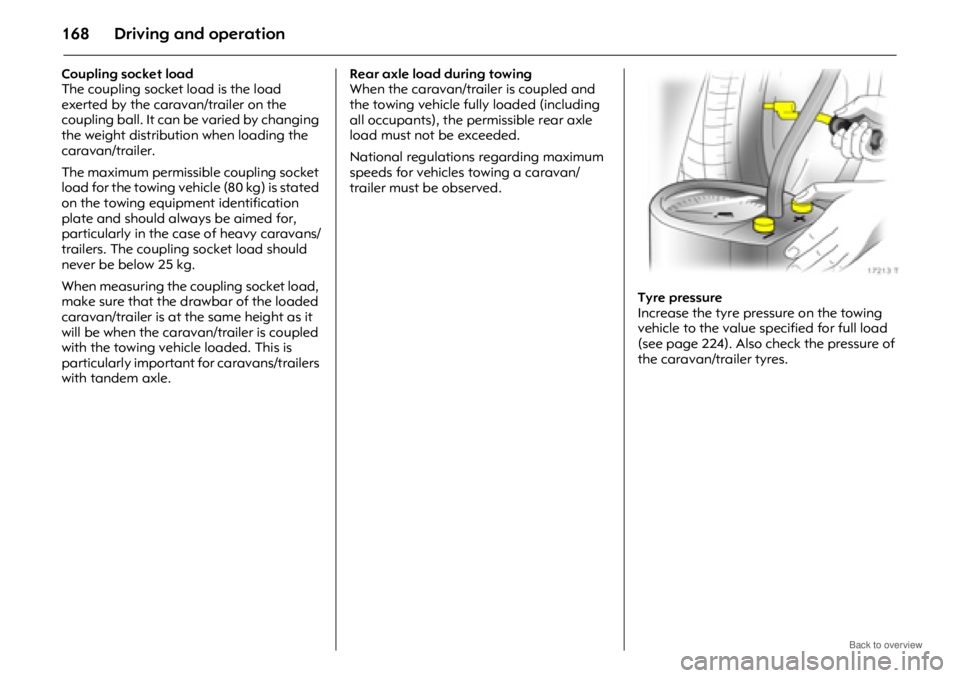
Tyre pressure
Increase the tyre pressure on the towing
vehicle to the value specified for full load
(see page 224). Also check the pressure of
the caravan/trailer tyres.
Page 178 of 234

Self-help, vehicle care178
Notes on temporary spare wheel
zUsing a temporary spare wheel may
change the driving behaviour of the
vehicle, particularly if using winter
tyres 3. Replace defective tyre as quickly
as possible, balanc e wheel and fit to
vehicle.
z Fit only one temporary spare wheel.
z Do not drive faster than 80 km/h
(50 mph).
z Take curves slowly.
z Do not use the temporary spare wheel
for a lengthy period.
z Replace temporary spare wheel with full
specification wheel without delay.
z When temporary spare wheel is fitted, do
not take the vehicle through an
automatic car wash with guide rails. The
temporary spare wheel may get caught
on the rails, causing damage to the tyre,
wheel and other vehicle parts.
z Tyre chains are not permitted on the
temporary spare wheel.
If tyre chains are necessary after a front
wheel puncture, fit the temporary spare
wheel to the rear and a rear wheel to the
front. Check tyre pressure and adjust if
necessary - see page 224.
z Follow the temporary spare wheel
instructions on pages 153, 181, 223. Notes on directional tyres
3
Tyres with a prescribed rotating direction
can only achieve their maximum
performance if they are fitted in the
prescribed rotating direction.
If a tyre or spare wheel is fitted that is
rotating in the wrong direction due to a
puncture, the following must be noted:
z The handling of the vehicle may be
different. Replace defective tyres as soon
as possible, have wheel balanced and
fitted to the vehicle.
z Do not drive faster than 80 km/h
(50 mph).
z Drive particularly carefully on wet and
snow-covered road surfaces.
z For more information on tyres with a
prescribed rotating direction -
see page 149.Wheel changing
In order to reduce the chance of possible
injuries, make the following preparations
and note the procedure:
zPark on a level, firm and non-slippery
surface.
z Switch on hazard warning lamps and
apply hand brake. Engage 1st gear or
reverse (automatic transmission 3 in P).
z Correctly set up warning triangle 3.
z Ensure all vehicle passengers are out of
the vehicle and clear of the vehicle and
other traffic.
z Take the spare wheel from under the
luggage compartment floor cover -
see page 177.
z Before raising the vehicle, turn front
wheels to straight-ahead position.
Page 181 of 234

Self-help, vehicle care181
Electrical system
Fuses
There are two fuse boxes in the vehicle:
the instrument panel fu se box is located on
the left-hand side of the front passenger’s
footwell, the engine compartment fuse box
is located next to the coolant reservoir.
It is advisable to carry a full set of fuses.
Spare fuses are kept in the engine
compartment fuse box.
7. Change the wheel.
Notes on spare wheel - see page 178.
8. Screw on wheel nuts and tighten slightly by hand until wheel is held
against the hub.
9. Rotate wrench anti-clockwise and lower vehicle to the ground.
10. Tighten wheel nuts in a cross wise sequence, putting the wrench on as far
as possible.
11. Stow replaced wheel in luggage compartment.
12. Stow the jacking equipment and warning triangle 3 - see pages 176,
177.
13. Check the tyre pressure of the newly fitted wheel - see page 224. Adjust as
necessary.
14. Have the new wheel balanced on the vehicle and have the tightening torque
of the wheel nuts checked as soon as
possible, and if necessary, corrected.
Tightening torque - see page 223.
15. Replace defective tyre on the wheel that was removed.
16. Replace temporary spare wheel with a full specification wheel without delay.
9 Warning
Electronic ignition systems generate very
high voltages. Do not touch the ignition
system; high voltage can be fatal.