warning light OPEL ANTARA 2009 User Guide
[x] Cancel search | Manufacturer: OPEL, Model Year: 2009, Model line: ANTARA, Model: OPEL ANTARA 2009Pages: 234, PDF Size: 3.01 MB
Page 94 of 234

Lighting94
Lighting
Exterior lamps
Turn light switch:
In positions 8 and 9, the tail lamps,
license plate lamps and instrument panel
lamps are also on. Daytime running lamps
3
Come on automatically when engine is
started.
They will turn off wh en the parking lamps
or dipped beam are on, or when the engine
is stopped.
Follow the regulations of the country in
which you are driving when using daytime
running lamps and front fog lamps.
Driving abroad - see page 100.
Lamps on reminder
If the driver’s door is opened when the light
switch is in position 8 or 9 and the
ignition is off, a warning chime will sound.
If the lamps are then switched off and back
on again, the warning chime will not sound.
Wiper activated lighting 3
With light switch in AUTO position,
if windscreen wipers are operated for
8 cycles or more, the exterior lamps
illuminate automatically.
Approach lighting 3
Depending upon outside light conditions,
when you press q on the remote control,
the hazard warning lamps flash twice and
the exterior lamps illuminate for approx.
20 seconds.
Main beam, headlamp flash ............. 95
Automatic dipped beam activation
3 95
Turn signal lamps ............................... 95
Front fog lamps >............................. 96
Fog tail lamp r.................................. 96
Reversing lamps.................................. 96
Centre high-mounted stop lamp ....... 96
Hazard warning lamps ...................... 97
Headlamp range adjustment q........ 97
Peripheral lighting .............................. 98
Instrument illumination, information display illumination .......................... 98
Interior courtesy lamps....................... 98
Battery discharge protection ............. 100
Headlamps when driving abroad ..... 100 7
=Off
8 = Parking lamps
9 = Dipped beam or main
beam
AUTO = Automatic dipped beam
activation 3
Page 95 of 234

Lighting95
Main beam, headlamp flash
To switch from dipped beam to main
beam, push lever forwards.
To switch back to dipped beam, pull lever
back towards steering wheel.
To activate the headlamp flash, pull lever
towards steering wheel. Main beam is
engaged for the duration of activation.
The blue control indicator P is illuminated
when main beam or headlamp flash is on.
Automatic dipped beam
activation 3
Light switch to AUTO; dipped beam comes
on automatically when the engine is
running, depending on outside light
conditions.
For reasons of safety, the light switch
should always remain in the AUTO
position.
To ensure automatic dipped beam
activation functions properly, do not cover
the light sensor on top of the instrument
panel.
Turn signal lamps
To activate, press lever up or down lightly.
When the steering wheel is turned back, the
lever automatically returns to its rest
position. This will not happen when making
a minor steering manoeuvre such as lane
changing.
Tap signal: briefly move lever to resistance
point. The turn signal then flashes three
times when changing lanes or the like.
Hold the lever if you want the turn signals
to flash for longer. When released, the lever
will spring back to rest position.
The volume of the turn signal lamps’
audible warning is dependent upon vehicle
speed.
Lever up = Right turn
Lever down = Left turn
Page 97 of 234

Lighting97
Hazard warning lamps
To switch on, press button ¨.
To switch off, press button ¨ again.
To aid location of the pushbutton, the red
surface is illuminated when the ignition is
switched on. When the button is pressed,
its control indicator flashes in unison with
the hazard warning lamps.
Headlamp range adjustment q
Manual headlamp range adjustment 3
With dipped beam switched on, adjust
headlamp range to suit vehicle load.
Correct adjustment of the headlamp range
reduces dazzle for other road users.
Automatic level control system 3 -
see page 143.
Vehicles without level control system Vehicles with level control system
Automatic headlamp range
adjustment
3
On vehicles with Xenon headlamps, the
range of the headlamps is adjusted
automatically based on vehicle load.
If control indicator q for automatic
headlamp range adjustment illuminates in
the instrument panel while driving, a fault
has occurred.
Have the cause of the fault remedied
immediately. Consult a workshop.
z Front seats occupied = 0
z All seats occupied = 1
z All seats occupied and load in
luggage compartment =2
z Driver’s seat occupied and load
in luggage compartment =3
z
Front seats occupied = 0
z All seats occupied = 1
z All seats occupied and load in
luggage compartment =1
z Driver’s seat occupied and load
in luggage compartment =2
Page 99 of 234

Lighting99
Courtesy lamps can be turned off
immediately by pressing button K.Front reading lamps
Left and right reading lamps are
individually operable. With ignition on: Rear interior lamps
Press button to turn on left and right rear
interior lamps individually.
Press button again to turn the lamp off.
On = Press button L or M
Off = Press button again
9 Warning
Avoid using interior lamps while driving in
the dark, as they can reduce driver
visibility.
Page 145 of 234
Driving and operation145
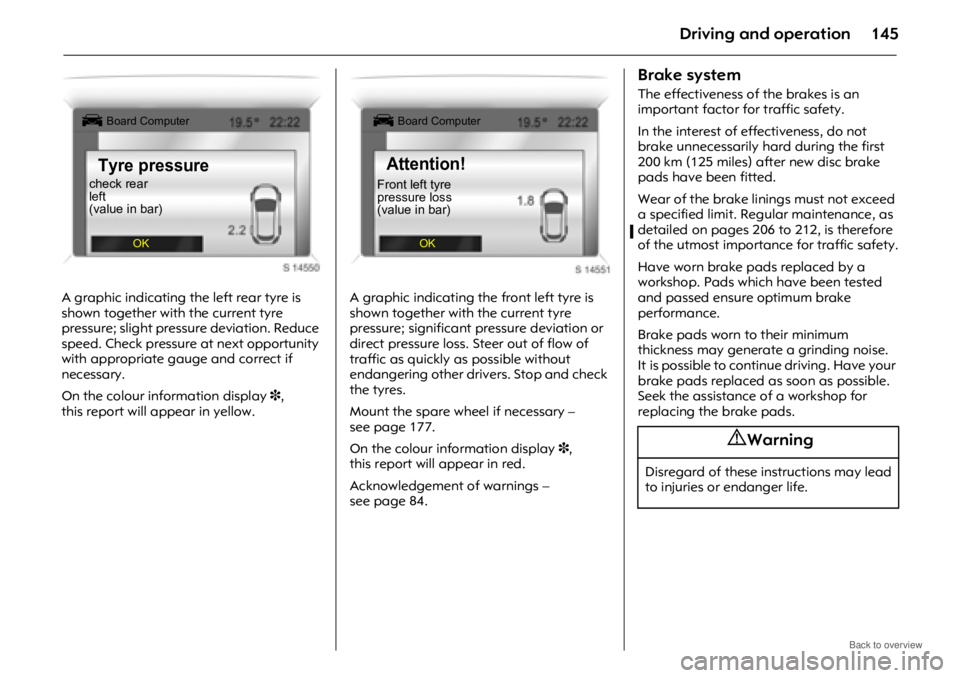
A graphic indicating the left rear tyre is
shown together with the current tyre
pressure; slight pressure deviation. Reduce
speed. Check pressure at next opportunity
with appropriate gauge and correct if
necessary.
On the colour information display 3,
this report will appear in yellow. A graphic indicating the front left tyre is
shown together with the current tyre
pressure; significant pressure deviation or
direct pressure loss. Steer out of flow of
traffic as quickly as possible without
endangering other drivers. Stop and check
the tyres.
Mount the spare wheel if necessary –
see page 177.
On the colour information display
3,
this report will appear in red.
Acknowledgement of warnings –
see page 84.
Brake system
The effectiveness of the brakes is an
important factor for traffic safety.
In the interest of effectiveness, do not
brake unnecessarily hard during the first
200 km (125 miles) after new disc brake
pads have been fitted.
Wear of the brake linings must not exceed
a specified limit. Regular maintenance, as
detailed on pages 206 to 212, is therefore
of the utmost importance for traffic safety.
Have worn brake pads replaced by a
workshop. Pads which have been tested
and passed ensure optimum brake
performance.
Brake pads worn to their minimum
thickness may generate a grinding noise.
It is possible to continue driving. Have your
brake pads replaced as soon as possible.
Seek the assistance of a workshop for
replacing the brake pads.
Ü Board Computer
Tyre pressure
OK
check rear
left
(value in bar)
Ü Board Computer
Attention!
OK
Front left tyre
pressure loss
(value in bar)
9 Warning
Disregard of these instructions may lead
to injuries or endanger life.
Page 147 of 234
Driving and operation147
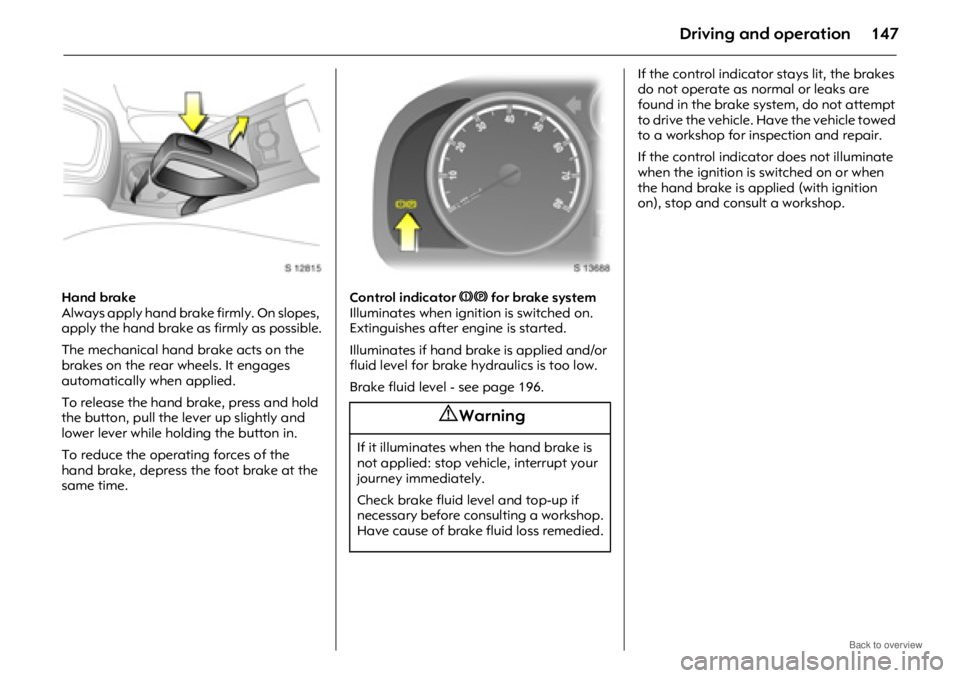
Hand brake
Always apply hand brake firmly. On slopes,
apply the hand brake as firmly as possible.
The mechanical hand brake acts on the
brakes on the rear wheels. It engages
automatically when applied.
To release the hand brake, press and hold
the button, pull the lever up slightly and
lower lever while holding the button in.
To reduce the operating forces of the
hand brake, depress the foot brake at the
same time. Control indicator
4 for brake system
Illuminates when ignition is switched on.
Extinguishes after engine is started.
Illuminates if hand brake is applied and/or
fluid level for brake hydraulics is too low.
Brake fluid level - see page 196. If the control indicator stays lit, the brakes
do not operate as normal or leaks are
found in the brake system, do not attempt
to drive the vehicle. Have the vehicle towed
to a workshop for inspection and repair.
If the control indicator does not illuminate
when the ignition is switched on or when
the hand brake is applied (with ignition
on), stop and consult a workshop.
9 Warning
If it illuminates when the hand brake is
not applied: stop vehi
cle, interrupt your
journey immediately.
Check brake fluid level and top-up if
necessary before consulting a workshop.
Have cause of brake fluid loss remedied.
Page 172 of 234

Self-help, vehicle care172
To open completely, locate the safety
catch, found slightly left of centre on the
underside of the bonnet, push the catch
upwards and lift the bonnet gently. The
bonnet is held open automatically.
When the bonnet is opened, leaves, dirt or
snow on the bonnet can slide down and
obstruct the air intake. Remove any leaves,
dirt or snow. Air intake - see page 114.
Never drive with bonnet open.
To close bonnet, lower it gradually,
allowing it to drop from a height of approx.
30 cm.
Check that the bonnet is locked in position
before driving, by pulling at its front edge.
If it is not engaged, repeat closing
procedure.
Starting
Do not start with quick charger
This prevents damage to electronic
components.
Do not start by pushing or towing
Because your vehicle is fitted with a
catalytic converter, it must not be started
by pushing or towing - see page 133.
The vehicle can only be started using jump
leads - see following pages.
Starting the engine with jump
leads 3
A vehicle with a discha rged battery can be
started using jump leads and the battery of
another vehicle.
Start attempts should be made at intervals
of 1 minute and should not last longer than
15 seconds.
9 Warning
If the vehicle battery requires charging
whilst still in the vehicle, ensure there is
adequate ventilation in and around the
battery compartment, to prevent risk of
explosion.
9 Warning
This must be done with extreme care. Any
deviation from the following instructions
could lead to personal injury or damage
resulting from battery explosion, as well
as to damage to the electrical systems in
both vehicles.
Page 181 of 234

Self-help, vehicle care181
Electrical system
Fuses
There are two fuse boxes in the vehicle:
the instrument panel fu se box is located on
the left-hand side of the front passenger’s
footwell, the engine compartment fuse box
is located next to the coolant reservoir.
It is advisable to carry a full set of fuses.
Spare fuses are kept in the engine
compartment fuse box.
7. Change the wheel.
Notes on spare wheel - see page 178.
8. Screw on wheel nuts and tighten slightly by hand until wheel is held
against the hub.
9. Rotate wrench anti-clockwise and lower vehicle to the ground.
10. Tighten wheel nuts in a cross wise sequence, putting the wrench on as far
as possible.
11. Stow replaced wheel in luggage compartment.
12. Stow the jacking equipment and warning triangle 3 - see pages 176,
177.
13. Check the tyre pressure of the newly fitted wheel - see page 224. Adjust as
necessary.
14. Have the new wheel balanced on the vehicle and have the tightening torque
of the wheel nuts checked as soon as
possible, and if necessary, corrected.
Tightening torque - see page 223.
15. Replace defective tyre on the wheel that was removed.
16. Replace temporary spare wheel with a full specification wheel without delay.
9 Warning
Electronic ignition systems generate very
high voltages. Do not touch the ignition
system; high voltage can be fatal.
Page 231 of 234

Index231
Fuel gauge ............................................... 76
Fuel system, diesel
................................ 194
Fuse extractor
........................................ 182
Fuses
....................................................... 181
G
Gears ........................................................ 17
Generator, see Alternator
....................... 74
Glasses compartment
............................. 65
Glove compartment
................................ 64
Bulb replacement
.............................. 191
Cooling
............................................... 105
Lighting
........................................ 64, 100
Graphical information display
......... 77, 83
Gross Vehicle Weight
........... 131, 167, 221
H
Halogen headlamp system .................. 185
Bulb replacement
.............................. 185
Hand brake
...................................... 19, 147
Hazard warning lamps
..................... 14, 97
Head restraints
.................................... 8, 39
Active head restraints
......................... 39
Head restraint position
....................... 39
Height adjustment
.............................. 39
Headlamp aiming
................................. 185
Headlamp flash
................................. 14, 95
Headlamp main beam
..................... 14, 95
Bulb replacement
.............................. 186
Control indicator
............................ 73, 95
Headlamp range adjustment
......... 97, 185
Automatic
............................................ 97
Manual
................................................. 97
Headlamp switch
.............................. 13, 94 Headlamp washer system
........ 16, 93, 199
Antifreeze protection
........................ 199
Capacities
.......................................... 225
Washer fluid reservoir
....................... 199
Headlamps
........................................ 13, 94
Bulb replacement
...................... 186, 187
Daytime running lamps
...................... 94
Driving abroad
.................................. 100
Front fog lamps
................................... 96
Warning device
............................. 92, 94
Wiper activated lighting
..................... 94
Heated exterior mirrors
.................. 16, 105
Heated front seats
................................ 105
Heated rear window
....................... 16, 105
Heating
.......................................... 103, 107
Exterior mirrors
.................................. 105
Rear window
...................................... 105
Seats
................................................... 105
With air conditioning system
.... 107, 108
With Electronic Climate Control
112, 113
Heating the footwell
............................. 108
Height adjustment Head restraints
................................ 8, 39
Seat belts
............................................. 47
Steering wheel
..................................... 13
High-pressure cleaners
143, 167, 202, 204
Horn
......................................................... 15
Hydraulic Brake Assist (HBA)
............... 138
I
Identification plate ............................... 215
Ignition logic
...................................... 80, 87
Ignition switch
......................................... 13
Illumination
........................................ 100
Ignition system
........................................ 19
Immobiliser
.............................................. 22
Information display
................................ 76
Bulb replacement
.............................. 191
Illumination
.......................................... 98
Infotainment system
..................... 101, 102
Inspection system
................................. 206
Instrument display
.................................. 75
Bulb replacement
.............................. 191
Illumination
.......................................... 98
Instrument panel
..................................... 10
Instruments
.............................................. 70
Interior lamps
.......................................... 98
Front reading lamps
........................... 99
Rear interior lamps
.............................. 99
Interior mirror
...................................... 9, 31
Interruption of power supply
... 83, 90, 120
Selector lever lock
............................. 120
ISOFIX
.......................................... 50, 51, 52
J
Jack ........................................................ 176
Jump leads
............................................ 172