light OPEL ANTARA 2009 Owner's Manual
[x] Cancel search | Manufacturer: OPEL, Model Year: 2009, Model line: ANTARA, Model: OPEL ANTARA 2009Pages: 234, PDF Size: 3.01 MB
Page 96 of 234

Lighting96
Front fog lamps
>
The front fog lamps can only be switched
on when both the ignition and headlamps
are on.
With automatic dipped beam activation 3,
parking lamps and dipped beam come on
simultaneously when the front fog lamps
are switched on.
Follow the regulations of the country in
which you are driving when using front fog
lamps.Fog tail lamp r
The fog tail lamp can only be switched on
when the ignition is on and the light switch
is in position 9, or the front fog lamps are
on and the light switch is in position 8.
With automatic dipped beam activation 3,
parking lamps and dipped beam come on
simultaneously when the fog tail lamp is
switched on.
Reversing lamps
Come on when reverse gear is engaged
and ignition is switched on.
Centre high-mounted stop lamp
Comes on when the brakes are applied,
acting as a third stop lamp, to supplement
the brake lamps.
On = Press button >, >
illuminates in instrument
panel.
Off = Press button > again, >
extinguishes in instrument
panel.
On = Press button r, r
illuminates in instrument
panel.
Off = Press button r again, r
extinguishes in instrument
panel.
Page 97 of 234

Lighting97
Hazard warning lamps
To switch on, press button ¨.
To switch off, press button ¨ again.
To aid location of the pushbutton, the red
surface is illuminated when the ignition is
switched on. When the button is pressed,
its control indicator flashes in unison with
the hazard warning lamps.
Headlamp range adjustment q
Manual headlamp range adjustment 3
With dipped beam switched on, adjust
headlamp range to suit vehicle load.
Correct adjustment of the headlamp range
reduces dazzle for other road users.
Automatic level control system 3 -
see page 143.
Vehicles without level control system Vehicles with level control system
Automatic headlamp range
adjustment
3
On vehicles with Xenon headlamps, the
range of the headlamps is adjusted
automatically based on vehicle load.
If control indicator q for automatic
headlamp range adjustment illuminates in
the instrument panel while driving, a fault
has occurred.
Have the cause of the fault remedied
immediately. Consult a workshop.
z Front seats occupied = 0
z All seats occupied = 1
z All seats occupied and load in
luggage compartment =2
z Driver’s seat occupied and load
in luggage compartment =3
z
Front seats occupied = 0
z All seats occupied = 1
z All seats occupied and load in
luggage compartment =1
z Driver’s seat occupied and load
in luggage compartment =2
Page 98 of 234

Lighting98
Peripheral lighting
The dipped beam and reversing lamps
illuminate for approx. 30 seconds after the
driver exits the vehicle and closes the door.
To activate function:
If the driver’s door is left open, the lamps
will extinguish after two minutes.
Peripheral lighting can be deactivated by
inserting the key in the ignition switch or by
pulling the turn signal lever towards the
steering wheel again while the driver’s door
is open.
Instrument illumination,
information display illumination
Comes on when ignition is switched on.
Brightness can be adjusted when the
exterior lamps are on: turn wheel to the
right or left until the desired brightness is
obtained.
If driver’s door is opened or q is pressed on
the remote control, instrument panel lamps
will illuminate automatically and stay on
for approx. 30 seconds until ignition switch
is turned to the ACC position.
Display mode 3 - see page 87.
Interior courtesy lamps
Front reading lamps, rear interior lamps
and luggage compartm ent lamps function
as courtesy lighting and illuminate when
the doors or tailgate are opened.
If doors or tailgate remain opened, the
lamps stay illuminated for approx.
10 minutes.
Once all doors and the tailgate are closed,
the courtesy lamps dim gradually after
approx. 10 seconds.
By pressing button d, both front reading
lamps and the rear interior lamps
illuminate.
Press the button again to turn the lamps
off.
1. Switch off ignition.
2. Remove ignition key.
3. Open driver’s door.
4. Pull turn signal lever towards
steering wheel.
Page 99 of 234

Lighting99
Courtesy lamps can be turned off
immediately by pressing button K.Front reading lamps
Left and right reading lamps are
individually operable. With ignition on: Rear interior lamps
Press button to turn on left and right rear
interior lamps individually.
Press button again to turn the lamp off.
On = Press button L or M
Off = Press button again
9 Warning
Avoid using interior lamps while driving in
the dark, as they can reduce driver
visibility.
Page 100 of 234

Lighting100
Luggage compartment lamps
Come on when a door or the tailgate is
opened. Front door lamps
Come on when a door is opened.
Once all doors are closed, the front door
lamps extinguish after approx. 10 seconds.
If the doors are left open, the lamps will
stay on for approx. 10 minutes.
Front door lamps can
also be turned off
immediately by pressing button
K in the
roof lining.
Ignition switch illumination
Comes on when you open a door.
Ignition switch illumination can also be
turned off immediately by pressing
button
K in the roof lining.
Sun visor lamps 3
Come on when vanity mirror covers are
opened. See page 34.
Ashtray illumination
The portable front ashtray, located in the
front drink holder, illuminates depending
on outside light conditions. See page 68.
Glove compartment illumination
Comes on when the glove compartment is
opened. See page 64.
Battery discharge protection
To prevent battery from becoming
discharged, the extern al lamps turn off
automatically approx. 10 minutes after the
ignition is switched off.
Battery discharge protecti on will not work if
the lamps are turned on 10 minutes after
the ignition has been switched off; the key
cannot be removed from the ignition switch
until the battery is recharged.
Headlamps when driving abroad
The asymmetrical dipped beam increases
the field of vision on the near side of the
lane.
When driving in coun tries which drive on
the opposite side of the road, this causes
glare for oncoming traffic.
For temporary periods, to avoid glare the
headlamp pattern should be adjusted
down to the horizontal position.
Have the headlamps adjusted by a
workshop.
Page 104 of 234
Climate control104
Air vents
Pleasant ventilation to the head area with
unheated or slightly warmed air depending
on the position of the temperature rotary
knob.
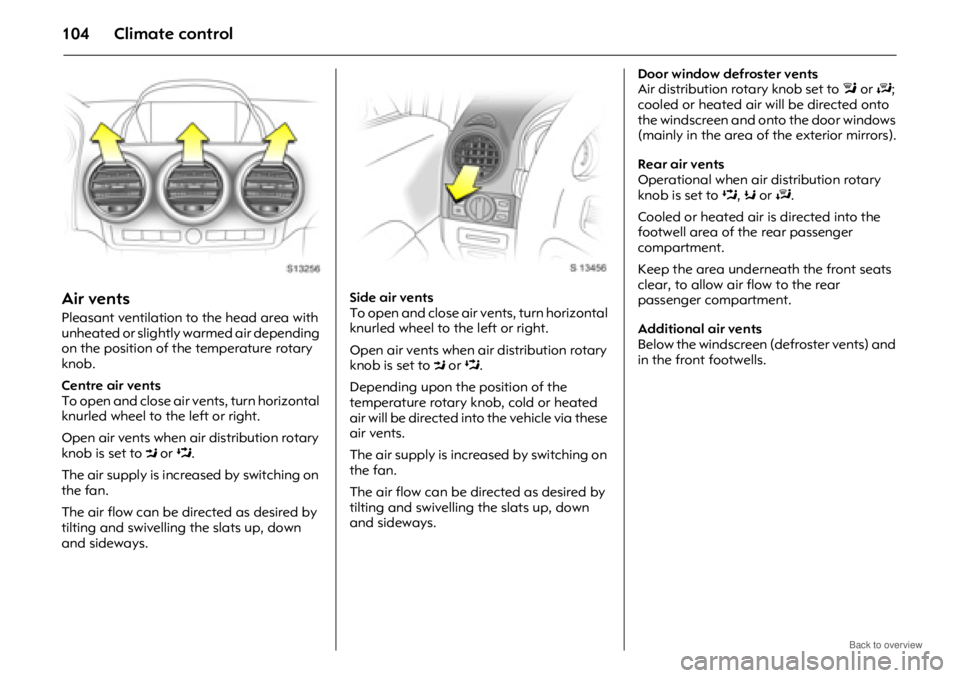
Centre air vents
To open and close air vents, turn horizontal
knurled wheel to the left or right.
Open air vents when air distribution rotary
knob is set to M or L.
The air supply is increased by switching on
the fan.
The air flow can be directed as desired by
tilting and swivelling the slats up, down
and sideways. Side air vents
To open and close air ve
nts, turn horizontal
knurled wheel to the left or right.
Open air vents when air distribution rotary
knob is set to M or L.
Depending upon the position of the
temperature rotary knob, cold or heated
air will be directed into the vehicle via these
air vents.
The air supply is increased by switching on
the fan.
The air flow can be directed as desired by
tilting and swivelling the slats up, down
and sideways. Door window defroster vents
Air distribution rotary knob set to
l or J ;
cooled or heated air wi ll be directed onto
the windscreen and onto the door windows
(mainly in the area of the exterior mirrors).
Rear air vents
Operational when air distribution rotary
knob is set to L, K or J .
Cooled or heated air is directed into the
footwell area of the rear passenger
compartment.
Keep the area underneath the front seats
clear, to allow air flow to the rear
passenger compartment.
Additional air vents
Below the windscreen (defroster vents) and
in the front footwells.
Page 111 of 234
Climate control111
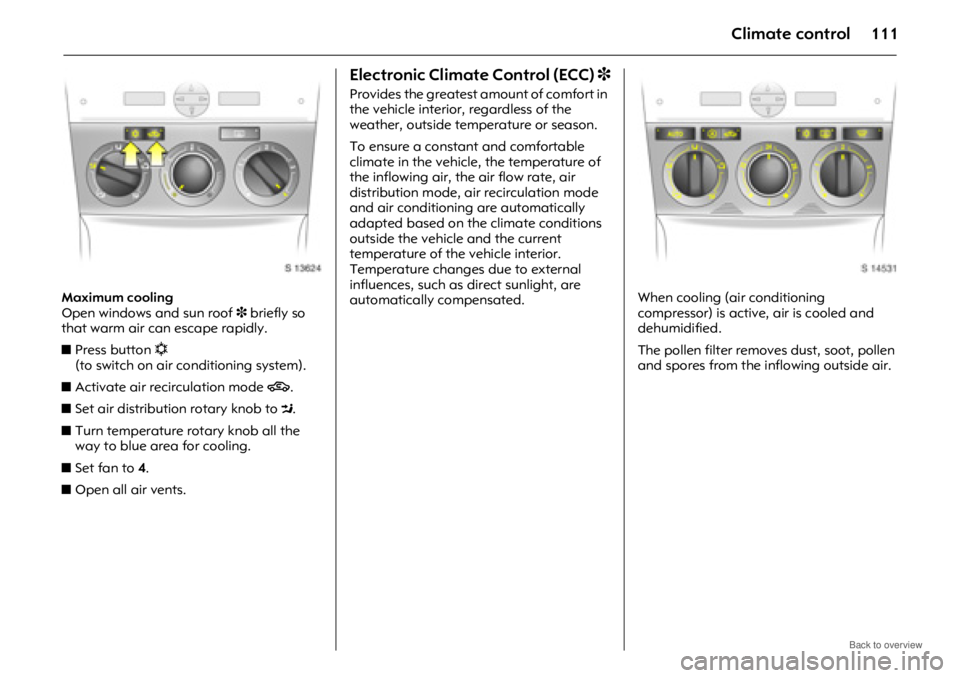
Maximum cooling
Open windows and sun roof 3 briefly so
that warm air can escape rapidly.
z Press button n
(to switch on air co nditioning system).
z Activate air recirculation mode 4.
z Set air distribution rotary knob to M.
z Turn temperature rotary knob all the
way to blue area for cooling.
z Set fan to 4.
z Open all air vents.
Electronic Climate Control (ECC) 3
Provides the greatest amount of comfort in
the vehicle interior, regardless of the
weather, outside temperature or season.
To ensure a constant and comfortable
climate in the vehicle, the temperature of
the inflowing air, the air flow rate, air
distribution mode, air recirculation mode
and air conditioning are automatically
adapted based on the climate conditions
outside the vehicle and the current
temperature of the vehicle interior.
Temperature changes due to external
influences, such as direct sunlight, are
automatically compensated. When cooling (air conditioning
compressor) is active, air is cooled and
dehumidified.
The pollen filter removes dust, soot, pollen
and spores from the
inflowing outside air.
Page 114 of 234

Climate control114
Air intake
The air intakes in front of the windscreen in
the engine compartment must be kept
clear to allow air intake. Remove any
leaves, dirt or snow.
Pollen filter
The pollen filter cleans dust, soot, pollen
and spores from the air entering from
outside. The active carbon layer 3
eliminates most odours and harmful
ambient gases from the air.
Replace the pollen filter at the intervals
given on pages 206 to 212.
Note
If the windscreen mists up in damp
weather, temporarily set the system as
described under "Window demisting and
defrosting" - see pages 108, 113.
Cooling is most efficient when the windows
are closed. If the interior is extremely hot
due to a long period in strong sunlight,
briefly open the windows and sun roof 3 to
allow hot air to escape quickly.
When cooling (air conditioning
compressor) is switched on, condensation
forms, which is expelled from the underside
of the vehicle.
When cooling is switched on, at least one of
the adjustable centre or side air vents must
be open so that the evaporator does not
ice up due to lack of air movement.
Cooling switches off automatically at low
outside temperatures.
Do not cover the interior temperature
sensor (located below the fan switch) or the
sunlight sensor (located in front of
windscreen defroster vents) as this could
cause the Electronic Climate Control (ECC)
system 3 to malfunction.
Maintenance
To ensure continuously efficient
performance and prolong the life of the air
conditioning system, it must be switched on
for a few minutes once a week, irrespective
of the weather and time of year.
Electronic Climate Control (ECC) 3 handles
this automatically while driving. Air
conditioning compressor operation is not
possible at low outside temperatures.
Malfunctions in the system must not be
rectified by the owner: consult a workshop.
Page 119 of 234

Driving and operation119
Parking
Before leaving the vehicle:
zDepress and hold foot brake,
z Apply hand brake,
z Move selector lever to position P,
z Turn key to LOCK position,
z Remove ignition key,
z Engage steering column lock,
z Lock the vehicle.
When the ignition is switched off, the
automatic transmission no longer responds
to movements of the selector lever. Rocking the vehicle
If it becomes necessary to rock the vehicle
to free it from water, ice, sand, mud, snow
or a dip, observe the following:
Check there are no objects or people in the
vicinity before attempting to rock the
vehicle.
Turn the steering wheel fully from left to
right to clear the area around the front
tyres.
Move the selector lever between
R and a
forward gear in a repeat pattern while
applying light pressure to the accelerator
pedal when the vehicle is in gear.
Do not spin the wheels or race the engine
and avoid sudden acceleration.
This applies only in the exceptional
circumstances mentioned above.
If the vehicle cannot be released after
rocking the vehicle several times, your
vehicle may need to be towed.
Towing - see page 174. Manoeuvring the vehicle
To manoeuvre the vehicle back and forth
during attempts to park or in garage
entrances, the creeping movement can be
utilized by releasing the foot brake.
Never actuate the accelerator and brake
pedals simultaneously.
Page 121 of 234
Driving and operation121
All Wheel Drive
All Wheel Drive (AWD) is an active-on-
demand system that engages
automatically, with no action required by
the driver. Depending on the driving
environment, the vehicle switches between
two-wheel drive and four-wheel drive, to
give the vehicle more traction and stability
when necessary.
If the front wheels begin to slip, the rear
wheels will automatically begin to drive the
vehicle as required.
More torque is transferred to the wheels
that have the most traction, so the vehicle
has optimum grip at all times.
There may be a slight engagement noise
during hard use.
As well as enabling the vehicle to be driven
off-road, this system also enables the
vehicle to be driven on normal roads
without incurring excessive tyre and
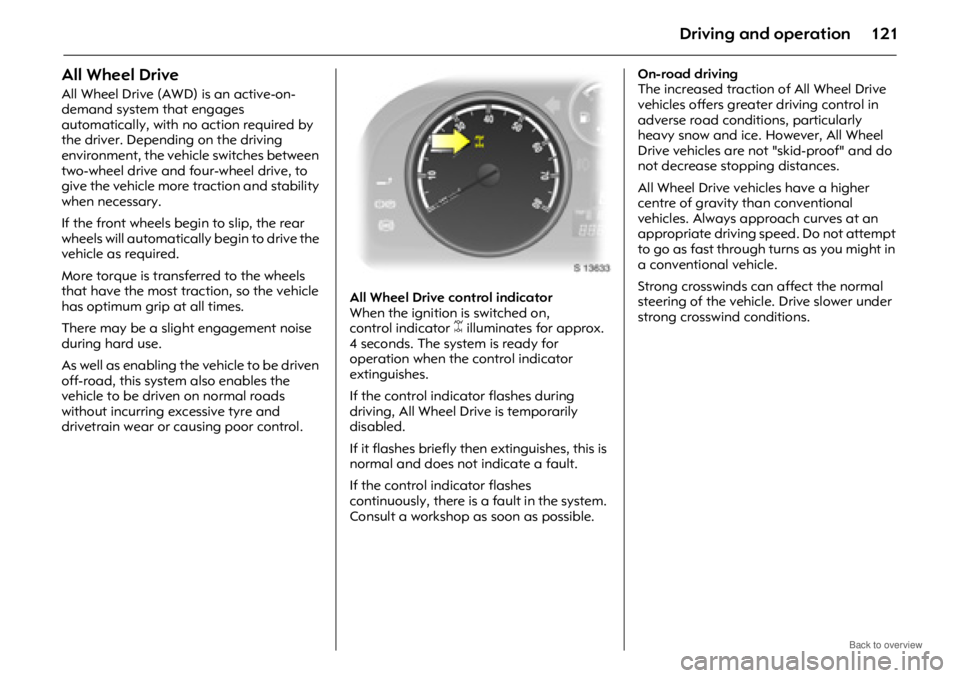
drivetrain wear or causing poor control. All Wheel Drive control indicator
When the ignition is switched on,
control indicator
B illuminates for approx.
4 seconds. The system is ready for
operation when the control indicator
extinguishes.
If the control indicator flashes during
driving, All Wheel Drive is temporarily
disabled.
If it flashes briefly then extinguishes, this is
normal and does not indicate a fault.
If the control indicator flashes
continuously, there is a fault in the system.
Consult a workshop as soon as possible. On-road driving
The increased traction
of All Wheel Drive
vehicles offers greate r driving control in
adverse road condit ions, particularly
heavy snow and ice. However, All Wheel
Drive vehicles are not "skid-proof" and do
not decrease stopping distances.
All Wheel Drive vehicles have a higher
centre of gravity than conventional
vehicles. Always approach curves at an
appropriate driving speed. Do not attempt
to go as fast through turns as you might in
a conventional vehicle.
Strong crosswinds can affect the normal
steering of the vehicle. Drive slower under
strong crosswind conditions.