light OPEL ANTARA 2009 Owner's Guide
[x] Cancel search | Manufacturer: OPEL, Model Year: 2009, Model line: ANTARA, Model: OPEL ANTARA 2009Pages: 234, PDF Size: 3.01 MB
Page 127 of 234

Driving and operation127
Driving hints
The first 1000 km (600 miles)
Drive your vehicle at various speeds. Do
not use full throttle. Never allow the engine
to labour at low revs.
Make good use of all gears. Depress the
accelerator pedal a maximum of around
three quarters of the available pedal travel
in all gears and drive ranges.
Do not drive faster than three quarters of
maximum speed.
Avoid quick starts, su dden acceleration
and prolonged high-speed driving, to
avoid engine damage and to conserve
fuel.
Do not brake unnecessarily hard for the
first 200 km (125 miles).
If possible, avoid towing another vehicle.
Never coast with engine not running
Many units may then not function (e.g.
brake servo unit, power steering, airbag
system). Driving in this manner is a danger
to yourself and others. Brake servo unit
With the engine not running, the brake
servo unit is no longer effective once the
brake pedal has been depressed once or
twice. The braking effect is not reduced,
but substantially greater foot pressure is
necessary to stop the vehicle.
Power steering
Never leave the steering wheel on full lock
when the vehicle is stationary, as this may
damage the power steering pump.
If the power steering should fail - e.g. when
the vehicle is being towed with the engine
switched off - the vehicle can still be
properly steered, but considerably greater
effort is necessary.
Driving in mountainous terrain or with a
caravan/trailer
Electrically driven fan; the fan cooling
capacity is not dependent on engine
speed. It is not necessary, therefore, when
driving uphill to shif
t down into a lower
gear if the vehicle can climb in a higher
gear. Driving in extreme conditions
When driving in hazard
ous conditions, e.g.
in snow, ice, mud, sand or water, drive
slowly and cautiously to allow for greater
braking distances.
If stuck, use 2nd gear (automatic
transmission in drive range 2) to avoid
spinning the front wheels.
Use sand, tyre chains or other non-slip
materials to provide traction when stuck in
snow, mud or ice.
Driving through water
Before attempting to drive through water,
check the depth. If the depth is slightly
lower than the underbody of your vehicle,
do not attempt to drive through it.
Driving too quickly through water can
cause water to enter the engine through
the air intake, causing severe damage.
Drive slowly, in a high engine rpm in as low
a gear as possible.
Driving with a roof load
Do not exceed the permissible roof load -
see page 221. For safety reasons,
distribute the load evenly and secure it
tightly with straps so that it cannot slip. Set
the tyre pressure to the value given for full
load. Do not drive faster than 120 km/h
(75 mph). Check and retighten straps at
frequent intervals.
Page 129 of 234

Driving and operation129
Save fuel, protect the
environment
Trend-setting technology
When developing and manufacturing your
vehicle, Opel used environment-friendly
and, in the main, recyclable materials. The
production methods used to make your
vehicle are likewise environmentally-
compatible.
Recycling of production wastes keeps the
circulation of material closed. Reduction of
energy and water requirements also helps
to conserve natural resources.
A highly advanced design means that your
vehicle can be easily disassembled at the
end of its working life, and the individual
materials separated for subsequent re-use.
Materials such as as bestos and cadmium
are not used. The refrigerant in the air
conditioning system is CFC-free.
New painting techniques employ water as
a solvent. End-of-life vehicle recovery
Information on end-of-life vehicle recovery
centres and the recycling of end-of-life
vehicles is available at www.opel.com.
Drive in an energy and
environment-conscious way
z
High fuel consumption, noise levels and
exhaust emissions are often caused by a
driving style that is not energy and
environment-conscious.
z You should therefore drive with energy in
mind: "more kilometres/miles with less
fuel".
z Reduce the noise level and exhaust
emissions by adopting an environment-
conscious driving style. This is extremely
worthwhile and improves quality of life.
Fuel consumption depends to a great
extent on your own personal driving style.
The following hints are intended to help
you consume fuel at a rate that is as close
as possible to the specified levels.
Check your vehicle’s fuel consumption
every time you refuel. This facilitates early
detection of any irregularities causing
increased fuel consumption. Warming up
z
Full throttle and warming up at idle
speed increase wear, fuel consumption,
fuel emission, the amount of pollutant in
the exhaust and the amount of noise.
z Drive off immediately after starting.
Warm up the engine by running it at
moderate engine speeds.
Uniform speed
z Hectic driving significantly increases fuel
consumption, the quantity of emission
and the proportion of pollutant in the
exhaust.
z Do not accelerate and brake
unnecessarily. Drive at uniform speed.
Avoid frequent starting-off and
stopping, e.g. at tra ffic lights, in short
distance traffic and in queues of traffic,
by means of clever planning. Select
roads with good traffic flow.
Idling
z The engine also consumes fuel when
idling.
z If you have to wait for more than
1 minute, it is worthwhile switching off
the engine. Five minutes of idling
corresponds to approx. one kilometre
(0.6 miles) of driving.
z Idling for more than 5 minutes can cause
excessive temperatures and damage to
the exhaust system.
Page 130 of 234

Driving and operation130
Overrun
zThe fuel supply is automatically shut off
during overrun, e.g. when the vehicle is
being driven down long gradients or
during braking - see page 128.
z To enable the overrun cut-off to take
effect and save fuel, do not accelerate or
declutch.
Correct gear selection
z High revs increase engine wear and fuel
consumption.
z Do not race your engine. Avoid driving at
high engine speeds.
Driving with an eye on the tachometer
saves fuel. If possible, drive at low revs in
each gear and at a constant speed.
Drive in top gear as much as possible,
shift up as soon as possible and do not
shift down prematurely.
High speed
z The faster the speed, the higher the fuel
consumption and noise level. Driving at
full throttle uses up a great deal of fuel
and generates excessive noise and high
emission levels.
z Slightly releasing the accelerator pedal
results in distinct fu el savings with no
major loss of speed.
Drive at no more than around three
quarters of maximum speed and you will
use up to 50% less fuel, without losing a
great deal of time. Tyre pressure
z
Inadequate tyre pressure, leading to
higher road resistance, costs money in
two ways; for more fuel and increased
tyre wear.
z Regular checks (every 14 days) pay off.
Electrical loads
z The power consumption of electrical
equipment increases fuel consumption.
z Switch off all additional consumers (e.g.
air conditioning, heated rear window)
when they are no longer required.
Roof racks 3
z Roof racks can increase fuel
consumption by approx. 1 l/100 km
(3.5 gal./1000 miles) due to air
resistance.
z Remove them if they are not being used. Repair and maintenance
z
Improper repairs or adjustment and
maintenance work can increase fuel
consumption. Do not carry out work on
the engine yourself.
You may, out of ignorance, infringe
environmental laws by not disposing of
materials properly.
Appropriate parts might not be recycled.
Contact with some of the materials
involved may pose a health hazard.
z We recommend that repairs and
maintenance be entrusted to an
Opel Partner.
Extreme driving conditions
z Driving up steep gradients, cornering,
driving on poor roads, and winter driving
all increase fuel consumption.
Fuel consumption increases dramatically
in urban traffic and at winter
temperatures, especially on short trips
when the engine operating temperature
is not reached.
z Follow the hints given above to keep fuel
consumption to a minimum under such
conditions.
Page 145 of 234
Driving and operation145
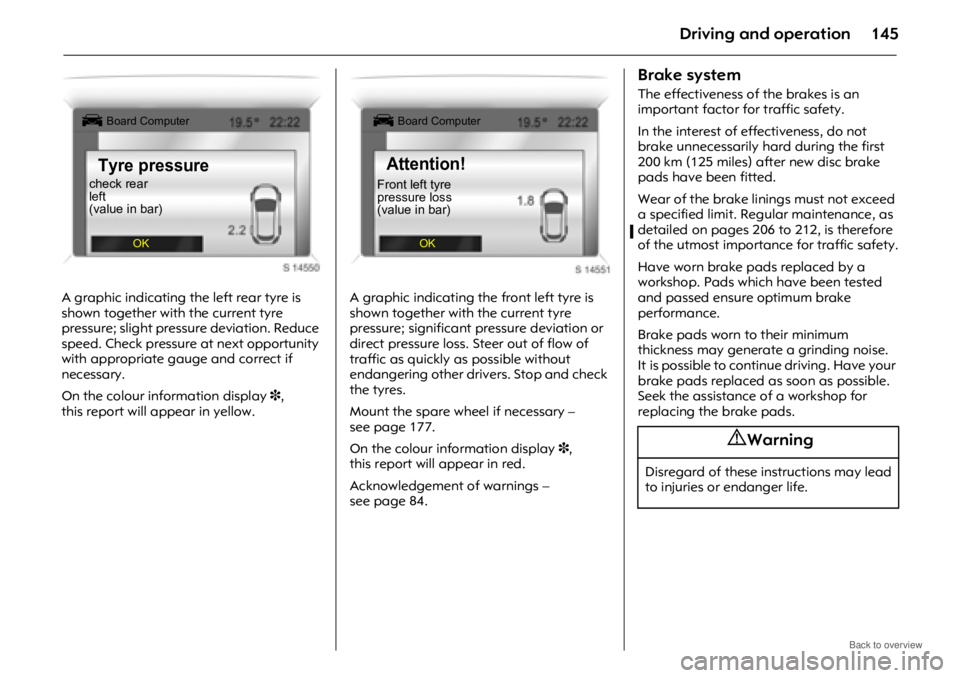
A graphic indicating the left rear tyre is
shown together with the current tyre
pressure; slight pressure deviation. Reduce
speed. Check pressure at next opportunity
with appropriate gauge and correct if
necessary.
On the colour information display 3,
this report will appear in yellow. A graphic indicating the front left tyre is
shown together with the current tyre
pressure; significant pressure deviation or
direct pressure loss. Steer out of flow of
traffic as quickly as possible without
endangering other drivers. Stop and check
the tyres.
Mount the spare wheel if necessary –
see page 177.
On the colour information display
3,
this report will appear in red.
Acknowledgement of warnings –
see page 84.
Brake system
The effectiveness of the brakes is an
important factor for traffic safety.
In the interest of effectiveness, do not
brake unnecessarily hard during the first
200 km (125 miles) after new disc brake
pads have been fitted.
Wear of the brake linings must not exceed
a specified limit. Regular maintenance, as
detailed on pages 206 to 212, is therefore
of the utmost importance for traffic safety.
Have worn brake pads replaced by a
workshop. Pads which have been tested
and passed ensure optimum brake
performance.
Brake pads worn to their minimum
thickness may generate a grinding noise.
It is possible to continue driving. Have your
brake pads replaced as soon as possible.
Seek the assistance of a workshop for
replacing the brake pads.
Ü Board Computer
Tyre pressure
OK
check rear
left
(value in bar)
Ü Board Computer
Attention!
OK
Front left tyre
pressure loss
(value in bar)
9 Warning
Disregard of these instructions may lead
to injuries or endanger life.
Page 147 of 234
Driving and operation147
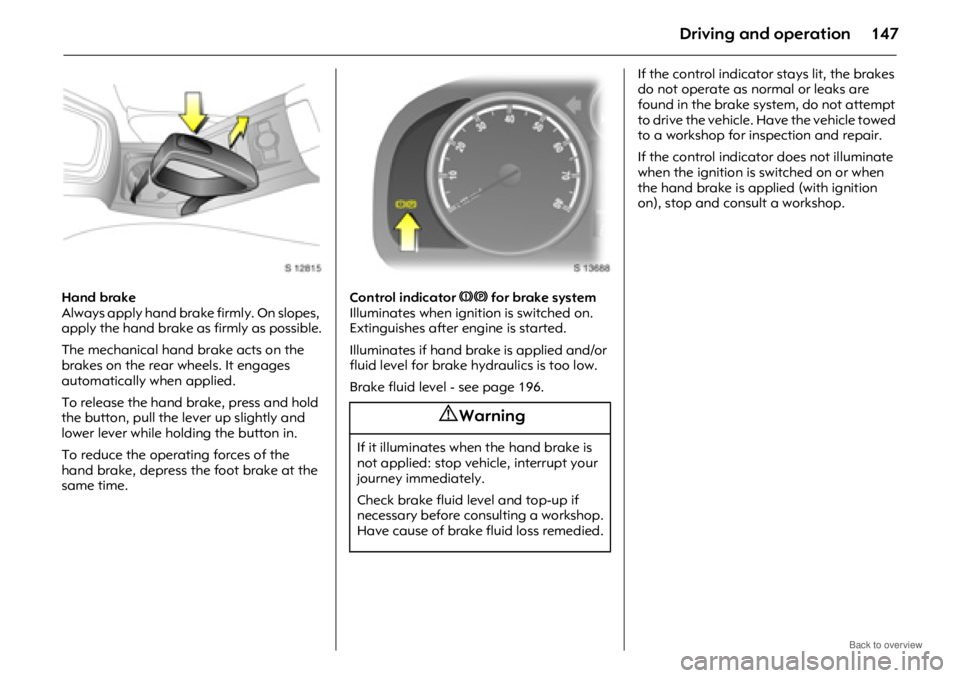
Hand brake
Always apply hand brake firmly. On slopes,
apply the hand brake as firmly as possible.
The mechanical hand brake acts on the
brakes on the rear wheels. It engages
automatically when applied.
To release the hand brake, press and hold
the button, pull the lever up slightly and
lower lever while holding the button in.
To reduce the operating forces of the
hand brake, depress the foot brake at the
same time. Control indicator
4 for brake system
Illuminates when ignition is switched on.
Extinguishes after engine is started.
Illuminates if hand brake is applied and/or
fluid level for brake hydraulics is too low.
Brake fluid level - see page 196. If the control indicator stays lit, the brakes
do not operate as normal or leaks are
found in the brake system, do not attempt
to drive the vehicle. Have the vehicle towed
to a workshop for inspection and repair.
If the control indicator does not illuminate
when the ignition is switched on or when
the hand brake is applied (with ignition
on), stop and consult a workshop.
9 Warning
If it illuminates when the hand brake is
not applied: stop vehi
cle, interrupt your
journey immediately.
Check brake fluid level and top-up if
necessary before consulting a workshop.
Have cause of brake fluid loss remedied.
Page 160 of 234
Driving and operation160
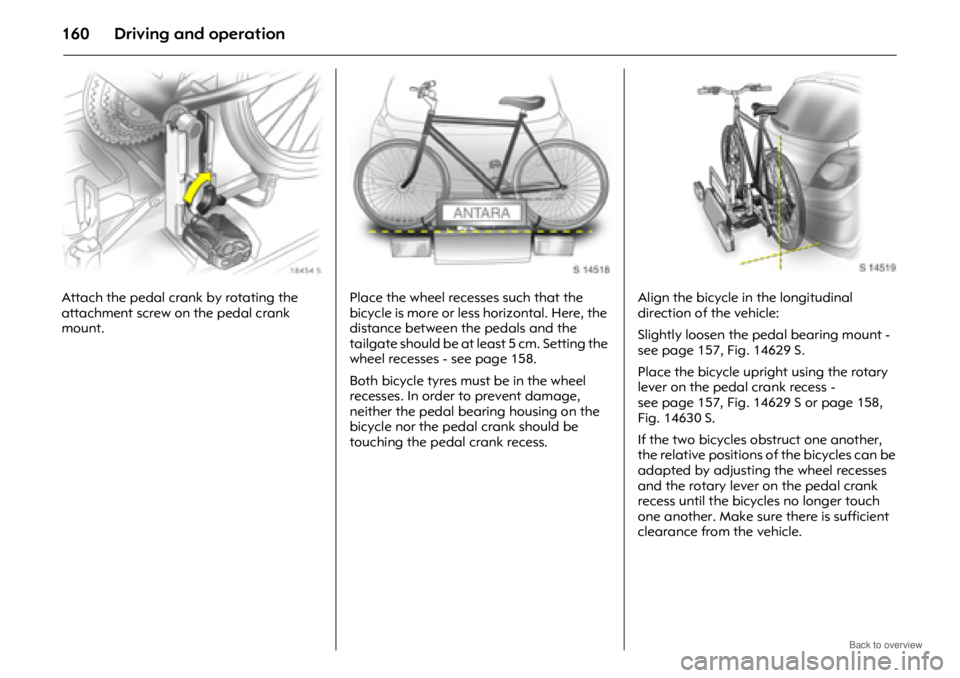
Attach the pedal crank by rotating the
attachment screw on the pedal crank
mount.Place the wheel recesses such that the
bicycle is more or less horizontal. Here, the
distance between the pedals and the
tailgate should be at least 5 cm. Setting the
wheel recesses - see page 158.
Both bicycle tyres must be in the wheel
recesses. In order to prevent damage,
neither the pedal bearing housing on the
bicycle nor the pedal crank should be
touching the pedal crank recess.Align the bicycle in the longitudinal
direction of the vehicle:
Slightly loosen the pedal bearing mount -
see page 157, Fig. 14629 S.
Place the bicycle upright using the rotary
lever on the pedal crank recess -
see page 157, Fig. 14629 S or page 158,
Fig. 14630 S.
If the two bicycles obstruct one another,
the relative positions of the bicycles can be
adapted by adjusting the wheel recesses
and the rotary lever on the pedal crank
recess until the bicycles no longer touch
one another. Make sure there is sufficient
clearance from the vehicle.
Page 167 of 234

Driving and operation167
Dismounting the coupling ball bar
Unlock coupling ball bar and remove key.
Push lever to the left, towards the coupling
ball bar and turn it downwards. Pull
coupling ball bar out of coupling housing.
Remove any rust or dirt from area around
the coupling housing and coupling ball bar
connection before inserting sealing plug in
the hole.
Place the coupling ball bar in the bag
supplied, fasten it wi th the strap and stow
it below the floor cover in the luggage
compartment.
Do not use steam-jet cleaners or other
high-pressure cleaners to clean the
coupling ball bar.
Towing
Caravan/trailer loads1)
The permissible caravan/trailer loads are
vehicle-dependent and engine-dependent
maximum values which must not be
exceeded.
The actual caravan/trailer load is the
difference between the actual gross weight
of the caravan/trailer and the actual
coupling socket load with the caravan/
trailer coupled.
When the caravan/trailer load is being
checked, therefore, on ly the caravan/trailer
wheels - and not the jockey wheel - must be
standing on the weighing apparatus.
The permissible caravan/trailer loads for
your vehicle are given in the vehicle papers.
Unless otherwise stated , they are valid for
gradients up to max. 12%.
The permissible caravan/trailer load should
be fully utilized only by drivers who are
adequately experienced in towing large
caravans/trailers.
The permitted caravan/trailer load applies
up to the specified incline and up to an
altitude of 1000 metres above sea level. Since engine power decreases as altitude
increases because of the air becoming
thinner, therefore reducing climbing ability,
it may not be possible for permissible trailer
loads to be fully utilized in mountainous
territory.
The permitted towing weight decreases by
10% for every 1000 metres of additional
altitude.
The towing weight does not have to be
reduced when driving on roads with slight
inclines (less than 8%, e.g. on motorways).
The actual caravan/trailer load plus the
actual Gross Vehicle Weight must not
exceed the maximum permitted towing
weight. For example, if the permitted Gross
Vehicle Weight is utilised, the caravan/
trailer load must only
be used until the
maximum permitted towing weight is
reached.
The maximum permitted towing weight is
shown on the vehicle id entification plate -
see page 215.
1)Observe national regulations.
Page 172 of 234

Self-help, vehicle care172
To open completely, locate the safety
catch, found slightly left of centre on the
underside of the bonnet, push the catch
upwards and lift the bonnet gently. The
bonnet is held open automatically.
When the bonnet is opened, leaves, dirt or
snow on the bonnet can slide down and
obstruct the air intake. Remove any leaves,
dirt or snow. Air intake - see page 114.
Never drive with bonnet open.
To close bonnet, lower it gradually,
allowing it to drop from a height of approx.
30 cm.
Check that the bonnet is locked in position
before driving, by pulling at its front edge.
If it is not engaged, repeat closing
procedure.
Starting
Do not start with quick charger
This prevents damage to electronic
components.
Do not start by pushing or towing
Because your vehicle is fitted with a
catalytic converter, it must not be started
by pushing or towing - see page 133.
The vehicle can only be started using jump
leads - see following pages.
Starting the engine with jump
leads 3
A vehicle with a discha rged battery can be
started using jump leads and the battery of
another vehicle.
Start attempts should be made at intervals
of 1 minute and should not last longer than
15 seconds.
9 Warning
If the vehicle battery requires charging
whilst still in the vehicle, ensure there is
adequate ventilation in and around the
battery compartment, to prevent risk of
explosion.
9 Warning
This must be done with extreme care. Any
deviation from the following instructions
could lead to personal injury or damage
resulting from battery explosion, as well
as to damage to the electrical systems in
both vehicles.
Page 179 of 234
Self-help, vehicle care179
zRemove wheel trim 3.
z Slacken wheel nuts one turn only before
raising the vehicle, but do not totally
unscrew or remove the nuts until the
wheel is off the ground.
z Never change more th an one wheel at a
time.
z Block wheel diagonally opposite the
wheel to be changed, by placing wedge
blocks or equivalent in front and behind
the wheel.
z Do not jack-up the vehicle when traffic is
too close.
z Use jack only when changing wheels.
z Never exceed jack maximum working
load (900 kg).
z If the ground on which the vehicle is
standing is soft, a solid board (max. 1 cm
thick) should be placed under the jack.
Using a thicker board could lead to
damage of the jack and the vehicle. z
Do not raise the vehicle more than is
necessary to change a wheel.
z No people or animals may be in the
vehicle when it is jacked-up.
z Never start or run the engine or crawl
under a jacked-up vehicle.
z Before screwing on the wheel nuts when
changing a wheel, ap ply a light coating
of grease to the cone of each wheel nut.
z Fully tighten the wheel nuts after
lowering the vehicle all the way, ensuring
nuts have been tightened to the correct
torque (see page 223).
z If conditions are not satisfactory to
change a wheel safely, consult a
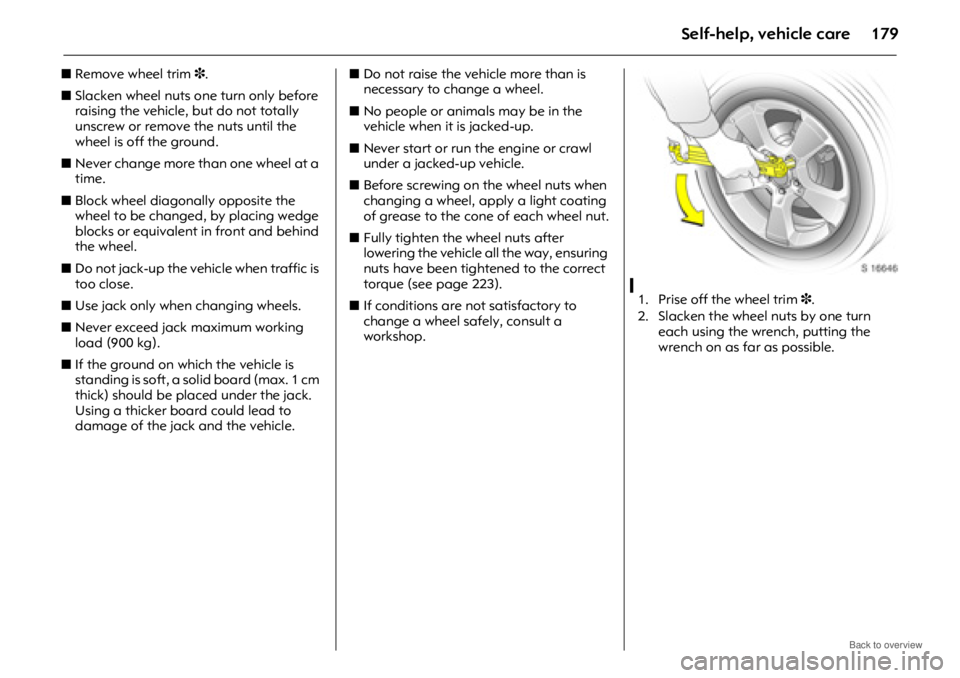
workshop. 1. Prise off the wheel trim 3
.
2. Slacken the wheel nuts by one turn each using the wrench, putting the
wrench on as far as possible.
Page 180 of 234
Self-help, vehicle care180
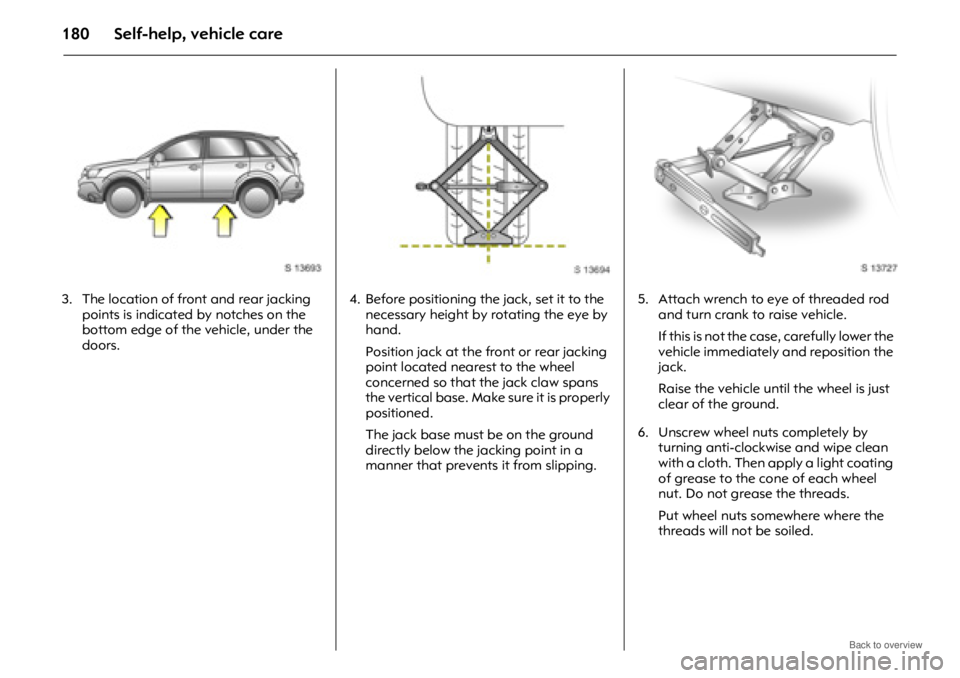
3. The location of front and rear jacking points is indicated by notches on the
bottom edge of the vehicle, under the
doors.4. Before positioning the jack, set it to the necessary height by rotating the eye by
hand.
Position jack at the front or rear jacking
point located nearest to the wheel
concerned so that the jack claw spans
the vertical base. Make sure it is properly
positioned.
The jack base must be on the ground
directly below the jacking point in a
manner that prevents it from slipping.5. Attach wrench to eye of threaded rod and turn crank to raise vehicle.
If this is not the case, carefully lower the
vehicle immediately and reposition the
jack.
Raise the vehicle until the wheel is just
clear of the ground.
6. Unscrew wheel nuts completely by turning anti-clockwise and wipe clean
with a cloth. Then apply a light coating
of grease to the cone of each wheel
nut. Do not grease the threads.
Put wheel nuts somewhere where the
threads will not be soiled.