transmission OPEL ANTARA 2009 Owner's Manual
[x] Cancel search | Manufacturer: OPEL, Model Year: 2009, Model line: ANTARA, Model: OPEL ANTARA 2009Pages: 234, PDF Size: 3.01 MB
Page 128 of 234

Driving and operation128
Switching off the engine
If the engine temperature is very high, e.g.
after driving in mountainous terrain: allow
engine to idle for approx. 2 minutes, in
order to prevent heat accumulation.
When you switch off, fans in the engine
compartment may continue running for a
time, to cool the engine.
Vehicles with turbocharger 3
In order to protect the turbocharger, after
running at high engine speeds or high
engine loads, operate the engine briefly at
a low load or run in neutral for approx.
30 seconds before switching off.
Save energy – more kilometres/miles
Please observe the running-in hints on the
previous page and the tips for energy
saving on the following pages.
Good, technically correct and economical
driving ensures maximum durability and
performance for your vehicle.
Overrun
The fuel supply is automatically shut off
during overrun, e.g. when the vehicle is
being driven down long gradients or during
braking. To enable the overrun cut-off to
come into action, do not accelerate or
declutch during overrun. Engine rpm
Under all driving conditions, drive in a
favourable engine speed range.
Warming up
Allow engine to warm up while driving. Do
not warm it up by le
tting it run at idling
speed. Do not apply full throttle until
engine reaches operating temperature.
After a cold start, automatic
transmission 3 does not shift into higher
gears until higher engine speeds have been
reached. This allows the catalytic converter
to quickly reach the temperature required
for optimum pollutant reduction.
Correct gear selection
Do not race your engine whilst in neutral or
with a low gear selected. Driving too fast in
individual gears or drive ranges as well as
stop-and-go traffic in crease engine wear
and fuel consumption.
Change down
When decreasing speed, shift down into
the next lowest gear. Do not slip the clutch
with a high-revving engine. This is
especially important when hill climbing. Clutch operation
3
Always depress the clutch pedal hard to
the floor, to prevent shifting difficulties and
transmission damage. There must be no
mats in the area of the pedals.
When driving, do not use the clutch pedal
as a foot rest; this will cause substantial
clutch wear.
Pedals
Do not place any objects in the footwell
which could slip under the pedals and
inhibit the pedal travel.
To ensure the pedal travel is uninhibited,
there must be no mats in the area of the
pedals.
When driving, do not use the brake pedal
as a foot rest; this will cause substantial
wear to brake components and cause
overheating, resultin g in longer braking
distances.
Battery care whilst driving
When driving slowly or when the vehicle
is stationary, e.g. in slow urban traffic,
stop-and-go traffic or traffic jams, turn off
all unnecessary electrical loads where
possible (e.g. heated rear window,
auxiliary headlamps).
When starting the engine, depress the
clutch pedal so that transmission
resistance is elimin ated and the starter
motor and battery are relieved.
Page 131 of 234

Driving and operation131
Fuels, refuelling
Fuel consumption
Optional equipment (e.g. wide tyres,
towing equipment) increases the kerb
weight and, in some cases, also the
permissible Gross Vehicle Weight.
This in turn increases fuel consumption and
reduces the maximum speed of the vehicle.
When the vehicle is new, there is increased
friction between the engine and
transmission components lasting for
several thousand kilometres. This also
increases fuel consumption. Fuel for petrol engines
Commercially available high-quality fuels
are suitable (see page 217). Fuel quality
has a decisive influence on the power
output, driveability and life of the engine.
The additives contained in the fuel play an
important role in this
regard. You should
therefore use only high-quality fuels
containing additives.
Petrol with too low an octane number can
cause pinking. Opel cannot be held liable
for resulting damage.
Petrol with a higher octane number can
always be used.
A dispensing pump for leaded fuel cannot
be inserted in the fuel tank of a vehicle that
must be operated on unleaded fuel only.
Use of petrol with an octane rating of 95
will ensure economical driving Fuel for diesel engines
Diesel engines must be operated only on
commercially available diesel fuel meeting
the specifications of DIN EN 590.
Marine diesel fuel, fuel oils, diesel fuels,
which are entirely or partially plant based
such as rape seed oil or bio-diesel,
Aquazole and similar diesel-water
emulsions must not be used.
The flow and filterability of diesel fuels are
insufficient at low temperatures, as a result
of crystallized paraffins.
Diesel fuels with improved low-
temperature properties are therefore
available on the market during the winter
months. Make sure that you use winter fuel
before the start of the cold weather
season.
Use of diesel fuels with manufacturer-
guaranteed winter properties eliminates
the need for additives.
Page 140 of 234
Driving and operation140
Cruise control 3
Cruise control can store and maintain
speeds over approx. 30 km/h (20 mph).
Deviation from the stored speed may occur
when driving uphill or downhill.
For safety reasons, cruise control cannot
be activated until the foot brake has been
depressed once.
Cruise control is operated with buttons
d, c and e on the turn signal lever. Do not use cruise control if it is not
advisable to maintain a constant speed
(e.g. in situations presenting a danger to
yourself and other road users, in heavy
traffic or on winding, slippery or greasy
roads).
With automatic transmission, only use
cruise control while in
D.
When cruise control is active, reaction
times may be increased, due to the
different position of the feet.
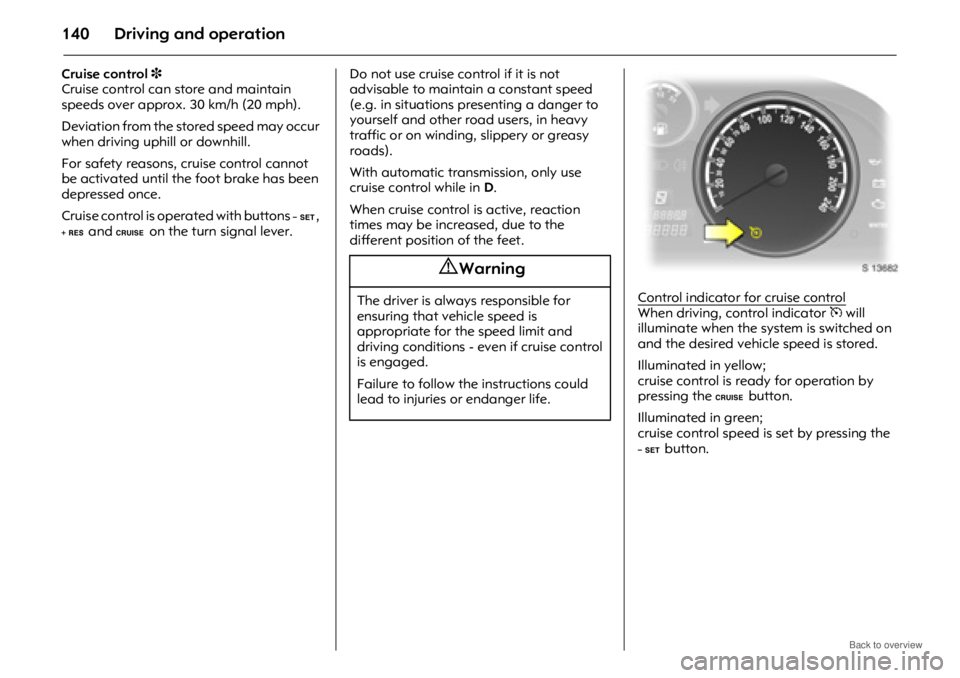
Control indicator for cruise control
When driving, control indicator m will
illuminate when the syst em is switched on
and the desired vehicle speed is stored.
Illuminated in yellow;
cruise control is ready for operation by
pressing the
ebutton.
Illuminated in green;
cruise control speed is set by pressing the
d button.
9 Warning
The driver is always responsible for
ensuring that vehicle speed is
appropriate for the speed limit and
driving conditions - even if cruise control
is engaged.
Failure to follow the instructions could
lead to injuries or endanger life.
Page 141 of 234
Driving and operation141
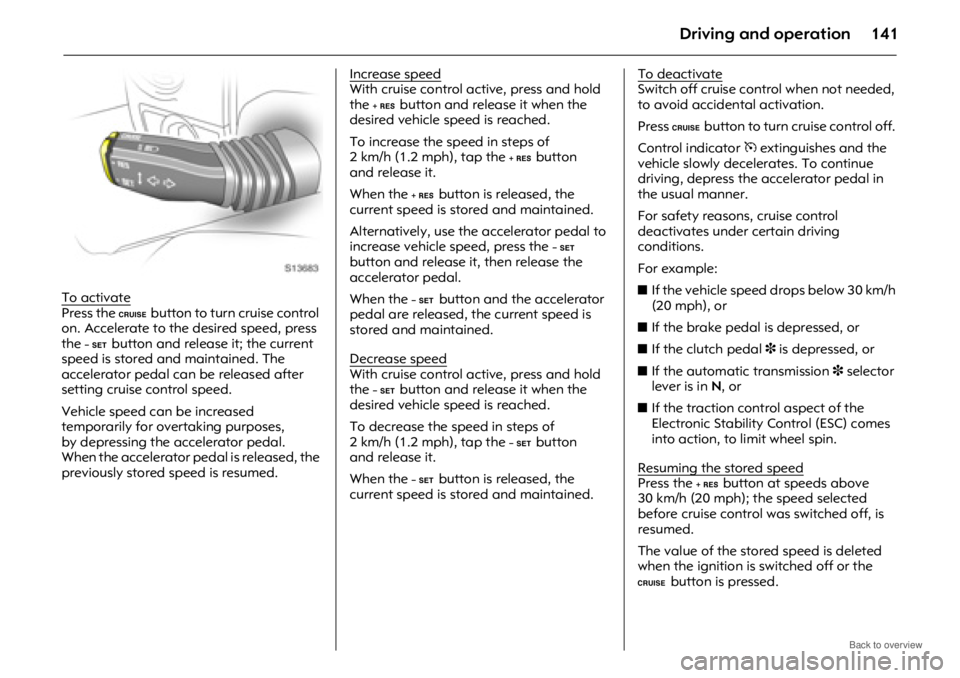
To activatePress the e button to turn cruise control
on. Accelerate to the desired speed, press
the
d button and release it; the current
speed is stored and maintained. The
accelerator pedal can be released after
setting cruise control speed.
Vehicle speed can be increased
temporarily for overtaking purposes,
by depressing the accelerator pedal.
When the accelerator pe dal is released, the
previously stored speed is resumed. Increase speed
With cruise control active, press and hold
the c button and release it when the
desired vehicle speed is reached.
To increase the speed in steps of
2 km/h (1.2 mph), tap the
c button
and release it.
When the
c button is released, the
current speed is stored and maintained.
Alternatively, use the accelerator pedal to
increase vehicle speed, press the
d
button and release it, then release the
accelerator pedal.
When the
d button and the accelerator
pedal are released, the current speed is
stored and maintained.
Decrease speed
With cruise control active, press and hold
the d button and release it when the
desired vehicle speed is reached.
To decrease the speed in steps of
2 km/h (1.2 mph), tap the
d button
and release it.
When the
d button is released, the
current speed is stored and maintained. To deactivate
Switch off cruise control when not needed,
to avoid accidental activation.
Press
e button to turn cruise control off.
Control indicator m extinguishes and the
vehicle slowly decelerates. To continue
driving, depress the accelerator pedal in
the usual manner.
For safety reasons, cruise control
deactivates under certain driving
conditions.
For example:
z If the vehicle speed drops below 30 km/h
(20 mph), or
z If the brake pedal is depressed, or
z If the clutch pedal 3 is depressed, or
z If the automatic transmission 3 selector
lever is in N, or
z If the traction control aspect of the
Electronic Stability Control (ESC) comes
into action, to limit wheel spin.
Resuming the stored speed
Press the c button at speeds above
30 km/h (20 mph); the speed selected
before cruise control was switched off, is
resumed.
The value of the stored speed is deleted
when the ignition is switched off or the
ebutton is pressed.
Page 142 of 234

Driving and operation142
Park pilot 3
The park pilot makes parking easier by
measuring the distance between the
vehicle and any obstacles to the front and
rear and giving an acoustic signal in the
passenger compartment.
The system records the distance using four
sensors in both the front and rear bumpers.
To activate
The park pilot activates automatically
when the ignition is switched on and a
forward gear or reverse gear is engaged
and the hand brake is released. The acoustic signal may differ depending
on the type of object detected.
If the vehicle approaches an obstacle when
in a forward gear or while reversing, a
series of signals can be heard in the vehicle
interior. The interval between the signals
becomes shorter as the distance is
reduced. If the distance is less than 30 cm,
the signal will be continuous.
To deactivate
The system deactivates automatically
when in neutral (aut omatic transmission 3
in N or P) with the hand brake applied.
When the vehicle speed is greater than
8 km/h (5 mph), the system also
deactivates.
To deactivate the system manually, press
button
b on the instrument panel.
The control indicator in the button will
illuminate.
If the button is pressed again, the control
indicator in the button will extinguish and
the system will be reactivated as soon as a
forward gear or reverse gear is engaged
and the hand brake is released.
9 Warning
Under certain circumstances, various
reflective surfaces on objects or clothing
as well as external noise sources may
cause the system to fail to detect
obstacles.
The park pilot may not recognise sharp
objects, thick clothes or sponge-like
materials which absorb the frequency.
If the sensors are damaged or covered
with snow, dirt or ice, the park pilot may
not activate.
For these reasons, care must be taken
when reversing, even if the park pilot is
operational. This is of particular
importance when in the vicinity of
pedestrians.
Page 169 of 234

Driving and operation169
Driving characteristics, towing tips
In the case of caravans/trailers with
brakes3, attach the breakaway stopping
cable to the eye 3 or loop around coupling
ball bar if no eye is available.
Ensure cable is crossed under the coupling
socket to ensure the caravan/trailer nose
cannot drop to the ground if it becomes
separated from the trailer hitch.
Do not allow the cable to drag along the
ground and always allow enough slack to
permit full turning. Fo llow the instructions
supplied with the towing equipment.
Before coupling the caravan/trailer,
lubricate the ball of the caravan/trailer
towing device. However, do not do so if a
stabilizer which acts on the coupling ball is
being used to damp rolling motions.
Handling is greatly influenced by the
loading of the caravan/trailer. Loads
should therefore be secured so that they
cannot slip and should be placed in the
centre of the caravan/trailer if possible,
i.e. above the axle.
Opel genuine parts an d accessories which
can be subsequently fitted aid trailer
operation, e.g. larg e mirrors for wide
caravans/trailers. In the case of caravans/trailers with low
directional stability, it is advisable to use a
friction-type stabilizer to damp rolling
motions.
Do not drive faster than 80 km/h (50 mph),
even in countries where higher speeds are
permitted.
When driving uphill, do not drive faster
than 30 km/h (20 mph) in 1st gear, or
50 km/h (30 mph) in 2nd gear.
Make sure that you have enough room
when cornering and avoid sudden
manoeuvres.
If the caravan/trailer starts to sway, drive
more slowly, do not attempt to correct the
steering and brake sharply if necessary.
If it is necessary to apply the brakes fully,
depress the brake pedal as hard as
possible.
The cooling fan is electrically operated.
The fan cooling capacity is not, therefore,
dependent on engine speed. It is not
necessary, when drivin
g uphill, to shift
down into a lower gear if the vehicle can
climb in a higher gear. When coupled to a caravan/trailer, the
vehicle requires more
braking effort when
driving down long grad ients, so select the
same gear as you would when driving
uphill and drive at roughly the same speed.
Automatic transmission in automatic mode
will select the drivin g program with the
optimum engine braking effect.
Remember that brak ing distances for
vehicles towing carava ns/trailers with and
without brakes is always greater than for
vehicles not towing a caravan/trailer. For
caravans/trailers with brakes, follow the
instructions carefully. Do not make any
modifications to the brake system.
Always check lamps on caravans/trailers
before towing. Ensure national regulations
are observed.
The fog tail lamp on the vehicle is
deactivated when towing a caravan/
trailer.
When reversing, if possible, have someone
provide assistance.
Drive slowly and shift down into a lower
gear when descending steep gradients
rather than holding the foot brake
depressed, to avoid overheating and
reduced brake efficiency.
Page 170 of 234
Driving and operation170
Block the wheels of both the caravan/trailer
and the vehicle when parking and always
apply the hand brake firmly. If possible, do
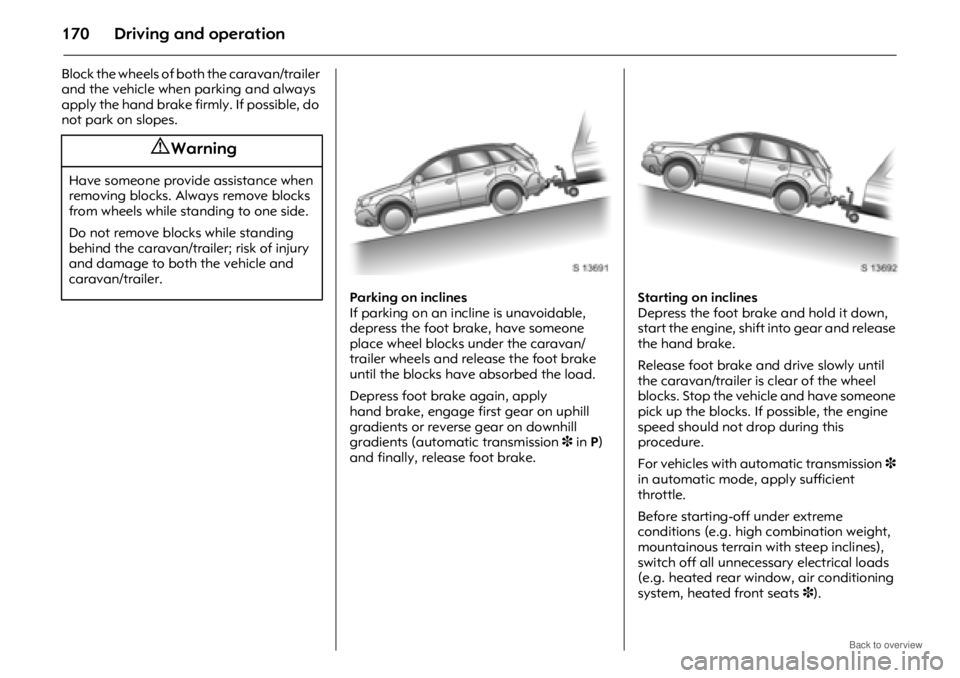
not park on slopes. Parking on inclines
If parking on an incline is unavoidable,
depress the foot brake, have someone
place wheel blocks under the caravan/
trailer wheels and release the foot brake
until the blocks have absorbed the load.
Depress foot brake again, apply
hand brake, engage first gear on uphill
gradients or reverse gear on downhill
gradients (automatic transmission 3 in P)
and finally, release foot brake. Starting on inclines
Depress the foot brake and hold it down,
start the engine, shift into gear and release
the hand brake.
Release foot brake and drive slowly until
the caravan/trailer is clear of the wheel
blocks. Stop the vehicle and have someone
pick up the blocks. If possible, the engine
speed should not drop during this
procedure.
For vehicles with automatic transmission
3
in automatic mode, apply sufficient
throttle.
Before starting-off under extreme
conditions (e.g. high combination weight,
mountainous terrain with steep inclines),
switch off all unnecessary electrical loads
(e.g. heated rear window, air conditioning
system, heated front seats 3).
9 Warning
Have someone provide assistance when
removing blocks. Always remove blocks
from wheels while standing to one side.
Do not remove blocks while standing
behind the caravan/trailer; risk of injury
and damage to both the vehicle and
caravan/trailer.
Page 173 of 234
Self-help, vehicle care173
zNever expose the battery to naked
flames or sparks.
z A discharged battery can freeze at
temperatures of 0
°C. Defrost the battery
in a warm room before connecting the
jump leads.
z Do not allow battery fluid to contact
eyes, skin, fabrics or painted surfaces.
The fluid contains sulphuric acid which
can cause injuries and damage in the
event of direct contact.
z Wear eye protection and protective
clothing when handling a battery. z
Use auxiliary battery with same voltage
(12 volts). Its capacity (Ah) must not be
considerably less than that of the
discharged battery. Voltage and
capacity information can be found on
the batteries.
z Use jump leads with insulated terminals
and a width of at least 16 mm
2 (25 mm2
for diesel engines).
z Do not disconnect the discharged
battery from the vehicle.
z Switch off all unnecessary electrical
consumers. Infotainment system may be
damaged if switched on while jump
starting.
z Do not lean over the battery during jump
starting procedure.
z Do not allow the terminals of one lead to
touch those of the other lead.
z The vehicles should not touch while jump
starting.
z Apply hand brake.
z Manual transmissi on in neutral,
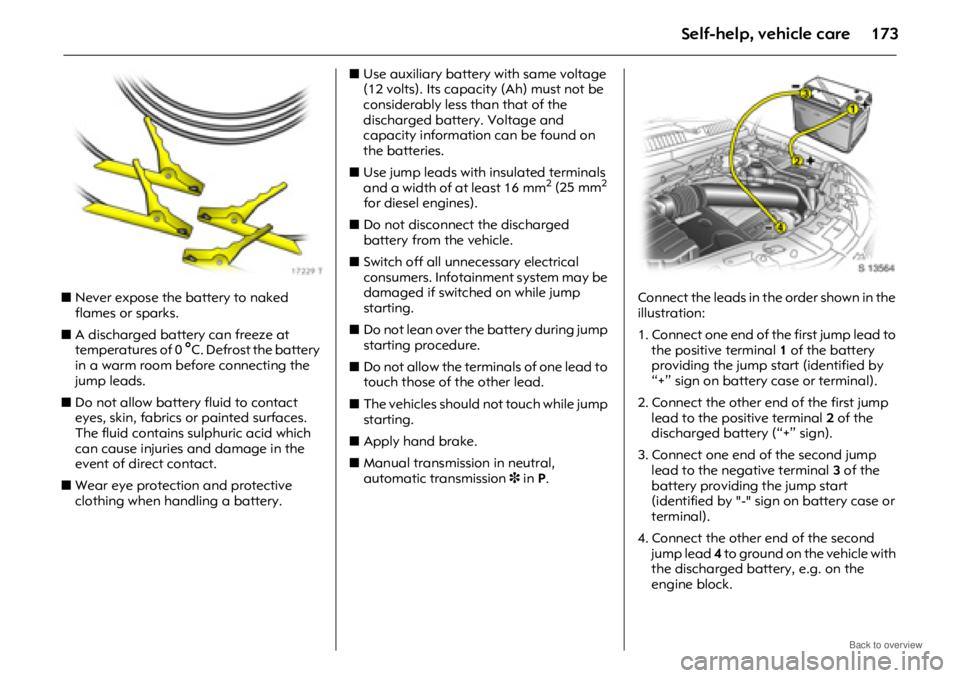
automatic transmission 3 in P. Connect the leads in th
e order shown in the
illustration:
1. Connect one end of the first jump lead to the positive terminal 1 of the battery
providing the jump start (identified by
“+” sign on battery case or terminal).
2. Connect the other end of the first jump lead to the positive terminal 2 of the
discharged battery (“+” sign).
3. Connect one end of the second jump lead to the negative terminal 3 of the
battery providing the jump start
(identified by "-" sign on battery case or
terminal).
4. Connect the other end of the second jump lead 4 to ground on the vehicle with
the discharged battery, e.g. on the
engine block.
Page 175 of 234
Self-help, vehicle care175
Keep tow rope 3 clear of front bumper,
and ensure it is secure ly fixed to the towing
eye at both ends. Pull on the tow rope 3 to
check.
To prevent entry of exhaust fumes from
towing vehicle, switch on air recirculation
mode (see page 109) and close the
windows.
Never let passengers ride in a vehicle that
is being towed.
Never tow a vehicle with damaged parts
that are not secured to the vehicle or if
wheels, brakes or steering are damaged.
Do not tow the vehicle with a tow rope 3 or
tow rod 3 for extended periods, to avoid
damage to the vehicle. Only tow in this
manner on hard-surfaced roads.
For vehicles with automatic transmission 3:
use flatbed or wheel lift equipment only.
Towing can cause severe damage to the
transmission.
Seek the assistance of a workshop. Towing service
Entrust your vehicle only to the towing
service of your choice and obtain an
estimate on towing costs before employing
any towing service. This will prevent
unnecessary expense and possible
insurance problems during claim
processing.
Use flatbed equipment whenever possible.
If vehicle is to be towed using a wheel lift,
tow with all wheels off the road, using a
towing dolly.
Never use sling-type equipment to tow the
vehicle or tow the vehicle with the front or
rear wheels on the road, to avoid causing
serious damage to the vehicle.
Place the gearshift lever in neutral
(automatic transmission 3
in N), switch on
hazard warning lamps, turn key to ignition
switch position ACC and release the
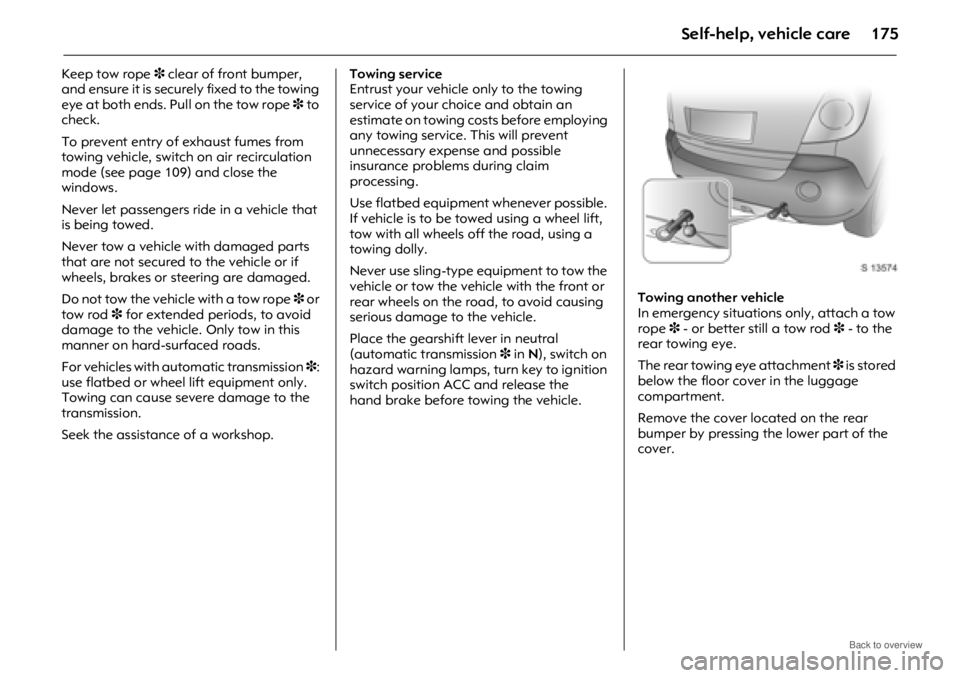
hand brake before towing the vehicle. Towing another vehicle
In emergency situations only, attach a tow
rope
3 - or better still a tow rod 3 - to the
rear towing eye.
The rear towing eye attachment 3 is stored
below the floor cover in the luggage
compartment.
Remove the cover located on the rear
bumper by pressing the lower part of the
cover.
Page 178 of 234

Self-help, vehicle care178
Notes on temporary spare wheel
zUsing a temporary spare wheel may
change the driving behaviour of the
vehicle, particularly if using winter
tyres 3. Replace defective tyre as quickly
as possible, balanc e wheel and fit to
vehicle.
z Fit only one temporary spare wheel.
z Do not drive faster than 80 km/h
(50 mph).
z Take curves slowly.
z Do not use the temporary spare wheel
for a lengthy period.
z Replace temporary spare wheel with full
specification wheel without delay.
z When temporary spare wheel is fitted, do
not take the vehicle through an
automatic car wash with guide rails. The
temporary spare wheel may get caught
on the rails, causing damage to the tyre,
wheel and other vehicle parts.
z Tyre chains are not permitted on the
temporary spare wheel.
If tyre chains are necessary after a front
wheel puncture, fit the temporary spare
wheel to the rear and a rear wheel to the
front. Check tyre pressure and adjust if
necessary - see page 224.
z Follow the temporary spare wheel
instructions on pages 153, 181, 223. Notes on directional tyres
3
Tyres with a prescribed rotating direction
can only achieve their maximum
performance if they are fitted in the
prescribed rotating direction.
If a tyre or spare wheel is fitted that is
rotating in the wrong direction due to a
puncture, the following must be noted:
z The handling of the vehicle may be
different. Replace defective tyres as soon
as possible, have wheel balanced and
fitted to the vehicle.
z Do not drive faster than 80 km/h
(50 mph).
z Drive particularly carefully on wet and
snow-covered road surfaces.
z For more information on tyres with a
prescribed rotating direction -
see page 149.Wheel changing
In order to reduce the chance of possible
injuries, make the following preparations
and note the procedure:
zPark on a level, firm and non-slippery
surface.
z Switch on hazard warning lamps and
apply hand brake. Engage 1st gear or
reverse (automatic transmission 3 in P).
z Correctly set up warning triangle 3.
z Ensure all vehicle passengers are out of
the vehicle and clear of the vehicle and
other traffic.
z Take the spare wheel from under the
luggage compartment floor cover -
see page 177.
z Before raising the vehicle, turn front
wheels to straight-ahead position.