transmission OPEL ANTARA 2009 User Guide
[x] Cancel search | Manufacturer: OPEL, Model Year: 2009, Model line: ANTARA, Model: OPEL ANTARA 2009Pages: 234, PDF Size: 3.01 MB
Page 102 of 234

Infotainment system102
Mobile telephones and radio
equipment (CB) 3
The Opel installation instructions and the
operating guidelines provided by the
telephone manufacturer must be observed
when fitting and op erating a mobile
telephone. Failure to do so could invalidate
the vehicle’s operating permit (EU Directive
95/54/EG).
Requirements to ensure trouble-free
operation:
z Professionally installe d exterior antenna,
to obtain the maximum range possible
z Maximum transmission power 10 W.
z Installation of the telephone in a suitable
spot (front centre console).
See important notes on page 57. Obtain advice on predetermined
installation locations for the external
antenna and equipment holder and ways
of using devices with transmission power of
more than 10 Watts. We recommend that
you consult your Opel Partner, who will
have brackets and various installation kits
and install them in accordance with
regulations.
Operation of a handsfree attachment with
no outside antenna, using the mobile
telephone standards GSM 900/1800/1900
and UMTS, may take place only if the
maximum transmission power of the
mobile telephone does not exceed 2 W, in
the case of GSM 900, and otherwise 1 W.
The operating instructions of the
manufacturer of the telephone and
handsfree attachment must be noted in all
cases.
For reasons of safety, we recommend that
you do not use the phone while driving.
Even use of a handsfree set can be a
distraction while driving. Be sure to observe
any country-specific regulations.
Infotainment and navigation
systems
3
The systems are operated as described in
the instruction manuals supplied.
The navigation system is supplied with a
CD or DVD detailing the local territory.
For additional coun tries/territories,
separate CD’s are availa ble from your Opel
Partner.
9 Warning
When used in the vehicle interior, mobile
telephones and radio equipment (CB)
with integrated antenna may cause
malfunctions in the vehicle electronics.
Mobile telephones and radio equipment
( C B ) s h o u l d o n l y b e u s e d w i t h a n a n t e n n a
fitted on the vehicle exterior.
Page 115 of 234

Driving and operation115
Driving and operationAutomatic transmission 3
The automatic transmission permits
manual gearshifting (manual mode) or
automatic gearshifting ( automatic mode)
with fully automatic clutch control.
The engine can only be started when the
selector lever is in position P or N. When
starting in P, turn key in ignition switch to
ACC or ON, depress foot brake and press
selector lever button before selecting a
gear.
Do not accelerate whilst gearshifting. If a
gear has been selected and the foot brake
is released without accelerating, the
vehicle will "creep".
Never operate the brake pedal and
accelerator simultaneously. Selecting
D puts the transmission in
automatic mode.
If the selector lever is moved to the left from
position D, manual mode is activated.
Forward gear changes only can then be
made manually by tipping the selector
lever towards + or -.
Automatic transmission
3................. 115
All Wheel Drive.................................... 121
Driving hints ........................................ 127
Save fuel, protect the environment ... 129
Fuels, refuelling ................................... 131
Catalytic converter, exhaust emissions........................................... 133
Drive control systems ......................... 136
Brake system ....................................... 145
Anti-lock Brake System (ABS) u....... 148
Wheels, tyres ....................................... 149
Roof racks 3........................................ 153
Flex-Fix system 3................................ 154
Towing equipment 3 .......................... 164
Towing ................................................. 1679 Warning
Disregard of these instructions may
cause damage to the vehicle and lead to
injuries or endanger life.
Page 116 of 234
Driving and operation116
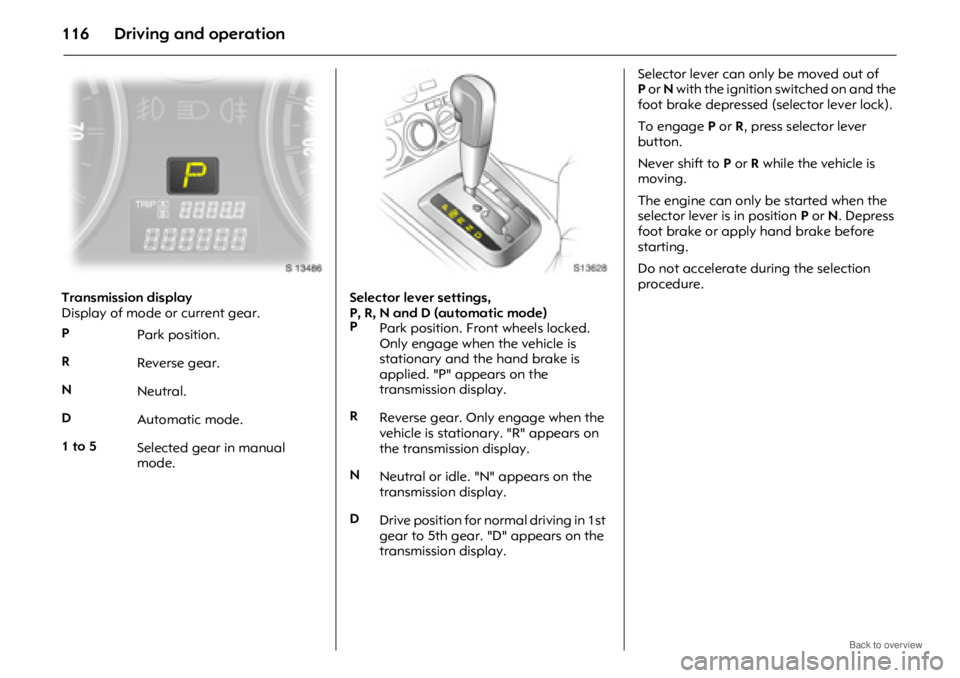
Transmission display
Display of mode or current gear.Selector lever settings,
P, R, N and D (automatic mode)Selector lever can only be moved out of
P
or N with the ignition switched on and the
foot brake depressed (selector lever lock).
To engage P or R, press selector lever
button.
Never shift to P or R while the vehicle is
moving.
The engine can only be started when the
selector lever is in position P or N. Depress
foot brake or apply hand brake before
starting.
Do not accelerate during the selection
procedure.
P Park position.
R Reverse gear.
N Neutral.
D Automatic mode.
1 to 5 Selected gear in manual
mode.
P
Park position. Front wheels locked.
Only engage when the vehicle is
stationary and the hand brake is
applied. "P" appears on the
transmission display.
R Reverse gear. Only engage when the
vehicle is stationary. "R" appears on
the transmission display.
N Neutral or idle. "N" appears on the
transmission display.
D Drive position for normal driving in 1st
gear to 5th gear. "D" appears on the
transmission display.
Page 117 of 234
Driving and operation117
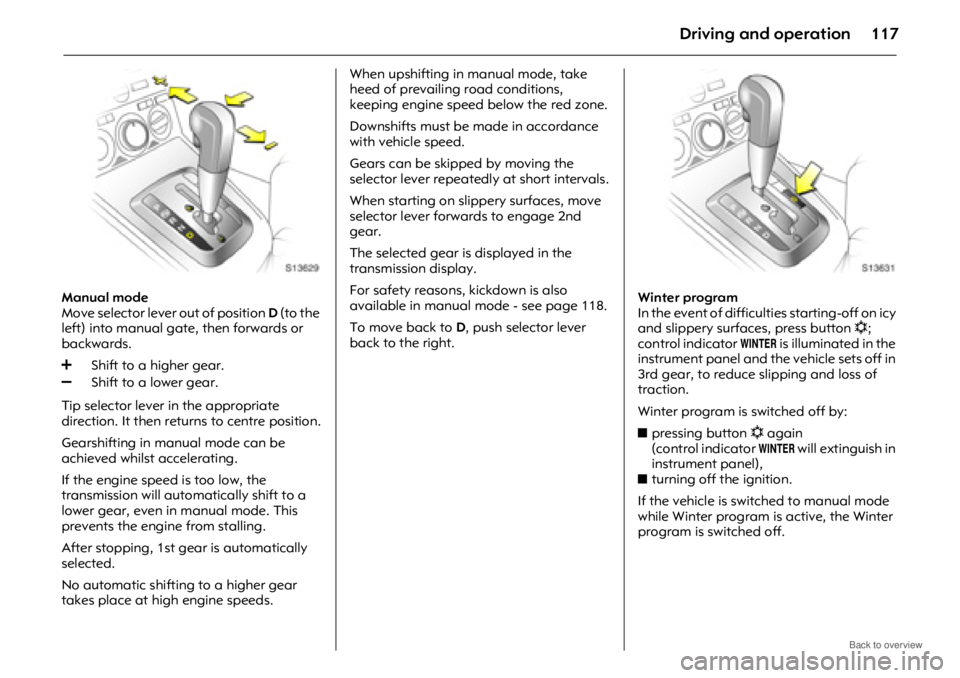
Manual mode
Move selector lever out of position D (to the
left) into manual gate, then forwards or
backwards.
Tip selector lever in the appropriate
direction. It then returns to centre position.
Gearshifting in manual mode can be
achieved whilst accelerating.
If the engine speed is too low, the
transmission will automatically shift to a
lower gear, even in manual mode. This
prevents the engine from stalling.
After stopping, 1st gear is automatically
selected.
No automatic shifting to a higher gear
takes place at high engine speeds. When upshifting in manual mode, take
heed of prevailing road conditions,
keeping engine speed below the red zone.
Downshifts must be made in accordance
with vehicle speed.
Gears can be skipped by moving the
selector lever repeated
ly at short intervals.
When starting on slippery surfaces, move
selector lever forwards to engage 2nd
gear.
The selected gear is displayed in the
transmission display.
For safety reasons, kickdown is also
available in manual mode - see page 118.
To move back to D, push selector lever
back to the right. Winter program
In the event of difficult
ies starting-off on icy
and slippery surfac es, press button n;
control indicator
0 is illuminated in the
instrument panel and the vehicle sets off in
3rd gear, to reduce slipping and loss of
traction.
Winter program is switched off by:
z pressing button n again
(control indicator
0 will extinguish in
instrument panel),
z turning off the ignition.
If the vehicle is switched to manual mode
while Winter program is active, the Winter
program is switched off.
Page 118 of 234
Driving and operation118
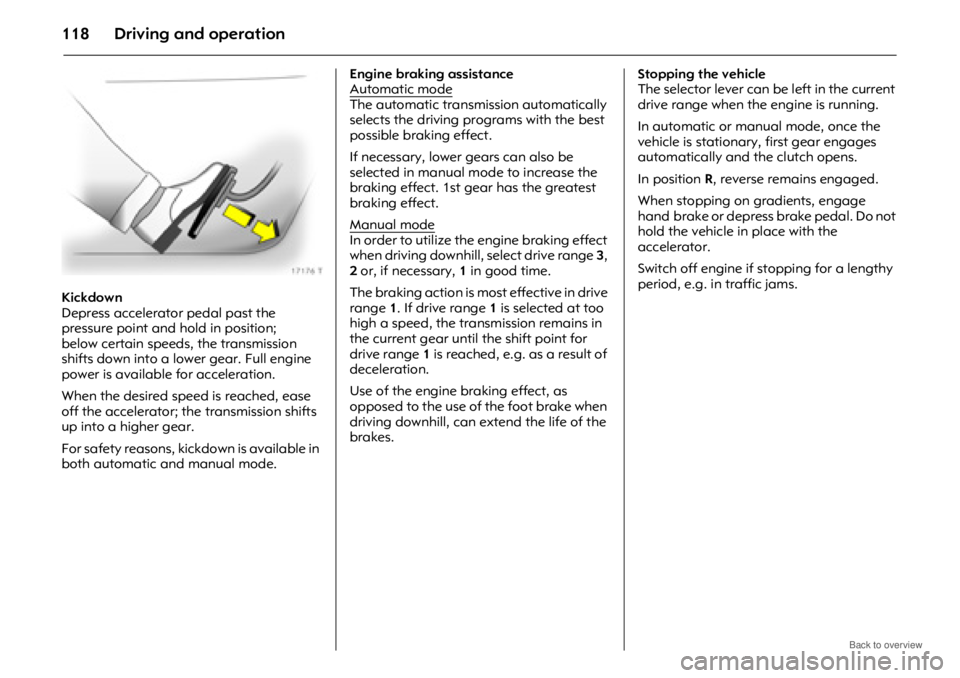
Kickdown
Depress accelerator pedal past the
pressure point and hold in position;
below certain speeds, the transmission
shifts down into a lower gear. Full engine
power is available for acceleration.
When the desired speed is reached, ease
off the accelerator; the transmission shifts
up into a higher gear.
For safety reasons, kickdown is available in
both automatic and manual mode. Engine braking assistance
Automatic mode
The automatic transmi
ssion automatically
selects the driving programs with the best
possible braking effect.
If necessary, lower gears can also be
selected in manual mo de to increase the
braking effect. 1st gear has the greatest
braking effect.
Manual mode
In order to utilize the engine braking effect
when driving downhill, select drive range 3,
2 or, if necessary, 1 in good time.
The braking action is mo st effective in drive
range 1. If drive range 1 is selected at too
high a speed, the transmission remains in
the current gear until the shift point for
drive range 1 is reached, e.g. as a result of
deceleration.
Use of the engine braking effect, as
opposed to the use of the foot brake when
driving downhill, can ex tend the life of the
brakes. Stopping the vehicle
The selector lever can be
left in the current
drive range when the engine is running.
In automatic or manual mode, once the
vehicle is stationary, first gear engages
automatically and the clutch opens.
In position R, reverse remains engaged.
When stopping on gradients, engage
hand brake or depress brake pedal. Do not
hold the vehicle in place with the
accelerator.
Switch off engine if stopping for a lengthy
period, e.g. in traffic jams.
Page 119 of 234

Driving and operation119
Parking
Before leaving the vehicle:
zDepress and hold foot brake,
z Apply hand brake,
z Move selector lever to position P,
z Turn key to LOCK position,
z Remove ignition key,
z Engage steering column lock,
z Lock the vehicle.
When the ignition is switched off, the
automatic transmission no longer responds
to movements of the selector lever. Rocking the vehicle
If it becomes necessary to rock the vehicle
to free it from water, ice, sand, mud, snow
or a dip, observe the following:
Check there are no objects or people in the
vicinity before attempting to rock the
vehicle.
Turn the steering wheel fully from left to
right to clear the area around the front
tyres.
Move the selector lever between
R and a
forward gear in a repeat pattern while
applying light pressure to the accelerator
pedal when the vehicle is in gear.
Do not spin the wheels or race the engine
and avoid sudden acceleration.
This applies only in the exceptional
circumstances mentioned above.
If the vehicle cannot be released after
rocking the vehicle several times, your
vehicle may need to be towed.
Towing - see page 174. Manoeuvring the vehicle
To manoeuvre the vehicle back and forth
during attempts to park or in garage
entrances, the creeping movement can be
utilized by releasing the foot brake.
Never actuate the accelerator and brake
pedals simultaneously.
Page 120 of 234
Driving and operation120
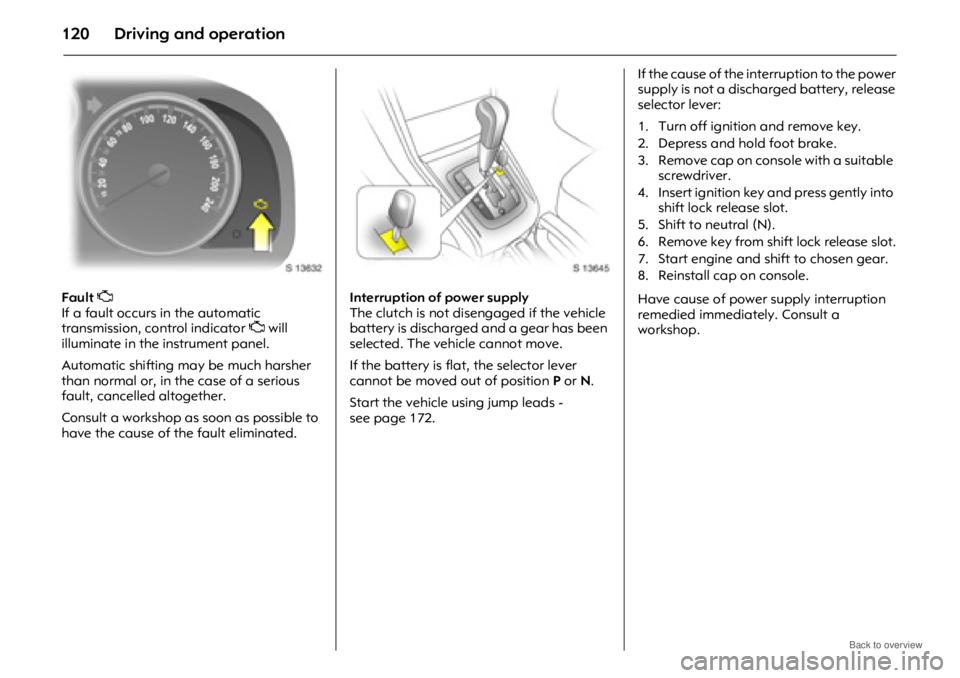
Fault Z
If a fault occurs in the automatic
transmission, control indicator Z will
illuminate in the instrument panel.
Automatic shifting may be much harsher
than normal or, in the case of a serious
fault, cancelled altogether.
Consult a workshop as soon as possible to
have the cause of the fault eliminated. Interruption of power supply
The clutch is not disengaged if the vehicle
battery is discharged and a gear has been
selected. The vehicle cannot move.
If the battery is flat, the selector lever
cannot be moved out of position
P or N.
Start the vehicle using jump leads -
see page 172. If the cause of the interruption to the power
supply is not a discharged battery, release
selector lever:
Have cause of power supply interruption
remedied immediately. Consult a
workshop.
1. Turn off ignition and remove key.
2. Depress and hold foot brake.
3. Remove cap on console with a suitable
screwdriver.
4. Insert ignition key and press gently into shift lock release slot.
5. Shift to neutral (N).
6. Remove key from shift lock release slot.
7. Start engine and shift to chosen gear.
8. Reinstall cap on console.
Page 122 of 234

Driving and operation122
Always exercise caution when in slippery
conditions (caused by sand, gravel, water,
snow or ice on the road), in order to
maintain vehicle control.
Use the accelerator to control the vehicle -
keep brake pedal use to a minimum.
zDo not slip the clutch.
z Do not spin the wheels.
z Do not make exaggerated or jerky
steering movements.
Driving a vehicle in snow and ice should be
undertaken with extreme caution:
z Select a gear suitable for the conditions.
z Start the vehicle moving with minimal
engine revs, low gear and combined
clutch and accelerator control.
z Change to a higher gear as quickly as
possible, to keep the engine revs low.
z With automatic transmission 3, select
drive range D and press button n, to
activate the Winter program. Off-road driving
During off-road drivin
g, you will encounter
a variety of driving conditions and
circumstances too numerous to list here.
Always use good judgement and common
sense. If you feel uncomfortable about
tackling a given situation, do not attempt
it.
Avoid protruding objects (such as rocks or
tree stumps) that may damage the
underbody and tyres of your vehicle.
Test the brakes after operating in mud, to
clear excess mud from the braking
surfaces.
Gripping the steering wheel
Terrain conditions can cause rapid and
unexpected movement in the steering,
especially rough terrain. Preparation
The duration, distance and conditions of
the off-road activity determine the extent
of the preparation th
at is required. The
following are given as guidelines.
Know the area where you will be driving,
either by inspection or from terrain maps.
Decide your route in advance and ensure
that it is a vehicular right of way
1).
Make a thorough check of the vehicle.
Check the following:
z Oil, water, fuel, brake and clutch fluid
levels,
z Drive belts,
z Windscreen wipers and washer system,
z Lamps.
Maintenance - see pages 126, 206.
9 Warning
Be ready to deal with these movements
by having a firm grip on the outer rim of
the steering wheel with the thumbs
outside the spokes, to guard against
injury from kickback.
1)Observe national regulations.
Page 126 of 234

Driving and operation126
Maintenance
Certain maintenance operations, e.g.
changes of engine oil, oil filter, air cleaner
element and brake pads, are required
more frequently for severe operating
conditions, e.g. driving on unsurfaced
roads, during thick dust or mud
accumulation, etc.
If the vehicle is driven off-road to a great
extent, the chassis will need regular
inspection.
Your Opel Partner will inform you which
additional service is required between the
normal service intervals, after
consideration of the specific operating
conditions of your vehicle.
Further information - see page 206.
Service checks after wading
After wading, check for the ingress of water
into the following:
zBrake fluid reservoir,
z Air cleaner element,
z Engine,
z Transmission,
z Axles,
z Interior of vehicle.
Renew any lubricating oil or hydraulic fluid
that has a milky appearance, indicating
contamination with water. All Wheel Drive summary
Do
z
Check fuel and tyres, water and oil levels
before venturing off-road.
z Survey on foot before driving off-road,
especially when traversing hillsides,
wading, driving in deep snow and over
ridges.
z Select the correct gear for the conditions.
z Use the engine’s power of acceleration
and deceleration with the correct gear,
to control the vehicle.
z Keep a firm grip on the outer rim of the
steering wheel - keep your thumbs away
from the spokes.
z Drive carefully and be prepared for
emergencies.
z Drive slower under crosswind conditions.
z Approach obstacles and conditions
off-road at the correct angles and with
sufficient momentum to negotiate the
obstacle, but do not put undue strain on
the vehicle.
z Use caution - if you are not sure, do not
do it. Don’tz
Do not venture off-road unless you are
certain that the conditions are capable
of being negotiated safely by you and
your vehicle.
z Do not take unnecessary risks.
z Do not use the brakes excessively, to
maintain steering control.
z Do not change gear on difficult terrain -
depressing the clutch may cause the
vehicle to stop because of drag on the
wheels - or accelerate backwards or
forwards when on a hill.
z Do not ride or slip the clutch.
z Do not spin the wheels if stuck in mud,
sand or snow - they will only dig in
deeper.
z Do not drive at an excessive speed,
especially into corners. Your All Wheel
Drive vehicle has a higher centre of
gravity than conventional vehicles.
Sudden changes of direction can lead to
loss of control.
Page 127 of 234

Driving and operation127
Driving hints
The first 1000 km (600 miles)
Drive your vehicle at various speeds. Do
not use full throttle. Never allow the engine
to labour at low revs.
Make good use of all gears. Depress the
accelerator pedal a maximum of around
three quarters of the available pedal travel
in all gears and drive ranges.
Do not drive faster than three quarters of
maximum speed.
Avoid quick starts, su dden acceleration
and prolonged high-speed driving, to
avoid engine damage and to conserve
fuel.
Do not brake unnecessarily hard for the
first 200 km (125 miles).
If possible, avoid towing another vehicle.
Never coast with engine not running
Many units may then not function (e.g.
brake servo unit, power steering, airbag
system). Driving in this manner is a danger
to yourself and others. Brake servo unit
With the engine not running, the brake
servo unit is no longer effective once the
brake pedal has been depressed once or
twice. The braking effect is not reduced,
but substantially greater foot pressure is
necessary to stop the vehicle.
Power steering
Never leave the steering wheel on full lock
when the vehicle is stationary, as this may
damage the power steering pump.
If the power steering should fail - e.g. when
the vehicle is being towed with the engine
switched off - the vehicle can still be
properly steered, but considerably greater
effort is necessary.
Driving in mountainous terrain or with a
caravan/trailer
Electrically driven fan; the fan cooling
capacity is not dependent on engine
speed. It is not necessary, therefore, when
driving uphill to shif
t down into a lower
gear if the vehicle can climb in a higher
gear. Driving in extreme conditions
When driving in hazard
ous conditions, e.g.
in snow, ice, mud, sand or water, drive
slowly and cautiously to allow for greater
braking distances.
If stuck, use 2nd gear (automatic
transmission in drive range 2) to avoid
spinning the front wheels.
Use sand, tyre chains or other non-slip
materials to provide traction when stuck in
snow, mud or ice.
Driving through water
Before attempting to drive through water,
check the depth. If the depth is slightly
lower than the underbody of your vehicle,
do not attempt to drive through it.
Driving too quickly through water can
cause water to enter the engine through
the air intake, causing severe damage.
Drive slowly, in a high engine rpm in as low
a gear as possible.
Driving with a roof load
Do not exceed the permissible roof load -
see page 221. For safety reasons,
distribute the load evenly and secure it
tightly with straps so that it cannot slip. Set
the tyre pressure to the value given for full
load. Do not drive faster than 120 km/h
(75 mph). Check and retighten straps at
frequent intervals.