tyre pressure OPEL ANTARA 2014 User Guide
[x] Cancel search | Manufacturer: OPEL, Model Year: 2014, Model line: ANTARA, Model: OPEL ANTARA 2014Pages: 217, PDF Size: 6.04 MB
Page 179 of 217
Vehicle care177
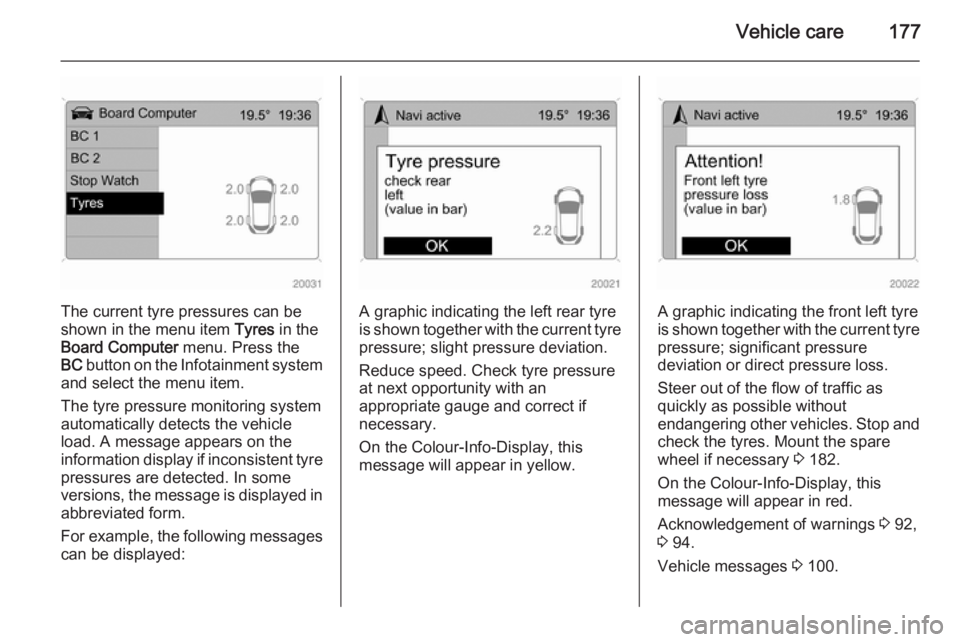
The current tyre pressures can be
shown in the menu item Tyres in the
Board Computer menu. Press the
BC button on the Infotainment system
and select the menu item.
The tyre pressure monitoring system
automatically detects the vehicle
load. A message appears on the
information display if inconsistent tyre
pressures are detected. In some
versions, the message is displayed in
abbreviated form.
For example, the following messages can be displayed:A graphic indicating the left rear tyre
is shown together with the current tyre
pressure; slight pressure deviation.
Reduce speed. Check tyre pressure at next opportunity with an
appropriate gauge and correct if
necessary.
On the Colour-Info-Display, this
message will appear in yellow.A graphic indicating the front left tyre is shown together with the current tyre
pressure; significant pressure
deviation or direct pressure loss.
Steer out of the flow of traffic as
quickly as possible without
endangering other vehicles. Stop and check the tyres. Mount the spare
wheel if necessary 3 182.
On the Colour-Info-Display, this
message will appear in red.
Acknowledgement of warnings 3 92,
3 94.
Vehicle messages 3 100.
Page 180 of 217
178Vehicle care
If the tyre pressure is to be reduced orincreased, switch off the ignition. Tyre
pressures 3 176, 3 207.
External high-power radio equipment
could disrupt the tyre pressure
monitoring system.
The tyre pressure monitoring system
valve cores and sealing rings must be
replaced each time the tyres are
changed.
Temperature compensation
Tyre pressure depends on the
temperature of the tyre. During
driving, tyre temperature and
pressure increase.
The tyre pressure value shown in the
display is the actual tyre pressure.
Therefore it is important to check tyre pressure with cold tyres.
Tread depth
Check tread depth at regular
intervals.
Tyres should be replaced for safety
reasons at a tread depth of 2-3 mm
(4 mm for winter tyres).For safety reasons it is recommended that the tread depth of the tyres on
one axle should not vary by more than
2 mm.
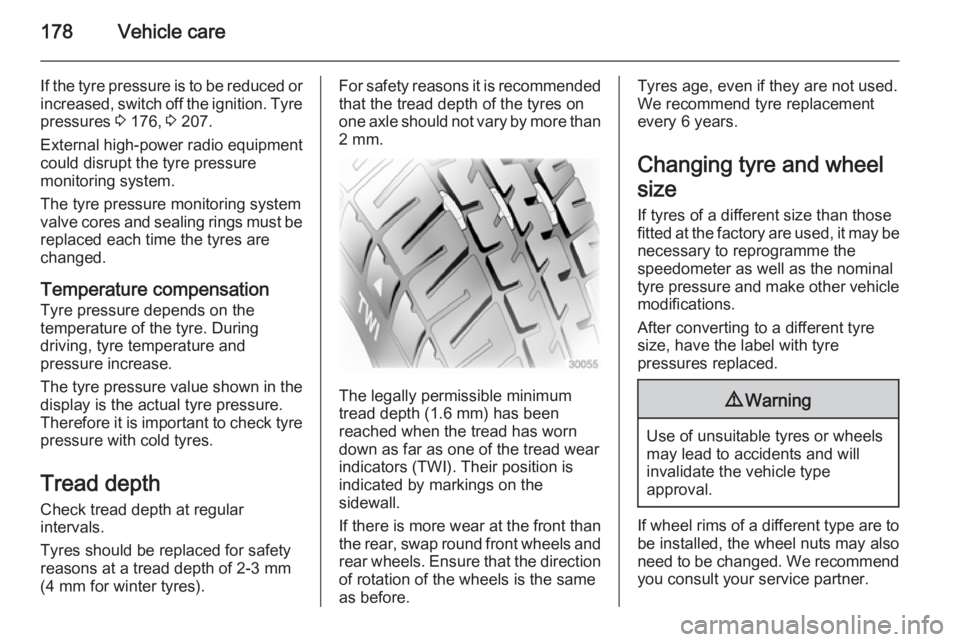
The legally permissible minimum
tread depth (1.6 mm) has been
reached when the tread has worn
down as far as one of the tread wear
indicators (TWI). Their position is
indicated by markings on the
sidewall.
If there is more wear at the front than
the rear, swap round front wheels and
rear wheels. Ensure that the direction
of rotation of the wheels is the same
as before.
Tyres age, even if they are not used.
We recommend tyre replacement
every 6 years.
Changing tyre and wheel
size
If tyres of a different size than those
fitted at the factory are used, it may be necessary to reprogramme the
speedometer as well as the nominal tyre pressure and make other vehicle modifications.
After converting to a different tyre
size, have the label with tyre
pressures replaced.9 Warning
Use of unsuitable tyres or wheels
may lead to accidents and will
invalidate the vehicle type
approval.
If wheel rims of a different type are to
be installed, the wheel nuts may also
need to be changed. We recommend you consult your service partner.
Page 181 of 217
Vehicle care179Wheel coversWheel covers and tyres that are
factory approved for the respective
vehicle and comply with all of the
relevant wheel and tyre combination
requirements must be used.
If the wheel covers and tyres used are
not factory approved, the tyres must
not have a rim protection ridge.
Wheel covers must not impair brake
cooling.9 Warning
Use of unsuitable tyres or wheel
covers could lead to sudden
pressure loss and thereby
accidents.
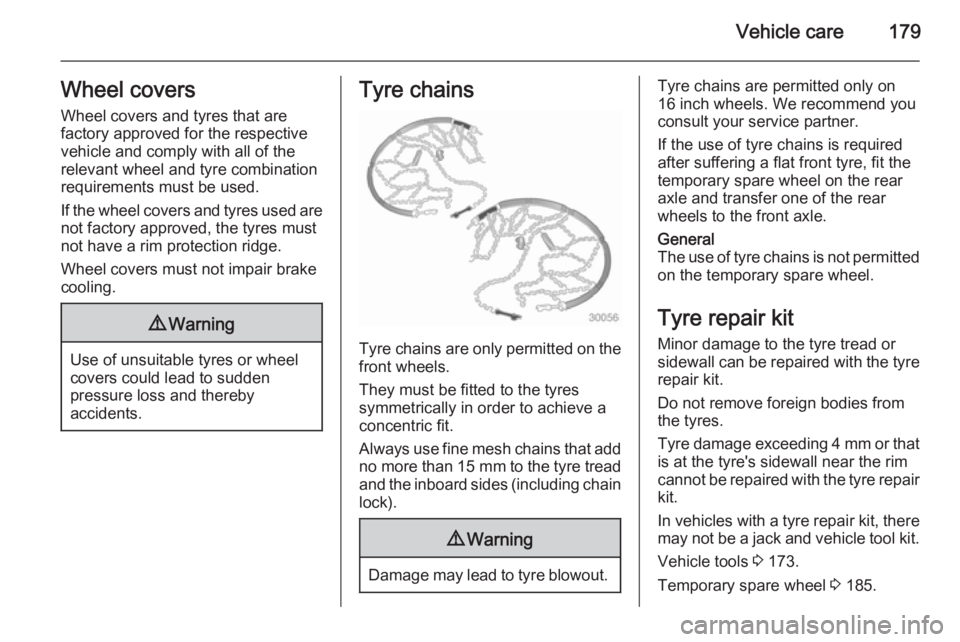
Tyre chains
Tyre chains are only permitted on the
front wheels.
They must be fitted to the tyres
symmetrically in order to achieve a
concentric fit.
Always use fine mesh chains that add no more than 15 mm to the tyre tread
and the inboard sides (including chain lock).
9 Warning
Damage may lead to tyre blowout.
Tyre chains are permitted only on
16 inch wheels. We recommend you consult your service partner.
If the use of tyre chains is required
after suffering a flat front tyre, fit the
temporary spare wheel on the rear
axle and transfer one of the rear
wheels to the front axle.General
The use of tyre chains is not permitted on the temporary spare wheel.
Tyre repair kit
Minor damage to the tyre tread or
sidewall can be repaired with the tyre
repair kit.
Do not remove foreign bodies from
the tyres.
Tyre damage exceeding 4 mm or that
is at the tyre's sidewall near the rim
cannot be repaired with the tyre repair kit.
In vehicles with a tyre repair kit, there may not be a jack and vehicle tool kit.
Vehicle tools 3 173.
Temporary spare wheel 3 185.
Page 183 of 217
Vehicle care181
6. Press the on/off button to turn the
tyre repair kit on. The tyre is filled
with sealant.
The pressure gauge briefly shows a high pressure while the sealant
canister is emptying. Then the
pressure starts to drop.
All of the sealant is pumped into
the tyre. Then the tyre is inflated.
7. Inflate the tyre to the recommended inflation pressure
using the pressure gauge. The
prescribed tyre pressure should
be obtained within 10 minutes
3 207 . When the correct pressure
is obtained, switch off the
compressor.
If the prescribed tyre pressure is
not obtained within 10 minutes,
remove the tyre repair kit. Move
the vehicle one tyre rotation.
Reattach the tyre repair kit and
continue the filling procedure for 10 minutes. If the prescribed tyre
pressure is still not obtained, the
tyre is too badly damaged. Seek
the assistance of a workshop.
Drain excess tyre pressure with
the button next to the pressure
gauge.
Do not run the compressor for
longer than 10 minutes.
8. Detach the tyre repair kit and replace the tyre valve cap.
9. Remove any excess sealant using a cloth.
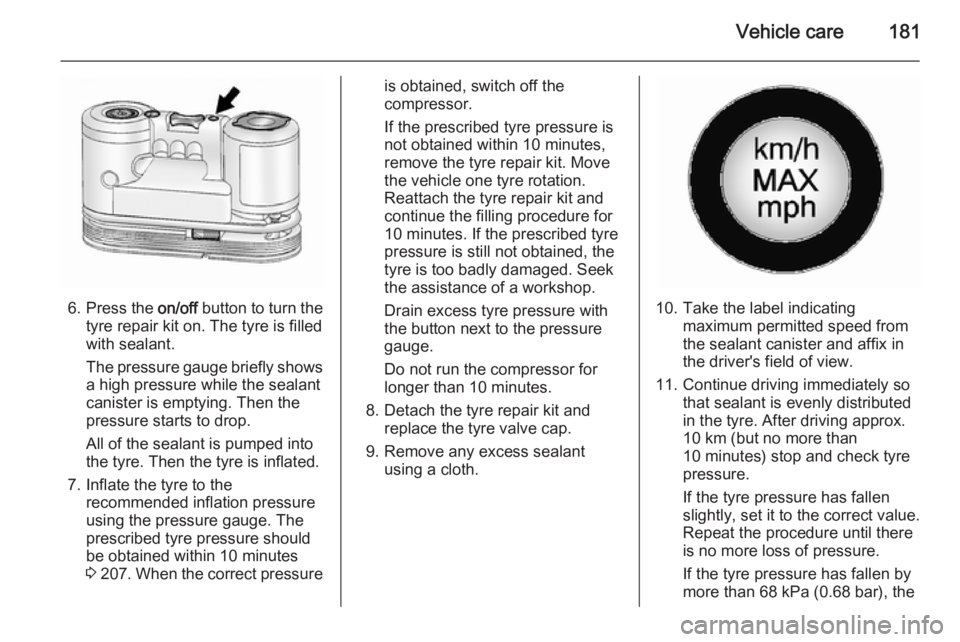
10. Take the label indicating maximum permitted speed from
the sealant canister and affix in
the driver's field of view.
11. Continue driving immediately so that sealant is evenly distributed
in the tyre. After driving approx.
10 km (but no more than
10 minutes) stop and check tyre
pressure.
If the tyre pressure has fallen
slightly, set it to the correct value.
Repeat the procedure until there
is no more loss of pressure.
If the tyre pressure has fallen by
more than 68 kPa (0.68 bar), the
Page 184 of 217
182Vehicle care
vehicle must not be driven. Seek
the assistance of a workshop.
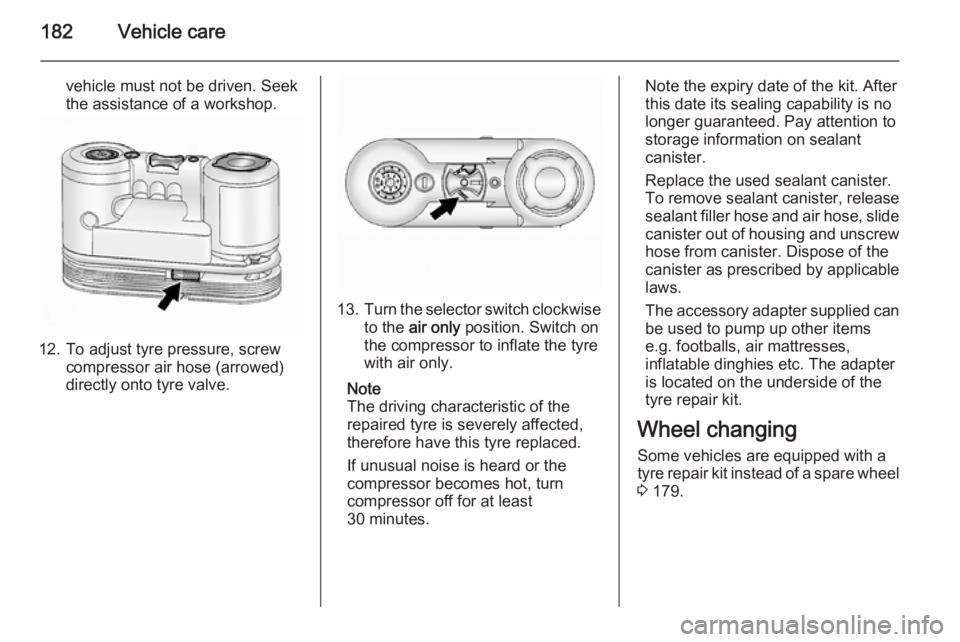
12. To adjust tyre pressure, screw compressor air hose (arrowed)
directly onto tyre valve.
13. Turn the selector switch clockwise
to the air only position. Switch on
the compressor to inflate the tyre
with air only.
Note
The driving characteristic of the
repaired tyre is severely affected,
therefore have this tyre replaced.
If unusual noise is heard or the
compressor becomes hot, turn
compressor off for at least
30 minutes.
Note the expiry date of the kit. After
this date its sealing capability is no
longer guaranteed. Pay attention to
storage information on sealant
canister.
Replace the used sealant canister.
To remove sealant canister, release sealant filler hose and air hose, slide
canister out of housing and unscrew hose from canister. Dispose of thecanister as prescribed by applicable
laws.
The accessory adapter supplied can
be used to pump up other items
e.g. footballs, air mattresses,
inflatable dinghies etc. The adapter
is located on the underside of the
tyre repair kit.
Wheel changing Some vehicles are equipped with a
tyre repair kit instead of a spare wheel 3 179.
Page 186 of 217
184Vehicle care
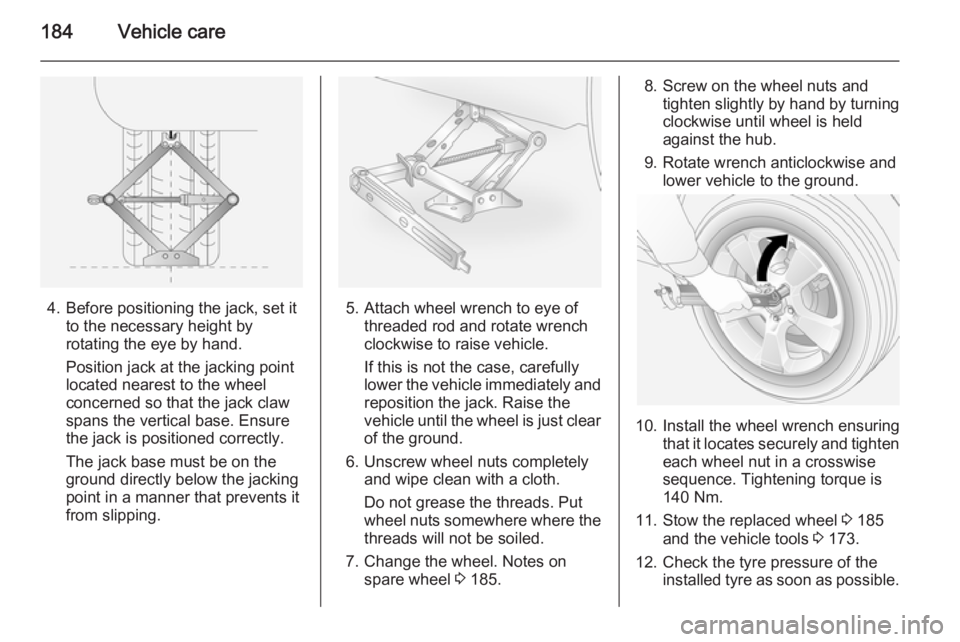
4. Before positioning the jack, set itto the necessary height by
rotating the eye by hand.
Position jack at the jacking point
located nearest to the wheel concerned so that the jack claw
spans the vertical base. Ensure
the jack is positioned correctly.
The jack base must be on the
ground directly below the jacking
point in a manner that prevents it
from slipping.5. Attach wheel wrench to eye of threaded rod and rotate wrench
clockwise to raise vehicle.
If this is not the case, carefully
lower the vehicle immediately and
reposition the jack. Raise the
vehicle until the wheel is just clear of the ground.
6. Unscrew wheel nuts completely and wipe clean with a cloth.
Do not grease the threads. Put
wheel nuts somewhere where the threads will not be soiled.
7. Change the wheel. Notes on spare wheel 3 185.
8. Screw on the wheel nuts and
tighten slightly by hand by turning
clockwise until wheel is held
against the hub.
9. Rotate wrench anticlockwise and lower vehicle to the ground.
10. Install the wheel wrench ensuring that it locates securely and tighten
each wheel nut in a crosswise
sequence. Tightening torque is
140 Nm.
11. Stow the replaced wheel 3 185
and the vehicle tools 3 173.
12. Check the tyre pressure of the installed tyre as soon as possible.
Page 194 of 217
192Vehicle care
Sunroof
Never clean with solvents or abrasive
agents, fuels, aggressive media
(e.g. paint cleaner, acetone-
containing solutions etc.), acidic or
highly alkaline media or abrasive
pads. Do not apply wax or polishing
agents to the sunroof.
Wheels and tyres Do not use high-pressure jet
cleaners.
Clean rims with a pH-neutral wheel
cleaner.
Rims are painted and can be treated
with the same agents as the body.
Paintwork damage
Rectify minor paintwork damage with
a touch-up pen before rust forms.
Have more extensive damage or rust areas repaired by a workshop.
Underbody Some areas of the vehicle underbody
have a PVC undercoating while other critical areas have a durable
protective wax coating.After the underbody is washed, check
the underbody and have it waxed if
necessary.
Bitumen/rubber materials could
damage the PVC coating. Have
underbody work carried out by a
workshop.
Before and after winter, wash the
underbody and have the protective
wax coating checked.
Towing equipment
Do not clean the coupling ball bar with
a steam-jet or high-pressure jet
cleaner.
Rear carrier system
Clean the rear carrier system with a
steam-jet or high-pressure jet cleaner
at least once a year.
Operate the rear carrier system once
in a while if not in regular use, in
particular during winter.Interior care
Interior and upholstery Only clean the vehicle interior,
including the instrument panel fascia
and panelling, with a dry cloth or
interior cleaner.
Clean the leather upholstery with
clear water and a soft cloth. In case of heavy soiling, use leather care.
The instrument cluster and the
displays should only be cleaned using
a soft damp cloth. If necessary use a
weak soap solution.
Clean fabric upholstery with a
vacuum cleaner and brush. Remove
stains with an upholstery cleaner.
Clothing fabrics may not be
colourfast. This could cause visible
discolourations, especially on light- coloured upholstery. Removable
stains and discolourations should be
cleaned as soon as possible.
Clean seat belts with lukewarm water or interior cleaner.
Page 209 of 217
![OPEL ANTARA 2014 User Guide Technical data207Tyre pressuresUp to full loadUp to full load ECOTrailer towingEngineTyresfrontrearfrontrearfrontrear[kPa/bar]
([psi])[kPa/bar]
([psi])[kPa/bar]
([psi])[kPa/bar]
([psi])[kPa/bar]
([psi](/img/37/58214/w960_58214-208.png "OPEL ANTARA 2014 User Guide Technical data207Tyre pressuresUp to full loadUp to full load ECOTrailer towingEngineTyresfrontrearfrontrearfrontrear[kPa/bar]
([psi])[kPa/bar]
([psi])[kPa/bar]
([psi])[kPa/bar]
([psi])[kPa/bar]
([psi")
Technical data207Tyre pressuresUp to full loadUp to full load ECOTrailer towingEngineTyresfrontrearfrontrearfrontrear[kPa/bar]
([psi])[kPa/bar]
([psi])[kPa/bar]
([psi])[kPa/bar]
([psi])[kPa/bar]
([psi])[kPa/bar]
([psi])All215/70 R 16 5)
,
235/65 R 17,
235/55 R 18,
235/50 R 19240/2.4 (35)240/2.4 (35)260/2.6 (38)260/2.6 (38)240/2.4 (35)280/2.8 (41)T 155/90 R 16 6)
(Temporary spare)420/4.2 (60)420/4.2 (60)––420/4.2 (60)420/4.2 (60)5) Spare wheel or winter tyres.
6) Spare wheel only.
Page 211 of 217
Customer information209
■ Vehicle reactions in particulardriving situations (e.g. inflation ofan airbag, activation of the stability
regulation system)
■ Environmental conditions (e.g. temperature)
These data are exclusively technical
and help identifying and correcting
errors as well as optimizing vehicle
functions.
Motion profiles indicating travelled
routes cannot be created with these
data.
If services are used (e.g. repair
works, service processes, warranty
cases, quality assurance),
employees of the service network
(manufacturer included) are able to
read out this technical information
from the event and error data storage
modules applying special diagnostic
devices. If required, you will receive
further information at these
workshops. After an error has been
corrected, the data are deleted from
the error storage module or they are
constantly overwritten.When using the vehicle, situations
may occur in which these technical
data related to other information
(accident report, damages on the
vehicle, witness statements etc.) may
be associated with a specific person -
possibly with the assistance of an
expert.
Additional functions contractually
agreed upon with the client (e.g.
vehicle location in emergency cases)
allow the transmission of particular
vehicle data from the vehicle.Radio Frequency
Identification (RFID) RFID technology is used in some
vehicles for functions such as tyre
pressure monitoring and ignition
system security. It is also used in
connection with conveniences such
as radio remote controls for door
locking/unlocking and starting, and in-
vehicle transmitters for garage door
openers. RFID technology in Opel
vehicles does not use or record
personal information or link with any
other Opel system containing
personal information.
Page 213 of 217
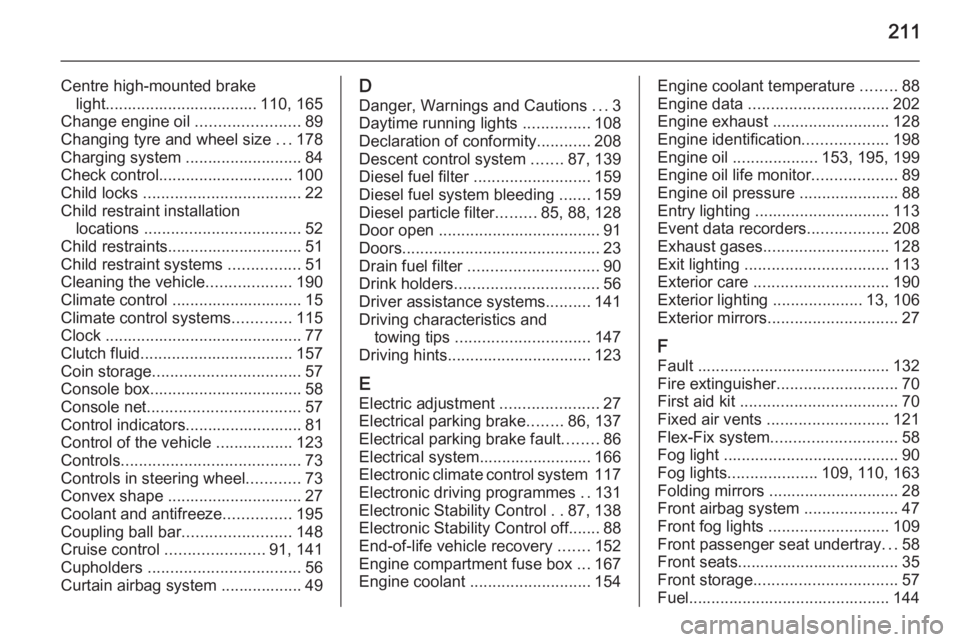
211
Centre high-mounted brakelight.................................. 110, 165
Change engine oil .......................89
Changing tyre and wheel size ...178
Charging system .......................... 84
Check control.............................. 100
Child locks ................................... 22
Child restraint installation locations ................................... 52
Child restraints.............................. 51
Child restraint systems ................51
Cleaning the vehicle ...................190
Climate control ............................. 15
Climate control systems .............115
Clock ............................................ 77
Clutch fluid .................................. 157
Coin storage ................................. 57
Console box.................................. 58
Console net .................................. 57
Control indicators.......................... 81
Control of the vehicle .................123
Controls ........................................ 73
Controls in steering wheel ............73
Convex shape .............................. 27
Coolant and antifreeze ...............195
Coupling ball bar ........................148
Cruise control ...................... 91, 141
Cupholders .................................. 56
Curtain airbag system .................. 49D
Danger, Warnings and Cautions ...3
Daytime running lights ...............108
Declaration of conformity ............208
Descent control system .......87, 139
Diesel fuel filter .......................... 159
Diesel fuel system bleeding .......159
Diesel particle filter .........85, 88, 128
Door open .................................... 91
Doors ............................................ 23
Drain fuel filter ............................. 90
Drink holders ................................ 56
Driver assistance systems ..........141
Driving characteristics and towing tips .............................. 147
Driving hints ................................ 123
E
Electric adjustment ......................27
Electrical parking brake ........86, 137
Electrical parking brake fault ........86
Electrical system......................... 166
Electronic climate control system 117
Electronic driving programmes ..131
Electronic Stability Control ..87, 138
Electronic Stability Control off....... 88 End-of-life vehicle recovery .......152
Engine compartment fuse box ...167
Engine coolant ........................... 154Engine coolant temperature ........88
Engine data ............................... 202
Engine exhaust .......................... 128
Engine identification ...................198
Engine oil ................... 153, 195, 199
Engine oil life monitor ...................89
Engine oil pressure ......................88
Entry lighting .............................. 113
Event data recorders ..................208
Exhaust gases ............................ 128
Exit lighting ................................ 113
Exterior care .............................. 190
Exterior lighting ....................13, 106
Exterior mirrors ............................. 27
F
Fault ........................................... 132
Fire extinguisher ........................... 70
First aid kit ................................... 70
Fixed air vents ........................... 121
Flex-Fix system ............................ 58
Fog light ....................................... 90
Fog lights .................... 109, 110, 163
Folding mirrors ............................. 28
Front airbag system .....................47
Front fog lights ........................... 109
Front passenger seat undertray ...58
Front seats.................................... 35
Front storage ................................ 57
Fuel............................................. 144