wheel OPEL ANTARA 2014 Workshop Manual
[x] Cancel search | Manufacturer: OPEL, Model Year: 2014, Model line: ANTARA, Model: OPEL ANTARA 2014Pages: 217, PDF Size: 6.04 MB
Page 180 of 217
178Vehicle care
If the tyre pressure is to be reduced orincreased, switch off the ignition. Tyre
pressures 3 176, 3 207.
External high-power radio equipment
could disrupt the tyre pressure
monitoring system.
The tyre pressure monitoring system
valve cores and sealing rings must be
replaced each time the tyres are
changed.
Temperature compensation
Tyre pressure depends on the
temperature of the tyre. During
driving, tyre temperature and
pressure increase.
The tyre pressure value shown in the
display is the actual tyre pressure.
Therefore it is important to check tyre pressure with cold tyres.
Tread depth
Check tread depth at regular
intervals.
Tyres should be replaced for safety
reasons at a tread depth of 2-3 mm
(4 mm for winter tyres).For safety reasons it is recommended that the tread depth of the tyres on
one axle should not vary by more than
2 mm.
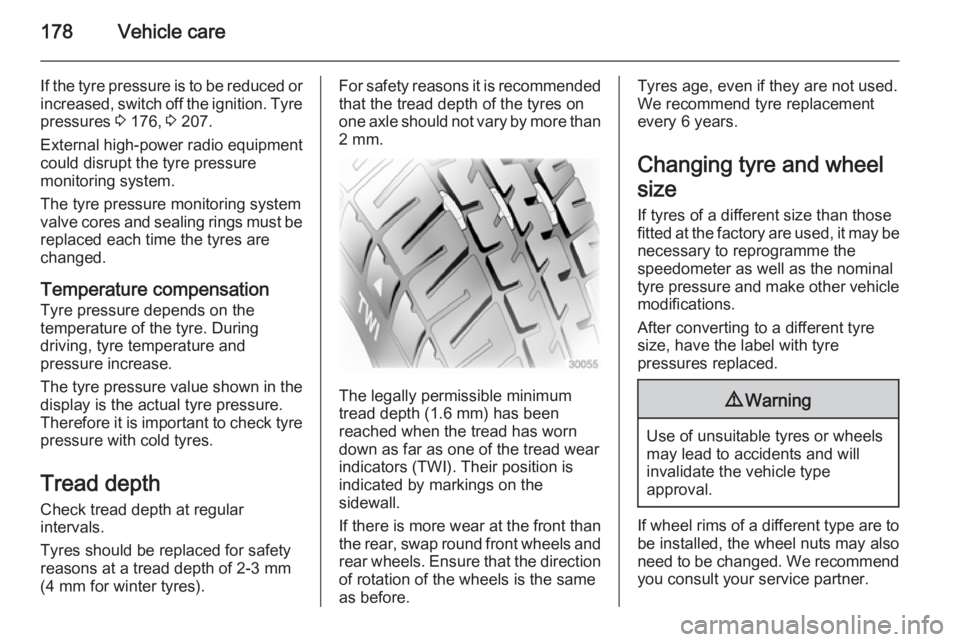
The legally permissible minimum
tread depth (1.6 mm) has been
reached when the tread has worn
down as far as one of the tread wear
indicators (TWI). Their position is
indicated by markings on the
sidewall.
If there is more wear at the front than
the rear, swap round front wheels and
rear wheels. Ensure that the direction
of rotation of the wheels is the same
as before.
Tyres age, even if they are not used.
We recommend tyre replacement
every 6 years.
Changing tyre and wheel
size
If tyres of a different size than those
fitted at the factory are used, it may be necessary to reprogramme the
speedometer as well as the nominal tyre pressure and make other vehicle modifications.
After converting to a different tyre
size, have the label with tyre
pressures replaced.9 Warning
Use of unsuitable tyres or wheels
may lead to accidents and will
invalidate the vehicle type
approval.
If wheel rims of a different type are to
be installed, the wheel nuts may also
need to be changed. We recommend you consult your service partner.
Page 181 of 217
Vehicle care179Wheel coversWheel covers and tyres that are
factory approved for the respective
vehicle and comply with all of the
relevant wheel and tyre combination
requirements must be used.
If the wheel covers and tyres used are
not factory approved, the tyres must
not have a rim protection ridge.
Wheel covers must not impair brake
cooling.9 Warning
Use of unsuitable tyres or wheel
covers could lead to sudden
pressure loss and thereby
accidents.
Tyre chains
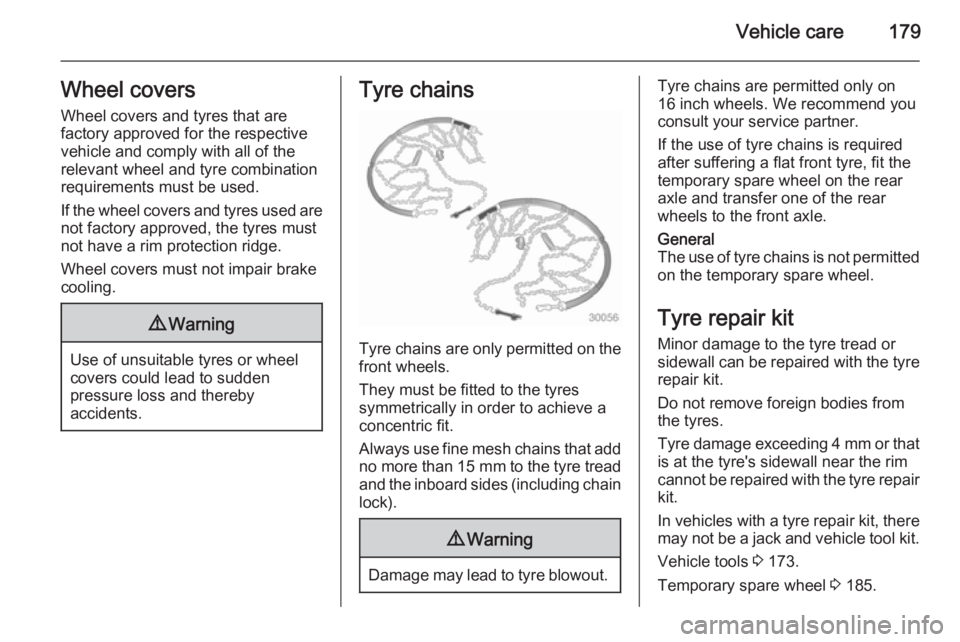
Tyre chains are only permitted on the
front wheels.
They must be fitted to the tyres
symmetrically in order to achieve a
concentric fit.
Always use fine mesh chains that add no more than 15 mm to the tyre tread
and the inboard sides (including chain lock).
9 Warning
Damage may lead to tyre blowout.
Tyre chains are permitted only on
16 inch wheels. We recommend you consult your service partner.
If the use of tyre chains is required
after suffering a flat front tyre, fit the
temporary spare wheel on the rear
axle and transfer one of the rear
wheels to the front axle.General
The use of tyre chains is not permitted on the temporary spare wheel.
Tyre repair kit
Minor damage to the tyre tread or
sidewall can be repaired with the tyre
repair kit.
Do not remove foreign bodies from
the tyres.
Tyre damage exceeding 4 mm or that
is at the tyre's sidewall near the rim
cannot be repaired with the tyre repair kit.
In vehicles with a tyre repair kit, there may not be a jack and vehicle tool kit.
Vehicle tools 3 173.
Temporary spare wheel 3 185.
Page 184 of 217
182Vehicle care
vehicle must not be driven. Seek
the assistance of a workshop.
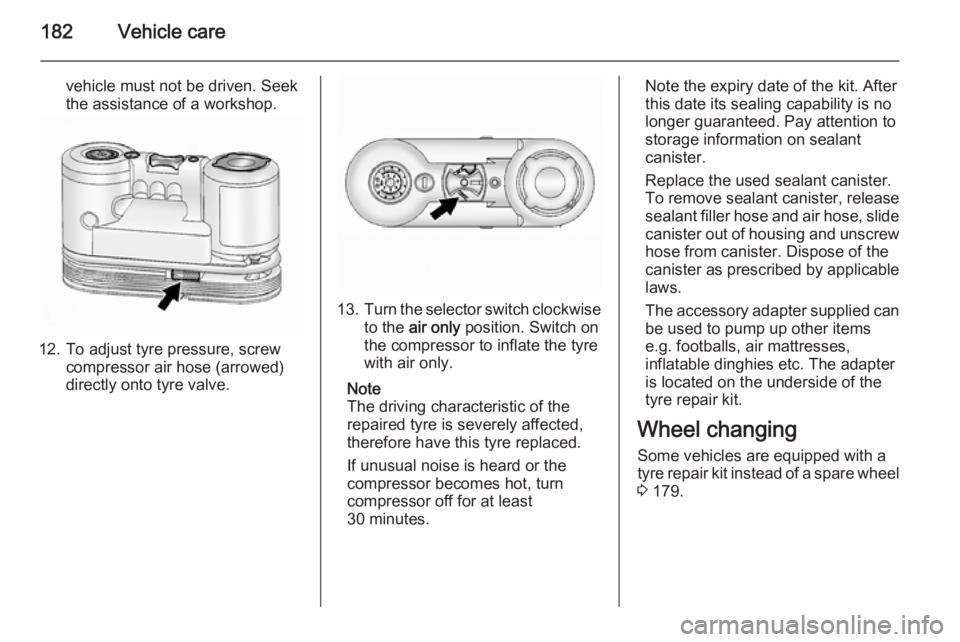
12. To adjust tyre pressure, screw compressor air hose (arrowed)
directly onto tyre valve.
13. Turn the selector switch clockwise
to the air only position. Switch on
the compressor to inflate the tyre
with air only.
Note
The driving characteristic of the
repaired tyre is severely affected,
therefore have this tyre replaced.
If unusual noise is heard or the
compressor becomes hot, turn
compressor off for at least
30 minutes.
Note the expiry date of the kit. After
this date its sealing capability is no
longer guaranteed. Pay attention to
storage information on sealant
canister.
Replace the used sealant canister.
To remove sealant canister, release sealant filler hose and air hose, slide
canister out of housing and unscrew hose from canister. Dispose of thecanister as prescribed by applicable
laws.
The accessory adapter supplied can
be used to pump up other items
e.g. footballs, air mattresses,
inflatable dinghies etc. The adapter
is located on the underside of the
tyre repair kit.
Wheel changing Some vehicles are equipped with a
tyre repair kit instead of a spare wheel 3 179.
Page 185 of 217

Vehicle care183
Make the following preparations and
observe the following information:
■ Park the vehicle on a level, firm and
non-slippery surface. The front wheels must be in the straight-ahead position.
■ Apply the electrical parking brake 3 137 and engage first gear,
reverse gear or P.
■ Remove the spare wheel 3 185.
■ Never change more than one wheel
at a time.
■ Block wheel diagonally opposite the wheel to be changed, by placing
wedge blocks or equivalent in front
and behind the wheel.
■ Use the jack only to change wheels
in case of puncture, not for
seasonal winter or summer tyre
changes.
■ Never exceed jack maximum working load (900 kg).
■ If the ground on which the vehicle is standing is soft, a solid board
(max. 1 cm thick) should be placed
under the jack.■ Do not raise the vehicle more than is necessary to change a wheel.
■ No people or animals may be in the
vehicle when it is jacked-up.
■ Never crawl under a jacked-up vehicle.
■ Do not start the engine when it is raised on the jack.
■ Clean wheel nuts and thread before
mounting the wheel.9 Warning
Do not grease wheel bolt, wheel
nut and wheel nut cone.
1. Pull off the wheel cover.
2. Install the wheel wrench ensuring that it locates securely and loosen
each wheel nut by one turn by
turning anticlockwise.
3. The location of front and rear jacking points is indicated by
notches on the bottom edge of the
vehicle, under the doors.
Page 186 of 217
184Vehicle care
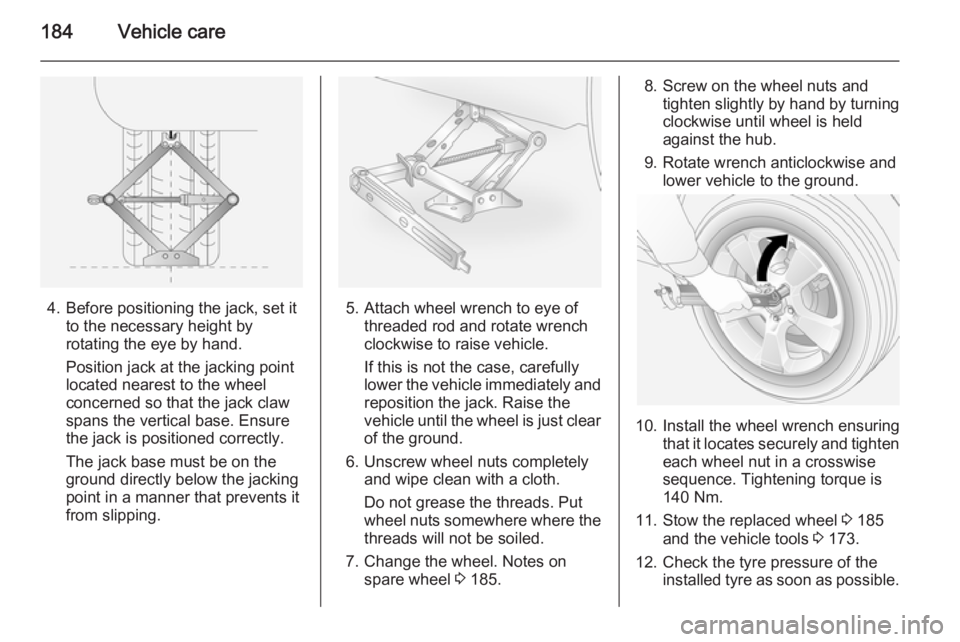
4. Before positioning the jack, set itto the necessary height by
rotating the eye by hand.
Position jack at the jacking point
located nearest to the wheel concerned so that the jack claw
spans the vertical base. Ensure
the jack is positioned correctly.
The jack base must be on the
ground directly below the jacking
point in a manner that prevents it
from slipping.5. Attach wheel wrench to eye of threaded rod and rotate wrench
clockwise to raise vehicle.
If this is not the case, carefully
lower the vehicle immediately and
reposition the jack. Raise the
vehicle until the wheel is just clear of the ground.
6. Unscrew wheel nuts completely and wipe clean with a cloth.
Do not grease the threads. Put
wheel nuts somewhere where the threads will not be soiled.
7. Change the wheel. Notes on spare wheel 3 185.
8. Screw on the wheel nuts and
tighten slightly by hand by turning
clockwise until wheel is held
against the hub.
9. Rotate wrench anticlockwise and lower vehicle to the ground.
10. Install the wheel wrench ensuring that it locates securely and tighten
each wheel nut in a crosswise
sequence. Tightening torque is
140 Nm.
11. Stow the replaced wheel 3 185
and the vehicle tools 3 173.
12. Check the tyre pressure of the installed tyre as soon as possible.
Page 187 of 217
Vehicle care185
Have the defective tyre renewed and
replace temporary spare wheel with a
full specification wheel without delay.
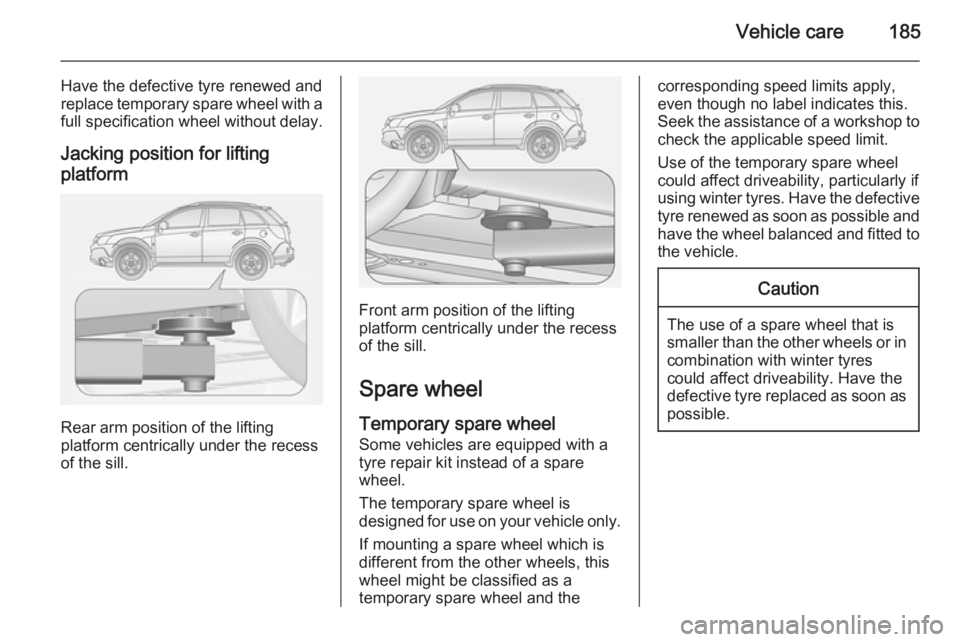
Jacking position for lifting platform
Rear arm position of the lifting
platform centrically under the recess
of the sill.
Front arm position of the lifting
platform centrically under the recess
of the sill.
Spare wheel
Temporary spare wheel
Some vehicles are equipped with a
tyre repair kit instead of a spare
wheel.
The temporary spare wheel is
designed for use on your vehicle only.
If mounting a spare wheel which is
different from the other wheels, this
wheel might be classified as a
temporary spare wheel and the
corresponding speed limits apply,
even though no label indicates this.
Seek the assistance of a workshop to
check the applicable speed limit.
Use of the temporary spare wheel
could affect driveability, particularly if
using winter tyres. Have the defective
tyre renewed as soon as possible and
have the wheel balanced and fitted to the vehicle.Caution
The use of a spare wheel that issmaller than the other wheels or in
combination with winter tyres
could affect driveability. Have the defective tyre replaced as soon as
possible.
Page 188 of 217

186Vehicle care
The temporary spare wheel is locatedin the load compartment below the
floor cover and is secured with a
screw-in retainer.
Push both levers on the floor cover
towards the handle and pull up the
cover by the handle. Hang the hook
to the upper part of the tailgate
opening.
Vehicle tools 3 173.
Remove the retainer by rotating it
anticlockwise and remove temporary
spare wheel from the spare wheel
well.
Only mount one temporary spare
wheel. Do not drive faster than
80 km/h. Take curves slowly. Do not
use for a long period of time.
When the temporary spare wheel is
fitted, do not take the vehicle through an automatic vehicle wash with guide
rails. The temporary spare wheel may get caught on the rails, causing
damage to the tyre, wheel and other
vehicle parts.
The use of tyre chains is not permitted on the temporary spare wheel.
Tyre chains 3 179.
Directional tyres
Fit directional tyres such that they roll in the direction of travel. The rolling
direction is indicated by a symbol
(e.g. an arrow) on the sidewall.
The following applies to tyres fitted
opposing the rolling direction:
■ Driveability may be affected. Have the defective tyre renewed as soon
as possible and have the wheel
balanced and fitted to the vehicle.■ Do not drive faster than 80 km/h.
■ Drive particularly carefully on wet and snow-covered road surfaces.9 Warning
Storing a jack, a wheel or other
equipment in the load
compartment could cause injury if they are not fixed in place
properly. During a sudden stop or
a collision, loose equipment could
cause personal injury or damage
to the vehicle.
Always store the jack and vehicle
tools in their respective storage
compartments and secure them properly.
Always place the damaged wheel
in the load compartment, secured
in the spare wheel well with the
screw-in retainer.
Page 191 of 217
Vehicle care189
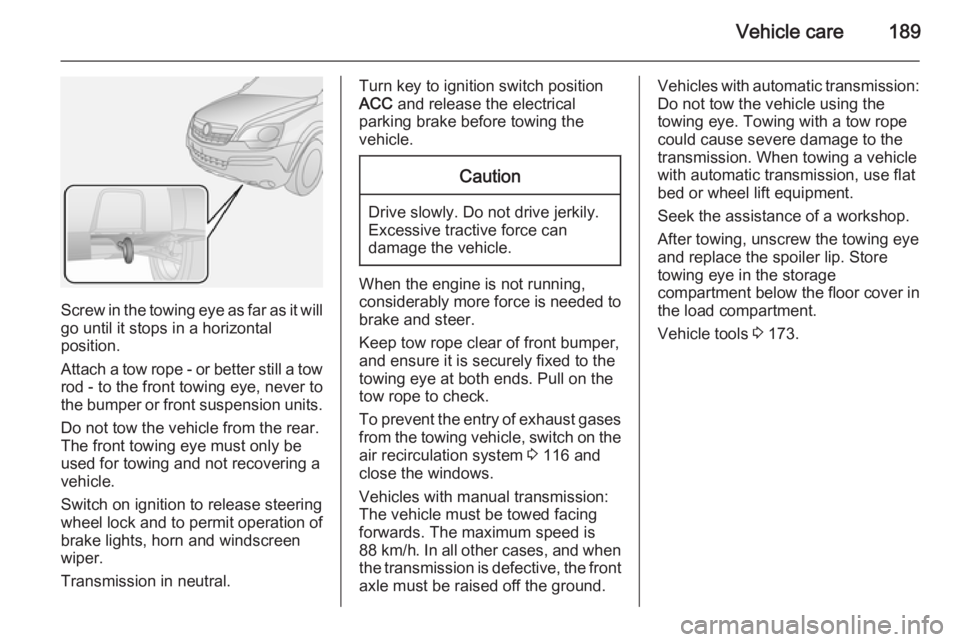
Screw in the towing eye as far as it will
go until it stops in a horizontal
position.
Attach a tow rope - or better still a tow
rod - to the front towing eye, never to
the bumper or front suspension units.
Do not tow the vehicle from the rear.
The front towing eye must only be
used for towing and not recovering a
vehicle.
Switch on ignition to release steering
wheel lock and to permit operation of
brake lights, horn and windscreen
wiper.
Transmission in neutral.
Turn key to ignition switch position
ACC and release the electrical
parking brake before towing the
vehicle.Caution
Drive slowly. Do not drive jerkily.
Excessive tractive force can
damage the vehicle.
When the engine is not running,
considerably more force is needed to
brake and steer.
Keep tow rope clear of front bumper, and ensure it is securely fixed to the
towing eye at both ends. Pull on the tow rope to check.
To prevent the entry of exhaust gases from the towing vehicle, switch on the
air recirculation system 3 116 and
close the windows.
Vehicles with manual transmission:
The vehicle must be towed facing
forwards. The maximum speed is
88 km/h . In all other cases, and when
the transmission is defective, the front axle must be raised off the ground.
Vehicles with automatic transmission:
Do not tow the vehicle using the
towing eye. Towing with a tow rope
could cause severe damage to the
transmission. When towing a vehicle with automatic transmission, use flat
bed or wheel lift equipment.
Seek the assistance of a workshop.
After towing, unscrew the towing eye
and replace the spoiler lip. Store
towing eye in the storage
compartment below the floor cover in the load compartment.
Vehicle tools 3 173.
Page 193 of 217

Vehicle care191
If using a car wash, comply with the
car wash manufacturer's instructions.
The windscreen wiper and rear
window wiper must be switched off.
Remove antenna and external
accessories such as roof racks etc.
If you wash your vehicle by hand,
make sure that the insides of the
wheel housings are also thoroughly
rinsed out.
Clean edges and folds on opened
doors and the bonnet as well as the
areas they cover.Caution
Always use a cleaning agent with
a pH value of 4 to 9.
Do not use cleaning agents on hot surfaces.
Have the door hinges of all doors
greased by a workshop.
Do not clean the engine compartment with a steam-jet or high-pressure jet
cleaner.
When cleaning with a high-pressure
jet cleaner, ensure a minimum
distance of 30 cm when working
around the tailgate to prevent
unintended unlocking.
Thoroughly rinse and leather-off the
vehicle. Rinse leather frequently. Use
separate leathers for painted and
glass surfaces: remnants of wax on
the windows will impair vision.
Do not use hard objects to remove
spots of tar. Use tar removal spray on
painted surfaces.
Exterior lights
Headlight and other light covers are
made of plastic. Do not use any
abrasive or caustic agents, do not use an ice scraper, and do not clean them
dry.
Polishing and waxing Wax the vehicle regularly (at the
latest when water no longer beads).
Otherwise, the paintwork will dry out.
Polishing is necessary only if the paint
has become dull or if solid deposits
have become attached to it.Paintwork polish with silicone forms a
protective film, making waxing
unnecessary.
Plastic body parts must not be treated with wax or polishing agents.
Windows and windscreen wiper blades
Use a soft lint-free cloth or chamois
leather together with window cleaner and insect remover.
When cleaning the rear window,
make sure the heating element inside
is not damaged.
For mechanical removal of ice, use a
sharp-edged ice scraper. Press the
scraper firmly against the glass so
that no dirt can get under it and
scratch the glass.
Clean smearing wiper blades with a
soft cloth and window cleaner.
Page 194 of 217
192Vehicle care
Sunroof
Never clean with solvents or abrasive
agents, fuels, aggressive media
(e.g. paint cleaner, acetone-
containing solutions etc.), acidic or
highly alkaline media or abrasive
pads. Do not apply wax or polishing
agents to the sunroof.
Wheels and tyres Do not use high-pressure jet
cleaners.
Clean rims with a pH-neutral wheel
cleaner.
Rims are painted and can be treated
with the same agents as the body.
Paintwork damage
Rectify minor paintwork damage with
a touch-up pen before rust forms.
Have more extensive damage or rust areas repaired by a workshop.
Underbody Some areas of the vehicle underbody
have a PVC undercoating while other critical areas have a durable
protective wax coating.After the underbody is washed, check
the underbody and have it waxed if
necessary.
Bitumen/rubber materials could
damage the PVC coating. Have
underbody work carried out by a
workshop.
Before and after winter, wash the
underbody and have the protective
wax coating checked.
Towing equipment
Do not clean the coupling ball bar with
a steam-jet or high-pressure jet
cleaner.
Rear carrier system
Clean the rear carrier system with a
steam-jet or high-pressure jet cleaner
at least once a year.
Operate the rear carrier system once
in a while if not in regular use, in
particular during winter.Interior care
Interior and upholstery Only clean the vehicle interior,
including the instrument panel fascia
and panelling, with a dry cloth or
interior cleaner.
Clean the leather upholstery with
clear water and a soft cloth. In case of heavy soiling, use leather care.
The instrument cluster and the
displays should only be cleaned using
a soft damp cloth. If necessary use a
weak soap solution.
Clean fabric upholstery with a
vacuum cleaner and brush. Remove
stains with an upholstery cleaner.
Clothing fabrics may not be
colourfast. This could cause visible
discolourations, especially on light- coloured upholstery. Removable
stains and discolourations should be
cleaned as soon as possible.
Clean seat belts with lukewarm water or interior cleaner.