battery OPEL ANTARA 2017.5 Manual user
[x] Cancel search | Manufacturer: OPEL, Model Year: 2017.5, Model line: ANTARA, Model: OPEL ANTARA 2017.5Pages: 225, PDF Size: 6.2 MB
Page 164 of 225

162Vehicle careBrake fluid9Warning
Brake fluid is poisonous and
corrosive. Avoid contact with eyes, skin, fabrics and painted surfaces.
The brake fluid level must be between
the MIN and MAX marks.
When topping up, ensure maximum cleanliness as contamination of the
brake fluid can lead to brake system
malfunctions. Have the cause of the
loss of brake fluid remedied by a
workshop.
Caution
Only use high-performance brake
fluid approved for the vehicle.
Brake fluid 3 202.
Brake fluid level control indicator R
3 85.
Clutch fluid
9 Warning
Clutch fluid is poisonous and
corrosive. Avoid contact with eyes, skin, fabrics and painted surfaces.
If the fluid in the reservoir falls below
the MIN mark, seek the assistance of
a workshop.
Clutch fluid 3 202.
Vehicle battery The vehicle battery is maintenance-
free provided that the driving profile
allows sufficient charging of the
battery. Short-distance-driving and
frequent engine starts can discharge
the vehicle battery. Avoid the use of
unnecessary electrical consumers.
Page 165 of 225

Vehicle care163
Batteries do not belong in household
waste. They must be disposed of at
an appropriate recycling collection
point.
Laying up the vehicle for more than
6 weeks can lead to battery
discharge. Disconnect the clamp from the negative terminal of the vehicle
battery.
Ensure the ignition is switched off
before connecting or disconnecting
the vehicle battery.
Retrofitted electrical or electronic
accessories can place an additional
load on the vehicle battery or
discharge the battery. Seek the
assistance of a workshop regarding technical possibilities, such as fitting
a more powerful battery.
Ensure the ignition is switched off
before reconnecting the vehicle
battery. Then perform the following
actions:
1. Set date and time in the information display 3 75.
2. If necessary, activate the power windows and sun roof 3 31, 3 33.
In order to prevent the vehicle battery
from discharging, some consumers
such as the courtesy lights
automatically switch off after a delay.
Charge a disconnected vehicle
battery every 6 weeks.
Vehicle battery discharge protection
3 113.
Replacing the vehicle battery Note
Any deviation from the instructions
given in this paragraph may lead to
a temporary deactivation of the stop-
start system.
When the vehicle battery is being
replaced, please ensure that there
are no open ventilation holes in the
vicinity of the positive terminal. If a
ventilation hole is open in this area, itmust be closed off with a dummy cap, and the ventilation in the vicinity of the
negative terminal must be opened.
Only use batteries that allow the fuse
box to be mounted above the vehicle
battery.
In vehicles with an AGM (Absorptive
Glass Mat) battery, make sure to
have the battery replaced with
another AGM battery.
An AGM battery can be identified by
the label on the battery. We
recommend the use of an original
Opel battery.
Page 166 of 225

164Vehicle careNote
Using an AGM vehicle battery
different from the original Opel
vehicle battery may result in a lower performance of the stop-start
system.
We recommend that you have the
vehicle battery replaced by a
workshop.
Stop-start system 3 126.
Charging the vehicle battery9 Warning
On vehicles with stop-start
system, ensure that the charging potential does not exceed
14.6 volts when using a battery
charger. Otherwise the vehicle
battery might be damaged.
Jump starting 3 194.
Warning label
Meaning of symbols:
● No sparks, naked flames or smoking.
● Always shield eyes. Explosive gases can cause blindness or
injury.
● Keep the vehicle battery out of reach of children.
● The vehicle battery contains sulfuric acid which could cause
blindness or serious burn
injuries.
● See the Owner's Manual for further information.
● Explosive gas may be present in the vicinity of the vehicle battery.
Diesel fuel filter
Drain diesel fuel filter of residual
water at every engine oil change.
Place a container underneath the
filter housing. Turn drain plug
anticlockwise using a suitable
screwdriver, to drain off the water.
The filter is drained as soon as diesel fuel emerges from the port. Retighten
the drain plug by turning it clockwise.
Page 180 of 225

178Vehicle careFuseCircuitAPO JACK
(CONSOLE)Power outlet
(centre
console)APO JACK (REAR
CARGO)Power outlet
(load compart‐
ment)AUDIO/KEY
CAPTUREAudio, key
captureAWD/VENTAll-wheel drive,
ventilationBCM (CTSY)Courtesy lightsBCM (DIMMER)Instrument illu‐
minationBCM (INT LIGHT
TRLR FOG)Interior lights,
trailer fog lightBCM (PRK/TRN)Parking lights,
turn signalsBCM (STOP)Brake lightsBCM (TRN SIG)Turn signalsBCM (VBATT)Battery voltageFuseCircuitCLSTRInstrument
clusterDC/DC
CONVERTERDC, DC
converterDRLDaytime
running lightsDR/LCKDriver door lockDRVR PWR SEATDriver power
seatDRV/PWR WNDWDriver power
windowERAGLONASSEmergency
road assistance
GlonassF/DOOR LOCKFuel filler flapFRT WSRFront washerFSCMFuel systemFSCM/VENT SOLFuel system,
vent solenoidHEATING MAT
SWHeating mat
switchFuseCircuitHTD SEAT PWRSeat heatingHVAC BLWRClimate control,
air conditioning
fanIPCInstrument
panel clusterISRVM/RCMInterior mirror,
remote
compass
moduleL/GATETailgateLOGISTIC MODELogistic modeOSRVMExterior mirrorsPAKSPassive active
keyless startPASS PWR
WNDWPassenger
power windowPWR DIODEPower diodePWR MODINGPower modingRR FOGHeated rear
window
Page 181 of 225
Vehicle care179FuseCircuitRR HEAT SEATRear seat
heatingRUN 2Power battery
key on runRUN/CRNKRun crankRVCRear view
cameraRVS/HVAC/DLCExterior
mirrors, climate
control, data
link connectionSCRPMSelective cata‐
lytic reduction
power moduleSDM (BATT)Safety Diag‐
nosis Module
(Battery)SDM (IGN 1)Safety Diag‐
nosis Module
(Ignition)SPARE-FuseCircuitS/ROOF/
FOLDING
MIRRORSunroof, folding
mirrorS/ROOF BATTSunroof batterySSPSPower steeringSTR/WHL SWSteering wheelTRLRTrailerTRLR BATTTrailer batteryXBCMExport Body
Control Module
After changing of defective fuses
close the fuse box cover and press
until it engages.
If the fuse box cover is not closed
correctly, malfunctions may occur.
Vehicle tools
Tools
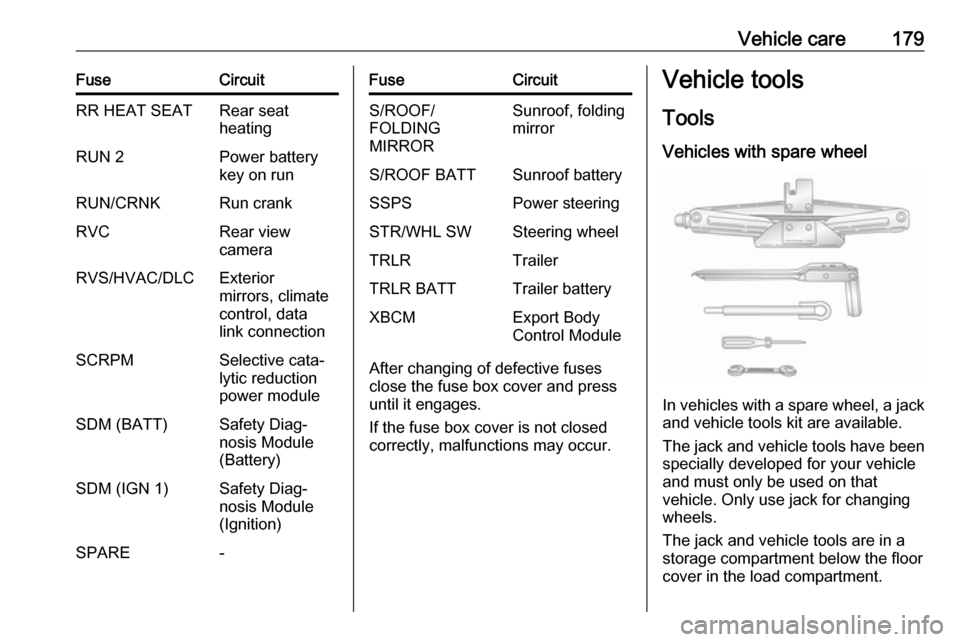
Vehicles with spare wheel
In vehicles with a spare wheel, a jack and vehicle tools kit are available.
The jack and vehicle tools have been
specially developed for your vehicle
and must only be used on that
vehicle. Only use jack for changing
wheels.
The jack and vehicle tools are in a
storage compartment below the floor
cover in the load compartment.
Page 190 of 225

188Vehicle care9Warning
Do not drive faster than 80 km/h.
Do not use for a lengthy period.
Steering and handling may be
affected.
If you have a flat tyre:
Apply the electrical parking brake
3 143 and engage first gear, reverse
gear or P.
The tyre repair kit is in a storage
compartment below the floor cover in the load compartment.
To remove the tyre repair kit, open the
tailgate.
Pull the floor cover handle upwards
3 68.
Vehicle tools 3 179.
Caution
Do not allow objects to protrude
above the top of the rear floor
storage compartment, to avoid
damage to the storage area and
the load compartment floor.
1. Release the sealant filler hose 1
and the power plug 2.
2. Unscrew valve cap from defective
tyre.
Screw the sealant filler hose onto
the tyre valve.
3. Connect the power plug to the power outlet. Unplug all items
from other power outlets.
4. Switch on ignition. To avoid discharging the battery, werecommend running the engine.5. Turn the selector switch anticlockwise to the sealant +
air position.
Page 196 of 225

194Vehicle careDirectional tyres
Fit directional tyres such that they roll in the direction of travel. The rolling
direction is indicated by a symbol
(e.g. an arrow) on the sidewall.
The following applies to tyres fitted
opposing the rolling direction:
● Driveability may be affected. Have the defective tyre renewed
or repaired as soon as possible
and fit it instead of the spare
wheel.
● Do not drive faster than 80 km/h.
● Drive particularly carefully on wet
and snow-covered road
surfaces.9 Warning
Storing a jack, a wheel or other
equipment in the load
compartment could cause injury if they are not fixed in place
properly. During a sudden stop or
a collision, loose equipment could
cause personal injury or damage
to the vehicle.
Always store the jack and vehicle
tools in their respective storage
compartments and secure them properly.
Always place the damaged wheel
in the load compartment, secured
in the spare wheel well with the
screw-in retainer.Jump starting
Do not start with quick charger.
A vehicle with a discharged battery can be started using jump leads and
the battery of another vehicle.9 Warning
Be extremely careful when starting
with jump leads. Any deviation
from the following instructions can
lead to injuries or damage caused
by battery explosion or damage to the electrical systems of both
vehicles.
9 Warning
Avoid contact of the battery with
eyes, skin, fabrics and painted
surfaces. The fluid contains
sulphuric acid which can cause
injuries and damage in the event
of direct contact.
● Never expose the battery to naked flames or sparks.
Page 197 of 225

Vehicle care195●A discharged battery can already
freeze at a temperature of 0 °C.
Defrost the frozen battery before
connecting jump leads.
● Wear eye protection and protective clothing when
handling a battery.
● Use a booster battery with the same voltage (12 Volts). Its
capacity (Ah) must not be much less than that of the discharged
battery.
● Use jump leads with insulated terminals and a cross section of
at least 16 mm 2
(25 mm 2
for
diesel engines).
● Do not disconnect the discharged
battery from the vehicle.
● Switch off all unnecessary electrical consumers. The
Infotainment system may be
damaged if switched on while jump starting.
● Do not lean over the battery during jump starting.
● Do not allow the terminals of one
lead to touch those of the other
lead.● The vehicles must not come into contact with each other during
the jump starting process.
● Apply the electrical parking brake
3 143, transmission in neutral,
automatic transmission in P.
● Open the positive terminal protection caps of both batteries.
Lead connection order:
1. Connect the red lead to the positive terminal 1 of the booster
battery.
2. Connect the other end of the red lead to the positive terminal 2 of
the discharged battery.
3. Connect the black lead to the negative terminal 3 of the booster
battery.
4. Connect the other end of the black
lead to a vehicle grounding point,
such as the engine block 4 or an
engine mounting bolt. Connect as far away from the discharged
battery as possible, however at
least 60 cm.
Route the leads so that they cannot
catch on rotating parts in the engine
compartment.
To start the engine: 1. Start the engine of the vehicle providing the jump start.
2. After 5 minutes, start the other engine. Start attempts should be
made for no longer than
15 seconds at an interval of
1 minute.
3. Allow both engines to idle for approx. 3 minutes with the leads
connected.
4. Switch on electrical consumers (e.g. headlights, heated rear
window) of the vehicle receiving
the jump start.
Page 198 of 225

196Vehicle care5. Operate discharged vehicle forapprox. 20 minutes to allow for
adequate battery recharging.
6. Reverse above sequence exactly when removing leads.Towing
Towing the vehicle
Remove the spoiler lip from the front
left-hand side of the vehicle by
unfastening the six screws located on the underside of the vehicle. Then
attach the towing eye.
The towing eye is stowed with the
vehicle tools 3 179.
Screw in the towing eye as far as it will
go until it stops in a horizontal
position.
Attach a tow rope - or better still a tow
rod - to the front towing eye, never to
the bumper or front suspension units.
Do not tow the vehicle from the rear.
The front towing eye must only be
used for towing and not recovering a
vehicle.
Switch on ignition to release steering wheel lock and to permit operation of
brake lights, horn and windscreen
wiper.
Transmission in neutral.
Page 220 of 225

218IndexAAccessories and vehicle modifications .......................... 157
Accessory sockets ........................77
Active head restraints .............35, 36
AdBlue .................................. 88, 131
Adjustable air vents ...................119
Airbag and belt tensioners ...........83
Airbag deactivation ................50, 83
Airbag label................................... 45 Airbag system .............................. 45
Air conditioning regular operation ................................ 121
Air conditioning system .............. 115
Air intake .................................... 120
Air vents...................................... 119
All wheel drive .....................86, 140
Antilock brake system ................ 142
Antilock brake system (ABS) .......85
Anti-theft alarm system ..........26, 91
Anti-theft locking system .............. 25
Appearance care ........................198
Apply footbrake ............................ 90
Armrest ................................... 39, 41
Armrest storage ........................... 58
Automatic anti-dazzle ..................30
Automatic dimming ......................30
Automatic headlight levelling system ...................................... 90
Automatic level control .......106, 147Automatic light control ...............106
Automatic transmission ........84, 136
Autostop ..................................... 126
AUX input ..................................... 58
B Battery .......................................... 84
Battery discharge protection ......113
Battery, jump starting.................. 194
Belt pretensioners......................... 41
Belts.............................................. 41 Bicycle rack .................................. 58
BlueInjection ............................... 131
Board-Info-Display .......................92
Bonnet ....................................... 158
Brake and clutch fluid .................202
Brake assist ............................... 144
Brake fluid .................................. 162
Brakes ............................... 142, 161
Brake system ............................... 85
Breakdown.................................. 196
Bulb replacement ....................... 165
C
Capacities .................................. 211
Card holder ................................... 56
Car Pass ...................................... 21
Catalytic converter ................84, 130
CD tray ......................................... 56
Central locking system ................22
Centre console storage ...............58