fuel OPEL ANTARA 2017.5 Manual user
[x] Cancel search | Manufacturer: OPEL, Model Year: 2017.5, Model line: ANTARA, Model: OPEL ANTARA 2017.5Pages: 225, PDF Size: 6.2 MB
Page 128 of 225

126Driving and operatingStarting the vehicle at low
temperatures
In extremely cold temperatures, i.e.
below -20 °С, it may be necessary to
crank the engine for up to
30 seconds for it to start.
Turn key to position START and hold
until engine starts. Start attempts
should not last longer than
30 seconds. If engine does not start, wait 10 seconds before repeatingstarting procedure.
Ensure the engine oil is of the correct viscosity, the correct fuel is used,
vehicle services are performed
regularly and the battery is sufficiently
charged.
Turbo engine warm-up Upon start-up, engine available
torque may be limited for a short time,
especially when the engine
temperature is cold. The limitation is
to allow the lubrication system to fully protect the engine.Overrun cut-off
The fuel supply is automatically cut-
off during overrun, i.e. when the
vehicle is driven with a gear engaged
but accelerator is released.
Stop-start system The stop-start system helps to save
fuel and to reduce the exhaust
emissions. When conditions allow, it
switches off the engine as soon as the
vehicle is at a low speed or at a
standstill, e.g. at a traffic light or in a
traffic jam. It starts the engine
automatically as soon as the clutch is depressed. A vehicle battery sensor
ensures that an Autostop is only performed if the vehicle battery is
sufficiently charged for a restart.
Activation
The stop-start system is available as soon as the engine is started, the
vehicle starts-off and the conditions
as stated below in this section are
fulfilled.Deactivation
Deactivate the stop-start system
manually by pressing s. The
deactivation is indicated when the
LED in the button extinguishes.
Fuel economy mode 3 122.
Autostop If the vehicle is at a low speed or at a
standstill, activate an Autostop as
follows:
● Depress the clutch pedal
● set the lever to neutral
● release the clutch pedal
Page 131 of 225
Driving and operating129● Lock the vehicle by pressing p
on the radio remote control 3 22.
Activate the anti-theft alarm
system 3 26.Engine exhaust9 Danger
Engine exhaust gases contain
poisonous carbon monoxide,
which is colourless and odourless and could be fatal if inhaled.
If exhaust gases enter the interior
of the vehicle, open the windows.
Have the cause of the fault
rectified by a workshop.
Avoid driving with an open load
compartment, otherwise exhaust
gases could enter the vehicle.
Malfunction indicator light 3 84.
Diesel particle filter
The diesel particle filter system filters
harmful soot particles out of the
exhaust gases. The system includes
a self-cleaning function that runs
automatically during driving without
any notification.
The filter is cleaned by periodically
burning off the soot particles at high
temperature. This process takes
place automatically under set driving
conditions and may take more than
15 minutes. Autostop is not available
and fuel consumption may be higher
during this period. The emission of
smells and smoke during this process is normal.
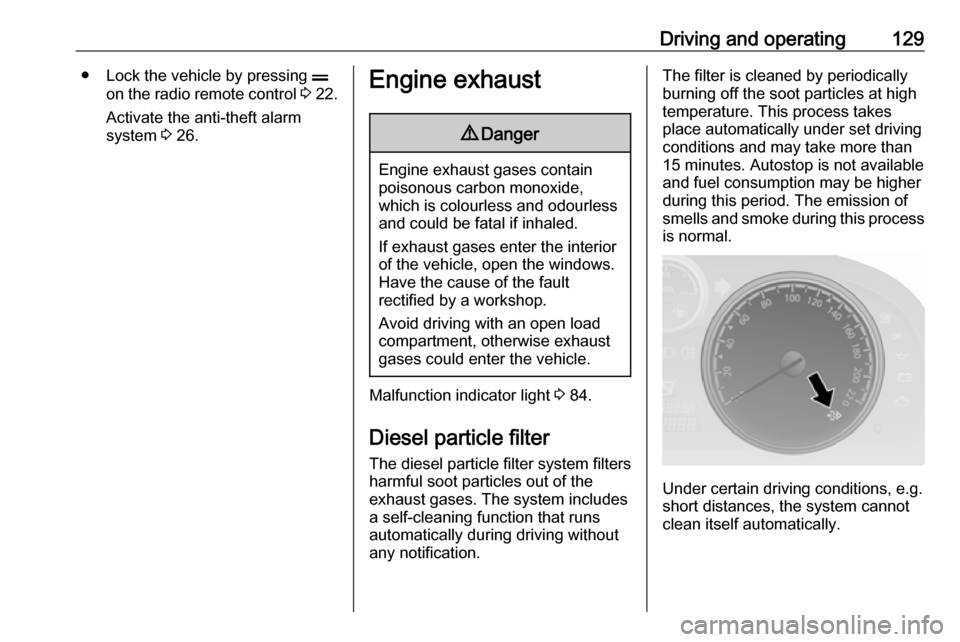
Under certain driving conditions, e.g.
short distances, the system cannot
clean itself automatically.
Page 132 of 225

130Driving and operatingIf cleaning of the filter is required andprevious driving conditions did not
enable automatic cleaning, it will be
indicated by control indicator %
3 88.
% illuminates, accompanied by a
warning chime, when diesel particle
filter is full. Start cleaning process as
soon as possible.
% flashes when diesel particle filter
has reached the maximum filling level. Start cleaning process
immediately to avoid damage to the
engine. A warning chime sounds
every 3 minutes until the cleaning
process is complete.
Cleaning process To activate the cleaning process,
continue driving, keeping engine
speed above 2000 revolutions per
minute. Shift down if necessary.
Diesel particle filter cleaning is then
started.
If control indicator Z illuminates
additionally in the instrument cluster
when the engine is running, there
may be a fault in the diesel particlefilter 3 84. Cleaning is not possible,
seek the assistance of a workshop
immediately.Caution
If the cleaning process is
interrupted, there is a risk of
provoking severe engine damage.
Cleaning takes place quickest at high engine speeds and loads.
Do not switch off the engine until the
cleaning process is complete. This is
indicated by the extinguished control
indicator %.
Catalytic converter
The catalytic converter reduces the
amount of harmful substances in the
exhaust gases.
Caution
Fuel grades other than those listed 3 207 could damage the catalytic
converter or electronic
components.
Unburnt fuel will overheat and
damage the catalytic converter.
Therefore avoid excessive use of the starter, running the fuel tank
dry and starting the engine by
pushing or towing.
In the event of misfiring, uneven
engine running, a reduction in engine performance or other unusual
problems, have the cause of the fault
rectified by a workshop as soon as
possible. In an emergency, driving
can be continued for a short period,
keeping vehicle speed and engine
speed low.
Malfunction indicator light 3 84.
Page 139 of 225
Driving and operating137Use of the engine braking effect, as
opposed to the use of the foot brake
when driving downhill, can extend the
life of the brakes.
Rocking the vehicle
Rocking the vehicle is only
permissible if the vehicle is stuck in
water, ice, sand, mud, snow or a dip.
Move the selector lever between D
and R in a repeat pattern while
applying light pressure to the
accelerator pedal when the vehicle is in gear. Do not race the engine and
avoid sudden acceleration.
If the vehicle cannot be released after
rocking the vehicle several times,
your vehicle may need to be towed
3 196.
Parking Apply the electrical parking brake and
engage P.
The ignition key can only be removed
when the selector lever is in position
P .Sport mode
Suspension and steering become
more direct and provide better
contact with the road surface. The
engine reacts more quickly to
accelerator pedal movements.
Automatic gear changing is also more
responsive.
Sport mode can reduce the vehicle's
fuel economy. Use normal mode whenever possible.
Note
Sport mode may be unavailable if the charging level of the vehicle
battery is too low.
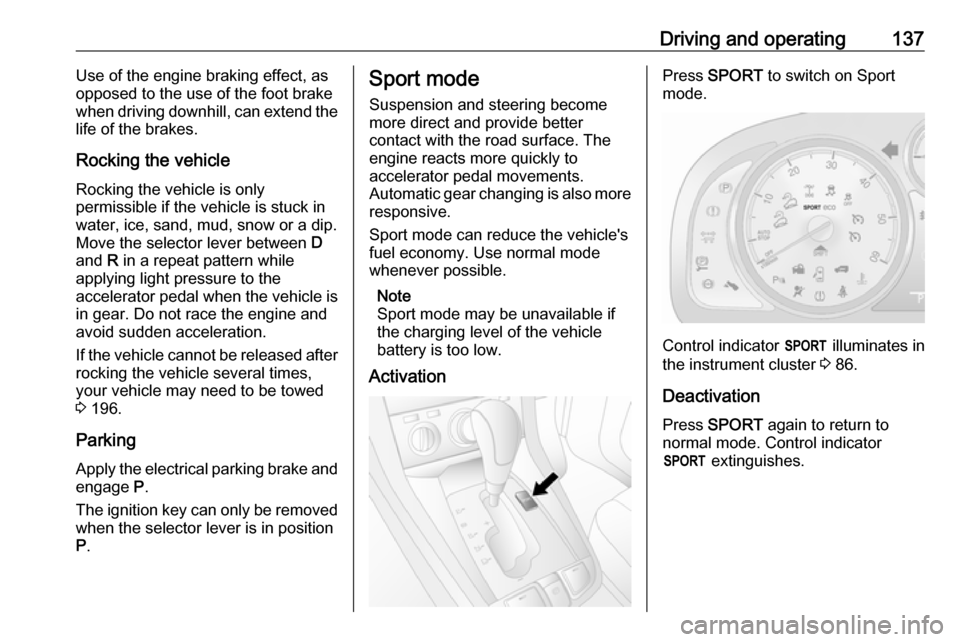
ActivationPress SPORT to switch on Sport
mode.
Control indicator S illuminates in
the instrument cluster 3 86.
Deactivation
Press SPORT again to return to
normal mode. Control indicator S extinguishes.
Page 140 of 225
![OPEL ANTARA 2017.5 Manual user 138Driving and operatingManual mode
Move selector lever out of position D
towards the left and then forwards or backwards.
<:Shift to a higher gear.]:Shift to a lower gear.
Tip selector lever in the a](/img/37/18759/w960_18759-139.png "OPEL ANTARA 2017.5 Manual user 138Driving and operatingManual mode
Move selector lever out of position D
towards the left and then forwards or backwards.
<:Shift to a higher gear.]:Shift to a lower gear.
Tip selector lever in the a")
138Driving and operatingManual mode
Move selector lever out of position D
towards the left and then forwards or backwards.
<:Shift to a higher gear.]:Shift to a lower gear.
Tip selector lever in the appropriate
direction. It then returns to the centre
position.
Gearshifting in manual mode can be
achieved whilst accelerating. If the
engine speed is too low, the
transmission will automatically shift to a lower gear, even in manual mode,
to prevent the engine from stalling.
If a higher gear is selected when
vehicle speed is too low, or a lower
gear when vehicle speed is too high,
the shift is not executed.
In manual mode, no automatic
shifting to a higher gear takes place
at high engine revolutions.
Gears can be skipped by moving the selector lever repeatedly at short
intervals.
After stopping, 1st gear is
automatically selected. When starting
on slippery surfaces, tip selector lever forwards to engage 2nd gear.
To move back to position D, move
selector lever back to the right.
Electronic driving programmes
● Following a cold start, the operating temperature
programme increases engine
speed to quickly bring the
catalytic converter to the required
temperature.Kickdown
In both automatic and manual modes, if the accelerator pedal is presseddown completely the transmission
shifts to a lower gear depending on
engine speed. Full engine power is
available for acceleration.
Fuel economy mode 3 122.
Fault In the event of a fault in the automatic
transmission, control indicator Z
illuminates in the instrument cluster
3 84 . Automatic shifting may be much
harsher than normal or, in the case of
a serious fault, cancelled altogether.
Have the cause of the fault remedied
by a workshop.
If control indicator g illuminates in
the instrument cluster when the
engine is running, this may indicate a
fault in the transmission electronics
3 84. The electronics switch to the
emergency running programme, fuel
consumption may increase and the
driveability of the vehicle may be
affected. Seek the assistance of a
workshop.
Page 142 of 225

140Driving and operatingCaution
It is not advisable to drive with thehand resting on the selector lever.
Fuel economy mode 3 122.
Drive systems
All-wheel drive
All-wheel drive is an active-on-
demand system that engages
automatically, with no action required
by the driver. Depending on the
driving environment, the vehicle
switches between two-wheel drive
and four-wheel drive, to give the vehicle more traction and stability
when necessary.
If the front wheels begin to slip, the
rear wheels will automatically begin to drive the vehicle as required. More
torque is transferred to the wheels
that have the most traction, so the
vehicle has optimum grip at all times. There may be a slight engagement
noise during hard use.
As well as enabling the vehicle to be
driven off-road, this system also
enables the vehicle to be driven on
normal roads without incurring
excessive tyre and drivetrain wear or
causing poor control.Ensure tyres (including the spare) are
inflated to the correct pressure
3 212 and are suitable for the
prevailing road conditions. For
optimum system performance, the
vehicle's tyres should not have
varying degrees of wear.
If control indicator B flashes in the
instrument cluster during driving, All-
wheel drive is temporarily disabled. If B flashes continuously, there is a fault
in the system; seek the assistance of
a workshop.
All-wheel drive control indicator B
3 86.
On-road driving
The increased traction of All-wheel
drive vehicles offers greater driving
control in adverse road conditions,
particularly heavy snow and ice.
However, All-wheel drive vehicles are not "skid-proof" and do not decrease
stopping distances.
All-wheel drive vehicles have a higher
centre of gravity than conventional vehicles. Always approach curves at
an appropriate driving speed. Do not
attempt to go as fast through turns as
Page 144 of 225

142Driving and operatingEnsure the radiator core and the areabetween the radiator and intercooler/
oil cooler (where installed) is cleaned, to maintain proper cooling air flow.Check the radiator and cooler cores
for blockage (sand, silt etc.).
Check the tyre treads.
Clean and check the mechanical
parts of the vehicle, particularly the
following areas:
● Driveshafts, including sealing bellows
● Front brake calipers, pads and discs
● Front suspension
● Clutch fork sealing bellows
● Rear brake calipers, pads and discs
● Rear suspension
● Fuel tank and underguard
● Breathers, axles and fuel tank
● Load sensing valve
● Transfer box and underguard
● Engine oil pan and underguardObserve the following: ● Do not spray high-pressure water
directly at the vehicle seals
● The wheels must be removed to clean all mud and stones from the
brake calipers and to check
brake pad wear
● The areas on the upper side of the underguards must be clearedof stones, to prevent damage to
the engine oil pan and the fuel
tankBrakes
The brake system comprises two
independent brake circuits.
If a brake circuit fails, the vehicle can
still be braked using the other brake
circuit. However, braking effect is
achieved only when the brake pedal
is depressed firmly. Considerably
more force is needed for this. The
braking distance is extended. Seek
the assistance of a workshop before
continuing your journey.
When the engine is not running, the
support of the brake servo unit
disappears once the brake pedal has
been depressed once or twice.
Braking effect is not reduced, but
braking requires significantly greater
force. It is especially important to bear this in mind when being towed.
Control indicator R 3 85.
Antilock brake system
Antilock brake system (ABS)
prevents the wheels from locking.
Page 152 of 225
150Driving and operatingCaution
Performance of the system can bereduced when sensors are
covered, e.g. by ice or snow.
Performance of the parking assist
system can be reduced due to
heavy loading.
Special conditions apply if there
are taller vehicles in the vicinity
(e.g. off-road vehicles, mini vans,
vans). Object identification and correct distance indication in the
upper part of these vehicles
cannot be guaranteed.
Objects with a very small reflection
cross-section, e.g. objects of
narrow size or soft materials, may
not be detected by the system.
Parking assist systems do not
detect objects outside the
detection range.
Fuel
Fuel for diesel engines
Only use diesel fuel that complies
with EN 590.
In countries outside the European
Union use Euro-Diesel fuel with a
sulphur concentration below 50 ppm.Caution
Use of fuel that does not comply
with EN 590 or similar can lead to engine power loss, increased
wear or engine damage and loss
of warranty.
Do not use marine diesel oils, heating
oils, Aquazole and similar diesel-
water emulsions. Diesel fuels must
not be diluted with fuels for petrol
engines.
Refuelling9 Danger
Before refuelling, switch off engine
and any external heaters with
combustion chambers. Switch off
any mobile phones.
Follow the operating and safety
instructions of the filling station
when refuelling.
9 Danger
Fuel is flammable and explosive.
No smoking. No naked flames or
sparks.
If you can smell fuel in your
vehicle, have the cause of this
remedied immediately by an
authorized dealer.
Caution
In case of misfuelling, do not
switch on ignition.
Page 153 of 225

Driving and operating151Fuel filler flap is located at left rear
side of vehicle.
The fuel filler flap can only be opened
if the vehicle is unlocked 3 22.
Release the fuel filler flap by pushing
the flap.
To unlock fuel filler cap: turn it
anticlockwise. If hissing occurs, wait
until it stops before completely
unscrewing the cap.
The fuel filler cap can be retained in
the holder on the inside of the fuel
filler flap.
When refuelling, fully insert the pump nozzle and switch it on.
After automatic cut-off, the tank can
be topped up by operating the pump
nozzle a maximum of two more times.Caution
Wipe off any overflowing fuel
immediately.
After refuelling, replace the fuel filler
cap and turn it clockwise until you
hear several clicks. Ensure the cap is
screwed in completely, otherwise
control indicator Z may illuminate in
the instrument cluster 3 84.
Close fuel filler flap.
Fuel filler cap
Only a genuine fuel filler cap provides full functionality. Diesel-engined
vehicles have special fuel filler caps.
Fuel consumption - CO 2-
Emissions
The fuel consumption (combined) of
the model Opel Antara is within a range of 10.9 to 6.3 l/100 km.
The CO 2 emission (combined) is
within a range of 255 to 167 g/km.
For the values specific for your
vehicle, refer to the EEC Certificate of Conformity provided with your vehicle
or other national registration
documents.
General information
The official fuel consumption and
specific CO 2 emission figures quoted
relate to the EU base model with
standard equipment.
Fuel consumption data and CO 2
emission data are determined
according to regulation R (EC) No.
715/2007 (in the latest applicable
version), taking into consideration the
vehicle weight in running order, as
specified by the regulation.
The figures are provided only for the
purpose of comparison between
different vehicle variants and must
not be taken as a guarantee for the
actual fuel consumption of a
particular vehicle. Additional
equipment may result in slightly
higher results than the stated
Page 154 of 225

152Driving and operatingconsumption and CO2 figures.
Furthermore, fuel consumption is dependent on personal driving style
as well as road and traffic conditions.Trailer hitch
General information
The coupling ball bar is kept in a bag,
fastened with a strap and is stowed
below the floor cover in the load
compartment.
Only use towing equipment that has
been approved for your vehicle.
Entrust retrofitting of towing
equipment to a workshop. It may be
necessary to make changes that
affect the cooling system, heat
shields or other equipment.
Control indicator á illuminates in the
instrument cluster when a trailer is
connected to the vehicle 3 91.
Driving characteristics and towing tips
In the case of trailers with brakes,
attach the break-away stopping cable
to the eye - not to the coupling ball
bar.
If no eye is available, loop cable
around coupling ball bar. Ensure
cable is crossed under the verticalcoupling socket to ensure the trailer
nose cannot drop to the ground if it
becomes separated from the trailer
hitch. Do not allow the cable to drag
along the ground and always allow
enough slack to permit full turning.
Follow the instructions supplied with
the towing equipment.
Before attaching a trailer, lubricate
the coupling ball. However, do not do so if a stabiliser, which acts on thecoupling ball, is being used to reduce
snaking movements. For trailers with
low driving stability, the use of a
friction-type stabiliser is strongly
recommended.
Do not drive faster than 80 km/h, even in countries where higher speeds are
permitted. When driving uphill, do not drive faster than 30 km/h in 1st gear,or 50 km/h in 2nd gear.
If the trailer starts snaking, drive more slowly, do not attempt to correct the
steering and brake sharply if
necessary.
When driving downhill, drive in the
same gear as if driving uphill and
drive at a similar speed.