transmission OPEL ASTRA J 2015 Manual user
[x] Cancel search | Manufacturer: OPEL, Model Year: 2015, Model line: ASTRA J, Model: OPEL ASTRA J 2015Pages: 343, PDF Size: 10.27 MB
Page 264 of 343

262Vehicle care
matching process should also be
performed after replacing a spare tyre with a road tyre containing the TPMS
sensor.
The malfunction light and the warning
message or code should go off at the
next ignition cycle. The sensors are
matched to the tyre/wheel positions,
using a TPMS relearn tool, in the
following order: left side front tyre,
right side front tyre, right side rear tyre and left side rear tyre. The turn signal
light at the current active position is
illuminated until sensor is matched.
Consult your workshop for service or
to purchase a relearn tool. There are
two minutes to match the first tyre/
wheel position, and five minutes
overall to match all four tyre/wheel
positions. If it takes longer, the
matching process stops and must be
restarted.The TPMS sensor matching process
is:
1. Apply the parking brake; on vehicles with automatic
transmission set the selector lever
to P.
2. Turn the ignition on.
3. Use the MENU button on the turn
signal lever to select the Vehicle
Information Menu in the Driver
Information Centre (DIC).
4. Turn the adjuster wheel to scroll to
the tyre pressure menu.
5. Press the SET/CLR button to
begin the sensor matching
process. A message requesting
acceptance of the process should
display.
6. Press the SET/CLR button again
to confirm the selection. The horn sounds twice to signal the
receiver is in relearn mode.
7. Start with the left side front tyre.
8. Place the relearn tool against the tyre sidewall, near the valve stem.Then press the button to activate
the TPMS sensor. A horn chirpconfirms that the sensor
identification code has been
matched to this tyre and wheel
position.
9. Proceed to the right side front tyre,
and repeat the procedure in Step 8.
10. Proceed to the right side rear tyre,
and repeat the procedure in
Step 8.
11. Proceed to the left side rear tyre, and repeat the procedure in
Step 8. The horn sounds twice to
indicate the sensor identification
code has been matched to the left side rear tyre, and the TPMS
sensor matching process is no
longer active.
12. Turn off the ignition.
13. Set all four tyres to the recommended air pressure level
as indicated on the tyre pressure
label.
14. Ensure the tyre loading status is set according selected pressure
3 119.
Page 279 of 343
Vehicle care277
■Never expose the vehicle battery to
naked flames or sparks.
■ A discharged vehicle battery can already freeze at a temperature of
0 °C. Defrost the frozen vehicle
battery before connecting jump
leads.
■ Wear eye protection and protective
clothing when handling a vehicle
battery.
■ Use a booster vehicle battery with the same voltage (12 Volts). Its
capacity (Ah) must not be much less than that of the discharged
vehicle battery.
■ Use jump leads with insulated terminals and a cross section of at
least 16 mm 2
(25 mm 2
for diesel
engines).
■ Do not disconnect the discharged vehicle battery from the vehicle.
■ Switch off all unnecessary electrical
consumers.
■ Do not lean over the vehicle battery
during jump starting.■ Do not allow the terminals of one lead to touch those of the other
lead.
■ The vehicles must not come into contact with each other during the
jump starting process.
■ Apply the parking brake, transmission in neutral, automatic
transmission in P.
■ Open the positive terminal protection caps of both vehicle
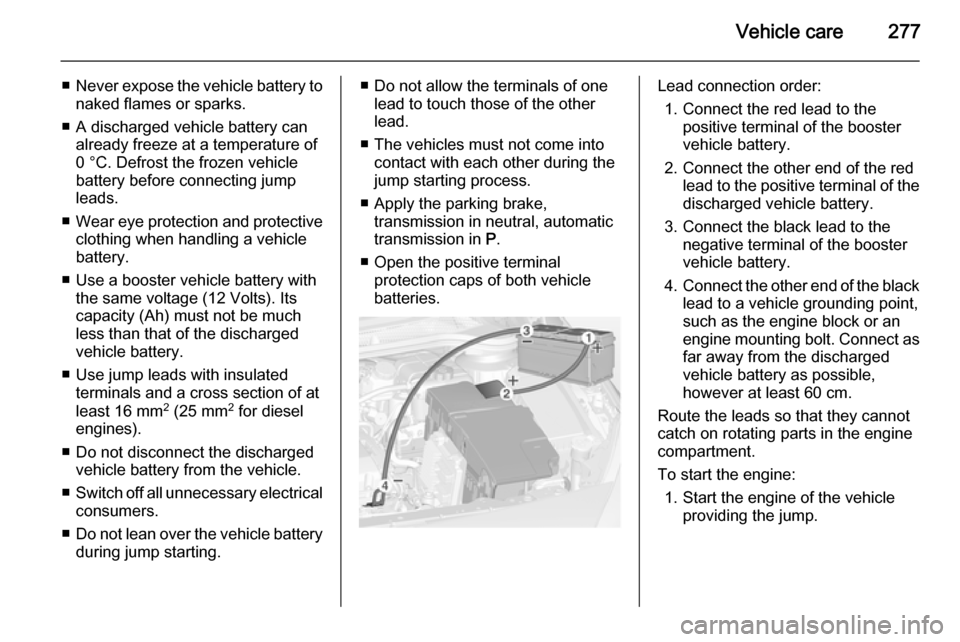
batteries.Lead connection order:
1. Connect the red lead to the positive terminal of the booster
vehicle battery.
2. Connect the other end of the red lead to the positive terminal of the
discharged vehicle battery.
3. Connect the black lead to the negative terminal of the booster
vehicle battery.
4. Connect the other end of the black
lead to a vehicle grounding point,
such as the engine block or an
engine mounting bolt. Connect as far away from the discharged
vehicle battery as possible,
however at least 60 cm.
Route the leads so that they cannot
catch on rotating parts in the engine
compartment.
To start the engine: 1. Start the engine of the vehicle providing the jump.
Page 280 of 343
278Vehicle care
2. After 5 minutes, start the otherengine. Start attempts should be
made for no longer than
15 seconds at an interval of
1 minute.
3. Allow both engines to idle for approx. 3 minutes with the leads
connected.
4. Switch on electrical consumers (e.g. headlights, heated rear
window) of the vehicle receiving
the jump start.
5. Reverse above sequence exactly when removing leads.Towing
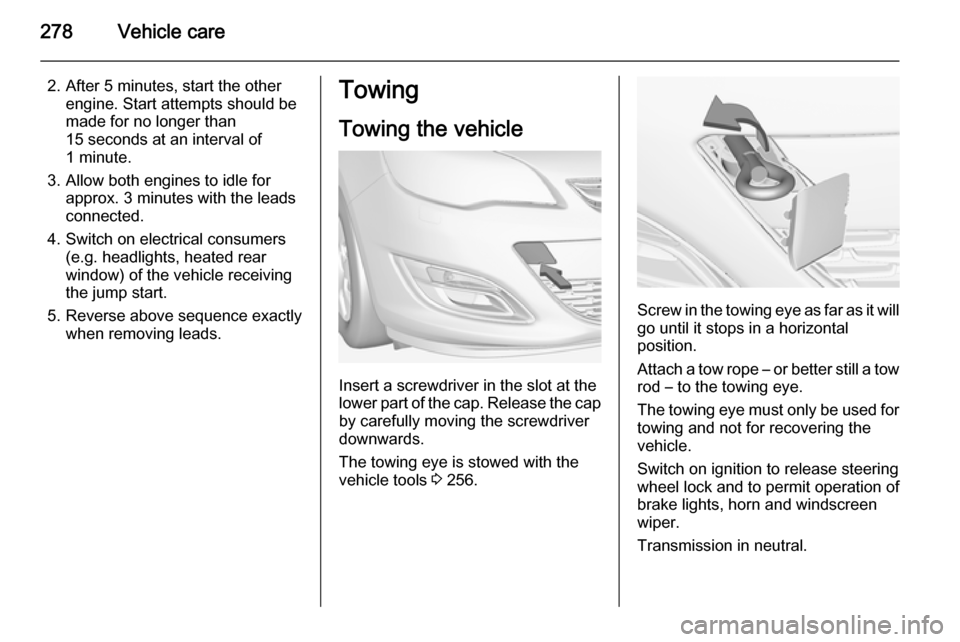
Towing the vehicle
Insert a screwdriver in the slot at the
lower part of the cap. Release the cap
by carefully moving the screwdriver
downwards.
The towing eye is stowed with the
vehicle tools 3 256.
Screw in the towing eye as far as it will
go until it stops in a horizontal
position.
Attach a tow rope – or better still a tow
rod – to the towing eye.
The towing eye must only be used for
towing and not for recovering the
vehicle.
Switch on ignition to release steering wheel lock and to permit operation of
brake lights, horn and windscreen
wiper.
Transmission in neutral.
Page 281 of 343

Vehicle care279Caution
Drive slowly. Do not drive jerkily.
Excessive tractive force can
damage the vehicle.
When the engine is not running,
considerably more force is needed to
brake and steer.
To prevent the entry of exhaust gases from the towing vehicle, switch on the
air recirculation and close the
windows.
Vehicles with automatic transmission: The vehicle must be towed facing
forwards, not faster than 80 km/h nor further than 100 km. In all other cases
and when the transmission is
defective, the front axle must be
raised off the ground.
Seek the assistance of a workshop.
After towing, unscrew the towing eye.
Insert cap at the top and engage
downwards.
Towing another vehicle
Insert a screwdriver in the slot at the
lower bend of the cap. Release the
cap by carefully moving the
screwdriver downwards.
The towing eye is stowed with the
vehicle tools 3 256.
Screw in the towing eye as far as it will
go until it stops in a horizontal
position.
The lashing eye at the rear
underneath the vehicle must never be used as a towing eye.
Attach a tow rope – or even better a
tow bar – to the towing eye.
The towing eye must only be used for
towing and not for recovering a
vehicle.
Page 297 of 343
![OPEL ASTRA J 2015 Manual user Technical data295Performance3-door hatchbackEngineA14XERA14NELA14NETA16XHTA16SHTMaximum speed 4)
[km/h]Manual transmission178 5)192201219230Automatic transmission––200210–4)
The maximum speed i](/img/37/18769/w960_18769-296.png "OPEL ASTRA J 2015 Manual user Technical data295Performance3-door hatchbackEngineA14XERA14NELA14NETA16XHTA16SHTMaximum speed 4)
[km/h]Manual transmission178 5)192201219230Automatic transmission––200210–4)
The maximum speed i")
Technical data295Performance3-door hatchbackEngineA14XERA14NELA14NETA16XHTA16SHTMaximum speed 4)
[km/h]Manual transmission178 5)192201219230Automatic transmission––200210–4)
The maximum speed indicated is achievable at kerb weight (without driver) plus 200 kg payload. Optional equipment could reduce the specified maximum
speed of the vehicle.
5) 4th gear.EngineA18XERA20NFTB16DTHB16DTLA17DTEA17DTCMaximum speed 4)
[km/h]Manual transmission200250198182183182Automatic transmission––––––4) The maximum speed indicated is achievable at kerb weight (without driver) plus 200 kg payload. Optional equipment could reduce the specified maximum
speed of the vehicle.
Page 298 of 343
![OPEL ASTRA J 2015 Manual user 296Technical data
EngineA17DTFA17DTSA20DTHA20DTRMaximum speed4)
[km/h]Manual transmission197196210225Automatic transmission––207–4) The maximum speed indicated is achievable at kerb weight (wit](/img/37/18769/w960_18769-297.png "OPEL ASTRA J 2015 Manual user 296Technical data
EngineA17DTFA17DTSA20DTHA20DTRMaximum speed4)
[km/h]Manual transmission197196210225Automatic transmission––207–4) The maximum speed indicated is achievable at kerb weight (wit")
296Technical data
EngineA17DTFA17DTSA20DTHA20DTRMaximum speed4)
[km/h]Manual transmission197196210225Automatic transmission––207–4) The maximum speed indicated is achievable at kerb weight (without driver) plus 200 kg payload. Optional equipment could reduce the specified maximum
speed of the vehicle.
5-door hatchback
EngineA14XELA14XERA14NELA14NETA16XERMaximum speed 4)
[km/h]Manual transmission168 5)1785)192202188Automatic transmission–––2001824)
The maximum speed indicated is achievable at kerb weight (without driver) plus 200 kg payload. Optional equipment could reduce the specified maximum
speed of the vehicle.
5) 4th gear.
Page 299 of 343
![OPEL ASTRA J 2015 Manual user Technical data297
EngineA16XHTA13DTEB16DTHB16DTLA17DTEA17DTCMaximum speed4)
[km/h]Manual transmission220175200184188186Automatic transmission212–––––4) The maximum speed indicated is achiev](/img/37/18769/w960_18769-298.png "OPEL ASTRA J 2015 Manual user Technical data297
EngineA16XHTA13DTEB16DTHB16DTLA17DTEA17DTCMaximum speed4)
[km/h]Manual transmission220175200184188186Automatic transmission212–––––4) The maximum speed indicated is achiev")
Technical data297
EngineA16XHTA13DTEB16DTHB16DTLA17DTEA17DTCMaximum speed4)
[km/h]Manual transmission220175200184188186Automatic transmission212–––––4) The maximum speed indicated is achievable at kerb weight (without driver) plus 200 kg payload. Optional equipment could reduce the specified maximum
speed of the vehicle.EngineA17DTFA17DTSA20DTHA20DTRMaximum speed 4)
[km/h]Manual transmission201198215226Automatic transmission––209–4) The maximum speed indicated is achievable at kerb weight (without driver) plus 200 kg payload. Optional equipment could reduce the specified maximum
speed of the vehicle.
Page 300 of 343
![OPEL ASTRA J 2015 Manual user 298Technical data
4-door notchback
EngineA14XERA14NET
A14NET
LPG
A16XERA16XHT
Maximum speed 4)
[km/h]Manual transmission183 5)207202193222Automatic transmission–205–1852154)
The maximum speed ind](/img/37/18769/w960_18769-299.png "OPEL ASTRA J 2015 Manual user 298Technical data
4-door notchback
EngineA14XERA14NET
A14NET
LPG
A16XERA16XHT
Maximum speed 4)
[km/h]Manual transmission183 5)207202193222Automatic transmission–205–1852154)
The maximum speed ind")
298Technical data
4-door notchback
EngineA14XERA14NET
A14NET
LPG
A16XERA16XHT
Maximum speed 4)
[km/h]Manual transmission183 5)207202193222Automatic transmission–205–1852154)
The maximum speed indicated is achievable at kerb weight (without driver) plus 200 kg payload. Optional equipment could reduce the specified maximum
speed of the vehicle.
5) 4th gear.EngineA13DTEB16DTHB16DTLA17DTEA17DTCA17DTFA17DTSMaximum speed 4)
[km/h]Manual transmission180205189191188206203Automatic transmission–––––––4) The maximum speed indicated is achievable at kerb weight (without driver) plus 200 kg payload. Optional equipment could reduce the specified maximum
speed of the vehicle.
Page 301 of 343
![OPEL ASTRA J 2015 Manual user Technical data299
Sports tourerEngineA14XERA14NELA14NETA16XERA16XHTMaximum speed [km/h]4)Manual transmission175190200185220Automatic transmission––1981802114)
The maximum speed indicated is achiev](/img/37/18769/w960_18769-300.png "OPEL ASTRA J 2015 Manual user Technical data299
Sports tourerEngineA14XERA14NELA14NETA16XERA16XHTMaximum speed [km/h]4)Manual transmission175190200185220Automatic transmission––1981802114)
The maximum speed indicated is achiev")
Technical data299
Sports tourerEngineA14XERA14NELA14NETA16XERA16XHTMaximum speed [km/h]4)Manual transmission175190200185220Automatic transmission––1981802114)
The maximum speed indicated is achievable at kerb weight (without driver) plus 200 kg payload. Optional equipment could reduce the specified maximum
speed of the vehicle.EngineA13DTEB16DTHB16DTLA17DTNA17DTEA17DTFMaximum speed 4)
[km/h]Manual transmission174200184182186198Automatic transmission––––––4) The maximum speed indicated is achievable at kerb weight (without driver) plus 200 kg payload. Optional equipment could reduce the specified maximum
speed of the vehicle.EngineA17DTCA17DTSA20DTHA20DTRMaximum speed 4)
[km/h]Manual transmission184195212224Automatic transmission––207–4) The maximum speed indicated is achievable at kerb weight (without driver) plus 200 kg payload. Optional equipment could reduce the specified maximum
speed of the vehicle.
Page 302 of 343
![OPEL ASTRA J 2015 Manual user 300Technical dataVehicle weight
Kerb weight, basic model without any optional equipment3-door hatchbackEngineManual transmissionAutomatic transmissionwithout/with air conditioning
[kg]A14XER1393/1408â](/img/37/18769/w960_18769-301.png "OPEL ASTRA J 2015 Manual user 300Technical dataVehicle weight
Kerb weight, basic model without any optional equipment3-door hatchbackEngineManual transmissionAutomatic transmissionwithout/with air conditioning
[kg]A14XER1393/1408â")
300Technical dataVehicle weight
Kerb weight, basic model without any optional equipment3-door hatchbackEngineManual transmissionAutomatic transmissionwithout/with air conditioning
[kg]A14XER1393/1408–A14NEL–/1437–A14NET–/1437–/1471A16XHT–/1503–/1503A16SHT–/1503–A18XER–/1437–A20NFT–/1550–B16DTH1503/1518–B16DTL1503/1518–