automatic transmission OPEL ASTRA K 2020 Manual user
[x] Cancel search | Manufacturer: OPEL, Model Year: 2020, Model line: ASTRA K, Model: OPEL ASTRA K 2020Pages: 305, PDF Size: 27.84 MB
Page 182 of 305

180Driving and operatingFor additional information including a
video, visit us online.
Adaptive cruise control is mainly
advised to be used on long straight
roads like motorways or country
roads with steady traffic. Do not use
the system if it is not advisable to
maintain a constant speed.
Control indicator A 3 114, m 3 114,
C 3 114.9 Warning
The complete driver attention is
always required while driving with adaptive cruise control. The driver stays fully in control of the vehicle
because the brake pedal, the
accelerator pedal and the cancel
switch have priority over any
adaptive cruise control operation.
Switching on the system
Press v to switch on adaptive cruise
control. C appears in the Driver
Information Centre.
Activation of the functionality bysetting the speed
Adaptive cruise control can be
activated at speeds above 25 km/h on
vehicles with automatic transmission
or 30 km/h on vehicles with manual
transmission. The upper speed limit is
180 km/h.
Accelerate to the desired speed and
turn thumb wheel to SET/-, the
current speed is stored and
maintained.
The adaptive cruise control symbol
C , the following distance setting and
set speed are indicated in the Driver
Information Centre.
The accelerator pedal can be
released. Adaptive cruise control
remains activated during gear
shifting.
Overriding set speed
It is always possible to drive faster
than the selected set speed by
depressing the accelerator pedal.
When the accelerator pedal is
released, the vehicle returns to the
desired distance if a slower vehicle is ahead. Otherwise it returns to the
stored speed.
Page 183 of 305

Driving and operating181Once the system is activated,
adaptive cruise control decelerates or
brakes if it detects a vehicle ahead,
which is slower or closer than the
desired following distance.9 Warning
Accelerating by the driver
deactivates automatic braking by
the system. This is indicated as a
pop-up warning in the Driver
Information Centre or by the
adaptive cruise control symbol
turning blue.
Take over current speed
If the accelerator pedal is pressed,
the current vehicle speed is taken
over as stored speed. This is also
valid, if the current vehicle speed is
lower than the Set Speed.
Increase or reduce speed
The preset speed can be changed by moving thumb wheel to RES/+ to
increase or SET/- to decrease the
speed. Move thumb wheel repeatedly
to change speed in small steps, move and hold to change speed in large
steps.
Resume stored speed If the system is switched on but
inactive and a speed was stored before, turn thumb wheel to RES/+ at
a speed above 5 km/h (with automatic
transmission) or above 30 km/h (with
manual transmission) to resume the stored speed.
Full speed range adaptive cruise
control on vehicles with automatic transmission
Full speed range adaptive cruise control will maintain a following
distance behind a detected vehicle
and slow your vehicle to a stop behind
that vehicle.When the vehicle ahead accelerates
after a brief stop, the adaptive cruise
control will drive off automatically
without driver action. If necessary,
press RES/+ or the accelerator pedal
to resume adaptive cruise control.
Pressing the accelerator pedal allows
more control over the acceleration
after driving off. Note that automatic
braking is disabled during usage of
the accelerator pedal.
If the stopped vehicle ahead was
stopped for a longer time and then
begins to move forward, the green
illuminated vehicle ahead control
indicator A will flash and a warning
chime will sound as a reminder to check traffic before proceeding.9 Warning
When full speed range adaptive
cruise control is deactivated or
cancelled, the vehicle will no
longer be held at a stop and can
Page 185 of 305

Driving and operating1839Warning
The Driver accepts full
responsibility to drive with the
appropriate following distance
based on traffic, weather, visibility and regional regulation. Followingdistance must be adjusted or the
system switched off when required by the prevailing conditions.
Detecting the vehicle ahead
The green illuminated vehicle ahead
control indicator A is displayed when
the system detects a vehicle in the driving path. The range of the sensors
is between 25 and 150 m depending
on vehicle speed.
Forward collision alert 3 187.
If this symbol does not display, or
displays briefly, adaptive cruise
control will not respond to vehicles
ahead.
Deactivation of the functionality
Adaptive cruise control is deactivated by the driver when:
● y is pressed.
● Brake pedal is applied.
● Clutch pedal is depressed for more than four seconds.
● Selector lever of automatic transmission is moved to N.
The system is also automatically
deactivated when:
● Vehicle speed accelerates above
190 km/h or slows down below
55 km/h . Vehicles with automatic
transmission slows down to a
stop without deactivating within
5 minutes.
● The Traction Control system is deactivated or operating.
● The Electronic Stability Control is
deactivated or operating.● There is no traffic and nothing detected on the road sides forapprox. 1 minute. In this case
there are no radar echoes and
the sensor may report that it is blocked.
● The active emergency braking system is applying the brakes.
● Driving on steep inclines.
● The radar sensor is blocked by an ice or water film.
● A fault is detected in the radar, camera, engine or brake system.
● The brakes need to cool down.
Additionally, the system is
automatically deactivated on vehicles with automatic transmission (full
speed range adaptive cruise control)
when:
● The incline uphill or downhill is greater than 20%.
● The electric parking brake is applied.
Page 245 of 305

Vehicle care243No.Circuit16Fuel injection17Fuel injection18Diesel exhaust system19–20–21–22ABS23Washer system for windscreen
and rear window24–25Diesel fuel heating26Transmission control module27Power tailgate module28–29Heated rear window30Mirror defrost31–No.Circuit32DC transformer / LED display /
Electrical heater / Climate
control / Glow plug controller33–34Horn35Engine control module36Right high beam (Halogen, Eco
LED) / Right low beam (LED)37Left high beam (Halogen, Eco
LED)38LED headlight / Automatic
headlight range adjustment39Front fog light40Central Gateway Module41–42Manual headlight range adjust‐
ment43Fuel pump44Rear view camera / Inside rear
view mirror / Trailer moduleNo.Circuit45LED headlight left / Automatic
headlight range adjustment left46Instrument cluster47Steering column lock48Rear wiper49Outside rearview mirror50LED headlight right / Automatic
headlight range adjustment
right51Left low beam (LED)52Engine control module / Trans‐
mission control module53Windscreen wiper54Windscreen wiper55Diesel Exhaust system56–57–
After having changed defective fuses,
close the fuse box cover and press
until it engages.
Page 254 of 305
252Vehicle careAfter inflating, some driving may be
required to update the tyre pressure
values in the Driver Information
Centre. During this time w may
illuminate.
If w illuminates at lower temperatures
and extinguishes after driving, this
could be an indicator for approaching
a low tyre pressure condition. Check
tyre pressure.
Vehicle messages 3 122.
If the tyre pressure must be reduced
or increased, switch off ignition.
Only mount wheels with pressure
sensors, otherwise the tyre pressure
will not be displayed and w
illuminates continuously.
A spare wheel or temporary spare
wheel is not equipped with pressure
sensors. The tyre pressure
monitoring system is not operational
for these tyres. Control indicator w
illuminates. For the further three
tyres, the system remains
operational.The use of commercially-available
liquid tyre repair kits can impair the
function of the system. Factory-
approved repair kits can be used.
Operating electronic devices or being close to facilities using similar wave
frequencies could disrupt the tyre
pressure monitoring system.
Each time the tyres are replaced, tyre
pressure monitoring system sensors
must be dismounted and serviced. For the screwed sensor, replace
valve core and sealing ring. For the
clipped sensor, replace complete
valve stem.
Use only original plastic valve caps to protect valve on any damage.Caution
Do not use metal valve caps as
they lead to valve oxidation and
damage.
Vehicle loading status
Adjust tyre pressure to load condition
according to the tyre information label or tyre pressure chart 3 285, and
select the appropriate setting in Tyre
Load within the Vehicle Information
Menu 3 115. This setting determines
the reference pressures for the tyre
pressure warnings.
The Tyre Load menu only appears
when the vehicle is at a standstill and the parking brake is applied. On
vehicles with automatic transmission
the selector lever must be in P.
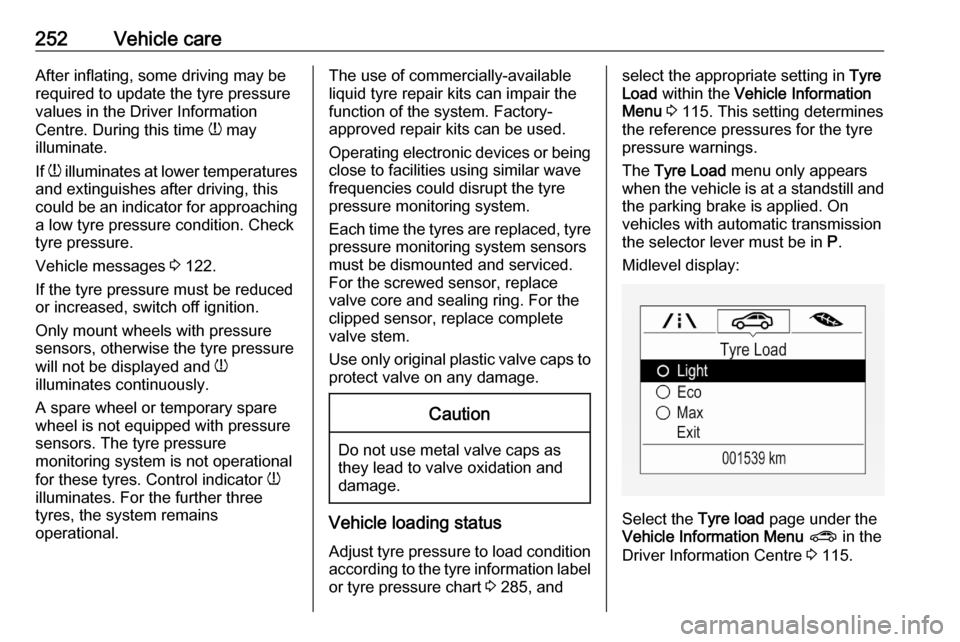
Midlevel display:
Select the Tyre load page under the
Vehicle Information Menu ? in the
Driver Information Centre 3 115.
Page 266 of 305
264Vehicle caresulphuric acid which can cause
injuries and damage in the event
of direct contact.
● Never expose the vehicle battery
to naked flames or sparks.
● A discharged vehicle battery can already freeze at a temperature
of 0 °C. Defrost the frozen vehicle battery before connecting jump
leads.
● Wear eye protection and protective clothing when
handling a vehicle battery.
● Use a booster vehicle battery with the same voltage (12 V). Its
capacity (Ah) must not be much
less than that of the discharged
vehicle battery.
● Use jump leads with insulated terminals and a cross section of
at least 16 mm 2
(25 mm 2
for
diesel engines).
● Do not disconnect the discharged
vehicle battery from the vehicle.
● Switch off all unnecessary electrical consumers.
● Do not lean over the vehiclebattery during jump starting.
● Do not allow the terminals of one
lead to touch those of the other
lead.
● The vehicles must not come into contact with each other during
the jump starting process.
● Apply the parking brake, transmission in neutral,
automatic transmission in P.
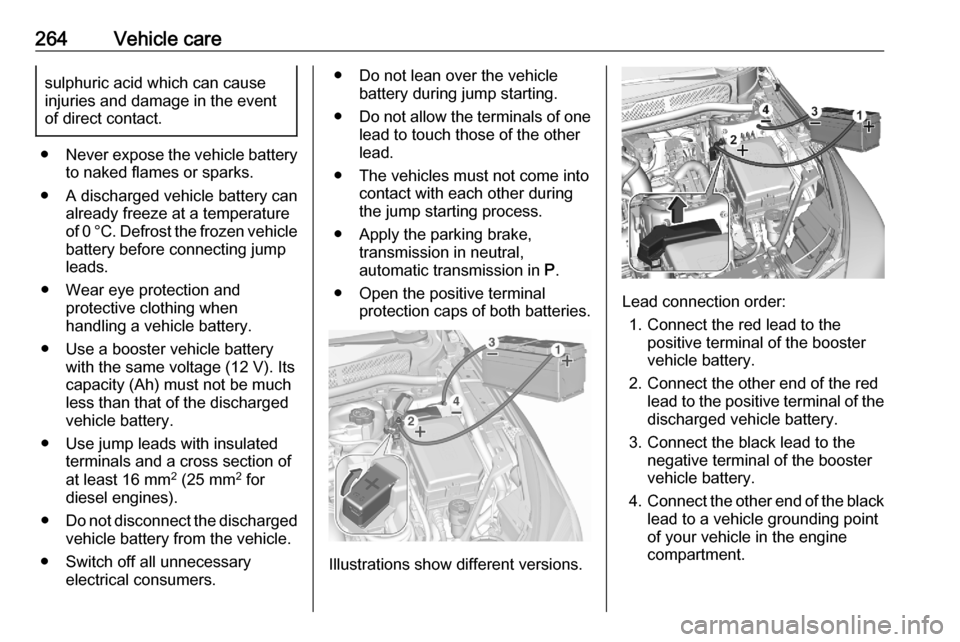
● Open the positive terminal protection caps of both batteries.
Illustrations show different versions.
Lead connection order:
1. Connect the red lead to the positive terminal of the booster
vehicle battery.
2. Connect the other end of the red lead to the positive terminal of the
discharged vehicle battery.
3. Connect the black lead to the negative terminal of the booster
vehicle battery.
4. Connect the other end of the black
lead to a vehicle grounding point
of your vehicle in the engine
compartment.
Page 268 of 305
266Vehicle careCaution
Deactivate the driver assistance
systems like active emergency
braking 3 190, otherwise the
vehicle may automatically brake during towing.
Switch the selector lever to neutral.
Release the parking brake.
Caution
Drive slowly. Do not drive jerkily.
Excessive tractive force can
damage the vehicle.
When the engine is not running,
considerably more force is needed to
brake and steer.
To prevent the entry of exhaust gases from the towing vehicle, switch on the
air recirculation and close the
windows.
Vehicles with automatic transmission: The vehicle must be towed facing
forwards, not faster than 80 km/h nor further than 100 km. In all other cases
and when the transmission is
defective, the front axle must be
raised off the ground.
Seek the assistance of a workshop.
After towing, unscrew the towing eye.
Insert cap at the top and engage
downwards.
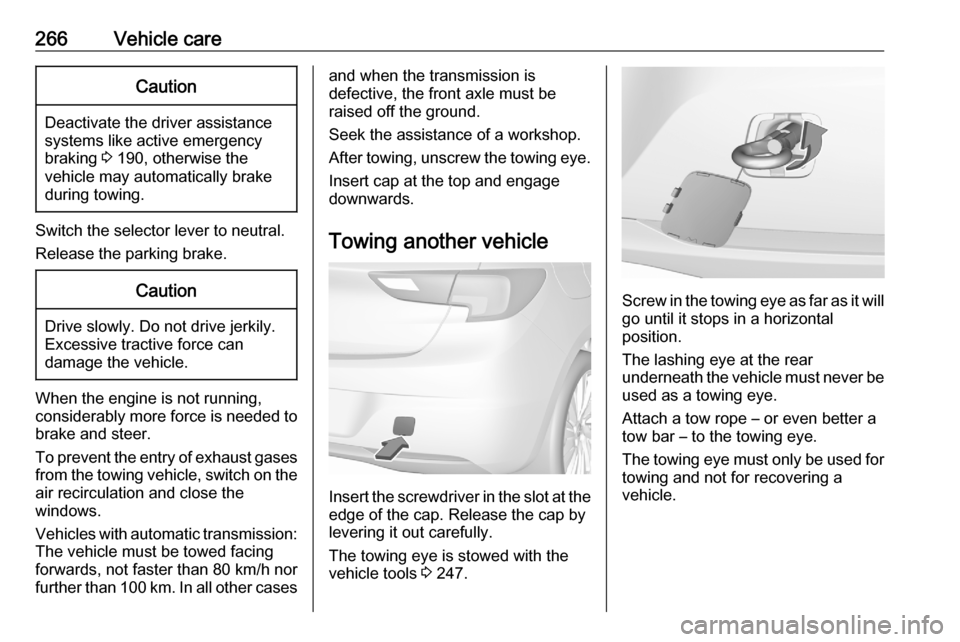
Towing another vehicle
Insert the screwdriver in the slot at the edge of the cap. Release the cap by
levering it out carefully.
The towing eye is stowed with the
vehicle tools 3 247.
Screw in the towing eye as far as it will
go until it stops in a horizontal
position.
The lashing eye at the rear
underneath the vehicle must never be used as a towing eye.
Attach a tow rope – or even better a
tow bar – to the towing eye.
The towing eye must only be used for
towing and not for recovering a
vehicle.
Page 283 of 305
![OPEL ASTRA K 2020 Manual user Technical data281Engine identifier codeF15DVCF15DVHSales designation1.51.5Piston displacement [cm3
]14961496Engine power [kW]7790at rpm32503500Torque [Nm]260300 2)
/ 285 3)at rpm1500-25001750-2500 2](/img/37/18790/w960_18790-282.png "OPEL ASTRA K 2020 Manual user Technical data281Engine identifier codeF15DVCF15DVHSales designation1.51.5Piston displacement [cm3
]14961496Engine power [kW]7790at rpm32503500Torque [Nm]260300 2)
/ 285 3)at rpm1500-25001750-2500 2")
Technical data281Engine identifier codeF15DVCF15DVHSales designation1.51.5Piston displacement [cm3
]14961496Engine power [kW]7790at rpm32503500Torque [Nm]260300 2)
/ 285 3)at rpm1500-25001750-2500 2)
/
1500-2750 3)Fuel typeDieselDiesel2)
MT
3) AT
Performance
5-door Hatchback
EngineF12SHLF12SHRF12SHTF14SHTB14XFTB16SHTMaximum speed [km/h]Manual transmission200215210215210235Automatic transmission–––210––
Page 284 of 305
![OPEL ASTRA K 2020 Manual user 282Technical dataEngineF15DVCF15DVHMaximum speed [km/h]Manual transmission200210Automatic transmission–205
Sports Tourer
EngineF12SHLF12SHRF12SHTF14SHTMaximum speed [km/h]Manual transmission20021521](/img/37/18790/w960_18790-283.png "OPEL ASTRA K 2020 Manual user 282Technical dataEngineF15DVCF15DVHMaximum speed [km/h]Manual transmission200210Automatic transmission–205
Sports Tourer
EngineF12SHLF12SHRF12SHTF14SHTMaximum speed [km/h]Manual transmission20021521")
282Technical dataEngineF15DVCF15DVHMaximum speed [km/h]Manual transmission200210Automatic transmission–205
Sports Tourer
EngineF12SHLF12SHRF12SHTF14SHTMaximum speed [km/h]Manual transmission200215210215Automatic transmission––210210EngineF15DVCF15DVHMaximum speed [km/h]Manual transmission200210Automatic transmission–205
Page 300 of 305

298IndexAAccessories and vehicle modifications .......................... 222
Active emergency braking ..........190
Adaptive cruise control .......114, 179
AdBlue ................................ 112, 163
Adjustable air vents ...................149
Airbag and belt tensioners .........109
Airbag deactivation ..............65, 109
Airbag label................................... 60
Airbag system .............................. 60
Air conditioning regular operation ................................ 150
Air conditioning system .............. 141
Air intake .................................... 150
Air vents...................................... 149
Antilock brake system ................ 170
Antilock brake system (ABS) .....111
Anti-theft alarm system ................37
Anti-theft locking system .............. 37
Appearance care ........................267
Armrest ................................... 55, 57
Armrest storage ........................... 74
Ashtrays ..................................... 101
Automatic anti-dazzle ..................42
Automatic light control ...............131
Automatic locking ........................30
Automatic transmission .............166
Autostop ..................................... 157
Auxiliary heater ........................... 149B
Baselevel display ........................115
Battery discharge protection ......140
Battery voltage ........................... 123
Belts.............................................. 58
BlueInjection ............................... 163
Bonnet ....................................... 224
Brake and clutch fluid .................273
Brake and clutch system ...........110
Brake assist ............................... 172
Brake fluid .................................. 227 Brakes ............................... 170, 227
Breakdown.................................. 265
Bulb replacement ....................... 230
C Capacities .................................. 284
Cargo management system ........84
Catalytic converter .....................163
Central locking system ................25
Centre console lighting ..............139
Changing tyre and wheel size ...254
Charging system ........................ 110
Child locks ................................... 31
Child restraint installation locations ................................... 69
Child restraints.............................. 67
Child restraint systems ................67
Climate control ............................. 16
Clock............................................. 97